
| REPORT ATTRIBUTE | DETAILS |
|---|---|
| Historical Period | 2020-2023 |
| Base Year | 2024 |
| Forecast Period | 2025-2032 |
| Traction Equipment Market Size 2024 | USD 9,222.1 million |
| Traction Equipment Market, CAGR | 6.10% |
| Traction Equipment Market Size 2032 | USD 14,827.1 million |
Market Overview:
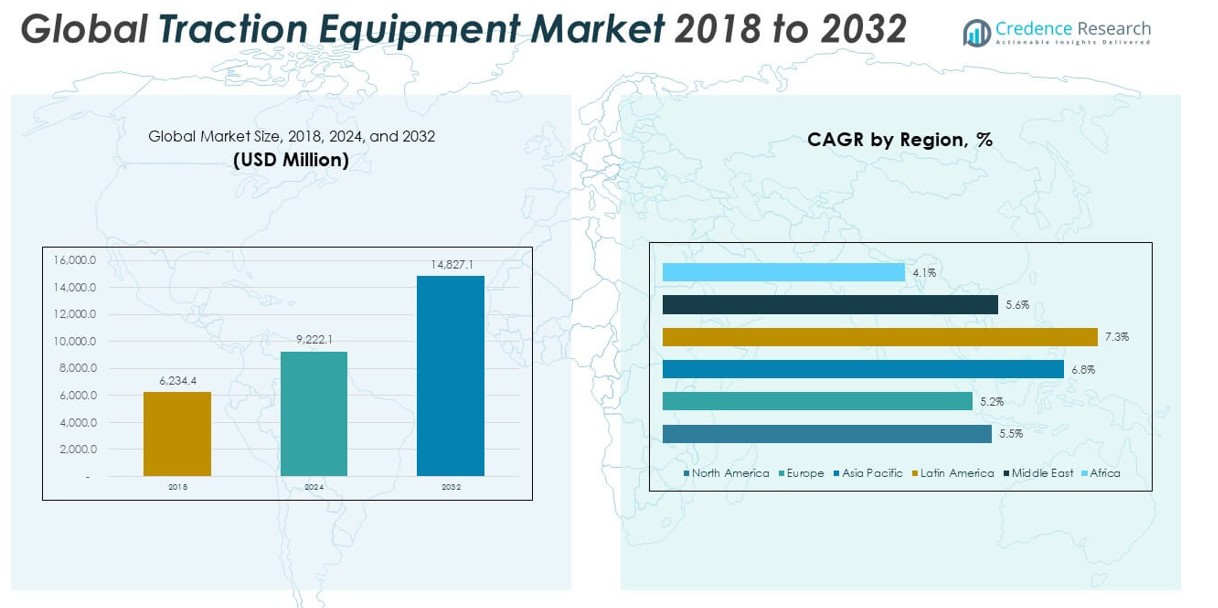
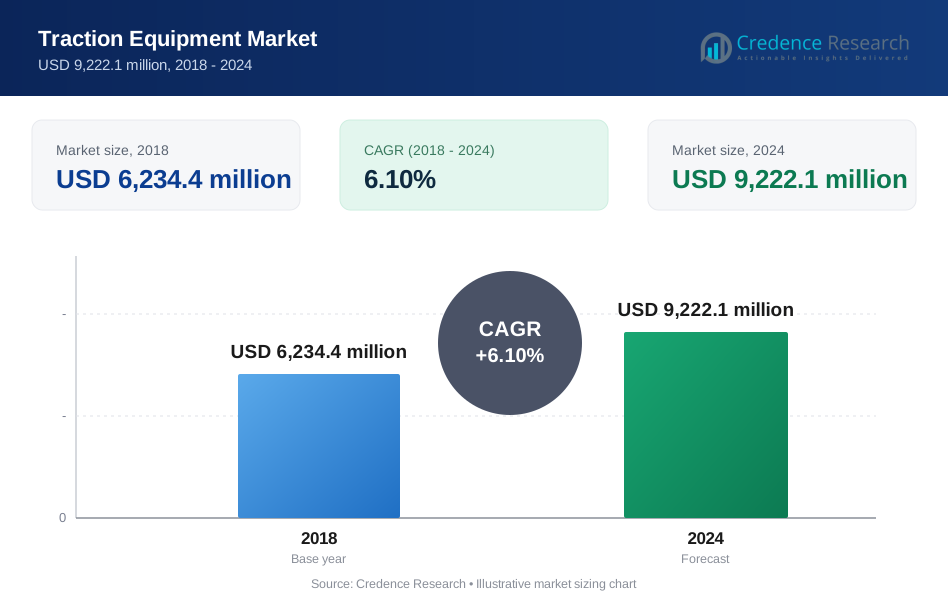
The Traction Equipment Market size was valued at USD 6,234.4 million in 2018 to USD 9,222.1 million in 2024 and is anticipated to reach USD 14,827.1 million by 2032, at a CAGR of 6.10% during the forecast period.
The growth of the traction equipment market is driven by several key factors. First, the electrification of transportation systems is a major contributor, as the global shift towards electric and hybrid vehicles, including electric trains, metros, and buses, requires advanced traction equipment for efficient operation. Technological advancements in traction motors, such as the development of high-efficiency induction and permanent magnet motors, further enhance energy efficiency and performance. Government initiatives also play a crucial role, with stringent emission regulations and sustainability goals pushing for the adoption of electrified rail networks. Additionally, rapid urbanization and the expansion of public transportation systems in emerging economies demand reliable and energy-efficient traction equipment to support the growing need for urban mobility solutions.
Regionally, the Asia-Pacific region is expected to lead the traction equipment market, owing to significant investments in electrified rail systems and rapid urbanization, particularly in countries like China and India. These countries are heavily investing in infrastructure, including modern metro networks and electric railways, which drive the demand for advanced traction systems. Europe also shows steady growth, with a focus on reducing carbon emissions and modernizing aging rail infrastructure. The adoption of electric traction equipment is being supported by government policies and sustainability initiatives. North America is witnessing moderate growth, driven by investments in high-speed rail projects and efforts to reduce fossil fuel dependency. Latin America and the Middle East & Africa, while slower in growth, are gradually adopting traction equipment due to infrastructure development projects and increasing demand for efficient public transportation systems. However, the economic and logistical challenges in these regions limit their market share.
Market Insights:
- The Traction Equipment Market was valued at USD 6,234.4 million in 2018 and is expected to reach USD 9,222.1 million by 2024, growing at a CAGR of 6.10% during the forecast period.
- The electrification of transportation systems is a key driver, with increasing adoption of electric and hybrid vehicles, including electric trains, metros, and buses, fueling demand for advanced traction equipment.
- Technological innovations in traction motors, such as high-efficiency induction and permanent magnet motors, are improving energy efficiency, reducing maintenance costs, and enhancing system performance.
- Government regulations focused on sustainability, emission reductions, and energy efficiency are accelerating the adoption of electrified rail networks and green technologies in public transport.
- Rapid urbanization and infrastructure development in emerging markets, particularly in Asia-Pacific, are driving investments in electrified public transport systems like metro networks and high-speed rail projects.
- High initial investment and maintenance costs are significant challenges, particularly in emerging markets, where budget constraints hinder the adoption of advanced traction systems.
- The lack of standardized equipment and the complexity of integrating new traction systems into legacy infrastructure pose additional challenges, slowing the growth of the market in some regions.
Market Drivers:
Electrification of Transportation Systems
The transition to electric transportation systems plays a pivotal role in driving the growth of the traction equipment market. As countries worldwide focus on reducing their carbon footprints, electric trains, metros, and buses have become essential components of sustainable public transportation infrastructure. The shift toward electrified rail networks, combined with the increasing adoption of electric and hybrid vehicles, has significantly amplified the demand for advanced traction equipment. It is imperative for these systems to utilize highly efficient motors that ensure reliable performance, energy conservation, and cost-effectiveness. As urban mobility evolves, electrification remains a key enabler in reducing greenhouse gas emissions and minimizing environmental impacts.
Technological Advancements in Traction Motors
Technological innovations in traction motor designs are another significant driver for the traction equipment market. High-efficiency induction motors and permanent magnet motors are setting new benchmarks in performance, contributing to more reliable and energy-efficient transportation systems. These advancements allow for better speed control, reduced maintenance costs, and lower energy consumption. It enables transportation operators to provide more cost-effective services while improving system reliability. With continuous development in materials and design, traction motor technologies are becoming increasingly sophisticated, meeting the evolving demands of modern transport systems.
- For instance, Nidec Corporation expanded its e-axle traction motor production line for EVs in 2025, with its latest models delivering torque densities exceeding 30 Nm/kg and supporting direct integration with digital vehicle management systems for predictive maintenance.
Government Regulations and Sustainability Policies
Government policies and regulations aimed at reducing emissions and promoting sustainability have become central drivers in the traction equipment market. Many countries have introduced stringent emission standards and set ambitious goals for reducing fossil fuel consumption. This has resulted in increased investments in electrified rail networks and energy-efficient public transport systems. Governments are also offering incentives to promote the adoption of green technologies, further accelerating the deployment of advanced traction equipment. It ensures that infrastructure projects are aligned with global sustainability objectives, driving both public and private sector investments into greener alternatives.
Urbanization and Infrastructure Development
Rapid urbanization and growing infrastructure development in emerging economies are essential factors influencing the traction equipment market. As cities expand, the need for efficient, high-capacity, and reliable public transportation systems becomes more pronounced. Metro networks and high-speed rail projects are seeing significant investments, particularly in regions like Asia-Pacific, where urban populations are expanding rapidly. To meet these demands, governments and private companies are investing in modern, electrified transportation infrastructure. It highlights the importance of integrating advanced traction equipment to ensure that new systems can handle increased passenger volumes while reducing operational costs and improving energy efficiency.
- For instance, CRRC Corporation Limited rolled out integrated traction systems for high-speed rail and mass transit in 2024, supporting the expansion of high-speed rail networks in China, India, and Japan.
Market Trends:
Shift Towards Hybrid and Electric Vehicles
One of the most prominent trends in the traction equipment market is the increasing shift towards hybrid and electric vehicles across various transportation sectors. Governments and businesses are focusing on sustainable transportation solutions, pushing for the electrification of rail systems, metro networks, and buses. This shift drives demand for traction equipment that supports efficient energy use, high reliability, and lower carbon emissions. Electric traction systems, which offer better performance and lower maintenance costs compared to traditional diesel engines, are becoming more common in both developed and emerging markets. It aligns with the global trend toward reducing dependence on fossil fuels and achieving sustainability targets in the transport sector.
Integration of Digital Technologies for Enhanced Performance
The integration of digital technologies, such as artificial intelligence (AI) and IoT, into traction equipment is another significant trend. These technologies are enhancing the performance and efficiency of traction systems by enabling real-time monitoring, predictive maintenance, and system optimization. AI and IoT are being used to gather data from traction motors, sensors, and other components to monitor performance and prevent potential failures. This trend is reducing downtime and improving the overall efficiency of public transportation systems. It allows operators to better manage their fleets, optimize energy consumption, and improve passenger service.
Focus on Lightweight and Energy-Efficient Materials
The demand for lightweight and energy-efficient materials in the design and construction of traction equipment is on the rise. Manufacturers are increasingly focusing on using materials such as carbon fiber, aluminum, and high-strength composites to reduce the weight of traction systems. Lighter traction equipment enhances energy efficiency and performance, enabling vehicles to travel longer distances with less energy consumption. It also contributes to the reduction of operational costs for transportation operators. This trend supports the broader goal of optimizing fuel efficiency and sustainability in transportation infrastructure projects.
- For instance, Schaeffler’s electric motors and actuators leverage high-strength composites and optimized bearing designs, delivering energy savings through reduced friction and maintenance needs; their linear actuators cover forces from 1.5–150 kN and travel ranges up to 2,000 mm, supporting diverse mobile machinery applications.
Development of High-Speed Rail Networks
The development of high-speed rail networks is gaining momentum, particularly in regions with rapidly growing urban populations. High-speed trains require advanced traction equipment that delivers superior performance at high velocities while maintaining energy efficiency. Countries in Asia-Pacific and Europe are at the forefront of expanding high-speed rail networks, and the demand for high-speed rail systems is expected to grow steadily in the coming years. It encourages innovation in traction technology, where enhanced motor designs and efficient power transmission systems are crucial for delivering the required speed and efficiency. This trend is reshaping the traction equipment market as the need for high-performance, high-capacity systems increases.
- For instance, Siemens’ modular inverter units and ABB’s lightweight SiC-based inverters are engineered for high power density and operational efficiency, critical for high-speed and metro applications.
Market Challenges Analysis:
High Initial Investment and Maintenance Costs
One of the primary challenges in the traction equipment market is the high initial investment and ongoing maintenance costs associated with advanced systems. The installation of electrified rail networks, along with the integration of new traction technologies, requires significant capital expenditure. This can be a barrier for governments and private companies, particularly in emerging markets, where budget constraints may limit the adoption of such systems. Furthermore, while electric traction systems offer long-term cost savings through reduced fuel consumption and lower maintenance requirements, the high upfront costs can be a deterrent. It requires careful financial planning and long-term investment strategies to overcome this challenge and ensure sustainable market growth.
Complexity of Integration and Standardization
The complexity of integrating new traction equipment into existing infrastructure poses another challenge in the market. Many regions have legacy systems that were designed for older, less efficient technologies. Upgrading or replacing these systems with advanced electric traction equipment requires not only significant investments but also time-consuming efforts to ensure compatibility with current infrastructure. Additionally, the lack of standardized equipment across different regions and transportation modes complicates the integration process. It increases the cost of development and deployment, and limits the scalability of solutions. Standardization efforts are crucial to reducing integration challenges and improving the overall efficiency of the traction equipment market.
Market Opportunities:
Expansion of Electrified Rail Networks
A significant opportunity in the traction equipment market lies in the global expansion of electrified rail networks. Many countries are investing heavily in upgrading their rail infrastructure to meet the growing demand for energy-efficient and environmentally friendly transportation. These efforts are driving the need for advanced traction systems that can support high-speed trains, metro lines, and suburban networks. It offers a promising market for traction equipment manufacturers, as electrification becomes a priority for urban mobility and intercity connectivity. Governments’ focus on sustainable transport infrastructure presents numerous opportunities for stakeholders to provide cutting-edge, energy-efficient solutions.
Advancement in Sustainable Mobility Solutions
The ongoing shift toward sustainable mobility presents further opportunities for growth in the traction equipment market. With increasing pressure to reduce carbon emissions, there is a growing demand for eco-friendly transportation solutions. Electric and hybrid systems, which rely on efficient traction equipment, are becoming more prevalent in both urban and rural transit. The rise of electric buses and vehicles in the public transport sector, coupled with incentives for green technology, creates favorable conditions for market growth. It is poised for expansion as cities and nations push toward carbon-neutral transportation systems, offering a fertile ground for innovation and investment.
Market Segmentation Analysis:
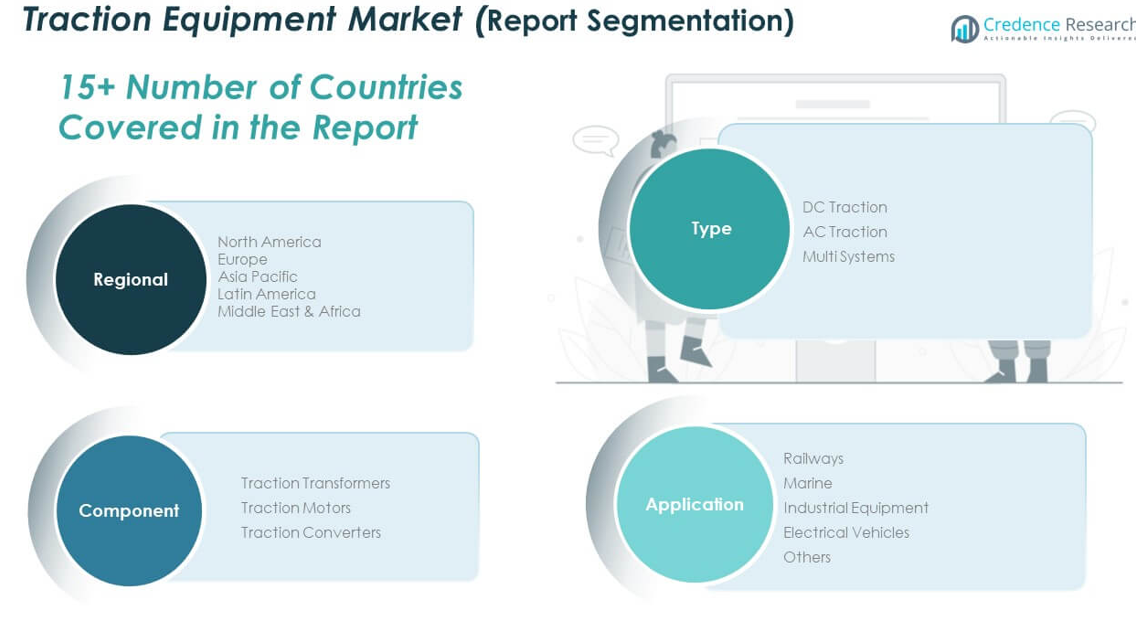
The traction equipment market is segmented by type, component, and application, each contributing to its overall growth.
By type, the market is divided into DC Traction, AC Traction, and Multi Systems. DC Traction is widely used in urban rail systems due to its efficient energy transfer, while AC Traction is preferred for long-distance high-speed rail networks, offering greater efficiency over long distances. Multi-systems are gaining popularity due to their ability to operate on various power supply systems, enhancing operational flexibility.
- For instance, the London Underground extensively uses DC traction systems in its urban rail network. DC traction motors are specifically chosen for their efficient energy transfer, which is ideal for frequent stops and starts typical in urban transit operations.
By components, the market is segmented into Traction Transformers, Traction Motors, and Traction Converters. Traction Transformers ensure reliable power supply, while Traction Motors are critical for providing the necessary propulsion force. Traction Converters manage the conversion of electrical energy, ensuring smooth operation of the traction system.
By application, the traction equipment market covers Railways, Marine, Industrial Equipment, Electrical Vehicles, and others. The railway sector remains the largest application area, driven by the expansion of electrified rail networks globally. The marine sector also contributes, with electric propulsion systems for ships. Industrial equipment and electric vehicles are emerging sectors, benefiting from the adoption of efficient traction solutions to reduce energy consumption and improve performance. These segments are driving the demand for advanced and energy-efficient traction equipment across various industries.
- For example, ABB supplies electric propulsion systems for cruise ships, which utilize energy-efficient electric motors and converters. These systems help reduce emissions and enhance maneuverability, contributing to more sustainable marine transport.
Segmentation:
By Type:
- DC Traction
- AC Traction
- Multi Systems
By Component:
- Traction Transformers
- Traction Motors
- Traction Converters
By Application:
- Railways
- Marine
- Industrial Equipment
- Electrical Vehicles
- Others
By Region:
- North America
- U.S.
- Canada
- Mexico
- Europe
- Germany
- France
- U.K.
- Italy
- Spain
- Rest of Europe
- Asia Pacific
- China
- Japan
- India
- South Korea
- South-east Asia
- Rest of Asia Pacific
- Latin America
- Brazil
- Argentina
- Rest of Latin America
- Middle East & Africa
- GCC Countries
- South Africa
- Rest of the Middle East and Africa
Regional Analysis:
North America Traction Equipment Market
The North America traction equipment market size was valued at USD 1,268.08 million in 2018, reaching USD 1,818.46 million in 2024, and is anticipated to reach USD 2,800.83 million by 2032, at a CAGR of 5.5% during the forecast period. The region holds a strong market position due to the ongoing development of high-speed rail networks and electrification of rail systems. The increasing demand for energy-efficient transportation solutions in the U.S. and Canada is fueling investments in advanced traction technologies. It is expected that government initiatives aimed at reducing emissions and promoting sustainable transport will further boost the demand for traction equipment in North America. The region's focus on infrastructure development, particularly in the public transport sector, provides substantial opportunities for manufacturers of traction systems.
Europe Traction Equipment Market
The Europe traction equipment market size was valued at USD 1,544.89 million in 2018, reaching USD 2,179.31 million in 2024, and is anticipated to reach USD 3,276.78 million by 2032, at a CAGR of 5.2% during the forecast period. Europe’s market growth is driven by the region’s commitment to sustainability and the expansion of high-speed rail networks. Countries such as Germany, France, and the U.K. are heavily investing in the modernization of existing rail infrastructure and the introduction of electric trains. It is anticipated that stringent regulations on emissions and carbon footprints will continue to support the adoption of electric traction equipment in both urban and intercity transport networks.
Asia Pacific Traction Equipment Market
The Asia Pacific traction equipment market size was valued at USD 2,168.33 million in 2018, reaching USD 3,334.70 million in 2024, and is anticipated to reach USD 5,634.29 million by 2032, at a CAGR of 6.8% during the forecast period. The region is the largest market for traction equipment due to rapid urbanization and large-scale investments in metro and rail infrastructure in countries like China, India, and Japan. It is anticipated that the demand for energy-efficient and sustainable transport will continue to rise as governments prioritize green technologies. The region’s focus on expanding metro systems and electric railways, along with substantial government support, makes it a key market for traction equipment manufacturers.
Latin America Traction Equipment Market
The Latin America traction equipment market size was valued at USD 651.50 million in 2018, reaching USD 1,038.41 million in 2024, and is anticipated to reach USD 1,829.66 million by 2032, at a CAGR of 7.3% during the forecast period. Latin America is witnessing increased investments in urban mobility, particularly in cities like São Paulo and Mexico City, which are expanding their metro systems. The region is also focusing on the modernization of railways to support economic growth. It is expected that the adoption of energy-efficient solutions will be a key driver for the traction equipment market in the region, fueled by both government initiatives and the growing need for sustainable transportation alternatives.
Middle East Traction Equipment Market
The Middle East traction equipment market size was valued at USD 443.27 million in 2018, reaching USD 639.49 million in 2024, and is anticipated to reach USD 993.41 million by 2032, at a CAGR of 5.6% during the forecast period. Countries in the Middle East, particularly the UAE and Saudi Arabia, are investing heavily in the development of modern rail and metro systems to improve urban mobility. The demand for efficient and eco-friendly traction equipment is growing due to these infrastructure projects. It is expected that the expansion of metro systems and other public transport initiatives will continue to drive market growth, positioning the region as a strong player in the global traction equipment market.
Africa Traction Equipment Market
The Africa traction equipment market size was valued at USD 158.35 million in 2018, reaching USD 211.71 million in 2024, and is anticipated to reach USD 292.09 million by 2032, at a CAGR of 4.1% during the forecast period. While Africa's market share remains relatively smaller compared to other regions, it is steadily growing as the demand for efficient public transport solutions increases. Several countries, including South Africa and Nigeria, are investing in rail infrastructure to improve connectivity and reduce congestion in urban areas. It is expected that ongoing development projects will boost the adoption of modern traction equipment, particularly in metro and commuter rail systems, supporting long-term market growth in the region.
Key Player Analysis:
- ABB Ltd.
- American Traction Systems
- Alstom SA
- Bombardier Inc.
- Crompton Greaves Limited
- Caterpillar Inc.
- GE Company
- Kawasaki Heavy Industries Ltd.
- VEM Group
- Toshiba International Corporation
- Other Key Players
Competitive Analysis:
The traction equipment market is highly competitive, with key players focusing on technological advancements and strategic partnerships to expand their market share. Major companies such as Siemens AG, Alstom, General Electric, and Mitsubishi Electric dominate the market by offering innovative solutions that improve energy efficiency and reduce operational costs. These players invest significantly in research and development to enhance traction motor designs, power systems, and integrated solutions for both electric and hybrid transportation. Emerging companies are also entering the market, offering specialized products for regional rail and metro systems. Market competition intensifies as manufacturers aim to capitalize on government policies promoting sustainability and the adoption of electric rail and metro systems. It is crucial for companies to focus on cost-effective, environmentally friendly solutions to remain competitive, particularly as demand for sustainable transport grows globally. The ability to provide tailored solutions for diverse infrastructure projects remains a key differentiator in this market.
Recent Developments:
- In February 2025, Kawasaki commenced sales of a hydraulic booster hydrogen compressor for large-scale hydrogen refueling, supporting the growth of hydrogen-powered mobility
- In March 2025, GE Vernova completed the acquisition of Woodward, Inc.’s heavy-duty gas turbine combustion parts business, bolstering its supply chain and U.S. manufacturing capabilities.
- In April 2025, ABB unveiled a suite of next-generation traction equipment at bauma 2025, including the Pro Battery Series-an advanced traction battery system for heavy-duty electric vehicles, the HES580 Mobile Inverter, and the AMXE160 Motor. These products are designed to improve energy efficiency, safety, and the operational lifespan of electric and hybrid construction and mining vehicles.
- In June 2025, Alstom opened its state-of-the-art Plant 4 facility in Hornell, New York, investing $75 million to reshore the production of stainless steel car body shells for passenger rail vehicles. This move strengthens U.S. rail manufacturing and supply chains, with the facility set to produce 200 multilevel commuter rail cars for Chicago’s Metra system.
Market Concentration & Characteristics:
The traction equipment market is moderately concentrated, with a few large players dominating the market, including Siemens AG, Alstom, General Electric, and Mitsubishi Electric. These companies hold significant market share due to their established presence, extensive product portfolios, and technological innovations. However, the market also features a range of smaller players who focus on niche segments, such as electric buses or regional rail networks. It remains highly competitive as companies continually strive to offer more efficient, cost-effective, and environmentally friendly solutions to meet the growing demand for electrified transportation. The market is characterized by high entry barriers due to the substantial capital investments required for manufacturing and R&D, as well as the complexity of integrating traction systems into existing infrastructure. Collaboration with governments and large-scale infrastructure projects also plays a crucial role in shaping market dynamics.
Report Coverage:
The research report offers an in-depth analysis based on type, component, and application. It details leading market players, providing an overview of their business, product offerings, investments, revenue streams, and key applications. Additionally, the report includes insights into the competitive environment, SWOT analysis, current market trends, as well as the primary drivers and constraints. Furthermore, it discusses various factors that have driven market expansion in recent years. The report also explores market dynamics, regulatory scenarios, and technological advancements that are shaping the industry. It assesses the impact of external factors and global economic changes on market growth. Lastly, it provides strategic recommendations for new entrants and established companies to navigate the complexities of the market.
Future Outlook:
- The traction equipment market is expected to grow significantly due to increasing investments in electrified rail and metro networks globally.
- Technological advancements in traction motor efficiency and energy storage systems will drive performance improvements.
- Governments will continue to promote sustainable transport initiatives, increasing demand for electric and hybrid traction solutions.
- The shift toward smart transportation systems and the integration of IoT and AI will enhance system efficiency and reliability.
- The expansion of high-speed rail networks in emerging markets will provide new opportunities for traction equipment providers.
- Demand for lightweight materials in traction equipment will rise, driven by efforts to improve energy efficiency.
- Urbanization in Asia-Pacific and Latin America will boost the need for modern metro and rail systems, supporting market growth.
- Partnerships between key players and governments will play a critical role in driving large-scale infrastructure projects.
- The rising focus on reducing carbon emissions will increase the preference for electric traction systems.
- Smaller players will find growth opportunities in niche markets, such as regional and freight rail systems.
Request a Free Sample
Fill in your details and we'll send you a free sample report.
- Sample data tables & charts
- Research methodology
Need a Custom Version of This Report?
Tailor the scope, geography, or segments to your exact requirements.
- Custom geography or segment scope
- Direct access to our analyst team
Frequently Asked Questions
What is the current size of the Traction Equipment Market?
What are the key segments within the Traction Equipment Market?
What are some challenges faced by the Traction Equipment Market?
Who are the major players in the Traction Equipment Market?
Table of Content
Chapter 1. Report Introduction
- 1.1 Report Description & Purpose
- 1.1.1 Report Title & Market Definition
- 1.1.2 Unique Selling Propositions (USP) & Key Differentiators
- 1.1.3 Value Proposition for Stakeholders
- 1.2 Research Objectives
- 1.2.1 Market Sizing Objectives (Volume & Revenue)
- 1.2.2 Segmentation Objectives
- 1.2.3 Competitive Intelligence Objectives
- 1.2.4 Forecast & Scenario Objectives
- 1.3 Report Scope
- 1.3.1 Traction Equipment Scope – Types & Subtypes Covered
- 1.3.2 Geographic Scope – Regions & Countries Covered
- 1.3.3 Historical Period, Base Year & Forecast Period (2018; forecast to 2024)
- 1.3.4 Inclusions & Exclusions
- 1.4 HS Code & Classification Framework
- 1.5 Currency, Units & Pricing Basis
- 1.6 Target Stakeholders
- 1.7 Limitations & Assumptions
Chapter 2. Executive Summary
- 2.1 Global Traction Equipment Market Snapshot
- 2.1.1 Market Size – Historical (2018) & Forecast (2018-2024) (2018: USD 6,234.4 million → 2024: USD 9,222.1 million)
- 2.1.2 Volume & Revenue – Global Totals
- 2.1.3 Key Market Highlights – Top Five Facts
- 2.2 Traction Equipment Market Segmentation Snapshot
- 2.2.1 Market Split by Region – 2018 vs. 2024
- 2.3 Competitive Snapshot
- 2.3.1 Top 10 Players by Revenue Share – 2018
- 2.3.2 Top 10 Players by Volume Share – 2018
- 2.3.3 Recent Strategic Developments (18-Month Summary)
- 2.4 Key Investment Highlights & Strategic Conclusions
Chapter 3. Traction Equipment Market Dynamics & Industry Analysis
- 3.1 Market Overview & Context
- 3.1.1 Traction Equipment Market Position in the Broader Automotive Value Chain
- 3.1.2 OEM vs. Replacement Market Dynamics
- 3.1.3 Market Maturity & Development Stage by Region
- 3.2 Traction Equipment Market Drivers
- 3.3 Traction Equipment Market Restraints & Challenges
- 3.4 Traction Equipment Market Opportunities
- 3.5 Porter's Five Forces Analysis
- 3.5.1 Threat of New Entrants
- 3.5.2 Bargaining Power of Suppliers
- 3.5.3 Bargaining Power of Buyers
- 3.5.4 Threat of Substitutes
- 3.5.5 Competitive Rivalry – Intensity Assessment
- 3.6 Traction Equipment Value Chain Analysis
- 3.6.1 Upstream – Raw Material/Input Suppliers
- 3.6.1.1 Raw Material/Input 1
- 3.6.1.2 Raw Material/Input 2
- 3.6.1.3 Raw Material/Input 3
- 3.6.2 Midstream – Production/Manufacturing/Service Delivery
- 3.6.2.1 Production/Process Overview
- 3.6.2.2 Key Facility Locations & Capacity by Manufacturer
- 3.6.3 Downstream – Distribution & End Consumer
- 3.6.3.1 Primary Channel – B2B/OEM
- 3.6.3.2 Secondary Channels – Dealer, Retail, Online, Direct
- 3.6.4 Value Chain Profitability Analysis
- 3.6.1 Upstream – Raw Material/Input Suppliers
- 3.7 PESTEL Analysis
- 3.7.1 Political Factors
- 3.7.2 Economic Factors
- 3.7.3 Social Factors
- 3.7.4 Technological Factors
- 3.7.5 Environmental Factors
- 3.7.6 Legal Factors
- 3.8 Traction Equipment Supply Chain Analysis
- 3.8.1 Raw Material/Input Supply Risk Assessment
- 3.8.2 Manufacturing Concentration Risk (Geographic Exposure)
- 3.8.3 Trade Disruption Impact Analysis
- 3.9 Regulatory & Policy Landscape
Note: The regulatory and policy landscape section covers regulations based on their applicability to the market, Traction Equipment category, geography, and scope of the study. Only regulatory frameworks with a material impact on operations, compliance, trade, sustainability, or market access are analyzed in detail.
Chapter 4. Key Investment Pockets & Opportunity Analysis
- 4.1 Traction Equipment Market Attractiveness Analysis
- 4.1.1 By Region – Investment Attractiveness Matrix (Volume × CAGR)
- 4.2 Absolute Revenue Growth Opportunity
- 4.2.1 By Region – Absolute USD Growth Through 2024
- 4.3 Incremental Volume Opportunity
- 4.3.1 By Region – Incremental Volume Through 2024
- 4.3.2 Segment – Incremental Volume
- 4.4 Emerging Submarket Opportunity Deep Dive (Subject to Applicability)
- 4.5 Emerging Market Opportunity Scorecards
- 4.5.1 United States
- 4.5.2 Europe
- 4.5.3 Asia
- 4.5.4 Middle East & Africa
Note: Emerging Market Opportunity Scorecards will be included based on relevance and strategic importance. Regions listed are indicative and may vary depending on data availability and market dynamics.
Chapter 5. Traction Equipment Import-Export Analysis & Trade Flows
- 5.1 Global Trade Overview
- 5.1.1 Global Export Value by Country (2018)
- 5.1.2 Global Export Volume by Country (2018)
- 5.1.3 Global Import Value by Country (2018)
- 5.1.4 Global Import Volume by Country (2018)
- 5.1.5 Net Trade Balance by Country (2018)
- 5.2 Export Analysis – Segment
- 5.2.1 Type 1 (HS Code)
- 5.2.2 Type 2 (HS Code)
- 5.2.3 Type 3 (HS Code)
- 5.2.4 Type 4 (HS Code)
- 5.2.5 Type 5 (HS Code)
- 5.3 Import Analysis – Segment
- 5.3.1 Type 1 (HS Code)
- 5.3.2 Type 2 (HS Code)
- 5.3.3 Type 3 (HS Code)
- 5.3.4 Type 4 (HS Code)
- 5.3.5 Type 5 (HS Code)
- 5.4 Average Unit Trade Prices
- 5.4.1 Average Export Price – Segment & Country
- 5.4.2 Average Import Price – Segment & Source Country
- 5.4.3 Price Trends (2018)
- 5.5 Key Trade Route Analysis
- 5.5.1 Trade Route 1
- 5.5.2 Trade Route 2
- 5.5.3 Trade Route 3
- 5.5.4 Trade Route 4
- 5.5.5 Trade Route 5
- 5.6 Trade Policy Impact Assessment
- 5.6.1 US Anti-Dumping & Section 301 Tariffs
- 5.6.2 EU Customs Union Impact
- 5.6.3 Major Free Trade Agreements
- 5.6.4 USMCA Rules of Origin
Note: Trade policy analysis will be included only where relevant to the Traction Equipment market.
Chapter 6. Competitive Landscape & Company Benchmarking
- 6.1 Traction Equipment Market Concentration & Structure
- 6.1.1 Herfindahl-Hirschman Index (HHI) – vs. 2018
- 6.1.2 Tier 1, Tier 2 & Tier 3 Market Structure
- 6.1.3 Global, Regional & Local Player Dynamics
- 6.2 Traction Equipment Market Share Analysis – 2018
- 6.2.1 Global Revenue Share by Company
- 6.2.2 Global Volume Share by Company
- 6.2.3 Regional Revenue Share
- 6.2.4 Market Share Evolution ( vs. 2018)
- 6.2.5 OEM Segment Share by Company
- 6.2.6 Replacement Segment Share by Company
- 6.3 Production/Delivery Capacity & Facility Analysis
- 6.3.1 Global Installed Capacity
- 6.3.2 Capacity Utilization Rates
- 6.3.3 Production/Output Volume
- 6.3.4 Facility Locations & Capacity Map
- 6.3.5 Planned Capacity Additions
- 6.4 Traction Equipment Competitive Benchmarking Matrix
- 6.4.1 Revenue, Volume, CAGR & Profitability Comparison
- 6.4.2 Channel Revenue Mix
- 6.4.3 Geographic Revenue Exposure
- 6.4.4 R&D Intensity
- 6.4.5 Sustainability Maturity
- 6.5 Strategic Developments in Traction Equipment (Last 24 Months)
- 6.5.1 Mergers, Acquisitions & Divestments
- 6.5.2 New Traction Equipment Launches
- 6.5.3 Facility Expansions
- 6.5.4 Strategic Alliances, Joint Ventures & Partnerships
- 6.5.5 Distribution Expansion & Market Entry
- 6.5.6 Sustainability & ESG Initiatives
- 6.6 Competitive Strategy Mapping
- 6.6.1 Leader, Challenger, Follower & Niche Classification
- 6.6.2 Pricing Strategy Comparison
- 6.6.3 Channel Strategy Matrix
Note: Strategic developments are included based on their materiality and the availability of reliable information.
Chapter 7. Global Traction Equipment Market – By Distribution Channel
- 7.1 Segment Overview
- 7.1.1 Volume & Revenue Split by Channel (2018 & 2024)
- 7.1.2 Channel Mix Evolution (2018-2024)
Chapter 8. Regional Market Analysis – Global Overview
- 8.1 Global Regional Overview
- 8.1.1 Regional Volume Share
- 8.1.2 Regional Revenue Share
- 8.1.3 Regional Volume by Region
- 8.1.4 Regional Revenue by Region
- 8.1.5 Regional Forecast Through 2024
- 8.2 Cross-Regional Segment Analysis
- 8.2.1 By Distribution Channel
- 8.2.2 By Brand/Price Tier
Chapter 9. North America Traction Equipment Market
- 9.1 United States
- 9.2 Canada
- 9.3 Mexico
Chapter 10. Europe Traction Equipment Market
- 10.1 Germany
- 10.2 France
- 10.3 Italy
- 10.4 United Kingdom
- 10.5 Spain
- 10.6 Poland
- 10.7 Russia
- 10.8 Netherlands
- 10.9 Belgium
- 10.10 Sweden
- 10.11 Denmark
- 10.12 Norway
- 10.13 Rest of Europe
Chapter 11. Asia Pacific Traction Equipment Market
- 11.1 China
- 11.2 India
- 11.3 Japan
- 11.4 South Korea
- 11.5 Thailand
- 11.6 Indonesia
- 11.7 Vietnam
- 11.8 Malaysia
- 11.9 Australia
- 11.10 Rest of Asia Pacific
Chapter 12. Latin America Traction Equipment Market
- 12.1 Brazil
- 12.2 Argentina
- 12.3 Colombia
- 12.4 Chile
- 12.5 Rest of Latin America
Chapter 13. Middle East Traction Equipment Market
- 13.1 Saudi Arabia
- 13.2 United Arab Emirates
- 13.3 Turkey
- 13.4 Israel
- 13.5 Iran
- 13.6 Rest of the Middle East
Chapter 14. Africa Traction Equipment Market
- 14.1 South Africa
- 14.2 Egypt
- 14.3 Nigeria
- 14.4 Morocco
- 14.5 Rest of Africa
Chapter 15. Traction Equipment Company Profiles
- 15.1 [Company 01]
- 15.1.1 Company Overview
- 15.1.2 Key Management Personnel
- 15.1.3 Products & Services Portfolio
- 15.1.4 Financial Performance
- 15.1.5 Key Market Focus & Geographic Presence
- 15.1.6 Recent Developments & Strategic Initiatives
Note: The company profile list is preliminary and may change based on research findings, market developments, data availability, and client requirements.
Chapter 16. Appendices
- Appendix A – List of Abbreviations & Acronyms
- Appendix B – Industry Classification Code Reference – Full Series
- Appendix C – Production & Capacity Data Tables
- Appendix D – End-Use & Demand Base Tables
- Appendix E – Consumption & Replacement Rate Assumptions
- Appendix F – ASP Reference Tables
- Appendix G – Manufacturing & Facility Database
- Appendix H – Import-Export Data Tables
- Appendix I – Regulatory Summary Tables
- Appendix J – Primary Research Participant List (Anonymized)
- Appendix K – Primary Research Questionnaire Framework
- Appendix L – Data Sources & Bibliography
- Appendix M – Market Size Divergence & Source Comparison
Chapter 17. Research Methodology
- 17.1 Research Framework & Philosophy
- 17.2 Secondary Research – Sources, Hierarchy & Data Extraction
- 17.3 Data Modeling – Bottom-Up & Top-Down Market Sizing
- 17.4 Primary Research – Stakeholder Framework, LOI & Sample Sizes
- 17.5 Forecast Methodology – Regression, Scenario & Sensitivity Analysis
- 17.6 Quality Control – Four-Layer Validation Framework
- 17.7 Limitations & Standard Assumptions
- 17.8 Disclaimer
