
| REPORT ATTRIBUTE | DETAILS |
|---|---|
| Historical Period | 2019-2022 |
| Base Year | 2023 |
| Forecast Period | 2024-2032 |
| X-Ray Non-destructive Testing (NDT) Market Size 2023 | USD 7,281.04 million |
| X-Ray Non-destructive Testing (NDT) Market, CAGR | 13.25% |
| X-Ray Non-destructive Testing (NDT) Market Size 2032 | USD 22,311.94 million |
Market Overview
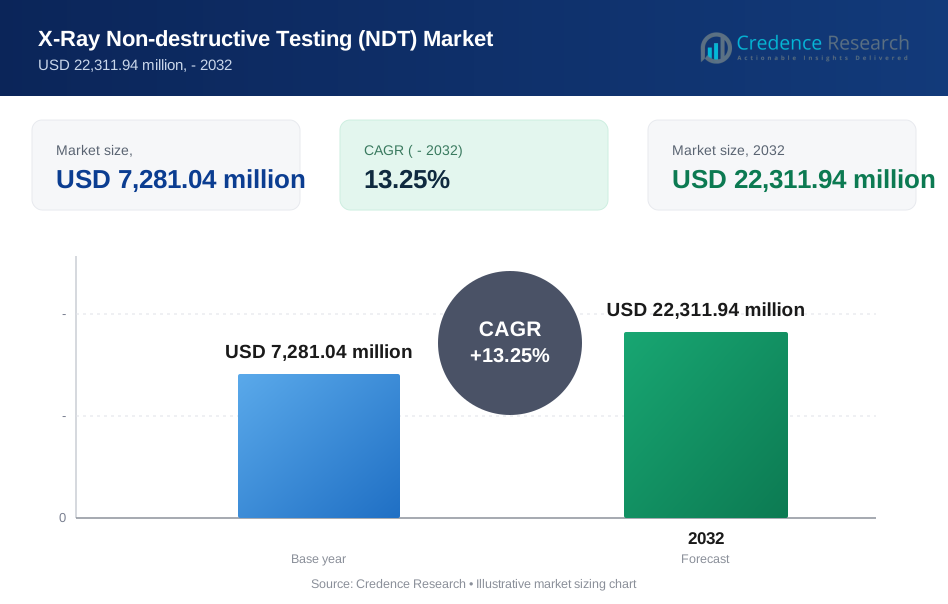
The Global X-Ray Non-destructive Testing (NDT) Market is projected to grow from USD 7,281.04 million in 2023 to an estimated USD 22,311.94 million by 2032, with a compound annual growth rate (CAGR) of 13.25% from 2024 to 2032. This substantial growth reflects the increasing demand for quality control and safety assurances across various industries, including aerospace, automotive, construction, and manufacturing. The emphasis on enhancing product reliability and longevity, along with regulatory compliance across global markets, continues to drive the adoption of X-ray NDT techniques. This technology plays a crucial role in the preventive maintenance and monitoring of critical infrastructures, ensuring operational safety and efficiency.
Market drivers for the X-Ray NDT sector include advancements in technology that improve defect recognition and cost-effectiveness, as well as the rising adoption of automation in industrial sectors. These technological improvements not only enhance detection capabilities but also reduce operational downtime, making the processes more efficient. The growing necessity to adhere to stringent safety regulations and standards across industries further propels the market forward. Moreover, trends such as the integration of AI and machine learning for better data analysis and interpretation are setting the stage for more sophisticated NDT solutions, thereby expanding the market's scope and applications.
Geographically, North America currently leads the Global X-Ray NDT Market, attributed to its robust industrial sector and stringent safety regulations. However, Asia-Pacific is expected to witness the highest growth rate during the forecast period due to rapid industrialization, particularly in countries like China and India, and increasing investments in infrastructure projects. Key players in the market include General Electric, Nikon Metrology, Olympus Corporation, and YXLON International. These companies are continuously innovating and expanding their product offerings to meet the diverse needs of their clients globally, thereby maintaining their competitive edge in the market.
Market Drivers
Increasing Regulatory and Safety Standards:
Across the globe, industries face stringent regulations regarding safety and quality, which significantly drive the demand for X-Ray NDT services. Governments and regulatory bodies are mandating rigorous inspection protocols to ensure safety and reliability in sectors such as aerospace, automotive, construction, and oil & gas. For example, in the aerospace industry, components must undergo thorough inspections to prevent failures that could lead to catastrophic outcomes. X-Ray NDT provides a non-invasive method to detect internal and surface defects, ensuring compliance with safety standards and helping companies avoid heavy penalties and reputational damage.
Technological Advancements in NDT Equipment:
The market is witnessing rapid technological advancements that enhance the efficiency and accuracy of non-destructive testing. Modern X-Ray NDT equipment offers improved imaging capabilities and greater penetration power, allowing for the detailed inspection of high-density materials and complex geometries. Innovations such as digital radiography and computed tomography provide high-resolution images that are crucial for precise defect detection. Additionally, the integration of artificial intelligence and machine learning algorithms is revolutionizing the way inspections are conducted by automating data analysis and interpretation processes, leading to faster decision-making and reduced human error.
Growth in Industries Requiring Quality Assurance:
The expansion of industries that require rigorous quality assurance measures, such as automotive, aerospace, and manufacturing, directly contributes to the growth of the X-Ray NDT market. These industries are increasingly adopting X-Ray NDT methods to ensure the integrity of critical components during both production and operation phases. The ability to detect flaws early in the manufacturing process not only ensures product quality and compliance with industry standards but also helps in extending the life of components and reducing maintenance costs. The ongoing innovation in materials and manufacturing technologies further necessitates advanced NDT methods to keep pace with new testing requirements.
Expansion in Emerging Economies:
Emerging economies in Asia-Pacific, Latin America, and parts of Africa are undergoing rapid industrialization and infrastructure development, which creates substantial opportunities for the X-Ray NDT market. The increasing investment in new industrial plants, public infrastructure, and energy facilities in these regions requires extensive safety evaluations and maintenance inspections. The demand for NDT services is further bolstered by the shift toward nuclear energy in several countries, which demands high levels of inspection rigor for safety assurance. The market's expansion in these regions is facilitated by the growing awareness of the benefits of preventive maintenance and quality control among local industries.
Market Trends
Digital Radiography Adoption:
Industries are increasingly adopting digital radiography over traditional film-based methods. Digital systems offer faster processing times, better image quality, and enhanced data storage capabilities. This shift not only improves the efficiency of inspections but also significantly reduces the environmental impact associated with chemical processing of traditional films.
Automation and Robotics Integration:
Automation and robotic technologies are being integrated into X-Ray NDT to increase the precision and repeatability of inspections. Automated systems can consistently perform tests under standardized conditions, reducing human error and increasing throughput. Robotics also enables the inspection of hazardous or difficult-to-access areas, enhancing worker safety and expanding the range of applications for X-Ray NDT.
Advanced Software Solutions:
The market is witnessing the introduction of advanced software solutions that provide enhanced image analysis and data management capabilities. These software systems utilize artificial intelligence (AI) and machine learning algorithms to automatically detect flaws and predict potential failures. This not only speeds up the inspection process but also improves accuracy by minimizing subjective interpretations.
Portable and Mobile X-Ray NDT Equipment:
There is a growing trend towards the development of portable and mobile X-Ray NDT equipment. This mobility allows for in-field inspections at construction sites, pipelines, and remote industrial facilities, providing greater flexibility and immediate evaluation of structural components and machinery.
Regulatory Compliance and Standards:
As global regulations become stricter, the demand for X-Ray NDT services that ensure compliance is on the rise. Industries are proactively adopting X-Ray NDT to adhere to international safety and quality standards, driving market growth and innovation in testing services.
Expansion in Aerospace and Automotive Sectors:
The aerospace and automotive sectors are increasingly utilizing X-Ray NDT due to their high safety and quality requirements. The need for precision in these industries, where even minor defects can lead to significant failures, is a critical driver for the adoption of advanced X-Ray NDT techniques.
Focus on Preventive Maintenance:
Preventive maintenance strategies are gaining traction across various industries to avoid unscheduled downtimes and expensive repairs. X-Ray NDT plays a crucial role in these strategies by detecting defects before they lead to major failures, thus ensuring continuous operation and extending the lifespan of equipment.
Market Restraints and Challenges
High Cost of Equipment:
One of the primary challenges in the X-Ray NDT market is the high cost associated with advanced NDT equipment. The initial investment for state-of-the-art X-Ray NDT machines can be substantial, deterring small to medium-sized enterprises from adopting these technologies. Additionally, the maintenance and calibration of this equipment entail ongoing costs, which can be a significant financial burden over time.
Lack of Skilled Technicians:
The operation of sophisticated X-Ray NDT equipment requires highly skilled technicians who are trained in both the technical aspects of the machines and the interpretation of results. There is a noticeable skills gap in the market, with a shortage of trained professionals who can efficiently handle the complex nature of modern NDT operations. This shortage limits the scalability of NDT services and poses a significant challenge for industry growth.
Regulatory and Safety Concerns:
While X-Ray NDT is crucial for ensuring safety and compliance with industry standards, the process itself involves exposure to radiation, which raises safety concerns. Strict regulations govern the use of radiation-emitting equipment to protect technicians and nearby personnel from potential health risks. Compliance with these regulations requires additional safety measures and training, increasing operational complexities and costs.
Technological Complexity and Integration Issues:
As X-Ray NDT technologies become more advanced, integrating these new systems into existing industrial processes can be challenging. The complexity of digital systems and data management tools requires not only hardware updates but also software compatibility checks. This integration is often a cumbersome and time-consuming process that can disrupt routine operations.
Market Saturation in Developed Regions:
In developed regions such as North America and Europe, the X-Ray NDT market is approaching saturation, making it difficult for new entrants to establish a foothold. The high market penetration of existing players and the mature nature of industries in these regions limit the growth opportunities for new technologies and services.
Economic Downturns:
Economic downturns significantly impact industries such as manufacturing, automotive, and aerospace, which are major end-users of X-Ray NDT. During these periods, companies may cut back on investments in new technologies and maintenance, directly affecting the demand for NDT services.
Market Segmentation Analysis
By Type
The Global X-Ray Non-destructive Testing (NDT) Market is segmented into devices, services, and after-sales and spare parts, each serving a critical role in the industry. The devices segment consists of X-Ray NDT equipment essential for high-quality imaging and precise defect detection, crucial in industries where safety and reliability are paramount. As technological advancements continue, newer, more sophisticated devices with enhanced functionalities and better digital integration are being developed, drawing significant investments from large-scale industries. The services segment caters to industries that either choose not to invest in expensive equipment or lack the expertise to conduct testing in-house, with a growing trend towards outsourcing these tasks to specialized firms for operational flexibility and cost-efficiency. Meanwhile, the after-sales and spare parts segment is vital for maintaining the efficiency and longevity of NDT equipment, providing a continuous revenue stream for manufacturers and ensuring that equipment continues to deliver accurate results throughout its service life.
By Application
In the automotive sector, X-Ray Non-destructive Testing (NDT) plays a crucial role in inspecting components and assemblies for defects that could compromise safety-critical systems, with ongoing innovations in materials and complex assemblies heightening its importance for ensuring product quality and regulatory compliance. In aerospace and national defense, the critical nature of components demands the highest safety and quality standards, making X-Ray NDT essential for detecting internal defects and maintaining integrity under extreme conditions, driven by stringent national and international regulations. The oil and gas industry relies on X-Ray NDT for inspecting pipelines, tanks, and other equipment to prevent leaks and failures, vital for environmental and safety compliance. Similarly, in power generation, especially in nuclear facilities, X-Ray NDT is indispensable for assessing critical components, crucial for plant safety and efficiency amid aging infrastructure and efforts to extend the lifespan of existing facilities while upholding rigorous safety standards.
Segments
Based on Type
- Devices
- Services
- After-sales and Spare Parts
Based on Application
- Automotive
- Aerospace and National Defense
- Petroleum and Natural Gas
- Power Generation
Based on the Geography:
- North America
- US
- Canada
- Europe
- Germany
- UK
- France
- Italy
- Spain
- Rest of Europe
- Asia Pacific
- China
- Japan
- India
- Australia
- South Korea
- Rest of Asia Pacific
- Latin America
- Brazil
- Mexico
- Argentina
- Rest of Latin America
- Middle East & Africa
- Saudi Arabia
- South Africa
- UAE
- Rest of the Middle East and Africa
Regional Analysis
North America (35%):
North America commands the largest share of the Global X-Ray NDT Market, holding approximately 35%. The region's dominance is driven by a robust industrial base, stringent regulatory standards, and a strong focus on innovation and technological advancements. North America's leadership in aerospace, automotive, and manufacturing sectors necessitates rigorous quality control measures, fostering substantial demand for X-Ray NDT solutions.
Europe (30%):
Europe follows closely with a market share of about 30%. The region's market is propelled by its advanced manufacturing capabilities and stringent safety regulations, especially in the aerospace and automotive industries. Europe's emphasis on maintaining high safety standards and improving operational efficiencies continues to drive the adoption of advanced NDT technologies. Additionally, the region’s focus on renewable energy and infrastructure refurbishment projects contributes to the market's growth.
Asia Pacific (25%):
Asia-Pacific is the fastest-growing region in the Global X-Ray NDT Market, currently holding a 25% share. This growth is spurred by rapid industrialization and infrastructure development, particularly in China and India. The expansion of manufacturing facilities, coupled with increasing investments in aerospace and automotive sectors, supports the burgeoning demand for NDT services. The region's commitment to enhancing industrial safety standards further amplifies the adoption of X-Ray NDT technologies.
Key players
- Teledyne
- Marietta
- Vidisco
- Werth
- General Electric
- Sigray
- VisiConsult
- Applied Technical Services
- Baker Hughes
- Shimadzu
- Comet Group
- Fujifilm
- SXRAY
- Nikon
- Sanying Precision Instruments
- Unicomp Technology
- QSA Global
- Jesse Garant
- Zeiss
- Laboratory Testing Inc
- Olympus Corporation
- Dothing Technologies
- Dandong NDT Equipment
- Rigaku
- SEC
- Spellman
- Mistras Group, Inc
Competitive Analysis
The competitive landscape of the Global X-Ray Non-destructive Testing (NDT) Market features a mix of established giants and innovative newcomers, each vying for technological supremacy and market share. Key players such as General Electric, Olympus Corporation, and Baker Hughes lead with extensive product portfolios and a strong global presence, backed by substantial R&D investments. Companies like Teledyne and Nikon focus on technological innovations to differentiate themselves, emphasizing advanced imaging solutions and software integration. Meanwhile, smaller players like Vidisco and Sigray carve out niches by specializing in specific industry applications or pioneering new technologies. This diverse competition drives continuous advancements in X-Ray NDT, improving the capabilities and applications of the technology across various industries.
Recent Developments
In March 2022, Ashtead Technology secured an exclusive rental contract with OceanTools, a subsea engineering firm from Aberdeen specializing in undersea technology. Under this agreement, Ashtead Technology became the sole rental partner for OceanTools' innovative DyeTectorTM systems. This includes the latest model, the D10 DyeTector®, a compact device designed to detect three major underwater dyes-rhodamine, ultraviolet, and fluorescein-through three distinct optical components. This partnership underscores Ashtead Technology's commitment to providing advanced technological solutions in the subsea market, enhancing capabilities in leak, dye, and cement detection.
In May 2023, Waygate Technologies launched the Phoenix V|tome|x M Omni, their new flagship Computed Tomography (CT) solution. This system replaces the company’s earlier CT model, providing enhanced flexibility, speed, and detection quality. It is designed for diverse applications ranging from 3D metrology and research in laboratory settings to precise automated inspections in production environments. This introduction marks a significant advancement in CT technology, positioning Waygate Technologies at the forefront of industrial NDT solutions.
In May 2023, Previan Technologies, Inc. acquired Sensor Networks, Inc. (SNI), a prominent provider of advanced sensing tools and technologies for the inspection and remote monitoring of safety-critical components. This acquisition allows Previan to integrate SNI’s expertise into its portfolio, notably enhancing the NDT solutions previously offered by Eddyfi Technologies. This strategic move is expected to strengthen Previan’s position in the market by broadening their capabilities in enhanced inspection and safety monitoring.
In February 2023, the American Society for Nondestructive Testing (ASNT) acquired NDT Classroom, a leading provider of online NDT training programs. This acquisition aims to enrich the educational resources available to NDT professionals by offering a comprehensive suite of online courses accessible worldwide. This strategic enhancement underscores ASNT’s commitment to advancing the knowledge and skills of NDT practitioners, thereby supporting professional development within the industry.
In October 2022, United Western Technologies Corp unveiled the EddyView II, a new portable Eddy Current flaw detector. This device features a spacious 8-inch touch screen display, enhancing usability with intuitive adjustments for gain and rotation. Compatible with both conventional and array probes, the EddyView II is versatile across various testing applications. It also includes a dedicated channel for monitoring probe-to-part coupling, ensuring the reliability of testing results.
In March 2022, Acuren Inspection, Inc., acquired Cambridge Materials Testing Limited, significantly enhancing its laboratory testing capabilities. This acquisition is particularly strategic for expanding Acuren’s service offerings in sectors such as aerospace, nuclear, medical, and consumer goods. By integrating Cambridge’s expertise, Acuren has broadened its ability to provide comprehensive NDT and field engineering services to its clients, strengthening its market position in these critical industries.
Market Concentration and Characteristics
The Global X-Ray Non-destructive Testing (NDT) Market exhibits a moderate to high market concentration, characterized by the presence of several key players who dominate the industry through technological innovation, extensive product portfolios, and global reach. Companies like General Electric, Olympus Corporation, and Nikon are leaders in the market, leveraging their advanced technological capabilities and broad service networks to maintain competitive advantages. These major players are complemented by a number of smaller specialized companies that focus on niche applications, contributing to a dynamic market environment. This sector is further characterized by a strong emphasis on R&D, with firms continuously innovating to offer more accurate, efficient, and safer NDT solutions. The market is also influenced by regulatory standards which drive the demand for X-Ray NDT services, ensuring compliance across critical industries such as aerospace, automotive, and oil and gas. This landscape indicates not only a competitive market with technological barriers to entry but also one that is responsive to technological advancements and regulatory frameworks.
Report Coverage
The research report offers an in-depth analysis based on Type and Application. It details leading market players, providing an overview of their business, product offerings, investments, revenue streams, and key applications. Additionally, the report includes insights into the competitive environment, SWOT analysis, current market trends, as well as the primary drivers and constraints. Furthermore, it discusses various factors that have driven market expansion in recent years. The report also explores market dynamics, regulatory scenarios, and technological advancements that are shaping the industry. It assesses the impact of external factors and global economic changes on market growth. Lastly, it provides strategic recommendations for new entrants and established companies to navigate the complexities of the market.
Future Outlook
- Continued innovation in X-Ray technology will enhance detection capabilities, improving the precision and efficiency of NDT processes.
- Increasingly stringent global safety and quality regulations will drive the demand for X-Ray NDT across various industries to ensure compliance and maintain standards.
- The integration of automation and artificial intelligence will streamline operations, reducing human error and operational costs while improving reliability.
- Rapid industrialization in Asia-Pacific and other emerging markets will significantly increase the demand for X-Ray NDT services as new industrial facilities come online.
- Heightened global awareness regarding safety and environmental impacts will push industries to adopt NDT technologies to prevent accidents and ensure public safety.
- Advancements in medical imaging and increasing healthcare standards will open new avenues for X-Ray NDT, particularly in medical device manufacturing.
- The energy sector, including renewable energy, will increasingly rely on X-Ray NDT for the maintenance and inspection of critical infrastructure.
- The aerospace and defense sectors will continue to exhibit strong demand for X-Ray NDT due to the critical need for precision and safety in component manufacturing.
- Digital radiography will become more prevalent, offering advantages such as reduced inspection times and better image quality over traditional methods.
- As technology evolves, there will be a greater need for specialized training and education programs to equip technicians with the necessary skills to handle advanced NDT equipment and interpretation.
Request a Free Sample
Fill in your details and we'll send you a free sample report.
- Sample data tables & charts
- Research methodology
Need a Custom Version of This Report?
Tailor the scope, geography, or segments to your exact requirements.
- Custom geography or segment scope
- Direct access to our analyst team
Frequently Asked Questions
What is the projected market size of the Global XRay NDT Market by 2032?
Which industries are driving the demand for XRay NDT services?
What technological advancements are influencing the XRay NDT Market?
Which region leads in the Global XRay NDT Market and why?
What are the main challenges facing the Global XRay NDT Market?
Table of Content
Chapter 1. Report Introduction
- 1.1 Report Description & Purpose
- 1.1.1 Report Title & Market Definition
- 1.1.2 Unique Selling Propositions (USP) & Key Differentiators
- 1.1.3 Value Proposition for Stakeholders
- 1.2 Research Objectives
- 1.2.1 Market Sizing Objectives (Volume & Revenue)
- 1.2.2 Segmentation Objectives
- 1.2.3 Competitive Intelligence Objectives
- 1.2.4 Forecast & Scenario Objectives
- 1.3 Report Scope
- 1.3.1 X-Ray Non-destructive Testing (NDT) Scope – Types & Subtypes Covered
- 1.3.2 Geographic Scope – Regions & Countries Covered
- 1.3.3 Historical Period, Base Year & Forecast Period (the historical period; forecast to 2032)
- 1.3.4 Inclusions & Exclusions
- 1.4 HS Code & Classification Framework
- 1.5 Currency, Units & Pricing Basis
- 1.6 Target Stakeholders
- 1.7 Limitations & Assumptions
Chapter 2. Executive Summary
- 2.1 Global X-Ray Non-destructive Testing (NDT) Market Snapshot
- 2.1.1 Market Size – Historical (the historical period) & Forecast (2032) (base year: USD 7,281.04 million → 2032: USD 22,311.94 million)
- 2.1.2 Volume & Revenue – Global Totals
- 2.1.3 Key Market Highlights – Top Five Facts
- 2.2 X-Ray Non-destructive Testing (NDT) Market Segmentation Snapshot
- 2.2.1 Market Split by Region – vs. 2032
- 2.3 Competitive Snapshot
- 2.3.1 Top 10 Players by Revenue Share –
- 2.3.2 Top 10 Players by Volume Share –
- 2.3.3 Recent Strategic Developments (18-Month Summary)
- 2.4 Key Investment Highlights & Strategic Conclusions
Chapter 3. X-Ray Non-destructive Testing (NDT) Market Dynamics & Industry Analysis
- 3.1 Market Overview & Context
- 3.1.1 X-Ray Non-destructive Testing (NDT) Market Position in the Broader Automotive Value Chain
- 3.1.2 OEM vs. Replacement Market Dynamics
- 3.1.3 Market Maturity & Development Stage by Region
- 3.2 X-Ray Non-destructive Testing (NDT) Market Drivers
- 3.3 X-Ray Non-destructive Testing (NDT) Market Restraints & Challenges
- 3.4 X-Ray Non-destructive Testing (NDT) Market Opportunities
- 3.5 Porter's Five Forces Analysis
- 3.5.1 Threat of New Entrants
- 3.5.2 Bargaining Power of Suppliers
- 3.5.3 Bargaining Power of Buyers
- 3.5.4 Threat of Substitutes
- 3.5.5 Competitive Rivalry – Intensity Assessment
- 3.6 X-Ray Non-destructive Testing (NDT) Value Chain Analysis
- 3.6.1 Upstream – Raw Material/Input Suppliers
- 3.6.1.1 Raw Material/Input 1
- 3.6.1.2 Raw Material/Input 2
- 3.6.1.3 Raw Material/Input 3
- 3.6.2 Midstream – Production/Manufacturing/Service Delivery
- 3.6.2.1 Production/Process Overview
- 3.6.2.2 Key Facility Locations & Capacity by Manufacturer
- 3.6.3 Downstream – Distribution & End Consumer
- 3.6.3.1 Primary Channel – B2B/OEM
- 3.6.3.2 Secondary Channels – Dealer, Retail, Online, Direct
- 3.6.4 Value Chain Profitability Analysis
- 3.6.1 Upstream – Raw Material/Input Suppliers
- 3.7 PESTEL Analysis
- 3.7.1 Political Factors
- 3.7.2 Economic Factors
- 3.7.3 Social Factors
- 3.7.4 Technological Factors
- 3.7.5 Environmental Factors
- 3.7.6 Legal Factors
- 3.8 X-Ray Non-destructive Testing (NDT) Supply Chain Analysis
- 3.8.1 Raw Material/Input Supply Risk Assessment
- 3.8.2 Manufacturing Concentration Risk (Geographic Exposure)
- 3.8.3 Trade Disruption Impact Analysis
- 3.9 Regulatory & Policy Landscape
Note: The regulatory and policy landscape section covers regulations based on their applicability to the market, X-Ray Non-destructive Testing (NDT) category, geography, and scope of the study. Only regulatory frameworks with a material impact on operations, compliance, trade, sustainability, or market access are analyzed in detail.
Chapter 4. Key Investment Pockets & Opportunity Analysis
- 4.1 X-Ray Non-destructive Testing (NDT) Market Attractiveness Analysis
- 4.1.1 By Region – Investment Attractiveness Matrix (Volume × CAGR)
- 4.2 Absolute Revenue Growth Opportunity
- 4.2.1 By Region – Absolute USD Growth Through 2032
- 4.3 Incremental Volume Opportunity
- 4.3.1 By Region – Incremental Volume Through 2032
- 4.3.2 Segment – Incremental Volume
- 4.4 Emerging Submarket Opportunity Deep Dive (Subject to Applicability)
- 4.5 Emerging Market Opportunity Scorecards
- 4.5.1 United States
- 4.5.2 Europe
- 4.5.3 Asia
- 4.5.4 Middle East & Africa
Note: Emerging Market Opportunity Scorecards will be included based on relevance and strategic importance. Regions listed are indicative and may vary depending on data availability and market dynamics.
Chapter 5. X-Ray Non-destructive Testing (NDT) Import-Export Analysis & Trade Flows
- 5.1 Global Trade Overview
- 5.1.1 Global Export Value by Country (the historical period)
- 5.1.2 Global Export Volume by Country (the historical period)
- 5.1.3 Global Import Value by Country (the historical period)
- 5.1.4 Global Import Volume by Country (the historical period)
- 5.1.5 Net Trade Balance by Country (the historical period)
- 5.2 Export Analysis – Segment
- 5.2.1 Type 1 (HS Code)
- 5.2.2 Type 2 (HS Code)
- 5.2.3 Type 3 (HS Code)
- 5.2.4 Type 4 (HS Code)
- 5.2.5 Type 5 (HS Code)
- 5.3 Import Analysis – Segment
- 5.3.1 Type 1 (HS Code)
- 5.3.2 Type 2 (HS Code)
- 5.3.3 Type 3 (HS Code)
- 5.3.4 Type 4 (HS Code)
- 5.3.5 Type 5 (HS Code)
- 5.4 Average Unit Trade Prices
- 5.4.1 Average Export Price – Segment & Country
- 5.4.2 Average Import Price – Segment & Source Country
- 5.4.3 Price Trends (the historical period)
- 5.5 Key Trade Route Analysis
- 5.5.1 Trade Route 1
- 5.5.2 Trade Route 2
- 5.5.3 Trade Route 3
- 5.5.4 Trade Route 4
- 5.5.5 Trade Route 5
- 5.6 Trade Policy Impact Assessment
- 5.6.1 US Anti-Dumping & Section 301 Tariffs
- 5.6.2 EU Customs Union Impact
- 5.6.3 Major Free Trade Agreements
- 5.6.4 USMCA Rules of Origin
Note: Trade policy analysis will be included only where relevant to the X-Ray Non-destructive Testing (NDT) market.
Chapter 6. Competitive Landscape & Company Benchmarking
- 6.1 X-Ray Non-destructive Testing (NDT) Market Concentration & Structure
- 6.1.1 Herfindahl-Hirschman Index (HHI) – vs.
- 6.1.2 Tier 1, Tier 2 & Tier 3 Market Structure
- 6.1.3 Global, Regional & Local Player Dynamics
- 6.2 X-Ray Non-destructive Testing (NDT) Market Share Analysis –
- 6.2.1 Global Revenue Share by Company
- 6.2.2 Global Volume Share by Company
- 6.2.3 Regional Revenue Share
- 6.2.4 Market Share Evolution ( vs. )
- 6.2.5 OEM Segment Share by Company
- 6.2.6 Replacement Segment Share by Company
- 6.3 Production/Delivery Capacity & Facility Analysis
- 6.3.1 Global Installed Capacity
- 6.3.2 Capacity Utilization Rates
- 6.3.3 Production/Output Volume
- 6.3.4 Facility Locations & Capacity Map
- 6.3.5 Planned Capacity Additions
- 6.4 X-Ray Non-destructive Testing (NDT) Competitive Benchmarking Matrix
- 6.4.1 Revenue, Volume, CAGR & Profitability Comparison
- 6.4.2 Channel Revenue Mix
- 6.4.3 Geographic Revenue Exposure
- 6.4.4 R&D Intensity
- 6.4.5 Sustainability Maturity
- 6.5 Strategic Developments in X-Ray Non-destructive Testing (NDT) (Last 24 Months)
- 6.5.1 Mergers, Acquisitions & Divestments
- 6.5.2 New X-Ray Non-destructive Testing (NDT) Launches
- 6.5.3 Facility Expansions
- 6.5.4 Strategic Alliances, Joint Ventures & Partnerships
- 6.5.5 Distribution Expansion & Market Entry
- 6.5.6 Sustainability & ESG Initiatives
- 6.6 Competitive Strategy Mapping
- 6.6.1 Leader, Challenger, Follower & Niche Classification
- 6.6.2 Pricing Strategy Comparison
- 6.6.3 Channel Strategy Matrix
Note: Strategic developments are included based on their materiality and the availability of reliable information.
Chapter 7. Global X-Ray Non-destructive Testing (NDT) Market – By Distribution Channel
- 7.1 Segment Overview
- 7.1.1 Volume & Revenue Split by Channel ( & 2032)
- 7.1.2 Channel Mix Evolution (2032)
Chapter 8. Regional Market Analysis – Global Overview
- 8.1 Global Regional Overview
- 8.1.1 Regional Volume Share
- 8.1.2 Regional Revenue Share
- 8.1.3 Regional Volume by Region
- 8.1.4 Regional Revenue by Region
- 8.1.5 Regional Forecast Through 2032
- 8.2 Cross-Regional Segment Analysis
- 8.2.1 By Distribution Channel
- 8.2.2 By Brand/Price Tier
Chapter 9. North America X-Ray Non-destructive Testing (NDT) Market
- 9.1 United States
- 9.2 Canada
- 9.3 Mexico
Chapter 10. Europe X-Ray Non-destructive Testing (NDT) Market
- 10.1 Germany
- 10.2 France
- 10.3 Italy
- 10.4 United Kingdom
- 10.5 Spain
- 10.6 Poland
- 10.7 Russia
- 10.8 Netherlands
- 10.9 Belgium
- 10.10 Sweden
- 10.11 Denmark
- 10.12 Norway
- 10.13 Rest of Europe
Chapter 11. Asia Pacific X-Ray Non-destructive Testing (NDT) Market
- 11.1 China
- 11.2 India
- 11.3 Japan
- 11.4 South Korea
- 11.5 Thailand
- 11.6 Indonesia
- 11.7 Vietnam
- 11.8 Malaysia
- 11.9 Australia
- 11.10 Rest of Asia Pacific
Chapter 12. Latin America X-Ray Non-destructive Testing (NDT) Market
- 12.1 Brazil
- 12.2 Argentina
- 12.3 Colombia
- 12.4 Chile
- 12.5 Rest of Latin America
Chapter 13. Middle East X-Ray Non-destructive Testing (NDT) Market
- 13.1 Saudi Arabia
- 13.2 United Arab Emirates
- 13.3 Turkey
- 13.4 Israel
- 13.5 Iran
- 13.6 Rest of the Middle East
Chapter 14. Africa X-Ray Non-destructive Testing (NDT) Market
- 14.1 South Africa
- 14.2 Egypt
- 14.3 Nigeria
- 14.4 Morocco
- 14.5 Rest of Africa
Chapter 15. X-Ray Non-destructive Testing (NDT) Company Profiles
- 15.1 [Company 01]
- 15.1.1 Company Overview
- 15.1.2 Key Management Personnel
- 15.1.3 Products & Services Portfolio
- 15.1.4 Financial Performance
- 15.1.5 Key Market Focus & Geographic Presence
- 15.1.6 Recent Developments & Strategic Initiatives
Note: The company profile list is preliminary and may change based on research findings, market developments, data availability, and client requirements.
Chapter 16. Appendices
- Appendix A – List of Abbreviations & Acronyms
- Appendix B – Industry Classification Code Reference – Full Series
- Appendix C – Production & Capacity Data Tables
- Appendix D – End-Use & Demand Base Tables
- Appendix E – Consumption & Replacement Rate Assumptions
- Appendix F – ASP Reference Tables
- Appendix G – Manufacturing & Facility Database
- Appendix H – Import-Export Data Tables
- Appendix I – Regulatory Summary Tables
- Appendix J – Primary Research Participant List (Anonymized)
- Appendix K – Primary Research Questionnaire Framework
- Appendix L – Data Sources & Bibliography
- Appendix M – Market Size Divergence & Source Comparison
Chapter 17. Research Methodology
- 17.1 Research Framework & Philosophy
- 17.2 Secondary Research – Sources, Hierarchy & Data Extraction
- 17.3 Data Modeling – Bottom-Up & Top-Down Market Sizing
- 17.4 Primary Research – Stakeholder Framework, LOI & Sample Sizes
- 17.5 Forecast Methodology – Regression, Scenario & Sensitivity Analysis
- 17.6 Quality Control – Four-Layer Validation Framework
- 17.7 Limitations & Standard Assumptions
- 17.8 Disclaimer
