Market Overview
Sweden Electric Vehicle (EV) Market size was valued at USD 10.69 million in 2018 to USD 15.06 million in 2024 and is anticipated to reach USD 25.04 million by 2032, at a CAGR of 6.27% during the forecast period.
| REPORT ATTRIBUTE |
DETAILS |
| Historical Period |
2020-2023 |
| Base Year |
2024 |
| Forecast Period |
2025-2032 |
| Sweden EV Market Size 2024 |
USD 15.06 Million |
| Sweden EV Market, CAGR |
6.27% |
| Sweden EV Market Size 2032 |
USD 25.04 Million |
The Sweden EV Market is shaped by global automakers and strong regional competition, with leading players including Volkswagen, BMW, Mercedes-Benz, Tesla, Volvo, Audi, Skoda, Nissan, and Geely Holding. Tesla leads the premium BEV category with advanced technology and a strong charging ecosystem, while Volkswagen and Volvo dominate the mass-market through broad product offerings and government-backed adoption programs. German manufacturers such as BMW, Mercedes-Benz, and Audi strengthen their presence by focusing on performance, design, and innovation. Nissan and Geely expand market accessibility by offering affordable EV models, catering to growing middle-income demand. Regionally, Southern Sweden leads with a 33% share in 2024, supported by urban concentration, advanced charging infrastructure, and high consumer awareness, making it the most influential region in driving nationwide EV adoption.
Access crucial information at unmatched prices!
Request your sample report today & start making informed decisions powered by Credence Research Inc.!
Download Sample
Market Insights
- The Sweden EV Market grew from USD 10.69 million in 2018 to USD 15.06 million in 2024 and is forecast to reach USD 25.04 million by 2032 at a CAGR of 6.27%.
- Battery Electric Vehicles dominated with 68% share in 2024, supported by subsidies, dense charging networks, and consumer preference, while PHEVs held 24% and other technologies 8%.
- Private buyers led with 71% share in 2024, driven by incentives and affordability, whereas corporate buyers accounted for 29%, supported by fleet electrification and tax benefits.
- Southern Sweden commanded the largest regional share at 33% in 2024, followed by Central Sweden at 28%, Stockholm at 21%, and Northern Sweden at 18%, showing balanced nationwide adoption.
- Key players include Volkswagen, BMW, Mercedes-Benz, Tesla, Volvo, Audi, Skoda, Nissan, and Geely Holding, each competing through innovation, affordability, advanced technology, and strong infrastructure partnerships.
Market Segment Insights
By Powertrain
In the Sweden EV Market, Battery Electric Vehicles (BEVs) hold a dominant position with a 68% share in 2024. Their growth is fueled by strong government subsidies, dense charging infrastructure, and consumer preference for zero-emission mobility. Plug-in Hybrid Electric Vehicles (PHEVs) account for 24% share, appealing to buyers who value range flexibility and combined fuel efficiency. The remaining 8% share is captured by other technologies, including hybrids and fuel cell vehicles, which serve niche segments focused on alternative propulsion solutions.
- For instance, heavy-duty electric trucks in Sweden saw a 15.8% increase in new registrations in early 2025, now comprising 8.9% of the market, reflecting adoption in commercial segments.
By End User
Private buyers lead the Sweden EV Market with a 71% share in 2024, driven by incentives for individuals, falling battery prices, and rising adoption in urban households. Corporate buyers represent 29% share, supported by sustainability commitments, fleet electrification targets, and tax benefits for company-owned vehicles. Private ownership continues to dominate due to consumer awareness and growing availability of affordable EV models, while corporate demand is expanding steadily in logistics, mobility services, and employee car leasing programs.
- For instance, in 2024 35% of new passenger cars in Sweden were battery-electric vehicles (BEVs), even though overall EV registrations dropped by 15.9% compared to 2023, from 112,179 to 94,333 units.
Key Growth Drivers
Government Incentives and Policy Support
The Sweden EV Market benefits strongly from extensive government subsidies, tax exemptions, and purchase incentives that reduce upfront costs for buyers. Exemptions from road tolls and lower registration taxes further encourage adoption across both private and corporate segments. National goals aligned with the EU’s climate targets have pushed authorities to invest in clean mobility infrastructure. This consistent policy backing lowers financial barriers, improves consumer confidence, and accelerates the transition from internal combustion vehicles to sustainable electric mobility solutions.
Expansion of Charging Infrastructure
Widespread deployment of fast-charging stations is a major driver of EV adoption in Sweden. Investments from both public agencies and private companies have created dense charging networks in urban centers and along highways. High accessibility reduces range anxiety, making EVs more practical for long-distance and daily commuting. Sweden’s commitment to developing smart charging and renewable energy integration enhances consumer convenience while promoting sustainable practices. This infrastructural progress directly strengthens BEV dominance, supporting growing demand across residential, commercial, and fleet users.
- For instance, Nima Energy announced the construction of 150 ultra-fast charging points from Stockholm to Skåne (the same region as Malmö), with some charging points capable of providing up to 300 km of charge in approximately 15 minutes, depending on the electric vehicle.
Consumer Shift Toward Sustainable Mobility
Rising environmental awareness and consumer preference for sustainable lifestyles drive EV sales growth in Sweden. Buyers increasingly value low operating costs, reduced carbon emissions, and access to low-emission zones in major cities. The younger demographic, in particular, demonstrates strong interest in adopting greener technologies and reducing dependence on fossil fuels. Automakers meet this demand by offering affordable models with improved driving ranges. This growing alignment between consumer values and product offerings ensures long-term momentum for electric vehicle adoption across the Swedish market.
- For instance, in January 2025, Sweden registered 5,660 battery electric vehicles (BEVs), reflecting a 15.3% year-on-year increase, with BEVs making up 28.8% of all new passenger car registrations. Plug-in hybrid vehicles (PHEVs) also grew 9.2% to 4,464 units, emphasizing consumer preference for low emissions and operational savings.
Key Trends & Opportunities
Corporate Fleet Electrification
Corporate buyers present a growing opportunity in the Sweden EV Market, as companies shift to meet net-zero commitments. Many large employers and logistics providers are electrifying fleets to cut costs and enhance brand reputation. Government tax benefits for company-owned EVs and fleet charging incentives accelerate this adoption. This trend creates strong growth potential for automakers and charging infrastructure providers, as business demand complements the already dominant private ownership base and expands the overall market penetration of EV technologies.
- For instance, in 2024, more than 60% of new company cars registered in Sweden were plug-in vehicles, driven by tax breaks and employer schemes; major Swedish employers provide bundled home or workplace charging to ease corporate fleet electrification.
Integration of Renewable Energy with EV Charging
Sweden’s strong renewable energy base opens opportunities for integrating clean electricity into EV charging infrastructure. Solar-powered stations, vehicle-to-grid (V2G) technologies, and smart charging networks enhance grid stability while ensuring sustainable power supply. This trend not only reduces the lifecycle emissions of EVs but also promotes energy independence. Companies investing in renewable-powered charging hubs gain a competitive edge by appealing to eco-conscious consumers. The synergy between renewable energy growth and EV adoption is expected to significantly expand the market’s long-term value proposition.
- For instance, in Sweden, Circle K opened its largest EV charging hub in February 2025 in Järna, featuring 26 ultra-fast charging points powered by solar panels that provide sustainable electricity for both light and heavy vehicles. This hub supports clean energy integration in EV charging infrastructure directly on site.
Key Challenges
High Upfront Costs for Consumers
Despite incentives, the initial purchase cost of EVs remains higher than conventional vehicles, creating barriers for some buyers. Premium models dominate the market, while affordable EV options are limited. Many middle-income households hesitate due to budget constraints, slowing broader adoption. Although operating costs are lower, the price gap continues to impact purchasing decisions. Bridging this cost divide through affordable models and enhanced subsidy schemes is necessary to ensure that EVs reach mass-market acceptance in Sweden.
Battery Supply Chain and Raw Material Dependence
The Sweden EV Market faces challenges from global supply chain volatility and dependence on critical raw materials like lithium, cobalt, and nickel. Supply disruptions and rising costs directly affect EV pricing and availability. Automakers are vulnerable to external shocks, given Sweden’s reliance on imported materials. While research into battery recycling and alternative chemistries is progressing, scaling these solutions remains difficult. Securing stable and sustainable supply chains will be critical to overcoming this structural challenge in the years ahead.
Charging Infrastructure Gaps in Rural Areas
Although urban regions in Sweden benefit from dense charging networks, rural and remote areas face limited accessibility. This uneven infrastructure distribution creates barriers for residents outside major cities, discouraging EV adoption in non-urban markets. Range anxiety persists among potential buyers who frequently travel long distances. Expanding charging coverage into rural communities will require significant investment and coordinated public-private efforts. Without addressing this challenge, adoption may remain concentrated in cities, slowing national-level EV penetration.
Regional Analysis
Northern Sweden
Northern Sweden accounts for 18% share of the Sweden EV Market in 2024. It benefits from strong renewable energy integration, particularly hydropower, which supports sustainable charging solutions. Government-backed infrastructure projects and incentives promote adoption among households and small businesses in the region. Cold climate conditions present challenges for battery performance, but investments in advanced thermal management systems help mitigate these issues. EV adoption is expanding in mining and logistics sectors, reflecting the region’s industrial focus. It continues to show steady growth potential despite infrastructure limitations in remote areas.
Central Sweden
Central Sweden holds a 28% share of the Sweden EV Market in 2024. The region’s strong manufacturing base and dense population support wider EV adoption. Major cities like Örebro and Uppsala provide robust charging infrastructure, encouraging private and corporate buyers alike. It benefits from government programs that incentivize clean mobility solutions across both urban and semi-urban zones. Corporate fleets are a growing segment, driven by cost savings and sustainability targets. Central Sweden demonstrates a balanced market structure, where demand comes from both households and businesses.
Southern Sweden
Southern Sweden leads with a 33% share of the Sweden EV Market in 2024. It benefits from high consumer awareness, well-developed infrastructure, and strong government incentives. The region’s urban concentration, particularly in Malmö, fuels high adoption rates among private buyers. Corporate electrification programs also thrive due to tax benefits and sustainability policies. Southern Sweden’s advanced logistics and retail networks encourage EV adoption for both short-distance delivery and personal transport. It maintains its leadership position with continuous investment in infrastructure and renewable energy-based charging solutions.
Stockholm
The Stockholm Region captures a 21% share of the Sweden EV Market in 2024. It stands out due to early adoption, dense charging infrastructure, and strict emission regulations. Consumers in the capital city demonstrate strong preference for BEVs, supported by access to low-emission zones and incentives for urban commuters. Corporate buyers also drive significant demand, as many businesses transition fleets to meet environmental goals. The government’s emphasis on reducing congestion and pollution accelerates market expansion. It remains one of the most dynamic regions, setting standards for EV integration across Sweden.
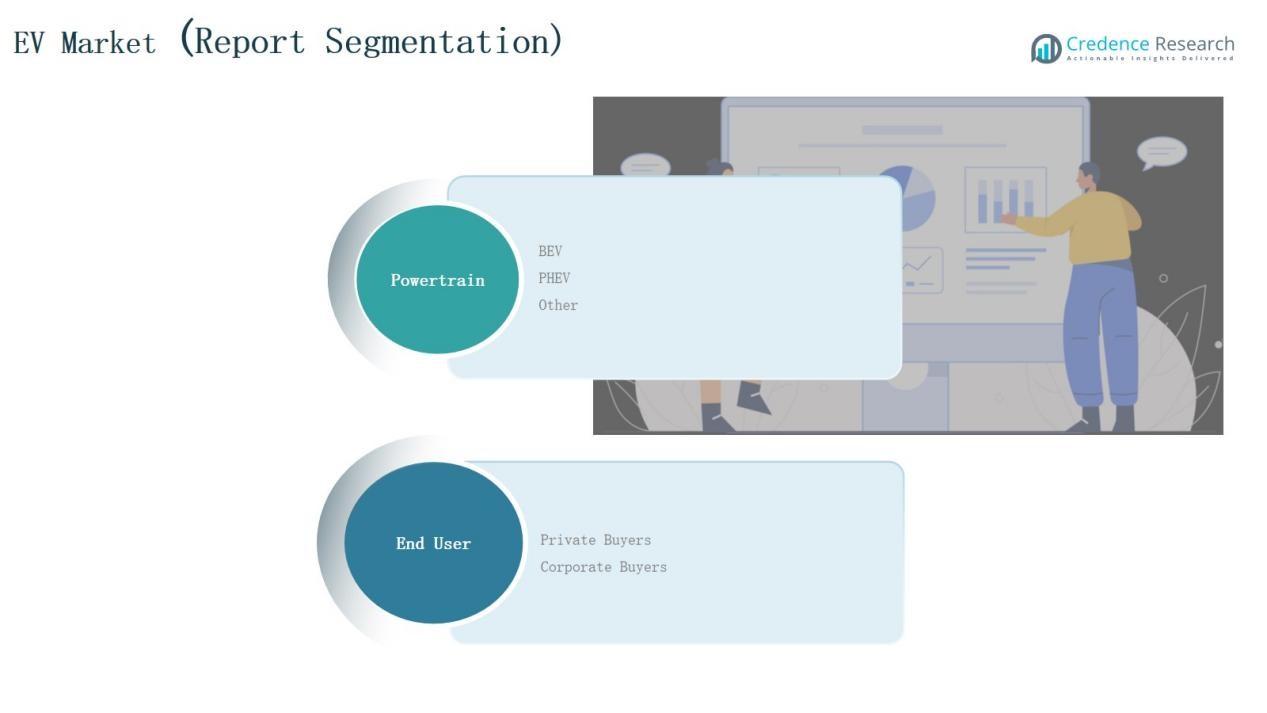
Market Segmentations:
By Powertrain
- BEV (Battery Electric Vehicles)
- PHEV (Plug-in Hybrid Electric Vehicles)
- Other (e.g. Hybrid, Fuel Cell, etc.)
By End User
- Private Buyers
- Corporate Buyers
By Region
- Northern
- Central
- Southern
- Stockholm
Competitive Landscape
The competitive landscape of the Sweden EV Market is shaped by a mix of global automakers and regional players competing to capture rising demand. Leading companies such as Volkswagen, BMW, Mercedes-Benz, Tesla, Volvo, Audi, Skoda, Nissan, and Geely Holding drive growth through expanded EV portfolios and aggressive investments in technology. Tesla dominates the premium BEV segment with its strong brand appeal and advanced charging ecosystem, while Volkswagen and Volvo leverage government incentives and broad product offerings to strengthen mass-market presence. German brands, including BMW and Mercedes-Benz, emphasize performance and innovation, targeting both private and corporate buyers. Nissan and Geely cater to affordability and practical usage, widening access for middle-income households. Competitive intensity increases as firms prioritize battery efficiency, range extension, and digital connectivity features to attract buyers. Partnerships with charging infrastructure providers and fleet electrification initiatives also form key strategies. It is a highly dynamic market where innovation, affordability, and sustainability determine success.
Shape Your Report to Specific Countries or Regions & Enjoy 30% Off!
Key Players
- Volkswagen
- BMW AG
- Mercedes-Benz
- Tesla
- Volvo
- Audi
- Skoda
- Nissan Motor Co., Ltd.
- Geely Holding
- Other
Recent Developments
- On July 3, 2025, Polestar announced that it will produce its upcoming Polestar 7 SUV at a Volvo Cars factory in Slovakia under a memorandum of understanding. This shift aims to reduce exposure to tariffs and strengthen production outside China.
- In early 2025, Volvo revealed plans to introduce five new models: including two new EVs (one being the ES90 electric sedan), two refreshed existing models, and a new long-range PHEV—expanding its portfolio toward full electrification.
- In August 2025, Lyten entered a binding agreement to acquire all of Northvolt’s remaining assets in Sweden and Germany, including the Northvolt Ett facility, Northvolt Labs, and related intellectual property.
Report Coverage
The research report offers an in-depth analysis based on Powertrain, End User and Region. It details leading market players, providing an overview of their business, product offerings, investments, revenue streams, and key applications. Additionally, the report includes insights into the competitive environment, SWOT analysis, current market trends, as well as the primary drivers and constraints. Furthermore, it discusses various factors that have driven market expansion in recent years. The report also explores market dynamics, regulatory scenarios, and technological advancements that are shaping the industry. It assesses the impact of external factors and global economic changes on market growth. Lastly, it provides strategic recommendations for new entrants and established companies to navigate the complexities of the market.
Future Outlook
- Battery electric vehicles will continue to lead the Sweden EV Market with rising adoption.
- Plug-in hybrids will remain relevant, supported by buyers seeking flexibility in usage.
- Charging infrastructure expansion will accelerate, covering both urban and rural regions.
- Corporate fleet electrification will gain momentum through tax benefits and sustainability goals.
- Renewable energy integration into charging networks will strengthen environmental benefits.
- Government incentives will sustain market growth by reducing purchase and ownership costs.
- Advances in battery technology will improve driving range and reduce charging time.
- Consumer awareness of sustainable mobility will push demand for affordable EV models.
- Competition among global and domestic automakers will intensify with new product launches.
- Digital features such as smart charging and connectivity will enhance buyer experience.



