Market Overview:
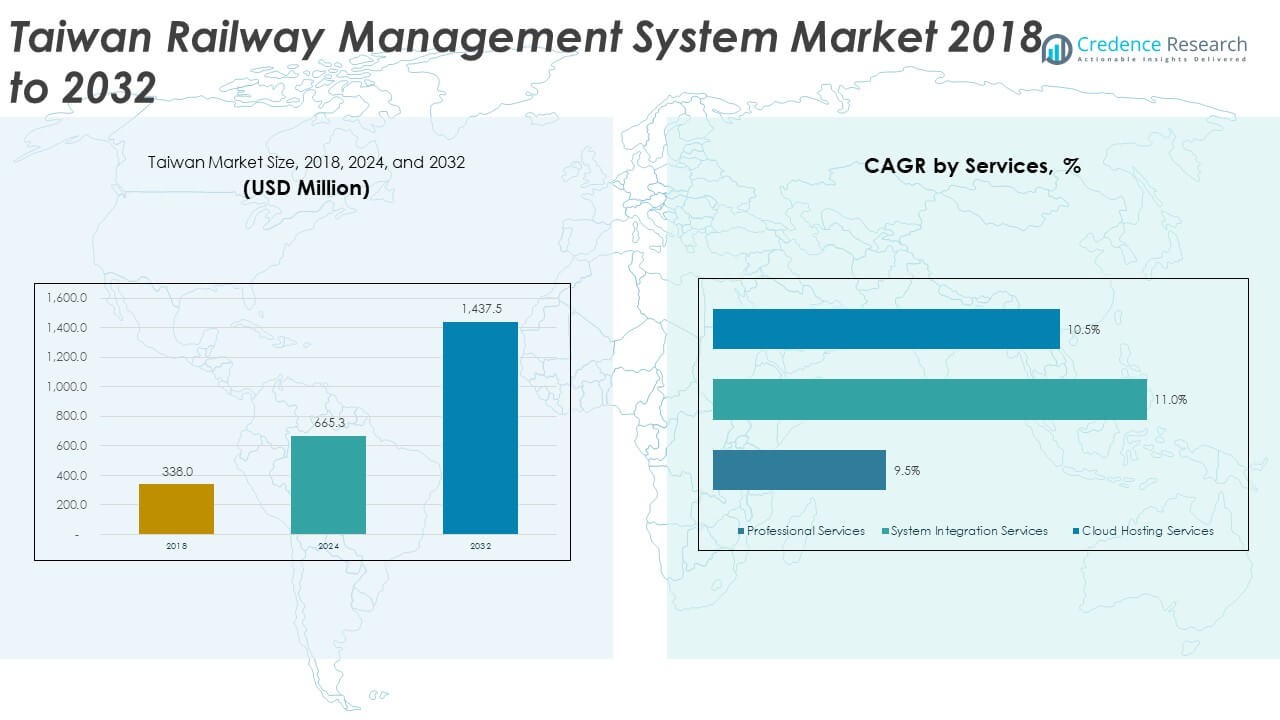
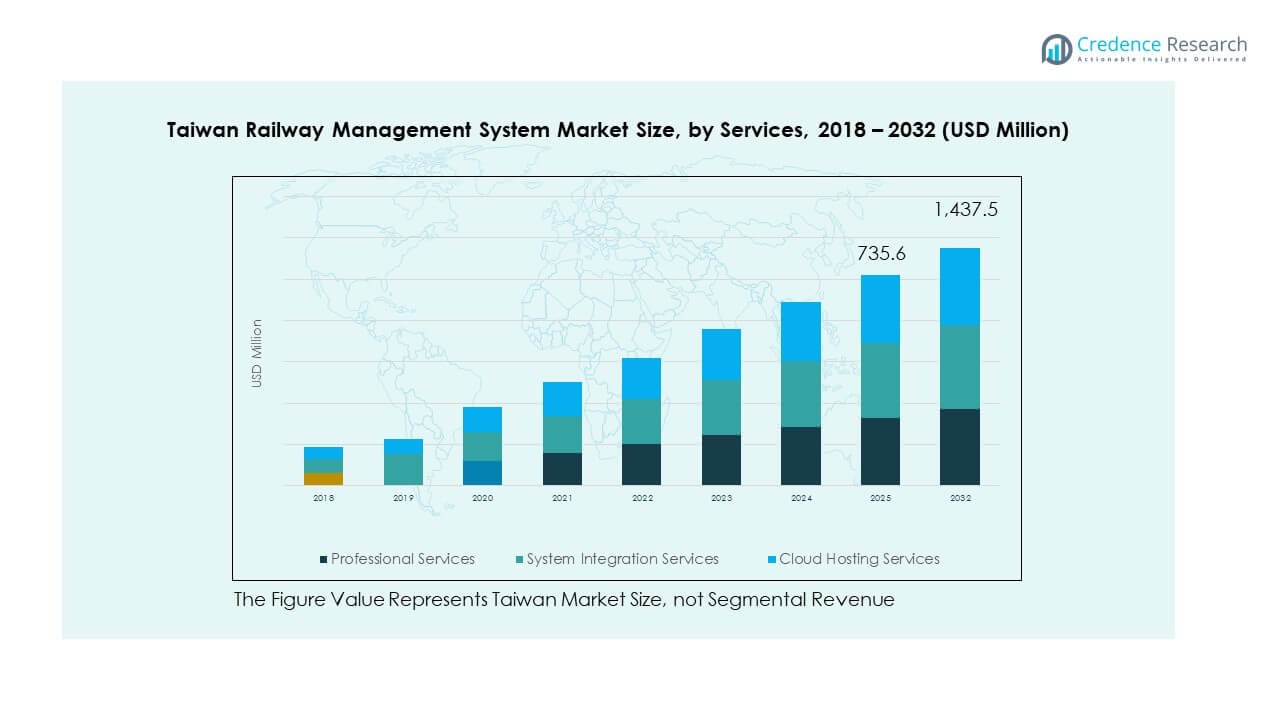
The Taiwan Railway Management System Market size was valued at USD 338.0 million in 2018 to USD 665.3 million in 2024 and is anticipated to reach USD 1,437.5 million by 2032, at a CAGR of 10.11% during the forecast period.
| REPORT ATTRIBUTE |
DETAILS |
| Historical Period |
2020-2023 |
| Base Year |
2024 |
| Forecast Period |
2025-2032 |
| Taiwan Railway Management System Market Size 2024 |
USD 665.3 Million |
| Taiwan Railway Management System Market, CAGR |
10.11% |
| Taiwan Railway Management System Market Size 2032 |
USD 1,437.5 Million |
Market growth is fueled by government investments in modernizing railway infrastructure and expanding digital platforms. Rising passenger traffic increases demand for advanced traffic control, signaling, and predictive maintenance systems. The push toward smart mobility and sustainability aligns with Taiwan’s broader vision for efficient urban transportation. Integration of automated scheduling, real-time ticketing, and asset management solutions is reshaping operational efficiency. It also highlights the growing importance of safety, reliability, and energy efficiency in railway operations.
Regionally, Northern Taiwan leads due to Taipei’s dense commuter population and ongoing urban rail expansion. The area benefits from strong government support and integration with smart city initiatives. Central Taiwan is emerging as an important hub, supported by industrial connectivity and logistics development. Southern Taiwan plays a strategic role, with Kaohsiung’s port-driven demand strengthening freight and passenger rail requirements. It demonstrates how different subregions contribute uniquely, reflecting a balanced yet diverse market expansion across Taiwan.
Access crucial information at unmatched prices!
Request your sample report today & start making informed decisions powered by Credence Research Inc.!
Download Sample
Market Insights
- The Taiwan Railway Management System Market size was USD 338.0 million in 2018, reached USD 665.3 million in 2024, and is projected to hit USD 1,437.5 million by 2032, growing at a CAGR of 10.11%.
- Northern Taiwan holds 46% share, driven by Taipei’s dense commuter base and metro expansions, while Central Taiwan captures 29% through industrial connectivity, and Southern Taiwan accounts for 25% supported by port-linked logistics.
- Central Taiwan emerges as the fastest-growing region with 29% share, led by industrial integration, rising infrastructure demand, and emphasis on traffic management and asset optimization.
- Service segments show balanced growth, with professional services and system integration services together accounting for 68% share, reflecting demand for consulting and digital integration.
- Cloud hosting services contribute 32% share, expanding quickly due to adoption of real-time monitoring, data management, and predictive analytics across rail systems.
Market Drivers
Government Investments in Modern Railway Infrastructure
The Taiwan Railway Management System Market is strongly driven by government-led investments in modern infrastructure. Authorities are prioritizing advanced signaling systems, centralized traffic control, and smart mobility integration. These initiatives support improved safety, faster response to disruptions, and increased operational efficiency. Digital platforms for scheduling and ticketing are receiving significant funding, creating new opportunities for technology adoption. Investments in automation and predictive maintenance solutions are reshaping daily railway operations. The government’s long-term vision for smart cities aligns with these upgrades. It also ensures greater synergy between rail and urban transportation systems. This focus continues to create stable growth momentum for the sector.
- For instance, Siemens Mobility was awarded a contract in June 2021 by the Taiwan Railways Administration to install electronic interlocking signaling systems at 68 stations, covering 450 km out of the island’s 1,110 km total railway network, under the “Taiwan Railway Smart Electrical Systems Upgrade and Signalling Interlocking System Update Project”.
Rising Passenger Demand and Urbanization Trends
Rapid urbanization and increasing mobility needs are fueling expansion in the Taiwan Railway Management System Market. The growing population in cities has intensified demand for reliable and safe public transport. Advanced management systems are critical to handling larger passenger volumes. Real-time monitoring and dynamic scheduling help minimize congestion during peak hours. Rising demand for seamless commuting experiences drives innovation in customer service platforms. Mobile-based ticketing and integrated payment solutions are being widely deployed. Taiwan’s high reliance on rail as a daily transport mode further strengthens adoption. It highlights the importance of efficient management systems to meet urban mobility challenges.
Adoption of Digital and Smart Technologies
Digital transformation is another key driver reshaping the Taiwan Railway Management System Market. Operators are implementing IoT sensors, AI-driven analytics, and cloud platforms to enhance performance. These solutions deliver predictive insights for maintenance and reduce unexpected downtime. Cybersecurity solutions are also gaining prominence with growing digital integration. Automation in scheduling and train control improves punctuality and safety standards. Digital ticketing systems ensure faster and secure passenger transactions. Operators view smart technologies as essential tools for optimizing resources. It has created a more connected, efficient, and reliable railway ecosystem.
- For instance, as part of the signaling upgrade contract, Siemens Mobility is providing the OMNES predictive maintenance solution a digital services platform that enables predictive insights for railway signaling maintenance, supporting digital transformation in Taiwan’s railway operations.
Focus on Safety, Energy Efficiency, and Sustainability
Growing concerns over passenger safety and environmental sustainability drive strong system upgrades. Safety regulations are prompting adoption of advanced surveillance and signaling frameworks. Automated emergency response systems are improving overall risk management. Taiwan is also advancing energy-efficient rail operations to reduce emissions. Modern management systems track energy consumption and optimize train performance. Sustainability goals align closely with these innovations. The Taiwan Railway Management System Market is positioned as a solution that supports both safety and sustainability objectives. It underpins a shift toward greener and more resilient transport infrastructure.
Market Trends
Integration of Smart Ticketing and Passenger Experience Solutions
The Taiwan Railway Management System Market is witnessing strong adoption of smart ticketing technologies. Mobile-based ticketing platforms and contactless payment solutions are being widely rolled out. These innovations reduce waiting times and enhance passenger convenience. Personalized travel services supported by data analytics are gaining traction. Operators are leveraging real-time data to improve customer engagement. AI-powered chatbots and self-service kiosks are redefining the passenger journey. Seamless digital platforms are also helping reduce operational costs. It highlights a trend toward digital-first solutions enhancing overall travel experience.
Expansion of Predictive Maintenance and Asset Management
Predictive maintenance is becoming central to operational strategies in the Taiwan Railway Management System Market. IoT-enabled monitoring devices are being deployed across trains and track infrastructure. These solutions enable real-time condition monitoring of critical assets. Data-driven insights help operators anticipate failures before they occur. This approach minimizes disruptions and improves service reliability. Asset management platforms now play a key role in life-cycle planning. Operators are achieving cost savings while ensuring safety compliance. It reflects a growing focus on preventive approaches over reactive maintenance.
- For instance, in 2023, THSRC completed 1,800 sets of turnout inspections and 8,241 km of routine track inspections and irregularity checks, using digital records and scheduling for asset lifecycle planning and safety enhancement.
Integration with Smart City and Mobility Ecosystems
Railway systems are increasingly linked with Taiwan’s broader smart city initiatives. The Taiwan Railway Management System Market benefits from integration with urban mobility platforms. This ensures smoother connectivity between trains, buses, and other transport modes. Smart data hubs allow seamless sharing of travel information across networks. Integrated systems promote multimodal ticketing and unified payment solutions. Urban planners see rail as the backbone of sustainable mobility. Such integration enhances efficiency and reduces city congestion. It creates a future-ready ecosystem that aligns rail with evolving urban demands.
- For instance, THSRC has enabled the T-EX mobile app to connect directly with smart watches for barcode station entry and partnered with over 10,000 convenience stores to offer unified ticket pickup and payment. This ensures travelers can switch seamlessly between digital, physical, and multimodal interfaces all cited in the company’s 2023 Sustainability Report.
Adoption of Advanced Automation and AI Systems
Automation and AI are transforming core operations within the Taiwan Railway Management System Market. AI-based traffic management systems optimize train scheduling and routing. Machine learning algorithms are enhancing energy use optimization. Autonomous monitoring tools ensure better compliance with safety protocols. Automation reduces reliance on manual processes and increases precision. Control centers powered by AI can adapt quickly to operational challenges. These innovations improve both service quality and cost efficiency. It reflects a steady move toward intelligent, automated rail management solutions.
Market Challenges Analysis
High Implementation Costs and Complex Integration Requirements
The Taiwan Railway Management System Market faces challenges due to high implementation costs. Upgrading to modern digital and automated systems requires significant capital. Smaller operators struggle to manage such financial burdens. Integration of new technologies with legacy rail infrastructure is complex. System compatibility and staff training add further pressure. The high initial investment slows the pace of adoption. Taiwan’s need for nationwide coverage magnifies the challenge. It places financial strain on operators seeking modernization while maintaining existing operations.
Cybersecurity Risks and Data Management Complexities
The shift toward digital platforms introduces growing cybersecurity concerns. The Taiwan Railway Management System Market now relies heavily on connected systems. Any breach could disrupt services and compromise passenger safety. Managing vast volumes of operational and passenger data poses challenges. Operators need robust frameworks for secure storage and compliance. Rising cyberattacks highlight the need for strong protective measures. Effective incident response mechanisms are essential but require skilled resources. It reflects an ongoing challenge in balancing innovation with system security.
Market Opportunities
Expansion of Smart Rail and Digital Platforms
The Taiwan Railway Management System Market holds strong opportunities in smart rail adoption. Expanding digital platforms for real-time ticketing and travel information will attract more passengers. Integration with smart city ecosystems enhances urban mobility efficiency. Advanced monitoring tools can support predictive maintenance expansion. Operators can leverage big data for optimizing passenger flow. Smart digital interfaces boost both convenience and operational efficiency. It is expected to strengthen Taiwan’s leadership in regional rail modernization.
Sustainability and Green Transport Initiatives
Sustainability goals are opening fresh opportunities for advanced rail management solutions. Taiwan is committed to building eco-friendly, low-emission transport networks. Management systems that optimize energy use align with this vision. Operators can adopt AI-powered energy monitoring to lower emissions. Public demand for sustainable travel strengthens adoption of green solutions. Global partnerships can support development of environmentally focused technologies. The Taiwan Railway Management System Market is well-positioned to benefit from this shift. It encourages innovation while addressing climate and environmental priorities.
Market Segmentation Analysis
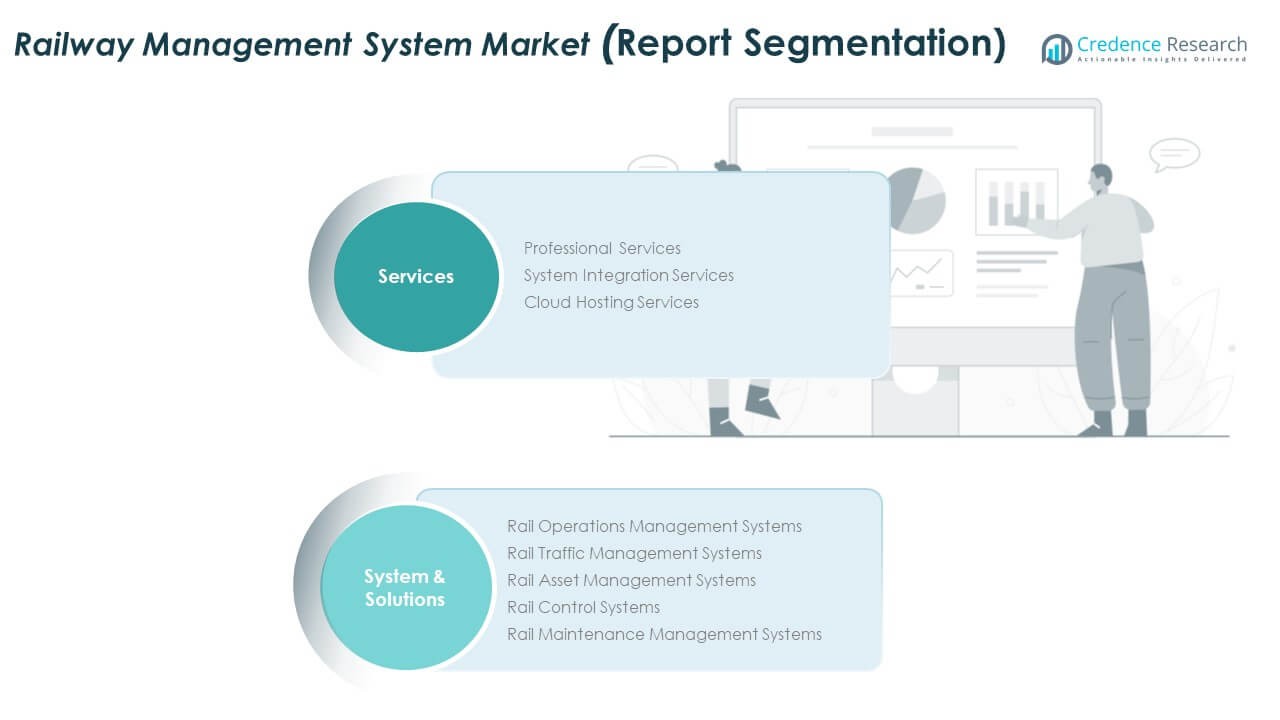
The Taiwan Railway Management System Market is segmented
By services
Into professional services, system integration services, and cloud hosting services. Professional services provide consulting and technical expertise to optimize deployment. System integration services play a vital role in linking legacy infrastructure with advanced digital platforms, ensuring operational continuity. Cloud hosting services are expanding with the growing demand for real-time data management and remote monitoring capabilities. Each service segment supports modernization goals, reflecting the market’s shift toward technology-driven operations. It highlights how diversified service offerings cater to both passenger-focused and operational efficiency needs.
- For instance, MiTAC’s 5G-based Maintenance and Train Performance Management System (MTPMS) accelerated delivery of driver alerts by up to 98% and enabled wireless transfer of schedule and log data at the Taiwan Railway Hsinchu Locomotive Depot, boosting data integrity and operator productivity.
By system and solution
The Taiwan Railway Management System Market is categorized into rail operations management systems, rail traffic management systems, rail asset management systems, rail control systems, and rail maintenance management systems. Rail traffic management systems dominate due to their critical role in scheduling, signaling, and safety assurance. Rail operations management systems enhance efficiency in daily functioning, while asset management systems strengthen lifecycle planning of fleets and infrastructure. Rail control systems improve safety compliance, and maintenance management systems focus on predictive and preventive maintenance strategies. It underscores the importance of integrated solutions in driving reliability, safety, and sustainability across Taiwan’s railway sector.
- For example, the AI-powered MiTAC/Intel platform provides real-time monitoring, predictive risk analysis, and immediate actionable alerts to train drivers and control centers, with eight train system anomalies predicted ahead of failures in just one quarter of 2022.
Segmentation
By Services Segment
- Professional Services
- System Integration Services
- Cloud Hosting Services
By System & Solution Segment
- Rail Operations Management Systems
- Rail Traffic Management Systems
- Rail Asset Management Systems
- Rail Control Systems
- Rail Maintenance Management Systems
Regional Analysis
Northern Taiwan: Urban Rail Modernization and Passenger Volume
Northern Taiwan holds a 46% share of the Taiwan Railway Management System Market, supported by Taipei’s extensive urban rail network and high commuter volumes. Strong investments in metro expansions and digital ticketing systems are driving growth. The region benefits from integration of rail with smart city projects, strengthening operational efficiency. Government funding has prioritized modernization to manage rising passenger density. Adoption of predictive maintenance and automated control systems further enhances reliability. Private partnerships also play a role in technology deployment. It highlights Northern Taiwan as the leading hub of innovation in rail management.
Central Taiwan: Industrial Connectivity and Infrastructure Expansion
Central Taiwan accounts for 29% of the Taiwan Railway Management System Market, driven by industrial logistics and passenger connectivity needs. Taichung serves as the focal point for rail upgrades and traffic management systems. Infrastructure expansion supports both passenger mobility and goods transport between urban and industrial hubs. Investment in asset management systems ensures efficient fleet utilization. The region is focusing on safety enhancements through surveillance and automated control platforms. Integration with manufacturing and industrial supply chains increases system demand. It positions Central Taiwan as a fast-growing segment of the national market.
Southern Taiwan: Port Connectivity and Regional Development
Southern Taiwan represents a 25% share of the Taiwan Railway Management System Market, supported by Kaohsiung’s role as a logistics and port hub. The region emphasizes rail connectivity for cargo movement and commuter transport. Investments target traffic management and rail control systems to handle rising demand. Green transport initiatives promote energy-efficient operations across southern rail corridors. Passenger service upgrades focus on digital platforms and real-time scheduling tools. Integration with international trade routes enhances the relevance of management solutions. It reflects Southern Taiwan’s strategic role in balancing freight and passenger requirements.
Shape Your Report to Specific Countries or Regions & Enjoy 30% Off!
Key Player Analysis
- ORing Industrial Networking Corp
- Toshiba
- Alstom
- Hitachi Ltd.
- Siemens AG
- Konten Networks Inc
- Pilz South East Asia Pte. Ltd
- Motorola Solutions
- Indra Sistemas
- Other Key Players
Competitive Analysis
The Taiwan Railway Management System Market is characterized by strong competition between global leaders and local innovators. Companies such as Toshiba, Alstom, Hitachi Ltd., and Siemens AG bring advanced digital platforms, automation tools, and predictive maintenance solutions. Local firms, including ORing Industrial Networking Corp and Konten Networks Inc, strengthen the ecosystem with tailored offerings aligned to Taiwan’s operational needs. Regional players like Pilz South East Asia and Motorola Solutions add value in control systems and communication technologies. Indra Sistemas contributes with traffic management expertise, further diversifying the competitive landscape. Each player emphasizes partnerships, smart city integration, and system upgrades to strengthen positioning. It demonstrates a balance between international innovation and localized adaptation that sustains competitive intensity.
Recent Developments
- In August 2024, Taiwan’s Alishan Forest Railway fully resumed operations after a 15-year gap, marking a significant development in the region’s railway management system market. This reopening was accompanied by the launch of two new tourist charter trains, which enhances the system’s operational capacity and supports Taiwan’s tourism strategy by integrating modern rail management practices within the revived line.
Report Coverage
The research report offers an in-depth analysis based on Services and System & Solution. It details leading market players, providing an overview of their business, product offerings, investments, revenue streams, and key applications. Additionally, the report includes insights into the competitive environment, SWOT analysis, current market trends, as well as the primary drivers and constraints. Furthermore, it discusses various factors that have driven market expansion in recent years. The report also explores market dynamics, regulatory scenarios, and technological advancements that are shaping the industry. It assesses the impact of external factors and global economic changes on market growth. Lastly, it provides strategic recommendations for new entrants and established companies to navigate the complexities of the market.
Future Outlook
- The Taiwan Railway Management System Market will expand with stronger integration of digital ticketing and passenger platforms.
- Growing emphasis on predictive maintenance will reduce disruptions and strengthen asset life cycles.
- AI-driven traffic management will improve train scheduling efficiency and optimize operational performance.
- Smart city initiatives will deepen alignment between rail systems and multimodal transport networks.
- Green transport policies will push operators to adopt energy-efficient management solutions.
- Local players will continue to collaborate with global firms for advanced system deployment.
- Demand for cloud-hosted platforms will increase due to the need for real-time analytics.
- Safety-focused innovations will drive investment in surveillance, signaling, and control systems.
- Logistics and port connectivity will fuel system demand in southern corridors.
- Strong government funding will sustain modernization efforts, reinforcing the market’s growth trajectory.



