Home » Automotive & Transportation » Automotive Windshield Market

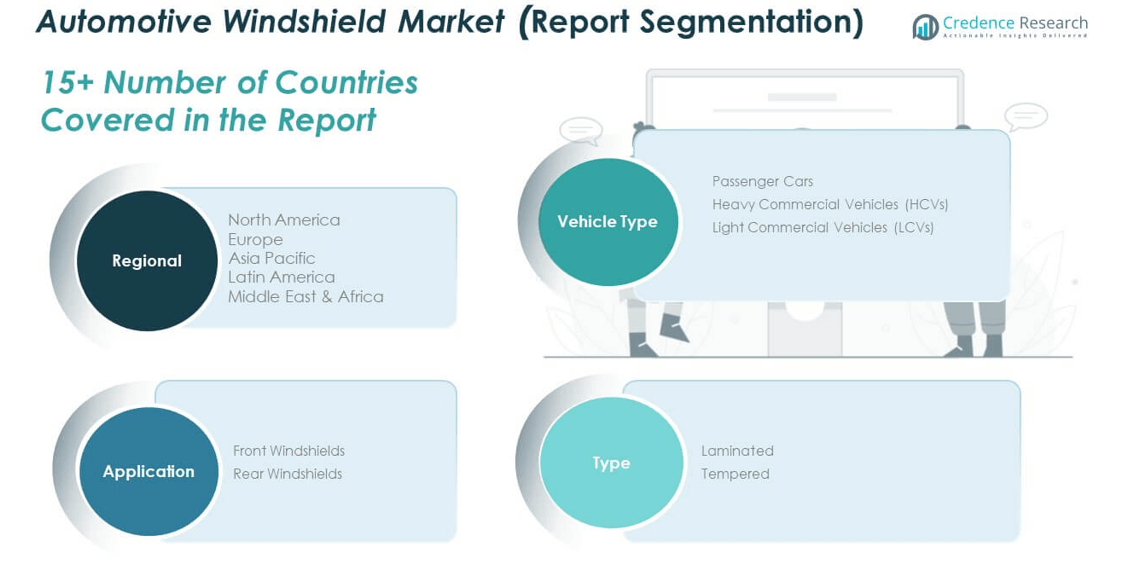
Automotive Windshield Market By Vehicle Type (Passenger Cars, Heavy Commercial Vehicles (HCVs), Light Commercial Vehicles (LCVs)); By Application (Front Windshields, Rear Windshields); By Type (Laminated, Tempered); By Region – Growth, Share, Opportunities & Competitive Analysis, 2024 – 2032

Report ID: 1553 | Report Format : Excel, PDF

Market Overview:

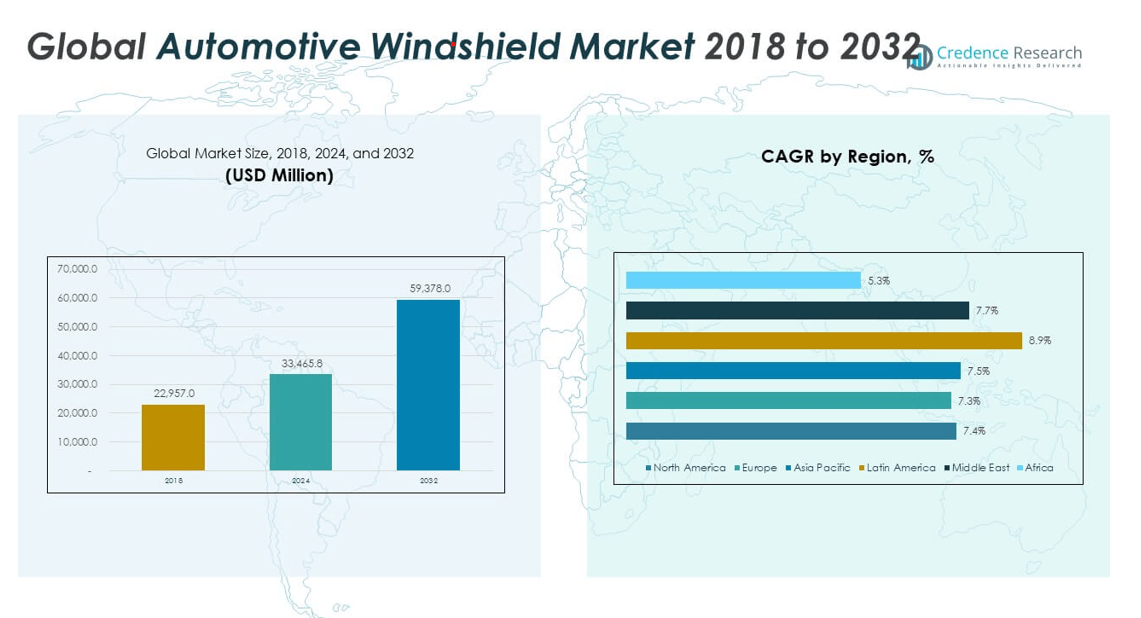
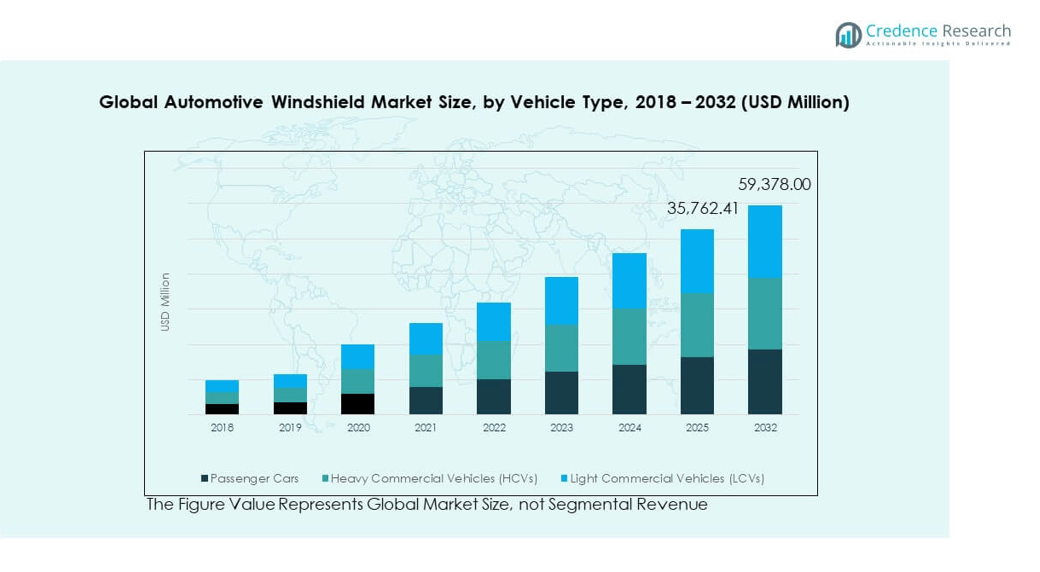
The Global Automotive Windshield Market size was valued at USD 22,957.0 million in 2018 to USD 33,465.8 million in 2024 and is anticipated to reach USD 59,378.0 million by 2032, at a CAGR of 7.51% during the forecast period.

REPORT ATTRIBUTE DETAILS
Historical Period 2020-2023
Base Year 2024
Forecast Period 2025-2032
Automotive Windshield Market Size 2024 USD 33,465.8 million
Automotive Windshield Market, CAGR 7.51%
Automotive Windshield Market Size 2032 USD 59,378.0 million


The market is driven by rising vehicle production, growing demand for safety features, and adoption of advanced glazing technologies. Increasing use of laminated and tempered glass to enhance occupant protection and visibility supports market expansion. The integration of smart windshields with sensors, head-up displays, and rain detection systems is also fueling demand among OEMs. Environmental regulations promoting lightweight and energy-efficient vehicles further strengthen the adoption of innovative windshield materials.

Asia-Pacific dominates the market due to its strong automotive manufacturing base and expanding consumer demand. North America and Europe follow, supported by high technology adoption and strong safety regulations. Emerging economies in Latin America and the Middle East are experiencing growing demand for passenger and commercial vehicles, driving aftermarket and OEM sales. The presence of major automotive suppliers and rising investments in smart mobility accelerate regional market growth.

Automotive Windshield Market size

Market Insights:

  • The Global Automotive Windshield Market was valued at USD 22,957.0 million in 2018, reached USD 33,465.8 million in 2024, and is expected to attain USD 59,378.0 million by 2032, growing at a CAGR of 7.51%.
  • Asia Pacific leads with 34% of the global share due to its strong automotive manufacturing base, technological progress, and rapid adoption of electric and connected vehicles.
  • Europe follows with 28%, supported by its advanced automotive ecosystem and high integration of smart and safety glass technologies, while North America holds 23%, driven by luxury vehicle demand and strong OEM presence.
  • Latin America is the fastest-growing region, holding 8% share, with expansion driven by urbanization, replacement demand, and growing production capacity in Brazil and Mexico.
  • Passenger cars account for about 60% of total demand, reflecting high production and safety adoption, while light commercial vehicles represent around 25%, supported by logistics and e-commerce growth.

Access crucial information at unmatched prices!

Request your sample report today & start making informed decisions powered by Credence Research Inc.!

Download Sample

Market Drivers:

Rising Vehicle Production and Demand for Enhanced Safety Standards

The Global Automotive Windshield Market is driven by growing vehicle production across passenger and commercial segments. Automakers are increasingly integrating advanced safety features, which has elevated demand for laminated and tempered glass windshields. Rising consumer awareness of occupant safety and visibility improvements also boosts adoption. Government regulations mandating safety glass usage strengthen the market outlook. Automakers focus on producing lightweight, impact-resistant, and energy-efficient windshields to meet evolving standards. The development of noise-reducing and glare-resistant designs further enhances driving comfort. Growing disposable income in developing economies contributes to higher vehicle sales, sustaining windshield demand.

  • For instance, AGC Automotive’s “Lamisafe” laminated windshields have achieved impact resistance that meets ECE R43 and FMVSS 208 certifications, with intrusion resistance measured at over 10 minutes during simulated break-in attempts and acoustic dampening reduction of external noise by up to 35 decibels in actual highway conditions.

Adoption of Smart and Connected Windshield Technologies

Integration of smart technologies in vehicles is significantly influencing windshield design and functionality. Manufacturers are developing windshields equipped with sensors, cameras, and head-up displays to enhance situational awareness. Smart windshields support driver-assistance features like lane-departure warning and collision detection, improving safety performance. Increasing use of augmented reality displays and connectivity features elevates driving experience. Demand for such advanced systems is rising among luxury and premium vehicles, pushing innovation across the supply chain. OEMs are collaborating with tech providers to produce cost-effective smart glass solutions. It encourages large-scale adoption across mid-range and electric vehicle models.

  • For instance, NSG Group was selected by Mercedes-Benz in 2024 to supply augmented reality head-up display windshields for the S-Class; these deliver high display image quality using advanced press bending technology and include solar reflecting coatings for de-icing, all verified and launched as standard in new S-Class models.

Growing Electric Vehicle Adoption and Sustainability Focus

Rising electric vehicle (EV) production is creating new opportunities for windshield manufacturers. EVs require aerodynamically optimized and thermally efficient glass to improve energy efficiency. The trend toward lightweight materials supports the use of advanced laminated and coated glass. Sustainable production processes and recyclable glass options align with global environmental goals. Increasing consumer preference for EVs drives investment in specialized glass manufacturing for energy retention and solar control. Governments promoting green mobility accelerate adoption across key markets. Continuous R&D in solar-reflective coatings and acoustic insulation adds value to EV-specific windshield systems.

Increasing Aftermarket Demand and Replacement Rates

The expanding vehicle fleet and growing focus on vehicle maintenance support the replacement windshield market. Rising cases of damage due to road debris, accidents, and temperature fluctuations boost replacement needs. Insurance coverage and service contracts are making repairs and replacements more accessible. The aftermarket segment benefits from digital service networks offering quick installation and calibration. Consumers prefer OEM-quality replacements to maintain performance and compliance with safety standards. Technological improvements, including automated windshield calibration systems, enhance service efficiency. Expanding e-commerce platforms and service centers also drive availability and accessibility across regions.

Market Trends:

Advancement in Head-Up Display (HUD) and Augmented Reality Windshields

The integration of head-up display (HUD) and augmented reality features is transforming the Global Automotive Windshield Market. These technologies project navigation, speed, and hazard alerts directly on the glass, improving driver awareness. Luxury and high-end vehicles have led this adoption, while mid-range segments are following through modular solutions. The use of AR windshields is growing due to demand for connected and intuitive driving experiences. Automakers collaborate with electronics and software firms to enhance display accuracy and clarity. Optical coatings and anti-reflective materials are improving projection visibility under varied light conditions. It is reshaping how drivers interact with vehicle information.

  • For instance, BMW launched its Panoramic Vision system for 2025 Neue Klasse models, projecting critical information onto the full-width windshield with high-definition display capabilities, recognized for consistent driver visibility and seamless integration into the vehicle’s line of sight, verified during the system’s CES 2025 world premiere.

Increased Use of Acoustic and Thermal Control Laminated Glass

Laminated glass with acoustic and thermal properties is gaining traction among OEMs and consumers. It minimizes road noise and enhances cabin comfort, especially in premium vehicles. Rising awareness of passenger comfort and energy conservation fuels demand for advanced glazing solutions. Thermal-control coatings reduce heat transmission, improving air conditioning efficiency. The technology also supports vehicle electrification goals by optimizing energy usage. Manufacturers are investing in multi-layer interlayer glass to balance durability and insulation. This trend is shaping material innovation and design strategies for next-generation windshields.

Shift Toward Lightweight and Sustainable Glass Manufacturing

Automakers are emphasizing vehicle weight reduction to improve fuel efficiency and reduce emissions. The windshield segment contributes to this through thinner, stronger glass compositions. Manufacturers are adopting chemical strengthening and advanced lamination techniques to ensure safety. Use of recycled glass materials is also expanding to meet sustainability targets. Regulatory focus on green production practices encourages innovation in energy-efficient processes. Companies are transitioning toward eco-friendly coatings and adhesives that lower environmental impact. The shift aligns with the global trend of sustainable automotive manufacturing.

Expansion of Windshield Integration in Autonomous and ADAS Vehicles

The rise of autonomous and semi-autonomous vehicles is increasing windshield functional complexity. Windshields now serve as structural, sensor, and data interface components in advanced driver-assistance systems (ADAS). Cameras, LiDAR, and sensors are being embedded into windshield structures for better field-of-view performance. Automakers rely on precision glass alignment and optical clarity to enhance sensor accuracy. Growth in ADAS-equipped vehicles boosts the integration of multifunctional glass panels. It drives demand for coatings that prevent signal interference and maintain visibility. This technological shift enhances the role of windshields as core safety and intelligence components.

Automotive Windshield Market share

Market Challenges Analysis:

High Production Costs and Complexity of Advanced Windshield Technologies

The Global Automotive Windshield Market faces cost challenges linked to advanced materials and processing methods. Production of smart, laminated, and coated glass requires expensive raw materials and precise manufacturing equipment. Integration of sensors and display systems increases design complexity and raises production expenses. OEMs struggle to balance innovation with affordability for mass-market vehicles. Supply chain fluctuations in specialty glass and chemical coatings further impact pricing stability. High maintenance and calibration costs also limit replacement affordability. It creates financial constraints for both manufacturers and consumers in emerging markets.

Stringent Safety Regulations and Supply Chain Constraints

Global safety standards demand compliance with rigorous impact resistance, clarity, and durability tests. Achieving these standards requires consistent material quality and testing accuracy, which raises operational costs. Supply chain disruptions caused by raw material shortages and logistics delays affect timely production. Dependence on specific glass suppliers limits flexibility and increases vulnerability during market fluctuations. Shortages of specialty glass components can delay OEM deliveries. Manufacturers must also manage regulatory differences across regions, complicating standardization. These challenges collectively hinder smooth market expansion and innovation speed.

Market Opportunities:

Emergence of Smart Mobility and Connected Vehicle Ecosystems

The Global Automotive Windshield Market benefits from the rise of connected mobility and smart infrastructure. Integration of 5G, V2X communication, and advanced display systems supports development of intelligent windshields. Automakers and tech firms are exploring glass-based interface solutions for real-time data visualization. Growing investment in connected vehicles opens space for sensor-embedded and display-integrated windshields. Partnerships among automakers, glass makers, and electronics companies encourage scalable innovation. It positions the windshield as a key human-machine interaction surface in next-generation vehicles.

Rising Adoption of Electric and Autonomous Vehicles

Expanding EV and autonomous vehicle production creates new applications for advanced windshields. These vehicles demand aerodynamically efficient, energy-optimizing, and sensor-compatible glass designs. Manufacturers can leverage opportunities by developing thermal-insulated and solar-protective glazing. Governments promoting cleaner mobility and EV incentives accelerate adoption across major economies. Innovation in lightweight, transparent conductive coatings further enhances EV range and visibility. These trends open a broad scope for technological advancement and premium product development.

Market Segmentation Analysis:

By Vehicle Type

The Global Automotive Windshield Market is segmented into passenger cars, heavy commercial vehicles (HCVs), and light commercial vehicles (LCVs). Passenger cars hold the dominant share due to high production volumes and growing demand for comfort and safety features. Rising urbanization and disposable income levels drive strong sales across this category. Light commercial vehicles are witnessing steady growth supported by expanding logistics and e-commerce activities. Heavy commercial vehicles contribute through demand for durable and impact-resistant windshields designed for extended operational use. Each vehicle segment focuses on improved visibility, safety, and performance standards.

  • For instance, Fuyao Glass, in partnership with Isuzu, produced windshields for heavy commercial vehicles that withstand debris impacts at velocities exceeding 120 km/h and complete durability tests over 1,000-hour continuous vibration cycles, according to 2025 third-party test results.

By Application

The market is divided into front and rear windshields, with front windshields accounting for the largest share. Their integration with sensors, cameras, and display systems enhances driver safety and vehicle intelligence. Rear windshields are evolving with defogging, heating, and improved visibility features. The rise in connected and electric vehicles strengthens demand across both applications. Manufacturers prioritize aerodynamic design and optical clarity to improve driver experience and vehicle efficiency.

  • For instance, Tesla vehicles are equipped with a standard heated rear windshield, side mirrors, and charge port that activate automatically with the defrost function. According to Tesla’s owner manuals, the rear defroster runs for 15 minutes before automatically shutting off. While the exact defrost time varies with weather conditions, independent winter tests on a snow-covered Model 3 and Model Y showed that the system needed 20–30 minutes to make the cars fully drivable without manual clearing.

By Type

Based on type, the market includes laminated and tempered glass. Laminated glass dominates due to its superior safety and shatter-resistance properties. It prevents fragmentation during impact, improving occupant protection. Tempered glass remains preferred for cost-effective applications and rear installations. Continuous innovation in coatings, UV protection, and lightweight glass formulations supports growth across both segments. It highlights the industry’s focus on safety, durability, and performance enhancement.

Automotive Windshield Market segmentation

Segmentation:

By Vehicle Type

  • Passenger Cars
  • Heavy Commercial Vehicles (HCVs)
  • Light Commercial Vehicles (LCVs)

By Application

  • Front Windshields
  • Rear Windshields

By Type

  • Laminated
  • Tempered

By Region

  • North America
    • U.S.
    • Canada
  • Europe
    • Germany
    • France
    • Italy
    • U.K.
    • Russia
    • Rest of Europe
  • Asia-Pacific
    • India
    • China
    • Japan
    • Rest of Asia-Pacific
  • Latin America
    • Brazil
    • Mexico
    • Rest of Latin America
  • Middle East and Africa
    • GCC Countries
    • South Africa
    • Rest of Middle East and Africa

Regional Analysis:

North America

The North America Global Automotive Windshield Market size was valued at USD 5,307.65 million in 2018 to USD 7,704.31 million in 2024 and is anticipated to reach USD 13,591.62 million by 2032, at a CAGR of 7.4% during the forecast period. North America holds around 23% share of the global market, driven by strong automotive production and high consumer preference for advanced safety technologies. The United States leads due to the presence of key OEMs and adoption of smart glass technologies. It benefits from rising integration of head-up displays and ADAS-enabled windshields in premium vehicles. Canada contributes through demand for replacement windshields and sustainable vehicle models. Mexico supports regional expansion with growing manufacturing capabilities and exports. Regulatory emphasis on road safety and energy efficiency encourages innovation across the supply chain.

Europe

The Europe Global Automotive Windshield Market size was valued at USD 6,607.01 million in 2018 to USD 9,533.93 million in 2024 and is anticipated to reach USD 16,685.22 million by 2032, at a CAGR of 7.3% during the forecast period. Europe accounts for nearly 28% of the total market share, supported by a strong automotive base and technological innovation. Germany, France, and the UK dominate due to luxury vehicle manufacturing and early adoption of smart glass. It benefits from regulations favoring laminated safety glass and low-emission materials. The region’s focus on electric mobility drives demand for lightweight and energy-efficient windshields. Eastern Europe shows steady growth from rising vehicle production and infrastructure investment. High replacement demand in Western Europe reinforces aftermarket growth.

Asia Pacific

The Asia Pacific Global Automotive Windshield Market size was valued at USD 7,858.17 million in 2018 to USD 11,471.13 million in 2024 and is anticipated to reach USD 20,390.41 million by 2032, at a CAGR of 7.5% during the forecast period. Asia Pacific commands the largest market share of about 34%, driven by rapid industrialization and expanding automotive production. China leads the region with strong domestic manufacturing and rising electric vehicle penetration. Japan and South Korea contribute through advanced materials and R&D innovations. India’s growing automotive sector and rising disposable income enhance demand for affordable safety glass. Southeast Asia is emerging as a hub for automotive component manufacturing. It benefits from favorable government policies and international collaborations.

Latin America

The Latin America Global Automotive Windshield Market size was valued at USD 1,455.47 million in 2018 to USD 2,312.49 million in 2024 and is anticipated to reach USD 4,554.29 million by 2032, at a CAGR of 8.9% during the forecast period. Latin America holds an estimated 8% share of the global market, supported by vehicle modernization and aftermarket expansion. Brazil leads production due to its strong automotive infrastructure. Argentina and Mexico contribute through growing assembly plants and imports of advanced glass systems. It benefits from the increasing preference for laminated and solar-control glass in passenger vehicles. The aftermarket sector is expanding through urban growth and replacement demand. Regional economic recovery and improved financing options are strengthening new vehicle sales.

Middle East

The Middle East Global Automotive Windshield Market size was valued at USD 1,095.05 million in 2018 to USD 1,614.96 million in 2024 and is anticipated to reach USD 2,909.52 million by 2032, at a CAGR of 7.7% during the forecast period. The region contributes about 5% of the global market share, led by GCC countries with increasing luxury vehicle imports. It experiences growth through rising urbanization and higher disposable income levels. Demand for UV-protected and heat-resistant windshields is strong due to extreme climatic conditions. The market benefits from the expansion of regional manufacturing capabilities and distribution networks. Strategic partnerships with European and Asian suppliers enhance product availability. Saudi Arabia and the UAE lead demand through premium and commercial vehicle segments.

Africa

The Africa Global Automotive Windshield Market size was valued at USD 633.61 million in 2018 to USD 829.00 million in 2024 and is anticipated to reach USD 1,246.94 million by 2032, at a CAGR of 5.3% during the forecast period. Africa represents nearly 2% share of the global market, supported by increasing vehicle imports and rising urban mobility. South Africa leads with its established automotive industry and growing local production. Egypt and Nigeria are emerging markets with expanding aftermarket demand. It benefits from rising awareness of vehicle safety and durability. Limited manufacturing infrastructure remains a challenge but creates opportunities for investment. Growing partnerships with international OEMs are expected to strengthen supply chains and regional presence.

Shape Your Report to Specific Countries or Regions & Enjoy 30% Off!

Key Player Analysis:

  • Corning
  • AGC Inc.
  • Fuyao Group
  • PPG
  • Dura Automotive
  • Vitro
  • Guardian Glass
  • Saint-Gobain
  • Nippon Glass
  • Asahi Glass

Competitive Analysis:

The Global Automotive Windshield Market is characterized by intense competition among global and regional manufacturers. Leading players focus on innovation, lightweight materials, and smart windshield integration to strengthen market position. Strategic mergers, collaborations, and investments in R&D are expanding product portfolios and geographic reach. It is witnessing high investment in advanced laminated, tempered, and solar-control glass technologies to meet rising safety and efficiency standards. Companies are aligning with OEMs to develop customized solutions for electric and autonomous vehicles. The market remains technology-driven, with firms competing on durability, design precision, and optical clarity.

Recent Developments:

  • In October 2025, Corning expanded its technology collaboration with GlobalFoundries to develop advanced glass-waveguide-based solutions for photonic integrated circuits, furthering its impact on smart and connected automotive applications. Additionally, Corning launched a new generation of Gorilla Glass Ceramic for vehicle applications earlier in 2025, which is positioned to offer enhanced durability and transparency for automotive windshields.
  • In September 2025, Fuyao Glass Industry Group unveiled an innovative front windshield integrating LiDAR and camera sensors. This new product, which debuted in the AITO M7 SUV, is designed to enhance intelligent driving features by improving near-infrared light transmittance and reducing signal attenuation.

Report Coverage:

The research report offers an in-depth analysis based on vehicle type, application, and type segments. It details leading market players, providing an overview of their business, product offerings, investments, revenue streams, and key applications. Additionally, the report includes insights into the competitive environment, SWOT analysis, current market trends, as well as the primary drivers and constraints. Furthermore, it discusses various factors that have driven market expansion in recent years. The report also explores market dynamics, regulatory scenarios, and technological advancements that are shaping the industry. It assesses the impact of external factors and global economic changes on market growth. Lastly, it provides strategic recommendations for new entrants and established companies to navigate the complexities of the market.

Future Outlook:

  • Rising integration of smart and connected windshield technologies across vehicle models.
  • Increasing adoption of laminated and solar-control glass for enhanced safety and efficiency.
  • Expansion of electric and autonomous vehicles boosting demand for specialized windshields.
  • Strong growth in Asia-Pacific supported by large-scale vehicle manufacturing.
  • Aftermarket services gaining traction with digital repair and calibration systems.
  • Advancements in lightweight and sustainable glass manufacturing processes.
  • Strategic partnerships between OEMs and glass producers to enhance innovation.
  • Growing consumer demand for noise reduction and temperature control features.
  • Regulatory support promoting eco-friendly windshield production standards.
  • Continuous R&D investment driving new materials and digital display integration.

CHAPTER NO. 1 :      GENESIS OF THE MARKET           

1.1 Market Prelude – Introduction & Scope

1.2 The Big Picture – Objectives & Vision

1.3 Strategic Edge – Unique Value Proposition

1.4 Stakeholder Compass – Key Beneficiaries

CHAPTER NO. 2 :      EXECUTIVE LENS

2.1 Pulse of the Industry – Market Snapshot

2.2 Growth Arc – Revenue Projections (USD Million)

2.3. Premium Insights – Based on Primary Interviews

CHAPTER NO. 3 :      AUTOMOTIVE WINDSHIELD MARKET FORCES & INDUSTRY PULSE

3.1 Foundations of Change – Market Overview
3.2 Catalysts of Expansion – Key Market Drivers
3.2.1 Momentum Boosters – Growth Triggers
3.2.2 Innovation Fuel – Disruptive Technologies
3.3 Headwinds & Crosswinds – Market Restraints
3.3.1 Regulatory Tides – Compliance Challenges
3.3.2 Economic Frictions – Inflationary Pressures
3.4 Untapped Horizons – Growth Potential & Opportunities
3.5 Strategic Navigation – Industry Frameworks
3.5.1 Market Equilibrium – Porter’s Five Forces
3.5.2 Ecosystem Dynamics – Value Chain Analysis
3.5.3 Macro Forces – PESTEL Breakdown

CHAPTER NO. 4 : KEY INVESTMENT EPICENTER        

4.1 Regional Goldmines – High-Growth Geographies

4.2 Product Frontiers – Lucrative Vehicle Type Categories

4.3 Type Sweet Spots – Emerging Demand Segments

CHAPTER NO. 5: REVENUE TRAJECTORY & WEALTH MAPPING

5.1 Momentum Metrics – Forecast & Growth Curves

5.2 Regional Revenue Footprint – Market Share Insights

5.3 Segmental Wealth Flow – Vehicle Type, Application, and Type Revenue

CHAPTER NO. 6 : TRADE & COMMERCE ANALYSIS    

6.1.      Import Analysis By Region

6.1.1.    Global Automotive Windshield Market Import Revenue By Region

6.2.      Export Analysis By Region

6.2.1.    Global Automotive Windshield Market Export Revenue By Region

CHAPTER NO. 7 :      COMPETITION ANALYSIS 

7.1.      Company Market Share Analysis

7.1.1.    Global Automotive Windshield Market: Company Market Share

7.2.      Global Automotive Windshield Market Company Revenue Market Share

7.3.      Strategic Developments

7.3.1.    Acquisitions & Mergers

7.3.2.    New Product Launch

7.3.3.    Regional Expansion

7.4.      Competitive Dashboard

7.5.      Company Assessment Metrics, 2024

CHAPTER NO. 8 : AUTOMOTIVE WINDSHIELD MARKET – BY VEHICLE TYPE SEGMENT ANALYSIS

8.1.      Automotive Windshield Market Overview By Vehicle Type Segment

8.1.1.    Automotive Windshield Market Revenue Share By Vehicle Type

8.2.       Passenger Cars

8.3.       Heavy Commercial Vehicles (HCVs)

8.4.       Light Commercial Vehicles (LCVs)

CHAPTER NO. 9 : AUTOMOTIVE WINDSHIELD MARKET – BY APPLICATION SEGMENT ANALYSIS

9.1.      Automotive Windshield Market Overview By Application Segment

9.1.1.    Automotive Windshield Market Revenue Share By Application

9.2.      Front Windshields

9.3.      Rear Windshields

CHAPTER NO. 10 : AUTOMOTIVE WINDSHIELD MARKET – BY TYPE SEGMENT ANALYSIS

10.1.     Automotive Windshield Market Overview By Type Segment

10.1.1.  Automotive Windshield Market Revenue Share By Type

10.2.    Laminated

10.3.    Tempered

CHAPTER NO. 11 : AUTOMOTIVE WINDSHIELD MARKET – REGIONAL ANALYSIS

11.1.     Automotive Windshield Market Overview By Region Segment

11.1.1.  Global Automotive Windshield Market Revenue Share By Region

10.1.2.  Regions

11.1.3.  Global Automotive Windshield Market Revenue By Region

11.1.4.  Vehicle Type

11.1.5.  Global Automotive Windshield Market Revenue By Vehicle Type

11.1.6.  Application

11.1.7. Global Automotive Windshield Market Revenue By Application

11.1.8.  Type

11.1.9. Global Automotive Windshield Market Revenue By Type

CHAPTER NO. 12 : NORTH AMERICA AUTOMOTIVE WINDSHIELD MARKET – COUNTRY ANALYSIS

12.1.     North America Automotive Windshield Market Overview By Country Segment

12.1.1.  North America Automotive Windshield Market Revenue Share By Region

12.2.     North America

12.2.1.  North America Automotive Windshield Market Revenue By Country

12.2.2.  Vehicle Type

12.2.3.  North America Automotive Windshield Market Revenue By Vehicle Type

12.2.4.  Application

12.2.5.  North America Automotive Windshield Market Revenue By Application

12.2.6.  Type

12.2.7.  North America Automotive Windshield Market Revenue By Type

12.3.     U.S.

12.4.     Canada

12.5.     Mexico

CHAPTER NO. 13 : EUROPE AUTOMOTIVE WINDSHIELD MARKET – COUNTRY ANALYSIS

13.1.     Europe Automotive Windshield Market Overview By Country Segment

13.1.1.  Europe Automotive Windshield Market Revenue Share By Region

13.2.     Europe

13.2.1.  Europe Automotive Windshield Market Revenue By Country

13.2.2.  Vehicle Type

13.2.3.  Europe Automotive Windshield Market Revenue By Vehicle Type

13.2.4.  Application

13.2.5.  Europe Automotive Windshield Market Revenue By Application

13.2.6.  Type

13.2.7.  Europe Automotive Windshield Market Revenue By Type

13.3.     UK

13.4.     France

13.5.     Germany

13.6.     Italy

13.7.     Spain

13.8.     Russia

13.9.    Rest of Europe

CHAPTER NO. 14 : ASIA PACIFIC AUTOMOTIVE WINDSHIELD MARKET – COUNTRY ANALYSIS

14.1.     Asia Pacific Automotive Windshield Market Overview By Country Segment

14.1.1.  Asia Pacific Automotive Windshield Market Revenue Share By Region

14.2.     Asia Pacific

14.2.1.  Asia Pacific Automotive Windshield Market Revenue By Country

14.2.2.  Vehicle Type

14.2.3.  Asia Pacific Automotive Windshield Market Revenue By Vehicle Type

14.2.4.  Application

14.2.5.  Asia Pacific Automotive Windshield Market Revenue By Application

14.2.6.  Type

14.2.7.  Asia Pacific Automotive Windshield Market Revenue By Type

14.3.     China

14.4.     Japan

14.5.     South Korea

14.6.     India

14.7.     Australia

14.8.     Southeast Asia

14.9.     Rest of Asia Pacific

CHAPTER NO. 15 : LATIN AMERICA AUTOMOTIVE WINDSHIELD MARKET – COUNTRY ANALYSIS

15.1.     Latin America Automotive Windshield Market Overview By Country Segment

15.1.1.  Latin America Automotive Windshield Market Revenue Share By Region

15.2.     Latin America

15.2.1.  Latin America Automotive Windshield Market Revenue By Country

15.2.2.  Vehicle Type

15.2.3.  Latin America Automotive Windshield Market Revenue By Vehicle Type

15.2.4.  Application

15.2.5.  Latin America Automotive Windshield Market Revenue By Application

15.2.6.  Type

15.2.7.  Latin America Automotive Windshield Market Revenue By Type

15.3.     Brazil

15.4.     Argentina

15.5.     Rest of Latin America

CHAPTER NO. 16 : MIDDLE EAST AUTOMOTIVE WINDSHIELD MARKET – COUNTRY ANALYSIS

16.1.     Middle East Automotive Windshield Market Overview By Country Segment

16.1.1.  Middle East Automotive Windshield Market Revenue Share By Region

16.2.     Middle East

16.2.1.  Middle East Automotive Windshield Market Revenue By Country

16.2.2.  Vehicle Type

16.2.3.  Middle East Automotive Windshield Market Revenue By Vehicle Type

16.2.4.  Application

16.2.5.  Middle East Automotive Windshield Market Revenue By Application

16.2.6.  Type

16.2.7.  Middle East Automotive Windshield Market Revenue By Type

16.3.     GCC Countries

16.4.     Israel

16.5.     Turkey

16.6.     Rest of Middle East

CHAPTER NO. 17 : AFRICA AUTOMOTIVE WINDSHIELD MARKET – COUNTRY ANALYSIS

17.1.     Africa Automotive Windshield Market Overview By Country Segment

17.1.1.  Africa Automotive Windshield Market Revenue Share By Region

17.2.     Africa

17.2.1.  Africa Automotive Windshield Market Revenue By Country

17.2.2.  Vehicle Type

17.2.3.  Africa Automotive Windshield Market Revenue By Vehicle Type

17.2.4.  Application

17.2.5.  Africa Automotive Windshield Market Revenue By Application

17.2.6.  Type

17.2.7.  Africa Automotive Windshield Market Revenue By Type

17.3.     South Africa

17.4.     Egypt

17.5.     Rest of Africa

CHAPTER NO. 18 : COMPANY PROFILES

18.1.      Corning

18.1.1.  Company Overview

18.1.2.  Vehicle Type Portfolio

18.1.3.  Financial Overview

18.1.4.  Recent Developments

18.1.5.  Growth Strategy

18.1.6.  SWOT Analysis

18.2.    AGC Inc.

18.3.    Fuyao Group

18.4.    PPG

18.5.    Dura Automotive

18.6.    Vitro

18.7.    Guardian Class

18.8.    Saint-Gobain

18.9.    Nippon Glass

18.10.  Ashi Glass

18.11.  Other Key Players

Request Free Sample

We prioritize the confidentiality and security of your data. Our promise: your information remains private.

Ready to Transform Data into Decisions?

Request Your Sample Report and Start Your Journey of Informed Choices


Providing the strategic compass for industry titans.

cr-clients-logos

Frequently Asked Questions:

What is the current market size for Global Automotive Windshield Market, and what is its projected size in 2032?

The Global Automotive Windshield Market was valued at USD 22,957.0 million in 2018 and USD 33,465.8 million in 2024. It is projected to reach USD 59,378.0 million by 2032, reflecting robust expansion supported by technological advancement and rising vehicle production.

At what Compound Annual Growth Rate is the Global Automotive Windshield Market projected to grow between 2025 and 2032?

The market is projected to grow at a CAGR of 7.51% during the forecast period, driven by growing demand for advanced glazing technologies, vehicle safety, and smart display integration across both passenger and commercial vehicles.

Which Global Automotive Windshield Market segment held the largest share in 2024?

The passenger car segment held the largest share in 2024 due to high production volumes and growing consumer preference for safety and comfort features, supported by continuous OEM innovation and material enhancements.

What are the primary factors fueling the growth of the Global Automotive Windshield Market?

Key factors include rising vehicle production, integration of smart technologies, increasing adoption of laminated glass, and stricter safety regulations that promote advanced materials and innovative design solutions across vehicle categories.

Who are the leading companies in the Global Automotive Windshield Market?

Prominent players include AGC Inc., Saint-Gobain, Fuyao Group, Guardian Glass, Corning, PPG, Vitro, Nippon Glass, and Dura Automotive. These companies focus on R&D, sustainability, and OEM partnerships to strengthen market presence

Who are the major players in this market?

Nippon Sheet Glass, Saint-Gobain, Fuyao Glass, Asahi Glass, Vitro, Xinyi Glass, Dura Automotive, Sisecam Group, Magna International, Guardian Industries and Central Glass among others. are some of the major players in the global market.

About Author

Ganesh Chandwade

Ganesh Chandwade

Senior Industry Consultant

Ganesh is a senior industry consultant specializing in heavy industries and advanced materials.

View Profile

Related Reports

Australia Underground Mining Equipment Market

The Australia Underground Mining Equipment Market size was valued at USD 2,230.50 million in 2018 to USD 2,615.00 million in 2024 and is anticipated to reach USD 4,092.30 million by 2032, at a CAGR of 7.70% during the forecast period

Tire Mold Market

The Tire Mold Market was valued at USD 1,558.64 million in 2024 and is projected to reach USD 1,742.01 million by 2032, registering a CAGR of 1.4% from 2024 to 2032.

Automotive Body-In-White Market

The Automotive Body-in-White Market size was valued at USD 77.4 billion in 2024 and is anticipated to reach USD 92.84 billion by 2032, growing at a CAGR of 2.3% during the forecast period.

Vehicle/Automotive Camshaft Market

The Vehicle Camshaft market was valued at USD 4.61 billion in 2024 and is projected to reach USD 6.76 billion by 2032, expanding at a CAGR of 4.9% during the forecast period.

Magnetic Bearing Market

Magnetic Bearing Market size was valued USD 4.19 billion in 2024 and is anticipated to reach USD 8.91 billion by 2032, at a CAGR of 9.9% during the forecast period.

Automotive LED Headlights Market

The Automotive LED Headlights Market was valued at USD 14.43 billion in 2024 and is projected to reach USD 20.85 billion by 2032, expanding at a CAGR of 4.71% during the forecast period.

Europe Electric Two-Wheeler Market

Europe Electric two wheeler market was valued at USD 843.22 million in 2024 and is anticipated to reach USD 1572.34 million by 2032, growing at a CAGR of 8.1 % during the forecast period.

Automotive Start-Stop System Market

The Automotive Start-Stop System Market size was valued at USD 42.62 billion in 2024 and is anticipated to reach USD 112.5 billion by 2032, growing at a CAGR of 12.9% during the forecast period.

Automotive Selective Catalytic Reduction (SCR) Market

The Automotive Selective Catalytic Reduction (SCR) market reached USD 9.05 billion in 2024 and is projected to grow to USD 12.78 billion by 2032, registering a CAGR of 4.41% during the forecast period.

Automotive Glass Market

The Automotive Glass Market size was valued at USD 36.48 Billion in 2024 and is anticipated to reach USD 51.09 Billion by 2032, at a CAGR of 4.3% during the forecast period.

Automotive Ignition Coil Market

The Automotive Ignition Coil Market was valued at USD 11,338 million in 2024 and is projected to reach USD 16,523.03 million by 2032, expanding at a CAGR of 4.82% during the forecast period.

Automotive Adaptive Cruise Control Market

The Automotive Adaptive Cruise Control Market size was valued at USD 40.31 billion in 2024 and is anticipated to reach USD 80.32 billion by 2032, at a CAGR of 9% during the forecast period.

Licence Option

The report comes as a view-only PDF document, optimized for individual clients. This version is recommended for personal digital use and does not allow printing. Use restricted to one purchaser only.
$4999

To meet the needs of modern corporate teams, our report comes in two formats: a printable PDF and a data-rich Excel sheet. This package is optimized for internal analysis. Unlimited users allowed within one corporate location (e.g., regional office).
$6999

The report will be delivered in printable PDF format along with the report’s data Excel sheet. This license offers 100 Free Analyst hours where the client can utilize Credence Research Inc. research team. Permitted for unlimited global use by all users within the purchasing corporation, such as all employees of a single company.
$12999

Report delivery within 24 to 48 hours

Credence Staff 3

WILLIAM, North America

Support Staff at Credence Research

KEITH PHILLIPS, Europe

Lee - CR Sales Staff

LEE VALLANCE, Asia Pacific

Kieran Jameson

KIERAN JAMESON, Australia

Smallform of Sample request
User Review

Thank you for the data! The numbers are exactly what we asked for and what we need to build our business case.

Materials Scientist
(privacy requested)

User Review

The report was an excellent overview of the Industrial Burners market. This report does a great job of breaking everything down into manageable chunks.

Imre Hof
Management Assistant, Bekaert

cr-clients-logos

Request Sample