Home » Automotive & Transportation » Selective Catalytic Reduction (SCR) Market

Selective Catalytic Reduction System Market By Vehicle Type (Passenger Vehicle, Light Commercial Vehicle, Heavy Commercial Vehicle); By Catalyst Type (Copper Zeolite, Iron Zeolite); By End Use (Automotive, Power Generation, Marine, Chemical & Petrochemical, Cement); By Geography – Growth, Share, Opportunities & Competitive Analysis, 2024 – 2032

Report ID: 19739 | Report Format : Excel, PDF

Market Overview

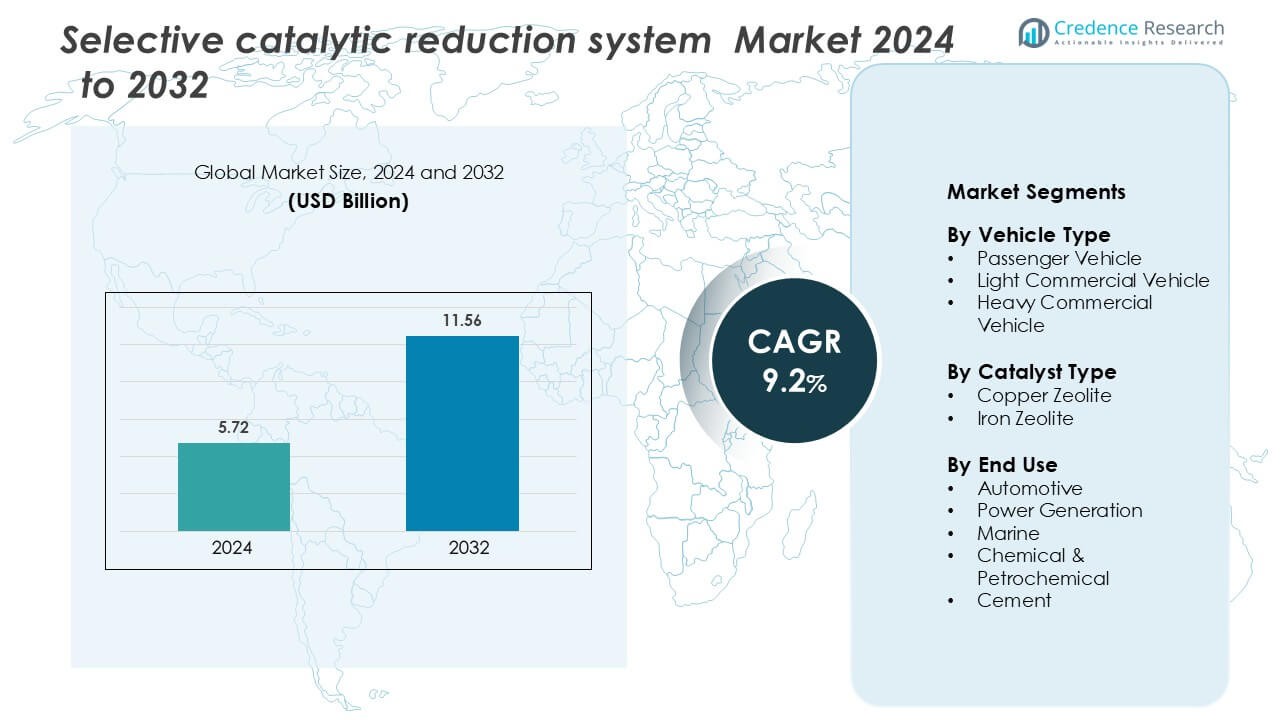
Selective catalytic reduction system market size was valued USD 5.72 billion in 2024 and is anticipated to reach USD 11.56 billion by 2032, at a CAGR of 9.2% during the forecast period.

REPORT ATTRIBUTE DETAILS
Historical Period 2020-2023
Base Year 2024
Forecast Period 2025-2032
Selective Catalytic Reduction (SCR) Market Size 2024 USD 5.72 Billion
Selective Catalytic Reduction (SCR) Market, CAGR 9.2%
Selective Catalytic Reduction (SCR) Market Size 2032 USD 11.56 Billion


The Selective Catalytic Reduction (SCR) System Market is dominated by leading players such as Johnson Matthey (U.K.), BOSCH (Germany), Cormetech (U.S.), Faurecia (France), Haldor Topsoe (Denmark), BASF (Germany), Bosal (Belgium), Envirotherm GmbH (Germany), Magneti Marelli SPA (Italy), and Ceram-Ibiden (Austria). These companies focus on developing high-efficiency catalysts, advanced dosing technologies, and lightweight system architectures to meet global emission standards. They invest heavily in R&D and strategic partnerships with OEMs to strengthen market positioning. Europe leads the global SCR system market with a 31% share, driven by stringent Euro VI regulations, robust automotive manufacturing infrastructure, and continuous innovation in emission control technologies across both passenger and commercial vehicle segments.

Access crucial information at unmatched prices!

Request your sample report today & start making informed decisions powered by Credence Research Inc.!

Download Sample

Market Insights

  • The Selective Catalytic Reduction (SCR) System Market was valued at USD 5.72 billion in 2024 and is projected to reach USD 11.56 billion by 2032, growing at a CAGR of 9.2% during the forecast period.
  • Rising emission regulations and growing adoption of diesel vehicles drive market growth, especially across heavy-duty transportation and industrial sectors.
  • Technological advancements such as compact system design, smart urea dosing, and durable catalysts are shaping market trends.
  • The market is highly competitive, with key players like Johnson Matthey, BOSCH, Faurecia, BASF, and Cormetech investing in R&D and expanding collaborations with OEMs to enhance emission control performance.
  • Europe dominates with a 31% regional share due to strong environmental policies, while Asia-Pacific holds a 33% share driven by expanding automotive production; among segments, heavy commercial vehicles lead adoption, supported by high diesel usage and stricter compliance requirements in logistics and construction industries.

Market Segmentation Analysis:

By Vehicle Type

Heavy commercial vehicles dominate the Selective Catalytic Reduction (SCR) System Market with a major share, driven by stricter emission norms for diesel engines and increased freight transportation. These vehicles rely heavily on SCR technology to meet Euro VI and EPA standards while maintaining fuel efficiency. The demand for advanced NOx reduction systems has surged as logistics and construction sectors expand globally. Passenger and light commercial vehicles are also adopting compact SCR units to comply with regulatory targets, but heavy-duty trucks remain the key revenue contributor due to their higher diesel consumption and emission output.

  • For instance, the Achates Power opposed-piston 10.6 L heavy-duty diesel engine project achieved a 90 % NOₓ reduction using SCR without a close-coupled light-off module.

By Catalyst Type

Copper zeolite catalysts hold the dominant market share in the SCR system segment due to their superior thermal stability and high efficiency in NOx reduction, especially under high-temperature diesel operations. Their enhanced durability and resistance to sulfur poisoning make them ideal for heavy-duty applications in commercial vehicles and industrial machinery. Iron zeolite catalysts, while cost-effective, find wider use in light vehicles and stationary systems operating at lower temperatures. The growing demand for fuel-efficient systems with lower ammonia slip continues to strengthen the adoption of copper-based catalysts across automotive and industrial sectors.

  • For instance, the commercial Cu‑SSZ‑13 catalyst achieved over 90% NOₓ conversion at 300 °C under simulated diesel exhaust conditions.

By End Use

The automotive segment leads the SCR system market, supported by the large-scale deployment of emission control systems in diesel vehicles. Rising enforcement of stringent emission standards such as Euro VI and Bharat Stage VI drives widespread installation of SCR systems in passenger cars, buses, and trucks. Power generation and marine sectors also contribute significantly, integrating SCR units to reduce NOx from turbines and marine engines. The chemical and cement industries follow, where SCR technology helps meet industrial air quality mandates, ensuring compliance with environmental regulations while maintaining operational efficiency.

Selective catalytic reduction system market

Key Growth Drivers

Rising Stringency of Emission Regulations

Stringent emission norms worldwide are the strongest catalyst for Selective Catalytic Reduction (SCR) system adoption. Governments across North America, Europe, and Asia-Pacific enforce standards such as Euro VI, EPA Tier 4, and Bharat Stage VI to curb nitrogen oxide (NOx) emissions from diesel engines. These regulations mandate advanced exhaust after-treatment solutions in commercial and passenger vehicles. Manufacturers are rapidly integrating SCR systems to comply without compromising performance. For instance, Cummins developed its Single Module™ SCR system to reduce NOx emissions by up to 90% while improving fuel efficiency. The enforcement of carbon-neutral transportation targets further amplifies SCR system demand in heavy-duty trucks, off-road machinery, and industrial engines.

  • For instance, Cummins developed its Single Module™ aftertreatment system, which combines the DPF and SCR systems into a single unit. This system achieves high efficiency in emissions reduction, including over 99% particulate matter (PM) removal and up to a 96% conversion of NOₓ.

Expanding Commercial Vehicle Production and Freight Movement

The growing global logistics and construction industries are driving SCR demand due to the extensive use of diesel-powered commercial vehicles. Increasing freight transport, driven by e-commerce and cross-border trade, has accelerated heavy-duty vehicle production. OEMs are equipping these vehicles with compact and high-efficiency SCR systems to meet both performance and emission requirements. For instance, Volvo Trucks implemented an advanced SCR-based exhaust treatment across its entire Euro VI lineup, improving operational efficiency and meeting stringent emission limits. Developing countries such as India and China are witnessing strong growth in truck and bus manufacturing, supported by infrastructure investments. This expansion continues to propel SCR technology deployment across medium and heavy commercial vehicles.

  • For instance, Volvo Trucks integrated its Selective Catalytic Reduction (SCR) exhaust treatment system in the Euro VI D13K engine family, achieving NOₓ emissions below 0.4 g/kWh while maintaining full power output of 500 hp under heavy-load conditions.

Growing Adoption in Industrial and Marine Applications

Beyond automotive use, SCR systems are gaining traction in stationary and marine sectors to comply with air quality regulations. Power plants, cement factories, and refineries are increasingly adopting SCR units to reduce NOx emissions from boilers and turbines. The marine industry is transitioning toward International Maritime Organization (IMO) Tier III compliance, driving SCR installations in ocean-going vessels. For instance, MAN Energy Solutions developed a high-efficiency marine SCR system that achieves up to 95% NOx reduction for large engines. These applications extend the technology’s market presence and diversify revenue streams. Industrial retrofitting projects and investments in cleaner maritime propulsion systems continue to expand SCR deployment globally.

Key Trends & Opportunities

Advancements in Catalyst Materials and Design

Ongoing R&D in catalyst chemistry is creating new opportunities for performance optimization in SCR systems. Innovations such as copper and iron zeolite catalysts enhance conversion efficiency and thermal durability across diverse temperature ranges. For instance, BASF’s Cu-CHA catalyst technology provides high NOx reduction efficiency even during cold-start conditions. Manufacturers are also developing compact and modular SCR units to meet space constraints in light-duty vehicles and non-road engines. The push for low-cost, sulfur-resistant catalysts opens new growth avenues for aftermarket players and component suppliers. These advancements not only improve operational reliability but also align with sustainability goals, reducing ammonia slip and maintenance frequency.

  • For instance, BASF’s Cu-CHA catalyst achieved thermal ageing equivalence of 16 hours at 800 °C, which correlates to a vehicle mileage of roughly 135,000 miles before significant degradation.

Integration of Smart Monitoring and IoT-Based Control Systems

The integration of digital technologies is transforming SCR system operations and maintenance. IoT-enabled sensors, telematics, and data analytics enhance system diagnostics, ensuring optimal urea dosing and emission performance. For instance, Bosch introduced intelligent SCR dosing control units that automatically adjust to engine load and temperature conditions. Real-time monitoring helps fleet operators track emissions compliance, fuel consumption, and AdBlue usage, improving overall efficiency. This digital transformation trend aligns with the broader movement toward connected and automated vehicles. It also opens new opportunities for predictive maintenance, remote calibration, and long-term cost savings for both OEMs and end-users.

  • For instance, an IoT-driven fleet health monitoring system (“IDHMS”) was deployed across more than 150 heavy vehicles in open-pit mines, providing real-time health data and intelligent dispatching via cloud analytics.

Key Challenges

 High Installation and Maintenance Costs

The complex design and precision components of SCR systems contribute to high initial installation costs, especially in heavy-duty and retrofit applications. Regular maintenance, including urea refilling, catalyst replacement, and sensor calibration, further increases operational expenses. Small fleet operators and developing economies face challenges in managing these costs, leading to slower adoption. For instance, integrating SCR units into compact vehicles often demands design modifications and increased system weight. Moreover, fluctuations in urea (AdBlue) prices add to the total ownership burden. Manufacturers must innovate cost-effective solutions without compromising emission reduction efficiency to ensure wider market penetration.

Performance Sensitivity and Operational Challenges

SCR system efficiency depends heavily on precise urea dosing, exhaust temperature, and catalyst performance. Inconsistent dosing or low exhaust temperatures can reduce NOx conversion efficiency and cause ammonia slip, affecting compliance. Harsh operating environments such as off-road, mining, and marine applications also expose systems to higher thermal stress and vibration. For instance, poorly maintained dosing injectors can lead to crystallization and system clogging, impacting durability. The dependence on high-quality AdBlue and periodic inspection increases maintenance complexity. These performance sensitivities highlight the need for robust design optimization, advanced monitoring, and high-grade materials to ensure long-term system reliability.

Regional Analysis

North America
North America holds a 28% share of the Selective Catalytic Reduction (SCR) System Market, driven by strict emission standards such as EPA Tier 4 and the California Air Resources Board (CARB) mandates. The United States leads regional adoption due to widespread deployment of SCR units in heavy-duty vehicles and industrial machinery. Strong regulatory enforcement across commercial transportation and power generation sectors supports market expansion. Major OEMs including Cummins, Caterpillar, and General Motors continue to integrate advanced SCR technologies to reduce NOx emissions and comply with environmental regulations across both on-road and off-road applications.

Europe

Europe commands a 31% market share, making it the leading region for SCR system adoption. The dominance stems from stringent Euro VI norms and the region’s commitment to carbon neutrality by 2050. Germany, France, and the United Kingdom are at the forefront, supported by established automotive manufacturing bases and clean mobility initiatives. Key players such as Bosch, Johnson Matthey, and Faurecia drive technological advancements in catalyst materials and dosing control systems. The growing shift toward electric and hybrid vehicles complements the SCR system’s use in diesel segments for improved efficiency and environmental compliance.

Asia-Pacific

Asia-Pacific accounts for a 33% market share, emerging as the fastest-growing region due to expanding vehicle production and industrialization. China, India, and Japan are key contributors, driven by the enforcement of China VI and Bharat Stage VI emission norms. The rapid growth of logistics, construction, and marine industries strengthens demand for SCR systems across both mobile and stationary applications. Leading regional manufacturers like Weifu Group and Tenneco are investing in localized SCR production. Increasing government incentives for emission control technology adoption further enhance the region’s dominance in the global market.

Latin America

Latin America captures a 5% market share, supported by gradual implementation of emission control frameworks in Brazil, Mexico, and Argentina. Rising demand for commercial vehicles in logistics and mining sectors fuels moderate growth. Brazil’s adoption of PROCONVE P8 standards, aligned with Euro VI regulations, has accelerated SCR system integration in heavy-duty vehicles. OEM collaborations with international SCR suppliers are increasing regional production capacity. Despite slower adoption in rural markets, expanding transportation infrastructure and urbanization are expected to create new opportunities for SCR deployment across the automotive and industrial sectors.

Middle East & Africa

The Middle East & Africa region holds a 3% market share, with steady adoption across the power generation, marine, and oil and gas sectors. Growing environmental awareness and regulatory initiatives in countries such as the UAE, Saudi Arabia, and South Africa drive market development. Industrial modernization projects and refinery upgrade further contribute to SCR deployment. For instance, regional utility providers are integrating SCR systems into gas turbines to meet emission reduction targets. While automotive adoption remains limited, increasing investment in cleaner industrial technologies is expected to boost long-term growth prospects.

Market Segmentations:

By Vehicle Type

  • Passenger Vehicle
  • Light Commercial Vehicle
  • Heavy Commercial Vehicle

By Catalyst Type

  • Copper Zeolite
  • Iron Zeolite

By End Use

  • Automotive
  • Power Generation
  • Marine
  • Chemical & Petrochemical
  • Cement

By Geography

  • North America
    • U.S.
    • Canada
    • Mexico
  • Europe
    • Germany
    • France
    • U.K.
    • Italy
    • Spain
    • Rest of Europe
  • Asia Pacific
    • China
    • Japan
    • India
    • South Korea
    • South-east Asia
    • Rest of Asia Pacific
  • Latin America
    • Brazil
    • Argentina
    • Rest of Latin America
  • Middle East & Africa
    • GCC Countries
    • South Africa
    • Rest of the Middle East and Africa

Competitive Landscape

The selective catalytic reduction (SCR) system market is dominated by established players such as Johnson Matthey, BOSCH, Cormetech, Faurecia, Haldor Topsoe, BASF, Bosal, Envirotherm GmbH, Magneti Marelli SPA, and Ceram-Ibiden. These companies focus on emission reduction technologies that comply with Euro VI, EPA, and other stringent global regulations. Strategic investments in advanced catalyst formulations and compact system designs are enhancing NOx conversion efficiency and fuel economy. Leading manufacturers are integrating digital monitoring and onboard diagnostics to improve real-time system performance. Collaborations with automotive OEMs and heavy-duty vehicle manufacturers strengthen supply chain integration and product customization. Continuous R&D efforts target longer catalyst life, lightweight substrates, and lower ammonia slip to optimize efficiency and durability. The competitive environment is further shaped by sustainability initiatives and the growing demand for cleaner diesel and hybrid powertrains in commercial and industrial vehicle fleets worldwide.

Shape Your Report to Specific Countries or Regions & Enjoy 30% Off!

Key Player Analysis

  • Johnson Matthey (U.K.)
  • BOSCH (Germany)
  • Cormetech (U.S.)
  • Faurecia (France)
  • Haldor Topsoe (Denmark)
  • BASF (Germany)
  • Bosal (Belgium)
  • Envirotherm GmbH (Germany)
  • Magneti Marelli SPA (Italy)
  • Ceram-Ibiden (Austria)

Recent Developments

  • In July 2025, YANMAR Marine International unveiled its SCR system. This system aims to drastically reduce NOx emissions from commercial vessels equipped with engines over 130 kW, especially in Emission Control Areas (ECAs). YANMAR’s SCR system aligns with the International Maritime Organization’s (IMO) Tier III emission standards.
  • In June 2025, Northwestern University developed a method to integrate metal-sulfur active sites into metal-organic frameworks, significantly enhancing catalytic efficiency in hydrogenation reactions and providing new strategies for designing advanced SCR catalysts.

Report Coverage

The research report offers an in-depth analysis based on Vehicle Type, Catalyst Type, End-User and Geography. It details leading market players, providing an overview of their business, product offerings, investments, revenue streams, and key applications. Additionally, the report includes insights into the competitive environment, SWOT analysis, current market trends, as well as the primary drivers and constraints. Furthermore, it discusses various factors that have driven market expansion in recent years. The report also explores market dynamics, regulatory scenarios, and technological advancements that are shaping the industry. It assesses the impact of external factors and global economic changes on market growth. Lastly, it provides strategic recommendations for new entrants and established companies to navigate the complexities of the market.

Future Outlook

  1. The market will expand with rising enforcement of global emission regulations across industries.
  2. Adoption of SCR systems will grow in commercial and heavy-duty vehicles to meet stricter NOx limits.
  3. Advancements in catalyst technology will improve conversion efficiency and system durability.
  4. Integration of digital monitoring and IoT control will enhance real-time emission management.
  5. Growing use of SCR systems in marine and power generation sectors will widen application scope.
  6. Regional manufacturers will increase localized production to reduce import dependency and costs.
  7. Hybrid and clean-diesel technologies will continue to rely on SCR for emission compliance.
  8. Retrofitting opportunities will rise in existing industrial and transportation fleets.
  9. Strategic partnerships between OEMs and catalyst developers will accelerate product innovation.
  10. Government incentives for green technology adoption will sustain long-term market growth.

1. Preface
1.1. Report DeSCRiption
1.1.1. Purpose of the Report
1.1.2. Target Audience
1.1.3. USP and Key Offerings
1.2. Research Scope
1.3. Research Methodology
1.3.1. Phase I – Secondary Research
1.3.2. Phase II – DataModelling
1.3.2.1. Company Share Analysis Model
1.3.2.2. Revenue Based Modelling
1.3.3. Phase III – Primary Research
1.3.4. Research Limitations
1.3.5. Assumptions
1.4. Market Introduction
1.5. Market Research Scope

2. Executive Summary
2.1. Market Snapshot: Global Selective catalytic reduction SCR market
2.2. Global Selective catalytic reduction SCR market, By Component
2.3. Global Selective catalytic reduction SCR market, By Vehicle Type
2.4. Global Selective catalytic reduction SCR market, By Fuel Type
2.5. Global Selective catalytic reduction SCR market, By Region

3. Market Dynamics & Factors Analysis
3.1. Introduction
3.1.1. Global Selective catalytic reduction SCR market Value, 2017-2030, (US$ Bn)
3.1.2. Y-o-Y Growth Trend Analysis
3.2. Market Dynamics
3.2.1. Market Drivers
3.2.2. Market Restraints
3.2.3. Market Opportunities
3.2.4. Major Industry Challenges
3.3. Growth and Development Patterns
3.4. Investment Feasibility Analysis
3.5. Market Opportunity Analysis
3.5.1. Component
3.5.2. Vehicle Type
3.5.3. Fuel Type
3.5.4. Geography

4. Premium Insights
4.1. STAR (Situation, Task, Action, Results) Analysis
4.2. Porter’s Five Forces Analysis
4.2.1. Threat of New Entrants
4.2.2. Bargaining Power of Buyers/Consumers
4.2.3. Bargaining Power of Suppliers
4.2.4. Threat of Substitute Components
4.2.5. Intensity of Competitive Rivalry
4.3. Key Market Trends
4.3.1. Demand Side Trends
4.3.2. Supply Side Trends
4.4. Value Chain Analysis
4.5. Component Analysis
4.6. Analysis and Recommendations
4.7. Marketing Strategy Analysis
4.7.1. Passenger Vehicle Marketing
4.7.2. Indirect Marketing
4.7.3. Marketing Channel Development Trend

5. Market Positioning of Key Players, 2022
5.1. Company market share of key players, 2022
5.2. Competitive Benchmarking
5.3. Market Positioning of Key Vendors
5.4. Geographical Presence Analysis
5.5. Major Strategies Adopted by Key Players
5.5.1. Key Strategies Analysis
5.5.2. Mergers and Acquisitions
5.5.3. Partnerships
5.5.4. Product Launch
5.5.5. Geographical Expansion
5.5.6. Urea Pumps

6. Economic Impact Analysis
6.1. Recession Impact
6.1.1. North America
6.1.2. Europe
6.1.3. Asia Pacific
6.1.4. Latin America
6.1.5. Middle East and Africa
6.2. Ukraine-Russia War Impact
6.2.1. North America
6.2.2. Europe
6.2.3. Asia Pacific
6.2.4. Latin America
6.2.5. Middle East and Africa
6.3. COVID-19 Impact Analysis
6.3.1. North America
6.3.2. Europe
6.3.3. Asia Pacific
6.3.4. Latin America
6.3.5. Middle East and Africa

7. Global Selective catalytic reduction SCR market, By Component
7.1. Global Selective catalytic reduction SCR market Overview, by Component
7.1.1. Global Selective catalytic reduction SCR market Revenue Share, By Component, 2022 Vs 2030 (in %)
7.2. Urea Tank
7.2.1. Global Selective catalytic reduction SCR market, By Region, 2017-2030 (US$ Bn)
7.3. Urea Pumps
7.3.1. Global Selective catalytic reduction SCR market, By Region, 2017-2030 (US$ Bn)
7.4. Engine Control Unit (ECU)
7.4.1. Global Selective catalytic reduction SCR market, By Region, 2017-2030 (US$ Bn)
7.5. Injector
7.5.1. Global Selective catalytic reduction SCR market, By Region, 2017-2030 (US$ Bn)
7.6. Others
7.6.1. Global Selective catalytic reduction SCR market, By Region, 2017-2030 (US$ Bn)

8. Global Selective catalytic reduction SCR market, By Vehicle Type
8.1. Global Selective catalytic reduction SCR market Overview, by Vehicle Type
8.1.1. Global Selective catalytic reduction SCR market, By Vehicle Type, 2022 vs 2030 (in%)
8.2. Passenger Vehicle
8.2.1. Global Selective catalytic reduction SCR market, By Region, 2017-2030 (US$ Bn)
8.3. Commercial Vehicle
8.3.1. Global Selective catalytic reduction SCR market, By Region, 2017-2030 (US$ Bn)

9. Global Selective catalytic reduction SCR market, by Fuel Type, 2017-2030(US$ Bn)
9.1. Global Selective catalytic reduction SCR market Overview, by Fuel Type
9.1.1. Global Selective catalytic reduction SCR market, By Fuel Type, 2022 vs 2030 (in%)
9.2. Gasoline
9.2.1. Global Selective catalytic reduction SCR market, By Region, 2017-2030 (US$ Bn)
9.3. Diesel
9.3.1. Global Selective catalytic reduction SCR market, By Region, 2017-2030 (US$ Bn)

10. Global Selective catalytic reduction SCR market, By Region
10.1. Global Selective catalytic reduction SCR market Overview, by Region
10.1.1. Global Selective catalytic reduction SCR market, By Region, 2022 vs 2030 (in%)
10.2. Component
10.2.1. Global Selective catalytic reduction SCR market, By Component, 2017-2030 (US$ Bn)
10.3. Vehicle Type
10.3.1. Global Selective catalytic reduction SCR market, By Vehicle Type, 2017-2030 (US$ Bn)
10.4. Fuel Type
10.4.1. Global Selective catalytic reduction SCR market, By Fuel Type, 2017-2030 (US$ Bn)

11. North America Selective catalytic reduction SCR market Analysis
11.1. North America Selective catalytic reduction SCR market, by Component, 2017-2030(US$ Bn)
11.1.1. Overview
11.1.2. SRC Analysis
11.2. North America Selective catalytic reduction SCR market, by Vehicle Type, 2017-2030(US$ Bn)
11.2.1. Overview
11.2.2. SRC Analysis
11.3. North America Selective catalytic reduction SCR market, by Fuel Type, 2017-2030(US$ Bn)
11.3.1. Overview
11.3.2. SRC Analysis
11.4. North America Selective catalytic reduction SCR market, by Country, 2017-2030(US$ Bn)
11.4.1. North America Selective catalytic reduction SCR market, by Country, 2022 Vs 2030 (in%)
11.4.2. U.S.
11.4.2.1. U.S. Selective catalytic reduction SCRMarket Estimates and Forecast, 2017-2030(US$ Bn)
11.4.2.2. U.S. Selective catalytic reduction SCR, By Component, 2017-2030(US$ Bn)
11.4.2.3. U.S. Selective catalytic reduction SCR, By Vehicle Type, 2017-2030(US$ Bn)
11.4.2.4. U.S. Selective catalytic reduction SCR, By Fuel Type, 2017-2030 (US$ Bn)
11.4.3. Canada
11.4.3.1. Canada Selective catalytic reduction SCR market Estimates and Forecast, 2017-2030(US$ Bn)
11.4.3.2. Canada Selective catalytic reduction SCR, By Component, 2017-2030(US$ Bn)
11.4.3.3. Canada Selective catalytic reduction SCR, By Vehicle Type, 2017-2030(US$ Bn)
11.4.3.4. Canada Selective catalytic reduction SCR, By Fuel Type, 2017-2030 (US$ Bn)
11.4.4. Mexico
11.4.4.1. Mexico Selective catalytic reduction SCR market Estimates and Forecast, 2017-2030 (US$ Bn)
11.4.4.2. Mexico Selective catalytic reduction SCR, By Component, 2017-2030 (US$ Bn)
11.4.4.3. Mexico Selective catalytic reduction SCR, By Vehicle Type, 2017-2030 (US$ Bn)
11.4.4.4. Mexico Selective catalytic reduction SCR, By Fuel Type, 2017-2030 (US$ Bn)

12. Europe Selective catalytic reduction SCR market Analysis
12.1. Europe Selective catalytic reduction SCR market, by Component, 2017-2030(US$ Bn)
12.1.1. Overview
12.1.2. SRC Analysis
12.2. Europe Selective catalytic reduction SCR market, by Vehicle Type, 2017-2030(US$ Bn)
12.2.1. Overview
12.2.2. SRC Analysis
12.3. Europe Selective catalytic reduction SCR market, by Fuel Type, 2017-2030(US$ Bn)
12.3.1. Overview
12.3.2. SRC Analysis
12.4. Europe Selective catalytic reduction SCR market, by Country, 2017-2030(US$ Bn)
12.4.1. Europe Selective catalytic reduction SCR market, by Country, 2022 Vs 2030 (in%)
12.4.2. Germany
5.4.2.1. Germany Selective catalytic reduction SCR market Estimates and Forecast, 2017-2030(US$ Bn)
12.4.2.2. Germany Selective catalytic reduction SCR, By Component, 2017-2030(US$ Bn)
12.4.2.3. Germany Selective catalytic reduction SCR, By Vehicle Type, 2017-2030(US$ Bn)
12.4.2.4. Germany Selective catalytic reduction SCR, By Fuel Type, 2017-2030 (US$ Bn)
12.4.3. France
12.4.3.1. France Selective catalytic reduction SCR market Estimates and Forecast, 2017-2030(US$ Bn)
12.4.3.2. France Selective catalytic reduction SCR, By Component, 2017-2030(US$ Bn)
12.4.3.3. France Selective catalytic reduction SCR, By Vehicle Type, 2017-2030(US$ Bn)
12.4.3.4. France Selective catalytic reduction SCR, By Fuel Type, 2017-2030 (US$ Bn)
12.4.4. UK
12.4.4.1. UK Selective catalytic reduction SCR market Estimates and Forecast, 2017-2030(US$ Bn)
12.4.4.2. UK Selective catalytic reduction SCR, By Component, 2017-2030(US$ Bn)
12.4.4.3. UK Selective catalytic reduction SCR, By Vehicle Type, 2017-2030(US$ Bn)
5.4.4.4. UK Selective catalytic reduction SCR, By Fuel Type, 2017-2030 (US$ Bn)
12.4.5. Italy
12.4.5.1. Italy Selective catalytic reduction SCR market Estimates and Forecast, 2017-2030(US$ Bn)
12.4.5.2. Italy Selective catalytic reduction SCR, By Component, 2017-2030(US$ Bn)
12.4.5.3. Italy Selective catalytic reduction SCR, By Vehicle Type, 2017-2030(US$ Bn)
12.4.5.4. Italy Selective catalytic reduction SCR, By Fuel Type, 2017-2030 (US$ Bn)
12.4.6. Spain
12.4.6.1. Spain Selective catalytic reduction SCR market Estimates and Forecast, 2017-2030(US$ Bn)
12.4.6.2. Spain Selective catalytic reduction SCR, By Component, 2017-2030(US$ Bn)
12.4.6.3. Spain Selective catalytic reduction SCR, By Vehicle Type, 2017-2030(US$ Bn)
12.4.6.4. Spain Selective catalytic reduction SCR, By Fuel Type, 2017-2030 (US$ Bn)
12.4.7. Rest of Europe
12.4.7.1. Rest of Europe Selective catalytic reduction SCR market Estimates and Forecast, 2017-2030(US$ Bn)
12.4.7.2. Rest of Europe Selective catalytic reduction SCR, By Component, 2017-2030(US$ Bn)
12.4.7.3. Rest of Europe Selective catalytic reduction SCR, By Vehicle Type, 2017-2030(US$ Bn)
12.4.7.4. Rest of Europe Selective catalytic reduction SCR, By Fuel Type, 2017-2030 (US$ Bn)

13. Asia Pacific Selective catalytic reduction SCR market Analysis
13.1. Asia Pacific Selective catalytic reduction SCR market, by Component, 2017-2030(US$ Bn)
13.1.1. Overview
13.1.2. SRC Analysis
13.2. Asia Pacific Selective catalytic reduction SCR market, by Vehicle Type, 2017-2030(US$ Bn)
13.2.1. Overview
13.2.2. SRC Analysis
13.3. Asia Pacific Selective catalytic reduction SCR market, by Fuel Type, 2017-2030(US$ Bn)
13.3.1. Overview
13.3.2. SRC Analysis
13.4. Asia Pacific Selective catalytic reduction SCR market, by Country, 2017-2030(US$ Bn)
13.4.1. Asia Pacific Selective catalytic reduction SCR market, by Country, 2022 Vs 2030 (in%)
6.4.2. China
13.4.2.1. China Selective catalytic reduction SCR market Estimates and Forecast, 2017-2030(US$ Bn)
13.4.2.2. China Selective catalytic reduction SCR, By Component, 2017-2030(US$ Bn)
13.4.2.3. China Selective catalytic reduction SCR, By Vehicle Type, 2017-2030(US$ Bn)
13.4.2.4. China Selective catalytic reduction SCR, By Fuel Type, 2017-2030 (US$ Bn)
13.4.3. Japan
13.4.3.1. Japan Selective catalytic reduction SCR market Estimates and Forecast, 2017-2030(US$ Bn)
13.4.3.2. Japan Selective catalytic reduction SCR, By Component, 2017-2030(US$ Bn)
13.4.3.3. Japan Selective catalytic reduction SCR, By Vehicle Type, 2017-2030(US$ Bn)
13.4.3.4. Japan Selective catalytic reduction SCR, By Fuel Type, 2017-2030 (US$ Bn)
13.4.4. India
13.4.4.1. India Selective catalytic reduction SCR market Estimates and Forecast, 2017-2030(US$ Bn)
13.4.4.2. India Selective catalytic reduction SCR, By Component, 2017-2030(US$ Bn)
13.4.4.3. India Selective catalytic reduction SCR, By Vehicle Type, 2017-2030(US$ Bn)
13.4.4.4. India Selective catalytic reduction SCR, By Fuel Type, 2017-2030 (US$ Bn)
13.4.5. South Korea
13.4.5.1. South Korea Selective catalytic reduction SCR market Estimates and Forecast, 2017-2030(US$ Bn)
13.4.5.2. South Korea Selective catalytic reduction SCR, By Component, 2017-2030(US$ Bn)
13.4.5.3. South Korea Selective catalytic reduction SCR, By Vehicle Type, 2017-2030(US$ Bn)
13.4.5.4. South Korea Selective catalytic reduction SCR, By Fuel Type, 2017-2030 (US$ Bn)
13.4.6. South-East Asia
13.4.6.1. South-East Asia Selective catalytic reduction SCR market Estimates and Forecast, 2017-2030(US$ Bn)
13.4.6.2. South-East Asia Selective catalytic reduction SCR, By Component, 2017-2030(US$ Bn)
13.4.6.3. South-East Asia Selective catalytic reduction SCR, By Vehicle Type, 2017-2030(US$ Bn)
13.4.6.4. South-East Asia Selective catalytic reduction SCR, By Fuel Type, 2017-2030 (US$ Bn)
13.4.7. Rest of Asia Pacific
13.4.7.1. Rest of Asia Pacific Selective catalytic reduction SCR market Estimates and Forecast, 2017-2030(US$ Bn)
13.4.7.2. Rest of Asia Pacific Selective catalytic reduction SCR, By Component, 2017-2030(US$ Bn)
13.4.7.3. Rest of Asia Pacific Selective catalytic reduction SCR, By Vehicle Type, 2017-2030(US$ Bn)
13.4.7.4. Rest of Asia Pacific Selective catalytic reduction SCR, By Fuel Type, 2017-2030 (US$ Bn)

14. Latin America Selective catalytic reduction SCR market Analysis
14.1. Latin America Selective catalytic reduction SCR market, by Component, 2017-2030(US$ Bn)
14.1.1. Overview
14.1.2. SRC Analysis
14.2. Latin America Selective catalytic reduction SCR market, by Vehicle Type, 2017-2030(US$ Bn)
14.2.1. Overview
14.2.2. SRC Analysis
14.3. Latin America Selective catalytic reduction SCR market, by Fuel Type, 2017-2030(US$ Bn)
14.3.1. Overview
14.3.2. SRC Analysis
14.4. Latin America Selective catalytic reduction SCR market, by Country, 2017-2030(US$ Bn)
14.4.1. Latin America Selective catalytic reduction SCR market, by Country, 2022 Vs 2030 (in%)
14.4.2. Brazil
14.4.2.1. Brazil Selective catalytic reduction SCR market Estimates and Forecast, 2017-2030(US$ Bn)
14.4.2.2. Brazil Selective catalytic reduction SCR, By Component, 2017-2030(US$ Bn)
14.4.2.3. Brazil Selective catalytic reduction SCR, By Vehicle Type, 2017-2030(US$ Bn)
14.4.2.4. Brazil Selective catalytic reduction SCR, By Fuel Type, 2017-2030 (US$ Bn)
14.4.3. Argentina
14.4.3.1. Argentina Selective catalytic reduction SCR market Estimates and Forecast, 2017-2030(US$ Bn)
14.4.3.2. ArgentinaSelective catalytic reduction SCR, By Component, 2017-2030(US$ Bn)
14.4.3.3. Argentina Selective catalytic reduction SCR, By Vehicle Type, 2017-2030(US$ Bn)
14.4.3.4. Argentina Selective catalytic reduction SCR, By Fuel Type, 2017-2030 (US$ Bn)
14.4.4. Rest of Latin America
14.4.4.1. Rest of Latin America Selective catalytic reduction SCR market Estimates and Forecast, 2017-2030(US$ Bn)
14.4.4.2. Rest of Latin America Selective catalytic reduction SCR, By Component, 2017-2030(US$ Bn)
14.4.4.3. Rest of Latin America Selective catalytic reduction SCR, By Vehicle Type, 2017-2030(US$ Bn)
14.4.4.4. Rest of Latin America Selective catalytic reduction SCR, By Fuel Type, 2017-2030 (US$ Bn)

15. Middle East and Africa Selective catalytic reduction SCR market Analysis

Request Free Sample

We prioritize the confidentiality and security of your data. Our promise: your information remains private.

Ready to Transform Data into Decisions?

Request Your Sample Report and Start Your Journey of Informed Choices


Providing the strategic compass for industry titans.

cr-clients-logos

Frequently Asked Questions:

What is the current market size for the Selective Catalytic Reduction (SCR) System Market, and what is its projected size in 2032?

The market was valued at USD 5.72 billion in 2024 and is projected to reach USD 11.56 billion by 2032.

At what Compound Annual Growth Rate is the Selective Catalytic Reduction (SCR) System Market projected to grow between 2025 and 2032?

The market is expected to grow at a CAGR of 9.2% during the forecast period.

Which Selective Catalytic Reduction (SCR) System Market segment held the largest share in 2024?

The heavy commercial vehicle segment held the largest share due to stringent diesel emission norms.

What are the primary factors fueling the growth of the Selective Catalytic Reduction (SCR) System Market?

Rising emission regulations, expanding commercial vehicle production, and industrial adoption drive growth.

Who are the leading companies in the Selective Catalytic Reduction (SCR) System Market?

Key players include BOSCH, Johnson Matthey, BASF, Faurecia, and Cormetech.

Which region commanded the largest share of the Selective Catalytic Reduction (SCR) System Market in 2024?

Europe led the market with a 31% share, driven by strict Euro VI regulations and advanced automotive manufacturing.

About Author

Ganesh Chandwade

Ganesh Chandwade

Senior Industry Consultant

Ganesh is a senior industry consultant specializing in heavy industries and advanced materials.

View Profile

Related Reports

Piston Market

Piston Market size was valued USD 2584.14 million in 2024 and is anticipated to reach USD 3619.01 million by 2032, at a CAGR of 4.3% during the forecast period.

Power Assisted Steering Market

Power Assisted Steering Market size was valued at USD 17,674 Million in 2024 and is anticipated to reach USD 24,942.44 Million by 2032, at a CAGR of 4.4% during the forecast period.

Pile Driving Machine Market

Pile Driving Machine Market size was valued USD 1818.5 million in 2024 and is anticipated to reach USD 2450.71 million by 2032, at a CAGR of 3.8% during the forecast period.

US Automotive EPP Foam Market

The US Automotive EPP Foam Market size was valued at USD 511.36 million in 2024 and is anticipated to reach USD 852.68 million by 2032, at a CAGR of 6.6 % during the forecast period.

Automotive Headliner (OE) Market

Automotive Headliner OE market size was valued at USD 12.4 Billion in 2024 and is anticipated to reach USD 16.97 Billion by 2032, at a CAGR of 4% during the forecast period.

Electronic Logging Device Market

The Electronic Logging Device Market size was valued at USD 12,500.00 million in 2018 to USD 14,303.36 million in 2024 and is anticipated to reach USD 20,346.91 million by 2032, at a CAGR of 4.55% during the forecast period.

Fifth Wheel Coupling Market

The Fifth Wheel Coupling Market size was valued at USD 650.00 million in 2018 to USD 762.19 million in 2024 and is anticipated to reach USD 1,158.91 million by 2032, at a CAGR of 5.45% during the forecast period.

Logistics Market

The global logistics market reached USD 5,650 billion in 2024 and is projected to grow to USD 7,625.99 billion by 2032, reflecting a CAGR of 3.82% during the forecast period.

Interior Car Accessories Market

Interior Car Accessories Market size was valued USD 304915 million in 2024 and is anticipated to reach USD 471508.81 million by 2032, at a CAGR of 5.6% during the forecast period.

Garbage Collection Trucks Market

Garbage Collection Trucks Market size was valued at USD 14.5 Billion in 2024 and is anticipated to reach USD 19.4 Billion by 2032, growing at a CAGR of 3.71% during the forecast period.

Lube Trucks Market

The Lube Trucks market was valued at USD 1,838.5 million in 2024 and is projected to reach USD 2,737.07 million by 2032, expanding at a CAGR of 5.1% during the forecast period.

Electric Boat Market

The Electric Boat Market size was valued at USD 4,100.00 million in 2018 to USD 6,507.94 million in 2024 and is anticipated to reach USD 18,413.29 million by 2032, at a CAGR of 13.91% during the forecast period.

Licence Option

The report comes as a view-only PDF document, optimized for individual clients. This version is recommended for personal digital use and does not allow printing. Use restricted to one purchaser only.
$4999

To meet the needs of modern corporate teams, our report comes in two formats: a printable PDF and a data-rich Excel sheet. This package is optimized for internal analysis. Unlimited users allowed within one corporate location (e.g., regional office).
$6999

The report will be delivered in printable PDF format along with the report’s data Excel sheet. This license offers 100 Free Analyst hours where the client can utilize Credence Research Inc. research team. Permitted for unlimited global use by all users within the purchasing corporation, such as all employees of a single company.
$12999

Report delivery within 24 to 48 hours

Credence Staff 3

WILLIAM, North America

Support Staff at Credence Research

KEITH PHILLIPS, Europe

Lee - CR Sales Staff

LEE VALLANCE, Asia Pacific

Kieran Jameson

KIERAN JAMESON, Australia

Smallform of Sample request
User Review

Thank you for the data! The numbers are exactly what we asked for and what we need to build our business case.

Materials Scientist
(privacy requested)

User Review

The report was an excellent overview of the Industrial Burners market. This report does a great job of breaking everything down into manageable chunks.

Imre Hof
Management Assistant, Bekaert

cr-clients-logos

Request Sample