Home » Automotive & Transportation » EV Charging Infrastructure Market

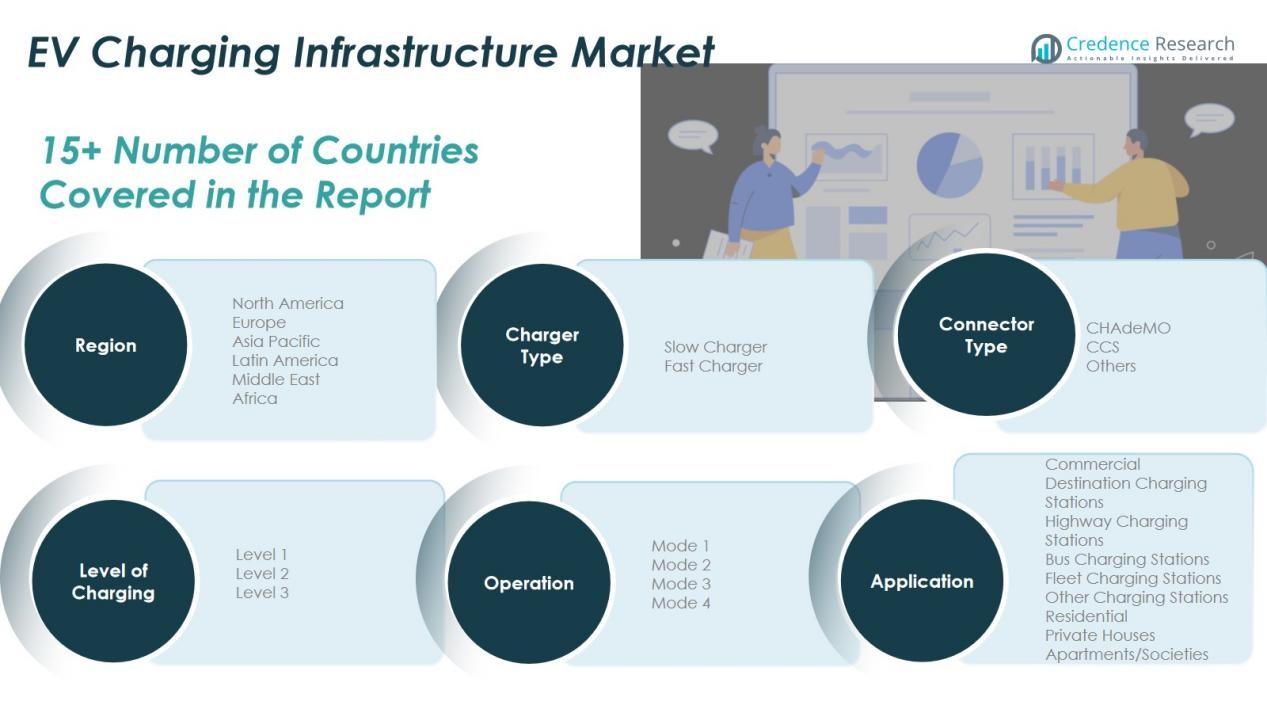
EV Charging Infrastructure Market By Charger Type (Slow Charger, Fast Charger); By Application (Commercial [Destination Charging Stations, Highway Charging Stations, Bus Charging Stations, Fleet Charging Stations, Other Charging Stations], Residential [Private Houses, Apartments/Societies]); By Connector Type (CHAdeMO, CCS, Others); By Level of Charging (Level 1, Level 2, Level 3); By Operation (Mode 1, Mode 2, Mode 3, Mode 4) – Growth, Share, Opportunities & Competitive Analysis, 2024 – 2032

Report ID: 5767 | Report Format : Excel, PDF

Market Overview:

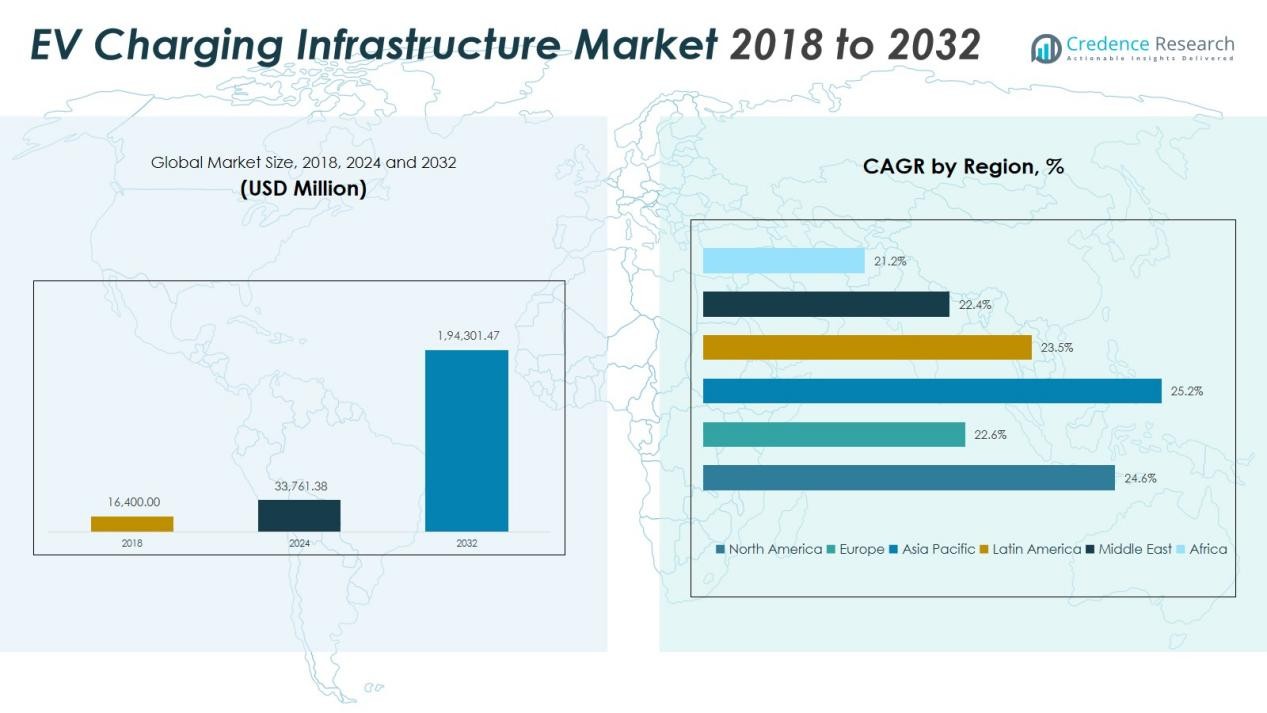
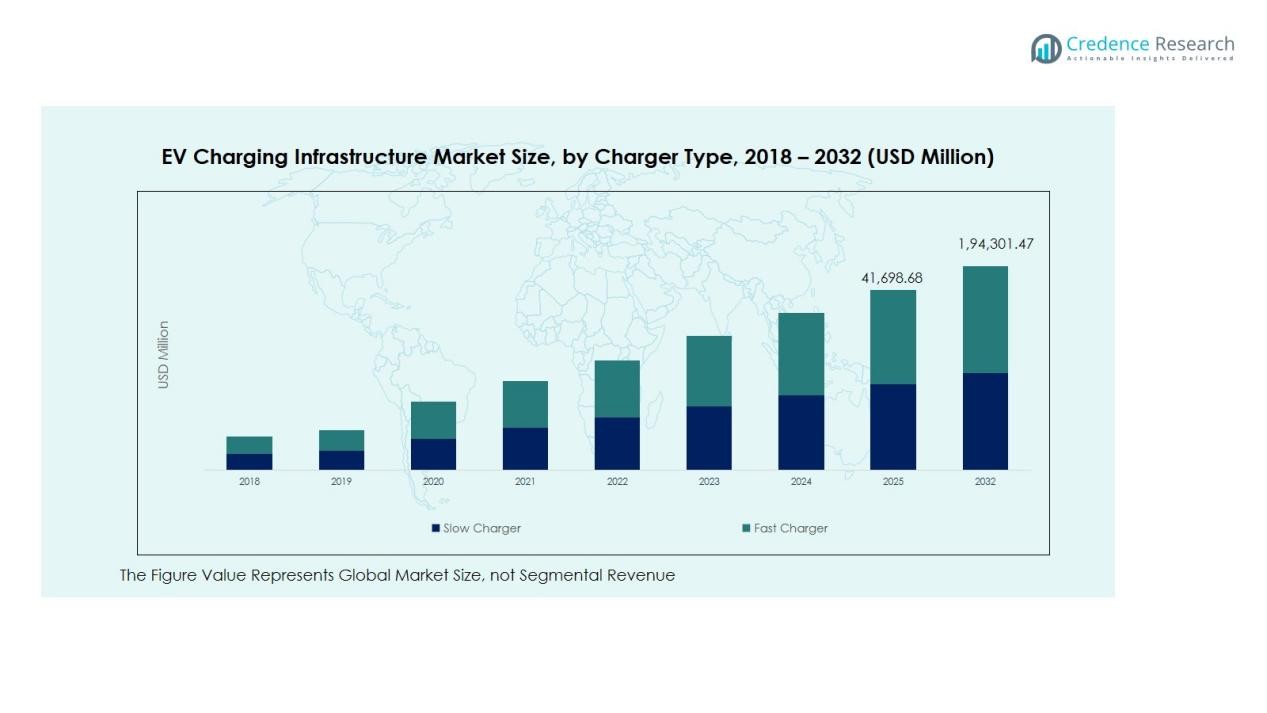
The Global EV Charging Infrastructure Market size was valued at USD  16,400 million in 2018 to USD  33,761.38 million in 2024 and is anticipated to reach USD   1,94,301.47 million by 2032, at a CAGR of 24.59% during the forecast period.

REPORT ATTRIBUTE DETAILS
Historical Period 2020-2023
Base Year 2024
Forecast Period 2025-2032
EV Charging Infrastructure Market Size 2024 USD 33,761.38 Million
EV Charging Infrastructure Market, CAGR 24.59%
EV Charging Infrastructure Market Size 2032 USD 1,94,301.47 Million


Growth in this market is driven by strong government incentives, emission-reduction mandates, and increasing infrastructure spending by both public and private sectors. The demand for fast-charging solutions continues to rise as consumers seek reduced charging times and higher convenience. Expanding electric vehicle ownership and the integration of renewable energy sources further enhance market development, creating opportunities for new entrants and established energy players alike.

Asia-Pacific dominates the Global EV Charging Infrastructure Market, accounting for over two-thirds of installations in 2024, led by large-scale deployments in China, Japan, and South Korea. Europe follows, supported by strict emission regulations and cross-border charging initiatives. North America is witnessing rapid growth, with expanding urban infrastructure and government funding programs promoting nationwide EV adoption.

Access crucial information at unmatched prices!

Request your sample report today & start making informed decisions powered by Credence Research Inc.!

Download Sample

Market Insights:

  • The Global EV Charging Infrastructure Market was valued at USD 16,400 million in 2018, reached USD 33,761.38 million in 2024, and is projected to reach USD 1,94,301.47 million by 2032, growing at a CAGR of 24.59% during the forecast period.
  • Asia-Pacific holds the largest share at over 67%, led by China, Japan, and South Korea, driven by large-scale government investments and strong EV adoption programs.
  • Europe accounts for about 18% of the market, supported by stringent emission regulations, renewable energy integration, and cross-border charging network expansion.
  • North America represents approximately 10% of the global share, driven by government initiatives like NEVI and expanding DC fast-charging corridors across the U.S. and Canada.
  • Asia-Pacific remains the fastest-growing region, supported by national electrification plans, rapid urbanization, and private investments in smart grid infrastructure.

EV Charging Infrastructure Market Size

Market Drivers:

Government Incentives and Policy Support Accelerating Infrastructure Deployment

The Global EV Charging Infrastructure Market benefits from strong government incentives, subsidies, and regulatory mandates promoting clean mobility. Policies such as tax credits, reduced import duties, and public-private partnerships encourage large-scale infrastructure expansion. It gains further support from initiatives like the U.S. National Electric Vehicle Infrastructure (NEVI) program and the European Union’s Green Deal, which prioritize zero-emission transport. These efforts ensure financial backing for charging network developers and create a favorable environment for long-term market growth.

  • For instance, the U.S. NEVI program has a total of $5 billion in federal funding allocated from 2022 to 2026. The amount allocated specifically for fiscal years 2022 to 2025 was approximately $3.3 billion [1, 2].

Rising Electric Vehicle Adoption Driving Infrastructure Expansion

Increasing global electric vehicle adoption is a core driver of the charging infrastructure market. Growing consumer awareness of sustainability and declining battery costs have accelerated EV sales, creating a pressing need for reliable charging solutions. It is also supported by automakers’ commitments to fully electric fleets, which boost demand for high-capacity and fast-charging systems. The expansion of both passenger and commercial EV segments strengthens the need for accessible charging facilities across urban and highway locations.

  • For instance, Uber India partnered with fleet operators to deploy 25,000 electric vehicles for ride-hailing by 2025-2026, directly increasing the requirement for urban and intercity charging stations to support its EV operations.

Technological Advancements Enhancing Efficiency and Accessibility

Rapid technological innovation in fast charging, connectivity, and smart grid integration is transforming the industry landscape. The development of ultra-fast chargers with outputs exceeding 350 kW reduces charging times and enhances user convenience. It also benefits from software-enabled energy management systems that optimize grid usage and support dynamic pricing. Interoperability advancements allow multiple charging standards to coexist, improving accessibility and customer satisfaction.

Growing Investment from Private Sector and Energy Companies

Rising private investment from utilities, oil majors, and technology firms fuels market expansion. Companies are building integrated charging networks to secure strategic positions in the evolving e-mobility ecosystem. It witnesses significant collaboration between automotive OEMs and energy providers to ensure coverage continuity and performance reliability. Continuous funding and infrastructure partnerships reinforce competitiveness and drive sustained growth across regional and global markets.

Market Trends:

Integration of Smart Charging Technologies and Digital Platforms

The Global EV Charging Infrastructure Market is witnessing rapid adoption of smart charging systems that combine real-time monitoring, dynamic load management, and data analytics. These systems enable efficient power distribution and grid stability while minimizing energy costs. It benefits from the integration of Internet of Things (IoT) sensors, mobile applications, and AI-based platforms that enhance user experience and operational efficiency. Demand for networked charging solutions continues to rise across commercial fleets and public stations. The growth of vehicle-to-grid (V2G) technology further supports grid resilience by allowing bidirectional energy flow. Charging operators are investing in digital platforms that support remote diagnostics, predictive maintenance, and seamless payment systems. These developments are transforming traditional charging networks into intelligent and user-centric infrastructure ecosystems.

  • For instance, Electrify America’s network has demonstrated rapid adoption of high-power charging, with stations capable of delivering up to 350 kW per stall in some deployments, enabling substantial reductions in typical charging times for long-range EVs

Expansion of Fast and Ultra-Fast Charging Networks Globally

Growing emphasis on reducing charging time drives significant investment in fast and ultra-fast charging stations worldwide. Automakers and infrastructure developers are deploying chargers with power outputs exceeding 150 kW to cater to next-generation electric vehicles. It is also influenced by advancements in battery technology and thermal management systems that support higher charging speeds. Highway corridors, urban centers, and logistics hubs are emerging as priority locations for deployment. The trend toward modular and scalable charger designs enables flexible installation and cost efficiency. Energy companies are expanding partnerships to establish nationwide fast-charging corridors that enhance long-distance travel convenience. These networks are becoming a key competitive differentiator in the global e-mobility landscape.

  • For instance, Hyundai Motor Group announced a strategy with SK On to expand high-power charging corridors that include 400 kW-capable units at select sites, enabling rapid top-ups for long-distance trips. 400 kW units deployed at pilot sites.

Market Challenges Analysis:

High Installation Costs and Limited Grid Capacity

The Global EV Charging Infrastructure Market faces major challenges from high setup and maintenance costs, which restrict widespread adoption. Developing fast-charging stations requires significant investment in hardware, land, and electrical upgrades. It often depends on grid availability, and many regions lack the power capacity to support large-scale deployment. Upgrading distribution networks and transformers adds further financial strain to utilities and operators. The imbalance between EV growth and grid readiness creates operational inefficiencies. Cost-sensitive markets find it difficult to justify large infrastructure projects without sustained policy or private investment support. These constraints slow the pace of charging network expansion in emerging economies.

Standardization and Interoperability Barriers

A lack of standardization in charging connectors, payment systems, and communication protocols remains a key obstacle. Users often encounter compatibility issues across networks, leading to inconsistent charging experiences. It requires collaboration among automakers, regulators, and technology providers to establish universal standards. Varying regional regulations complicate cross-border operations and infrastructure planning. Operators face challenges in integrating hardware and software systems from multiple vendors. Limited interoperability discourages consumer confidence and affects overall network utilization rates. Harmonized policies and open protocols are essential to achieve a seamless and unified charging ecosystem.

EV Charging Infrastructure Market Share

Market Opportunities:

Expansion of Renewable Energy Integration and Smart Grid Synergies

The Global EV Charging Infrastructure Market holds strong opportunities through integration with renewable energy and smart grids. The shift toward solar- and wind-powered charging stations supports carbon-neutral transportation goals. It benefits from advancements in energy storage systems that balance load demands and reduce grid stress. The adoption of smart grids enhances charging efficiency and enables real-time energy optimization. Governments are funding green energy projects to link EV charging with distributed energy resources. The alignment of EV infrastructure with renewable energy ecosystems creates sustainable business models and long-term profitability.

Emergence of Fleet Electrification and Commercial Charging Networks

Fleet electrification across logistics, ride-sharing, and delivery services opens major growth avenues for charging infrastructure providers. Companies are investing in depot-based and on-route charging hubs to support large electric fleets. It gains momentum from operational cost advantages and corporate commitments to sustainability targets. The expansion of electric buses and commercial vans increases the need for fast and reliable charging points. Energy and mobility service providers are forming alliances to build specialized fleet-charging platforms. The growing preference for managed charging services and subscription-based business models creates recurring revenue potential and strengthens market competitiveness.

Market Segmentation Analysis:

By Charger Type

The Global EV Charging Infrastructure Market is segmented into slow and fast chargers. Fast chargers dominate due to rising consumer demand for quick turnaround and growing deployment across highways and commercial hubs. It benefits from expanding urban mobility and the adoption of high-capacity batteries in electric vehicles. Slow chargers continue to serve residential applications due to their cost-effectiveness and compatibility with standard power outlets. Continuous upgrades in charging speed and safety standards are reinforcing technological advancements in both segments.

  • For instance, in 2024, EVgo and General Motors surpassed the milestone of 2,000 existing fast-charging stalls across more than 30 U.S. states as part of their collaboration, with each stall delivering up to 350 kW of power

By Application

The market covers commercial and residential applications. Commercial installations lead due to large-scale adoption across public parking areas, fleet depots, and transportation corridors. It gains traction from the growth of destination and highway charging networks supporting long-distance EV travel. Residential charging remains vital for daily home use, supported by incentives promoting private charger installation. Increasing integration of smart home technologies is enhancing convenience and energy efficiency in residential setups.

  • For Instance, New York City’s Metropolitan Transportation Authority (MTA) is actively deploying EV charging infrastructure across its depots as part of its plan to convert its entire bus fleet to zero-emissions vehicles by 2040.

By Connector Type

The market is segmented into CHAdeMO, CCS, and others. CCS holds the largest share due to its compatibility with most new-generation electric vehicles and rapid-charging capabilities. It benefits from strong adoption across Europe and North America, driven by regulatory standardization. CHAdeMO continues to maintain relevance in Asia, particularly in Japan. Other connectors, including proprietary and Type 2 formats, contribute to market diversity and support varying regional infrastructure policies.

EV Charging Infrastructure Market Segmentation

Segmentations:

By Charger Type

  • Slow Charger
  • Fast Charger

By Application

  • Commercial
  • Destination Charging Stations
  • Highway Charging Stations
  • Bus Charging Stations
  • Fleet Charging Stations
  • Other Charging Stations
  • Residential
  • Private Houses
  • Apartments/Societies

By Connector Type

  • CHAdeMO
  • CCS
  • Others

By Level of Charging

  • Level 1
  • Level 2
  • Level 3

By Operation

  • Mode 1
  • Mode 2
  • Mode 3
  • Mode 4

By Region

  • North America
    • U.S.
    • Canada
    • Mexico
  • Europe
    • Germany
    • France
    • U.K.
    • Italy
    • Spain
    • Rest of Europe
  • Asia Pacific
    • China
    • Japan
    • India
    • South Korea
    • South-east Asia
    • Rest of Asia Pacific
  • Latin America
    • Brazil
    • Argentina
    • Rest of Latin America
  • Middle East & Africa
    • GCC Countries
    • South Africa
    • Rest of the Middle East and Africa

Regional Analysis:

North America

The North America EV Charging Infrastructure Market size was valued at USD 2,525.60 million in 2018 to USD 5,050.50 million in 2024 and is anticipated to reach USD 28,970.70 million by 2032, at a CAGR of 24.6% during the forecast period. North America holds a significant market share of the Global EV Charging Infrastructure Market, driven by strong policy incentives and rapid EV adoption across the United States and Canada. It benefits from federal and state programs such as NEVI, which support large-scale fast-charging network expansion. The U.S. leads regional growth with extensive private and public sector investments in DC fast-charging corridors. Canada follows, emphasizing sustainability goals and smart city programs. Strategic alliances among automakers and utilities are improving charging accessibility across major urban routes. Continuous infrastructure upgrades strengthen the region’s leadership in next-generation charging technology.

Europe

The Europe EV Charging Infrastructure Market size was valued at USD 2,017.20 million in 2018 to USD 3,807.36 million in 2024 and is anticipated to reach USD 19,187.79 million by 2032, at a CAGR of 22.6% during the forecast period. Europe accounts for a strong share of the global market, supported by emission regulations and the European Green Deal’s e-mobility targets. It emphasizes interoperable networks, cross-border connectivity, and standardized payment systems. The UK, Germany, France, and the Netherlands lead deployment, supported by large public investment programs. Growing adoption of electric buses and fleet electrification further accelerates demand. The region’s focus on renewable integration into charging networks enhances energy sustainability and long-term efficiency.

Asia Pacific

The Asia Pacific EV Charging Infrastructure Market size was valued at USD 10,069.60 million in 2018 to USD 21,095.66 million in 2024 and is anticipated to reach USD 126,548.70 million by 2032, at a CAGR of 25.2% during the forecast period. Asia Pacific dominates the global market with the largest regional share, led by China, Japan, and South Korea. It benefits from strong government mandates, national electrification plans, and mass-scale public infrastructure projects. China continues to account for the majority of installed charging stations, followed by rapid growth in India and Southeast Asia. The expansion of EV fleets and urban charging networks is transforming transportation systems. Increasing private investment and smart grid integration further strengthen the regional market structure.

Latin America

The Latin America EV Charging Infrastructure Market size was valued at USD 1,049.60 million in 2018 to USD 2,140.13 million in 2024 and is anticipated to reach USD 11,438.53 million by 2032, at a CAGR of 23.5% during the forecast period. Latin America shows emerging growth potential supported by urban electrification initiatives and regional emission policies. Brazil and Mexico are the key contributors with strong automotive sector support and pilot EV infrastructure programs. It gains momentum from partnerships between energy providers and public agencies focusing on green mobility. The commercial fleet segment is driving early adoption across logistics and municipal transport. Gradual grid modernization and renewable energy integration will strengthen the region’s EV ecosystem.

Middle East

The Middle East EV Charging Infrastructure Market size was valued at USD 459.20 million in 2018 to USD 864.07 million in 2024 and is anticipated to reach USD 4,295.13 million by 2032, at a CAGR of 22.4% during the forecast period. The Middle East market is expanding through government sustainability initiatives and diversification of the energy mix. It is driven by EV adoption in GCC nations such as the UAE and Saudi Arabia. Dubai’s Green Mobility Strategy and Saudi Vision 2030 are key accelerators of infrastructure rollout. Increasing private investment from oil and energy majors supports large-scale charging projects. Regional expansion of smart city projects and public charging corridors improves accessibility across key transport routes.

Africa

The Africa EV Charging Infrastructure Market size was valued at USD 278.80 million in 2018 to USD 803.66 million in 2024 and is anticipated to reach USD 3,860.62 million by 2032, at a CAGR of 21.2% during the forecast period. Africa remains a developing market with growing attention toward clean mobility and energy access. South Africa leads adoption with pilot EV charging corridors supported by renewable energy. It benefits from the rising participation of private players in urban charging networks. Limited grid capacity and affordability constraints currently slow expansion across other countries. International collaborations and donor-funded projects are expected to improve infrastructure readiness. Continuous government support and renewable integration will play a key role in scaling adoption.

Key Player Analysis:

  • ABB Ltd.
  • ChargePoint, Inc.
  • Leviton Manufacturing Co., Inc.
  • Blink Charging Co.
  • Tesla Inc.
  • Webasto Group
  • Eaton Corporation plc
  • Schneider Electric
  • Siemens
  • Broadband TelCom Power, Inc.
  • Delta Electronics, Inc.
  • Tritium DCFC Limited

Competitive Analysis:

The Global EV Charging Infrastructure Market is characterized by strong competition among established global and regional players. ABB Ltd. leads in high-power charging systems and turnkey infrastructure solutions for public and fleet applications. ChargePoint, Inc. maintains a dominant position in North America with extensive public charging networks and advanced cloud-based management platforms. Leviton Manufacturing Co., Inc. focuses on residential and workplace chargers supported by robust energy management solutions. Blink Charging Co. emphasizes strategic partnerships and network expansion through public installations. Tesla Inc. continues to strengthen its proprietary Supercharger network while integrating open-access capabilities for non-Tesla vehicles. Webasto Group expands through innovative home and commercial charging systems with modular and smart functionalities. The market remains dynamic, driven by continuous product innovation, cross-industry alliances, and government-backed infrastructure initiatives that enhance global competitiveness and accelerate sustainable mobility adoption.

Shape Your Report to Specific Countries or Regions & Enjoy 30% Off!

Recent Developments:

  • In October 2025, SoftBank Group enters into a definitive agreement to acquire ABB’s robotics business, with closing anticipated mid-to-late 2026.
  • In August 2025, ABB India reports a ₹173.6 crore order from Siemens Gamesa for wind turbine components, highlighting a major client win and collaboration in renewable energy deployment.

Report Coverage:

The research report offers an in-depth analysis based on Charger Type, Application, Connector Type, Level of Charging, Operation and Region. It details leading market players, providing an overview of their business, product offerings, investments, revenue streams, and key applications. Additionally, the report includes insights into the competitive environment, SWOT analysis, current market trends, as well as the primary drivers and constraints. Furthermore, it discusses various factors that have driven market expansion in recent years. The report also explores market dynamics, regulatory scenarios, and technological advancements that are shaping the industry. It assesses the impact of external factors and global economic changes on market growth. Lastly, it provides strategic recommendations for new entrants and established companies to navigate the complexities of the market.

Future Outlook:

  • The Global EV Charging Infrastructure Market is expected to experience rapid network expansion supported by global sustainability mandates and green energy transitions.
  • Growing adoption of electric vehicles across passenger and commercial segments will drive continuous demand for public and private charging stations.
  • Integration of renewable energy sources into charging infrastructure will strengthen grid resilience and reduce operational costs.
  • The shift toward ultra-fast and high-capacity chargers will improve convenience and shorten charging durations significantly.
  • Smart and connected charging systems using AI and IoT technologies will enhance efficiency and real-time energy management.
  • Fleet electrification across logistics, public transport, and ride-sharing sectors will create long-term infrastructure demand.
  • Private investments and public-private partnerships will accelerate large-scale charging network deployment in urban and highway locations.
  • Interoperability advancements and unified payment systems will simplify user experience and promote standardization globally.
  • Emerging economies in Asia, the Middle East, and Latin America will become key growth centers due to government support and EV incentives.
  • The market will continue to evolve toward sustainable, intelligent, and service-based charging ecosystems driving the global transition to clean mobility.

CHAPTER NO. 1 : GENESIS OF THE MARKET

1.1 Market Prelude – Introduction & Scope

1.2 The Big Picture – Objectives & Vision

1.3 Strategic Edge – Unique Value Proposition

1.4 Stakeholder Compass – Key Beneficiaries

CHAPTER NO. 2 : EXECUTIVE LENS

2.1 Pulse of the Industry – Market Snapshot

2.2 Growth Arc – Revenue Projections (USD Million)

2.3. Premium Insights – Based on Primary Interviews

CHAPTER NO. 3 : EV CHARGING INFRASTRUCTURE MARKET FORCES & INDUSTRY PULSE

3.1 Foundations of Change – Market Overview

3.2 Catalysts of Expansion – Key Market Drivers

3.2.1 Momentum Boosters – Growth Triggers

3.2.2 Innovation Fuel – Disruptive Technologies

3.3 Headwinds & Crosswinds – Market Restraints

3.3.1 Regulatory Tides – Compliance Challenges

3.3.2 Economic Frictions – Inflationary Pressures

3.4 Untapped Horizons – Growth Potential & Opportunities

3.5 Strategic Navigation – Industry Frameworks

3.5.1 Market Equilibrium – Porter’s Five Forces

3.5.2 Ecosystem Dynamics – Value Chain Analysis

3.5.3 Macro Forces – PESTEL Breakdown

3.6 Price Trend Analysis

3.6.1 Regional Price Trend

3.6.2 Price Trend by product

CHAPTER NO. 4 : KEY INVESTMENT EPICENTER

4.1 Regional Goldmines – High-Growth Geographies

4.2 Product Frontiers – Lucrative Product Categories

4.3 Application Sweet Spots – Emerging Demand Segments

CHAPTER NO. 5: REVENUE TRAJECTORY & WEALTH MAPPING

5.1 Momentum Metrics – Forecast & Growth Curves

5.2 Regional Revenue Footprint – Market Share Insights

5.3 Segmental Wealth Flow – Charger Type & Application Revenue

CHAPTER NO. 6 : TRADE & COMMERCE ANALYSIS

6.1. Import Analysis by Region

6.1.1. Global EV Charging Infrastructure Market Import Revenue By Region

6.2. Export Analysis by Region

6.2.1. Global EV Charging Infrastructure Market Export Revenue By Region

CHAPTER NO. 7 : COMPETITION ANALYSIS

7.1. Company Market Share Analysis

7.1.1. Global EV Charging Infrastructure Market: Company Market Share

7.2. Global EV Charging Infrastructure Market Company Revenue Market Share

7.3. Strategic Developments

7.3.1. Acquisitions & Mergers

7.3.2. New Product Launch

7.3.3. Regional Expansion

7.4. Competitive Dashboard

7.5. Company Assessment Metrics, 2024

CHAPTER NO. 8 : EV CHARGING INFRASTRUCTURE MARKET – BY CHARGER TYPE SEGMENT ANALYSIS

8.1. EV Charging Infrastructure Market Overview by Charger Type Segment

8.1.1. EV Charging Infrastructure Market Revenue Share By Charger Type

8.2. Slow Charger

8.3. Fast Charger

CHAPTER NO. 9 : EV CHARGING INFRASTRUCTURE MARKET – BY APPLICATION SEGMENT ANALYSIS

9.1. EV Charging Infrastructure Market Overview by Application Segment

9.1.1. EV Charging Infrastructure Market Revenue Share By Application

9.2. Commercial

9.2.1 Destination Charging Stations

9.2.2 Highway Charging Stations

9.2.3 Bus Charging Stations

9.2.4 Fleet Charging Stations

9.2.5 Other Charging Stations

9.3. Residential

9.3.1 Private Houses

9.3.2 Apartments/Societies

CHAPTER NO. 10 : EV CHARGING INFRASTRUCTURE MARKET – BY CONNECTOR TYPE SEGMENT ANALYSIS

10.1. EV Charging Infrastructure Market Overview by Connector Type Segment

10.1.1. EV Charging Infrastructure Market Revenue Share By Connector Type

10.2. CHAdeMO

10.3. CCS

10.4. Others

CHAPTER NO. 11 : EV CHARGING INFRASTRUCTURE MARKET – BY LEVEL OF CHARGING SEGMENT ANALYSIS

11.1. EV Charging Infrastructure Market Overview by Level of Charging

11.1.1. EV Charging Infrastructure Market Revenue Share By Level of Charging

11.2. Level 1

11.3. Level 2

11.4. Level 3

CHAPTER NO. 12 : EV CHARGING INFRASTRUCTURE MARKET – BY OPERATION SEGMENT ANALYSIS

12.1. EV Charging Infrastructure Market Overview by Operation Segment

12.1.1. EV Charging Infrastructure Market Revenue Share By Operation

12.2. Mode 1

12.3. Mode 2

12.4. Mode 3

12.5. Mode 4

CHAPTER NO. 13 : EV CHARGING INFRASTRUCTURE MARKET – REGIONAL ANALYSIS

13.1. EV Charging Infrastructure Market Overview by Region Segment

13.1.1. Global EV Charging Infrastructure Market Revenue Share By Region

13.1.2. Regions

13.1.3. Global EV Charging Infrastructure Market Revenue By Region

13.1.4. Charger Type

13.1.5. Global EV Charging Infrastructure Market Revenue By Charger Type

13.1.6. Application

13.1.7. Global EV Charging Infrastructure Market Revenue By Application

13.1.8. Connector Type

13.1.9. Global EV Charging Infrastructure Market Revenue By Connector Type

13.1.10. Level of Charging

13.1.12. Global EV Charging Infrastructure Market Revenue By Level of Charging

13.1.13. Operation

13.1.14. Global EV Charging Infrastructure Market Revenue By Operation

CHAPTER NO. 14 : NORTH AMERICA EV CHARGING INFRASTRUCTURE MARKET – COUNTRY ANALYSIS

14.1. North America EV Charging Infrastructure Market Overview by Country Segment

14.1.1. North America EV Charging Infrastructure Market Revenue Share By Region

14.2. North America

14.2.1. North America EV Charging Infrastructure Market Revenue By Country

14.2.2. Charger Type

14.2.3. North America EV Charging Infrastructure Market Revenue By Charger Type

14.2.4. Application

14.2.5. North America EV Charging Infrastructure Market Revenue By Application

14.2.6. Connector Type

14.2.7. North America EV Charging Infrastructure Market Revenue By Connector Type

14.2.8. Level of Charging

14.2.9. North America EV Charging Infrastructure Market Revenue By Level of Charging

14.2.10. Operation

14.2.11. North America EV Charging Infrastructure Market Revenue By Operation

14.3. U.S.

14.4. Canada

14.5. Mexico

CHAPTER NO. 15 : EUROPE EV CHARGING INFRASTRUCTURE MARKET – COUNTRY ANALYSIS

15.1. Europe EV Charging Infrastructure Market Overview by Country Segment

15.1.1. Europe EV Charging Infrastructure Market Revenue Share By Region

15.2. Europe

15.2.1. Europe EV Charging Infrastructure Market Revenue By Country

15.2.2. Charger Type

15.2.3. Europe EV Charging Infrastructure Market Revenue By Charger Type

15.2.4. Application

15.2.5. Europe EV Charging Infrastructure Market Revenue By Application

15.2.6. Connector Type

15.2.7. Europe EV Charging Infrastructure Market Revenue By Connector Type

15.2.8. Level of Charging

15.2.9. Europe EV Charging Infrastructure Market Revenue By Level of Charging

15.2.10. Operation

15.2.11. Europe EV Charging Infrastructure Market Revenue By Operation

15.3. UK

15.4. France

15.5. Germany

15.6. Italy

15.7. Spain

15.8. Russia

15.9. Rest of Europe

CHAPTER NO. 16 : ASIA PACIFIC EV CHARGING INFRASTRUCTURE MARKET – COUNTRY ANALYSIS

16.1. Asia Pacific EV Charging Infrastructure Market Overview by Country Segment

16.1.1. Asia Pacific EV Charging Infrastructure Market Revenue Share By Region

16.2. Asia Pacific

16.2.1. Asia Pacific EV Charging Infrastructure Market Revenue By Country

16.2.2. Charger Type

16.2.3. Asia Pacific EV Charging Infrastructure Market Revenue By Charger Type

16.2.4. Application

16.2.5. Asia Pacific EV Charging Infrastructure Market Revenue By Application

16.2.6. Connector Type

16.2.7. Asia Pacific EV Charging Infrastructure Market Revenue By Connector Type

16.2.8. Level of Charging

16.2.9. Asia Pacific EV Charging Infrastructure Market Revenue By Level of Charging

16.2.10. Operation

16.2.11. Asia Pacific EV Charging Infrastructure Market Revenue By Operation

16.3. China

16.4. Japan

16.5. South Korea

16.6. India

16.7. Australia

16.8. Southeast Asia

16.9. Rest of Asia Pacific

CHAPTER NO. 17 : LATIN AMERICA EV CHARGING INFRASTRUCTURE MARKET – COUNTRY ANALYSIS

17.1. Latin America EV Charging Infrastructure Market Overview by Country Segment

17.1.1. Latin America EV Charging Infrastructure Market Revenue Share By Region

17.2. Latin America

17.2.1. Latin America EV Charging Infrastructure Market Revenue By Country

17.2.2. Charger Type

17.2.3. Latin America EV Charging Infrastructure Market Revenue By Charger Type

17.2.4. Application

17.2.5. Latin America EV Charging Infrastructure Market Revenue By Application

17.2.6. Connector Type

17.2.7. Latin America EV Charging Infrastructure Market Revenue By Connector Type

17.2.8. Level of Charging

17.2.9. Latin America EV Charging Infrastructure Market Revenue By Level of Charging

17.2.10. Operation

17.2.11. Latin America EV Charging Infrastructure Market Revenue By Operation

17.3. Brazil

17.4. Argentina

17.5. Rest of Latin America

CHAPTER NO. 18 : MIDDLE EAST EV CHARGING INFRASTRUCTURE MARKET – COUNTRY ANALYSIS

18.1. Middle East EV Charging Infrastructure Market Overview by Country Segment

18.1.1. Middle East EV Charging Infrastructure Market Revenue Share By Region

18.2. Middle East

18.2.1. Middle East EV Charging Infrastructure Market Revenue By Country

18.2.2. Charger Type

18.2.3. Middle East EV Charging Infrastructure Market Revenue By Charger Type

18.2.4. Application

18.2.5. Middle East EV Charging Infrastructure Market Revenue By Application

18.2.6. Connector Type

18.2.7. Middle East EV Charging Infrastructure Market Revenue By Connector Type

18.2.8. Level of Charging

18.2.9. Middle East EV Charging Infrastructure Market Revenue By Level of Charging

18.2.10. Operation

18.2.11. Middle East EV Charging Infrastructure Market Revenue By Operation

18.3. GCC Countries

18.4. Israel

18.5. Turkey

18.6. Rest of Middle East

CHAPTER NO. 19 : AFRICA EV CHARGING INFRASTRUCTURE MARKET – COUNTRY ANALYSIS

19.1. Africa EV Charging Infrastructure Market Overview by Country Segment

19.1.1. Africa EV Charging Infrastructure Market Revenue Share By Region

19.2. Africa

19.2.1. Africa EV Charging Infrastructure Market Revenue By Country

19.2.2. Charger Type

19.2.3. Africa EV Charging Infrastructure Market Revenue By Charger Type

19.2.4. Application

19.2.5. Africa EV Charging Infrastructure Market Revenue By Application

19.2.6. Connector Type

19.2.7. Africa EV Charging Infrastructure Market Revenue By Connector Type

19.2.8. Level of Charging

19.2.9. Africa EV Charging Infrastructure Market Revenue By Level of Charging

19.2.10. Operation

19.2.11. Africa EV Charging Infrastructure Market Revenue By Operation

19.3. South Africa

19.4. Egypt

19.5. Rest of Africa

CHAPTER NO. 20 : COMPANY PROFILES

20.1. ABB Ltd.

20.1.1. Company Overview

20.1.2. Product Portfolio

20.1.3. Financial Overview

20.1.4. Recent Developments

20.1.5. Growth Strategy

20.1.6. SWOT Analysis

20.2. ChargePoint, Inc.

20.3. Leviton Manufacturing Co., Inc.

20.4. Blink Charging Co.

20.5. Tesla Inc.

20.6. Webasto Group

20.7. Eaton Corporation plc

20.8. Schneider Electric

20.9. Siemens

20.10. Broadband TelCom Power, Inc.

20.11. Delta Electronics, Inc.

20.12. Tritium DCFC Limited

Request Free Sample

We prioritize the confidentiality and security of your data. Our promise: your information remains private.

Ready to Transform Data into Decisions?

Request Your Sample Report and Start Your Journey of Informed Choices


Providing the strategic compass for industry titans.

cr-clients-logos

Frequently asked questions 

What is the current market size for the Global EV Charging Infrastructure Market, and what is its projected size in 2032?

The Global EV Charging Infrastructure Market was valued at USD 16,400 million in 2018, reached USD 33,761.38 million in 2024, and is projected to reach USD 194,301.47 million by 2032.

At what Compound Annual Growth Rate is the Global EV Charging Infrastructure Market projected to grow between 2024 and 2032?

The Global EV Charging Infrastructure Market is expected to expand at a CAGR of 24.59% during the forecast period from 2024 to 2032.

Which segment held the largest share of the Global EV Charging Infrastructure Market in 2024?

The fast charger segment held the largest share in 2024, driven by rapid adoption of high-capacity and ultra-fast charging systems across public and commercial networks.

What are the primary factors fueling the growth of the Global EV Charging Infrastructure Market?

Key factors include government incentives, emission-reduction mandates, rising EV adoption, and private investment in fast-charging networks and smart grid integration.

Who are the leading companies in the Global EV Charging Infrastructure Market?

Major players include ABB Ltd., ChargePoint, Inc., Leviton Manufacturing Co., Inc., Blink Charging Co., Tesla Inc., and Webasto Group.

Which region commanded the largest share of the Global EV Charging Infrastructure Market in 2024?

Asia-Pacific dominated the market in 2024, accounting for over two-thirds of global installations, led by large-scale deployment in China, Japan, and South Korea.

About Author

Ganesh Chandwade

Ganesh Chandwade

Senior Industry Consultant

Ganesh is a senior industry consultant specializing in heavy industries and advanced materials.

View Profile

Related Reports

Piston Market

Piston Market size was valued USD 2584.14 million in 2024 and is anticipated to reach USD 3619.01 million by 2032, at a CAGR of 4.3% during the forecast period.

Power Assisted Steering Market

Power Assisted Steering Market size was valued at USD 17,674 Million in 2024 and is anticipated to reach USD 24,942.44 Million by 2032, at a CAGR of 4.4% during the forecast period.

Pile Driving Machine Market

Pile Driving Machine Market size was valued USD 1818.5 million in 2024 and is anticipated to reach USD 2450.71 million by 2032, at a CAGR of 3.8% during the forecast period.

US Automotive EPP Foam Market

The US Automotive EPP Foam Market size was valued at USD 511.36 million in 2024 and is anticipated to reach USD 852.68 million by 2032, at a CAGR of 6.6 % during the forecast period.

Automotive Headliner (OE) Market

Automotive Headliner OE market size was valued at USD 12.4 Billion in 2024 and is anticipated to reach USD 16.97 Billion by 2032, at a CAGR of 4% during the forecast period.

Electronic Logging Device Market

The Electronic Logging Device Market size was valued at USD 12,500.00 million in 2018 to USD 14,303.36 million in 2024 and is anticipated to reach USD 20,346.91 million by 2032, at a CAGR of 4.55% during the forecast period.

Fifth Wheel Coupling Market

The Fifth Wheel Coupling Market size was valued at USD 650.00 million in 2018 to USD 762.19 million in 2024 and is anticipated to reach USD 1,158.91 million by 2032, at a CAGR of 5.45% during the forecast period.

Logistics Market

The global logistics market reached USD 5,650 billion in 2024 and is projected to grow to USD 7,625.99 billion by 2032, reflecting a CAGR of 3.82% during the forecast period.

Interior Car Accessories Market

Interior Car Accessories Market size was valued USD 304915 million in 2024 and is anticipated to reach USD 471508.81 million by 2032, at a CAGR of 5.6% during the forecast period.

Garbage Collection Trucks Market

Garbage Collection Trucks Market size was valued at USD 14.5 Billion in 2024 and is anticipated to reach USD 19.4 Billion by 2032, growing at a CAGR of 3.71% during the forecast period.

Lube Trucks Market

The Lube Trucks market was valued at USD 1,838.5 million in 2024 and is projected to reach USD 2,737.07 million by 2032, expanding at a CAGR of 5.1% during the forecast period.

Electric Boat Market

The Electric Boat Market size was valued at USD 4,100.00 million in 2018 to USD 6,507.94 million in 2024 and is anticipated to reach USD 18,413.29 million by 2032, at a CAGR of 13.91% during the forecast period.

Licence Option

The report comes as a view-only PDF document, optimized for individual clients. This version is recommended for personal digital use and does not allow printing. Use restricted to one purchaser only.
$4999

To meet the needs of modern corporate teams, our report comes in two formats: a printable PDF and a data-rich Excel sheet. This package is optimized for internal analysis. Unlimited users allowed within one corporate location (e.g., regional office).
$6999

The report will be delivered in printable PDF format along with the report’s data Excel sheet. This license offers 100 Free Analyst hours where the client can utilize Credence Research Inc. research team. Permitted for unlimited global use by all users within the purchasing corporation, such as all employees of a single company.
$12999

Report delivery within 24 to 48 hours

Credence Staff 3

WILLIAM, North America

Support Staff at Credence Research

KEITH PHILLIPS, Europe

Lee - CR Sales Staff

LEE VALLANCE, Asia Pacific

Kieran Jameson

KIERAN JAMESON, Australia

Smallform of Sample request
User Review

Thank you for the data! The numbers are exactly what we asked for and what we need to build our business case.

Materials Scientist
(privacy requested)

User Review

The report was an excellent overview of the Industrial Burners market. This report does a great job of breaking everything down into manageable chunks.

Imre Hof
Management Assistant, Bekaert

cr-clients-logos

Request Sample