Home » Automotive & Transportation » Electronic Logging Device Market

Electronic Logging Device Market By Product Type (Standalone ELDs, Integrated ELDs); By Technology (Cellular-Based ELDs, Satellite-Based ELDs); By End-User (Trucking Industry, Logistics and Transportation Companies, Government Agencies, Other Sectors) – Growth, Share, Opportunities & Competitive Analysis, 2024 – 2032

Report ID: 5826 | Report Format : Excel, PDF

Market Overview:

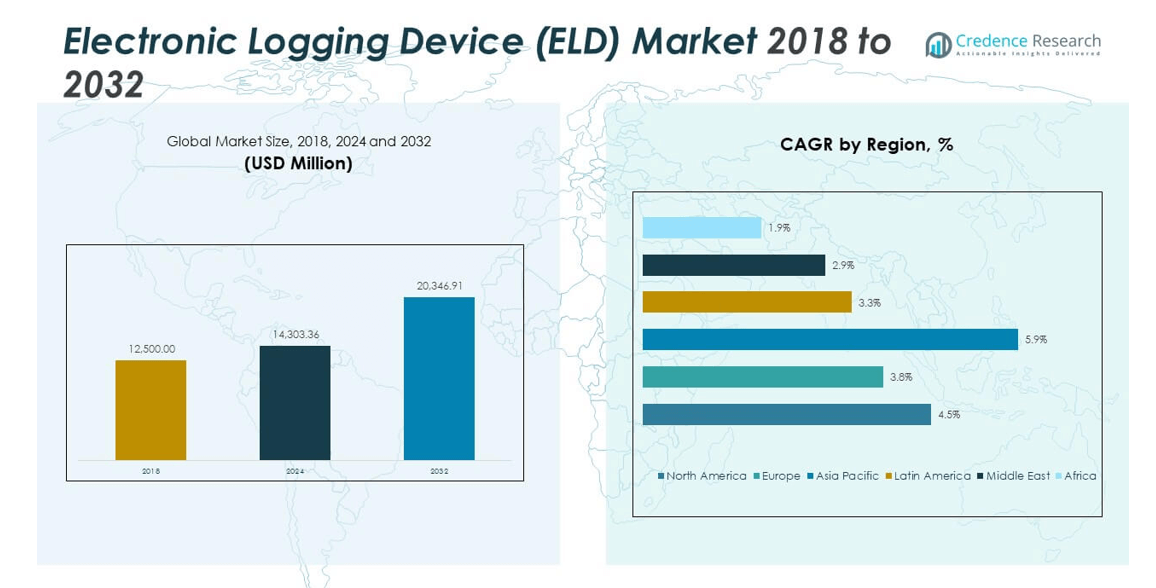
The Electronic Logging Device Market size was valued at USD 12,500.00 million in 2018 to USD 14,303.36 million in 2024 and is anticipated to reach USD 20,346.91 million by 2032, at a CAGR of 4.55% during the forecast period.

REPORT ATTRIBUTE DETAILS
Historical Period 2020-2023
Base Year 2024
Forecast Period 2025-2032
Electronic Logging Device Market Size 2024 USD 14,303.36 million
Electronic Logging Device Market, CAGR 4.55%
Electronic Logging Device Market Size 2032 USD 20,346.91 million


Growth in the Electronic Logging Device Market is driven by strict regulatory mandates for driver hour tracking and fleet compliance. Increasing emphasis on road safety and fuel efficiency encourages transport companies to adopt automated systems for monitoring operations. It gains momentum from expanding logistics and e-commerce industries that rely on digital tools for real-time fleet visibility. The integration of cloud, IoT, and analytics solutions enhances data accuracy and compliance reporting, supporting large-scale adoption across commercial vehicle operators.

North America leads the market due to early regulatory enforcement and high telematics adoption. Europe follows with widespread digital tachograph usage and unified transport safety policies. Asia Pacific emerges as the fastest-growing region, supported by expanding logistics infrastructure and rapid digital transformation in commercial fleets. Latin America, the Middle East, and Africa show gradual progress, driven by modernization efforts and increasing awareness of fleet management efficiency.

Electronic Logging Device Market size

Market Insights:

  • The Electronic Logging Device Market was valued at USD 12,500.00 million in 2018, reached USD 14,303.36 million in 2024, and is projected to achieve USD 20,346.91 million by 2032, growing at a CAGR of 4.55%.
  • North America dominates with a 41.7% share due to strong regulatory mandates, advanced telematics infrastructure, and high fleet compliance adoption across the U.S. and Canada.
  • Europe follows with a 24.4% share, supported by the EU’s transport digitalization policies and widespread integration of ELDs for cross-border logistics and driver safety management.
  • Asia Pacific accounts for 27.1% and remains the fastest-growing region, driven by rapid logistics expansion, e-commerce growth, and digital transformation across China, India, and Japan.
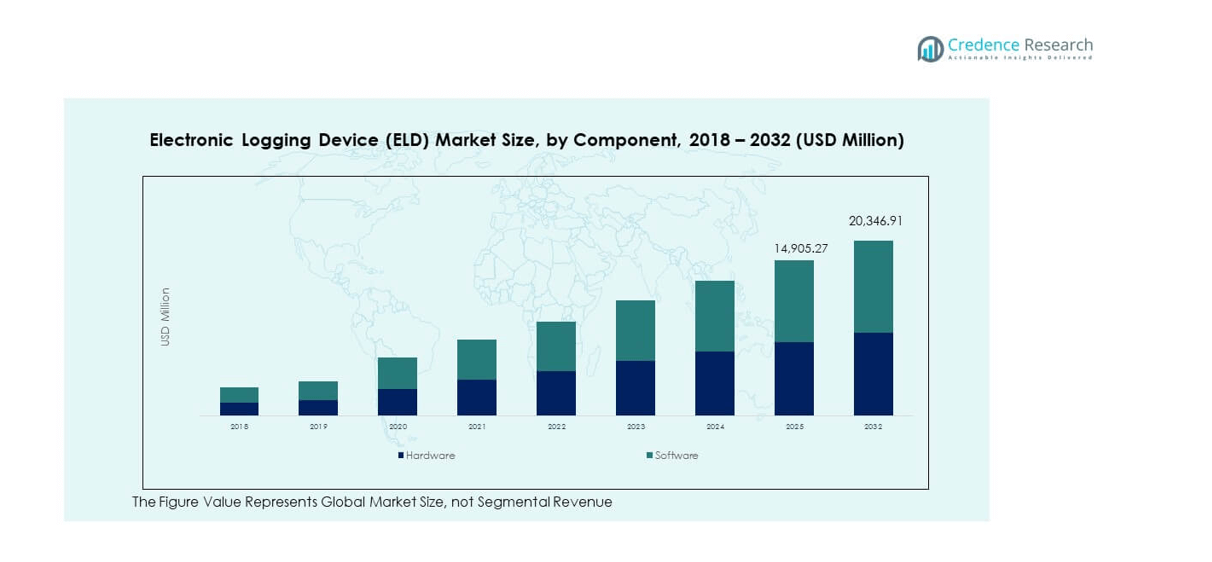
  • Hardware accounts for nearly 60% of segment revenue due to regulatory installation requirements, while software holds around 40%, reflecting rising demand for analytics-driven compliance and fleet management solutions.

Access crucial information at unmatched prices!

Request your sample report today & start making informed decisions powered by Credence Research Inc.!

Download Sample

Market Drivers

Growing Enforcement of Vehicle Compliance Regulations and Hours-of-Service Rules

Strict government regulations for commercial fleet safety drive strong adoption of electronic logging devices. The U.S. ELD mandate and similar global policies make compliance mandatory across carriers. Transport firms depend on digital records to reduce violations and improve driver accountability. The Electronic Logging Device Market grows rapidly as fleets modernize operations. Automated data tracking reduces paperwork, human error, and administrative costs. It improves transparency in managing driving hours and vehicle use. Strict enforcement by authorities pushes even smaller fleets to install devices. Compliance technology becomes a key business requirement in transport operations worldwide.

  • For instance, Geotab’s ELD maintains an overall device failure rate considerably less than 1%, far below industry standards, ensuring reliable automatic recording of driving time and engine data.

Rising Focus on Driver Safety, Fleet Efficiency, and Real-Time Monitoring

Fleet operators adopt telematics systems to enhance vehicle safety and performance. Real-time monitoring allows managers to track driver behavior and prevent fatigue-related risks. It supports efficient route management and helps reduce unnecessary fuel use. The Electronic Logging Device Market benefits from integration with GPS, IoT, and cloud systems. Transport companies gain visibility into driving habits and compliance levels. It reduces accident risks, increases accountability, and boosts driver productivity. Data-driven management strengthens decision-making and operational reliability. Safety-focused strategies continue to fuel investment in connected fleet solutions.

Increasing Fleet Digitization and Transition Toward Automated Operations

Automation and connectivity are reshaping transport logistics worldwide. Companies are digitizing fleet operations to meet rising demand for transparency and control. Electronic logging devices enable seamless recordkeeping across connected systems. The Electronic Logging Device Market expands as firms adopt integrated platforms. It supports predictive maintenance and helps manage downtime efficiently. Operators use digital analytics to plan routes and optimize deliveries. Growing e-commerce logistics increases the need for automated tracking systems. Fleet modernization continues to accelerate digital transformation in transportation networks.

  • For instance, Omnitracs’ ELD platform offers cloud-based analytics and over-the-air software updates that enable continuous automated logging and fleet compliance. Its connected ecosystem supports reliable data management and real-time visibility across diverse commercial fleets.

Rising Demand for Cost Reduction and Operational Transparency in Logistics

Transport companies prioritize systems that improve performance and reduce fuel and labor costs. Electronic logging devices simplify workflow management and reduce manual data entry. The Electronic Logging Device Market gains momentum as firms seek better financial control. It helps managers identify inefficiencies in fleet usage and idle time. Transparent data reporting supports accurate billing and customer trust. Fleets with efficient tracking systems improve profitability and service reliability. The combination of compliance, visibility, and savings drives market adoption. Operational transparency remains a core value for logistics efficiency worldwide.

Electronic Logging Device Market share

Market Trends

Integration of Artificial Intelligence and Predictive Analytics in Fleet Management

AI integration transforms how fleets use data from electronic logging devices. Predictive analytics helps detect risks before they cause breakdowns or delays. It supports driver scoring models that promote safety and compliance improvements. The Electronic Logging Device Market evolves toward intelligent automation. It helps predict fuel needs, monitor maintenance, and optimize delivery timing. AI-driven insights increase productivity and extend vehicle lifespan. Companies value tools that merge compliance with operational foresight. Advanced analytics redefine modern fleet performance standards.

  • For instance, DBB Software develops AI-driven fleet management platforms that use IoT and cloud integration to enable predictive maintenance and optimize vehicle performance. Its solutions help improve operational efficiency, safety, and scalability across connected transport systems.

Growing Use of Cloud Platforms and Internet of Things (IoT) Connectivity

Cloud-based platforms simplify large-scale fleet management and data storage. IoT connectivity allows devices to sync data in real time for improved accuracy. The Electronic Logging Device Market benefits from this seamless data ecosystem. It connects vehicles, drivers, and administrators through unified dashboards. Firms analyze performance across fleets from any location. Real-time connectivity enhances decision-making and response speed. Scalability of cloud solutions attracts global logistics and delivery services. Continuous data exchange strengthens operational agility and reliability.

Emergence of Integrated Mobility Ecosystems Across Transportation Networks

Fleet management now aligns with wider mobility ecosystems that include EVs and autonomous fleets. Integrated platforms link ELDs with smart logistics systems for real-time control. The Electronic Logging Device Market adapts to these ecosystem changes. It allows interoperability with various telematics and transport management solutions. Operators gain visibility across vehicle types and service models. Such integration simplifies operations and strengthens compliance efficiency. Growing investment in smart mobility expands product applications. The evolution of connected infrastructure fuels global adoption.

  • For instance, Geotab’s AI Safety Center benchmarks collision risk across mixed fleets and predicts incidents using data from over 100,000 miles traveled, supporting integrated smart mobility platforms

Adoption of Data-Driven Solutions for Predictive Compliance and Decision Support

Fleets depend on advanced software to anticipate compliance risks early. Predictive compliance tools help managers maintain records without manual checks. The Electronic Logging Device Market embraces these digital innovations. It enables data harmonization between inspection agencies and carriers. Managers gain predictive insights that enhance decision reliability. Real-time alerts support corrective actions before rule violations occur. Companies adopt systems that simplify audit processes and reporting. Data automation continues to define future compliance frameworks globally.

Market Challenges Analysis

High Implementation Costs and Integration Barriers Among Small Fleet Operators

Initial hardware, installation, and software expenses challenge smaller transport companies. Many small fleets delay ELD adoption due to limited budgets and lack of digital infrastructure. The Electronic Logging Device Market faces uneven growth across business sizes. It often requires training, technical support, and software upgrades. Integration with legacy systems becomes complex for traditional operators. It limits adoption speed and increases total ownership costs. Some firms remain hesitant to invest due to uncertain ROI. The financial and operational strain slows penetration in cost-sensitive markets.

Data Privacy Concerns and Limited Standardization Across Global Regulations

Concerns over data security and unauthorized access remain significant. Drivers worry about constant surveillance, while carriers seek secure data transmission. The Electronic Logging Device Market must align with multiple regional rules. It faces challenges in standardizing data formats and reporting systems. Privacy laws differ across jurisdictions, making compliance complex. Companies need strong encryption and transparent data policies. It increases software development and certification costs. Trust-building through secure platforms becomes critical for long-term market confidence.

Market Opportunities

Expansion into Developing Regions with Growing Logistics Infrastructure and Regulation

Emerging economies expand their logistics and transport infrastructure rapidly. Governments introduce digital compliance laws to improve safety and accountability. The Electronic Logging Device Market sees strong entry potential in Asia and Latin America. It benefits from rising cross-border trade and modernization programs. Local manufacturers invest in affordable, region-specific ELD solutions. Partnerships with fleet operators accelerate technology adoption. It enables smaller carriers to meet evolving safety standards. Regulation-driven growth creates new revenue channels across developing markets.

Adoption of Advanced Features Such as Predictive Maintenance and Smart Analytics

Manufacturers add predictive analytics, AI, and vehicle health tracking to attract fleets. These features enhance value beyond compliance by improving operational insights. The Electronic Logging Device Market evolves toward integrated fleet intelligence. It empowers managers to anticipate failures and manage performance. Smart analytics support decision-making and performance benchmarking. Fleets using such devices gain measurable efficiency improvements. It creates long-term savings and supports sustainability goals. ELD evolution into intelligent platforms ensures continued growth opportunities.

Market Segmentation Analysis:

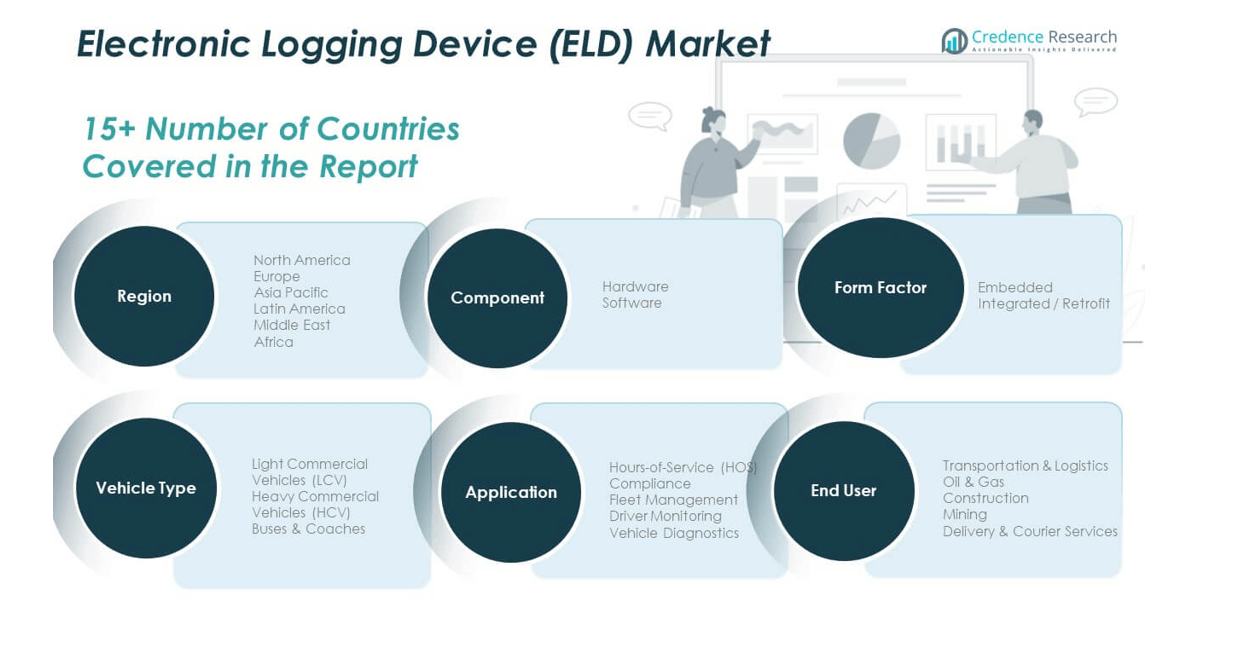
The Electronic Logging Device Market is segmented by component, application, end-user, form factor, and vehicle type.

By component, hardware holds a major share due to high demand for durable and compliant tracking units across commercial fleets. Software grows steadily with the adoption of data analytics, cloud integration, and mobile connectivity that enhance real-time reporting and compliance accuracy. Integration between hardware and software platforms improves automation and fleet visibility, supporting seamless operational control across transport networks.

  • For instance, MiX Telematics hardware supports fleet and asset tracking with high system uptime of 99.9%. Software grows steadily with the adoption of data analytics, cloud integration, and mobile connectivity that enhance real-time reporting and compliance accuracy.

By application, Hours-of-Service (HOS) compliance leads due to strict enforcement of driver working hours. Fleet management follows, driven by the need for efficient routing and vehicle tracking. Driver monitoring and vehicle diagnostics gain momentum as fleets seek predictive maintenance and performance analytics to ensure safety and reduce downtime. By end-user, transportation and logistics dominate the demand landscape, supported by heavy fleet deployment. Oil and gas, construction, and mining sectors adopt ELDs for compliance and safety in remote operations. Delivery and courier services expand usage to manage increasing urban delivery volumes.

  • For instance, Lytx Compliance Services audits driver logs from multiple ELD providers, processes data within 24-48 hours, and offers dashboards for detailed compliance risk visibility.

By form factor, embedded systems gain traction in new-generation vehicles for reliable integration, while retrofit devices remain popular among existing fleets. By vehicle type, heavy commercial vehicles lead adoption due to regulatory obligations and long-haul operations. Light commercial vehicles and buses follow as ELD use expands to passenger and regional delivery segments. This diverse segmentation highlights the market’s broad industrial relevance and increasing alignment with digital fleet transformation.

Electronic Logging Device Market segmentation

Segmentation:

By Component

  • Hardware
  • Software

By Application

  • Hours-of-Service (HOS) Compliance
  • Fleet Management
  • Driver Monitoring
  • Vehicle Diagnostics

By End-User

  • Transportation & Logistics
  • Oil & Gas
  • Construction
  • Mining
  • Delivery & Courier Services

By Form Factor

  • Embedded
  • Integrated / Retrofit

By Vehicle Type

  • Light Commercial Vehicles (LCV)
  • Heavy Commercial Vehicles (HCV)
  • Buses & Coaches

By Region

  • North America
    • U.S.
    • Canada
    • Mexico
  • Europe
    • Germany
    • France
    • U.K.
    • Italy
    • Spain
    • Rest of Europe
  • Asia Pacific
    • China
    • Japan
    • India
    • South Korea
    • South-east Asia
    • Rest of Asia Pacific
  • Latin America
    • Brazil
    • Argentina
    • Rest of Latin America
  • Middle East & Africa
    • GCC Countries
    • South Africa
    • Rest of the Middle East and Africa

Regional Analysis:

North America

The North America Electronic Logging Device Market size was valued at USD 5,262.50 million in 2018 to USD 5,958.70 million in 2024 and is anticipated to reach USD 8,466.39 million by 2032, at a CAGR of 4.5% during the forecast period. North America accounts for nearly 41.7% of the global market share, driven by early regulatory mandates and strong telematics adoption. The region’s Federal Motor Carrier Safety Administration (FMCSA) rule enforces strict compliance across commercial fleets, ensuring near-universal use of ELDs. It benefits from advanced connectivity, high vehicle digitization, and established fleet management infrastructure. Key providers such as Samsara, Geotab, and Omnitracs lead innovation with AI-enabled analytics and integrated compliance systems. Transport companies across the U.S., Canada, and Mexico continue expanding ELD integration to enhance transparency and safety. It maintains technological leadership through advanced software ecosystems and scalable service models that support regional logistics expansion.

Europe

The Europe Electronic Logging Device Market size was valued at USD 3,175.00 million in 2018 to USD 3,486.77 million in 2024 and is anticipated to reach USD 4,674.76 million by 2032, at a CAGR of 3.8% during the forecast period. Europe contributes about 24.4% of the total market, supported by growing fleet automation and unified transport policies. The region benefits from the EU’s mobility package and digital tachograph directives promoting driver safety and compliance. It emphasizes sustainable transport systems that integrate ELD data into eco-driving frameworks. Germany, the UK, and France remain leading adopters with advanced logistics and vehicle tracking networks. Fleet operators invest in cloud-based ELDs for multi-country reporting and analytics. Rising demand for cross-border visibility and performance efficiency boosts adoption across European carriers. It continues to evolve toward connected, low-emission logistics systems that align with environmental and operational goals.

Asia Pacific

The Asia Pacific Electronic Logging Device Market size was valued at USD 2,837.50 million in 2018 to USD 3,401.99 million in 2024 and is anticipated to reach USD 5,377.71 million by 2032, at a CAGR of 5.9% during the forecast period. The region represents nearly 27.1% of the global share, showing the fastest growth pace globally. Rising logistics activities in China, India, Japan, and Southeast Asia drive high adoption rates. Governments encourage transport digitalization through smart fleet programs and vehicle tracking mandates. It gains traction due to expanding e-commerce, infrastructure investment, and competitive telematics pricing. Local and global vendors collaborate to deliver cost-effective and scalable ELD solutions. The market benefits from increasing awareness of compliance, road safety, and performance management. It remains the most dynamic region, supported by industrial expansion and rapid fleet modernization.

Latin America

The Latin America Electronic Logging Device Market size was valued at USD 608.75 million in 2018 to USD 687.85 million in 2024 and is anticipated to reach USD 886.51 million by 2032, at a CAGR of 3.3% during the forecast period. Latin America contributes around 4.9% of the global market share, with gradual adoption supported by regulatory progress and logistics growth. Countries such as Brazil and Mexico show stronger implementation due to road transport modernization and regional trade expansion. It benefits from fleet safety awareness and the demand for operational efficiency in long-haul trucking. Local vendors develop affordable retrofit solutions to meet regional fleet requirements. Increasing private investment in digital logistics drives system integration across carriers. The market expands with urbanization and e-commerce growth, improving tracking and compliance capabilities. It holds potential for steady expansion through regulatory harmonization and connected fleet innovations.

Middle East

The Middle East Electronic Logging Device Market size was valued at USD 387.50 million in 2018 to USD 408.98 million in 2024 and is anticipated to reach USD 510.82 million by 2032, at a CAGR of 2.9% during the forecast period. The region accounts for nearly 3.2% of the global market, reflecting moderate adoption driven by fleet modernization programs. GCC countries lead in ELD usage due to smart transport initiatives and growing commercial logistics. It benefits from digital infrastructure and rising investment in intelligent transportation systems. Oil and gas fleets use ELDs to enhance safety and regulatory compliance. Regional players focus on integrating devices with existing telematics for asset tracking. Partnerships with global vendors support technology transfer and compliance monitoring. It continues to develop through diversified fleet operations and government support for transport automation.

Africa

The Africa Electronic Logging Device Market size was valued at USD 228.75 million in 2018 to USD 359.07 million in 2024 and is anticipated to reach USD 430.73 million by 2032, at a CAGR of 1.9% during the forecast period. Africa represents about 2.7% of the global market share, showing early adoption stages but rising interest in fleet safety systems. South Africa leads regional use due to established commercial transport infrastructure. It benefits from donor-funded logistics projects and growing digital awareness. Local fleet operators adopt ELDs to improve asset visibility and reduce downtime. Challenges include limited connectivity and high implementation costs in smaller economies. International vendors target partnerships to expand coverage in emerging corridors. It holds long-term potential through government-led safety campaigns and gradual logistics digitalization across key trade regions.

Shape Your Report to Specific Countries or Regions & Enjoy 30% Off!

Key Player Analysis:

  • Omnitracs
  • Trimble Inc.
  • Geotab Inc.
  • Teletrac Navman
  • Donlen Corporation
  • Motive (formerly KeepTruckin)
  • Verizon Connect
  • Samsara Inc.
  • EROAD
  • AtlasTracker
  • Gorilla Safety
  • Pedigree Technologies
  • Rand McNally
  • Transflo

Competitive Analysis:

The Electronic Logging Device Market features intense competition among several global providers. Leading firms such as Geotab Inc., Samsara Inc., Omnitracs, Trimble Inc. and Verizon Connect compete on hardware-software integration, analytics capabilities and regulatory compliance coverage. Companies differentiate by offering cloud-based telematics, predictive maintenance tools, scalable pricing models and cross-region support. Smaller and niche providers attempt to gain share through cost-effective retrofit kits or flexible subscription models. The market rewards innovation in connectivity, data analytics and ease of deployment, placing pressure on firms to continuously upgrade their offerings. Consolidation and strategic partnerships also shape competitive dynamics. It remains critical for players to balance compliance features, reliability, and user-friendly interfaces to maintain or grow their market positions.

Recent Developments:

  • In January 2025, Trimble partnered with Qualcomm to launch an ultra-precise positioning technology for heavy vehicles, offering centimeter-level accuracy designed to improve navigation and safety for automated trucks, with commercial deployment expected by 2028.
  • In February 2024, Geotab Inc. partnered with Daimler Trucks North America to integrate its MyGeotab platform with Daimler trucks, boosting data connectivity and fleet management for trucking operations.

Report Coverage:

The research report offers an in-depth analysis based on component, application, end-user, form factor, and vehicle type. It details leading market players, providing an overview of their business, product offerings, investments, revenue streams, and key applications. Additionally, the report includes insights into the competitive environment, SWOT analysis, current market trends, as well as the primary drivers and constraints. Furthermore, it discusses various factors that have driven market expansion in recent years. The report also explores market dynamics, regulatory scenarios, and technological advancements that are shaping the industry. It assesses the impact of external factors and global economic changes on market growth. Lastly, it provides strategic recommendations for new entrants and established companies to navigate the complexities of the market.

Future Outlook:

  • The Electronic Logging Device Market will experience consistent growth driven by fleet modernization and regulatory mandates.
  • Expansion of cloud-based analytics platforms will increase demand for connected and automated compliance tools.
  • Integration of artificial intelligence and machine learning will enhance predictive fleet management and driver monitoring.
  • The market will witness greater adoption across small and mid-sized fleets due to affordable ELD subscription models.
  • Growing emphasis on fuel efficiency and route optimization will push demand for data-driven fleet management systems.
  • Embedded ELD solutions will gain traction in next-generation vehicles, replacing conventional plug-in models.
  • Regional regulatory harmonization will create opportunities for international logistics companies to standardize ELD systems.
  • Partnerships between OEMs and telematics providers will strengthen hardware–software integration across fleets.
  • ELD platforms will evolve toward full telematics ecosystems supporting EV fleets and autonomous logistics operations.
  • Sustainability goals will encourage the development of low-power, eco-friendly ELD devices with extended lifecycle performance.

CHAPTER NO. 1 :      GENESIS OF THE MARKET           

1.1 Market Prelude – Introduction & Scope

1.2 The Big Picture – Objectives & Vision

1.3 Strategic Edge – Unique Value Proposition

1.4 Stakeholder Compass – Key Beneficiaries

CHAPTER NO. 2 :      EXECUTIVE LENS

2.1 Pulse of the Industry – Market Snapshot

2.2 Growth Arc – Revenue Projections (USD Million)

2.3. Premium Insights – Based on Primary Interviews

CHAPTER NO. 3 :      ELECTRONIC LOGGING DEVICE (ELD) MARKET FORCES & INDUSTRY PULSE        

3.1 Foundations of Change – Market Overview
3.2 Catalysts of Expansion – Key Market Drivers
3.2.1 Momentum Boosters – Growth Triggers
3.2.2 Innovation Fuel – Disruptive Technologies
3.3 Headwinds & Crosswinds – Market Restraints
3.3.1 Regulatory Tides – Compliance Challenges
3.3.2 Economic Frictions – Inflationary Pressures
3.4 Untapped Horizons – Growth Potential & Opportunities
3.5 Strategic Navigation – Industry Frameworks
3.5.1 Market Equilibrium – Porter’s Five Forces
3.5.2 Ecosystem Dynamics – Value Chain Analysis
3.5.3 Macro Forces – PESTEL Breakdown

3.6 Price Trend Analysis

3.6.1 Regional Price Trend
3.6.2 Price Trend by product

CHAPTER NO. 4 :      KEY INVESTMENT EPICENTER    

4.1 Regional Goldmines – High-Growth Geographies

4.2 Product Frontiers – Lucrative Product Categories

4.3 Application Sweet Spots – Emerging Demand Segments

CHAPTER NO. 5: REVENUE TRAJECTORY & WEALTH MAPPING

5.1 Momentum Metrics – Forecast & Growth Curves

5.2 Regional Revenue Footprint – Market Share Insights

5.3 Segmental Wealth Flow – Component & Application Revenue

CHAPTER NO. 6 :      TRADE & COMMERCE ANALYSIS

6.1.      Import Analysis by Region

6.1.1.    Global Electronic Logging Device (ELD) Market Import Revenue By Region

6.2.      Export Analysis by Region

6.2.1.    Global Electronic Logging Device (ELD) Market Export Revenue By Region

CHAPTER NO. 7 :      COMPETITION ANALYSIS 

7.1.      Company Market Share Analysis

7.1.1.    Global Electronic Logging Device (ELD) Market: Company Market Share

7.2.      Global Electronic Logging Device (ELD) Market Company Revenue Market Share

7.3.      Strategic Developments

7.3.1.    Acquisitions & Mergers

7.3.2.    New Product Launch

7.3.3.    Regional Expansion

7.4.      Competitive Dashboard

7.5.    Company Assessment Metrics, 2024

CHAPTER NO. 8 :      ELECTRONIC LOGGING DEVICE (ELD) MARKET – BY COMPONENT SEGMENT ANALYSIS        

8.1.      Electronic Logging Device (ELD) Market Overview by Component Segment

8.1.1.    Electronic Logging Device (ELD) Market Revenue Share By Component

8.2.      Hardware

8.3.      Software

CHAPTER NO. 9 :      ELECTRONIC LOGGING DEVICE (ELD) MARKET – BY APPLICATION SEGMENT ANALYSIS       

9.1.      Electronic Logging Device (ELD) Market Overview by Application Segment

9.1.1.    Electronic Logging Device (ELD) Market Revenue Share By Application

9.2.      Hours-of-Service (HOS) Compliance

9.3.      Fleet Management

9.4.      Driver Monitoring

9.5.      Vehicle Diagnostics

CHAPTER NO. 10 :    ELECTRONIC LOGGING DEVICE (ELD) MARKET – BY END-USER SEGMENT ANALYSIS  

10.1.     Electronic Logging Device (ELD) Market Overview by End-user Segment

10.1.1.  Electronic Logging Device (ELD) Market Revenue Share By End-user

10.2.     Transportation & Logistics

10.3.     Oil & Gas

10.4.     Construction

10.5.     Mining

10.6.     Delivery & Courier Services

CHAPTER NO. 11 :    ELECTRONIC LOGGING DEVICE (ELD) MARKET – BY FORM FACTOR SEGMENT ANALYSIS     

11.1.     Electronic Logging Device (ELD) Market Overview by Form Factor Segment

11.1.1.  Electronic Logging Device (ELD) Market Revenue Share By Form Factor

11.2.     Embedded

11.3.     Integrated / Retrofit

CHAPTER NO. 12 :    ELECTRONIC LOGGING DEVICE (ELD) MARKET – BY VEHICLE TYPE SEGMENT ANALYSIS     

12.1.     Electronic Logging Device (ELD) Market Overview by Vehicle Type Segment

12.1.1.  Electronic Logging Device (ELD) Market Revenue Share By Vehicle Type

12.2.     Light Commercial Vehicles (LCV)

12.3.     Heavy Commercial Vehicles (HCV)

12.4.     Buses & Coaches

CHAPTER NO. 13 :    ELECTRONIC LOGGING DEVICE (ELD) MARKET – REGIONAL ANALYSIS

13.1.     Electronic Logging Device (ELD) Market Overview by Region Segment

13.1.1.  Global Electronic Logging Device (ELD) Market Revenue Share By Region

13.1.2.  Regions

13.1.3.  Global Electronic Logging Device (ELD) Market Revenue By Region

13.1.4.  Component

13.1.5.  Global Electronic Logging Device (ELD) Market Revenue By Component

13.1.6.  Application

13.1.7.  Global Electronic Logging Device (ELD) Market Revenue By Application

13.1.8.  End-user

13.1.9.  Global Electronic Logging Device (ELD) Market Revenue By End-user

13.1.10. Form Factor

13.1.12. Global Electronic Logging Device (ELD) Market Revenue By Form Factor

13.1.13. Vehicle Type

13.1.14. Global Electronic Logging Device (ELD) Market Revenue By Vehicle Type

CHAPTER NO. 14 :    NORTH AMERICA ELECTRONIC LOGGING DEVICE (ELD) MARKET – COUNTRY ANALYSIS  

14.1.     North America Electronic Logging Device (ELD) Market Overview by Country Segment

14.1.1.  North America Electronic Logging Device (ELD) Market Revenue Share By Region

14.2.     North America

14.2.1.  North America Electronic Logging Device (ELD) Market Revenue By Country

14.2.2.  Component

14.2.3.  North America Electronic Logging Device (ELD) Market Revenue By Component

14.2.4.  Application

14.2.5.  North America Electronic Logging Device (ELD) Market Revenue By Application

14.2.6.  End-user

14.2.7.  North America Electronic Logging Device (ELD) Market Revenue By End-user

14.2.8.  Form Factor

14.2.9.  North America Electronic Logging Device (ELD) Market Revenue By Form Factor

14.2.10. Vehicle Type

14.2.11. North America Electronic Logging Device (ELD) Market Revenue By Vehicle Type

14.3.     U.S.

14.4.     Canada

14.5.     Mexico

CHAPTER NO. 15 :    EUROPE ELECTRONIC LOGGING DEVICE (ELD) MARKET – COUNTRY ANALYSIS 

15.1.     Europe Electronic Logging Device (ELD) Market Overview by Country Segment

15.1.1.  Europe Electronic Logging Device (ELD) Market Revenue Share By Region

15.2.     Europe

15.2.1.  Europe Electronic Logging Device (ELD) Market Revenue By Country

15.2.2.  Component

15.2.3.  Europe Electronic Logging Device (ELD) Market Revenue By Component

15.2.4.  Application

15.2.5.  Europe Electronic Logging Device (ELD) Market Revenue By Application

15.2.6.  End-user

15.2.7.  Europe Electronic Logging Device (ELD) Market Revenue By End-user

15.2.8.  Form Factor

15.2.9.  Europe Electronic Logging Device (ELD) Market Revenue By Form Factor

15.2.10. Vehicle Type

15.2.11. Europe Electronic Logging Device (ELD) Market Revenue By Vehicle Type

15.3.     UK

15.4.     France

15.5.     Germany

15.6.     Italy

15.7.     Spain

15.8.     Russia

15.9.   Rest of Europe

CHAPTER NO. 16 :    ASIA PACIFIC ELECTRONIC LOGGING DEVICE (ELD) MARKET – COUNTRY ANALYSIS 

16.1.     Asia Pacific Electronic Logging Device (ELD) Market Overview by Country Segment

16.1.1.  Asia Pacific Electronic Logging Device (ELD) Market Revenue Share By Region

16.2.     Asia Pacific

16.2.1.  Asia Pacific Electronic Logging Device (ELD) Market Revenue By Country

16.2.2.  Component

16.2.3.  Asia Pacific Electronic Logging Device (ELD) Market Revenue By Component

16.2.4.  Application

16.2.5.  Asia Pacific Electronic Logging Device (ELD) Market Revenue By Application

16.2.6.  End-user

16.2.7.  Asia Pacific Electronic Logging Device (ELD) Market Revenue By End-user

16.2.8.  Form Factor

16.2.9.  Asia Pacific Electronic Logging Device (ELD) Market Revenue By Form Factor

16.2.10. Vehicle Type

16.2.11. Asia Pacific Electronic Logging Device (ELD) Market Revenue By Vehicle Type

16.3.     China

16.4.     Japan

16.5.     South Korea

16.6.     India

16.7.     Australia

16.8.     Southeast Asia

16.9.     Rest of Asia Pacific

CHAPTER NO. 17 :    LATIN AMERICA ELECTRONIC LOGGING DEVICE (ELD) MARKET – COUNTRY ANALYSIS

17.1.     Latin America Electronic Logging Device (ELD) Market Overview by Country Segment

17.1.1.  Latin America Electronic Logging Device (ELD) Market Revenue Share By Region

17.2.     Latin America

17.2.1.  Latin America Electronic Logging Device (ELD) Market Revenue By Country

17.2.2.  Component

17.2.3.  Latin America Electronic Logging Device (ELD) Market Revenue By Component

17.2.4.  Application

17.2.5.  Latin America Electronic Logging Device (ELD) Market Revenue By Application

17.2.6.  End-user

17.2.7.  Latin America Electronic Logging Device (ELD) Market Revenue By End-user

17.2.8.  Form Factor

17.2.9.  Latin America Electronic Logging Device (ELD) Market Revenue By Form Factor

17.2.10. Vehicle Type

17.2.11. Latin America Electronic Logging Device (ELD) Market Revenue By Vehicle Type

17.3.     Brazil

17.4.     Argentina

17.5.     Rest of Latin America

CHAPTER NO. 18 :    MIDDLE EAST ELECTRONIC LOGGING DEVICE (ELD) MARKET – COUNTRY ANALYSIS

18.1.     Middle East Electronic Logging Device (ELD) Market Overview by Country Segment

18.1.1.  Middle East Electronic Logging Device (ELD) Market Revenue Share By Region

18.2.     Middle East

18.2.1.  Middle East Electronic Logging Device (ELD) Market Revenue By Country

18.2.2.  Component

18.2.3.  Middle East Electronic Logging Device (ELD) Market Revenue By Component

18.2.4.  Application

18.2.5.  Middle East Electronic Logging Device (ELD) Market Revenue By Application

18.2.6.  End-user

18.2.7.  Middle East Electronic Logging Device (ELD) Market Revenue By End-user

18.2.8.  Form Factor

18.2.9.  Middle East Electronic Logging Device (ELD) Market Revenue By Form Factor

18.2.10. Vehicle Type

18.2.11. Middle East Electronic Logging Device (ELD) Market Revenue By Vehicle Type

18.3.     GCC Countries

18.4.     Israel

18.5.     Turkey

18.6.     Rest of Middle East

CHAPTER NO. 19 :    AFRICA ELECTRONIC LOGGING DEVICE (ELD) MARKET – COUNTRY ANALYSIS       

19.1.     Africa Electronic Logging Device (ELD) Market Overview by Country Segment

19.1.1.  Africa Electronic Logging Device (ELD) Market Revenue Share By Region

19.2.     Africa

19.2.1.  Africa Electronic Logging Device (ELD) Market Revenue By Country

19.2.2.  Component

19.2.3.  Africa Electronic Logging Device (ELD) Market Revenue By Component

19.2.4.  Application

19.2.5.  Africa Electronic Logging Device (ELD) Market Revenue By Application

19.2.6.  End-user

19.2.7.  Africa Electronic Logging Device (ELD) Market Revenue By End-user

19.2.8.  Form Factor

19.2.9.  Africa Electronic Logging Device (ELD) Market Revenue By Form Factor

19.2.10. Vehicle Type

19.2.11. Africa Electronic Logging Device (ELD) Market Revenue By Vehicle Type

19.3.     South Africa

19.4.     Egypt

19.5.     Rest of Africa

CHAPTER NO. 20 :    COMPANY PROFILES         

20.1.     Omnitracs

20.1.1.  Company Overview

20.1.2.  Product Portfolio

20.1.3.  Financial Overview

20.1.4.  Recent Developments

20.1.5.  Growth Strategy

20.1.6.  SWOT Analysis

20.2.     Trimble

20.3.     Geotab

20.4.     Teletrac Navman

20.5.     Donlen

20.6.     Motive (formerly KeepTruckin)

20.7.     Verizon Connect

20.8.     Samsara

20.9.     EROAD

20.10.   AtlasTracker

20.11.   Gorilla Safety

20.12.   Pedigree Technologies

20.13.   Rand McNally

20.14.   Transflo

Request Free Sample

We prioritize the confidentiality and security of your data. Our promise: your information remains private.

Ready to Transform Data into Decisions?

Request Your Sample Report and Start Your Journey of Informed Choices


Providing the strategic compass for industry titans.

cr-clients-logos

Frequently Asked Questions

What is the projected growth of the Electronic Logging Device (ELD) market?

The Electronic Logging Device Market was valued at USD 14,303.36 million in 2024 and is expected to reach USD 20,346.91 million by 2032, reflecting steady expansion.

At what Compound Annual Growth Rate is the Electronic Logging Device Market projected to grow between 2024 and 2032?

The Electronic Logging Device Market is projected to grow at a CAGR of 4.55% during the forecast period, supported by regulatory compliance and digitization trends.

What are the main drivers of the ELD market?

Key drivers include increasing government regulations on driver hours-of-service (HOS) and the growing need for fleet management solutions, as well as the adoption of ELD mandates in regions like North America and Europe.

How do ELDs benefit businesses?

ELDs improve fleet efficiency by automating hours-of-service tracking, reducing human error, preventing fraud, and enabling better route planning, fuel management, and real-time vehicle monitoring, leading to cost savings.

Which regions are driving the ELD market growth?

North America, due to stringent regulations like the U.S. ELD mandate, and Europe, with similar compliance pressures, are leading the market. The Asia Pacific region is also growing rapidly, along with Latin America and the Middle East & Africa.

How is technology influencing the ELD market?

The integration of ELDs with telematics, cloud-based fleet management systems, and other advanced technologies is enhancing their popularity and driving further growth in the market.

About Author

Ganesh Chandwade

Ganesh Chandwade

Senior Industry Consultant

Ganesh is a senior industry consultant specializing in heavy industries and advanced materials.

View Profile

Related Reports

Automotive Headliner (OE) Market

Automotive Headliner OE market size was valued at USD 12.4 Billion in 2024 and is anticipated to reach USD 16.97 Billion by 2032, at a CAGR of 4% during the forecast period.

Fifth Wheel Coupling Market

The Fifth Wheel Coupling Market size was valued at USD 650.00 million in 2018 to USD 762.19 million in 2024 and is anticipated to reach USD 1,158.91 million by 2032, at a CAGR of 5.45% during the forecast period.

Logistics Market

The global logistics market reached USD 5,650 billion in 2024 and is projected to grow to USD 7,625.99 billion by 2032, reflecting a CAGR of 3.82% during the forecast period.

Interior Car Accessories Market

Interior Car Accessories Market size was valued USD 304915 million in 2024 and is anticipated to reach USD 471508.81 million by 2032, at a CAGR of 5.6% during the forecast period.

Garbage Collection Trucks Market

Garbage Collection Trucks Market size was valued at USD 14.5 Billion in 2024 and is anticipated to reach USD 19.4 Billion by 2032, growing at a CAGR of 3.71% during the forecast period.

Lube Trucks Market

The Lube Trucks market was valued at USD 1,838.5 million in 2024 and is projected to reach USD 2,737.07 million by 2032, expanding at a CAGR of 5.1% during the forecast period.

Electric Boat Market

The Electric Boat Market size was valued at USD 4,100.00 million in 2018 to USD 6,507.94 million in 2024 and is anticipated to reach USD 18,413.29 million by 2032, at a CAGR of 13.91% during the forecast period.

Automotive Telematics Market

The Automotive Telematics Market size reached USD 45,488 million in 2024 and is expected to grow to USD 114,245.7 million by 2032, registering a CAGR of 12.2% during the forecast period.

EV Sensors Market

The EV Sensors Market was valued at USD 16 Billion in 2024 and is anticipated to reach USD 50.66 Billion by 2032, growing at a CAGR of 15.5% during the forecast period.

Electric Track Vehicle System Market

The Electric Track Vehicle System market reached USD 32.21 billion in 2024 and is projected to reach USD 87.47 billion by 2032, registering a CAGR of 13.3% during the forecast period.

E-Commerce Logistics Market

The e-commerce logistics market reached USD 470.83 billion in 2024 and is projected to grow to USD 2,325.91 billion by 2032, reflecting a strong CAGR of 22.1% during the forecast period.

Automotive Simulation Market

The Automotive Simulation market reached USD 2,158 million in 2024 and is projected to rise to USD 4,163.04 million by 2032, registering a CAGR of 8.56% during the forecast period.

Licence Option

The report comes as a view-only PDF document, optimized for individual clients. This version is recommended for personal digital use and does not allow printing. Use restricted to one purchaser only.
$4999

To meet the needs of modern corporate teams, our report comes in two formats: a printable PDF and a data-rich Excel sheet. This package is optimized for internal analysis. Unlimited users allowed within one corporate location (e.g., regional office).
$6999

The report will be delivered in printable PDF format along with the report’s data Excel sheet. This license offers 100 Free Analyst hours where the client can utilize Credence Research Inc. research team. Permitted for unlimited global use by all users within the purchasing corporation, such as all employees of a single company.
$12999

Report delivery within 24 to 48 hours

Credence Staff 3

WILLIAM, North America

Support Staff at Credence Research

KEITH PHILLIPS, Europe

Lee - CR Sales Staff

LEE VALLANCE, Asia Pacific

Kieran Jameson

KIERAN JAMESON, Australia

Smallform of Sample request
User Review

Thank you for the data! The numbers are exactly what we asked for and what we need to build our business case.

Materials Scientist
(privacy requested)

User Review

The report was an excellent overview of the Industrial Burners market. This report does a great job of breaking everything down into manageable chunks.

Imre Hof
Management Assistant, Bekaert

cr-clients-logos

Request Sample