Home » Information and Communications Technology » Technology & Media » U.S. Mainframe Modernization Services Market

U.S. Mainframe Modernization Services Market By Service Type (Application Modernization, Data Modernization, Infrastructure Modernization, Integration Services, Consulting and Assessment Services); By Modernization Approach (Rehosting, Replatforming, Refactoring, Re-architecting, Replacement); By End-User (Banking, Financial Services, and Insurance (BFSI), Government and Public Sector, Healthcare and Life Sciences, Retail and E-commerce, Manufacturing and Others); By Organization Size (Large Enterprises, Small and Medium Enterprises); By Deployment Type (On-Premise, Cloud-Based, Hybrid Deployment) – Growth, Share, Opportunities & Competitive Analysis, 2024 – 2032

Report ID: 65626 | Report Format : Excel, PDF

Market Overview:

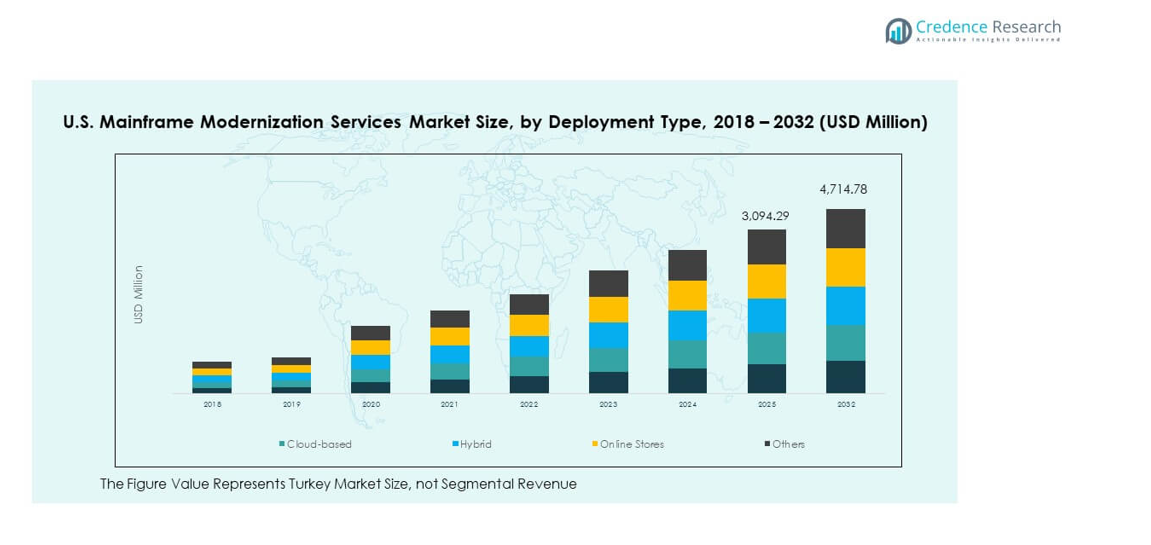
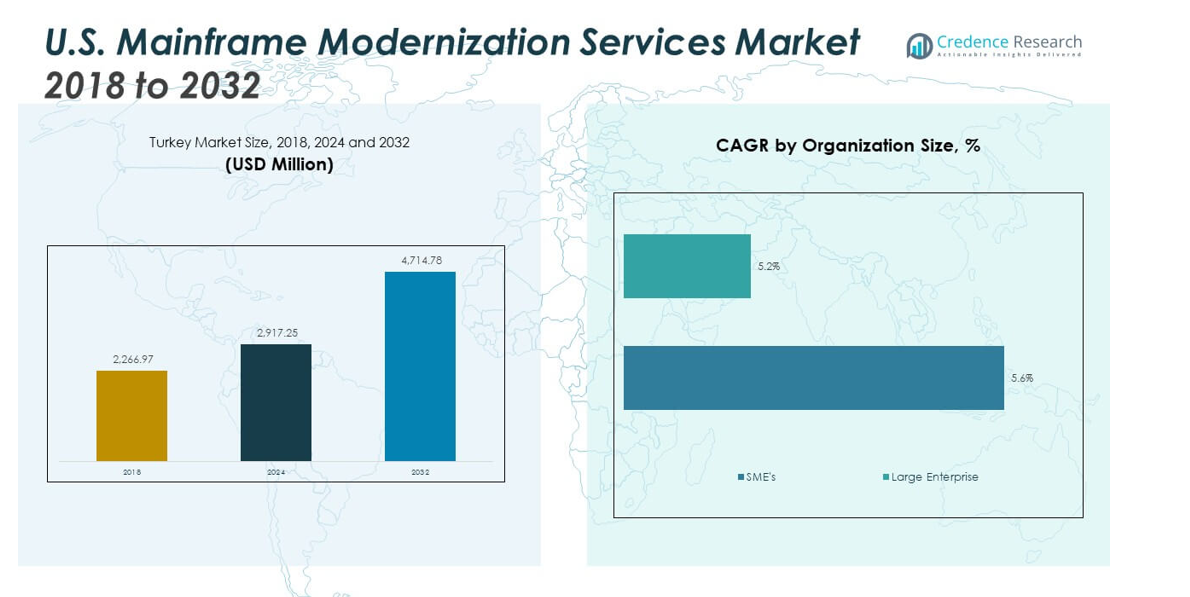
The U.S. Mainframe Modernization Services Market size was valued at USD 2,266.97 million in 2018 to USD 2,917.25 million in 2024 and is anticipated to reach USD 4,714.78 million by 2032, at a CAGR of 6.20% during the forecast period.

REPORT ATTRIBUTE DETAILS
Historical Period 2020-2023
Base Year 2024
Forecast Period 2025-2032
U.S. Mainframe Modernization Services Market Size 2024 USD 2,917.25 million
U.S. Mainframe Modernization Services Market, CAGR 6.20%
U.S. Mainframe Modernization Services Market Size 2032 USD 4,714.78 million


Market growth is driven by rising pressure to reduce operational risk and improve agility. Enterprises modernize mainframes to integrate cloud, analytics, and API-based systems. Skilled workforce shortages push firms toward managed modernization partners. Regulatory compliance also drives upgrades in security and data governance. Cost optimization motivates code refactoring and workload optimization. Business demand for faster application deployment supports DevOps adoption. These factors together strengthen demand for structured and phased modernization programs.

The market is led by the United States due to a high concentration of legacy mainframe users. Financial services, government agencies, and large retailers drive sustained demand. The Northeast and Midwest remain strong due to dense enterprise and public sector presence. The West Coast shows growth from digital-first integration projects. Southern states emerge through modernization in healthcare and utilities. Nationwide adoption reflects broad reliance on mainframe platforms across industries.

U.S. Mainframe Modernization Services Market size

Market Insights:

  • The market expanded from USD 2,266.97 million in 2018 to USD 2,917.25 million in 2024 and is projected to reach USD 4,714.78 million by 2032, growing at a CAGR of 6.20%, driven by sustained enterprise reliance on legacy mainframes and phased modernization strategies.
  • The Western United States leads with about 35% share due to strong technology adoption and large enterprise IT budgets, followed by the Northeast at nearly 25% supported by BFSI concentration, and the Midwest at around 22% driven by manufacturing and regional financial institutions.
  • The Southern United States is the fastest-growing region with close to 18% share, supported by rising healthcare, telecom, and public sector modernization activity and wider adoption of hybrid deployment models.
  • By deployment type, hybrid deployment holds the largest share at about 45%, reflecting enterprise preference for balancing control with scalability while modernizing critical workloads.
  • Cloud-based deployment accounts for nearly 35% share, driven by flexibility and integration needs, while on-premise models retain around 20% share due to compliance and data sensitivity requirements.

Access crucial information at unmatched prices!

Request your sample report today & start making informed decisions powered by Credence Research Inc.!

Download Sample

Market Drivers:

Sustained Reliance On Mainframes For High-Volume Mission-Critical Operations

Large enterprises depend on mainframes for core transaction processing. Financial institutions process payments and settlements on these systems. Insurance firms manage policies and claims through legacy platforms. Government agencies rely on mainframes for citizen records. System stability remains non-negotiable for these users. Modernization extends system life without disruption. Risk reduction drives service adoption. The U.S. Mainframe Modernization Services Market supports controlled transformation.

  • For instance, IBM zSystems supports hybrid cloud DevOps pipelines that perform up to 15× faster in test cycles. Modernization extends system life without disruption. Risk reduction drives service adoption.

Enterprise Pressure To Improve Operational Agility And Application Responsiveness

Business units demand faster product and service launches. Legacy environments limit rapid application changes. Modernization enables modular application architectures. Service providers refactor code for flexibility. Enterprises gain faster development cycles. Improved responsiveness supports competitive positioning. IT teams align systems with business goals. Agility remains a key modernization driver.

  • For instance, Infosys modernization helped a telco save USD 13 million annually by re-engineering CRM. Improved responsiveness supports competitive positioning.

Escalating Workforce Constraints Within Legacy Technology Environments

Mainframe-skilled professionals continue to retire. New graduates favor cloud-native technologies. Enterprises face operational continuity risk. Service partners provide specialized expertise. Knowledge transfer becomes a priority activity. Automation reduces manual dependency. Workforce gaps accelerate modernization decisions. Talent scarcity shapes long-term strategy.

Heightened Focus On Security, Audit Readiness, And System Resilience

Cyber threats target legacy vulnerabilities. Regulators demand stronger data controls. Enterprises modernize to enhance security frameworks. Improved monitoring supports audit readiness. Encryption upgrades protect sensitive data. Resilience planning gains executive attention. Modernization aligns systems with compliance needs. Security concerns sustain demand.

U.S. Mainframe Modernization Services Market share

Market Trends:

Growing Preference For Incremental Modernization Over Full System Replacement

Enterprises avoid disruptive platform replacements. Incremental approaches reduce operational risk. Teams modernize applications in defined phases. Core processing remains intact. This model suits regulated industries. Service providers design staged roadmaps. Risk-managed execution gains favor. Adoption continues across sectors.

  • For instance, Roc ket Software closes a USD 2.275 billion acquisition of modernization & connectivity assets, enhancing hybrid capabilities.

Expansion Of Platform-Agnostic Toolsets Supporting Cross-Environment Operations

Tool vendors support mainframe and cloud integration. Unified toolsets simplify system management. Enterprises gain centralized visibility. Cross-platform tools improve efficiency. Vendors invest in interoperability features. Standardization reduces operational complexity. Tool maturity influences vendor selection. This trend reshapes service delivery.

  • For instance, Google Cloud’s Mainframe Assessment Tool inventories workloads and recommends target architectures. Vendors invest in interoperability features. Standardization reduces operational complexity.

Rising Use Of Advanced Testing And Simulation Before Production Changes

Enterprises emphasize pre-deployment validation. Simulation tools model workload behavior. Testing reduces outage risk. Automated testing improves release confidence. Providers embed testing frameworks in projects. Quality assurance gains priority. Risk avoidance shapes modernization planning. Testing maturity defines success.

Increased Adoption Of Long-Term Managed Modernization Engagement Models

Enterprises favor predictable service structures. Managed models reduce internal workload. Providers offer continuous optimization services. Performance metrics guide service outcomes. Long-term contracts improve cost visibility. Trust strengthens provider relationships. This trend supports recurring revenue growth. Managed services gain traction.

Market Challenges Analysis:

High Architectural Complexity Across Decades Of Customized Legacy Systems

Mainframe environments reflect long customization histories. Documentation gaps hinder transformation planning. Interconnected applications raise dependency risks. Testing cycles become resource intensive. Enterprises require uninterrupted system availability. Errors impact critical business functions. Providers face execution pressure. The U.S. Mainframe Modernization Services Market navigates these complexities.

Budget Sensitivity And Unclear Short-Term Business Value Perception

Modernization requires multi-year investment. Executive teams scrutinize spending justification. Benefits appear gradually over time. Cost overruns remain a concern. Scope creep challenges project control. ROI measurement lacks standard benchmarks. Decision cycles extend due to uncertainty. Financial caution slows adoption.

Market Opportunities:

Rising Modernization Demand Across Public Sector And Regulated Utility Enterprises

Public institutions operate large legacy estates. Budget discipline favors modernization strategies. Compliance requirements support upgrade initiatives. Utilities depend on system reliability. Modernization enhances disaster recovery readiness. Providers tailor solutions to regulatory needs. These sectors offer steady demand. Long-term contracts support growth.

Growth Of Industry-Aligned And Outcome-Focused Modernization Service Models

Enterprises seek sector-specific modernization expertise. Financial services prioritize transaction integrity. Healthcare emphasizes data accessibility and privacy. Outcome-based pricing gains interest. Providers link fees to performance milestones. This model improves accountability. Client trust strengthens partnerships. It expands service opportunities.

Market Segmentation Analysis:

By Service Type

Application modernization leads demand as enterprises update core systems for agility. Data modernization supports analytics, governance, and secure data access. Infrastructure modernization focuses on performance, scalability, and system resilience. Integration services enable connectivity with cloud and digital platforms. Consulting and assessment services guide roadmap design and risk control. These services support phased transformation programs. Service mix reflects enterprise maturity levels.

  • For instance, IBM’s zSystems DevOps integration can execute tests up to 15× faster than traditional mainframe. Integration services enable connectivity with cloud and digital platforms.

By Modernization Approach

Rehosting remains common for risk-averse organizations. Replatforming improves efficiency with limited code change. Refactoring supports performance and maintainability goals. Re-architecting enables long-term digital alignment. Replacement sees selective use for non-core applications. Approach choice depends on complexity and business impact. The U.S. Mainframe Modernization Services Market reflects a preference for balanced strategies.

  • For instance, tools like TmaxSoft OpenFrame rehost legacy assets to cloud environments quickly. Refactoring supports performance and maintainability goals.

By End-User

BFSI dominates due to transaction volume and compliance needs. Government and public sector drive steady modernization demand. Healthcare and life sciences focus on data access and security. Retail and e-commerce modernize for real-time operations. Manufacturing and others adopt modernization to improve system integration. End-user needs vary by regulatory and operational intensity. Sector diversity supports stable demand.

By Organization Size

Large enterprises represent the primary customer base. Complex legacy estates require structured modernization. Small and medium enterprises adopt selective upgrades. Budget control shapes SME service adoption. Scale influences service scope and timelines. Both segments value risk mitigation. Size affects provider engagement models.

By Deployment Type

On-premise remains relevant for sensitive workloads. Cloud-based deployment gains traction for flexibility. Hybrid deployment balances control and scalability. Enterprises favor hybrid for gradual transition. Deployment choice aligns with compliance needs. Architecture strategy drives service demand.

U.S. Mainframe Modernization Services Market segmentation

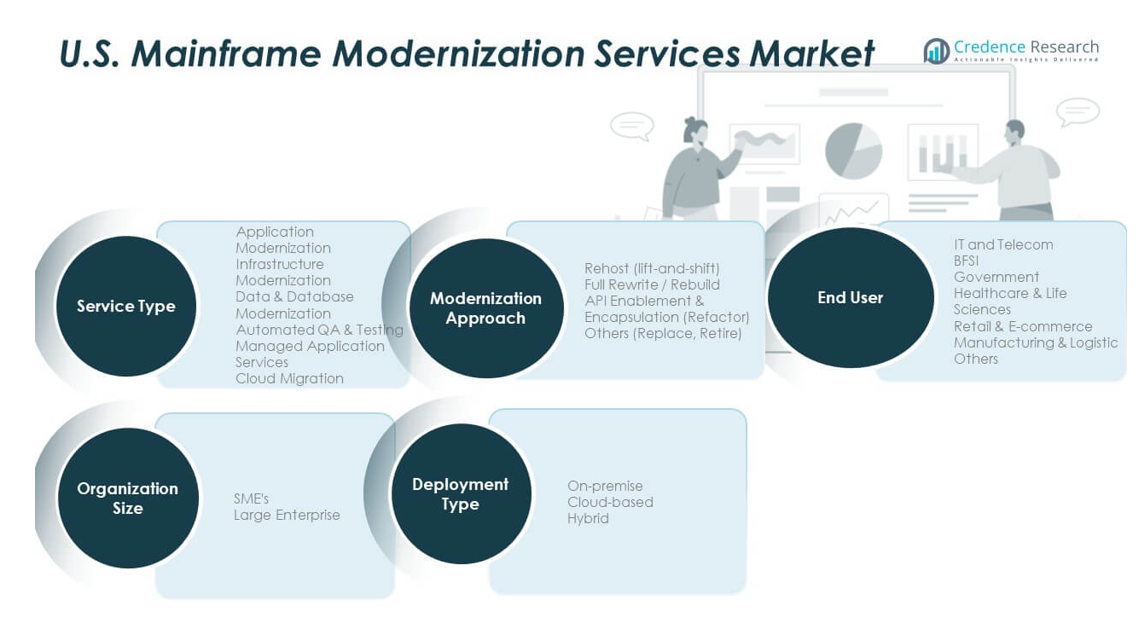
Segmentation:

  • By Service Type
    • Application Modernization
    • Data Modernization
    • Infrastructure Modernization
    • Integration Services
    • Consulting and Assessment Services
  • By Modernization Approach
    • Rehosting
    • Replatforming
    • Refactoring
    • Re-architecting
    • Replacement
  • By End-User
    • Banking, Financial Services, and Insurance (BFSI)
    • Government and Public Sector
    • Healthcare and Life Sciences
    • Retail and E-commerce
    • Manufacturing and Others
  • By Organization Size
    • Large Enterprises
    • Small and Medium Enterprises
  • By Deployment Type
    • On-Premise
    • Cloud-Based
    • Hybrid Deployment

Regional Analysis:

Western United States Dominates Through Technology-Driven Enterprise Demand

The U.S. Mainframe Modernization Services Market shows the Western United States leading with nearly 35% market share. The region benefits from a strong presence of technology firms and digital-first enterprises. Large corporations modernize mainframes to align with cloud-native ecosystems. Financial services, technology providers, and media companies drive steady demand. Enterprises focus on integration, automation, and scalability improvements. High IT budgets support complex multi-year modernization programs. The West remains the most advanced regional market.

Northeastern And Midwestern United States Sustain Demand From Core Industries

The Northeastern region accounts for around 25% market share, supported by dense BFSI concentration. Banks and insurers rely on mainframes for transaction-heavy operations. Regulatory oversight encourages continuous system upgrades. The Midwest contributes close to 22% share through manufacturing and regional financial institutions. Enterprises modernize to improve system reliability and integration. Cost discipline shapes phased project execution. Both regions value stability and long-term service partnerships.

Southern United States And Emerging Regional Markets Show Steady Expansion

The Southern United States holds approximately 18% market share and shows rising momentum. Healthcare, telecom, and energy enterprises drive modernization activity. Population growth supports expansion of digital public services. Enterprises adopt hybrid deployment models to manage risk. Smaller regional markets together represent about 10% share. These areas modernize selectively based on operational needs. Regional diversity supports balanced national growth.

Shape Your Report to Specific Countries or Regions & Enjoy 30% Off!

Key Player Analysis:

  • IBM
  • Infosys
  • Tata Consultancy Services (TCS)
  • Cognizant
  • Accenture
  • HCL Technologies
  • DXC Technology
  • Wipro
  • Capgemini
  • NTT DATA Services

Competitive Analysis:

The competitive landscape of the U.S. Mainframe Modernization Services Market features global IT service providers with deep legacy expertise. Large vendors compete on domain knowledge, delivery scale, and modernization frameworks. Firms differentiate through automation tools, hybrid architecture capability, and industry-specific solutions. Strategic partnerships with cloud providers strengthen service depth. Providers emphasize risk-controlled migration and phased execution models. Client retention depends on long-term managed service capability. Competitive intensity remains high due to large enterprise contracts and recurring revenue potential.

Recent Developments:

  • On December 16, 2025, Accenture signed an agreement to acquire a majority stake of 65% in DLB Associates, a US-based AI data center engineering and consulting firm. The acquisition is designed to expand Accenture’s end-to-end data center capabilities to help clients accelerate time to market and meet demand for AI enablement. Upon closing, DLB’s approximately 620 employees, led by David Quirk and Neil Chauhan, will join Accenture’s Industry X practice, augmenting its infrastructure and capital projects (I&CP) capabilities. DLB, founded in 1980, specializes in data center site selection, design engineering, commissioning, and energy optimization services. While not directly focused on mainframe modernization, this acquisition strengthens Accenture’s ability to support infrastructure modernization and AI-driven transformation initiatives for enterprise clients.
  • In May 2025, Cognizant expanded its strategic collaboration with Pegasystems to augment agentic AI services and drive rapid cloud transformations for joint clients. The partnership integrates Cognizant’s intellectual property with Pega Blueprint capabilities, enabling the rapid conversion of legacy systems into AI-powered solutions. The collaboration focuses on integrating Pega Blueprint with Cognizant’s internal innovation program Bluebolt to help teams rapidly convert ideas into Minimum Viable Products using low-code tools and AI-assisted process mapping. Cognizant leverages its AI-driven code rewrite workbench to extract legacy logic, data, and workflows, reimplementing them in cloud-ready environments on the Pega Infinity platform. This partnership represents a strategic shift away from traditional ‘lift-and-shift’ approaches toward AI-infused transformation journeys.
  • In April 2025, IBM announced the IBM z17, its next-generation mainframe platform engineered with integrated artificial intelligence capabilities spanning hardware, software, and system operations. The z17 features the Telum II processor with embedded AI accelerators, enabling the system to process over 450 billion inference operations daily with response times under one millisecond. The platform underwent five years of development incorporating feedback from more than 100 clients and resulted in more than 300 filed patents. The z17 achieved general availability on June 8, 2025. IBM is also introducing the Spyre Accelerator in Q4 2025 as an add-on to provide additional compute power for generative AI tasks. Additionally, IBM previewed z/OS 3.2, scheduled for Q3 2025, which will include support for hardware-accelerated AI and hybrid cloud data integration.

Report Coverage:

The research report offers an in-depth analysis based on service type, modernization approach, end-user, organization size, and deployment type. It details leading market players, providing an overview of their business, product offerings, investments, revenue streams, and key applications. Additionally, the report includes insights into the competitive environment, SWOT analysis, current market trends, as well as the primary drivers and constraints. Furthermore, it discusses various factors that have driven market expansion in recent years. The report also explores market dynamics, regulatory scenarios, and technological advancements that are shaping the industry. It assesses the impact of external factors and global economic changes on market growth. Lastly, it provides strategic recommendations for new entrants and established companies to navigate the complexities of the market.

Future Outlook:

  • Enterprises will prioritize phased modernization to reduce operational risk.
  • Hybrid deployment models will dominate long-term strategies.
  • Automation tools will shorten assessment and migration timelines.
  • Managed modernization services will gain wider acceptance.
  • BFSI and public sector demand will remain stable anchors.
  • Security-driven upgrades will shape service scope.
  • Skill shortages will support outsourcing growth.
  • Industry-specific modernization frameworks will expand.
  • Provider competition will intensify around value delivery.
  • Long-term contracts will improve revenue visibility.

CHAPTER NO. 1 : INTRODUCTION 21

1.1. Report Description 21

Purpose of the Report 21

USP & Key Offerings 21

1.2. Key Benefits for Stakeholders 22

1.3. Target Audience 22

CHAPTER NO. 2 : EXECUTIVE SUMMARY 23

CHAPTER NO. 3 : U.S. MAINFRAME MODERNIZATION SERVICES MARKET FORCES & INDUSTRY PULSE 25

3.1. Foundations of Change – Market Overview 25

3.2. Catalysts of Expansion – Key Market Drivers 27

3.3. Momentum Boosters – Growth Triggers 28

3.4. Innovation Fuel – Disruptive Technologies 28

3.5. Headwinds & Crosswinds – Market Restraints 29

3.6. Regulatory Tides – Compliance Challenges 30

3.7. Economic Frictions – Inflationary Pressures 30

3.8. Untapped Horizons – Growth Potential & Opportunities and Strategic Navigation – Industry Frameworks 31

3.9. Market Equilibrium – Porter’s Five Forces 32

3.10. Macro Forces – PESTEL Breakdown 34

CHAPTER NO. 4 : COMPETITION ANALYSIS 36

4.1. Company Market Share Analysis 36

4.1.1. U.S. Mainframe Modernization Services Market Company Revenue Market Share 36

4.2. Strategic Developments 38

4.2.1. Acquisitions & Mergers 38

4.2.2. New Service Type Launch 39

4.2.3. Agreements & Collaborations 40

4.3. Competitive Dashboard 41

4.4. Company Assessment Metrics, 2024 42

CHAPTER NO. 5 : U.S. MARKET ANALYSIS, INSIGHTS & FORECAST, BY SERVICE TYPE 43

CHAPTER NO. 6 : U.S. MARKET ANALYSIS, INSIGHTS & FORECAST, BY MODERNIZATION APPROACH 48

CHAPTER NO. 7 : U.S. MARKET ANALYSIS, INSIGHTS & FORECAST, BY END-USER 52

CHAPTER NO. 8 : U.S. MARKET ANALYSIS, INSIGHTS & FORECAST, BY ORGANIZATION SIZE 57

CHAPTER NO. 9 : U.S. MARKET ANALYSIS, INSIGHTS & FORECAST, BY DEPLOYMENT TYPE 61

CHAPTER NO. 10 : COMPANY PROFILE 65

10.1. IBM 65

10.2. Infosys 68

10.3. TCS 68

10.4. Cognizant 68

10.5. Accenture 68

10.6. HCL Technologies 68

10.7. DXC Technology 68

10.8. Wipro 68

10.9. Capgemini 68

10.10. NTT DATA Services 68

10.11. Company 11 68

10.12. Company 12 68

10.13. Company 13 68

10.14. Company 14 68


List of Figures

FIG NO. 1. U.S. Mainframe Modernization Services Market Revenue Share, By Service Type, 2024 & 2032 43

FIG NO. 2. Market Attractiveness Analysis, By Service Type 44

FIG NO. 3. Incremental Revenue Growth Opportunity by Service Type, 2024 – 2032 45

FIG NO. 4. U.S. Mainframe Modernization Services Market Revenue Share, By Modernization Approach, 2024 & 2032 48

FIG NO. 5. Market Attractiveness Analysis, By Modernization Approach 49

FIG NO. 6. Incremental Revenue Growth Opportunity by Modernization Approach, 2024 – 2032 50

FIG NO. 7. U.S. Mainframe Modernization Services Market Revenue Share, By End-user, 2024 & 2032 52

FIG NO. 8. Market Attractiveness Analysis, By End-user 53

FIG NO. 9. Incremental Revenue Growth Opportunity by End-user, 2024 – 2032 54

FIG NO. 10. U.S. Mainframe Modernization Services Market Revenue Share, By Organization Size, 2024 & 2032 57

FIG NO. 11. Market Attractiveness Analysis, By Organization Size 58

FIG NO. 12. Incremental Revenue Growth Opportunity by Organization Size, 2024 – 2032 59

FIG NO. 13. U.S. Mainframe Modernization Services Market Revenue Share, By Deployment Type, 2024 & 2032 61

FIG NO. 14. Market Attractiveness Analysis, By Deployment Type 62

FIG NO. 15. Incremental Revenue Growth Opportunity by Deployment Type, 2024 – 2032 63


List of Tables

TABLE NO. 1. : U.S. Mainframe Modernization Services Market Revenue, By Service Type, 2018 – 2024 (USD Million) 46

TABLE NO. 2. : U.S. Mainframe Modernization Services Market Revenue, By Service Type, 2025 – 2032 (USD Million) 47

TABLE NO. 3. : U.S. Mainframe Modernization Services Market Revenue, By Modernization Approach, 2018 – 2024 (USD Million) 51

TABLE NO. 4. : U.S. Mainframe Modernization Services Market Revenue, By Modernization Approach, 2025 – 2032 (USD Million) 51

TABLE NO. 5. : U.S. Mainframe Modernization Services Market Revenue, By End-user, 2018 – 2024 (USD Million) 55

TABLE NO. 6. : U.S. Mainframe Modernization Services Market Revenue, By End-user, 2025 – 2032 (USD Million) 56

TABLE NO. 7. : U.S. Mainframe Modernization Services Market Revenue, By Organization Size, 2018 – 2024 (USD Million) 60

TABLE NO. 8. : U.S. Mainframe Modernization Services Market Revenue, By Organization Size, 2025 – 2032 (USD Million) 60

TABLE NO. 9. : U.S. Mainframe Modernization Services Market Revenue, By Deployment Type, 2018 – 2024 (USD Million) 64

TABLE NO. 10. : U.S. Mainframe Modernization Services Market Revenue, By Deployment Type, 2025 – 2032 (USD Million) 64



Request Free Sample

We prioritize the confidentiality and security of your data. Our promise: your information remains private.

Ready to Transform Data into Decisions?

Request Your Sample Report and Start Your Journey of Informed Choices


Providing the strategic compass for industry titans.

cr-clients-logos

Frequently Asked Questions

What is the current market size for U.S. Mainframe Modernization Services Market, and what is its projected size in 2032?

The U.S. Mainframe Modernization Services Market reached USD 2,917.25 million in 2024 and is projected to reach USD 4,714.78 million by 2032.

At what Compound Annual Growth Rate is the U.S. Mainframe Modernization Services Market projected to grow between 2024 and 2032?

The U.S. Mainframe Modernization Services Market is projected to grow at a CAGR of 6.20% during the forecast period.

What factors are driving the growth of the U.S. Mainframe Modernization Services market?

Key drivers include the rising demand for scalable and cost-effective IT infrastructure, increased cloud adoption, advancements in digital transformation, integration of AI and machine learning, and a focus on regulatory compliance and data security. Organizations are modernizing to enhance operational efficiency, reduce maintenance costs, and improve customer experiences.

What are the key segments within the U.S. Mainframe Modernization Services market?

The market is segmented by type into application modernization, cloud migration, data modernization, integration services, and consulting services. Deployment modes include on-premises and cloud-based solutions, catering to end-users across industries such as BFSI, healthcare, IT and telecommunications, retail, and e-commerce.

What are some challenges faced by the U.S. Mainframe Modernization Services market?

Challenges include the high costs associated with modernization projects and the complexity of transitioning legacy systems. These challenges are exacerbated by the risk of operational disruptions and the shortage of skilled professionals who can navigate both legacy and modern IT frameworks.

Who are the major players in the U.S. Mainframe Modernization Services market?

Key players include IBM Corporation, Accenture, DXC Technology, Cognizant, Microsoft Corporation, Deloitte, Amazon Web Services (AWS), Capgemini U.S., HCL Technologies, and Infosys. These companies provide a wide range of modernization services, including cloud migration, application optimization, and consulting.

About Author

Sushant Phapale

Sushant Phapale

ICT & Automation Expert

Sushant is an expert in ICT, automation, and electronics with a passion for innovation and market trends.

View Profile

Related Reports

Electronic Design Automation Software Market

The Electronic Design Automation Software Market size was valued at USD 13,312 million in 2024 and is anticipated to reach USD 26,544.04 million by 2032, growing at a CAGR of 9.01% during the forecast period.

Electrical Conduit Systems Market

Electrical Conduit Systems Market size was valued at USD 10.98 Billion in 2024 and is anticipated to reach USD 18.45 Billion by 2032, at a CAGR of 6.7% during the forecast period.

Storage Area Network (SAN) Solutions Market

The Global Storage Area Network (SAN) Solutions Market size was valued at USD 18,450.00 million in 2018 to USD 21,623.19 million in 2024 and is anticipated to reach USD 32,708.50 million by 2032, at a CAGR of 5.38% during the forecast period.

Conditional Access System (CAS) Market

The Conditional Access System (CAS) Market size was valued at USD 5,690 million in 2024 and is anticipated to reach USD 9,157.55 million by 2032, growing at a CAGR of 6.13% during the forecast period.

Structural Health Monitoring Market

The Global Structural Health Monitoring Market size was valued at USD 2,500.00 million in 2018 to USD 3,684.63 million in 2024 and is anticipated to reach USD 8,066.69 million by 2032, at a CAGR of 10.36% during the forecast period.

Traffic Enforcement Camera Market

Traffic Enforcement Camera Market size was valued at USD 2,853 Million in 2024 and is anticipated to reach USD 7,378.8 Million by 2032, at a CAGR of 12.61% during the forecast period.

Pregnancy Tracking and Postpartum Care Apps Market

The pregnancy tracking and postpartum care apps market was valued at USD 318.59 million in 2024 and is projected to reach USD 1,255.56 million by 2032, expanding at a compound annual growth rate (CAGR) of 18.7% during the forecast period.

Positioning Systems Market

The Positioning Systems Market is projected to grow from USD 101,126.27 million in 2024 to an estimated USD 333,827.2 million by 2032, with a compound annual growth rate (CAGR) of 16.1% from 2024 to 2032.

Automotive Halogen Bulbs Market

Automotive Halogen Bulbs Market size was valued USD 15154 million in 2024 and is anticipated to reach USD 24153.32 million by 2032, at a CAGR of 6% during the forecast period.

Education Technology (EdTech) Market

Education Technology (EdTech) Market size was valued at USD 163,478 Million in 2024 and is anticipated to reach USD 437,683.5 Million by 2032, at a CAGR of 13.1% during the forecast period.

Digital Forensics Market

Digital Forensics market size was valued at USD 11,543 million in 2024 and is anticipated to reach USD 28,173.51 million by 2032, growing at a CAGR of 11.8% during the forecast period.

Automotive Fuse Market

Automotive Fuse Market size was valued USD 2988 million in 2024 and is anticipated to reach USD 6358.18 million by 2032, at a CAGR of 9.9% during the forecast period.

Licence Option

The report comes as a view-only PDF document, optimized for individual clients. This version is recommended for personal digital use and does not allow printing. Use restricted to one purchaser only.
$2999

To meet the needs of modern corporate teams, our report comes in two formats: a printable PDF and a data-rich Excel sheet. This package is optimized for internal analysis. Unlimited users allowed within one corporate location (e.g., regional office).
$4999

The report will be delivered in printable PDF format along with the report’s data Excel sheet. This license offers 100 Free Analyst hours where the client can utilize Credence Research Inc. research team. Permitted for unlimited global use by all users within the purchasing corporation, such as all employees of a single company.
$8999

Report delivery within 24 to 48 hours

Europe

North America

Email

Smallform of Sample request
User Review

Thank you for the data! The numbers are exactly what we asked for and what we need to build our business case.

Materials Scientist
(privacy requested)

User Review

The report was an excellent overview of the Industrial Burners market. This report does a great job of breaking everything down into manageable chunks.

Imre Hof
Management Assistant, Bekaert

cr-clients-logos

Request Sample