Home » Information and Communications Technology » Technology & Media » Academic Scheduling Software Market

Academic Scheduling Software Market By Deployment (On-Premise, Cloud-Based); By Functionality (Course & Class Scheduling, Exam & Assessment Scheduling, Resource & Room Allocation, Faculty & Staff Workload Management, Others); By End User (K–12 Schools, Higher Education Institutions, Vocational/Training Centers) – Growth, Share, Opportunities & Competitive Analysis, 2024 – 2032

Report ID: 71044 | Report Format : Excel, PDF

Market Overview

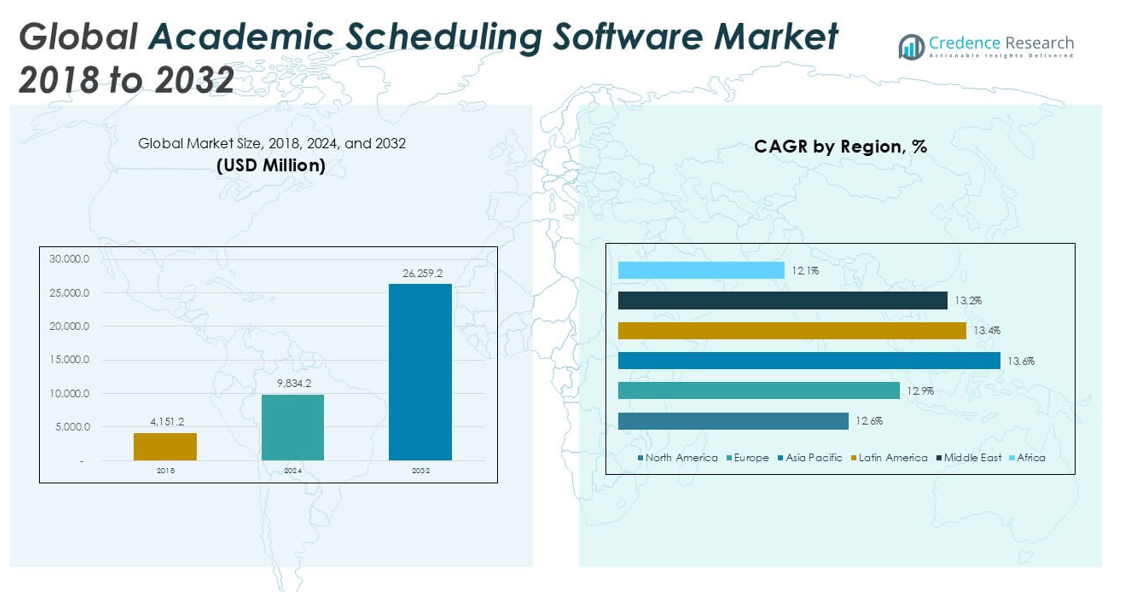
Global Academic Scheduling Software market size was valued at USD 4,151.2 million in 2018 to USD 9,834.2 million in 2024 and is anticipated to reach USD 26,259.2 million by 2032, at a CAGR of 13.02% during the forecast period.

REPORT ATTRIBUTE DETAILS
Historical Period 2020-2023
Base Year 2024
Forecast Period 2025-2032
Academic Scheduling Software Market Size 2024 USD 9,834.2 million
Academic Scheduling Software Market, CAGR 13.02%
Academic Scheduling Software Market Size 2032 USD 26,259.2 million


The global academic scheduling software market features strong competition among key players such as Ad Astra, Accruent, October Resolutions Ltd, Modern Campus USA Inc., Coursedog Inc., VirtoSoftware, Civitas Learning Inc., Arlo, and Creatrix Campus. These companies compete through cloud-native platforms, automation depth, and integration strength with institutional systems. North America leads the market with an exact share of 33.1%, driven by early digital adoption and complex higher education needs. Asia Pacific follows with a 26.9% share, supported by rapid enrollment growth and education digitization. Europe holds a 22.0% share, backed by public-sector digital initiatives and standardized academic planning across universities.

Academic Scheduling Software Market size

Market Insights

  • The market grew from USD 4,151.2 million in 2018 to USD 9,834.2 million in 2024 and may reach USD 26,259.2 million by 2032, at a 13.02% CAGR.
  • Growth is driven by education digitization, rising enrollment, and demand for automated scheduling across complex academic environments worldwide.
  • Cloud-based deployment leads deployment segments due to scalability and lower costs, while course and class scheduling holds the largest functionality share.
  • Competition remains moderate, with vendors focusing on cloud platforms, system integration, analytics, and long-term institutional contracts to gain share.
  • North America leads with 33.1% share, followed by Asia Pacific at 26.9% and Europe at 22.0%, while budget limits restrain adoption in Africa and parts of Latin America.

Access crucial information at unmatched prices!

Request your sample report today & start making informed decisions powered by Credence Research Inc.!

Download Sample

Market Segmentation Analysis:

By Deployment

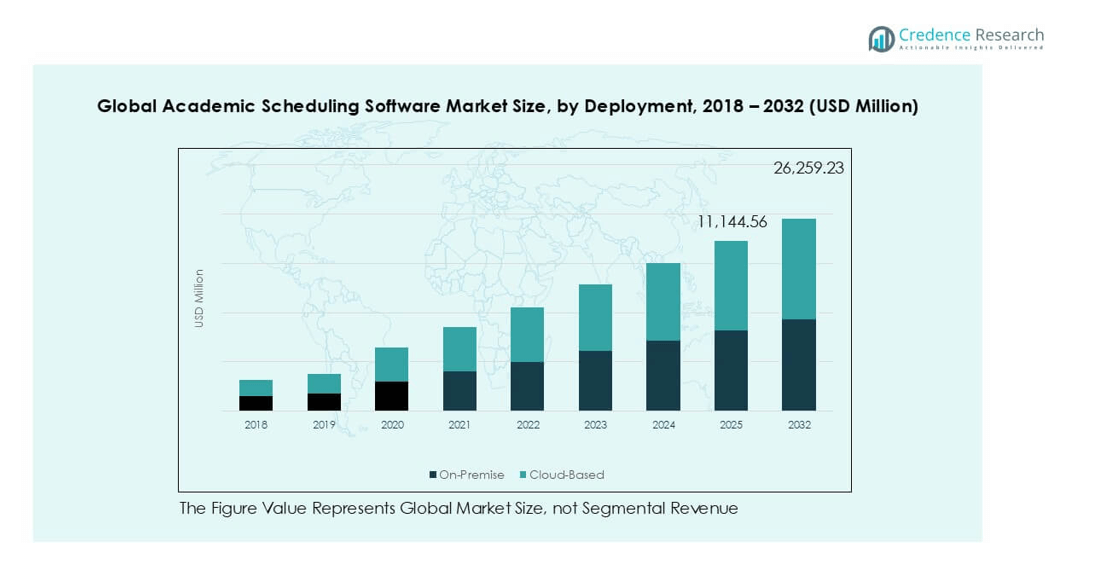
The deployment segment shows clear dominance of cloud-based academic scheduling software, accounting for the majority market share. Cloud-based solutions lead due to lower upfront costs, faster deployment, and easy scalability across campuses. Institutions favor cloud platforms for real-time updates, remote access, and seamless integration with learning management and student information systems. Automatic software updates and reduced IT maintenance further support adoption. On-premise solutions retain demand among institutions with strict data control needs, but limited flexibility and higher infrastructure costs constrain growth compared to cloud-based deployments.

  • For instance, Ellucian’s SaaS-based scheduling and SIS platforms support more than 2,900 higher-education institutions worldwide and are designed to handle tens of thousands of concurrent student schedule transactions during peak registration periods.

By Functionality

Course and class scheduling represents the dominant functionality segment, holding the largest revenue share. This dominance stems from the critical need to manage complex timetables, student enrollments, and curriculum structures efficiently. Automated conflict detection, optimized timetable generation, and rule-based scheduling drive adoption. Exam and assessment scheduling follows, supported by growing digital examination workflows. Resource and room allocation gains traction as institutions aim to maximize space utilization. Faculty workload management adoption rises steadily, driven by compliance, transparency, and balanced workload planning requirements.

  • For instance, Oracle’s PeopleSoft Campus Solutions scheduling engine can process thousands of course sections in a single scheduling run, applying hundreds of academic rules to prevent instructor, room, and student conflicts across large university systems.

By End User

Higher education institutions dominate the end-user segment, capturing the largest market share globally. Universities and colleges face complex scheduling needs involving large student populations, diverse programs, and shared resources. Advanced scheduling tools help improve operational efficiency and student experience. K–12 schools show steady growth, supported by increasing digital transformation initiatives and centralized district-level planning. Vocational and training centers adopt scheduling software to manage flexible course formats and short-term programs. Overall growth is driven by rising enrollment volumes and administrative automation priorities.

Key Growth Drivers

Rapid Digital Transformation in Education

Digital transformation across global education systems remains a primary growth driver. Institutions increasingly replace manual scheduling with automated platforms. Academic scheduling software improves accuracy, speed, and operational transparency. Administrators use these systems to manage growing student volumes efficiently. Digital tools reduce timetable conflicts and administrative errors. Governments support education digitization through funding and policy initiatives. Cloud adoption accelerates system accessibility across campuses. Integration with learning management and student information systems strengthens value. Institutions prioritize data-driven planning and centralized control. The shift toward hybrid and online learning further increases scheduling complexity. Software solutions address multi-format course delivery needs. Demand rises as institutions seek scalable digital infrastructure. This transformation sustains long-term market expansion globally.

  • For instance, Ellucian’s Banner and Colleague platforms support over 18 million students globally and can process tens of thousands of schedule changes within peak registration windows without system downtime.

Increasing Enrollment and Program Complexity

Rising student enrollment drives demand for advanced scheduling solutions. Universities manage diverse programs, electives, and interdisciplinary courses. Manual systems struggle with such complexity. Scheduling software automates rule-based timetable generation. Institutions optimize class capacity and resource utilization. Growing international student intake adds scheduling challenges. Multi-campus operations require centralized planning tools. Academic software supports flexible semester structures and credit systems. Institutions improve student satisfaction through reduced scheduling conflicts. Faculty assignment accuracy also improves. These factors strengthen adoption across higher education markets. Complexity-driven demand remains a strong growth catalyst.

  • For instance, Oracle PeopleSoft Campus Solutions supports universities with more than 100,000 active students and can apply several hundred scheduling constraints per timetable run to avoid class, room, and instructor conflicts.

Operational Efficiency and Cost Optimization

Institutions focus strongly on operational efficiency. Scheduling software reduces administrative workload significantly. Automation lowers dependency on manual staff hours. Institutions minimize scheduling errors and rework costs. Cloud-based platforms reduce IT infrastructure spending. Predictive scheduling improves space and faculty utilization. Management gains real-time visibility into operations. Data analytics support better planning decisions. Cost optimization remains critical amid budget constraints. Schools seek solutions with faster return on investment. These efficiency benefits directly drive procurement decisions. Cost-focused adoption supports steady market growth.

Academic Scheduling Software Market share

Key Trends & Opportunities

Expansion of Cloud-Based and SaaS Models

Cloud-based scheduling platforms dominate new deployments. SaaS models offer subscription-based affordability. Institutions avoid large upfront investments. Vendors provide frequent feature updates seamlessly. Remote access supports distributed academic environments. Scalability suits both small schools and large universities. Cloud platforms enable faster implementation timelines. Integration with third-party education systems improves functionality. Data security standards continue to strengthen. Emerging markets adopt cloud solutions rapidly. Vendors expand regional cloud infrastructure. This trend creates strong recurring revenue opportunities. Cloud adoption remains a major growth avenue.

  • For instance, Ellucian’s SaaS platforms operate on cloud infrastructure that supports more than 2,900 institutions and manages millions of scheduling transactions during peak enrollment periods each academic term.

AI-Driven Scheduling and Predictive Analytics

Artificial intelligence enhances scheduling precision. AI algorithms optimize timetables dynamically. Systems learn from historical enrollment data. Predictive analytics forecast class demand patterns. Institutions proactively allocate faculty and resources. AI reduces bottlenecks during peak enrollment periods. Automation improves decision-making accuracy. Advanced analytics support scenario planning. Vendors differentiate through intelligent features. Demand rises for smart scheduling capabilities. AI-driven tools create premium product opportunities. This trend reshapes competitive positioning.

Key Challenges

Data Security and Privacy Concerns

Data security remains a critical challenge. Academic systems handle sensitive student information. Institutions face strict data protection regulations. Cloud deployments raise concerns over data sovereignty. Breaches can damage institutional reputation. Compliance requirements vary by region. Smaller institutions lack strong cybersecurity resources. Vendors must invest heavily in security frameworks. Encryption and access controls increase system costs. Resistance slows adoption in conservative markets. Trust-building becomes essential for vendors. Security challenges continue to limit full-scale deployment.

Integration and Change Management Issues

System integration presents ongoing challenges. Institutions use multiple legacy platforms. Scheduling software must integrate seamlessly. Poor integration causes workflow disruptions. Data migration risks affect implementation timelines. Staff resistance slows adoption rates. Training requirements increase transition costs. Change management remains resource intensive. Customization needs vary widely across institutions. Vendors face long deployment cycles. Smaller schools struggle with technical readiness. These challenges moderate short-term market growth.

Regional Analysis

North America

North America represents the largest regional market, holding about 33.1% share in 2024. The market was valued at USD 1,406.85 million in 2018 and reached USD 3,253.14 million in 2024. It is projected to expand to USD 8,402.95 million by 2032, growing at a CAGR of 12.6%. Strong digital maturity across U.S. and Canadian institutions drives adoption. Universities prioritize cloud scheduling to manage complex curricula. High IT budgets support advanced integrations. Regulatory compliance and data security capabilities further strengthen regional demand and long-term market leadership.

Europe

Europe accounts for around 22.0% of the global market share in 2024. The regional market stood at USD 917.84 million in 2018 and expanded to USD 2,160.42 million in 2024. It is expected to reach USD 5,719.26 million by 2032, registering a CAGR of 12.9%. Growth is supported by education digitization policies across Western Europe. Universities focus on standardized academic planning tools. Cross-border student mobility increases scheduling complexity. Public funding programs accelerate software deployment across higher education and secondary education systems.

Asia Pacific

Asia Pacific holds approximately 26.9% market share, making it the fastest-growing region. The market was valued at USD 1,083.89 million in 2018 and grew to USD 2,647.36 million in 2024. It is forecast to reach USD 7,352.58 million by 2032, at a CAGR of 13.6%. Rapid enrollment growth fuels strong demand. Governments invest heavily in digital education infrastructure. Cloud-based platforms gain preference due to scalability. Expanding private universities and training institutes further support sustained regional growth momentum.

Latin America

Latin America captured about 11.0% of the global market share in 2024. The regional market size increased from USD 447.50 million in 2018 to USD 1,079.09 million in 2024. It is projected to reach USD 2,948.91 million by 2032, growing at a CAGR of 13.4%. Adoption rises as institutions modernize administrative systems. Cloud deployment supports cost-sensitive institutions. Government-led digital education initiatives encourage adoption. Expanding higher education access continues to create steady scheduling software demand.

Middle East

The Middle East represents nearly 4.8% of global market share in 2024. The market was valued at USD 198.43 million in 2018 and reached USD 475.13 million in 2024. It is expected to grow to USD 1,286.70 million by 2032, at a CAGR of 13.2%. National education modernization programs drive growth. Universities adopt digital platforms to support smart campus initiatives. International branch campuses increase scheduling complexity. Investment in cloud infrastructure supports broader software deployment.

Africa

Africa holds a smaller share of about 2.2% of the global market in 2024. The market size stood at USD 96.72 million in 2018 and increased to USD 219.02 million in 2024. It is projected to reach USD 548.82 million by 2032, growing at a CAGR of 12.1%. Adoption remains gradual due to budget constraints. Cloud-based solutions improve accessibility. Expanding tertiary education enrollment supports demand. International development programs also contribute to gradual digital transformation across academic institutions.

Academic Scheduling Software Market segmentation

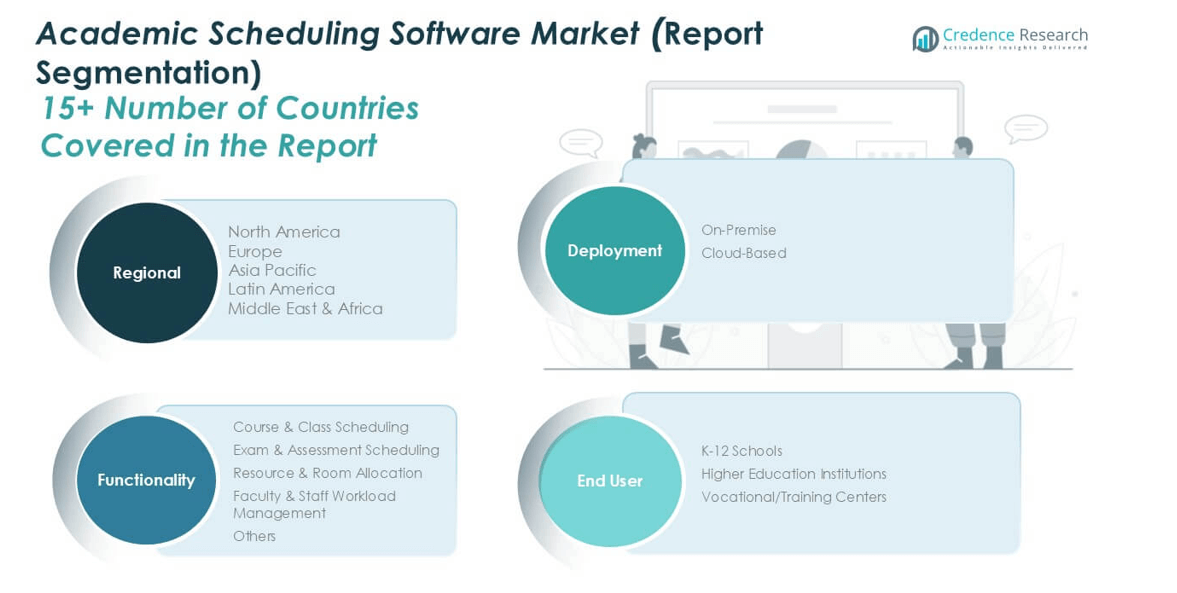
Market Segmentations:

By Deployment

  • On-Premise
  • Cloud-Based

By Functionality

  • Course & Class Scheduling
  • Exam & Assessment Scheduling
  • Resource & Room Allocation
  • Faculty & Staff Workload Management
  • Others

By End User

  • K–12 Schools
  • Higher Education Institutions
  • Vocational/Training Centers

By Geography

  • North America
    • U.S.
    • Canada
    • Mexico
  • Europe
    • Germany
    • France
    • U.K.
    • Italy
    • Spain
    • Rest of Europe
  • Asia Pacific
    • China
    • Japan
    • India
    • South Korea
    • South-east Asia
    • Rest of Asia Pacific
  • Latin America
    • Brazil
    • Argentina
    • Rest of Latin America
  • Middle East & Africa
    • GCC Countries
    • South Africa
    • Rest of the Middle East and Africa

Competitive Landscape

The competitive landscape of the global academic scheduling software market remains moderately fragmented, with a mix of established vendors and emerging technology providers. Leading companies compete through cloud-first platforms, advanced automation, and strong integration capabilities with student information and learning management systems. Vendors focus on usability, scalability, and compliance to meet diverse institutional needs. Strategic partnerships with education technology providers strengthen market positioning. Product differentiation increasingly relies on AI-driven scheduling, analytics, and workflow automation. Vendors also emphasize customer support and implementation services to retain clients. Regional expansion and subscription-based pricing models support recurring revenue growth. Continuous feature enhancement and platform modernization remain key competitive priorities.

Shape Your Report to Specific Countries or Regions & Enjoy 30% Off!

Key Player Analysis

  • Ad Astra
  • Accruent
  • October Resolutions Ltd
  • Modern Campus USA Inc.
  • Coursedog Inc.
  • VirtoSoftware, Inc.
  • Civitas Learning Inc.
  • Arlo
  • Creatrix Campus

Recent Developments

  • In Aug 2025, Accruent published a brochure for EMS + Ellucian SIS integration, focusing on unified campus scheduling and real-time updates.
  • In Sep 2025, Accruent announced Accruent Insights 2025 event spotlighting future tech trends and connected solutions (not scheduling specific but relevant to product direction).
  • In 2024, one of the key providers of web-based & on-demand solutions for higher education, CollegeNET, Inc., launched the 2024 Social Mobility Index (SMI). The SMI selects USA universities and colleges according to their ability to enroll students from low-income backgrounds and graduate them to secure good-paying jobs. The 2024 SMI includes 1,205 four-year institutions

Report Coverage

The research report offers an in-depth analysis based on Deployment, Functionality, End-User and Geography. It details leading market players, providing an overview of their business, product offerings, investments, revenue streams, and key applications. Additionally, the report includes insights into the competitive environment, SWOT analysis, current market trends, as well as the primary drivers and constraints. Furthermore, it discusses various factors that have driven market expansion in recent years. The report also explores market dynamics, regulatory scenarios, and technological advancements that are shaping the industry. It assesses the impact of external factors and global economic changes on market growth. Lastly, it provides strategic recommendations for new entrants and established companies to navigate the complexities of the market.

Future Outlook

  1. Cloud-based platforms will remain the preferred deployment model across institutions worldwide.
  2. Artificial intelligence will increasingly support automated and conflict-free timetable creation.
  3. Integration with learning management and student information systems will deepen.
  4. Demand from higher education institutions will continue to dominate overall adoption.
  5. K–12 schools will increase usage through district-level digital planning initiatives.
  6. Data analytics will guide enrollment forecasting and resource optimization decisions.
  7. Vendors will expand subscription and modular pricing models.
  8. Cybersecurity and compliance features will gain higher investment priority.
  9. Emerging markets will show faster adoption as digital education expands.
  10. Continuous software upgrades will focus on usability and workflow automation.

CHAPTER NO. 1 :      GENESIS OF THE MARKET           

1.1 Market Prelude – Introduction & Scope

1.2 The Big Picture – Objectives & Vision

1.3 Strategic Edge – Unique Value Proposition

1.4 Stakeholder Compass – Key Beneficiaries

CHAPTER NO. 2 :      EXECUTIVE LENS

2.1 Pulse of the Industry – Market Snapshot

2.2 Growth Arc – Revenue Projections (USD Million)

2.3. Premium Insights – Based on Primary Interviews

CHAPTER NO. 3 :      ACADEMIC SCHEDULING SOFTWARE MARKET FORCES & INDUSTRY PULSE

3.1 Foundations of Change – Market Overview
3.2 Catalysts of Expansion – Key Market Drivers
3.2.1 Momentum Boosters – Growth Triggers
3.2.2 Innovation Fuel – Disruptive Technologies
3.3 Headwinds & Crosswinds – Market Restraints
3.3.1 Regulatory Tides – Compliance Challenges
3.3.2 Economic Frictions – Inflationary Pressures
3.4 Untapped Horizons – Growth Potential & Opportunities
3.5 Strategic Navigation – Industry Frameworks
3.5.1 Market Equilibrium – Porter’s Five Forces
3.5.2 Ecosystem Dynamics – Value Chain Analysis
3.5.3 Macro Forces – PESTEL Breakdown

CHAPTER NO. 4 : KEY INVESTMENT EPICENTER        

4.1 Regional Goldmines – High-Growth Geographies

4.2 Product Frontiers – Lucrative Deployment Categories

4.3 End User Sweet Spots – Emerging Demand Segments

CHAPTER NO. 5: REVENUE TRAJECTORY & WEALTH MAPPING

5.1 Momentum Metrics – Forecast & Growth Curves

5.2 Regional Revenue Footprint – Market Share Insights

5.3 Segmental Wealth Flow – Deployment, Functionality, and End User Revenue

CHAPTER NO. 6 : TRADE & COMMERCE ANALYSIS    

6.1.      Import Analysis By Region

6.1.1.    Global Academic Scheduling Software Market Import Revenue By Region

6.2.      Export Analysis By Region

6.2.1.    Global Academic Scheduling Software Market Export Revenue By Region

CHAPTER NO. 7 :      COMPETITION ANALYSIS 

7.1.      Company Market Share Analysis

7.1.1.    Global Academic Scheduling Software Market: Company Market Share

7.2.      Global Academic Scheduling Software Market Company Revenue Market Share

7.3.      Strategic Developments

7.3.1.    Acquisitions & Mergers

7.3.2.    New Product Launch

7.3.3.    Regional Expansion

7.4.      Competitive Dashboard

7.5.      Company Assessment Metrics, 2024

CHAPTER NO. 8 : ACADEMIC SCHEDULING SOFTWARE MARKET – BY DEPLOYMENT SEGMENT ANALYSIS

8.1.      Academic Scheduling Software Market Overview By Deployment Segment

8.1.1.    Academic Scheduling Software Market Revenue Share By Deployment

8.2.       On-Premise

8.3.       Cloud-Based

CHAPTER NO. 9 : ACADEMIC SCHEDULING SOFTWARE MARKET – BY FUNCTIONALITY SEGMENT ANALYSIS

9.1.      Academic Scheduling Software Market Overview By Functionality Segment

9.1.1.    Academic Scheduling Software Market Revenue Share By Functionality

9.2.      Course & Class Scheduling

9.3.      Exam & Assessment Scheduling

9.4.      Resource & Room Allocation

9.5.      Faculty & Staff Workload Management

9.6.      Others

CHAPTER NO. 10 : ACADEMIC SCHEDULING SOFTWARE MARKET – BY END USER SEGMENT ANALYSIS

10.1.     Academic Scheduling Software Market Overview By End User Segment

10.1.1.  Academic Scheduling Software Market Revenue Share By End User

10.2.    K-12 Schools

10.3.    Higher Education Institutions

10.4.    Vocational/Training Centers

CHAPTER NO. 11 : ACADEMIC SCHEDULING SOFTWARE MARKET – REGIONAL ANALYSIS

11.1.     Academic Scheduling Software Market Overview By Region Segment

11.1.1.  Global Academic Scheduling Software Market Revenue Share By Region

10.1.2.  Regions

11.1.3.  Global Academic Scheduling Software Market Revenue By Region

11.1.4.  Deployment

11.1.5.  Global Academic Scheduling Software Market Revenue By Deployment

11.1.6.  Functionality

11.1.7. Global Academic Scheduling Software Market Revenue By Functionality

11.1.8.  End User

11.1.9. Global Academic Scheduling Software Market Revenue By End User

CHAPTER NO. 12 : NORTH AMERICA ACADEMIC SCHEDULING SOFTWARE MARKET – COUNTRY ANALYSIS

12.1.     North America Academic Scheduling Software Market Overview By Country Segment

12.1.1.  North America Academic Scheduling Software Market Revenue Share By Region

12.2.     North America

12.2.1.  North America Academic Scheduling Software Market Revenue By Country

12.2.2.  Deployment

12.2.3.  North America Academic Scheduling Software Market Revenue By Deployment

12.2.4.  Functionality

12.2.5.  North America Academic Scheduling Software Market Revenue By Functionality

12.2.6.  End User

12.2.7.  North America Academic Scheduling Software Market Revenue By End User

12.3.     U.S.

12.4.     Canada

12.5.     Mexico

CHAPTER NO. 13 : EUROPE ACADEMIC SCHEDULING SOFTWARE MARKET – COUNTRY ANALYSIS

13.1.     Europe Academic Scheduling Software Market Overview By Country Segment

13.1.1.  Europe Academic Scheduling Software Market Revenue Share By Region

13.2.     Europe

13.2.1.  Europe Academic Scheduling Software Market Revenue By Country

13.2.2.  Deployment

13.2.3.  Europe Academic Scheduling Software Market Revenue By Deployment

13.2.4.  Functionality

13.2.5.  Europe Academic Scheduling Software Market Revenue By Functionality

13.2.6.  End User

13.2.7.  Europe Academic Scheduling Software Market Revenue By End User

13.3.     UK

13.4.     France

13.5.     Germany

13.6.     Italy

13.7.     Spain

13.8.     Russia

13.9.    Rest of Europe

CHAPTER NO. 14 : ASIA PACIFIC ACADEMIC SCHEDULING SOFTWARE MARKET – COUNTRY ANALYSIS

14.1.     Asia Pacific Academic Scheduling Software Market Overview By Country Segment

14.1.1.  Asia Pacific Academic Scheduling Software Market Revenue Share By Region

14.2.     Asia Pacific

14.2.1.  Asia Pacific Academic Scheduling Software Market Revenue By Country

14.2.2.  Deployment

14.2.3.  Asia Pacific Academic Scheduling Software Market Revenue By Deployment

14.2.4.  Functionality

14.2.5.  Asia Pacific Academic Scheduling Software Market Revenue By Functionality

14.2.6.  End User

14.2.7.  Asia Pacific Academic Scheduling Software Market Revenue By End User

14.3.     China

14.4.     Japan

14.5.     South Korea

14.6.     India

14.7.     Australia

14.8.     Southeast Asia

14.9.     Rest of Asia Pacific

CHAPTER NO. 15 : LATIN AMERICA ACADEMIC SCHEDULING SOFTWARE MARKET – COUNTRY ANALYSIS

15.1.     Latin America Academic Scheduling Software Market Overview By Country Segment

15.1.1.  Latin America Academic Scheduling Software Market Revenue Share By Region

15.2.     Latin America

15.2.1.  Latin America Academic Scheduling Software Market Revenue By Country

15.2.2.  Deployment

15.2.3.  Latin America Academic Scheduling Software Market Revenue By Deployment

15.2.4.  Functionality

15.2.5.  Latin America Academic Scheduling Software Market Revenue By Functionality

15.2.6.  End User

15.2.7.  Latin America Academic Scheduling Software Market Revenue By End User

15.3.     Brazil

15.4.     Argentina

15.5.     Rest of Latin America

CHAPTER NO. 16 : MIDDLE EAST ACADEMIC SCHEDULING SOFTWARE MARKET – COUNTRY ANALYSIS

16.1.     Middle East Academic Scheduling Software Market Overview By Country Segment

16.1.1.  Middle East Academic Scheduling Software Market Revenue Share By Region

16.2.     Middle East

16.2.1.  Middle East Academic Scheduling Software Market Revenue By Country

16.2.2.  Deployment

16.2.3.  Middle East Academic Scheduling Software Market Revenue By Deployment

16.2.4.  Functionality

16.2.5.  Middle East Academic Scheduling Software Market Revenue By Functionality

16.2.6.  End User

16.2.7.  Middle East Academic Scheduling Software Market Revenue By End User

16.3.     GCC Countries

16.4.     Israel

16.5.     Turkey

16.6.     Rest of Middle East

CHAPTER NO. 17 : AFRICA ACADEMIC SCHEDULING SOFTWARE MARKET – COUNTRY ANALYSIS

17.1.     Africa Academic Scheduling Software Market Overview By Country Segment

17.1.1.  Africa Academic Scheduling Software Market Revenue Share By Region

17.2.     Africa

17.2.1.  Africa Academic Scheduling Software Market Revenue By Country

17.2.2.  Deployment

17.2.3.  Africa Academic Scheduling Software Market Revenue By Deployment

17.2.4.  Functionality

17.2.5.  Africa Academic Scheduling Software Market Revenue By Functionality

17.2.6.  End User

17.2.7.  Africa Academic Scheduling Software Market Revenue By End User

17.3.     South Africa

17.4.     Egypt

17.5.     Rest of Africa

CHAPTER NO. 18 : COMPANY PROFILES

18.1.     Ad Astra

18.1.1.  Company Overview

18.1.2.  Product Portfolio

18.1.3.  Financial Overview

18.1.4.  Recent Developments

18.1.5.  Growth Strategy

18.1.6.  SWOT Analysis

18.2.     Accruent

18.3.    October Resolutions Ltd

18.4.    Modern Campus USA Inc.

18.5.    Coursedog Inc.

18.6.    VirtoSoftware, Inc.

18.7.    Civitas Learning Inc.

18.8.    Arlo

18.9.    Creatrix Campus

18.10.  Other Key Players

Request Free Sample

We prioritize the confidentiality and security of your data. Our promise: your information remains private.

Ready to Transform Data into Decisions?

Request Your Sample Report and Start Your Journey of Informed Choices


Providing the strategic compass for industry titans.

cr-clients-logos

Frequently Asked Questions:

What is the projected growth of the academic scheduling software market?

The market was valued at USD 9,834.2 million in 2024 and is projected to reach USD 26,259.2 million by 2032.

At what Compound Annual Growth Rate is the Global Academic Scheduling Software market projected to grow between 2024 and 2032?

The market is expected to grow at a CAGR of 13.02% during the forecast period.

What factors are driving the demand for academic scheduling software?

The demand is fueled by the need to manage large volumes of student data, class schedules, and faculty assignments, along with the rise of online and hybrid learning models, automation, cloud-based solutions, and data-driven decision-making.

Which region holds the largest share of the academic scheduling software market?

North America holds the largest market share, mainly due to early adoption of advanced technology and the presence of key market players, with the United States being a major contributor.

Which region is expected to experience the highest growth in the academic scheduling software market?

The Asia-Pacific region is expected to see the highest growth due to the increasing number of educational institutions, rapid digitization, and government initiatives in countries like China and India.

How will cloud-based solutions impact the academic scheduling software market?

Cloud-based solutions will enhance scalability, accessibility, and integration with other institutional systems, driving greater demand and supporting the market’s growth potential.

About Author

Sushant Phapale

Sushant Phapale

ICT & Automation Expert

Sushant is an expert in ICT, automation, and electronics with a passion for innovation and market trends.

View Profile

Related Reports

Industrial X-Ray Inspection Systems Market

Industrial X-Ray Inspection Systems Market size was valued at USD 595.8 Million in 2024 and is anticipated to reach USD 1,094.64 Million by 2032, at a CAGR of 7.9% during the forecast period.

Sports Analytics Market

The Sports Analytics Market size was valued at USD 1971.86 million in 2024 and is anticipated to reach USD 6245 million by 2032, at a CAGR of 15.5% during the forecast period (2024-2032).

Reed Sensor Market

The Reed Sensor Market size was valued at USD 1151.04 million in 2024 and is anticipated to reach USD 1834.58 million by 2032, at a CAGR of 6 % during the forecast period.

Baggage Scanners Market

Baggage Scanners Market was valued at USD 2.21 billion in 2024 and is anticipated to reach USD 3.01 billion by 2032, growing at a CAGR of 3.95 % during the forecast period.

Online Voting System Market

The global online voting system market was valued at USD 2,447.6 million in 2024 and is projected to reach USD 6,721.75 million by 2032, expanding at a CAGR of 13.46% during the forecast period.

Logistic Software Market

Logistic Software Market was valued at USD 14827.6 million in 2024 and is anticipated to reach USD 27444.85 million by 2032, growing at a CAGR of 8% during the forecast period.

Woodworking Design Software Market

The Woodworking Design Software Market was valued at USD 1,597.5 million in 2024 and is anticipated to reach USD 2,584.86 million by 2032, reflecting a CAGR of 6.2% during the forecast period.

Robotic Pet Dogs Market

Robotic Pet Dogs Market was valued at USD 1690 million in 2024 and is anticipated to reach USD 4391.99 million by 2032, growing at a CAGR of 12.68% during the forecast period.

In-ceiling Speakers Market

The global in ceiling speakers market was valued at USD 6.3 billion in 2024 and is projected to reach USD 10.66 billion by 2032, registering a CAGR of 6.8% over the forecast period.

Penetration Testing As A Service (PTaaS) Market

Penetration Testing As A Service (PTaaS) Market was valued at USD 2.32 billion in 2024 and is anticipated to reach USD 7.92 billion by 2032, growing at a CAGR of 16.6 % during the forecast period.

Robotic Desktop Automation (RDA) Market

Robotic Desktop Automation (RDA) Market was valued at USD 2.48 billion in 2024 and is anticipated to reach USD 7.69 billion by 2032, growing at a CAGR of 15.2 % during the forecast period.

Video Banking Service Market

The global video banking service market was valued at USD 84.41 billion in 2024 and is projected to reach USD 206.03 billion by 2032, expanding at a CAGR of 11.8% during the forecast period (2025–2032).

Licence Option

The report comes as a view-only PDF document, optimized for individual clients. This version is recommended for personal digital use and does not allow printing. Use restricted to one purchaser only.
$4999

To meet the needs of modern corporate teams, our report comes in two formats: a printable PDF and a data-rich Excel sheet. This package is optimized for internal analysis. Unlimited users allowed within one corporate location (e.g., regional office).
$6999

The report will be delivered in printable PDF format along with the report’s data Excel sheet. This license offers 100 Free Analyst hours where the client can utilize Credence Research Inc. research team. Permitted for unlimited global use by all users within the purchasing corporation, such as all employees of a single company.
$12999

Report delivery within 24 to 48 hours

Europe

North America

Email

Smallform of Sample request
User Review

Thank you for the data! The numbers are exactly what we asked for and what we need to build our business case.

Materials Scientist
(privacy requested)

User Review

The report was an excellent overview of the Industrial Burners market. This report does a great job of breaking everything down into manageable chunks.

Imre Hof
Management Assistant, Bekaert

cr-clients-logos

Request Sample