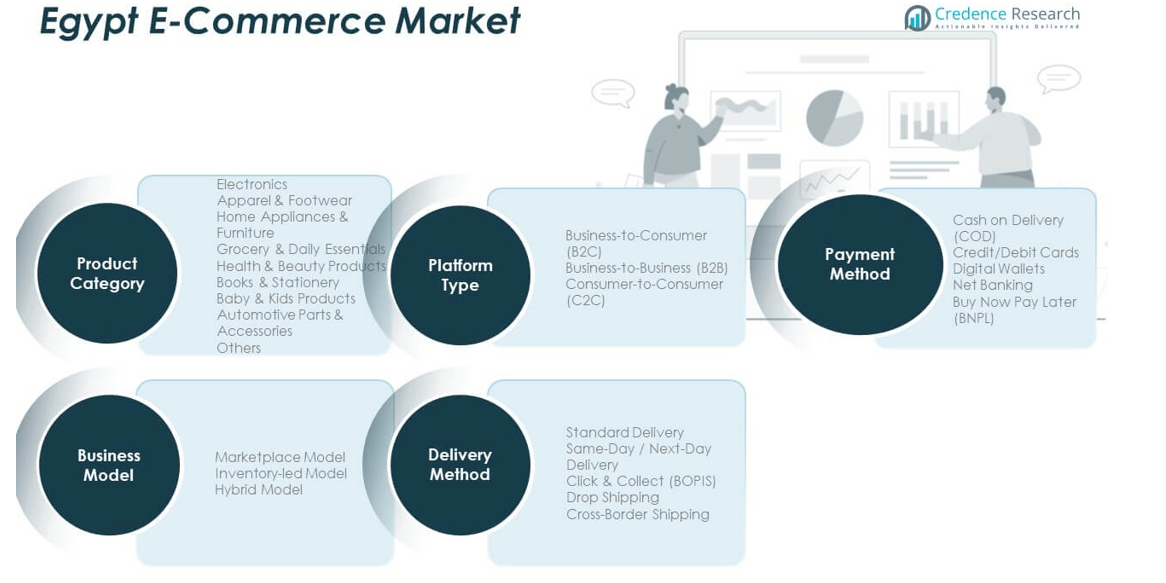
Egypt E-Commerce Market By Product Category (Electronics, Apparel & Footwear, Home Appliances & Furniture, Grocery & Daily Essentials, Health & Beauty Products); By Platform Type (Business-to-Consumer (B2C), Business-to-Business (B2B), Consumer-to-Consumer (C2C)); By Payment Method (Cash on Delivery (COD), Credit/Debit Cards, Digital Wallets, Net Banking, Buy Now Pay Later (BNPL)); By Business Model (Marketplace Model, Inventory-led Model, Hybrid Model); By Delivery Method / Distribution Channel (Standard Delivery, Same-Day / Next-Day Delivery, Click & Collect (BOPIS), Drop Shipping, Cross-Border Shipping) – Growth, Share, Opportunities & Competitive Analysis, 2024 – 2032

Report ID: 82457 | Report Format : Excel, PDF

Market Overview:

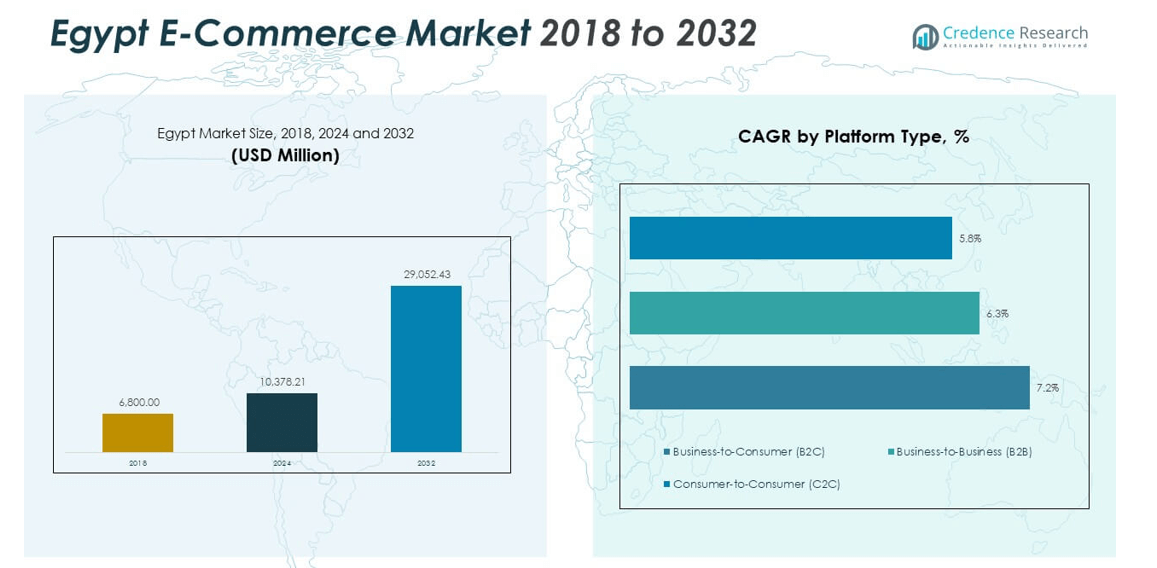
The Egypt E-Commerce Market size was valued at USD 6,800.00 million in 2018, reached USD 10,378.21 million in 2024, and is anticipated to reach USD 29,052.43 million by 2032, at a CAGR of 13.88% during the forecast period.

REPORT ATTRIBUTE DETAILS
Historical Period 2020-2023
Base Year 2024
Forecast Period 2025-2032
Egypt E-Commerce Market Size 2024 USD 10,378.21 million
Egypt E-Commerce Market, CAGR 13.88%
Egypt E-Commerce Market Size 2032 USD 29,052.43 million


Rising internet access, wider smartphone use, and secure payment options drive strong growth in the Egypt E-Commerce Market. Young consumers adopt online shopping for daily needs and lifestyle products. Banks and fintech firms expand digital payments, which speeds up online transactions. Logistics providers strengthen last-mile delivery to reduce delays. Retailers invest in omnichannel models to serve urban and semi-urban buyers. Global marketplaces expand their presence and increase category depth. Local sellers use social commerce to reach wider audiences.

Regional activity centers around Cairo, Giza, and Alexandria, which lead due to higher income levels and strong digital infrastructure. Emerging cities such as Mansoura and Tanta gain traction as logistics networks expand. Rural areas observe gradual adoption as mobile commerce access improves. Cross-border platforms capture interest due to broader product choices. Local marketplaces strengthen their reach through regional warehouses. These shifts create varied growth patterns across Egypt.

Egypt E-Commerce Market size

Market Insights:

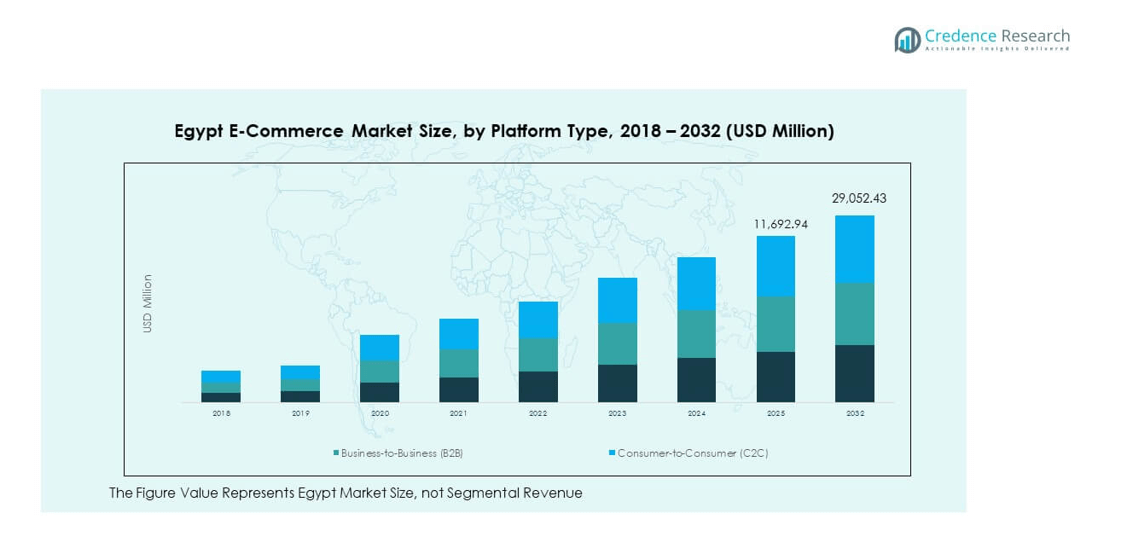
  • The Egypt E-Commerce Market grew from USD 6,800 million in 2018 to USD 11,672.94 million in 2024 and is projected to reach USD 29,052.43 million by 2032, reflecting a strong CAGR of 13.88% driven by wider digital adoption and expanding online consumption.
  • Cairo and Giza hold 58% of the market due to dense urban populations, strong digital infrastructure, and high purchasing power. Alexandria and Canal Cities contribute 22%, supported by logistics connectivity and active online buyers. The Delta Region and Upper Egypt account for 20%, reflecting steady digital inclusion and rising mobile-first behavior.
  • The fastest-growing region is the Delta Region and Upper Egypt, holding 20% share, driven by expanding delivery routes, wider smartphone penetration, and strong adoption of social-commerce-led buying.
  • Business-to-Consumer (B2C) platforms form the largest segment in the chart, representing the highest share in platform usage through strong participation across retail categories.
  • Business-to-Business (B2B) and Consumer-to-Consumer (C2C) segments together contribute the remaining platform-type distribution, reflecting increasing SME procurement and steady growth in peer-driven digital trade.

Access crucial information at unmatched prices!

Request your sample report today & start making informed decisions powered by Credence Research Inc.!

Download Sample

Market Drivers:

Expanding Digital Access And Strong Consumer Adoption Across Urban And Semi-Urban Groups

The Egypt E-Commerce Market advances due to wider internet access across major cities. Households purchase smartphones with better data plans that support online browsing. Brands use targeted advertising to reach younger groups that prefer digital shopping journeys. Logistics firms push faster delivery networks to cover dense neighborhoods. Payment service providers roll out secure gateways that improve user trust. Retailers introduce loyalty programs that promote repeat buying behavior. Social commerce accelerates growth through high engagement rates on major platforms. Product variety increases and attracts buyers searching for convenience. It benefits from steady transition toward digital-first choices.

  • For instance, Vodafone Egypt serves approximately 53 million mobile subscribers, which strengthens digital access and supports higher online shopping activity across urban areas.

Rising Adoption Of Cashless Payments And Rapid Growth Of Local Fintech Platforms

Safer digital transactions strengthen customer confidence in the Egypt E-Commerce Market. Banks promote mobile wallets that simplify order payments for larger segments. Fintech firms integrate QR-based payment options across many retail categories. Merchants accept contactless transactions that reduce cart abandonment. Government pushes broader financial inclusion efforts that support online spending. Younger consumers pick wallet services for ease of refunds and faster checkout flow. Retailers add automated billing tools that minimize errors. Payment providers enhance fraud detection to protect high-volume transactions. It benefits from stronger reliability in digital settlement systems.

  • For instance, Fawry processes more than 6 million transactions per day across its network of more than 400 thousand agents/points, reinforcing trust in digital payments nationwide.

Greater Retail Digitization And Strong Shift Toward Omnichannel Fulfillment Models

Large brands deploy unified sales platforms that boost the Egypt E-Commerce Market. Stores add click-and-collect services that simplify order journeys. Retail chains connect warehouse data with front-end systems for real-time inventory visibility. Consumers trust brands that offer smooth movement between online and offline touchpoints. Businesses analyze customer behavior to reduce stock gaps. Automated tools support accurate dispatch operations. User engagement rises when brands use data-led recommendations. Delivery firms partner with retailers to strengthen last-mile reliability. It gains momentum from the retail sector’s wider platform upgrades.

Growing Demand For Convenience-Focused Shopping Supported By Lifestyle Changes And Digital Media Influence

Shoppers use digital channels more due to tight schedules across major cities within the Egypt E-Commerce Market. Many households prefer home delivery for groceries and essentials. Influencer-led marketing drives interest in beauty, fashion, and home products. Media content shapes buying patterns among active online users. Retailers expand product categories to match rising lifestyle needs. Apps improve interface quality to shorten search times. Customer support teams use chat tools to assist high-volume queries. Promotions raise conversion during peak events. It gains traction from daily dependence on online platforms.

Market Trends:

Strong Expansion Of Mobile-First Shopping Behavior Across All Age Segments

Mobile engagement grows across the Egypt E-Commerce Market due to better device affordability. Users complete purchases through apps that offer shorter navigation. Retailers create mobile-optimized storefronts with clean layouts. Payment flows become smoother with one-tap settlement. Push notifications drive rapid response to flash deals. Influencers shape product preferences on social platforms. Younger buyers dominate app-based sessions during seasonal sales. Brands design vertical videos for quick product previews. It advances due to growth in mobile-centric habits.

  • For instance, TikTok surpassed 1 billion global monthly active users, and Egypt ranks among its fastest-growing MENA markets, boosting mobile-driven discovery and purchase behavior.

Rise Of Cross-Border Marketplaces And Growing Interest In International Brands

Global platforms attract steady traffic within the Egypt E-Commerce Market. Consumers compare international and local products for quality assurance. Shoppers search for niche categories not supplied by local sellers. Global sellers invest in faster delivery routes to reduce waiting time. Buyers rely on transparent return policies for high-value imports. Fashion and electronics lead in cross-border demand. Product authenticity tools create higher confidence for premium goods. Currency-friendly payment options increase adoption. It gains visibility through rising interest in global selections.

  • For instance, AliExpress serves millions of users globally and ships to Egypt through its extensive logistics network, supporting strong demand for cross-border fashion and electronics.

Rapid Growth Of Social Commerce Driven By High Engagement On Visual Platforms

Social platforms influence purchasing decisions in the Egypt E-Commerce Market. Short-form content highlights product features in relatable formats. Sellers promote curated bundles to attract impulse buyers. Live-stream selling gains attention from younger users. Engagement rises when brands use local influencers. Direct checkout tools cut time between discovery and purchase. Social ads target behavior patterns with strong accuracy. User reviews shape community trust. It strengthens due to the social layer’s growing impact on buying decisions.

Wider Use Of AI-Based Personalization Tools And Improved Customer Experience Systems

AI supports better recommendations within the Egypt E-Commerce Market. Systems track browsing patterns to refine product visibility. Chatbots address common queries within seconds. Brands use predictive tools to plan inventory for fast-moving goods. Voice search becomes more common in mobile apps. Recommendation engines increase repeat purchases among loyal users. Personal dashboards highlight deals based on shopping history. Platforms reduce friction through automated support flows. It benefits from smarter digital interaction systems.

Market Challenges Analysis:

Logistics Fragmentation And Delivery Pressure Across Dense And Expanding City Networks

Delivery complexity shapes the Egypt E-Commerce Market and creates operational stress for many sellers. Urban congestion affects timing for fragile and bulky shipments. Couriers handle rising order volumes during peak seasons with limited route flexibility. Rural delivery still lacks unified coverage, which slows expansion. High fuel costs reduce margin levels for small businesses. Storage gaps delay order consolidation for multi-item shipments. Return handling increases workload for warehouses. Miscommunication between courier teams and buyers triggers repeated attempts. It faces persistent friction from uneven logistics maturity.

Limited Financial Inclusion, Fraud Risks, And Ongoing Trust Concerns Among New Digital Users

Financial access gaps challenge many potential shoppers within the Egypt E-Commerce Market. Cash-on-delivery dependence creates verification issues for sellers. Fraudulent claims increase processing time for service teams. Inconsistent digital literacy reduces user comfort with payment apps. Data security concerns impact checkout rates across certain groups. Merchants invest in customer education to reduce hesitation. New users seek visible safety markers in app interfaces. Platforms work on stronger verification tools to protect high-value categories. It encounters recurring trust barriers during user onboarding.

Market Opportunities:

Expansion Of Digital Payments, Fintech Adoption, And Broader Financial Inclusion Potential

Wider financial access unlocks stronger prospects across the Egypt E-Commerce Market. Mobile wallets help onboard shoppers that avoid card-based payments. Banks introduce simple onboarding steps for new digital customers. QR acceptance widens across groceries, services, and lifestyle categories. Payment providers enable low-cost settlement for small merchants. Fintech apps raise digital literacy through guided flows. Businesses tap underserved regions with secure payment tools. It gains advantage from higher adoption of digital finance.

Growth Potential In Tier-2 Cities, Rural Commerce, And Local Seller Enablement Programs

Untapped regions generate long-term expansion for the Egypt E-Commerce Market. Platforms invest in regional warehouses to shorten delivery time. Local sellers use online storefronts to reach broader audiences. Training programs help micro-businesses upload and manage inventory. Logistics partners extend delivery zones through new route networks. Government efforts support digital inclusion at community level. Consumers trust platforms that guarantee easy returns. It grows due to wider participation from emerging regions.

Market Segmentation Analysis:

By Product Category

The Egypt E-Commerce Market expands across major categories that meet rising consumer demand. Electronics lead due to strong interest in smartphones, laptops, and accessories. Apparel and footwear attract young shoppers that prefer trend-driven and value-focused choices. Home appliances and furniture grow through wider access to large-format items and efficient delivery networks. Grocery and daily essentials gain traction from steady demand for quick-replenishment products. Health and beauty products rise due to strong digital marketing and influencer-driven visibility. Consumers shift toward trusted platforms that offer reliable returns. It gains strength through broad category diversification.

  • For instance, Samsung shipped approximately 6 millionsmartphones globally in 2023, driving high online demand for electronics across major e-commerce channels. It gains strength through broad category diversification (e.g., TVs, home appliances, etc.).

By Platform Type

Platform adoption shifts based on buyer needs across the Egypt E-Commerce Market. Business-to-consumer platforms attract higher order volumes from retail categories. Business-to-business platforms support bulk procurement for SMEs and distributors. Consumer-to-consumer platforms grow from peer-led transactions across fashion and household items. Platforms invest in secure payment systems to support user confidence. Category depth improves buyer retention on major marketplaces. Traffic rises during promotional periods and national shopping events. It benefits from stronger digital participation across segments.

By Payment Method

Payment behavior shapes overall adoption trends within the Egypt E-Commerce Market. Cash on delivery remains common among first-time and cautious shoppers. Credit and debit cards serve urban users with established banking access. Digital wallets grow due to simple onboarding and faster checkout journeys. Net banking supports structured payments for higher-value orders. Buy now pay later attracts younger shoppers that seek flexible settlement cycles. Platforms invest in fraud prevention tools to improve safety. It gains momentum from improved payment convenience.

By Delivery Method / Distribution Channel

Delivery preferences guide fulfillment priorities for the Egypt E-Commerce Market. Standard delivery handles routine orders with stable timelines. Same-day and next-day delivery attract buyers who require speed for essential items. Click and collect offers flexible pick-up options for urban shoppers. Drop shipping supports wide product listings without heavy inventory requirements. Cross-border shipping extends access to global brands with structured logistics. Fulfillment hubs enhance coverage for regional delivery zones. It improves service quality through better route optimization.

Egypt E-Commerce Market segmentation

Segmentation:

By Product Category

  • Electronics
  • Apparel & Footwear
  • Home Appliances & Furniture
  • Grocery & Daily Essentials
  • Health & Beauty Products

By Platform Type

  • Business-to-Consumer (B2C)
  • Business-to-Business (B2B)
  • Consumer-to-Consumer (C2C)

By Payment Method

  • Cash on Delivery (COD)
  • Credit/Debit Cards
  • Digital Wallets
  • Net Banking
  • Buy Now Pay Later (BNPL)

By Business Model

  • Marketplace Model
  • Inventory-led Model
  • Hybrid Model

By Delivery Method / Distribution Channel

  • Standard Delivery
  • Same-Day / Next-Day Delivery
  • Click & Collect (BOPIS)
  • Drop Shipping
  • Cross-Border Shipping

Regional Analysis:

Cairo and Giza

Cairo and Giza hold the largest share of the Egypt E-Commerce Market with nearly 58% of total activity. High internet penetration supports strong online buying behavior in these regions. Retailers invest in faster delivery networks that handle dense demand. Buyers rely on mobile apps to shop across electronics, fashion, and essentials. Local and international platforms base major warehouse operations in these cities. Payment adoption grows through banks and fintech firms offering secure digital tools. It strengthens its position through consistent digital spending.

Alexandria and Canal Cities

Alexandria and the Canal Cities account for nearly 22% of the market share and show steady expansion. Strong port connectivity supports faster movement of cross-border goods. Consumers adopt e-commerce platforms to access wider product selections. Retailers view these regions as high-potential zones for electronics and lifestyle categories. Logistics partners introduce regional hubs to improve delivery predictability. Buyers prefer mixed payment methods depending on order value and product type. It gains visibility through widening regional fulfillment capacity.

Delta Region and Upper Egypt

The Delta Region and Upper Egypt collectively contribute around 20% of the Egypt E-Commerce Market and reflect emerging growth. Mobile-first users drive strong activity in Tier-2 and Tier-3 cities. Platforms target these regions through localized campaigns and language-specific content. Delivery firms expand routes to shorten lead times for essentials, beauty, and home products. Cash-on-delivery remains common, though wallet adoption rises among younger customers. Merchants use social commerce tools to reach rural and semi-urban buyers. It gains traction as digital inclusion efforts expand each year.

Shape Your Report to Specific Countries or Regions & Enjoy 30% Off!

Key Player Analysis:

  • Amazon Egypt
  • Jumia
  • Elaraby Group
  • Carrefour
  • Hanimex
  • Fawry
  • Breadfast
  • Chefaa
  • elmenus
  • Taager
  • MaxAB
  • Okhtein
  • Yodawy
  • Manzzeli
  • Homzmart

Competitive Analysis:

The Egypt E-Commerce Market features strong competition driven by expanding digital adoption and rising consumer expectations. Global platforms and major regional players scale operations to secure higher traffic and stronger brand visibility. Local firms hold ground through faster delivery, localized catalogs, and high engagement on mobile channels. Payment service providers influence platform selection through secure and simple checkout tools. Retail chains integrate online and offline channels to build wider reach and stable customer retention. Logistics partners improve delivery accuracy to support large daily order volumes. It evolves through continuous upgrades in service quality, platform experience, and product variety.

Recent Developments:

  • In September 2025, Amazon Egypt reinforced its commitment to Egypt’s digital economy by announcing its second consecutive collaboration with Shark Tank Egypt. This strategic partnership aims to provide new pathways for small and medium-sized businesses and entrepreneurs to grow their businesses online by connecting visionary business leaders with Amazon’s comprehensive resources, including its technology infrastructure, fulfillment network, and customer reach. Additionally, in October 2025, Amazon Egypt renewed its partnership with Valu, a leading fintech platform, to expand seamless financing solutions for customers. This collaboration builds on Amazon’s previous acquisition of a 3.95% direct stake in Valu in June 2025 at EGP 6.041 per share, signaling deep integration into Egypt’s financial ecosystem. The renewed partnership aims to provide greater financial flexibility, easier access to a broader variety of products, and personalized savings for a larger number of consumers through effortless checkout processes.
  • In August 2025, Breadfast secured a significant $10 million investment from the European Bank for Reconstruction and Development (EBRD) as part of its Series B2 funding round, led by Novastar Ventures. This strategic injection brought Breadfast’s valuation to approximately $382.3 million, demonstrating strong institutional confidence in the startup. The funding is aimed at accelerating Breadfast’s expansion across Egypt by increasing fulfillment centers in current strongholds—Cairo, Giza, Alexandria, and Mansoura—while entering new cities to broaden its national footprint. The company plans to leverage the capital to improve its proprietary technology and expand private-label products to boost margins and maintain price competitiveness. Swedish investment firm Vostok New Ventures (VNV) reported that its 7.9% stake in Breadfast nearly doubled to $30.2 million since its initial 2021 investment, exemplifying investor confidence in Breadfast’s robust growth trajectory as a fully integrated quick-commerce platform delivering over 6,000 products within 60 minutes.
  • In October 2024, Jumia announced plans to establish new integrated warehouses in Egypt as part of its broader continental expansion strategy. The Egyptian facility spans approximately 27,000 square meters and was anticipated to reach full operational capacity by January 2025. This expansion is strategically positioned to facilitate penetration into inland areas, enhance e-commerce development, improve cost efficiency, and support Jumia’s ongoing growth across the African continent. Earlier, in September 2024, Jumia Egypt partnered with Forsa, a subsidiary of Drive Financial under the Ghabbour Auto Group, to offer flexible installment payment options. Through this agreement, Jumia customers can purchase various products—including electronics, home appliances, fashion items, beauty products, and groceries—while benefiting from convenient installment services, allowing customers to repay purchases over time rather than upfront.

Report Coverage:

The research report offers an in-depth analysis based on Product Category, Platform Type, Payment Method, Business Model, and Delivery Method. It details leading market players, providing an overview of their business, product offerings, investments, revenue streams, and key applications. Additionally, the report includes insights into the competitive environment, SWOT analysis, current market trends, as well as the primary drivers and constraints. Furthermore, it discusses various factors that have driven market expansion in recent years. The report also explores market dynamics, regulatory scenarios, and technological advancements that are shaping the industry. It assesses the impact of external factors and global economic changes on market growth. Lastly, it provides strategic recommendations for new entrants and established companies to navigate the complexities of the market.

Future Outlook:

  • Online demand in the Egypt E-Commerce Market will expand through stronger mobile adoption and digital behavior shifts.
  • Payment diversity will grow with higher wallet usage and wider acceptance of flexible methods.
  • Logistics networks will improve through new hubs and advanced delivery optimization tools.
  • B2C platforms will gain deeper penetration across emerging cities with regional fulfillment support.
  • B2B digital ordering will rise as SMEs adopt streamlined procurement systems.
  • Social commerce will influence product discovery and shape brand engagement trends.
  • Cross-border ordering will accelerate due to wider access to global categories.
  • Omnichannel retailing will strengthen through unified inventory and consistent service models.
  • AI-driven tools will refine personalization and efficient customer interaction flows.
  • Market competition will intensify through platform expansion, local partnerships, and service innovation.

CHAPTER NO. 1 : INTRODUCTION 19

1.1.1. Report Description 19

Purpose of the Report 19

USP & Key Offerings 19

1.1.2. Key Benefits for Stakeholders 19

1.1.3. Target Audience 20

1.1.4. Report Scope 20

CHAPTER NO. 2 : EXECUTIVE SUMMARY 21

2.1. Egypt E-Commerce Market Snapshot 21

2.1.1. Egypt E-Commerce Market, 2018 – 2032 (USD Million) 23

CHAPTER NO. 3 : EGYPT E-COMMERCE MARKET INDUSTRY ANALYSIS 24

3.1. Introduction 24

3.2. Market Drivers 25

3.2.1. Growing Internet & Smartphone Penetration 25

3.2.2. Rising Digital Payments Adoption 26

3.3. Market Restraints 27

3.3.1. Low Trust in Online Transactions 27

3.4. Market Opportunities 28

3.4.1. Market Opportunity Analysis 28

3.5. Porter’s Five Forces Analysis 29

CHAPTER NO. 4 : ANALYSIS COMPETITIVE LANDSCAPE 30

4.1. Company Market Share Analysis 2024 30

4.1.1. Egypt E-Commerce Market: Company Market Share, by Volume, 2024 30

4.1.2. Egypt E-Commerce Market: Company Market Share, by Revenue, 2024 31

4.1.3. Egypt E-Commerce Market: Top 6 Company Market Share, by Revenue, 2024 31

4.1.4. Egypt E-Commerce Market: Top 3 Company Market Share, by Revenue, 2024 32

4.2. Egypt E-Commerce Market Company Revenue Market Share, 2024 33

4.3. Company Assessment Metrics, 2024 34

4.3.1. Stars 34

4.3.2. Emerging Leaders 34

4.3.3. Pervasive Players 34

4.3.4. Participants 34

4.4. Start-ups /SMEs Assessment Metrics, 2024 34

4.4.1. Progressive Companies 34

4.4.2. Responsive Companies 34

4.4.3. Dynamic Companies 34

4.4.4. Starting Blocks 34

4.5. Strategic Developments 35

4.5.1. Acquisitions & Mergers 35

New Product Launch 35

Egypt Expansion 35

4.6. Key Players Product Matrix 36

CHAPTER NO. 5 : PESTEL & ADJACENT MARKET ANALYSIS 37

5.1. PESTEL 37

5.1.1. Political Factors 37

5.1.2. Economic Factors 37

5.1.3. Social Factors 37

5.1.4. Technological Factors 37

5.1.5. Environmental Factors 37

5.1.6. Legal Factors 37

5.2. Adjacent Market Analysis 37

CHAPTER NO. 6 : EGYPT E-COMMERCE MARKET BY PRODUCT CATEGORY SEGMENT ANALYSIS 38

6.1. Egypt E-Commerce Market Overview, by Product Category Segment 38

6.1.1. Egypt E-Commerce Market Revenue Share, By Product Category, 2023 & 2032 39

6.1.2. Egypt E-Commerce Market Attractiveness Analysis, By Product Category 40

6.1.3. Incremental Revenue Growth Opportunity, by Product Category, 2024 – 2032 40

6.1.4. Egypt E-Commerce Market Revenue, By Product Category, 2018, 2023, 2027 & 2032 41

6.2. Electronics 42

6.3. Apparel & Footwear 43

6.4. Home Appliances & Furniture 44

6.5. Grocery & Daily Essentials 45

6.6. Health & Beauty Products 46

CHAPTER NO. 7 : EGYPT E-COMMERCE MARKET BY PLATFORM TYPE SEGMENT ANALYSIS 47

7.1. Egypt E-Commerce Market Overview, by Platform Type Segment 47

7.1.1. Egypt E-Commerce Market Revenue Share, By Platform Type, 2023 & 2032 48

7.1.2. Egypt E-Commerce Market Attractiveness Analysis, By Platform Type 49

7.1.3. Incremental Revenue Growth Opportunity, by Platform Type, 2024 – 2032 49

7.1.4. Egypt E-Commerce Market Revenue, By Platform Type, 2018, 2023, 2027 & 2032 50

7.2. Business-to-Consumer (B2C) 51

7.3. Business-to-Business (B2B) 52

7.4. Consumer-to-Consumer (C2C) 53

CHAPTER NO. 8 : EGYPT E-COMMERCE MARKET BY PAYMENT METHOD SEGMENT ANALYSIS 54

8.1. Egypt E-Commerce Market Overview, by Payment Method Segment 54

8.1.1. Egypt E-Commerce Market Revenue Share, By Payment Method, 2023 & 2032 55

8.1.2. Egypt E-Commerce Market Attractiveness Analysis, By Payment Method 56

8.1.3. Incremental Revenue Growth Opportunity, by Payment Method, 2024 – 2032 56

8.1.4. Egypt E-Commerce Market Revenue, By Payment Method, 2018, 2023, 2027 & 2032 57

8.2. Cash on Delivery (COD) 58

8.3. Credit/Debit Cards 59

8.4. Digital Wallets 60

8.5. Net Banking 61

8.6. Buy Now Pay Later (BNPL) 62

CHAPTER NO. 9 : EGYPT E-COMMERCE MARKET BY BUSINESS MODEL SEGMENT ANALYSIS 63

9.1. Egypt E-Commerce Market Overview, by Business Model Segment 63

9.1.1. Egypt E-Commerce Market Revenue Share, By Business Model, 2023 & 2032 64

9.1.2. Egypt E-Commerce Market Attractiveness Analysis, By Business Model 65

9.1.3. Incremental Revenue Growth Opportunity, by Business Model, 2024 – 2032 65

9.1.4. Egypt E-Commerce Market Revenue, By Business Model, 2018, 2023, 2027 & 2032 66

9.2. Marketplace Model 67

9.3. Inventory-led Model 68

9.4. Hybrid Model 69

CHAPTER NO. 10 : EGYPT E-COMMERCE MARKET BY DELIVERY METHOD SEGMENT ANALYSIS 70

10.1. Egypt E-Commerce Market Overview, by Delivery Method Segment 70

10.1.1. Egypt E-Commerce Market Revenue Share, By Distribution Channel, 2023 & 2032 71

10.1.2. Egypt E-Commerce Market Attractiveness Analysis, By Distribution Channel 72

10.1.3. Incremental Revenue Growth Opportunity, by Distribution Channel, 2024 – 2032 72

10.1.4. Egypt E-Commerce Market Revenue, By Distribution Channel, 2018, 2023, 2027 & 2032 73

10.2. Standard Delivery 74

10.3. Same-Day / Next-Day Delivery 75

10.4. Click & Collect (BOPIS) 76

10.5. Drop Shipping 77

10.6. Cross-Border Shipping 78

CHAPTER NO. 11 : EGYPT E-COMMERCE MARKET EGYPT ANALYSIS 79

11.1. Product Category 79

11.1.1. Egypt E-Commerce Market Revenue, By Product Category, 2018 – 2023 (USD Million) 79

11.1.2. Egypt E-Commerce Market Revenue, By Product Category, 2024 – 2032 (USD Million) 79

11.2. Platform Type 80

11.2.1. Egypt E-Commerce Market Revenue, By Platform Type, 2018 – 2023 (USD Million) 80

11.2.2. Egypt E-Commerce Market Revenue, By Platform Type, 2024 – 2032 (USD Million) 80

11.3. Payment Method 81

11.3.1. Egypt E-Commerce Market Revenue, By Payment Method, 2018 – 2023 (USD Million) 81

11.3.2. Egypt E-Commerce Market Revenue, By Payment Method, 2024 – 2032 (USD Million) 81

11.4. Business Model 82

11.4.1. Egypt E-Commerce Market Revenue, By Business Model, 2018 – 2023 (USD Million) 82

11.4.2. Egypt E-Commerce Market Revenue, By Business Model, 2024 – 2032 (USD Million) 82

11.5. Distribution Channel 83

11.5.1. Egypt E-Commerce Market Revenue, By Distribution Channel, 2018 – 2023 (USD Million) 83

11.5.2. Egypt E-Commerce Market Revenue, By Distribution Channel, 2024 – 2032 (USD Million) 83

CHAPTER NO. 12 : COMPANY PROFILES 84

12.1. Amazon Egypt 84

12.1.1. Company Overview 84

12.1.2. Product Portfolio 84

12.1.3. Swot Analysis 84

12.1.4. Business Strategy 85

12.1.5. Financial Overview 85

12.2. Jumia 86

12.3. Elaraby Group 86

12.4. Carrefour 86

12.5. Hanimex 86

12.6. Fawry 86

12.7. Breadfast 86

12.8. Chefaa 86

12.9. elmenus 86

12.10. Taager 86

12.11. MaxAB 86

12.12. Okhtein 86

12.13. Yodawy 86

12.14. Manzzeli 86

12.15. Homzmart 86


List of Figures

FIG NO. 1. Egypt E-Commerce Market Revenue, 2018 – 2032 (USD Million) 23

FIG NO. 2. Porter’s Five Forces Analysis for Egypt E-Commerce Market 29

FIG NO. 3. Company Share Analysis, 2024 30

FIG NO. 4. Company Share Analysis, 2024 31

FIG NO. 5. Company Share Analysis, 2024 31

FIG NO. 6. Company Share Analysis, 2024 32

FIG NO. 7. Egypt E-Commerce Market Company Revenue Market Share, 2024 33

FIG NO. 8. Egypt E-Commerce Market Revenue Share, By Product Category, 2023 & 2032 39

FIG NO. 9. Market Attractiveness Analysis, By Product Category 40

FIG NO. 10. Incremental Revenue Growth Opportunity by Product Category, 2024 – 2032 40

FIG NO. 11. Egypt E-Commerce Market Revenue, By Product Category, 2018, 2023, 2027 & 2032 41

FIG NO. 12. Egypt E-Commerce Market for Electronics, Revenue (USD Million) 2018 – 2032 42

FIG NO. 13. Egypt E-Commerce Market for Apparel & Footwear, Revenue (USD Million) 2018 – 2032 43

FIG NO. 14. Egypt E-Commerce Market for Home Appliances & Furniture, Revenue (USD Million) 2018 – 2032 44

FIG NO. 15. Egypt E-Commerce Market for Grocery & Daily Essentials, Revenue (USD Million) 2018 – 2032 45

FIG NO. 16. Egypt E-Commerce Market for Health & Beauty Products, Revenue (USD Million) 2018 – 2032 46

FIG NO. 17. Egypt E-Commerce Market Revenue Share, By Platform Type, 2023 & 2032 48

FIG NO. 18. Market Attractiveness Analysis, By Platform Type 49

FIG NO. 19. Incremental Revenue Growth Opportunity by Platform Type, 2024 – 2032 49

FIG NO. 20. Egypt E-Commerce Market Revenue, By Platform Type, 2018, 2023, 2027 & 2032 50

FIG NO. 21. Egypt E-Commerce Market for Business-to-Consumer (B2C), Revenue (USD Million) 2018 – 2032 51

FIG NO. 22. Egypt E-Commerce Market for Business-to-Business (B2B), Revenue (USD Million) 2018 – 2032 52

FIG NO. 23. Egypt E-Commerce Market for Consumer-to-Consumer (C2C), Revenue (USD Million) 2018 – 2032 53

FIG NO. 24. Egypt E-Commerce Market Revenue Share, By Payment Method, 2023 & 2032 55

FIG NO. 25. Market Attractiveness Analysis, By Payment Method 56

FIG NO. 26. Incremental Revenue Growth Opportunity by Payment Method, 2024 – 2032 56

FIG NO. 27. Egypt E-Commerce Market Revenue, By Payment Method, 2018, 2023, 2027 & 2032 57

FIG NO. 28. Egypt E-Commerce Market for Cash on Delivery (COD), Revenue (USD Million) 2018 – 2032 58

FIG NO. 29. Egypt E-Commerce Market for Credit/Debit Cards, Revenue (USD Million) 2018 – 2032 59

FIG NO. 30. Egypt E-Commerce Market for Digital Wallets, Revenue (USD Million) 2018 – 2032 60

FIG NO. 31. Egypt E-Commerce Market for Net Banking, Revenue (USD Million) 2018 – 2032 61

FIG NO. 32. Egypt E-Commerce Market for Buy Now Pay Later (BNPL), Revenue (USD Million) 2018 – 2032 62

FIG NO. 33. Egypt E-Commerce Market Revenue Share, By Business Model, 2023 & 2032 64

FIG NO. 34. Market Attractiveness Analysis, By Business Model 65

FIG NO. 35. Incremental Revenue Growth Opportunity by Business Model, 2024 – 2032 65

FIG NO. 36. Egypt E-Commerce Market Revenue, By Business Model, 2018, 2023, 2027 & 2032 66

FIG NO. 37. Egypt E-Commerce Market for Marketplace Model, Revenue (USD Million) 2018 – 2032 67

FIG NO. 38. Egypt E-Commerce Market for Inventory-led Model, Revenue (USD Million) 2018 – 2032 68

FIG NO. 39. Egypt E-Commerce Market for Hybrid Model, Revenue (USD Million) 2018 – 2032 69

FIG NO. 40. Egypt E-Commerce Market Revenue Share, By Distribution Channel, 2023 & 2032 71

FIG NO. 41. Market Attractiveness Analysis, By Distribution Channel 72

FIG NO. 42. Incremental Revenue Growth Opportunity by Distribution Channel, 2024 – 2032 72

FIG NO. 43. Egypt E-Commerce Market Revenue, By Distribution Channel, 2018, 2023, 2027 & 2032 73

FIG NO. 44. Egypt E-Commerce Market for Standard Delivery, Revenue (USD Million) 2018 – 2032 74

FIG NO. 45. Egypt E-Commerce Market for Same-Day / Next-Day Delivery, Revenue (USD Million) 2018 – 2032 75

FIG NO. 46. Egypt E-Commerce Market for Click & Collect (BOPIS), Revenue (USD Million) 2018 – 2032 76

FIG NO. 47. Egypt E-Commerce Market for Drop Shipping, Revenue (USD Million) 2018 – 2032 77

FIG NO. 48. Egypt E-Commerce Market for Cross-Border Shipping, Revenue (USD Million) 2018 – 2032 78


List of Tables

TABLE NO. 1. : Egypt E-Commerce Market: Snapshot 21

TABLE NO. 2. : Drivers for the Egypt E-Commerce Market: Impact Analysis 25

TABLE NO. 3. : Restraints for the Egypt E-Commerce Market: Impact Analysis 27

TABLE NO. 4. : Egypt E-Commerce Market Revenue, By Product Category, 2018 – 2023 (USD Million) 79

TABLE NO. 5. : Egypt E-Commerce Market Revenue, By Product Category, 2024 – 2032 (USD Million) 79

TABLE NO. 6. : Egypt E-Commerce Market Revenue, By Platform Type, 2018 – 2023 (USD Million) 80

TABLE NO. 7. : Egypt E-Commerce Market Revenue, By Platform Type, 2024 – 2032 (USD Million) 80

TABLE NO. 8. : Egypt E-Commerce Market Revenue, By Payment Method, 2018 – 2023 (USD Million) 81

TABLE NO. 9. : Egypt E-Commerce Market Revenue, By Payment Method, 2024 – 2032 (USD Million) 81

TABLE NO. 10. : Egypt E-Commerce Market Revenue, By Business Model, 2018 – 2023 (USD Million) 82

TABLE NO. 11. : Egypt E-Commerce Market Revenue, By Business Model, 2024 – 2032 (USD Million) 82

TABLE NO. 12. : Egypt E-Commerce Market Revenue, By Distribution Channel, 2018 – 2023 (USD Million) 83

TABLE NO. 13. : Egypt E-Commerce Market Revenue, By Distribution Channel, 2024 – 2032 (USD Million) 83

 

Request Free Sample

We prioritize the confidentiality and security of your data. Our promise: your information remains private.

Ready to Transform Data into Decisions?

Request Your Sample Report and Start Your Journey of Informed Choices


Providing the strategic compass for industry titans.

cr-clients-logos

Frequently Asked Questions

What is the current size of the Egypt e-commerce market?

The Egypt E-Commerce Market reached USD 10,378.21 million in 2024 and is projected to reach USD 29,052.43 million by 2032, supported by strong digital adoption across major regions.

At what Compound Annual Growth Rate is the Egypt E-Commerce Market projected to grow between 2024 and 2032?

The Egypt E-Commerce Market is expected to grow at a CAGR of 13.88% through 2032, driven by rising digital payments, faster delivery systems, and strong mobile engagement.

What are the key drivers of growth in the Egypt e-commerce market?

Key drivers include increased internet and mobile phone penetration, a growing middle-class population, rising disposable incomes, improved digital payment solutions, and the shift from physical stores to online platforms.

Which regions in Egypt are leading the e-commerce market?

Cairo and Alexandria dominate the market, with a substantial share of revenue due to better internet access, higher disposable incomes, and a tech-savvy population.

Is e-commerce growth expanding to other areas beyond Cairo and Alexandria?

Yes, e-commerce is increasingly penetrating smaller cities and rural areas, supported by improved internet access, affordable smartphones, and growing logistics networks.

About Author

Sushant Phapale

Sushant Phapale

ICT & Automation Expert

Sushant is an expert in ICT, automation, and electronics with a passion for innovation and market trends.

View Profile

Related Reports

Student Information System Market

Student Information System Market size was valued at USD 11,970.93 million in 2024 and is anticipated to reach USD 34,124.14 million by 2032, at a CAGR of 13.99% during the forecast period.

Retail Interactive Kiosk Market

Retail Interactive Kiosk Market size was valued at USD 13,980 million in 2024 and is anticipated to reach USD 26,029.74 million by 2032, at a CAGR of 8.08% during the forecast period.

Mobile Payment Data Protection Market

Mobile Payment Data Protection market size was valued at USD 26,350.83 million in 2024 and is anticipated to reach USD 79,493.1 million by 2032, at a CAGR of 14.8% during the forecast period.

Low-Voltage Cables and Accessories Market

The Low-Voltage Cables and Accessories Market size was valued at USD 122,988 million in 2024 and is anticipated to reach USD 184,496.4 million by 2032, expanding at a CAGR of 5.2% during the forecast period.

Life Insurance Policy Administration System Market

The Life Insurance Policy Administration System market size was valued at USD 6,288 million in 2024 and is anticipated to reach USD 15,347.34 million by 2032, expanding at a CAGR of 11.8% during the forecast period.

Cooling Towers Market

The global demand for Cooling Towers was valued at USD 3,812.50 Million in 2023 and is expected to reach USD 5,914.43 Million in 2032, growing at a CAGR of 5.00% between 2024 and 2032.

Hybrid Microgrid Energy Management Software Market

The Global Hybrid Microgrid Energy Management Software Market size was valued at USD 786.57 million in 2018 to USD 1,478.26 million in 2024 and is anticipated to reach USD 4,063.70 million by 2032, at a CAGR of 12.56% during the forecast period.

UK Premium Fully Integrated Dishwasher Market

The UK Premium Fully Integrated Dishwasher Market size was valued at USD 430.62 million in 2018 to USD 677.41 million in 2024 and is anticipated to reach USD 1,253.47 million by 2032, at a CAGR of 7.45% during the forecast period.

UAE Artificial Intelligence in Retail Market

The UAE AI in Retail Market size was valued at USD 99.10 million in 2018 to USD 212.15 million in 2024. The market is anticipated to reach USD 850.25 million by 2032. The forecast period reflects a CAGR of 17.67%.

Electronic Design Automation Software Market

The Electronic Design Automation Software Market size was valued at USD 13,312 million in 2024 and is anticipated to reach USD 26,544.04 million by 2032, growing at a CAGR of 9.01% during the forecast period.

Electrical Conduit Systems Market

Electrical Conduit Systems Market size was valued at USD 10.98 Billion in 2024 and is anticipated to reach USD 18.45 Billion by 2032, at a CAGR of 6.7% during the forecast period.

Storage Area Network (SAN) Solutions Market

The Global Storage Area Network (SAN) Solutions Market size was valued at USD 18,450.00 million in 2018 to USD 21,623.19 million in 2024 and is anticipated to reach USD 32,708.50 million by 2032, at a CAGR of 5.38% during the forecast period.

Licence Option

The report comes as a view-only PDF document, optimized for individual clients. This version is recommended for personal digital use and does not allow printing. Use restricted to one purchaser only.
$2999

To meet the needs of modern corporate teams, our report comes in two formats: a printable PDF and a data-rich Excel sheet. This package is optimized for internal analysis. Unlimited users allowed within one corporate location (e.g., regional office).
$4999

The report will be delivered in printable PDF format along with the report’s data Excel sheet. This license offers 100 Free Analyst hours where the client can utilize Credence Research Inc. research team. Permitted for unlimited global use by all users within the purchasing corporation, such as all employees of a single company.
$8999

Report delivery within 24 to 48 hours

Europe

North America

Email

Smallform of Sample request
User Review

Thank you for the data! The numbers are exactly what we asked for and what we need to build our business case.

Materials Scientist
(privacy requested)

User Review

The report was an excellent overview of the Industrial Burners market. This report does a great job of breaking everything down into manageable chunks.

Imre Hof
Management Assistant, Bekaert

cr-clients-logos

Request Sample