| REPORT ATTRIBUTE |
DETAILS |
| Historical Period |
2020-2023 |
| Base Year |
2024 |
| Forecast Period |
2025-2032 |
| UK Distributed Acoustic Sensing Market Size 2024 |
USD 26.44 Million |
| UK Distributed Acoustic Sensing Market, CAGR |
12.02% |
| UK Distributed Acoustic Sensing Market Size 2032 |
USD 65.57 Million |
Market Overview:
The UK Distributed Acoustic Sensing Market is projected to grow from USD 26.44 million in 2024 to an estimated USD 65.57 million by 2032, with a compound annual growth rate (CAGR) of 12.02% from 2024 to 2032.
The growth of the UK Distributed Acoustic Sensing (DAS) market is largely fueled by several key factors. One of the primary drivers is the ongoing infrastructure development in the country, which necessitates advanced monitoring systems to ensure the safety and efficiency of various projects. DAS technology provides continuous, real-time monitoring, making it particularly valuable in applications such as pipeline surveillance and structural health monitoring. Additionally, rising security concerns are contributing to the adoption of DAS solutions. The technology’s ability to offer perimeter monitoring and early detection of intrusions positions it as an ideal solution for safeguarding critical infrastructure. Technological advancements in fiber optic systems and data analytics further enhance the capabilities of DAS, improving sensitivity and accuracy. Moreover, increasing government regulations that require the monitoring of critical infrastructure continue to push for the widespread implementation of DAS systems in the UK.
The UK is a key player in the broader European DAS market, which is experiencing substantial growth. The demand for DAS solutions across Europe is primarily driven by the need for real-time monitoring in sectors such as oil and gas, transportation, and infrastructure. This regional trend is mirrored in the UK, where the focus on infrastructure development and security aligns well with the capabilities offered by DAS technology. The country’s strategic initiatives, such as investments in transportation networks and energy infrastructure, create a favorable environment for the adoption of DAS solutions. While specific data for the UK market is limited, the country’s ongoing commitment to improving infrastructure and enhancing security suggests that it will continue to be a significant market for DAS technology in the coming years.
Access crucial information at unmatched prices!
Request your sample report today & start making informed decisions powered by Credence Research Inc.!
Download Sample
Market Insights:
- The UK Distributed Acoustic Sensing (DAS) market is projected to grow from USD 26.44 million in 2024 to USD 65.57 million by 2032, reflecting a CAGR of 12.02% from 2024 to 2032.
- The Global Distributed Acoustic Sensing Market is projected to grow from USD 639.45 million in 2024 to an estimated USD 1596.46 million by 2032, with a compound annual growth rate (CAGR) of 12.12% from 2024 to 2032.
- Infrastructure development is a primary driver, with increasing demand for real-time monitoring across sectors like oil and gas, energy, and transportation.
- DAS technology is being adopted to address rising security concerns, providing effective perimeter monitoring and early detection of intrusions.
- Technological advancements in fiber optics and data analytics are enhancing DAS systems’ sensitivity, accuracy, and cost-effectiveness, further fueling market growth.
- Regulatory requirements in industries such as oil and gas and transportation are pushing for the adoption of DAS systems to ensure continuous monitoring and compliance.
- Despite its potential, high initial investment costs and the complexity of system integration pose challenges to broader DAS adoption in the UK.
- Regional differences in DAS adoption exist, with England leading the market (67.4%) followed by Scotland (18.6%), Wales (8.1%), and Northern Ireland (5.9%).
Market Drivers:
Infrastructure Development
The ongoing expansion of infrastructure in the UK is one of the primary drivers behind the growth of the Distributed Acoustic Sensing (DAS) market. With a strong focus on the development of critical infrastructure such as highways, bridges, pipelines, and energy facilities, there is an increasing need for advanced monitoring solutions. For instance, Sensonic’s DAS systems are being used to monitor railway infrastructure in real time, detecting threats such as trespassing, cable tampering, and natural hazards like landslides or rockfalls. DAS technology plays a pivotal role in ensuring the structural health and integrity of these projects by providing continuous, real-time data on any vibrations or changes in the environment. Its ability to monitor vast stretches of infrastructure with minimal physical intervention makes it highly valuable for sectors engaged in large-scale infrastructure development.
Security and Surveillance Needs
In an era of heightened security concerns, the demand for reliable surveillance systems has significantly increased, driving the adoption of DAS technology in the UK. DAS provides an effective means of monitoring perimeters, detecting unauthorized access, and identifying potential threats in real-time. Its application in securing critical infrastructure, including airports, power plants, and military bases, has been pivotal in preventing breaches and ensuring safety. The ability of DAS systems to detect disturbances in real time, without the need for extensive on-the-ground surveillance infrastructure, is a critical factor in addressing growing security challenges.
Technological Advancements
Advancements in fiber optics and data analytics have substantially enhanced the capabilities of DAS technology, making it more efficient and cost-effective. The evolution of optical fibers, which serve as the core of DAS systems, has resulted in systems that offer greater sensitivity, longer ranges, and improved accuracy in monitoring. Coupled with improvements in data processing and machine learning algorithms, DAS systems now provide actionable insights in real time. These technological developments have not only increased the scope of DAS applications but also reduced the overall cost of implementation, further propelling market growth in the UK.
Regulatory Requirements
The UK’s regulatory framework has increasingly emphasized safety and environmental monitoring, encouraging the adoption of DAS technology. For instance, DAS systems are used to monitor offshore wind farms, ensuring compliance with environmental regulations by detecting vibrations and acoustic signals that may indicate structural issues or potential hazards. Additionally, in the energy sector, DAS technology is being utilized to monitor underground storage facilities for carbon capture and storage (CCS) projects, helping meet government-mandated requirements for leak detection and environmental protection. These applications showcase how DAS systems are instrumental in meeting stringent regulatory standards while maintaining operational efficiency.
Market Trends:
Integration with IoT and Smart Systems
A prominent trend in the UK Distributed Acoustic Sensing (DAS) market is the increasing integration of DAS technology with Internet of Things (IoT) and smart systems. As industries move towards digitalization and automation, the ability to integrate DAS with other monitoring and control systems has become a key advantage. By connecting DAS technology to IoT platforms, users can gain real-time insights, automate responses to detected anomalies, and improve operational efficiency. This trend is particularly noticeable in sectors like transportation and energy, where real-time data integration can enhance decision-making and reduce response times to potential issues, ultimately leading to greater safety and cost savings.
Focus on Environmental Monitoring
Another growing trend in the UK DAS market is its use in environmental monitoring. As the UK continues to prioritize sustainability and environmental protection, there is increasing demand for technologies that can monitor environmental changes in real time. DAS systems are being used to monitor factors such as ground movement, temperature variations, and seismic activity, providing valuable data for industries like oil and gas, agriculture, and construction. For instance, ICP DAS systems are used to monitor wind turbine foundations by collecting vibration data and transmitting it to remote control centers. This ensures structural integrity while providing actionable insights into environmental changes. These systems offer a non-intrusive, cost-effective way to monitor large areas that would otherwise require extensive manual labor. The UK’s commitment to reducing carbon emissions and meeting climate targets is likely to further drive the adoption of DAS technology in environmental monitoring applications.
Adoption in Energy and Utilities Sector
The energy and utilities sector in the UK has emerged as one of the key adopters of DAS technology. With the rise of renewable energy sources, such as wind and solar, and the ongoing development of energy infrastructure, there is a growing need for real-time monitoring solutions that can provide continuous feedback on the performance and integrity of these systems. DAS technology is increasingly being applied for pipeline monitoring, underground cable detection, and the monitoring of offshore wind farms, enabling operators to detect leaks, potential failures, or irregularities at an early stage. For example, Bandweaver’s iDAS systems provide real-time acoustic sensing along buried cables to identify potential failures or third-party interference before they escalate. This ensures uninterrupted energy distribution while reducing maintenance costs. The energy sector’s growing focus on operational efficiency and risk reduction is likely to further accelerate the adoption of DAS solutions.
Shift Towards Automated and Predictive Maintenance
A notable trend in the UK DAS market is the shift towards automated and predictive maintenance. As industries seek to minimize downtime and reduce maintenance costs, DAS systems offer the ability to predict equipment failure before it occurs. By continuously monitoring infrastructure and assets, DAS systems can detect vibrations, temperature changes, and other indicators that may signal the need for maintenance or repair. Predictive maintenance powered by DAS technology allows for proactive intervention, which not only increases the lifespan of assets but also enhances operational efficiency. This trend is gaining traction across various sectors in the UK, particularly in critical infrastructure like transportation, energy, and manufacturing.
Market Challenges Analysis:
High Initial Investment Costs
One of the major challenges facing the UK Distributed Acoustic Sensing (DAS) market is the high initial investment required for the installation and deployment of DAS systems. The cost of fiber optic cables, specialized sensors, and associated infrastructure can be significant, making it a barrier for smaller businesses or organizations with limited budgets. For instance, deploying an active DAS system in a 250,000 square foot commercial building can cost between £300,000 and £800,000 for single-network coverage, and up to £2 million for multi-carrier systems. While DAS offers long-term cost savings through improved monitoring and predictive maintenance, the upfront capital expenditure can be prohibitive, especially for industries with tight financial constraints. This cost factor can slow the adoption of DAS technology, particularly in industries where budgets are already stretched thin.
Complexity of Integration
Another challenge in the UK DAS market is the complexity of integrating DAS systems with existing infrastructure and technologies. Many companies in the UK operate with legacy systems that may not be compatible with the latest DAS solutions. Integrating new technology into these systems often requires significant modifications, which can be both time-consuming and costly. Additionally, the specialized nature of DAS systems means that staff may need to undergo training to effectively operate and maintain the technology. The challenge of seamless integration can hinder the widespread adoption of DAS, particularly in sectors where quick, cost-effective implementation is a priority.
Limited Awareness and Expertise
Despite the growing demand for DAS technology, there is still a lack of widespread awareness and expertise in its application. Many organizations are not fully aware of the potential benefits of DAS systems or are unsure how to leverage them for maximum impact. This lack of knowledge can lead to hesitation in adopting the technology, particularly in industries that are not yet familiar with advanced sensing solutions. Moreover, the specialized nature of DAS technology requires skilled professionals for installation, operation, and maintenance, and the limited availability of such expertise may pose a challenge to market growth in the UK.
Market Opportunities:
The UK Distributed Acoustic Sensing (DAS) market presents significant opportunities driven by the growing demand for advanced monitoring technologies across various sectors. One of the key opportunities lies in the country’s push toward infrastructure modernization and the expansion of critical infrastructure projects, such as transportation networks, utilities, and energy systems. As these industries seek more efficient and cost-effective ways to monitor and maintain large-scale assets, DAS technology offers a valuable solution. The ability of DAS to provide real-time data over vast distances with minimal maintenance requirements makes it an attractive option for sectors such as oil and gas, construction, and energy, where infrastructure monitoring is critical to operational safety and efficiency.
Additionally, the increasing focus on sustainability and environmental monitoring presents another opportunity for DAS growth in the UK. With the government’s commitment to achieving carbon reduction targets and improving environmental monitoring systems, DAS technology can play a pivotal role in tracking environmental changes such as soil movement, temperature fluctuations, and seismic activity. This capability is particularly important in industries like renewable energy, where real-time monitoring of offshore wind farms or solar installations can prevent failures and reduce operational costs. As awareness of DAS technology increases and its integration with IoT systems improves, the market will likely witness broader adoption across sectors that require continuous, reliable monitoring, further enhancing its growth potential in the UK.
Market Segmentation Analysis:
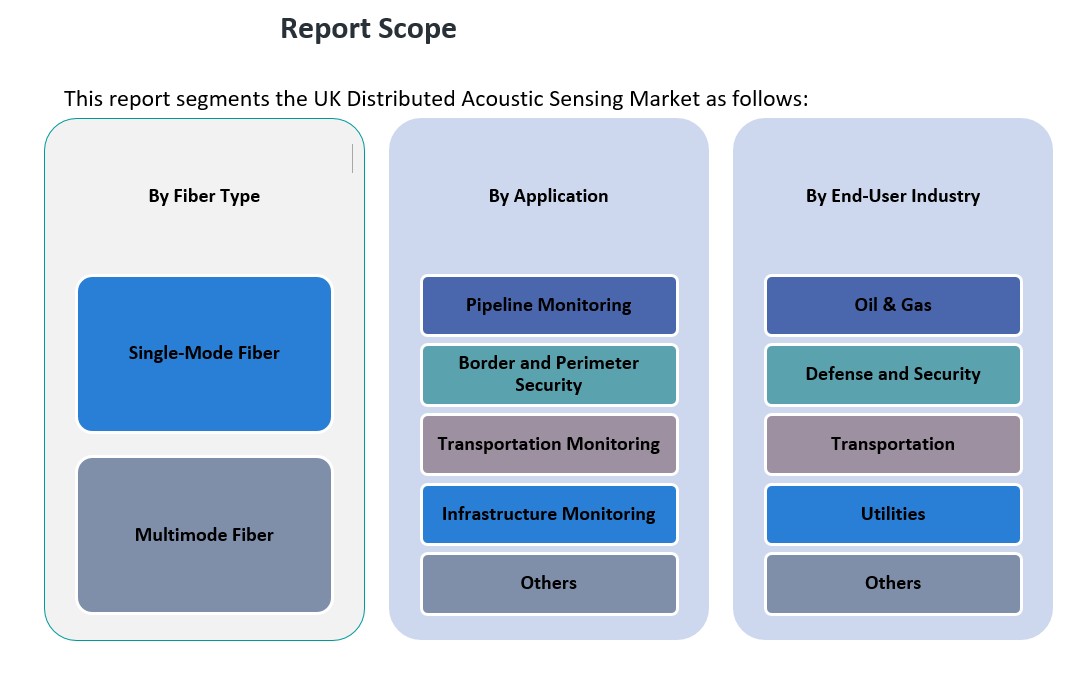
The UK Distributed Acoustic Sensing (DAS) market is segmented based on fiber type, application, and end-user industry, each catering to specific needs across various sectors.
By Fiber Type, the market is divided into Single-Mode Fiber and Multimode Fiber. Single-mode fiber is widely used for long-distance and high-precision applications due to its low loss and high sensitivity, making it ideal for monitoring large infrastructure such as pipelines and offshore facilities. In contrast, multimode fiber, which offers lower cost and easier installation over shorter distances, is often used in localized monitoring applications within transportation and security sectors.
By Application, the DAS market in the UK includes segments such as Pipeline Monitoring, Transportation Monitoring, Border and Perimeter Security, Infrastructure Monitoring, and others. Pipeline monitoring remains a significant application, particularly in the oil and gas industry, where continuous monitoring of pipelines for leaks or damage is critical. Transportation monitoring, including rail and road systems, is gaining traction due to the need for real-time data on asset performance and security. Border and perimeter security applications are seeing increased demand as concerns over national security rise. Infrastructure monitoring encompasses the broader range of applications, ensuring the safety and integrity of bridges, tunnels, and other critical infrastructure.
By End-User Industry, the market is categorized into Oil & Gas, Defense and Security, Transportation, Utilities, and others. The oil and gas sector represents a major end-user, driven by the need for efficient pipeline monitoring and operational safety. The defense and security sector is adopting DAS technology for border and perimeter surveillance, while transportation and utilities sectors leverage it to improve operational efficiency and safety in their infrastructure.
Segmentation:
By Fiber Type:
- Single-Mode Fiber
- Multimode Fiber
By Application:
- Pipeline Monitoring
- Transportation Monitoring
- Border and Perimeter Security
- Infrastructure Monitoring
- Others
By End-User Industry:
- Oil & Gas
- Defense and Security
- Transportation
- Utilities
- Others
Regional Analysis:
The UK Distributed Acoustic Sensing (DAS) market demonstrates significant regional variation, driven by differences in infrastructure development, energy production, transportation networks, and adoption of advanced monitoring technologies. England dominates the market, followed by Scotland, Wales, and Northern Ireland. Each region contributes uniquely to the market’s overall growth trajectory.
England holds the largest market share of 67.4% in the UK DAS market. The region’s dominance stems from its well-established oil and gas infrastructure, expanding railway networks, and concentration of major urban centers. The presence of leading DAS technology providers, research institutions, and high capital investments in smart infrastructure and pipeline monitoring have further propelled adoption. London and the Southeast of England, in particular, have emerged as innovation hubs, facilitating collaborations between technology developers and end-use industries such as energy, defense, and utilities.
Scotland accounts for 18.6% of the UK DAS market share. The region’s substantial contribution is attributed to its extensive offshore oil and gas exploration activities in the North Sea. Distributed Acoustic Sensing is widely deployed for pipeline surveillance, downhole monitoring, and seismic activity analysis. Additionally, Scotland’s increasing focus on renewable energy projects and environmental monitoring enhances demand for DAS technologies, especially in remote and harsh environments. Government-backed research and development initiatives have further reinforced market expansion in this region.
Wales contributes 8.1% to the UK DAS market. The region has seen steady growth due to its developing energy sector, including renewable energy projects and legacy coal infrastructure transitioning into monitored energy transport systems. Wales also benefits from UK-wide smart city initiatives and infrastructure modernization programs that incorporate real-time monitoring solutions like DAS. The regional government’s support for innovation and infrastructure safety continues to drive gradual adoption.
Northern Ireland represents the smallest share in the market, accounting for 5.9%. The relatively limited infrastructure and lower density of industrial operations constrain widespread DAS deployment. However, growth opportunities remain in the form of government-led digitization programs and the need for enhanced security systems in strategic facilities. Cross-border collaboration with the Republic of Ireland on energy and transportation projects may further open avenues for DAS technology applications in the coming years.
Key Player Analysis:
- Silixa Ltd.
- OptaSense (QinetiQ Group)
- Fotech Solutions Ltd.
- AP Sensing GmbH
- Weatherford International
- Halliburton Company
- Omnisens SA
- Bandweaver Technologies
- Schlumberger Limited
- Baker Hughes Company
Competitive Analysis:
The UK Distributed Acoustic Sensing (DAS) market is highly competitive, with several key players offering advanced solutions across various sectors, including oil and gas, transportation, and infrastructure monitoring. Major companies like OptaSense and Fotech Solutions are at the forefront, providing cutting-edge DAS technology tailored to a range of applications, such as pipeline monitoring and security. Fotech Solutions, a subsidiary of Oleum Technologies, offers robust systems for real-time monitoring, while OptaSense is known for its innovative solutions in fiber-optic sensing. Other players, such as Schneider Electric and Siemens, also compete in this market with integrated DAS solutions, often focused on infrastructure and environmental monitoring. As competition intensifies, companies differentiate themselves through technological advancements, customer service, and the ability to integrate DAS with other IoT and smart systems. These companies continue to expand their market presence by offering tailored solutions to meet the diverse needs of the UK market.
Recent Developments:
- In November 2024, Sensonic marked a significant milestone by inaugurating its Fiber Sensing Innovation Farm in Hampshire, United Kingdom. This facility is dedicated to advancing Distributed Acoustic Sensing (DAS) technologies for railway applications. It allows researchers, engineers, and industry partners to test and develop DAS solutions in simulated real-world conditions without disrupting active railway operations.
- In September 2023, researchers from the University of New Mexicoand Sandia National Laboratories developed a novel method to monitor local sea ice in Alaska using Distributed Acoustic Sensing (DAS) technology. By leveraging a telecommunications fiber optic cable combined with machine learning algorithms, the team analyzed ground vibrations caused by ocean waves to detect sea ice coverage and strength.
- In December 2023, Luna Innovations Inc. acquired Silixa Ltd., a UK-based leader in distributed fiber optic sensing solutions. This strategic acquisition enhanced Luna’s capabilities in distributed acoustic sensing (DAS), distributed temperature sensing (DTS), and distributed strain sensing (DSS), enabling improved performance for applications in energy, natural environments, mining, and defense.
Market Concentration & Characteristics:
The UK Distributed Acoustic Sensing (DAS) market exhibits a moderately concentrated structure, with several key players commanding substantial market shares. Leading companies such as OptaSense, Fotech Solutions, Silixa Ltd., and Halliburton dominate the landscape, offering advanced DAS solutions tailored to sectors like oil and gas, transportation, and infrastructure monitoring. These firms leverage their technological expertise and established client bases to maintain competitive advantages. Characteristically, the UK DAS market is marked by continuous innovation, with companies investing heavily in research and development to enhance sensing capabilities and data analytics. This focus on innovation is driven by the increasing demand for real-time monitoring solutions across various industries. Additionally, the market is influenced by stringent regulations governing the use of DAS systems, particularly in sectors such as defense and utilities, which can impact deployment strategies. Strategic mergers and acquisitions are prevalent, as companies seek to expand their technological portfolios and market reach. The end-user concentration is notable, with the oil and gas industry being a significant driver, followed by transportation and infrastructure sectors, all of which require reliable and efficient monitoring systems.
Shape Your Report to Specific Countries or Regions & Enjoy 30% Off!
Report Coverage:
The research report offers an in-depth analysis based on Fiber Type, Application and End-User Industry. It details leading market players, providing an overview of their business, product offerings, investments, revenue streams, and key applications. Additionally, the report includes insights into the competitive environment, SWOT analysis, current market trends, as well as the primary drivers and constraints. Furthermore, it discusses various factors that have driven market expansion in recent years. The report also explores market dynamics, regulatory scenarios, and technological advancements that are shaping the industry. It assesses the impact of external factors and global economic changes on market growth. Lastly, it provides strategic recommendations for new entrants and established companies to navigate the complexities of the market.
Future Outlook:
- The UK Distributed Acoustic Sensing market is expected to see consistent growth driven by increasing demand for real-time monitoring across critical infrastructure sectors.
- Technological advancements, particularly in fiber optics and data analytics, will enhance the efficiency and capabilities of DAS systems.
- Growing investment in renewable energy infrastructure, such as offshore wind farms, will create significant demand for DAS solutions.
- Increased focus on environmental monitoring will open new applications for DAS in industries such as agriculture and climate research.
- The need for advanced security solutions will drive further adoption of DAS for perimeter monitoring in critical sites.
- The integration of DAS with IoT and smart city initiatives will fuel market expansion, enabling better data utilization and automation.
- Regulatory pressures in sectors like oil and gas will encourage wider adoption of DAS for continuous monitoring and compliance.
- The demand for predictive maintenance in transportation and utilities will accelerate the implementation of DAS technology.
- Competitive dynamics will encourage mergers and acquisitions as companies aim to expand their technological capabilities and market reach.
- The UK’s focus on infrastructure development and smart technologies will ensure DAS remains a crucial component of future projects.



