| REPORT ATTRIBUTE |
DETAILS |
| Historical Period |
2020-2023 |
| Base Year |
2024 |
| Forecast Period |
2025-2032 |
| Germany Distributed Acoustic Sensing Market Size 2024 |
USD 42.37 Million |
| Germany Distributed Acoustic Sensing Market, CAGR |
12.73% |
| Germany Distributed Acoustic Sensing Market Size 2032 |
USD 110.48 Million |
Market Overview:
The Germany Distributed Acoustic Sensing Market is projected to grow from USD 42.37 million in 2024 to an estimated USD 110.48 million by 2032, with a compound annual growth rate (CAGR) of 12.73% from 2024 to 2032.
Several factors are propelling the growth of the DAS market in Germany. The nation’s commitment to energy transition and the integration of renewable energy sources necessitate advanced monitoring systems, where DAS plays a crucial role in ensuring the integrity and efficiency of energy infrastructure. In the transportation sector, Germany’s extensive railway and highway networks require continuous monitoring to maintain safety and operational efficiency, making DAS an invaluable tool. Additionally, the increasing need for security and surveillance in both urban and border areas has led to the deployment of DAS systems for real-time threat detection and response. Technological advancements, such as the integration of artificial intelligence and machine learning with DAS, are further enhancing the capabilities and applications of these systems, driving their adoption across various sectors.
Within Europe, Germany stands out as a key player in the DAS market. The country’s robust industrial base, coupled with substantial investments in research and development, positions it at the forefront of DAS technology implementation. Germany’s emphasis on infrastructure development and modernization, particularly in transportation and energy sectors, creates a conducive environment for the deployment of DAS systems. Furthermore, the government’s focus on enhancing national security measures aligns with the applications of DAS in surveillance and threat detection. Collaborations between German industries and research institutions are fostering innovation in DAS technologies, ensuring the country’s continued leadership in this market segment.
Access crucial information at unmatched prices!
Request your sample report today & start making informed decisions powered by Credence Research Inc.!
Download Sample
Market Insights:
- The Germany Distributed Acoustic Sensing market is projected to grow from USD 42.37 million in 2024 to USD 110.48 million by 2032, registering a CAGR of 12.73%.
- The Global Distributed Acoustic Sensing Market is projected to grow from USD 639.45 million in 2024 to an estimated USD 1596.46 million by 2032, with a compound annual growth rate (CAGR) of 12.12% from 2024 to 2032.
- Germany’s energy transition and renewable integration drive DAS deployment for real-time asset monitoring and environmental compliance.
- Transportation infrastructure, including railways and highways, increasingly adopts DAS to enhance safety through predictive maintenance.
- Rising security threats are accelerating the use of DAS in border surveillance, urban safety, and critical infrastructure protection.
- Technological integration with AI and Industry 4.0 platforms is expanding DAS use in smart manufacturing and automation.
- High upfront investment, data interpretation complexity, and regulatory ambiguity continue to challenge widespread market adoption.
- Bavaria, North Rhine-Westphalia, and Lower Saxony lead regional growth due to strong industrial bases and infrastructure investment.
Market Drivers:
Advancements in Infrastructure Monitoring and Maintenance
Germany’s commitment to enhancing and maintaining its critical infrastructure significantly drives the demand for Distributed Acoustic Sensing (DAS) systems. As a country known for its expansive railway networks, highways, tunnels, and pipelines, the need for real-time structural health monitoring has never been more critical. For example, fiber optic sensors embedded in highway bridges provide real-time data on vibrations and stress levels, enabling timely interventions to prevent structural failures. DAS systems offer continuous, high-resolution data acquisition across long distances, enabling proactive maintenance and reducing operational downtimes. These systems support early detection of anomalies such as pipeline leaks, ground movements, or structural stress, which ensures public safety while minimizing repair costs. With Germany increasingly prioritizing smart infrastructure and digital transformation, DAS technologies are becoming a fundamental part of national infrastructure strategies.
Growing Adoption in the Energy Sector
Germany’s ambitious energy transition (Energiewende) and its drive toward a more sustainable energy ecosystem have created significant opportunities for DAS deployment. The technology plays a crucial role in monitoring oil and gas pipelines, wind farms, and power grids, ensuring the safe and efficient operation of these assets. In the context of Germany’s declining reliance on nuclear energy and fossil fuels, and its growing investment in renewable sources, DAS offers real-time insights into energy asset performance and integrity. In particular, the oil and gas sector benefits from DAS’s ability to detect flow anomalies, pressure changes, and unauthorized activities near pipelines, thereby enhancing environmental compliance and operational efficiency.
Rising Demand for Advanced Security and Surveillance Solutions
As security threats become increasingly sophisticated, Germany has recognized the need for next-generation perimeter intrusion detection systems. DAS systems offer a non-intrusive and highly effective method for monitoring vast and sensitive areas, such as borders, military installations, and critical national infrastructure. These systems detect vibrations and acoustic signals with high precision, allowing for the immediate identification and localization of intrusions. In urban security and public safety scenarios, DAS has emerged as a powerful complement to traditional surveillance tools. Its integration into smart city initiatives underscores Germany’s push toward leveraging innovative technologies for comprehensive security solutions.
Technological Integration and Industry 4.0 Adoption
Germany’s leadership in Industry 4.0 is fueling the adoption of DAS as part of broader automation and smart monitoring systems. The convergence of DAS with artificial intelligence, machine learning, and cloud computing is expanding the scope and scalability of acoustic sensing solutions. These integrations enable predictive analytics, anomaly detection, and enhanced decision-making, particularly in manufacturing and industrial automation environments. For example, smart factories utilize AI-driven DAS solutions to monitor production processes autonomously, optimizing resource usage and minimizing risks. As industries increasingly seek to optimize performance while minimizing risk and cost, DAS systems are being embedded into intelligent monitoring frameworks. This technological synergy positions Germany to capitalize on next-generation sensing capabilities, fostering continuous innovation and driving the DAS market forward.
Market Trends:
Integration of Distributed Acoustic Sensing in Subsea Infrastructure Monitoring
Germany is increasingly focusing on enhancing the security of its subsea fiber optic cables, vital components of global internet infrastructure. Recent incidents in the Baltic Sea have underscored the vulnerability of these cables to potential sabotage. In response, German technology firms are adopting Distributed Acoustic Sensing (DAS) techniques to detect disturbances in fiber optic signals caused by vibrations or temperature changes. This approach enables the identification of suspicious activities, such as unauthorized underwater drones or vessels near critical cables, thereby providing early warnings of potential threats. For instance, Companies like AP Sensing are at the forefront of developing and implementing DAS technology for subsea applications, contributing to enhanced maritime security.
Expansion of DAS Applications in Renewable Energy Projects
Germany’s commitment to renewable energy has led to the proliferation of wind farms and solar installations. DAS technology is increasingly being utilized to monitor the structural health of these installations. For instance, in wind farms, DAS systems can detect vibrations and stress on turbine blades and towers, facilitating predictive maintenance and reducing downtime. Fiber sensing technologies also monitor cable integrity in offshore wind farms, detecting risks posed by fishing vessels or ship anchors. This trend aligns with Germany’s Energiewende policy, aiming for a sustainable and reliable energy supply.
Adoption of DAS in Urban Infrastructure for Smart City Initiatives
Urban centers in Germany are integrating DAS technology into their infrastructure as part of smart city initiatives. DAS systems are employed to monitor traffic flow, detect incidents on roadways, and oversee the structural integrity of bridges and tunnels. This real-time data collection aids in optimizing traffic management, enhancing public safety, and extending the lifespan of critical urban structures. The adoption of DAS in urban environments reflects a broader trend toward leveraging advanced sensing technologies for efficient city management.
Collaborative Research and Development Efforts Enhancing DAS Capabilities
German research institutions and private enterprises are increasingly collaborating to advance DAS technology. These partnerships focus on enhancing the sensitivity, range, and data analytics capabilities of DAS systems. Innovations emerging from these collaborations are expanding the potential applications of DAS across various sectors, including environmental monitoring and disaster prevention. Such cooperative efforts underscore Germany’s dedication to maintaining a leading position in the development and deployment of cutting-edge sensing technologies.
Market Challenges Analysis:
High Initial Investment and Implementation Costs
One of the primary restraints affecting the growth of the Distributed Acoustic Sensing (DAS) market in Germany is the high initial cost associated with system deployment. Implementing DAS requires substantial investment in both hardware and specialized software, along with integration into existing infrastructure. For industries with limited capital expenditure budgets, particularly small and medium enterprises, these upfront costs can be prohibitive. Furthermore, the need for trained personnel and sophisticated analytical tools to interpret complex DAS-generated data adds to the financial burden, slowing adoption in cost-sensitive sectors.
Technical Limitations and Data Interpretation Complexity
Despite technological advancements, DAS systems still face technical limitations that hinder their widespread deployment. Signal attenuation, limited sensing range, and environmental interferences can affect the accuracy and reliability of measurements. Moreover, the interpretation of DAS data requires advanced algorithms and expert knowledge, which are not always readily available. The complexity in distinguishing between relevant and irrelevant acoustic events increases the potential for false positives or missed detections, especially in dynamic and noisy environments such as urban areas or industrial facilities.
Regulatory Uncertainty and Standardization Gaps
Germany’s DAS market also faces challenges related to regulatory uncertainty and the absence of standardized practices. The deployment of DAS systems, particularly in sectors involving critical infrastructure or surveillance, must adhere to strict data protection and privacy regulations under German and EU law. However, the lack of clear guidelines or frameworks specific to DAS technology complicates compliance. For instance, the rollout of smart meters in Germany was initially slow due to concerns about data security until manufacturers were certified by the Federal Office for Information Security (BSI). This uncertainty may deter potential adopters and slow innovation, especially in applications involving public or sensitive data.
Integration Challenges Across Diverse Infrastructure
Integrating DAS solutions into Germany’s complex and varied infrastructure landscape poses additional difficulties. Legacy systems, varying network protocols, and disparate operational environments require customized solutions that can increase project timelines and costs. This fragmentation can delay deployment and reduce scalability, particularly in large-scale infrastructure or multi-stakeholder projects.
Market Opportunities:
Germany presents a compelling opportunity for growth in the Distributed Acoustic Sensing (DAS) market, driven by the country’s strong focus on digital transformation and infrastructure modernization. The nation’s transition toward smart infrastructure and intelligent transportation systems opens avenues for DAS to be integrated into long-range asset monitoring solutions, particularly in sectors such as railways, highways, and energy distribution. As DAS technology allows for continuous, real-time monitoring using existing fiber optic networks, it offers a scalable solution for infrastructure health diagnostics, fault detection, and security surveillance. With the government’s increased emphasis on enhancing public safety, critical asset protection, and operational efficiency, DAS stands out as a cost-effective and reliable solution capable of addressing these objectives through passive, wide-area monitoring.
In addition to infrastructure, Germany’s push toward renewable energy and sustainability further expands market opportunities for DAS. Wind and solar power installations, as well as power transmission lines, require advanced monitoring to ensure uninterrupted performance and early fault detection. DAS offers an ideal fit, capable of detecting structural anomalies, temperature shifts, and unauthorized access along distributed assets. Moreover, the integration of DAS with artificial intelligence and data analytics is unlocking innovative applications across Industry 4.0 domains, enhancing predictive maintenance and operational intelligence. As industries in Germany pursue higher levels of automation, efficiency, and data-driven decision-making, the demand for versatile, real-time sensing technologies such as DAS is poised to accelerate, creating a favorable environment for long-term market growth and technological innovation.
Market Segmentation Analysis:
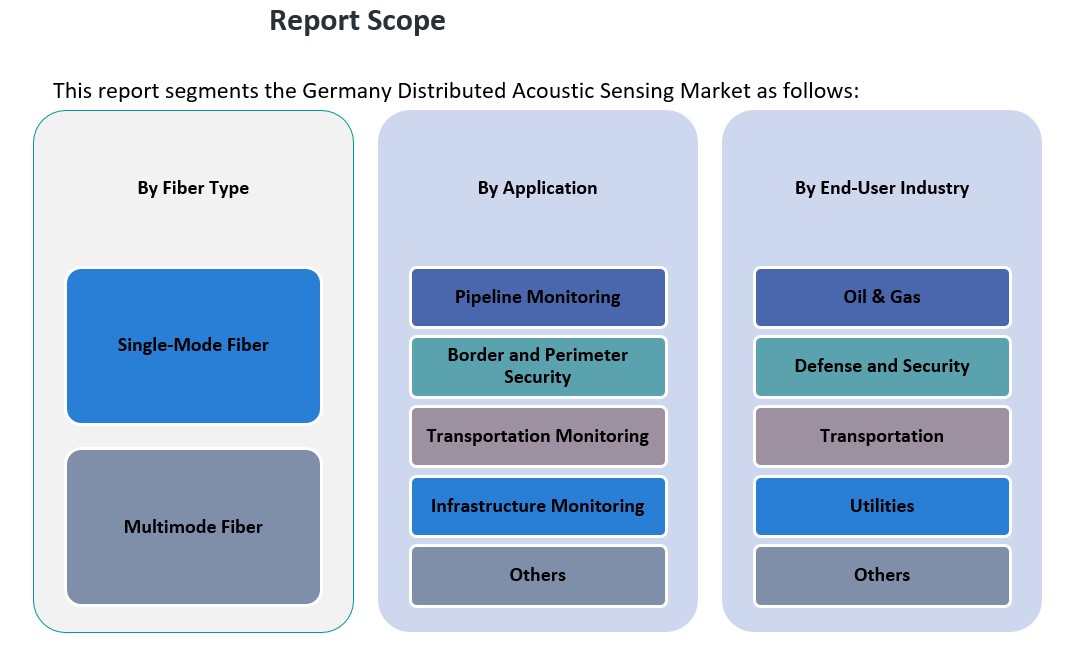
The Germany Distributed Acoustic Sensing (DAS) market is segmented by fiber type, application, and end-user industry, each playing a critical role in shaping the demand landscape.
By fiber type, single-mode fiber dominates the market due to its superior long-distance sensing capabilities and low signal attenuation. It is preferred in large-scale deployments such as oil pipelines and national transportation networks. Multimode fiber, while offering shorter range and higher bandwidth, finds niche applications in compact, high-density environments requiring localized monitoring solutions.
By application, pipeline monitoring holds a significant share owing to Germany’s focus on securing and maintaining its extensive oil, gas, and utility pipelines. DAS systems provide real-time data for leak detection, intrusion alerts, and flow assurance. Transportation monitoring is another vital segment, benefiting from Germany’s advanced rail and road infrastructure that demands continuous safety oversight. Border and perimeter security applications are growing in relevance, with increased emphasis on national security and surveillance technologies. Infrastructure monitoring is also gaining momentum, particularly in urban development projects and smart city initiatives where DAS enables structural health diagnostics.
By end-user industry, the oil and gas sector leads adoption, using DAS for pipeline integrity and exploration safety. The defense and security segment is rapidly expanding, leveraging DAS for intrusion detection and situational awareness. Transportation and utilities sectors follow closely, utilizing the technology for infrastructure performance and fault monitoring. The growing need for real-time, non-intrusive, and cost-efficient monitoring solutions positions these segments as key growth contributors in Germany’s DAS market.
Segmentation:
By Fiber Type:
- Single-Mode Fiber
- Multimode Fiber
By Application:
- Pipeline Monitoring
- Transportation Monitoring
- Border and Perimeter Security
- Infrastructure Monitoring
- Others
By End-User Industry:
- Oil & Gas
- Defense and Security
- Transportation
- Utilities
- Others
Regional Analysis:
The Distributed Acoustic Sensing (DAS) market in Germany exhibits significant regional variations, influenced by industrial concentration, infrastructure development, and investment in technological advancements. While specific market share data by region within Germany is limited, an analysis based on industrial activities and infrastructure projects provides insights into regional dynamics.
Bavaria and Baden-Württemberg are prominent regions in the DAS market, driven by their robust industrial bases, including automotive and manufacturing sectors. The presence of extensive transportation networks and ongoing infrastructure projects in these states fosters the adoption of DAS technologies for monitoring and maintenance purposes.
North Rhine-Westphalia, Germany’s most populous state, contributes significantly to the DAS market due to its dense urban infrastructure and industrial activities. The region’s focus on enhancing public safety and infrastructure resilience aligns with the deployment of DAS systems for real-time monitoring.
Lower Saxony and Schleswig-Holstein are key players in the energy sector, particularly in renewable energy initiatives. The integration of DAS technologies in wind farms and energy transmission lines in these regions supports the monitoring of structural integrity and operational efficiency.
Berlin and Brandenburg are emerging as hubs for smart city initiatives, incorporating advanced sensing technologies, including DAS, into urban planning and infrastructure management. The emphasis on digital transformation and sustainable urban development in these regions propels the growth of the DAS market.
Key Player Analysis:
- Silixa Ltd.
- OptaSense (QinetiQ Group)
- Fotech Solutions Ltd.
- AP Sensing GmbH
- Weatherford International
- Halliburton Company
- Omnisens SA
- Bandweaver Technologies
- Schlumberger Limited
- Baker Hughes Company
Competitive Analysis:
The Germany Distributed Acoustic Sensing (DAS) market is moderately competitive, with both global and domestic players actively strengthening their presence through innovation and strategic partnerships. Key companies such as AP Sensing GmbH, a Germany-based leader, leverage advanced fiber optic sensing technologies and strong research capabilities to cater to local and international demand. Global firms like Halliburton, OFS (a Furukawa Company), and Fotech Solutions also maintain a competitive edge by offering integrated DAS solutions tailored to pipeline monitoring, security, and infrastructure applications. Companies in this market emphasize technological differentiation, focusing on signal processing accuracy, data analytics, and AI integration. Collaborations with government bodies, utility providers, and energy companies support market penetration. As adoption expands across transportation, energy, and security sectors, competitive intensity is expected to rise, encouraging continuous innovation and product enhancement to meet Germany’s growing demand for real-time, intelligent sensing technologies.
Recent Developments:
- In July 2024, VIAVI Solutions Inc.introduced the NITRO® Fiber Sensing solution, a cutting-edge real-time asset monitoring and analytics system designed for critical infrastructure. This innovative solution integrates Distributed Acoustic Sensing (DAS), Distributed Temperature Sensing (DTS), and Simultaneous Temperature and Strain Sensing (DTSS) technologies. It enables operators to monitor fiber optic cables for temperature, strain, and acoustic vibrations, providing precise alerts to detect and prevent external threats such as human interference or environmental hazards.
- In September 2023, researchers from the University of New Mexicoand Sandia National Laboratories developed a novel method to monitor local sea ice in Alaska using Distributed Acoustic Sensing (DAS) technology. By leveraging a telecommunications fiber optic cable combined with machine learning algorithms, the team analyzed ground vibrations caused by ocean waves to detect sea ice coverage and strength.
- In December 2023, Luna Innovations Inc. acquired Silixa Ltd., a UK-based leader in distributed fiber optic sensing solutions. This strategic acquisition enhanced Luna’s capabilities in distributed acoustic sensing (DAS), distributed temperature sensing (DTS), and distributed strain sensing (DSS), enabling improved performance for applications in energy, natural environments, mining, and defense.
Market Concentration & Characteristics:
The Distributed Acoustic Sensing (DAS) market in Germany is characterized by a moderate concentration, with a mix of established global players and innovative domestic firms contributing to its development. Leading companies such as AP Sensing GmbH, based in Böblingen, leverage Germany’s strong engineering heritage to offer advanced DAS solutions tailored to various industries. International firms like Halliburton, Schlumberger, and Silixa also maintain a significant presence, providing comprehensive DAS technologies for applications ranging from pipeline monitoring to infrastructure surveillance. Germany’s DAS market benefits from its robust industrial base, advanced infrastructure, and commitment to technological innovation. The country’s emphasis on Industry 4.0 and smart infrastructure initiatives fosters an environment conducive to the adoption of DAS technologies. Moreover, the integration of DAS with emerging technologies such as artificial intelligence and machine learning enhances its capabilities, enabling real-time data analysis and predictive maintenance. As industries increasingly prioritize safety, efficiency, and environmental compliance, the demand for sophisticated monitoring solutions like DAS is expected to grow, solidifying Germany’s position as a key market in the global DAS landscape.
Shape Your Report to Specific Countries or Regions & Enjoy 30% Off!
Report Coverage:
The research report offers an in-depth analysis based on Fiber Type, Application and End-User Industry. It details leading market players, providing an overview of their business, product offerings, investments, revenue streams, and key applications. Additionally, the report includes insights into the competitive environment, SWOT analysis, current market trends, as well as the primary drivers and constraints. Furthermore, it discusses various factors that have driven market expansion in recent years. The report also explores market dynamics, regulatory scenarios, and technological advancements that are shaping the industry. It assesses the impact of external factors and global economic changes on market growth. Lastly, it provides strategic recommendations for new entrants and established companies to navigate the complexities of the market.
Future Outlook:
- Increased infrastructure investments will drive broader adoption of DAS in transportation and urban development projects.
- Technological advancements in AI and machine learning will enhance data interpretation and reduce false positives.
- Integration with smart grid systems will support Germany’s transition to renewable energy monitoring.
- Demand from the defense and security sector will rise due to heightened focus on national surveillance capabilities.
- Expansion of subsea DAS applications will improve maritime infrastructure protection and cable security.
- Cross-sector collaborations will foster innovation and create customized sensing solutions for varied industries.
- Growing reliance on predictive maintenance will increase DAS adoption in utilities and industrial automation.
- Enhanced regulatory clarity will facilitate faster deployment in critical infrastructure projects.
- Continued R&D funding will position Germany as a hub for next-generation DAS innovation.
- Adoption in environmental monitoring will grow, driven by climate resilience and disaster risk management efforts.



