Market Overview:
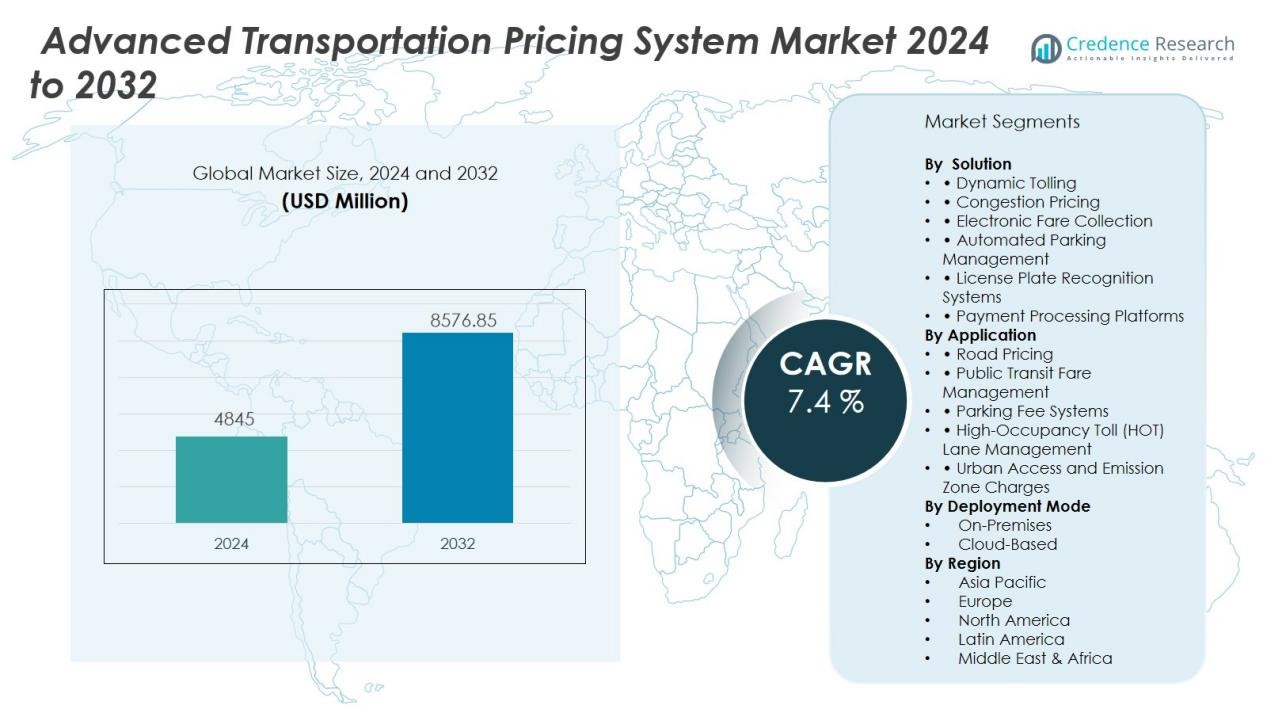
The advanced transportation pricing system market size was valued at USD 4845 million in 2024 and is anticipated to reach USD 8576.85 million by 2032, at a CAGR of 7.4 % during the forecast period (2024-2032).
| REPORT ATTRIBUTE | DETAILS |
|---|---|
| Historical Period | 2020-2024 |
| Base Year | 2024 |
| Forecast Period | 2025-2032 |
| Advanced Transportation Pricing System Market Size 2024 | USD 4845 Million |
| Advanced Transportation Pricing System Market, CAGR | 7.4 % |
| Advanced Transportation Pricing System Market Size 2032 | USD 8576.85 Million |
Key drivers for the advanced transportation pricing system market include growing government investments in smart city infrastructure, the rising emphasis on demand management, and the push to reduce traffic congestion and environmental impacts. Authorities are deploying these systems to enable flexible pricing based on congestion levels, distance traveled, and vehicle emissions, which supports better traffic distribution and encourages sustainable transportation behaviors. Advances in AI, cloud computing, and mobile payment integration continue to enhance the capabilities and effectiveness of pricing systems globally.
Regionally, North America leads the market, supported by established transportation infrastructure, early adoption of electronic tolling, and robust funding for technology upgrades. Europe follows, driven by stringent emission regulations and expanding investments in intelligent transport systems. The Asia-Pacific region is expected to register the fastest growth, propelled by rapid urban expansion, infrastructure modernization, and large-scale government initiatives targeting efficient and sustainable urban mobility.
Market Insights:
- The advanced transportation pricing system market reached USD 4,845 million in 2024 and is forecasted to hit USD 8,576.85 million by 2032, at a 7.4% CAGR.
- Government investments in smart city infrastructure and demand management drive widespread adoption of advanced pricing technologies.
- Authorities deploy flexible pricing systems based on congestion, distance traveled, and vehicle emissions to optimize traffic and support sustainable transportation.
- Integration of AI, cloud computing, and mobile payment technologies enhances system capabilities and streamlines revenue collection globally.
- North America leads the market with a 36% share, followed by Europe at 29%, and Asia-Pacific at 22%, with rapid growth in urbanization and infrastructure modernization fueling expansion in Asia-Pacific.
- Environmental sustainability initiatives promote emissions-based tolling and congestion charges, accelerating adoption of adaptive pricing models.
- The market faces challenges from data privacy concerns, public acceptance, high initial investment, and complex integration requirements, especially in regions with legacy infrastructure.
Market Drivers:
Rising Urbanization and Congestion Necessitate Smarter Pricing Mechanisms:
Rapid urban population growth and rising vehicle ownership in metropolitan regions have significantly intensified road congestion and strained existing transport networks. The advanced transportation pricing system market addresses these challenges by enabling authorities to implement dynamic pricing strategies, which distribute traffic more efficiently and discourage peak-hour congestion. Demand for smarter mobility solutions continues to surge, making pricing systems integral to urban planning. These systems support more sustainable city environments and improve commuter experiences.
Government Policy Support and Infrastructure Modernization Fuel Adoption:
Strong policy initiatives and public investments in intelligent transport systems accelerate the implementation of advanced pricing technologies. Governments prioritize smart city development and sustainable transportation, creating favorable regulatory environments for market expansion. The advanced transportation pricing system market benefits from these initiatives, which often mandate or incentivize technology adoption across urban and interurban corridors. Policy-driven modernization efforts ensure continuous upgrades and integration of advanced pricing tools in public infrastructure.
- For instance, Siemens Mobility supplied Cooperative Intelligent Transport System (C-ITS) infrastructure covering 2,200 km of Austria’s highways in partnership with ASFiNAG, enabling real-time vehicle-to-infrastructure communication across the entire network.
Integration of Digital Technologies Enhances Efficiency and Revenue:
Continuous advancements in digital technologies, including IoT, artificial intelligence, and mobile payments, play a crucial role in the market’s growth. These tools enable real-time monitoring, predictive analytics, and seamless transaction processing, which boost operational efficiency and transparency. The advanced transportation pricing system market leverages these digital solutions to automate tolling, parking, and congestion pricing while reducing administrative costs and revenue leakages. Technology-driven platforms foster trust among stakeholders and streamline the user experience.
- For instance, Conduent Transportation processes nearly 12 million tolling transactions every day-over 4.3 billion annually-through its Real-Time Payments hub, reducing invoice-to-payment times from days to minutes.
Environmental Sustainability Drives Demand for Adaptive Pricing Solutions:
Growing concerns about air quality and environmental sustainability prompt authorities to seek adaptive pricing systems that incentivize greener travel behaviors. The advanced transportation pricing system market responds by supporting emissions-based charging, distance-based tolling, and congestion charges that align with environmental targets. These mechanisms promote the use of public transit, low-emission vehicles, and alternative transport modes. Environmental objectives further enhance the market’s relevance and long-term adoption.
Market Trends:
Integration of Artificial Intelligence and Real-Time Data Analytics Optimizes Pricing Efficiency:
The advanced transportation pricing system market is witnessing strong adoption of artificial intelligence and real-time data analytics to enable dynamic and demand-responsive pricing models. AI-powered algorithms analyze large volumes of traffic, weather, and behavioral data to recommend pricing strategies that balance revenue generation and congestion management. It allows operators to adjust tolls, fares, or parking fees instantly in response to fluctuating demand and changing urban conditions. Real-time analytics support predictive traffic management and proactive incident detection, which improves both operational efficiency and traveler satisfaction. The market’s focus on continuous data integration drives the evolution of sophisticated, adaptive pricing platforms that can learn and improve over time.
- For instance, Uber dispatch system generates 30 million matched-pair predictions per minute.
Mobile Payment Solutions and Seamless User Experience Lead Market Transformation:
The rapid expansion of mobile payment solutions and contactless technologies is transforming how users interact with advanced transportation pricing systems. It enhances user convenience by supporting cashless, secure, and instant transactions across tolls, public transit, and parking environments. Mobile applications and digital wallets provide commuters with real-time updates on pricing, availability, and route options, which simplifies travel planning and promotes adoption of pricing mechanisms. The advanced transportation pricing system market benefits from the convergence of digital interfaces, enabling operators to personalize services and build loyalty through reward programs or dynamic discounts. Growing demand for frictionless mobility experiences continues to shape the competitive landscape and drives technological advancements across the sector.
- For instance, the Octopus Wallet app in Hong Kong has grown to over 4.5 million active digital wallets, enabling commuters to tap and pay seamlessly across buses, subways, and parking facilities .
Market Challenges Analysis:
Data Privacy Concerns and Public Acceptance Impede System Deployment:
The advanced transportation pricing system market faces persistent challenges related to data privacy and public acceptance. Collection and analysis of real-time user data can raise concerns about surveillance, misuse of personal information, and potential security breaches. Public skepticism and resistance may hinder system adoption if commuters perceive pricing mechanisms as unfair or intrusive. Addressing these concerns requires transparent data policies, robust cybersecurity measures, and effective communication strategies to build trust and acceptance.
Complex Integration and High Initial Costs Restrain Adoption:
Implementing advanced transportation pricing systems demands significant investment in infrastructure, digital platforms, and back-end integration. Many cities struggle with legacy systems and complex operational environments, making it difficult to achieve seamless interoperability across multiple transport modes. The advanced transportation pricing system market must overcome these technical and financial barriers to reach broader deployment. High upfront costs, ongoing maintenance requirements, and the need for skilled personnel can slow the pace of adoption, particularly in regions with limited resources.
Market Opportunities:
Expansion of Smart City Initiatives Creates New Revenue Streams:
Global investment in smart city infrastructure generates significant opportunities for the advanced transportation pricing system market. Cities prioritize efficient urban mobility, digital connectivity, and sustainable development, driving demand for intelligent pricing platforms across toll roads, congestion zones, and public transit systems. It can capitalize on large-scale deployments in emerging economies where urbanization accelerates rapidly. Integration with multi-modal transport and real-time traveler information systems further broadens the scope for innovative service offerings. Collaboration with public and private stakeholders will help unlock new applications and revenue models.
Adoption of Green Mobility and Environmental Incentive Programs Fuels Market Growth:
The shift toward green mobility and low-emission transportation solutions opens growth avenues for the advanced transportation pricing system market. It enables cities to implement emissions-based tolling, incentives for electric vehicles, and congestion charges that support environmental targets. These strategies align with global sustainability goals and attract funding from governments and international organizations. By supporting flexible, adaptive pricing models, the market positions itself at the forefront of climate-smart urban transportation. This trend encourages further innovation in digital solutions and long-term customer engagement.
Market Segmentation Analysis:
By Solution:
The advanced transportation pricing system market includes a diverse range of solutions such as dynamic tolling, congestion pricing, electronic fare collection, and automated parking management. Dynamic tolling and congestion pricing dominate due to rising urban congestion and the need for demand-responsive road usage. Electronic fare collection gains traction in public transit networks, driven by contactless payments and mobile ticketing. Automated parking management solutions also see increased adoption as cities seek to optimize limited urban parking spaces.
- For instance, Stockholm’s expanded congestion pricing scheme cut daily vehicle kilometers traveled by about 270,000 km.
By Deployment:
Deployment models span on-premises and cloud-based systems. Cloud-based deployment is rapidly gaining preference due to its scalability, flexibility, and lower upfront costs. It enables real-time updates, remote monitoring, and seamless integration with third-party applications. On-premises deployment remains relevant in regions or sectors with strict data sovereignty requirements, but its share continues to decline as organizations shift to cloud-centric architectures for better operational efficiency.
- For instance, AWS IoT Core managed 100,000 devices publishing 975,000,000 messages over 30 days.
By Application:
The market addresses applications across road pricing, public transit fare management, and parking fee systems. Road pricing leads adoption, propelled by the expansion of toll roads, congestion zones, and urban access charges. Public transit fare management systems experience strong demand as authorities modernize networks and encourage cashless transactions. Parking fee management rounds out the segment, responding to increased pressure on urban infrastructure and the need to streamline revenue collection and enforcement. The advanced transportation pricing system market aligns solutions closely with evolving mobility needs across metropolitan areas.
Segmentations:
By Solution:
- Dynamic Tolling
- Congestion Pricing
- Electronic Fare Collection
- Automated Parking Management
- License Plate Recognition Systems
- Payment Processing Platforms
By Deployment:
- Cloud-Based
- On-Premises
By Application:
- Road Pricing
- Public Transit Fare Management
- Parking Fee Systems
- High-Occupancy Toll (HOT) Lane Management
- Urban Access and Emission Zone Charges
By Region:
- North America
- U.S.
- Canada
- Mexico
- Europe
- Germany
- France
- U.K.
- Italy
- Spain
- Rest of Europe
- Asia Pacific
- China
- Japan
- India
- South Korea
- South-east Asia
- Rest of Asia Pacific
- Latin America
- Brazil
- Argentina
- Rest of Latin America
- Middle East & Africa
- GCC Countries
- South Africa
- Rest of the Middle East and Africa
Regional Analysis:
North America :
North America commands a 36% share of the advanced transportation pricing system market, reflecting its mature digital infrastructure and widespread adoption of electronic tolling and congestion pricing solutions. Strong public funding, favorable regulatory policies, and an established ecosystem of technology vendors drive continuous market expansion in the United States and Canada. Regional authorities prioritize investment in intelligent transport systems to manage rising urban congestion and optimize revenue streams. Integration of cloud-based analytics, contactless payments, and AI-driven pricing models supports advanced system capabilities. Public-private partnerships accelerate deployment timelines and foster ongoing innovation. North America remains a prime destination for pilot projects and new technology launches.
Europe :
Europe holds a 29% share of the advanced transportation pricing system market, propelled by strict environmental regulations and ambitious sustainability targets across the region. Countries such as Germany, the United Kingdom, Sweden, and the Netherlands deploy congestion charging and emissions-based tolling to address urban air quality and promote eco-friendly mobility. The European Union supports market development through harmonized regulatory frameworks and dedicated funding for smart mobility initiatives. Integration of advanced pricing systems with multimodal public transit networks improves efficiency and commuter satisfaction. It benefits from the region’s focus on interoperability and cross-border coordination. Europe’s dynamic policy landscape fosters rapid technology adoption and widespread acceptance of innovative pricing mechanisms.
Asia-Pacific:
Asia-Pacific accounts for a 22% share of the advanced transportation pricing system market and leads in growth rate, fueled by rapid urbanization, large-scale infrastructure investments, and robust government support for smart city projects. China, India, Japan, and Southeast Asian countries commit significant resources to modernize transport networks and implement digital pricing platforms. Population density and increasing vehicle ownership intensify the need for congestion management and efficient revenue collection. It leverages public and private sector collaboration to accelerate project rollout. Adoption of mobile payments, AI-based monitoring, and cloud integration positions Asia-Pacific at the forefront of market expansion and digital transformation in urban transportation.
Key Player Analysis:
- Conduent
- IBM
- Cubic Corporation
- International Road Dynamics
- Iteris
- Ericsson
- TransCore
- Viaplus
- Kapsch TrafficCom
- Q-Free
Competitive Analysis:
The advanced transportation pricing system market features a competitive landscape shaped by global technology leaders and specialized solution providers. Key players include Conduent, IBM, Cubic Corporation, International Road Dynamics, Iteris, and Ericsson, each leveraging strong portfolios in intelligent transport solutions and digital infrastructure. These companies invest heavily in R&D to drive innovation in dynamic tolling, real-time analytics, and integrated payment systems. It sees frequent collaborations between public agencies and private firms to deliver large-scale deployments and customized regional solutions. Competitive differentiation focuses on system reliability, interoperability, cybersecurity, and seamless user experience. Strategic acquisitions, technology partnerships, and expansion into emerging markets enable leading companies to strengthen their positions and respond to evolving mobility needs. The market demands continuous adaptation to regulatory shifts, customer preferences, and rapid advancements in digital and data-driven technologies.
Recent Developments:
- In July 2025, Conduent announced a strategic collaboration with Fairmarkit to enhance its procurement workflows and finance capabilities.
- In February 2025, Cubic introduced the FEnX fare gate system for enhanced security and passenger experience in public transit.
- In February 2025, Ericsson announced a new wave of products, including energy-efficient Massive MIMO radios, new Indoor 5G solutions, and RAN Connect open fronthaul equipment to advance programmable networks.
Market Concentration & Characteristics:
The advanced transportation pricing system market exhibits moderate to high market concentration, with a mix of global technology providers, specialized software vendors, and established infrastructure companies dominating key segments. Leading players maintain strong competitive positions through continuous innovation, strategic partnerships, and large-scale deployment capabilities. It features high barriers to entry due to complex integration requirements, significant capital investment, and the need for robust cybersecurity measures. The market is characterized by rapid technological evolution, a focus on interoperability, and increasing demand for scalable, cloud-based solutions. Collaboration between public agencies and private sector companies remains essential to support large-scale adoption and ongoing advancements in system capabilities.
Report Coverage:
The research report offers an in-depth analysis based on Solution, Deployment, Application and Region. It details leading Market players, providing an overview of their business, product offerings, investments, revenue streams, and key applications. Additionally, the report includes insights into the competitive environment, SWOT analysis, current Market trends, as well as the primary drivers and constraints. Furthermore, it discusses various factors that have driven Market expansion in recent years. The report also explores Market dynamics, regulatory scenarios, and technological advancements that are shaping the industry. It assesses the impact of external factors and global economic changes on Market growth. Lastly, it provides strategic recommendations for new entrants and established companies to navigate the complexities of the Market.
Future Outlook:
- Increased deployment of adaptive pricing mechanisms will enable cities to manage congestion more effectively and align pricing with real-time demand.
- Wider use of AI-driven predictive models will empower operators to anticipate traffic patterns and adjust charges proactively.
- Integration of vehicle-to-everything (V2X) data sources and sensor networks will refine price calibration and optimize network efficiency.
- Expansion of multimodal pricing platforms will create seamless interfaces across toll roads, transit systems, and parking facilities.
- Growing collaboration with mobility-as-a-service (MaaS) providers will open opportunities for bundled travel solutions engaging both public and private sectors.
- Enhanced cybersecurity protocols and data governance frameworks will strengthen user trust in pricing systems
- Progressive environmental policies will encourage deployment of emissions-linked pricing and low-emission zone strategies.
- Adoption of blockchain and distributed ledger technologies will support auditability and transparency in transaction processing.
- Mobile-first interfaces and digital wallets will promote user engagement through personalized pricing offers and loyalty benefits.
- Scaling cloud-native platforms and edge computing capabilities will support modular, cost-efficient implementation across diverse geographic regions.

Request a Free Sample
Fill in your details and we'll send you a free sample report.
- Sample data tables & charts
- Research methodology
Market Dynamics
Government Investments in Smart City Infrastructure
Significant public funding and policy support for smart city initiatives are accelerating the deployment of advanced transportation pricing systems, enabling cities to manage congestion, optimize revenue, and modernize mobility networks.
Emphasis on Demand Management and Congestion Reduction
Rising urbanization and vehicle ownership are straining transport networks, prompting authorities to adopt dynamic pricing mechanisms that distribute traffic more efficiently and discourage peak-hour congestion.
Integration of Digital Technologies
Advancements in AI, IoT, cloud computing, and mobile payments are enhancing the capabilities of pricing systems, enabling real-time monitoring, predictive analytics, and seamless, cashless transactions that improve operational efficiency and user experience.
Environmental Sustainability Initiatives
Growing concerns about air quality and climate change are driving adoption of emissions-based tolling and congestion charges, incentivizing greener travel behaviors and supporting cities' environmental targets.
Infrastructure Modernization and Regulatory Support
Ongoing upgrades to transportation infrastructure, coupled with favorable regulatory frameworks, are facilitating the integration of advanced pricing solutions across urban and interurban corridors, ensuring continuous market growth.
Need a Custom Version of This Report?
Tailor the scope, geography, or segments to your exact requirements.
- Custom geography or segment scope
- Direct access to our analyst team
Frequently Asked Questions
What is the current market size for the advanced transportation pricing system market, and what is its projected size in 2032?
At what Compound Annual Growth Rate is the advanced transportation pricing system market projected to grow between 2024 and 2032?
Which advanced transportation pricing system market segment held the largest share in 2024?
What are the primary factors fueling the growth of the advanced transportation pricing system market?
Who are the leading companies in the advanced transportation pricing system market?
Which region commanded the largest share of the advanced transportation pricing system market in 2024?
Table of Content
Chapter 1 Market Segmentation
- 1.1 Segmentation Framework
- 1.1.1 Product and Service Classification
- 1.1.2 Application and End-Use Classification
- 1.1.3 Technology and Solution Classification
- 1.1.4 Customer and Distribution Channel Classification
- 1.1.5 Geographic Segmentation
- 1.1.6 Market Segment Definitions and Boundaries
- 1.2 By Solution
- 1.2.1 Dynamic Tolling
- 1.2.2 Congestion Pricing
- 1.2.3 Electronic Fare Collection
- 1.2.4 Automated Parking Management
- 1.2.5 License Plate Recognition Systems
- 1.2.6 Payment Processing Platforms
- 1.3 By Deployment
- 1.3.1 Cloud-Based
- 1.3.2 On-Premises
- 1.4 By Application
- 1.4.1 Road Pricing
- 1.4.2 Public Transit Fare Management
- 1.4.3 Parking Fee Systems
- 1.4.4 High-Occupancy Toll (HOT) Lane Management
- 1.4.5 Urban Access and Emission Zone Charges
Chapter 2 Introduction
- 2.1 Report Objectives and Scope
- 2.2 Product Definition and Industry Terminology
- 2.3 Market Inclusions and Exclusions
- 2.4 Research Process
- 2.4.1 Primary Research and Expert Interviews
- 2.4.2 Secondary Research and Source Review
- 2.4.3 Top-Down and Bottom-Up Estimation
- 2.4.4 Data Triangulation and Verification
- 2.5 Market Size Measurement Basis
- 2.5.1 2024: USD 4,845 million → 2032: USD 8,576.85 million
- 2.6 Historical and Forecast Reference Periods
- 2.6.1 Base Year: 2024
- 2.6.2 Forecast Period: 2024-2032
- 2.7 Research Assumptions and Limitations
Chapter 3 Executive Summary
- 3.1 Market Snapshot and Key Findings
- 3.2 Base-Year Market Size, 2024
- 3.3 Forecast Market Size, 2032
- 3.4 Revenue and Volume Growth Outlook
- 3.5 Key Demand and Supply Indicators
- 3.6 Leading Market Segments
- 3.7 Fastest-Growing Market Opportunities
- 3.8 Regional Performance Highlights
- 3.9 Technology and Industry Transformation
- 3.10 Competitive Landscape Summary
- 3.11 Analyst View and Strategic Implications
Chapter 4 Global Advanced Transportation Pricing System Market Trends and Developments
- 4.1 Historical Industry Development
- 4.2 Recent Market Trends and Developments
- 4.3 Demand and Customer Behavior Trends
- 4.4 Technology and Product Innovation
- 4.5 Artificial Intelligence, Automation and Digitalization
- 4.6 Local Manufacturing and Supply Chain Realignment
- 4.7 Industry Partnerships, Mergers and Acquisitions
- 4.8 Sustainability and Circular Economy Developments
- 4.9 Government and Private Sector Investment Trends
- 4.10 Emerging Business Models and Commercialization
- 4.11 Industry Developments and Announcements
Chapter 5 Global Advanced Transportation Pricing System Market Production, Supply and Demand Analysis
- 5.1 Demand Trend and Consumption Analysis
- 5.2 Demand Forecast, 2024-2032
- 5.3 Production and Output Trend
- 5.4 Production and Output Forecast, 2024-2032
- 5.5 Installed Capacity and Capacity Utilization
- 5.6 Company-Wise Production Plants and Statistics
- 5.6.1 Installed Production Capacity
- 5.6.2 Actual Production
- 5.6.3 Planned Capacity and Expansion Targets
- 5.7 Supply Chain Structure and Procurement Trends
- 5.8 Supply-Demand Gap and Bottlenecks
- 5.9 Import Dependence and Sourcing Structure
- 5.10 Contract Manufacturing and Outsourcing
- 5.11 Regional Supply and Demand Concentration
Chapter 6 Global Advanced Transportation Pricing System Market Pricing Analysis
- 6.1 Pricing Structure and Measurement
- 6.2 Historical Pricing Trends
- 6.3 Pricing Outlook, 2024-2032
- 6.4 Average Selling Price and Unit Economics
- 6.5 Pricing by Product and Market Segment
- 6.6 Geographic Pricing Differences
- 6.7 Key Input, Energy, Labor and Logistics Costs
- 6.8 Contract Pricing and Purchasing Models
- 6.9 Pricing Sensitivity and Competitive Positioning
- 6.10 Price, Margin and Profitability Implications
Chapter 7 Global Advanced Transportation Pricing System Market Dynamics
- 7.1 Market Growth Drivers
- 7.1.1 Demand-Side Drivers
- 7.1.2 Technology and Innovation Drivers
- 7.1.3 Infrastructure and Investment Drivers
- 7.1.4 Regulatory and Policy Drivers
- 7.2 Market Restraints
- 7.2.1 Cost and Affordability Constraints
- 7.2.2 Technology and Adoption Barriers
- 7.2.3 Supply Chain and Operational Constraints
- 7.3 Market Challenges
- 7.3.1 Competitive Pressure and Margin Erosion
- 7.3.2 Skills, Infrastructure and Implementation Gaps
- 7.4 Emerging Market Opportunities
- 7.5 Market Dynamics Impact and Time-Horizon Assessment
Chapter 8 Global Advanced Transportation Pricing System Value Chain Analysis
- 8.1 Industry Value Chain Overview
- 8.2 Upstream Suppliers and Critical Inputs
- 8.3 Technology and Component Providers
- 8.4 Manufacturing or Service Delivery
- 8.5 Distribution, Channel Partners and Integrators
- 8.6 Downstream Applications and End Users
- 8.7 Value Addition and Profit Pools
- 8.8 Vertical Integration and Outsourcing
- 8.9 Supplier Concentration and Risk
- 8.10 Supply Chain Localization and Resilience
Chapter 9 Global Advanced Transportation Pricing System Market Regulations and Policies
- 9.1 Relevant Laws, Standards and Compliance Frameworks
- 9.2 Product, Service, Safety and Quality Requirements
- 9.3 Government Policies, Incentives and Subsidies
- 9.4 Imports, Exports and Trade Barriers
- 9.5 Public Procurement and Local Content Requirements
- 9.6 Environmental and Sustainability Compliance
- 9.7 Upcoming Policy Changes and Market Implications
Chapter 10 Global Advanced Transportation Pricing System Market Hotspots and Opportunities
- 10.1 Market Opportunity Mapping and Growth Hotspots
- 10.2 High-Growth Applications and Customer Groups
- 10.3 Underserved Markets and White-Space Opportunities
- 10.4 Emerging Technology and Product Opportunities
- 10.5 New Capacity and Investment Hotspots
- 10.6 Market Entry and Expansion Opportunities
- 10.7 Distribution and Partnership Opportunities
- 10.8 Near-Term and Long-Term Commercial Potential
- 10.9 Opportunity Attractiveness and Execution Risks
Chapter 11 Global Advanced Transportation Pricing System Market Outlook, 2024-2032
- 11.1 Market Size and Analysis
- 11.1.1 Revenue (Market Measurement: 2024: USD 4,845 million → 2032: USD 8,576.85 million)
- 11.1.2 Market Volume and Quantity Sold
- 11.1.3 Historical Market Size
- 11.1.4 Base-Year Market Size, 2024
- 11.2 Market Forecast, 2024-2032
- 11.2.1 Revenue Forecast to 2032
- 11.2.2 Volume Forecast to 2032
- 11.2.3 CAGR and Year-on-Year Growth
- 11.2.4 Incremental Revenue Opportunity
- 11.3 Forecast Assumptions and Scenario Analysis
- 11.3.1 Base-Case Forecast
- 11.3.2 Optimistic and Conservative Scenarios
- 11.3.3 Technology, Pricing and Policy Sensitivities
- 11.4 Market Attractiveness and Growth Outlook
Chapter 12 Global Advanced Transportation Pricing System Market Segmentation and Outlook
- 12.1 Segmentation Summary and Market Shares, 2024
- 12.2 Largest and Fastest-Growing Segments
- 12.3 By Solution - Market Size and Forecast, 2024-2032
- 12.3.1 Segment Definition and Scope
- 12.3.2 Historical Market Size
- 12.3.3 Revenue Forecast, 2024-2032
- 12.3.4 Volume Forecast, 2024-2032
- 12.3.5 Base-Year Market Share, 2024
- 12.3.6 Segment CAGR and Growth Drivers
- 12.3.7 Subsegment Market Size and Forecast
- 12.3.7.1 Dynamic Tolling
- 12.3.7.2 Congestion Pricing
- 12.3.7.3 Electronic Fare Collection
- 12.3.7.4 Automated Parking Management
- 12.3.7.5 License Plate Recognition Systems
- 12.3.7.6 Payment Processing Platforms
- 12.3.8 Subsegment Pricing and Adoption Trends
- 12.3.9 Leading Suppliers and Competition
- 12.3.10 Regional Demand and Opportunities
- 12.4 By Deployment - Market Size and Forecast, 2024-2032
- 12.4.1 Segment Definition and Scope
- 12.4.2 Historical Market Size
- 12.4.3 Revenue Forecast, 2024-2032
- 12.4.4 Volume Forecast, 2024-2032
- 12.4.5 Base-Year Market Share, 2024
- 12.4.6 Segment CAGR and Growth Drivers
- 12.4.7 Subsegment Market Size and Forecast
- 12.4.7.1 Cloud-Based
- 12.4.7.2 On-Premises
- 12.4.8 Subsegment Pricing and Adoption Trends
- 12.4.9 Leading Suppliers and Competition
- 12.4.10 Regional Demand and Opportunities
- 12.5 By Application - Market Size and Forecast, 2024-2032
- 12.5.1 Segment Definition and Scope
- 12.5.2 Historical Market Size
- 12.5.3 Revenue Forecast, 2024-2032
- 12.5.4 Volume Forecast, 2024-2032
- 12.5.5 Base-Year Market Share, 2024
- 12.5.6 Segment CAGR and Growth Drivers
- 12.5.7 Subsegment Market Size and Forecast
- 12.5.7.1 Road Pricing
- 12.5.7.2 Public Transit Fare Management
- 12.5.7.3 Parking Fee Systems
- 12.5.7.4 High-Occupancy Toll (HOT) Lane Management
- 12.5.7.5 Urban Access and Emission Zone Charges
- 12.5.8 Subsegment Pricing and Adoption Trends
- 12.5.9 Leading Suppliers and Competition
- 12.5.10 Regional Demand and Opportunities
- 12.6 Segment Growth Comparison
- 12.7 Segment Attractiveness and Priority Matrix
Chapter 13 Global Advanced Transportation Pricing System End-Use and Application Market Outlook
- 13.1 End-Use Industry and Customer Demand Structure
- 13.2 Leading Applications and Customer Groups
- 13.3 End-Use Market Size, Share and Forecast
- 13.4 Major End-Use Industry Deep Dives
- 13.4.1 Customer Requirements and Use Cases
- 13.4.2 Demand and Replacement Cycles
- 13.4.3 Technical and Regulatory Considerations
- 13.4.4 Purchasing and Procurement Models
- 13.4.5 Leading Vendors and Distribution Channels
- 13.4.6 Forecast and Commercial Opportunities
- 13.5 Emerging Applications and Cross-Segment Demand
- 13.6 End-Use Industry Investment Priorities
Chapter 14 Global Advanced Transportation Pricing System Geographic Market Outlook, 2024-2032
- 14.1 Regional Market Size and Share, 2024
- 14.2 Regional Market Forecast, 2024-2032
- 14.3 Regional Pricing, Production and Demand Differences
- 14.4 North America
- 14.4.1 United States
- 14.4.2 Canada
- 14.4.3 Mexico
- 14.5 Europe
- 14.5.1 Germany
- 14.5.2 France
- 14.5.3 Italy
- 14.5.4 United Kingdom
- 14.5.5 Spain
- 14.5.6 Poland
- 14.5.7 Russia
- 14.5.8 Netherlands
- 14.5.9 Belgium
- 14.5.10 Sweden
- 14.5.11 Denmark
- 14.5.12 Norway
- 14.5.13 Rest of Europe
- 14.6 Asia Pacific
- 14.6.1 China
- 14.6.2 India
- 14.6.3 Japan
- 14.6.4 South Korea
- 14.6.5 Thailand
- 14.6.6 Indonesia
- 14.6.7 Vietnam
- 14.6.8 Malaysia
- 14.6.9 Australia
- 14.6.10 Rest of Asia Pacific
- 14.7 Latin America
- 14.7.1 Brazil
- 14.7.2 Argentina
- 14.7.3 Colombia
- 14.7.4 Chile
- 14.7.5 Rest of Latin America
- 14.8 Middle East
- 14.8.1 Saudi Arabia
- 14.8.2 United Arab Emirates
- 14.8.3 Turkey
- 14.8.4 Israel
- 14.8.5 Iran
- 14.8.6 Rest of the Middle East
- 14.9 Africa
- 14.9.1 South Africa
- 14.9.2 Egypt
- 14.9.3 Nigeria
- 14.9.4 Morocco
- 14.9.5 Rest of Africa
- 14.10 Regional Investment, Policy and Supply Chain Differences
- 14.11 Regional Competitive Landscape
- 14.12 Geographic Growth Hotspots
Chapter 15 Global Advanced Transportation Pricing System Technology, Innovation and Sustainability Outlook
- 15.1 Technology Landscape and Maturity
- 15.2 Product, Process and Service Innovation
- 15.3 AI, Automation and Digital Tools in the Industry
- 15.4 Technology Adoption and Performance Benchmarking
- 15.5 Innovation Pipeline and R&D Investment
- 15.6 Patent and Intellectual Property Trends
- 15.7 Energy Efficiency and Resource Management
- 15.8 Sustainability, Recycling and Circularity
- 15.9 Technology Roadmap, 2024-2032
- 15.10 Risks of Obsolescence and Technology Substitution
Chapter 16 Global Advanced Transportation Pricing System Market Key Strategic Imperatives
- 16.1 Growth and Market Entry Priorities
- 16.2 High-Return Products and Segments
- 16.3 Pricing, Profitability and Cost Optimization
- 16.4 Technology Investment and Product Differentiation
- 16.5 Supply Chain Localization and Resilience
- 16.6 Distribution and Customer Acquisition
- 16.7 Partnership, Acquisition and Capacity Strategy
- 16.8 Regional Expansion Priorities
- 16.9 Short-, Medium- and Long-Term Actions
Chapter 17 Competition Outlook
- 17.1 Industry Competition Characteristics
- 17.2 Market Structure and Concentration
- 17.3 Market Share and Competitive Positioning, 2024
- 17.4 Company-Wise Revenue and Product Benchmarking
- 17.5 Production and Service Capacity Benchmarking
- 17.6 Technology, Pricing and Differentiation
- 17.7 Regional Footprint and Distribution Strength
- 17.8 Mergers, Acquisitions and Strategic Alliances
- 17.9 New Entrants and Competitive Threats
- 17.10 Porter's Five Forces and Industry Attractiveness
- 17.11 Competitive Outlook, 2024-2032
Chapter 18 Company Profiles
- 18.1 Company Coverage and Selection Criteria
- 18.2 Conduent
- 18.2.1 Business Description
- 18.2.2 Company Ownership and Geographic Presence
- 18.2.3 Product and Service Portfolio
- 18.2.4 Manufacturing and Operating Footprint
- 18.2.5 Production Capacity and Expansion Plans
- 18.2.6 Financial Performance and Investment
- 18.2.7 Market Share and Competitive Position
- 18.2.8 Technology and Innovation Capabilities
- 18.2.9 Strategic Alliances or Partnerships
- 18.2.10 Recent Developments
- 18.2.11 Growth Strategy and Outlook
- 18.3 IBM
- 18.4 Cubic Corporation
- 18.5 International Road Dynamics
- 18.6 Iteris
- 18.7 Ericsson
- 18.8 TransCore
- 18.9 Viaplus
- 18.10 Kapsch TrafficCom
- 18.11 Q-Free
- 18.12 Other Relevant Market Participants
Note: Every listed company is profiled on the structure shown under the first company. The company list is preliminary and may change based on research findings, market developments, data availability and client requirements.
Chapter 19 Disclaimer
- 19.1 Research and Forecast Disclaimer
- 19.2 Data Source and Estimation Limitations
Note: The depth of individual sections depends on data availability for this market. Volume, capacity, trade and other unit-based metrics are included where applicable.