
| REPORT ATTRIBUTE | DETAILS |
|---|---|
| Historical Period | 2019-2022 |
| Base Year | 2023 |
| Forecast Period | 2024-2032 |
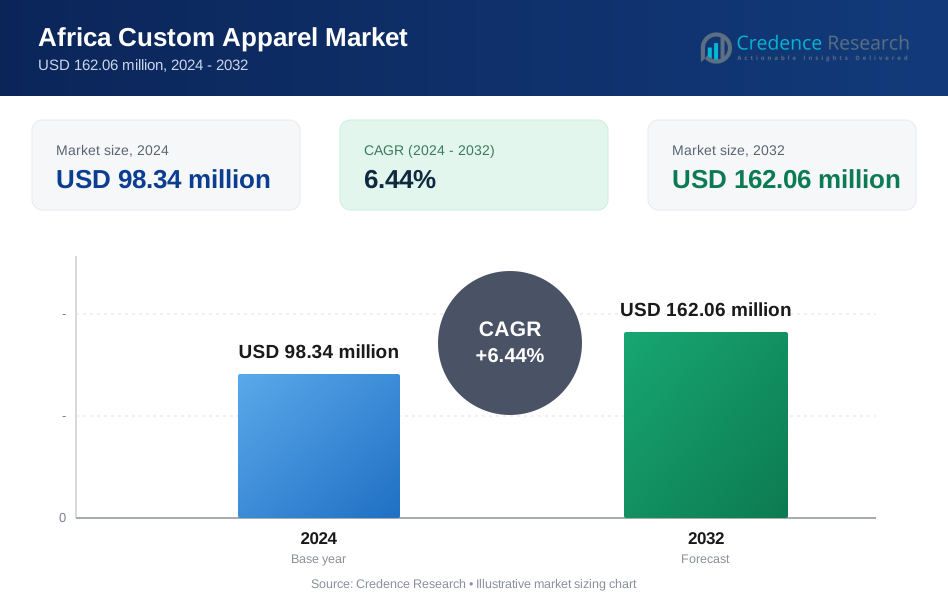
| Africa Custom Apparel Market Size 2024 | USD 98.34 Million |
| Africa Custom Apparel Market, CAGR | 6.44% |
| Africa Custom Apparel Market Size 2032 | USD 162.06 Million |
Market Overview:
The Africa Custom Apparel Market is projected to grow from USD 98.34 million in 2024 to an estimated USD 162.06 million by 2032, with a compound annual growth rate (CAGR) of 6.44% from 2024 to 2032.
Several key drivers are propelling the growth of the Africa custom apparel market. A growing emphasis on individuality and personal expression has significantly boosted the demand for custom clothing, particularly among urban youth. The increasing influence of social media and fashion influencers has further accelerated the adoption of unique apparel styles. Technological advancements in apparel production, such as digital printing and 3D knitting, have made customization more accessible and cost-effective. Moreover, the expansion of online platforms specializing in custom clothing has enabled small and medium enterprises (SMEs) and independent designers to tap into this lucrative market. In addition, the growing popularity of sustainable and ethically produced apparel is shaping consumer preferences. Local brands are increasingly aligning their offerings with eco-conscious trends, utilizing sustainable materials and promoting transparency in the production process. These efforts resonate strongly with the environmentally aware segment of the African market, further driving the demand for custom apparel.
Regionally, the Africa custom apparel market exhibits varying dynamics across key areas. South Africa stands as a significant contributor, driven by a well-developed fashion industry, a high rate of urbanization, and the growing penetration of online shopping. The country has seen a surge in demand for personalized clothing options, particularly in metropolitan areas like Johannesburg and Cape Town, where fashion-conscious consumers dominate. Nigeria is another prominent market, fueled by its large population and a thriving entertainment industry that heavily influences fashion trends. The rising number of local designers and fashion startups is bolstering the custom apparel ecosystem in the country. Additionally, Kenya and Ghana are emerging as fast-growing markets due to increased digital connectivity and the rise of e-commerce platforms catering to custom clothing demands. These countries are leveraging their strong cultural heritage to create unique apparel designs that appeal both locally and internationally.
Market Insights:
- The Africa custom apparel market is projected to grow from USD 98.34 million in 2024 to USD 162.06 million by 2032, at a robust CAGR of 44% during the forecast period.
- Increasing consumer emphasis on personalization and self-expression is driving demand for custom apparel, particularly among younger, fashion-conscious demographics in urban areas.
- Technological advancements, such as digital printing and 3D knitting, are enabling cost-effective customization and expanding production capabilities for small and medium enterprises (SMEs).
- The rapid growth of e-commerce platforms is bridging gaps between designers and consumers, increasing accessibility to custom clothing in both urban and rural areas.
- Sustainability trends are reshaping the market, with consumers favoring eco-friendly materials and brands prioritizing transparent and ethical production practices.
- Regional leaders like South Africa, Nigeria, Kenya, and Ghana are driving market growth, with South Africa accounting for approximately 35% of the market share due to its well-developed fashion industry and e-commerce penetration.
- Logistical challenges, high production costs, and limited technological access remain key constraints, but businesses that address these issues stand to unlock significant growth potential in this dynamic market.
Market Drivers:
Growing Consumer Demand for Personalization
The increasing emphasis on individuality and self-expression is a major driver for the Africa custom apparel market. For instance, Afrikrea, an online marketplace for African-inspired fashion, has seen a significant increase in demand for personalized clothing, with many consumers seeking unique designs that reflect their cultural heritage and personal style. Consumers, especially in urban areas, are seeking unique clothing that reflects their personal identity, cultural heritage, or specific fashion preferences. This demand is particularly strong among younger demographics, who value the ability to customize designs, colors, and fits. The rising influence of global fashion trends and social media platforms has further fueled the desire for bespoke apparel, creating a lucrative opportunity for businesses offering personalized clothing solutions.
Technological Advancements in Apparel Production
Innovations in apparel manufacturing are significantly shaping the custom clothing market in Africa. Technologies such as digital printing, 3D knitting, and computer-aided design (CAD) systems have streamlined the customization process, enabling businesses to produce high-quality, tailored garments at reduced costs. For instance, Maxhosa Africa has integrated 3D knitting technology into their production process, enabling them to create intricate designs with precision and efficiency. These advancements have lowered barriers for small and medium enterprises (SMEs) and independent designers, allowing them to compete effectively in the market. Additionally, the integration of artificial intelligence and data analytics in design and production processes is enhancing efficiency and enabling brands to deliver precise, customer-specific solutions.
Expansion of E-Commerce Platforms
The rapid growth of digital commerce is transforming the accessibility and reach of custom apparel across Africa. For instance, Jumia, one of Africa's largest e-commerce platforms, offers a wide range of personalized clothing options, bridging the gap between designers and consumers. Online platforms specializing in personalized clothing are bridging the gap between designers and consumers, offering a convenient and cost-effective medium for interaction. The increasing adoption of mobile shopping apps and online payment systems has made it easier for consumers to explore, design, and purchase custom apparel. E-commerce also enables businesses to reach underserved markets, including rural and semi-urban areas, thereby expanding their customer base and driving overall market growth.
Shift Towards Sustainable and Ethical Fashion
The growing awareness of sustainability and ethical practices among African consumers is a critical driver for the custom apparel market. For instance, Studio 189, a Ghanaian fashion brand, integrates recycled fabrics and organic materials into their products, meeting the demand for environmentally friendly clothing. Consumers are increasingly prioritizing environmentally friendly and socially responsible clothing, prompting brands to adopt sustainable materials and transparent production processes. Local designers and manufacturers are integrating recycled fabrics, organic materials, and low-impact dyes into their products to meet this demand. Additionally, the push for ethical labor practices and fair trade is shaping the industry’s trajectory, with consumers willing to support brands that align with these values. This shift not only addresses environmental concerns but also positions custom apparel businesses as responsible players in the global fashion ecosystem.
Market Trends:
Integration of Digital Technology in Customization
The adoption of digital tools and platforms is reshaping the custom apparel market in Africa. Technologies such as 3D modeling and augmented reality are providing consumers with virtual fitting options, enhancing their shopping experience. For instance, Nike has been developing its own generative AI model to design products using exclusive athlete data, which significantly speeds up the prototyping process. E-commerce platforms specializing in custom apparel are increasingly incorporating AI-driven recommendation systems, enabling more personalized and efficient customer interactions. Additionally, mobile-first strategies are dominating the market, given the high penetration of smartphones in urban and semi-urban areas. This digital transformation is democratizing access to custom clothing and driving growth among tech-savvy consumers.
Rise of Sustainable and Ethical Fashion
Sustainability has emerged as a defining trend in the Africa custom apparel market. Consumers are showing a growing preference for eco-friendly fabrics, such as organic cotton and recycled materials. Local brands are capitalizing on this trend by promoting transparency in their supply chains and emphasizing fair labor practices. For instance, Dibella significantly increased its adoption of Cotton Made in Africa, expanding usage from 300,000 kg in 2023 to 750,000 kg in 2024, highlighting the growing emphasis on sustainable sourcing practices. Governments and non-governmental organizations are also supporting initiatives to reduce textile waste and promote circular fashion economies. This shift towards sustainability is not only catering to environmentally conscious consumers but is also helping brands build long-term trust and loyalty.
Cultural Revival in Apparel Design
A strong resurgence of cultural identity is influencing the custom apparel market across Africa. Designers are incorporating traditional patterns, motifs, and fabrics into modern designs, creating unique offerings that appeal to both local and global audiences. For instance, UNESCO reports a 42% increase in demand for African haute couture over the next 10 years, showcasing the continent's rich textile traditions. African prints and textiles, such as kente, ankara, and shweshwe, are gaining renewed prominence as they blend cultural heritage with contemporary fashion trends. This cultural revival has positioned custom apparel as a medium for storytelling and self-expression, fostering pride and connection among consumers.
Evolving Consumer Preferences and Urbanization
Rapid urbanization and the rise of a young, fashion-conscious population are driving significant changes in consumer behavior. Urban dwellers, particularly in metropolitan hubs like Lagos, Nairobi, and Johannesburg, are seeking custom clothing that aligns with their lifestyle and professional needs. The demand for versatile, functional, and stylish apparel is growing, reflecting a shift toward practicality without compromising aesthetics. For instance, South Africa's cultural influence extends beyond its borders, shaping fashion trends and consumer behavior across the Middle East and Africa, with its fashion weeks setting the agenda for style and aesthetics. Additionally, the influence of global fashion trends through social media and online platforms is shaping local tastes, creating opportunities for brands to innovate and cater to evolving preferences. These trends underscore the market's dynamic nature and its ability to adapt to modern consumer demands.
Market Challenges Analysis:
Limited Technological Access
The adoption of advanced technologies, such as digital printing and automated tailoring, remains constrained in many parts of Africa due to high initial costs and limited infrastructure. Small and medium enterprises (SMEs) and local designers, who dominate the custom apparel market, often struggle to access the capital needed for investing in modern manufacturing tools. This technological gap hinders production efficiency and scalability, restricting the market’s potential growth.
Logistical and Supply Chain Constraints
Africa faces significant logistical challenges, including underdeveloped transportation networks and inefficient supply chains. These issues impact the timely procurement of raw materials and the distribution of finished products, increasing operational costs. Moreover, high customs duties and inconsistent regulatory frameworks in cross-border trade further complicate supply chain management, particularly for businesses aiming to serve multiple regional markets.
High Production Costs
Custom apparel production often requires skilled labor and specialized materials, which can drive up costs. In markets where price sensitivity is high, the affordability of custom apparel becomes a challenge. Competing with mass-produced, low-cost alternatives also puts additional pressure on local businesses to maintain competitive pricing while ensuring profitability.
Digital Divide and Limited E-Commerce Penetration
While e-commerce platforms are growing, limited internet access and digital literacy in rural areas constrain the market’s reach. Many potential customers remain underserved due to a lack of digital connectivity, reducing the market's ability to tap into the full consumer base.
Cultural and Market Diversity
Africa’s vast cultural and economic diversity can pose challenges for standardizing operations and marketing strategies. Businesses must navigate varying consumer preferences, income levels, and fashion trends across different regions, requiring tailored approaches that increase complexity and costs. Addressing these restraints is essential to unlocking the full potential of the Africa custom apparel market.
Market Opportunities:
The Africa custom apparel market presents significant growth opportunities, driven by shifting consumer preferences toward personalized fashion and the increasing accessibility of customization technologies. As a young and dynamic continent with a large population of fashion-conscious individuals, Africa is uniquely positioned to become a hub for custom apparel. The rising influence of social media platforms and fashion influencers has amplified demand for unique clothing that reflects personal identity, providing local designers and small-to-medium enterprises (SMEs) a chance to capitalize on this trend. Technological advancements, such as digital printing and 3D knitting, are reducing production costs and enabling businesses to cater to broader audiences, further opening avenues for market expansion.
Another substantial opportunity lies in the integration of sustainability and cultural heritage into custom apparel offerings. Consumers are increasingly drawn to eco-friendly and ethically produced clothing, creating demand for brands that prioritize sustainable materials and transparent production practices. Additionally, Africa's rich cultural diversity provides a foundation for unique and culturally inspired designs that resonate with both local and international markets. With e-commerce platforms rapidly growing in penetration across the continent, businesses have the opportunity to reach underserved rural and urban markets alike. By addressing logistical challenges and leveraging digital platforms, companies can scale their operations efficiently, tapping into a lucrative and expanding customer base. This blend of cultural richness, digital innovation, and sustainability creates a promising landscape for long-term growth in the Africa custom apparel market.
Market Segmentation Analysis:
The Africa custom apparel market is segmented based on type, end-user, and distribution channel, with each segment contributing uniquely to the market's growth and dynamics.
By Type, shirts and suits dominate the market due to their high demand among both corporate and casual consumers. Shirts, in particular, account for a significant share, driven by their adaptability to various customization options, such as embroidery, prints, and tailored fits. Coats and pants follow closely, supported by a growing preference for formal and semi-formal apparel. Skirts hold a substantial share, primarily fueled by demand among women and younger demographics for stylish and functional designs.
By End-user, the women’s segment leads the market, contributing a major share due to their higher inclination toward fashion and customization. The men’s segment is also expanding, driven by increasing awareness of personalized styles and professional dressing. Meanwhile, the children’s segment is gaining momentum, with parents increasingly seeking custom apparel for special occasions and school uniforms.
By Distribution Channel, the online segment is experiencing rapid growth, supported by the proliferation of e-commerce platforms and mobile shopping apps. Online channels offer convenience, diverse customization options, and access to a broader audience, making them increasingly popular among younger consumers. The offline segment continues to hold a significant share, especially in regions with less digital penetration, where physical stores provide personalized consultations and on-site tailoring.
Segmentation:
By Type
- Coat
- Skirt
- Pants
- Shirt
- Suit
By End-user
- Women
- Men
- Children
By Distribution Channel
- Offline
- Online
Regional Analysis:
The Africa custom apparel market is witnessing dynamic growth across various regions, driven by cultural diversity, evolving consumer preferences, and advancements in digital commerce. South Africa, Nigeria, Kenya, and Ghana emerge as key markets, each contributing distinctively to the market's expansion.
South Africa holds the largest market share, accounting for approximately 35% of the regional market in 2024. The country's well-developed fashion industry, coupled with high urbanization rates, fuels the demand for personalized clothing. Metropolitan areas like Johannesburg and Cape Town are hubs for fashion-conscious consumers, who are actively seeking unique apparel that aligns with their individual styles. The widespread adoption of e-commerce platforms and the influence of global fashion trends further solidify South Africa's leadership position.
Nigeria captures the second-largest market share, contributing around 28% to the total. With a burgeoning population and a thriving entertainment industry, the country serves as a major influencer of fashion trends across the continent. The rising number of local designers and startups offering bespoke clothing reflects the growing preference for customization. Moreover, the cultural richness of Nigeria is a significant driver, as consumers seek to integrate traditional patterns and styles into modern apparel.
Kenya accounts for approximately 20% of the market share, driven by increased digital connectivity and a rising middle-class population. Nairobi, as a fashion-forward city, plays a pivotal role in shaping the custom apparel ecosystem. The country benefits from a growing e-commerce sector, which has made custom clothing more accessible to diverse demographics. Kenya's emphasis on sustainability and local craftsmanship also contributes to its market growth.
Ghana, with a market share of around 12%, is an emerging player in the custom apparel sector. The country's strong cultural identity and vibrant textile industry provide a solid foundation for growth. Local brands are leveraging their heritage to create unique designs that appeal to both domestic and international consumers. The adoption of online shopping platforms is further enhancing market accessibility in Ghana.
The remaining 5% of the market is distributed across other African nations, where the custom apparel market is gradually evolving. Countries like Ethiopia, Rwanda, and Tanzania show promise due to increasing digitalization and growing interest in personalized fashion. Overall, the Africa custom apparel market's regional dynamics are shaped by a combination of cultural influences, technological advancements, and consumer-driven demand for individuality.
Key Player Analysis:
- Adidas AG
- Allied Shirts
- Amazon.com Inc.
- CafePress Inc.
- DOWNTOWN CUSTOM PRINTWEAR
- Jakprints
- Lynka Sp. z.o.o.
- Nike Inc.
- Printful Inc.
- Redbubble Ltd.
- Society6 LLC
- Spreadshirt Inc.
- TeeTalkies
- THREADBIRD
- UberPrints Inc.
- Vantage Custom Classics Inc.
- Zazzle Inc.
Competitive Analysis:
The Africa custom apparel market is characterized by intense competition among regional players, international brands, and independent designers. Established companies leverage their extensive supply chains, advanced manufacturing technologies, and brand recognition to maintain a significant market share. These players often focus on delivering high-quality products and scaling their operations across multiple regions. Small and medium enterprises (SMEs) and local designers actively compete by offering culturally inspired, bespoke apparel that appeals to specific consumer preferences. The growing popularity of e-commerce platforms enables these players to expand their reach and directly connect with target audiences, particularly younger, urban consumers. Innovation and sustainability are key differentiators in the competitive landscape. For instance, Gap's DressBot allows customers to virtually try on clothing tailored to their preferences, enhancing customer engagement and satisfaction. Companies adopting eco-friendly materials and transparent production practices gain a competitive edge, especially as environmentally conscious consumers drive demand. Social media and influencer marketing further amplify competition, with brands actively engaging customers through creative campaigns and personalized offerings to establish loyalty and market presence.
Recent Developments:
- On November 5, 2024, Printful and Printify announced their merger to accelerate growth in the global market, combining their strengths to offer a broader range of products and improved fulfillment solutions.
- On January 8, 2025, Nike announced the "2025 After Dark Tour," a women's race series designed to promote fitness and community engagement among female athlete.
Market Concentration & Characteristics:
The Africa custom apparel market exhibits a moderately fragmented structure, with a mix of established regional players and emerging small and medium enterprises (SMEs). Market concentration is relatively low, as numerous independent designers and startups leverage digital platforms to cater to niche and localized demands. Larger companies maintain a competitive edge through advanced manufacturing capabilities, diverse product offerings, and stronger supply chain networks. Key characteristics of the market include a focus on personalization, driven by increasing consumer demand for unique apparel that reflects individual identity. The adoption of advanced production technologies, such as digital printing and 3D knitting, is enabling efficient and cost-effective customization. Additionally, sustainability is a defining trend, with brands prioritizing eco-friendly materials and ethical practices to align with growing environmental awareness. The market's dynamism is further enhanced by the influence of social media, cultural heritage, and the expanding reach of e-commerce platforms across the region.
Report Coverage:
The research report offers an in-depth analysis based on By Type, By End-user and By Distribution Channel It details leading market players, providing an overview of their business, product offerings, investments, revenue streams, and key applications. Additionally, the report includes insights into the competitive environment, SWOT analysis, current market trends, as well as the primary drivers and constraints. Furthermore, it discusses various factors that have driven market expansion in recent years. The report also explores market dynamics, regulatory scenarios, and technological advancements that are shaping the industry. It assesses the impact of external factors and global economic changes on market growth. Lastly, it provides strategic recommendations for new entrants and established companies to navigate the complexities of the market.
Future Outlook:
- The Africa custom apparel market is expected to witness robust growth driven by increasing consumer preference for personalized clothing.
- Advancements in digital printing and 3D knitting technologies will enhance accessibility and cost-efficiency in customization.
- The rising influence of social media and fashion influencers will continue to shape consumer trends and boost market demand.
- E-commerce platforms will play a pivotal role in expanding the reach of custom apparel, especially among younger demographics.
- Sustainable and ethical fashion practices will gain traction, with local brands adopting eco-friendly materials and transparent production processes.
- Urbanization and rising disposable incomes in key markets like South Africa, Nigeria, and Kenya will fuel growth.
- Cultural heritage and traditional designs will influence custom apparel offerings, appealing to both local and international markets.
- Increased participation of small and medium enterprises (SMEs) and independent designers will diversify market competition.
- Regional collaborations and partnerships will create opportunities for scaling production and distribution networks.
- Overcoming challenges like technological barriers and logistical constraints will be crucial for sustained market expansion.
Request a Free Sample
Fill in your details and we'll send you a free sample report.
- Sample data tables & charts
- Research methodology
Market Dynamics
Growing Consumer Demand for Personalization
African consumers, especially urban youth, are increasingly seeking custom apparel that reflects their individuality, cultural heritage, and personal style. This trend is amplified by the influence of social media and fashion influencers, making personalized clothing highly desirable.
Technological Advancements in Apparel Production
Innovations such as digital printing, 3D knitting, and computer-aided design have made custom apparel production more accessible and cost-effective for SMEs and independent designers, enabling a wider range of unique, high-quality products.
Expansion of E-Commerce Platforms
The rapid growth of online shopping and mobile commerce in Africa has made custom apparel more accessible, allowing designers and brands to reach a broader audience, including underserved rural and semi-urban markets.
Shift Towards Sustainable and Ethical Fashion
Rising environmental awareness is driving demand for custom apparel made from eco-friendly materials and produced through transparent, ethical processes. Brands that prioritize sustainability are resonating with a growing segment of environmentally conscious consumers.
Cultural Revival and Heritage Integration
Designers are increasingly incorporating traditional African patterns, motifs, and textiles into modern custom apparel, appealing to both local pride and international interest in authentic, culturally inspired fashion.
Need a Custom Version of This Report?
Tailor the scope, geography, or segments to your exact requirements.
- Custom geography or segment scope
- Direct access to our analyst team
Frequently Asked Questions
What is the projected growth of the Africa custom apparel market?
What factors are driving the growth of the custom apparel market in Africa?
Which regions in Africa are leading the custom apparel market?
What challenges does the Africa custom apparel market face?
Table of Content
Chapter 1 Market Segmentation
- 1.1 Segmentation Framework
- 1.1.1 Product and Service Classification
- 1.1.2 Application and End-Use Classification
- 1.1.3 Technology and Solution Classification
- 1.1.4 Customer and Distribution Channel Classification
- 1.1.5 Geographic Segmentation
- 1.1.6 Market Segment Definitions and Boundaries
- 1.2 By Type
- 1.2.1 Coat
- 1.2.2 Skirt
- 1.2.3 Pants
- 1.2.4 Shirt
- 1.2.5 Suit
- 1.3 By End-user
- 1.3.1 Women
- 1.3.2 Men
- 1.3.3 Children
Chapter 2 Introduction
- 2.1 Report Objectives and Scope
- 2.2 Product Definition and Industry Terminology
- 2.3 Market Inclusions and Exclusions
- 2.4 Research Process
- 2.4.1 Primary Research and Expert Interviews
- 2.4.2 Secondary Research and Source Review
- 2.4.3 Top-Down and Bottom-Up Estimation
- 2.4.4 Data Triangulation and Verification
- 2.5 Market Size Measurement Basis
- 2.5.1 2024: USD 98.34 million → 2032: USD 162.06 million
- 2.6 Historical and Forecast Reference Periods
- 2.6.1 Base Year: 2024
- 2.6.2 Forecast Period: 2024-2032
- 2.7 Research Assumptions and Limitations
Chapter 3 Executive Summary
- 3.1 Market Snapshot and Key Findings
- 3.2 Base-Year Market Size, 2024
- 3.3 Forecast Market Size, 2032
- 3.4 Revenue and Volume Growth Outlook
- 3.5 Key Demand and Supply Indicators
- 3.6 Leading Market Segments
- 3.7 Fastest-Growing Market Opportunities
- 3.8 Regional Performance Highlights
- 3.9 Technology and Industry Transformation
- 3.10 Competitive Landscape Summary
- 3.11 Analyst View and Strategic Implications
Chapter 4 Africa Custom Apparel Market Trends and Developments
- 4.1 Historical Industry Development
- 4.2 Recent Market Trends and Developments
- 4.3 Demand and Customer Behavior Trends
- 4.4 Technology and Product Innovation
- 4.5 Artificial Intelligence, Automation and Digitalization
- 4.6 Local Manufacturing and Supply Chain Realignment
- 4.7 Industry Partnerships, Mergers and Acquisitions
- 4.8 Sustainability and Circular Economy Developments
- 4.9 Government and Private Sector Investment Trends
- 4.10 Emerging Business Models and Commercialization
- 4.11 Industry Developments and Announcements
Chapter 5 Africa Custom Apparel Market Production, Supply and Demand Analysis
- 5.1 Demand Trend and Consumption Analysis
- 5.2 Demand Forecast, 2024-2032
- 5.3 Production and Output Trend
- 5.4 Production and Output Forecast, 2024-2032
- 5.5 Installed Capacity and Capacity Utilization
- 5.6 Company-Wise Production Plants and Statistics
- 5.6.1 Installed Production Capacity
- 5.6.2 Actual Production
- 5.6.3 Planned Capacity and Expansion Targets
- 5.7 Supply Chain Structure and Procurement Trends
- 5.8 Supply-Demand Gap and Bottlenecks
- 5.9 Import Dependence and Sourcing Structure
- 5.10 Contract Manufacturing and Outsourcing
- 5.11 Regional Supply and Demand Concentration
Chapter 6 Africa Custom Apparel Market Pricing Analysis
- 6.1 Pricing Structure and Measurement
- 6.2 Historical Pricing Trends
- 6.3 Pricing Outlook, 2024-2032
- 6.4 Average Selling Price and Unit Economics
- 6.5 Pricing by Product and Market Segment
- 6.6 Geographic Pricing Differences
- 6.7 Key Input, Energy, Labor and Logistics Costs
- 6.8 Contract Pricing and Purchasing Models
- 6.9 Pricing Sensitivity and Competitive Positioning
- 6.10 Price, Margin and Profitability Implications
Chapter 7 Africa Custom Apparel Market Dynamics
- 7.1 Market Growth Drivers
- 7.1.1 Demand-Side Drivers
- 7.1.2 Technology and Innovation Drivers
- 7.1.3 Infrastructure and Investment Drivers
- 7.1.4 Regulatory and Policy Drivers
- 7.2 Market Restraints
- 7.2.1 Cost and Affordability Constraints
- 7.2.2 Technology and Adoption Barriers
- 7.2.3 Supply Chain and Operational Constraints
- 7.3 Market Challenges
- 7.3.1 Competitive Pressure and Margin Erosion
- 7.3.2 Skills, Infrastructure and Implementation Gaps
- 7.4 Emerging Market Opportunities
- 7.5 Market Dynamics Impact and Time-Horizon Assessment
Chapter 8 Africa Custom Apparel Value Chain Analysis
- 8.1 Industry Value Chain Overview
- 8.2 Upstream Suppliers and Critical Inputs
- 8.3 Technology and Component Providers
- 8.4 Manufacturing or Service Delivery
- 8.5 Distribution, Channel Partners and Integrators
- 8.6 Downstream Applications and End Users
- 8.7 Value Addition and Profit Pools
- 8.8 Vertical Integration and Outsourcing
- 8.9 Supplier Concentration and Risk
- 8.10 Supply Chain Localization and Resilience
Chapter 9 Africa Custom Apparel Market Regulations and Policies
- 9.1 Relevant Laws, Standards and Compliance Frameworks
- 9.2 Product, Service, Safety and Quality Requirements
- 9.3 Government Policies, Incentives and Subsidies
- 9.4 Imports, Exports and Trade Barriers
- 9.5 Public Procurement and Local Content Requirements
- 9.6 Environmental and Sustainability Compliance
- 9.7 Upcoming Policy Changes and Market Implications
Chapter 10 Africa Custom Apparel Market Hotspots and Opportunities
- 10.1 Market Opportunity Mapping and Growth Hotspots
- 10.2 High-Growth Applications and Customer Groups
- 10.3 Underserved Markets and White-Space Opportunities
- 10.4 Emerging Technology and Product Opportunities
- 10.5 New Capacity and Investment Hotspots
- 10.6 Market Entry and Expansion Opportunities
- 10.7 Distribution and Partnership Opportunities
- 10.8 Near-Term and Long-Term Commercial Potential
- 10.9 Opportunity Attractiveness and Execution Risks
Chapter 11 Africa Custom Apparel Market Outlook, 2024-2032
- 11.1 Market Size and Analysis
- 11.1.1 Revenue (Market Measurement: 2024: USD 98.34 million → 2032: USD 162.06 million)
- 11.1.2 Market Volume and Quantity Sold
- 11.1.3 Historical Market Size
- 11.1.4 Base-Year Market Size, 2024
- 11.2 Market Forecast, 2024-2032
- 11.2.1 Revenue Forecast to 2032
- 11.2.2 Volume Forecast to 2032
- 11.2.3 CAGR and Year-on-Year Growth
- 11.2.4 Incremental Revenue Opportunity
- 11.3 Forecast Assumptions and Scenario Analysis
- 11.3.1 Base-Case Forecast
- 11.3.2 Optimistic and Conservative Scenarios
- 11.3.3 Technology, Pricing and Policy Sensitivities
- 11.4 Market Attractiveness and Growth Outlook
Chapter 12 Africa Custom Apparel Market Segmentation and Outlook
- 12.1 Segmentation Summary and Market Shares, 2024
- 12.2 Largest and Fastest-Growing Segments
- 12.3 By Type - Market Size and Forecast, 2024-2032
- 12.3.1 Segment Definition and Scope
- 12.3.2 Historical Market Size
- 12.3.3 Revenue Forecast, 2024-2032
- 12.3.4 Volume Forecast, 2024-2032
- 12.3.5 Base-Year Market Share, 2024
- 12.3.6 Segment CAGR and Growth Drivers
- 12.3.7 Subsegment Market Size and Forecast
- 12.3.7.1 Coat
- 12.3.7.2 Skirt
- 12.3.7.3 Pants
- 12.3.7.4 Shirt
- 12.3.7.5 Suit
- 12.3.8 Subsegment Pricing and Adoption Trends
- 12.3.9 Leading Suppliers and Competition
- 12.3.10 Regional Demand and Opportunities
- 12.4 By End-user - Market Size and Forecast, 2024-2032
- 12.4.1 Segment Definition and Scope
- 12.4.2 Historical Market Size
- 12.4.3 Revenue Forecast, 2024-2032
- 12.4.4 Volume Forecast, 2024-2032
- 12.4.5 Base-Year Market Share, 2024
- 12.4.6 Segment CAGR and Growth Drivers
- 12.4.7 Subsegment Market Size and Forecast
- 12.4.7.1 Women
- 12.4.7.2 Men
- 12.4.7.3 Children
- 12.4.8 Subsegment Pricing and Adoption Trends
- 12.4.9 Leading Suppliers and Competition
- 12.4.10 Regional Demand and Opportunities
- 12.5 Segment Growth Comparison
- 12.6 Segment Attractiveness and Priority Matrix
Chapter 13 Africa Custom Apparel End-Use and Application Market Outlook
- 13.1 End-Use Industry and Customer Demand Structure
- 13.2 Leading Applications and Customer Groups
- 13.3 End-Use Market Size, Share and Forecast
- 13.4 Major End-Use Industry Deep Dives
- 13.4.1 Customer Requirements and Use Cases
- 13.4.2 Demand and Replacement Cycles
- 13.4.3 Technical and Regulatory Considerations
- 13.4.4 Purchasing and Procurement Models
- 13.4.5 Leading Vendors and Distribution Channels
- 13.4.6 Forecast and Commercial Opportunities
- 13.5 Emerging Applications and Cross-Segment Demand
- 13.6 End-Use Industry Investment Priorities
Chapter 14 Africa Custom Apparel Geographic Market Outlook, 2024-2032
- 14.1 Regional Market Size and Country-Level Shares, 2024
- 14.2 Country Market Size Comparison, 2024
- 14.3 Country Market Forecasts, 2024-2032
- 14.4 Subregional Industrial and Demand Clusters
- 14.5 Intra-Regional Pricing and Cost Differences
- 14.6 Cross-Border Trade and Supply Networks
- 14.7 Regional Supply and Demand Balances
- 14.8 Country Opportunity Comparison and Prioritization
Note: Every listed country is covered on the structure shown under the first country.
Chapter 15 Africa Custom Apparel Technology, Innovation and Sustainability Outlook
- 15.1 Technology Landscape and Maturity
- 15.2 Product, Process and Service Innovation
- 15.3 AI, Automation and Digital Tools in the Industry
- 15.4 Technology Adoption and Performance Benchmarking
- 15.5 Innovation Pipeline and R&D Investment
- 15.6 Patent and Intellectual Property Trends
- 15.7 Energy Efficiency and Resource Management
- 15.8 Sustainability, Recycling and Circularity
- 15.9 Technology Roadmap, 2024-2032
- 15.10 Risks of Obsolescence and Technology Substitution
Chapter 16 Africa Custom Apparel Market Key Strategic Imperatives
- 16.1 Growth and Market Entry Priorities
- 16.2 High-Return Products and Segments
- 16.3 Pricing, Profitability and Cost Optimization
- 16.4 Technology Investment and Product Differentiation
- 16.5 Supply Chain Localization and Resilience
- 16.6 Distribution and Customer Acquisition
- 16.7 Partnership, Acquisition and Capacity Strategy
- 16.8 Regional Expansion Priorities
- 16.9 Short-, Medium- and Long-Term Actions
Chapter 17 Competition Outlook
- 17.1 Industry Competition Characteristics
- 17.2 Market Structure and Concentration
- 17.3 Market Share and Competitive Positioning, 2024
- 17.4 Company-Wise Revenue and Product Benchmarking
- 17.5 Production and Service Capacity Benchmarking
- 17.6 Technology, Pricing and Differentiation
- 17.7 Regional Footprint and Distribution Strength
- 17.8 Mergers, Acquisitions and Strategic Alliances
- 17.9 New Entrants and Competitive Threats
- 17.10 Porter's Five Forces and Industry Attractiveness
- 17.11 Competitive Outlook, 2024-2032
Chapter 18 Company Profiles
- 18.1 Company Coverage and Selection Criteria
- 18.2 Nike Inc.
- 18.2.1 Business Description
- 18.2.2 Company Ownership and Geographic Presence
- 18.2.3 Product and Service Portfolio
- 18.2.4 Manufacturing and Operating Footprint
- 18.2.5 Production Capacity and Expansion Plans
- 18.2.6 Financial Performance and Investment
- 18.2.7 Market Share and Competitive Position
- 18.2.8 Technology and Innovation Capabilities
- 18.2.9 Strategic Alliances or Partnerships
- 18.2.10 Recent Developments
- 18.2.11 Growth Strategy and Outlook
- 18.3 Adidas AG
- 18.4 Printful Inc.
- 18.5 Amazon.com Inc.
- 18.6 Redbubble Ltd.
- 18.7 Spreadshirt Inc.
- 18.8 Zazzle Inc.
- 18.9 Allied Shirts
- 18.10 CafePress Inc.
- 18.11 UberPrints Inc.
- 18.12 Other Relevant Market Participants
Note: Every listed company is profiled on the structure shown under the first company. The company list is preliminary and may change based on research findings, market developments, data availability and client requirements.
Chapter 19 Disclaimer
- 19.1 Research and Forecast Disclaimer
- 19.2 Data Source and Estimation Limitations
Note: The depth of individual sections depends on data availability for this market. Volume, capacity, trade and other unit-based metrics are included where applicable.

