
| REPORT ATTRIBUTE | DETAILS |
|---|---|
| Historical Period | 2019-2022 |
| Base Year | 2023 |
| Forecast Period | 2024-2032 |
| Air Freight Services Market Size 2024 | USD 151,025 million |
| Air Freight Services Market, CAGR | 6.30% |
| Air Freight Services Market Size 2032 | USD 246,214.44 million |
Market Overview:
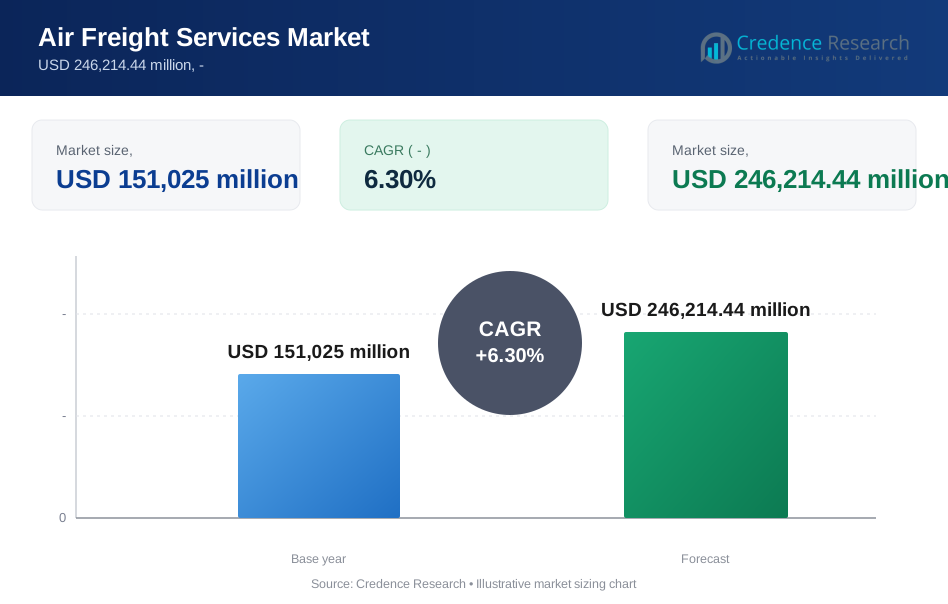
The global Air Freight Services Market is expected to grow from USD 151,025 million in 2024 to USD 246,214.44 million by 2032, at a compound annual growth rate (CAGR) of 6.30%. The air freight industry plays a crucial role in transporting goods across long distances in a short time, making it indispensable for industries like pharmaceuticals, electronics, and perishables. The market growth is supported by increased global trade activities, e-commerce expansion, and the need for rapid delivery services, particularly in supply chain management. The air freight sector has also seen a rise in demand for cargo services for high-value, time-sensitive products.
Key drivers of the market include the expansion of e-commerce, as more consumers demand faster delivery of online orders, and the growth of industries that rely on rapid transportation of goods. The pharmaceutical and electronics sectors, in particular, have boosted air freight services by requiring quick transportation of delicate or temperature-sensitive goods. Additionally, technological advancements such as real-time tracking systems and automated handling at airports enhance the efficiency of air freight services, reducing delivery times and costs. The increasing focus on sustainability and carbon emissions is also driving innovations in eco-friendly aircraft and fuel-efficient operations.
In terms of regional analysis, North America holds the largest share of the air freight market, accounting for approximately 35% of the global market in 2024. The region's dominance is driven by the presence of large logistics companies like FedEx and UPS, alongside advanced infrastructure and high trade volumes. Europe follows closely, with demand supported by the automotive and aerospace sectors. Asia-Pacific is expected to experience the fastest growth, driven by the rapid industrialization and increasing exports in countries like China, Japan, and South Korea. Furthermore, e-commerce giants such as Alibaba in China are driving the demand for air freight services in the region.
Key Player Analysis:
- FedEx Corporation
- UPS (United Parcel Service) Inc.
- DHL Global Forwarding
- Cathay Pacific Airways Cargo
- Emirates SkyCargo
- Kuehne + Nagel International AG
- H. Robinson Worldwide, Inc.
- DB Schenker
- China Airlines Cargo
- Lufthansa Cargo AG
Competitive Analysis:
The Air Freight Services Market is highly competitive, with a few dominant global players such as FedEx, UPS, and DHL leading the market due to their extensive logistics networks, superior infrastructure, and strong brand presence. These companies continue to invest in sustainable aviation fuel (SAF) and automated cargo handling to enhance efficiency and meet environmental regulations. Emirates SkyCargo and Cathay Pacific Cargo hold strong positions in transcontinental shipping due to their strategic locations and extensive air fleets. Additionally, Kuehne + Nagel and DB Schenker maintain significant market shares by offering specialized services like cold chain logistics for pharmaceuticals and temperature-sensitive goods. Smaller regional players are also emerging by focusing on niche markets such as e-commerce or cold chain logistics, challenging the dominance of larger firms by providing more flexible, tailored services. The competition is expected to increase as companies enhance their digitalization efforts to improve tracking, efficiency, and customer service.
Recent Developments:
- In 2024, DHL reported a 10% increase in air cargo capacity compared to the previous year, driven by a robust 17% growth in passenger belly cargo. This was further bolstered by increased demand in the lead-up to the Lunar New Year, as well as disputes in the Middle East that impacted global trade.
- UPS announced its 2024 Peak Season Surcharge, which aims to manage the rising demand for air cargo services, particularly in the e-commerce sector. The company also highlighted its efforts to enhance capacity and efficiency for high-demand routes from Asia-Pacific and the Middle East.
- Emirates SkyCargo saw an 18% increase in air cargo volumes for the fiscal year 2023–2024, with significant growth in both scheduled and freighter operations. This surge was driven by demand for high-value goods, including pharmaceuticals and automotive parts, across key global trade routes.
- In 2023, FedEx expanded its fleet with more fuel-efficient aircraft, aiming to reduce emissions as part of its broader sustainability strategy. This move aligns with global trends toward more eco-friendly air freight solutions, responding to increasing regulatory and customer pressure for greener logistics.
Market Concentration & Characteristics:
The Air Freight Services Market is moderately concentrated, with a few dominant global players such as FedEx, UPS, DHL, and Emirates SkyCargo holding a significant market share due to their extensive networks, infrastructure, and technological advancements. These key players are continuously investing in expanding their cargo fleets and adopting sustainable aviation fuel (SAF) and digital tracking systems to meet increasing global trade demands and environmental regulations. The market is characterized by high competition, driven by growing e-commerce, time-sensitive shipments, and cross-border logistics. Regional and niche players also contribute by offering specialized services, particularly in sectors like pharmaceutical cold chain logistics and automotive parts. While large companies dominate in terms of scale and capacity, technological innovations and sustainability initiatives are shaping the competitive landscape.
Report Coverage:
The research report offers an in-depth analysis based on Services, Destination, End User, and Region. It details leading market players, providing an overview of their business, product offerings, investments, revenue streams, and key applications. Additionally, the report includes insights into the competitive environment, SWOT analysis, current market trends, as well as the primary drivers and constraints. Furthermore, it discusses various factors that have driven market expansion in recent years. The report also explores market dynamics, regulatory scenarios, and technological advancements that are shaping the industry. It assesses the impact of external factors and global economic changes on market growth. Lastly, it provides strategic recommendations for new entrants and established companies to navigate the complexities of the market.
Future Outlook:
- The adoption of sustainable aviation fuel (SAF) will increase as air freight companies aim to reduce their carbon footprint and comply with global environmental regulations.
- E-commerce growth will continue to drive demand for air freight services, particularly for express and same-day deliveries of high-value, time-sensitive goods.
- The expansion of digital freight platforms will enhance real-time tracking, improving transparency and operational efficiency for both shippers and customers.
- The development of fuel-efficient aircraft and investments in green technologies will be key priorities as companies seek to improve fuel consumption and meet sustainability goals.
- Cold chain logistics will grow, driven by the increasing demand for temperature-sensitive goods such as pharmaceuticals and perishable foods.
- The expansion of freight capacity in Asia-Pacific will be significant, supported by growing exports and regional manufacturing activities.
- Automation and AI will further streamline cargo handling processes, reducing delays and improving speed and accuracy in air freight operations.
- The rise in geopolitical risks and trade disruptions will require more flexible and adaptive air freight strategies to ensure supply chain resilience.
- Regional players will increasingly compete with global giants by offering niche services, especially in emerging markets.
- The shift towards carbon-neutral logistics will intensify, with companies investing in eco-friendly initiatives to meet consumer and regulatory demands
Request a Free Sample
Fill in your details and we'll send you a free sample report.
- Sample data tables & charts
- Research methodology
Need a Custom Version of This Report?
Tailor the scope, geography, or segments to your exact requirements.
- Custom geography or segment scope
- Direct access to our analyst team
Frequently Asked Questions
What is the current size of the Air Freight Services Market?
What factors are driving the growth of the Air Freight Services Market?
What are some challenges faced by the Air Freight Services Market?
Who are the major players in the Air Freight Services Market?
Table of Content
Chapter 1. Report Introduction
- 1.1 Report Description & Purpose
- 1.1.1 Report Title & Market Definition
- 1.1.2 Unique Selling Propositions (USP) & Key Differentiators
- 1.1.3 Value Proposition for Stakeholders
- 1.2 Research Objectives
- 1.2.1 Market Sizing Objectives (Volume & Revenue)
- 1.2.2 Segmentation Objectives
- 1.2.3 Competitive Intelligence Objectives
- 1.2.4 Forecast & Scenario Objectives
- 1.3 Report Scope
- 1.3.1 Air Freight Services Scope – Types & Subtypes Covered
- 1.3.2 Geographic Scope – Regions & Countries Covered
- 1.3.3 Historical Period, Base Year & Forecast Period (the historical period; forecast to the forecast period)
- 1.3.4 Inclusions & Exclusions
- 1.4 HS Code & Classification Framework
- 1.5 Currency, Units & Pricing Basis
- 1.6 Target Stakeholders
- 1.7 Limitations & Assumptions
Chapter 2. Executive Summary
- 2.1 Global Air Freight Services Market Snapshot
- 2.1.1 Market Size – Historical (the historical period) & Forecast (the forecast period) (base year: USD 151,025 million → forecast year: USD 246,214.44 million)
- 2.1.2 Volume & Revenue – Global Totals
- 2.1.3 Key Market Highlights – Top Five Facts
- 2.2 Air Freight Services Market Segmentation Snapshot
- 2.2.1 Market Split by Region – vs.
- 2.3 Competitive Snapshot
- 2.3.1 Top 10 Players by Revenue Share –
- 2.3.2 Top 10 Players by Volume Share –
- 2.3.3 Recent Strategic Developments (18-Month Summary)
- 2.4 Key Investment Highlights & Strategic Conclusions
Chapter 3. Air Freight Services Market Dynamics & Industry Analysis
- 3.1 Market Overview & Context
- 3.1.1 Air Freight Services Market Position in the Broader Automotive Value Chain
- 3.1.2 OEM vs. Replacement Market Dynamics
- 3.1.3 Market Maturity & Development Stage by Region
- 3.2 Air Freight Services Market Drivers
- 3.3 Air Freight Services Market Restraints & Challenges
- 3.4 Air Freight Services Market Opportunities
- 3.5 Porter's Five Forces Analysis
- 3.5.1 Threat of New Entrants
- 3.5.2 Bargaining Power of Suppliers
- 3.5.3 Bargaining Power of Buyers
- 3.5.4 Threat of Substitutes
- 3.5.5 Competitive Rivalry – Intensity Assessment
- 3.6 Air Freight Services Value Chain Analysis
- 3.6.1 Upstream – Raw Material/Input Suppliers
- 3.6.1.1 Raw Material/Input 1
- 3.6.1.2 Raw Material/Input 2
- 3.6.1.3 Raw Material/Input 3
- 3.6.2 Midstream – Production/Manufacturing/Service Delivery
- 3.6.2.1 Production/Process Overview
- 3.6.2.2 Key Facility Locations & Capacity by Manufacturer
- 3.6.3 Downstream – Distribution & End Consumer
- 3.6.3.1 Primary Channel – B2B/OEM
- 3.6.3.2 Secondary Channels – Dealer, Retail, Online, Direct
- 3.6.4 Value Chain Profitability Analysis
- 3.6.1 Upstream – Raw Material/Input Suppliers
- 3.7 PESTEL Analysis
- 3.7.1 Political Factors
- 3.7.2 Economic Factors
- 3.7.3 Social Factors
- 3.7.4 Technological Factors
- 3.7.5 Environmental Factors
- 3.7.6 Legal Factors
- 3.8 Air Freight Services Supply Chain Analysis
- 3.8.1 Raw Material/Input Supply Risk Assessment
- 3.8.2 Manufacturing Concentration Risk (Geographic Exposure)
- 3.8.3 Trade Disruption Impact Analysis
- 3.9 Regulatory & Policy Landscape
Note: The regulatory and policy landscape section covers regulations based on their applicability to the market, Air Freight Services category, geography, and scope of the study. Only regulatory frameworks with a material impact on operations, compliance, trade, sustainability, or market access are analyzed in detail.
Chapter 4. Key Investment Pockets & Opportunity Analysis
- 4.1 Air Freight Services Market Attractiveness Analysis
- 4.1.1 By Region – Investment Attractiveness Matrix (Volume × CAGR)
- 4.2 Absolute Revenue Growth Opportunity
- 4.2.1 By Region – Absolute USD Growth Through the forecast period
- 4.3 Incremental Volume Opportunity
- 4.3.1 By Region – Incremental Volume Through the forecast period
- 4.3.2 Segment – Incremental Volume
- 4.4 Emerging Submarket Opportunity Deep Dive (Subject to Applicability)
- 4.5 Emerging Market Opportunity Scorecards
- 4.5.1 United States
- 4.5.2 Europe
- 4.5.3 Asia
- 4.5.4 Middle East & Africa
Note: Emerging Market Opportunity Scorecards will be included based on relevance and strategic importance. Regions listed are indicative and may vary depending on data availability and market dynamics.
Chapter 5. Air Freight Services Import-Export Analysis & Trade Flows
- 5.1 Global Trade Overview
- 5.1.1 Global Export Value by Country (the historical period)
- 5.1.2 Global Export Volume by Country (the historical period)
- 5.1.3 Global Import Value by Country (the historical period)
- 5.1.4 Global Import Volume by Country (the historical period)
- 5.1.5 Net Trade Balance by Country (the historical period)
- 5.2 Export Analysis – Segment
- 5.2.1 Type 1 (HS Code)
- 5.2.2 Type 2 (HS Code)
- 5.2.3 Type 3 (HS Code)
- 5.2.4 Type 4 (HS Code)
- 5.2.5 Type 5 (HS Code)
- 5.3 Import Analysis – Segment
- 5.3.1 Type 1 (HS Code)
- 5.3.2 Type 2 (HS Code)
- 5.3.3 Type 3 (HS Code)
- 5.3.4 Type 4 (HS Code)
- 5.3.5 Type 5 (HS Code)
- 5.4 Average Unit Trade Prices
- 5.4.1 Average Export Price – Segment & Country
- 5.4.2 Average Import Price – Segment & Source Country
- 5.4.3 Price Trends (the historical period)
- 5.5 Key Trade Route Analysis
- 5.5.1 Trade Route 1
- 5.5.2 Trade Route 2
- 5.5.3 Trade Route 3
- 5.5.4 Trade Route 4
- 5.5.5 Trade Route 5
- 5.6 Trade Policy Impact Assessment
- 5.6.1 US Anti-Dumping & Section 301 Tariffs
- 5.6.2 EU Customs Union Impact
- 5.6.3 Major Free Trade Agreements
- 5.6.4 USMCA Rules of Origin
Note: Trade policy analysis will be included only where relevant to the Air Freight Services market.
Chapter 6. Competitive Landscape & Company Benchmarking
- 6.1 Air Freight Services Market Concentration & Structure
- 6.1.1 Herfindahl-Hirschman Index (HHI) – vs.
- 6.1.2 Tier 1, Tier 2 & Tier 3 Market Structure
- 6.1.3 Global, Regional & Local Player Dynamics
- 6.2 Air Freight Services Market Share Analysis –
- 6.2.1 Global Revenue Share by Company
- 6.2.2 Global Volume Share by Company
- 6.2.3 Regional Revenue Share
- 6.2.4 Market Share Evolution ( vs. )
- 6.2.5 OEM Segment Share by Company
- 6.2.6 Replacement Segment Share by Company
- 6.3 Production/Delivery Capacity & Facility Analysis
- 6.3.1 Global Installed Capacity
- 6.3.2 Capacity Utilization Rates
- 6.3.3 Production/Output Volume
- 6.3.4 Facility Locations & Capacity Map
- 6.3.5 Planned Capacity Additions
- 6.4 Air Freight Services Competitive Benchmarking Matrix
- 6.4.1 Revenue, Volume, CAGR & Profitability Comparison
- 6.4.2 Channel Revenue Mix
- 6.4.3 Geographic Revenue Exposure
- 6.4.4 R&D Intensity
- 6.4.5 Sustainability Maturity
- 6.5 Strategic Developments in Air Freight Services (Last 24 Months)
- 6.5.1 Mergers, Acquisitions & Divestments
- 6.5.2 New Air Freight Services Launches
- 6.5.3 Facility Expansions
- 6.5.4 Strategic Alliances, Joint Ventures & Partnerships
- 6.5.5 Distribution Expansion & Market Entry
- 6.5.6 Sustainability & ESG Initiatives
- 6.6 Competitive Strategy Mapping
- 6.6.1 Leader, Challenger, Follower & Niche Classification
- 6.6.2 Pricing Strategy Comparison
- 6.6.3 Channel Strategy Matrix
Note: Strategic developments are included based on their materiality and the availability of reliable information.
Chapter 7. Global Air Freight Services Market – By Distribution Channel
- 7.1 Segment Overview
- 7.1.1 Volume & Revenue Split by Channel ( & )
- 7.1.2 Channel Mix Evolution (the forecast period)
Chapter 8. Regional Market Analysis – Global Overview
- 8.1 Global Regional Overview
- 8.1.1 Regional Volume Share
- 8.1.2 Regional Revenue Share
- 8.1.3 Regional Volume by Region
- 8.1.4 Regional Revenue by Region
- 8.1.5 Regional Forecast Through the forecast period
- 8.2 Cross-Regional Segment Analysis
- 8.2.1 By Distribution Channel
- 8.2.2 By Brand/Price Tier
Chapter 9. North America Air Freight Services Market
- 9.1 United States
- 9.2 Canada
- 9.3 Mexico
Chapter 10. Europe Air Freight Services Market
- 10.1 Germany
- 10.2 France
- 10.3 Italy
- 10.4 United Kingdom
- 10.5 Spain
- 10.6 Poland
- 10.7 Russia
- 10.8 Netherlands
- 10.9 Belgium
- 10.10 Sweden
- 10.11 Denmark
- 10.12 Norway
- 10.13 Rest of Europe
Chapter 11. Asia Pacific Air Freight Services Market
- 11.1 China
- 11.2 India
- 11.3 Japan
- 11.4 South Korea
- 11.5 Thailand
- 11.6 Indonesia
- 11.7 Vietnam
- 11.8 Malaysia
- 11.9 Australia
- 11.10 Rest of Asia Pacific
Chapter 12. Latin America Air Freight Services Market
- 12.1 Brazil
- 12.2 Argentina
- 12.3 Colombia
- 12.4 Chile
- 12.5 Rest of Latin America
Chapter 13. Middle East Air Freight Services Market
- 13.1 Saudi Arabia
- 13.2 United Arab Emirates
- 13.3 Turkey
- 13.4 Israel
- 13.5 Iran
- 13.6 Rest of the Middle East
Chapter 14. Africa Air Freight Services Market
- 14.1 South Africa
- 14.2 Egypt
- 14.3 Nigeria
- 14.4 Morocco
- 14.5 Rest of Africa
Chapter 15. Air Freight Services Company Profiles
- 15.1 [Company 01]
- 15.1.1 Company Overview
- 15.1.2 Key Management Personnel
- 15.1.3 Products & Services Portfolio
- 15.1.4 Financial Performance
- 15.1.5 Key Market Focus & Geographic Presence
- 15.1.6 Recent Developments & Strategic Initiatives
Note: The company profile list is preliminary and may change based on research findings, market developments, data availability, and client requirements.
Chapter 16. Appendices
- Appendix A – List of Abbreviations & Acronyms
- Appendix B – Industry Classification Code Reference – Full Series
- Appendix C – Production & Capacity Data Tables
- Appendix D – End-Use & Demand Base Tables
- Appendix E – Consumption & Replacement Rate Assumptions
- Appendix F – ASP Reference Tables
- Appendix G – Manufacturing & Facility Database
- Appendix H – Import-Export Data Tables
- Appendix I – Regulatory Summary Tables
- Appendix J – Primary Research Participant List (Anonymized)
- Appendix K – Primary Research Questionnaire Framework
- Appendix L – Data Sources & Bibliography
- Appendix M – Market Size Divergence & Source Comparison
Chapter 17. Research Methodology
- 17.1 Research Framework & Philosophy
- 17.2 Secondary Research – Sources, Hierarchy & Data Extraction
- 17.3 Data Modeling – Bottom-Up & Top-Down Market Sizing
- 17.4 Primary Research – Stakeholder Framework, LOI & Sample Sizes
- 17.5 Forecast Methodology – Regression, Scenario & Sensitivity Analysis
- 17.6 Quality Control – Four-Layer Validation Framework
- 17.7 Limitations & Standard Assumptions
- 17.8 Disclaimer
