
| REPORT ATTRIBUTE | DETAILS |
|---|---|
| Historical Period | 2020-2023 |
| Base Year | 2024 |
| Forecast Period | 2025-2032 |
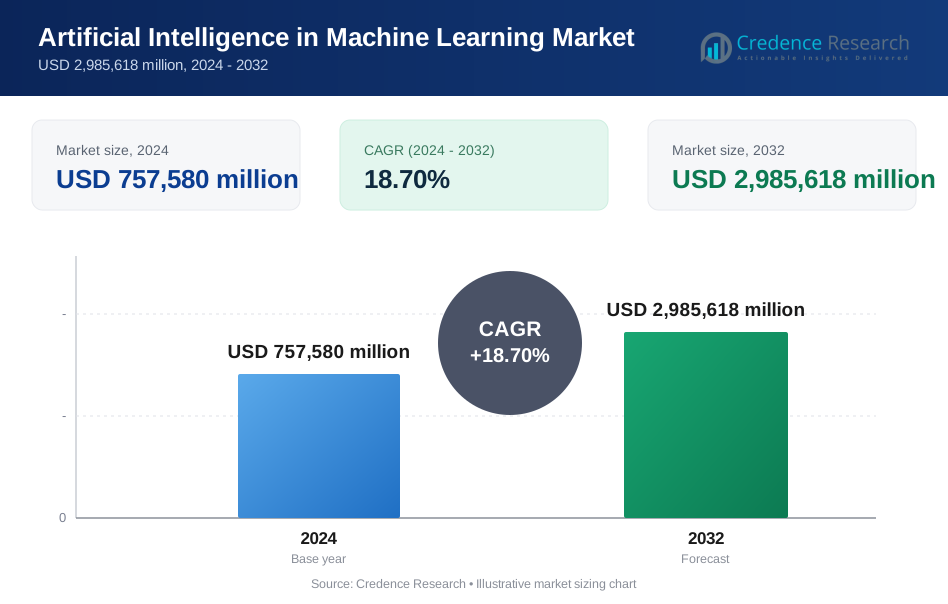
| Artificial Intelligence in Machine Learning Market Size 2024 | USD 757,580 million |
| Artificial Intelligence in Machine Learning Market, CAGR | 18.7% |
| Artificial Intelligence in Machine Learning Market Size 2032 | USD 2,985,618 million |
Market Overview:
The Artificial Intelligence in Machine Learning market is projected to grow from USD 757,580 million in 2024 to USD 2,985,618 million by 2032, expanding at a compound annual growth rate (CAGR) of 18.7%.
The Artificial Intelligence in Machine Learning (AI in ML) market is experiencing rapid growth, driven by increasing demand for automation, data-driven decision-making, and advancements in deep learning technologies. Enterprises across sectors such as healthcare, finance, retail, and manufacturing are integrating AI-powered ML solutions to enhance efficiency, customer experience, and operational accuracy. The proliferation of big data, coupled with rising investments in AI infrastructure, fuels further market expansion. Moreover, the growing adoption of cloud-based AI platforms accelerates deployment and scalability. Trends such as the rise of generative AI, edge computing, and explainable AI are shaping the future landscape, enabling real-time insights and greater transparency in AI models. Strategic collaborations between tech companies and research institutions are fostering innovation, while government initiatives worldwide support AI integration through funding and regulatory frameworks. As AI continues to evolve, the convergence of AI with other technologies like IoT and blockchain is expected to create new avenues for market growth and transformation.
The Artificial Intelligence in Machine Learning market demonstrates strong geographical presence across North America, Europe, Asia Pacific, Latin America, and the Middle East & Africa. North America leads the market due to early adoption and a robust technological ecosystem, followed by rapid growth in Asia Pacific driven by government support and innovation. Europe maintains a strong focus on ethical AI and regulatory frameworks, while Latin America and the Middle East & Africa show promising potential with increasing digital transformation efforts. Key players driving global market development include Google (Alphabet Inc.), Microsoft Corporation, IBM Corporation, Amazon Web Services (AWS), NVIDIA Corporation, Intel Corporation, Salesforce, SAP SE, Oracle Corporation, Facebook, Apple Inc., and Alibaba Group. These companies actively influence regional dynamics through product innovation, global expansion, and strategic partnerships.
Market Insights:
- The Artificial Intelligence in Machine Learning market is projected to grow from USD 757,580 million in 2024 to USD 2,985,618 million by 2032, registering a strong CAGR of 7%.
- Rapid demand for automation, operational efficiency, and intelligent decision-making is propelling AI in ML adoption across industries like healthcare, finanmanufacturing.
- Big data proliferation and advanced analytics are key drivers, enabling businesses to generate real-time insights, improve strategies, and optimize customer experiences.
- Breakthroughs in deep learning, NLP, and computer vision are expanding AI capabilities, allowing companies to deploy scalable, adaptable, and more accurate ML solutions.
- Global support through government initiatives, funding, and policy frameworks is fostering innovation and enterprise-wide AI implementation across regions.
- Data privacy, security concerns, and a lack of skilled AI professionals pose significant challenges, especially for SMEs struggling with high implementation costs.
- Regionally, North America leads with 38% market share, followed by Asia Pacific (27%), Europe (25%), and Latin America and the Middle East & Africa (5% each), all supported by growing digital transformation and strategic investments.
Market Drivers:
Rising Demand for Automation and Operational Efficiency:
One of the primary drivers of the Artificial Intelligence in Machine Learning (AI in ML) market is the increasing demand for automation across industries. Businesses are leveraging AI-driven ML tools to automate repetitive tasks, reduce human error, and streamline workflows. For instance, Walmart employs AI in supply chain management to forecast demand and manage inventory, which ensures product availability, minimizes stockouts, and saves money on surplus inventory. This trend is particularly evident in sectors such as manufacturing, logistics, and customer service, where operational efficiency translates directly into cost savings and improved service delivery. As organizations strive to remain competitive in a digital-first economy, the integration of AI technologies becomes a strategic priority.
Proliferation of Big Data and Advanced Analytics:
The exponential growth of data generation across digital platforms is fueling the need for advanced analytics, thereby driving the AI in ML market. Machine learning algorithms thrive on large datasets, enabling more accurate predictions, real-time insights, and improved decision-making. As enterprises accumulate vast amounts of structured and unstructured data, the demand for sophisticated AI solutions capable of extracting value from this information continues to rise. This data-centric approach is becoming integral to business intelligence and strategy development.
Technological Advancements in AI and ML Algorithms:
Continuous innovations in AI and ML technologies significantly contribute to market growth. Breakthroughs in deep learning, natural language processing, and computer vision have expanded the capabilities of AI systems across various applications. These advancements have made it possible to develop more robust, adaptable, and scalable solutions that cater to complex business challenges. As research and development in AI accelerates, companies gain access to tools that were previously limited to academic or high-tech environments, further broadening market adoption.
Supportive Government Initiatives and Investment Landscape:
Global governments and regulatory bodies are increasingly recognizing the transformative potential of AI and are implementing policies to support its development. Public and private investments in AI research, infrastructure, and workforce development are creating a fertile ecosystem for innovation. For instance, Tech giants like Meta, Amazon, Alphabet, and Microsoft plan to spend as much as $320 billion combined on AI technologies and datacenter buildouts in 2025. These initiatives, combined with favorable regulatory frameworks, encourage enterprises to adopt AI technologies, thereby driving sustained growth in the AI in ML market.
Market Trends:
Emergence of Generative AI Technologies:
One of the most significant trends in the Artificial Intelligence in Machine Learning (AI in ML) market is the rapid emergence of generative AI technologies. These models, capable of producing text, images, audio, and even code, are reshaping content creation and innovation processes across industries. Businesses are adopting generative AI to enhance creativity, streamline marketing operations, and develop new products. The integration of such tools into customer support, design, and software development has opened up new use cases, making AI more accessible and impactful.
Increased Adoption of Edge AI Solutions:
As organizations seek faster processing and real-time decision-making, there is a growing shift toward edge AI solutions. By deploying machine learning models directly on edge devices, companies reduce latency and reliance on cloud infrastructure. For instance, Tesla uses edge AI to process data from cameras, radar, and ultrasonic sensors in real-time, enabling immediate decision-making for its Autopilot and Full Self-Driving (FSD) systems, which allows the car to adjust speed, steering, or braking in response to road conditions. This trend is particularly prevalent in sectors such as automotive, healthcare, and manufacturing, where immediate data analysis is critical. Edge AI not only improves performance but also enhances data security by minimizing the transfer of sensitive information to centralized servers.
Focus on Explainable and Ethical AI:
With the widespread deployment of AI, there is a heightened emphasis on explainability and ethical standards. Organizations and stakeholders are increasingly demanding transparency in machine learning decisions to ensure accountability and fairness. This has led to the development of explainable AI (XAI) frameworks that make complex algorithms more interpretable. Additionally, regulatory bodies are proposing guidelines that prioritize responsible AI use, prompting companies to integrate ethical considerations into their AI strategies.
Integration with Other Emerging Technologies:
The convergence of AI with technologies like the Internet of Things (IoT), blockchain, and augmented reality is creating new possibilities within the AI in ML market. For instance, Walmart uses blockchain to track food products from farm to shelf, quickly addressing contamination issues, and uses AI to optimize inventory management and delivery efficiency. These integrations enhance functionality, enable seamless data exchange, and support innovative applications. AI-powered IoT systems offer predictive maintenance in industrial settings, while AI combined with blockchain improves data traceability and security.
Market Challenges Analysis:
Data Privacy and Security Concerns:
A major challenge facing the Artificial Intelligence in Machine Learning (AI in ML) market is the growing concern over data privacy and security. As AI systems heavily rely on vast datasets to train and improve their performance, organizations must often process sensitive and personal information. This reliance increases the risk of data breaches, misuse, and unauthorized access, especially when data is shared across third-party platforms or stored in less secure environments. In addition, the complexity of AI algorithms can make it difficult to trace the source of data misuse or pinpoint accountability in the event of a breach. For instance, Gravy Analytics, a location data broker, suffered a data breach potentially exposing precise location data of millions of individuals. Regulatory frameworks such as the General Data Protection Regulation (GDPR) in Europe and similar laws in other regions impose strict compliance requirements, putting added pressure on companies to implement robust data governance policies. Ensuring secure data management and maintaining user trust remain critical barriers that organizations must address to fully harness AI’s potential.
Lack of Skilled Workforce and High Implementation Costs:
Another significant challenge in the AI in ML market is the shortage of skilled professionals capable of developing, deploying, and maintaining advanced AI systems. Despite the increasing availability of AI tools and platforms, there remains a high demand for talent with specialized knowledge in machine learning algorithms, data science, and model interpretability. This skills gap hinders the pace of AI adoption, particularly for small and medium-sized enterprises (SMEs) that may lack the resources to compete for top talent. Moreover, the initial costs associated with AI implementation, including infrastructure investment, software licensing, and employee training, can be prohibitively high. For many organizations, these financial barriers limit their ability to integrate AI into core operations effectively. Addressing this challenge requires a multi-faceted approach involving educational initiatives, public-private partnerships, and increased access to affordable AI solutions. Without such measures, the growth and democratization of AI in ML technologies could be significantly restrained.
Market Opportunities:
The Artificial Intelligence in Machine Learning (AI in ML) market presents significant opportunities across a wide range of industries as digital transformation accelerates globally. With organizations increasingly relying on data-driven strategies, AI-powered machine learning applications are becoming essential for improving efficiency, reducing operational costs, and enabling predictive decision-making. Sectors such as healthcare, finance, automotive, and retail are particularly well-positioned to benefit from AI integration. In healthcare, for example, machine learning can facilitate faster diagnostics and personalized treatment plans, while in finance, it enhances fraud detection and customer service automation. As AI solutions become more scalable and accessible, even small and medium-sized enterprises are beginning to adopt these technologies, unlocking new business models and enhancing competitiveness.
The growing availability of cloud-based platforms and open-source AI frameworks further expands market opportunities by lowering the entry barrier for organizations to implement machine learning solutions. Additionally, emerging markets offer substantial growth potential due to increasing digitization, government support for innovation, and expanding IT infrastructure. Innovations in areas such as generative AI, autonomous systems, and reinforcement learning are also expected to create new use cases and applications. Moreover, as AI becomes increasingly integrated with complementary technologies like IoT, 5G, and edge computing, organizations can explore real-time, intelligent systems that transform operations and customer engagement. These developments collectively signal a promising future for stakeholders investing in the AI in ML market.
Market Segmentation Analysis:
By Component
The Artificial Intelligence in Machine Learning market is segmented into solutions and services. Solutions dominate the segment, driven by growing adoption of AI-powered platforms for automation, analytics, and data processing. Services, including consulting, integration, and support, are gaining momentum as enterprises seek tailored implementation and ongoing optimization of AI solutions.
By Deployment Mode
Deployment in the AI in ML market is categorized into cloud and on-premises. Cloud-based deployment leads the segment due to its scalability, cost-efficiency, and ease of integration. It supports rapid innovation and remote access, making it ideal for dynamic business environments, while on-premises deployment remains relevant for data-sensitive industries prioritizing security.
By Industry Vertical
The market spans various industry verticals, including healthcare, BFSI, retail, IT & telecom, and manufacturing. Healthcare and BFSI are prominent adopters, leveraging AI for diagnostics and fraud prevention, respectively. Retail and IT & telecom utilize AI to enhance customer engagement, while manufacturing adopts it for predictive maintenance and quality control.
Segments:
Based on Component
- Solutions
- Services
Based on Deployment Mode
- Cloud
- On-Premises
Based on Industry Vertical
- Healthcare
- BFSI
- Retail
- IT & Telecomm
- Manufacturing
Based on the Geography:
- North America
- U.S.
- Canada
- Mexico
- Europe
- Germany
- France
- U.K.
- Italy
- Spain
- Rest of Europe
- Asia Pacific
- China
- Japan
- India
- South Korea
- South-east Asia
- Rest of Asia Pacific
- Latin America
- Brazil
- Argentina
- Rest of Latin America
- Middle East & Africa
- GCC Countries
- South Africa
- Rest of the Middle East and Africa
Regional Analysis:
North America
North America holds the largest share in the Artificial Intelligence in Machine Learning market, accounting for 38% of the global market in 2024. This dominance is driven by early technology adoption, a well-developed digital ecosystem, and the presence of major AI companies. The United States leads regional growth through AI applications in healthcare, finance, retail, and automotive sectors. Strong government support, strategic investments in AI research, and a highly skilled workforce continue to position North America as a global leader in AI advancement and innovation. The region also benefits from active startup ecosystems and venture capital funding in AI technologies.
Europe
Europe captures 25% of the global AI in Machine Learning market in 2024. The region places strong emphasis on ethical AI development, regulatory standards, and industrial automation. Countries such as Germany, the United Kingdom, and France are spearheading AI integration, particularly in manufacturing, automotive, and financial services. The European Union’s focus on digital innovation, research collaboration, and cross-border data initiatives reinforces regional competitiveness. Increasing investments in education and digital skills training further support the region's strategic approach to AI. Europe also promotes cross-industry partnerships to drive responsible AI development and adoption across all sectors.
Asia Pacific
Asia Pacific accounts for 27% of the global market share in 2024 and continues to grow rapidly. The region benefits from robust government support, substantial investments, and high demand across sectors such as telecommunications, e-commerce, and smart manufacturing. China leads the region with its national AI strategy and infrastructure, while Japan, India, and South Korea contribute significantly to regional momentum. Asia Pacific also experiences rapid AI startup growth and rising public-private collaboration. As digital connectivity improves and AI applications diversify, the region is becoming a global powerhouse in AI innovation, driving economic transformation and competitiveness in global markets.
Latin America and Middle East & Africa
Latin America and the Middle East & Africa each hold 5% of the global market in 2024. While smaller in scale, both regions show rising potential due to increasing digital transformation, government support, and AI-focused innovation initiatives. Countries like Brazil, the UAE, and South Africa are implementing AI in areas such as public services, finance, and education. Emerging tech hubs and pilot programs are beginning to shape the local AI landscape. Although challenges like infrastructure limitations and a skills gap persist, ongoing investments, international partnerships, and regional policy reforms are fostering a more favorable environment for AI adoption.
Key Player Analysis:
- Amazon Web Services (AWS)
- Apple Inc.
- SAP SE
- Microsoft Corporation
- Alibaba Group
- Salesforce
- IBM Corporation
- Oracle Corporation
- NVIDIA Corporation
- Intel Corporation
- Google (Alphabet Inc.)
Competitive Analysis:
The Artificial Intelligence in Machine Learning market is highly competitive, driven by innovation, strategic collaborations, and aggressive investment in research and development. Leading players such as Google (Alphabet Inc.), Microsoft Corporation, IBM Corporation, Amazon Web Services (AWS), NVIDIA Corporation, Intel Corporation, Salesforce, SAP SE, Oracle Corporation, Facebook, Apple Inc., and Alibaba Group are shaping the global landscape with their advanced AI capabilities and broad product portfolios. These companies leverage cloud infrastructure, large-scale data processing, and proprietary machine learning algorithms to maintain a competitive edge. They are also focusing on expanding their global footprint through mergers, acquisitions, and strategic alliances, targeting emerging economies and untapped industry verticals. Continuous enhancement of AI models, development of industry-specific solutions, and integration of complementary technologies such as cloud computing, IoT, and edge computing remain central to their growth strategies. Additionally, many of these firms are investing in responsible AI initiatives, emphasizing transparency, ethical standards, and regulatory compliance to gain trust and ensure sustainable market leadership.
Recent Developments:
- In June 2023, Apple unveiled a range of AI-powered features in iOS, including enhanced Siri functionality, on-device machine learning for better privacy.
- In July 2023, Oracle launched its comprehensive AI Platform, designed to build, train, and deploy AI models at scale.
- In August 2023, Alibaba expanded its cloud-based AI services by introducing new machine learning tools aimed at optimizing operations in e-commerce, logistics, and customer service.
Market Concentration & Characteristics:
The Artificial Intelligence in Machine Learning market exhibits a high degree of market concentration, with a few dominant players controlling a significant portion of the global share. Companies such as Google, Microsoft, Amazon Web Services, IBM, and NVIDIA lead the competitive landscape through robust research capabilities, extensive product portfolios, and strong global presence. The market is characterized by rapid technological innovation, continuous investment in AI infrastructure, and strategic collaborations between enterprises and research institutions. Scalability, adaptability, and real-time data processing remain essential attributes of leading AI in ML solutions. Additionally, the market favors organizations that offer integrated platforms combining AI, cloud computing, and big data analytics. High entry barriers, driven by complex technology requirements and the need for skilled expertise, further contribute to market consolidation. As the demand for intelligent automation and predictive analytics grows, market leaders continue to shape the direction of AI development while setting benchmarks for reliability, efficiency, and innovation.
Report Coverage:
The research report offers an in-depth analysis based on Component, Deployment model, Industry Vertical and Geography. It details leading market players, providing an overview of their business, product offerings, investments, revenue streams, and key applications. Additionally, the report includes insights into the competitive environment, SWOT analysis, current market trends, as well as the primary drivers and constraints. Furthermore, it discusses various factors that have driven market expansion in recent years. The report also explores market dynamics, regulatory scenarios, and technological advancements that are shaping the industry. It assesses the impact of external factors and global economic changes on market growth. Lastly, it provides strategic recommendations for new entrants and established companies to navigate the complexities of the market.
Future Outlook:
- The adoption of AI in machine learning will continue to expand across all major industries, including healthcare, finance, manufacturing, and retail.
- Cloud-based AI platforms will play a central role in enabling faster deployment and greater scalability of ML solutions.
- Integration of generative AI will enhance content creation, design, and customer engagement applications.
- Edge computing will become increasingly important to support real-time AI processing in remote and low-latency environments.
- Explainable AI will gain traction as organizations prioritize transparency and accountability in automated decision-making.
- Governments will increase investments in AI infrastructure, education, and regulatory frameworks to foster responsible innovation.
- Cross-industry collaborations and public-private partnerships will accelerate AI research and application development.
- Demand for skilled AI professionals will rise, prompting educational institutions to expand AI and data science programs.
- Small and medium enterprises will adopt AI solutions more widely as costs decrease and tools become more accessible.
- Convergence of AI with IoT, blockchain, and robotics will unlock new opportunities for digital transformation.
Request a Free Sample
Fill in your details and we'll send you a free sample report.
- Sample data tables & charts
- Research methodology
Market Dynamics
Automation and Operational Efficiency
Organizations are increasingly leveraging AI-driven machine learning tools to automate repetitive tasks, reduce human error, and streamline workflows, particularly in sectors like manufacturing, logistics, and customer service, resulting in significant cost savings and improved service delivery.
Big Data Proliferation and Advanced Analytics
The exponential growth of structured and unstructured data across digital platforms is fueling demand for advanced analytics, enabling machine learning algorithms to generate real-time insights, improve business strategies, and optimize customer experiences.
Technological Advancements in Deep Learning and NLP
Breakthroughs in deep learning, natural language processing, and computer vision are expanding the capabilities of AI systems, allowing for more robust, scalable, and accurate machine learning solutions across diverse applications.
Supportive Government Initiatives and Investments
Global governments and regulatory bodies are investing in AI research, infrastructure, and workforce development, creating a supportive ecosystem for innovation and encouraging enterprises to adopt AI technologies through favorable policies and funding.
Cloud-Based AI Platform Adoption
The shift toward cloud-based AI platforms is accelerating deployment and scalability of machine learning solutions, making it easier for organizations of all sizes to access, implement, and scale AI capabilities without heavy upfront infrastructure investments.
Need a Custom Version of This Report?
Tailor the scope, geography, or segments to your exact requirements.
- Custom geography or segment scope
- Direct access to our analyst team
Frequently Asked Questions
What is the current size of the Artificial Intelligence in Machine Learning Market?
What factors are driving the growth of the Artificial Intelligence in Machine Learning Market?
What are the key segments within the Artificial Intelligence in Machine Learning Market?
Who are the major players in the Artificial Intelligence in Machine Learning Market?
Table of Content
Chapter 1 Market Segmentation
- 1.1 Segmentation Framework
- 1.1.1 Product and Service Classification
- 1.1.2 Application and End-Use Classification
- 1.1.3 Technology and Solution Classification
- 1.1.4 Customer and Distribution Channel Classification
- 1.1.5 Geographic Segmentation
- 1.1.6 Market Segment Definitions and Boundaries
- 1.2 By Component
- 1.2.1 Solutions
- 1.2.2 Services
- 1.3 By Deployment Mode
- 1.3.1 Cloud
- 1.3.2 On-Premises
- 1.4 By Industry Vertical
- 1.4.1 Healthcare
- 1.4.2 BFSI
- 1.4.3 Retail
- 1.4.4 IT & Telecom
- 1.4.5 Manufacturing
Chapter 2 Introduction
- 2.1 Report Objectives and Scope
- 2.2 Product Definition and Industry Terminology
- 2.3 Market Inclusions and Exclusions
- 2.4 Research Process
- 2.4.1 Primary Research and Expert Interviews
- 2.4.2 Secondary Research and Source Review
- 2.4.3 Top-Down and Bottom-Up Estimation
- 2.4.4 Data Triangulation and Verification
- 2.5 Market Size Measurement Basis
- 2.5.1 2024: USD 757,580 million → 2032: USD 2,985,618 million
- 2.6 Historical and Forecast Reference Periods
- 2.6.1 Base Year: 2024
- 2.6.2 Forecast Period: 2024-2032
- 2.7 Research Assumptions and Limitations
Chapter 3 Executive Summary
- 3.1 Market Snapshot and Key Findings
- 3.2 Base-Year Market Size, 2024
- 3.3 Forecast Market Size, 2032
- 3.4 Revenue and Volume Growth Outlook
- 3.5 Key Demand and Supply Indicators
- 3.6 Leading Market Segments
- 3.7 Fastest-Growing Market Opportunities
- 3.8 Regional Performance Highlights
- 3.9 Technology and Industry Transformation
- 3.10 Competitive Landscape Summary
- 3.11 Analyst View and Strategic Implications
Chapter 4 Global Artificial Intelligence in Machine Learning Market Trends and Developments
- 4.1 Historical Industry Development
- 4.2 Recent Market Trends and Developments
- 4.3 Demand and Customer Behavior Trends
- 4.4 Technology and Product Innovation
- 4.5 Artificial Intelligence, Automation and Digitalization
- 4.6 Local Manufacturing and Supply Chain Realignment
- 4.7 Industry Partnerships, Mergers and Acquisitions
- 4.8 Sustainability and Circular Economy Developments
- 4.9 Government and Private Sector Investment Trends
- 4.10 Emerging Business Models and Commercialization
- 4.11 Industry Developments and Announcements
Chapter 5 Global Artificial Intelligence in Machine Learning Market Production, Supply and Demand Analysis
- 5.1 Demand Trend and Consumption Analysis
- 5.2 Demand Forecast, 2024-2032
- 5.3 Production and Output Trend
- 5.4 Production and Output Forecast, 2024-2032
- 5.5 Installed Capacity and Capacity Utilization
- 5.6 Company-Wise Production Plants and Statistics
- 5.6.1 Installed Production Capacity
- 5.6.2 Actual Production
- 5.6.3 Planned Capacity and Expansion Targets
- 5.7 Supply Chain Structure and Procurement Trends
- 5.8 Supply-Demand Gap and Bottlenecks
- 5.9 Import Dependence and Sourcing Structure
- 5.10 Contract Manufacturing and Outsourcing
- 5.11 Regional Supply and Demand Concentration
Chapter 6 Global Artificial Intelligence in Machine Learning Market Pricing Analysis
- 6.1 Pricing Structure and Measurement
- 6.2 Historical Pricing Trends
- 6.3 Pricing Outlook, 2024-2032
- 6.4 Average Selling Price and Unit Economics
- 6.5 Pricing by Product and Market Segment
- 6.6 Geographic Pricing Differences
- 6.7 Key Input, Energy, Labor and Logistics Costs
- 6.8 Contract Pricing and Purchasing Models
- 6.9 Pricing Sensitivity and Competitive Positioning
- 6.10 Price, Margin and Profitability Implications
Chapter 7 Global Artificial Intelligence in Machine Learning Market Dynamics
- 7.1 Market Growth Drivers
- 7.1.1 Demand-Side Drivers
- 7.1.2 Technology and Innovation Drivers
- 7.1.3 Infrastructure and Investment Drivers
- 7.1.4 Regulatory and Policy Drivers
- 7.2 Market Restraints
- 7.2.1 Cost and Affordability Constraints
- 7.2.2 Technology and Adoption Barriers
- 7.2.3 Supply Chain and Operational Constraints
- 7.3 Market Challenges
- 7.3.1 Competitive Pressure and Margin Erosion
- 7.3.2 Skills, Infrastructure and Implementation Gaps
- 7.4 Emerging Market Opportunities
- 7.5 Market Dynamics Impact and Time-Horizon Assessment
Chapter 8 Global Artificial Intelligence in Machine Learning Value Chain Analysis
- 8.1 Industry Value Chain Overview
- 8.2 Upstream Suppliers and Critical Inputs
- 8.3 Technology and Component Providers
- 8.4 Manufacturing or Service Delivery
- 8.5 Distribution, Channel Partners and Integrators
- 8.6 Downstream Applications and End Users
- 8.7 Value Addition and Profit Pools
- 8.8 Vertical Integration and Outsourcing
- 8.9 Supplier Concentration and Risk
- 8.10 Supply Chain Localization and Resilience
Chapter 9 Global Artificial Intelligence in Machine Learning Market Regulations and Policies
- 9.1 Relevant Laws, Standards and Compliance Frameworks
- 9.2 Product, Service, Safety and Quality Requirements
- 9.3 Government Policies, Incentives and Subsidies
- 9.4 Imports, Exports and Trade Barriers
- 9.5 Public Procurement and Local Content Requirements
- 9.6 Environmental and Sustainability Compliance
- 9.7 Data Protection, AI and Cybersecurity Compliance
- 9.8 Upcoming Policy Changes and Market Implications
Chapter 10 Global Artificial Intelligence in Machine Learning Market Hotspots and Opportunities
- 10.1 Market Opportunity Mapping and Growth Hotspots
- 10.2 High-Growth Applications and Customer Groups
- 10.3 Underserved Markets and White-Space Opportunities
- 10.4 Emerging Technology and Product Opportunities
- 10.5 New Capacity and Investment Hotspots
- 10.6 Market Entry and Expansion Opportunities
- 10.7 Distribution and Partnership Opportunities
- 10.8 Near-Term and Long-Term Commercial Potential
- 10.9 Opportunity Attractiveness and Execution Risks
Chapter 11 Global Artificial Intelligence in Machine Learning Market Outlook, 2024-2032
- 11.1 Market Size and Analysis
- 11.1.1 Revenue (Market Measurement: 2024: USD 757,580 million → 2032: USD 2,985,618 million)
- 11.1.2 Market Volume and Quantity Sold
- 11.1.3 Historical Market Size
- 11.1.4 Base-Year Market Size, 2024
- 11.2 Market Forecast, 2024-2032
- 11.2.1 Revenue Forecast to 2032
- 11.2.2 Volume Forecast to 2032
- 11.2.3 CAGR and Year-on-Year Growth
- 11.2.4 Incremental Revenue Opportunity
- 11.3 Forecast Assumptions and Scenario Analysis
- 11.3.1 Base-Case Forecast
- 11.3.2 Optimistic and Conservative Scenarios
- 11.3.3 Technology, Pricing and Policy Sensitivities
- 11.4 Market Attractiveness and Growth Outlook
Chapter 12 Global Artificial Intelligence in Machine Learning Market Segmentation and Outlook
- 12.1 Segmentation Summary and Market Shares, 2024
- 12.2 Largest and Fastest-Growing Segments
- 12.3 By Component - Market Size and Forecast, 2024-2032
- 12.3.1 Segment Definition and Scope
- 12.3.2 Historical Market Size
- 12.3.3 Revenue Forecast, 2024-2032
- 12.3.4 Volume Forecast, 2024-2032
- 12.3.5 Base-Year Market Share, 2024
- 12.3.6 Segment CAGR and Growth Drivers
- 12.3.7 Subsegment Market Size and Forecast
- 12.3.7.1 Solutions
- 12.3.7.2 Services
- 12.3.8 Subsegment Pricing and Adoption Trends
- 12.3.9 Leading Suppliers and Competition
- 12.3.10 Regional Demand and Opportunities
- 12.4 By Deployment Mode - Market Size and Forecast, 2024-2032
- 12.4.1 Segment Definition and Scope
- 12.4.2 Historical Market Size
- 12.4.3 Revenue Forecast, 2024-2032
- 12.4.4 Volume Forecast, 2024-2032
- 12.4.5 Base-Year Market Share, 2024
- 12.4.6 Segment CAGR and Growth Drivers
- 12.4.7 Subsegment Market Size and Forecast
- 12.4.7.1 Cloud
- 12.4.7.2 On-Premises
- 12.4.8 Subsegment Pricing and Adoption Trends
- 12.4.9 Leading Suppliers and Competition
- 12.4.10 Regional Demand and Opportunities
- 12.5 By Industry Vertical - Market Size and Forecast, 2024-2032
- 12.5.1 Segment Definition and Scope
- 12.5.2 Historical Market Size
- 12.5.3 Revenue Forecast, 2024-2032
- 12.5.4 Volume Forecast, 2024-2032
- 12.5.5 Base-Year Market Share, 2024
- 12.5.6 Segment CAGR and Growth Drivers
- 12.5.7 Subsegment Market Size and Forecast
- 12.5.7.1 Healthcare
- 12.5.7.2 BFSI
- 12.5.7.3 Retail
- 12.5.7.4 IT & Telecom
- 12.5.7.5 Manufacturing
- 12.5.8 Subsegment Pricing and Adoption Trends
- 12.5.9 Leading Suppliers and Competition
- 12.5.10 Regional Demand and Opportunities
- 12.6 Segment Growth Comparison
- 12.7 Segment Attractiveness and Priority Matrix
Chapter 13 Global Artificial Intelligence in Machine Learning End-Use and Application Market Outlook
- 13.1 End-Use Industry and Customer Demand Structure
- 13.2 Leading Applications and Customer Groups
- 13.3 End-Use Market Size, Share and Forecast
- 13.4 Major End-Use Industry Deep Dives
- 13.4.1 Customer Requirements and Use Cases
- 13.4.2 Demand and Replacement Cycles
- 13.4.3 Technical and Regulatory Considerations
- 13.4.4 Purchasing and Procurement Models
- 13.4.5 Leading Vendors and Distribution Channels
- 13.4.6 Forecast and Commercial Opportunities
- 13.5 Emerging Applications and Cross-Segment Demand
- 13.6 End-Use Industry Investment Priorities
Chapter 14 Global Artificial Intelligence in Machine Learning Geographic Market Outlook, 2024-2032
- 14.1 Regional Market Size and Share, 2024
- 14.2 Regional Market Forecast, 2024-2032
- 14.3 Regional Pricing, Production and Demand Differences
- 14.4 North America
- 14.4.1 United States
- 14.4.2 Canada
- 14.4.3 Mexico
- 14.5 Europe
- 14.5.1 Germany
- 14.5.2 France
- 14.5.3 Italy
- 14.5.4 United Kingdom
- 14.5.5 Spain
- 14.5.6 Poland
- 14.5.7 Russia
- 14.5.8 Netherlands
- 14.5.9 Belgium
- 14.5.10 Sweden
- 14.5.11 Denmark
- 14.5.12 Norway
- 14.5.13 Rest of Europe
- 14.6 Asia Pacific
- 14.6.1 China
- 14.6.2 India
- 14.6.3 Japan
- 14.6.4 South Korea
- 14.6.5 Thailand
- 14.6.6 Indonesia
- 14.6.7 Vietnam
- 14.6.8 Malaysia
- 14.6.9 Australia
- 14.6.10 Rest of Asia Pacific
- 14.7 Latin America
- 14.7.1 Brazil
- 14.7.2 Argentina
- 14.7.3 Colombia
- 14.7.4 Chile
- 14.7.5 Rest of Latin America
- 14.8 Middle East
- 14.8.1 Saudi Arabia
- 14.8.2 United Arab Emirates
- 14.8.3 Turkey
- 14.8.4 Israel
- 14.8.5 Iran
- 14.8.6 Rest of the Middle East
- 14.9 Africa
- 14.9.1 South Africa
- 14.9.2 Egypt
- 14.9.3 Nigeria
- 14.9.4 Morocco
- 14.9.5 Rest of Africa
- 14.10 Regional Investment, Policy and Supply Chain Differences
- 14.11 Regional Competitive Landscape
- 14.12 Geographic Growth Hotspots
Chapter 15 Global Artificial Intelligence in Machine Learning Technology, Innovation and Sustainability Outlook
- 15.1 Technology Landscape and Maturity
- 15.2 Product, Process and Service Innovation
- 15.3 AI, Automation and Digital Tools in the Industry
- 15.4 Technology Adoption and Performance Benchmarking
- 15.5 Innovation Pipeline and R&D Investment
- 15.6 Patent and Intellectual Property Trends
- 15.7 Energy Efficiency and Resource Management
- 15.8 Sustainability, Recycling and Circularity
- 15.9 Technology Roadmap, 2024-2032
- 15.10 Risks of Obsolescence and Technology Substitution
Chapter 16 Global Artificial Intelligence in Machine Learning Market Key Strategic Imperatives
- 16.1 Growth and Market Entry Priorities
- 16.2 High-Return Products and Segments
- 16.3 Pricing, Profitability and Cost Optimization
- 16.4 Technology Investment and Product Differentiation
- 16.5 Supply Chain Localization and Resilience
- 16.6 Distribution and Customer Acquisition
- 16.7 Partnership, Acquisition and Capacity Strategy
- 16.8 Regional Expansion Priorities
- 16.9 Short-, Medium- and Long-Term Actions
Chapter 17 Competition Outlook
- 17.1 Industry Competition Characteristics
- 17.2 Market Structure and Concentration
- 17.3 Market Share and Competitive Positioning, 2024
- 17.4 Company-Wise Revenue and Product Benchmarking
- 17.5 Production and Service Capacity Benchmarking
- 17.6 Technology, Pricing and Differentiation
- 17.7 Regional Footprint and Distribution Strength
- 17.8 Mergers, Acquisitions and Strategic Alliances
- 17.9 New Entrants and Competitive Threats
- 17.10 Porter's Five Forces and Industry Attractiveness
- 17.11 Competitive Outlook, 2024-2032
Chapter 18 Company Profiles
- 18.1 Company Coverage and Selection Criteria
- 18.2 Google (Alphabet Inc.)
- 18.2.1 Business Description
- 18.2.2 Company Ownership and Geographic Presence
- 18.2.3 Product and Service Portfolio
- 18.2.4 Manufacturing and Operating Footprint
- 18.2.5 Production Capacity and Expansion Plans
- 18.2.6 Financial Performance and Investment
- 18.2.7 Market Share and Competitive Position
- 18.2.8 Technology and Innovation Capabilities
- 18.2.9 Strategic Alliances or Partnerships
- 18.2.10 Recent Developments
- 18.2.11 Growth Strategy and Outlook
- 18.3 Microsoft Corporation
- 18.4 IBM Corporation
- 18.5 Amazon Web Services (AWS)
- 18.6 NVIDIA Corporation
- 18.7 Intel Corporation
- 18.8 Salesforce
- 18.9 SAP SE
- 18.10 Oracle Corporation
- 18.11 Apple Inc.
- 18.12 Other Relevant Market Participants
Note: Every listed company is profiled on the structure shown under the first company. The company list is preliminary and may change based on research findings, market developments, data availability and client requirements.
Chapter 19 Disclaimer
- 19.1 Research and Forecast Disclaimer
- 19.2 Data Source and Estimation Limitations
Note: The depth of individual sections depends on data availability for this market. Volume, capacity, trade and other unit-based metrics are included where applicable.

