
| REPORT ATTRIBUTE | DETAILS |
|---|---|
| Historical Period | 2019-2022 |
| Base Year | 2023 |
| Forecast Period | 2024-2032 |
| Artificial Urinary Sphincter Market Size 2024 | USD 474.8 Million |
| Artificial Urinary Sphincter Market, CAGR | 5.7% |
| Artificial Urinary Sphincter Market Size 2032 | USD 739.79 Million |
Market Overview
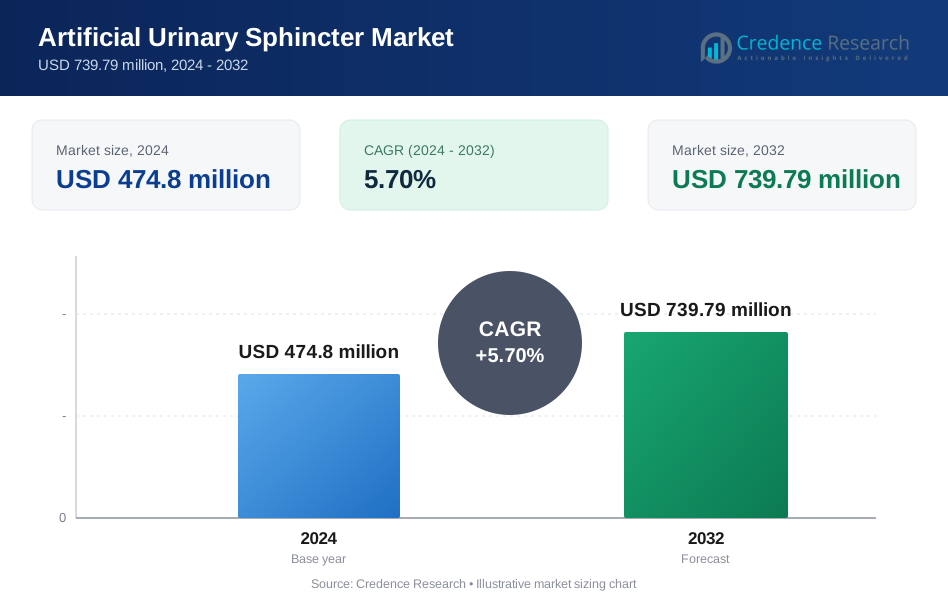
The Artificial Urinary Sphincter Market is projected to grow from USD 474.8 million in 2024 to an estimated USD 739.79 million by 2032, with a compound annual growth rate (CAGR) of 5.7% from 2024 to 2032.
Key drivers of the artificial urinary sphincter market include the increasing prevalence of urinary incontinence, particularly among aging populations, and advancements in medical technologies. The rising demand for minimally invasive procedures and improved patient outcomes are further fueling market growth. Additionally, there is a growing focus on enhancing the quality of life for individuals suffering from urinary disorders, which is driving the adoption of artificial urinary sphincters as a treatment option. Technological advancements, such as the development of more reliable, durable, and easier-to-use devices, are also contributing to the market's expansion.
Regionally, North America holds a significant share of the artificial urinary sphincter market due to the presence of advanced healthcare infrastructure and a high rate of adoption of innovative medical technologies. The United States, in particular, is seeing increased demand driven by the aging population and the growing prevalence of urinary incontinence. Europe is also expected to experience considerable growth, driven by an aging population and increased awareness of urinary incontinence treatments. In the Asia Pacific region, emerging economies like China and India are witnessing rising healthcare expenditures and improvements in medical technologies, which are likely to drive the adoption of artificial urinary sphincters. Latin America and the Middle East & Africa regions are expected to experience gradual growth, with improving healthcare access and an increasing focus on urological health.
Market Insights
- The Artificial Urinary Sphincter Market is expected to grow from USD 474.8 million in 2024 to USD 739.79 million by 2032, with a CAGR of 5.7%.
- Key market drivers include the rising incidence of urinary incontinence, especially in the elderly population, and advancements in medical device technology.
- Increasing demand for minimally invasive treatments and improved outcomes for patients are further boosting the adoption of artificial urinary sphincters.
- Technological innovations in the design and functionality of artificial urinary sphincters are enhancing their effectiveness and ease of use, contributing to market growth.
- Market restraints include the high cost of the devices and potential complications or side effects associated with their implantation.
- North America is the largest market, driven by advanced healthcare infrastructure and a high adoption rate of innovative medical technologies.
- The Asia Pacific region is expected to witness significant growth, with emerging economies increasing healthcare investments and improving access to urological treatments.
Market Drivers
Increasing Prevalence of Urinary Incontinence
The prevalence of urinary incontinence, particularly in aging populations, is a major driver of the artificial urinary sphincter market. For instance, the World Health Organization (WHO) estimates that over 200 million people worldwide suffer from some form of urinary incontinence. In the United States alone, the National Institutes of Health (NIH) has reported that around 25 million Americans are affected by urinary incontinence. Additionally, in Europe, the European Association of Urology notes that approximately 12.4% of men and 18.6% of women suffer from incontinence, with these numbers expected to rise due to an aging demographic. This growing incidence significantly drives the demand for solutions like artificial urinary sphincters.
Technological Advancements in Medical Devices
Technological innovation plays a pivotal role in the growth of the artificial urinary sphincter market. For instance, the U.S. Food and Drug Administration (FDA) has approved several advanced iterations of artificial urinary sphincters. In 2020, the FDA granted approval for new models with enhanced durability and ease of use, which have been incorporated into healthcare systems across the country. For instance, the European Medicines Agency (EMA) has noted that advanced materials and improved manufacturing techniques have resulted in fewer complications and greater reliability, making these devices more appealing to healthcare providers and patients. In 2021, the NIH funded over $2 million in research aimed at improving the design and functionality of urinary incontinence treatments, further supporting technological advancement in this area.
Rising Healthcare Awareness and Access
As global healthcare access improves, awareness around treatments for urinary incontinence is also rising. For instance, the World Bank reports that healthcare spending in low- and middle-income countries increased by 5.6% from 2015 to 2020. In countries such as India and China, healthcare budgets have seen substantial increases, with China’s National Health Commission allocating approximately $12.6 billion for public health services in 2020, which includes efforts to improve urological care. These increases in healthcare budgets are ensuring greater availability of treatments like artificial urinary sphincters. For example, India's Ministry of Health and Family Welfare has been actively promoting awareness campaigns targeting urological conditions, contributing to rising demand for such advanced treatments.
Supportive Government Initiatives and Funding
Government support through research funding and healthcare programs is driving the growth of the artificial urinary sphincter market. For instance, in 2020, the National Institutes of Health (NIH) allocated $3.5 million for research into improving treatments for urinary incontinence and related conditions. The European Union has also invested significant resources into healthcare innovation. Through the Horizon 2020 program, the EU allocated over €80 billion for research between 2014 and 2020, with a portion directed toward advancing medical devices, including those for urinary incontinence. This funding supports the development of new and improved artificial urinary sphincters, making them more accessible and effective for patients worldwide.
Market Trends
Increased Adoption of Artificial Intelligence in Medical Devices
The integration of artificial intelligence (AI) into medical devices is becoming a significant trend in the healthcare sector, particularly for artificial urinary sphincters. AI enables enhanced precision in surgical procedures and post-surgical management. For instance, the U.S. Department of Health and Human Services (HHS) allocated $1.5 billion in 2021 for the adoption of AI technologies in medical treatments, including those for urological devices. This is expected to drive further development in AI-powered artificial urinary sphincters, leading to improved patient outcomes.
Focus on Personalized Healthcare Solutions
There is an increasing trend toward personalized healthcare solutions, where treatments are tailored to individual needs. This shift is particularly noticeable in the development of artificial urinary sphincters, which are becoming more customizable for individual patients. For instance, the National Institutes of Health (NIH) reported that in 2020, it invested over $700 million in personalized medicine research. This funding supports the development of customized treatments for urinary incontinence, including more adaptable artificial urinary sphincter technologies.
Growing Government Funding for Urological Health Research
Government funding for urological health is increasing, fueling innovation in the artificial urinary sphincter market. For instance, the U.S. National Cancer Institute (NCI) allocated $68 million in 2021 for research into urological disorders, which includes urinary incontinence. These funds are supporting the development of innovative devices like artificial urinary sphincters that can improve the quality of life for individuals suffering from incontinence.
Expansion of Healthcare Infrastructure in Emerging Markets
Emerging markets are witnessing significant growth in healthcare infrastructure, leading to the expansion of access to advanced medical treatments like artificial urinary sphincters. For example, in 2021, the Government of Brazil allocated $4.2 billion to expand healthcare access, with a portion of this funding directed toward improving urological care and medical devices. This is expected to drive increased adoption of artificial urinary sphincters in these regions as healthcare access improves.
Market Challenges Analysis
High Treatment and Device Costs
One of the primary challenges in the artificial urinary sphincter market is the high cost associated with both the devices and the treatments. These devices are often expensive to manufacture, requiring advanced materials and precision engineering, which contribute to the overall cost. For instance, in the United States, the average cost of an artificial urinary sphincter implant, including the procedure, can exceed $15,000, creating a financial barrier for many patients, particularly those without adequate insurance coverage. Additionally, the costs associated with post-surgical care and device maintenance further add to the financial burden. In many developing countries, the high cost of these devices limits their availability and adoption, making it difficult for healthcare systems to incorporate them into regular treatment regimens. Governments and healthcare organizations must explore cost-effective solutions and funding mechanisms to alleviate these financial constraints and ensure broader access to treatment.
Risk of Surgical Complications and Device Failure
Another significant challenge facing the artificial urinary sphincter market is the risk of surgical complications and device failure. While these devices are generally effective, there are inherent risks associated with their implantation, including infection, device malfunction, or dislocation. For instance, a study published by the U.S. National Institutes of Health (NIH) found that nearly 10% of patients experience complications such as infection or device-related failure within five years of implantation. This presents a challenge for both patients and healthcare providers, as re-surgeries or device replacements may be necessary. Moreover, the long-term effectiveness and reliability of artificial urinary sphincters can be impacted by issues such as wear and tear over time. These complications can result in higher treatment costs, prolonged recovery periods, and reduced patient satisfaction, underscoring the need for continuous improvements in device design and surgical techniques.
Market Opportunities
The artificial urinary sphincter market presents significant growth opportunities due to the increasing global prevalence of urinary incontinence, particularly among the aging population. As the global population continues to age, the demand for effective treatments for urinary disorders, including incontinence, is expected to rise. The World Health Organization (WHO) estimates that by 2050, over 2 billion people worldwide will be aged 60 or older, a demographic that is highly susceptible to conditions such as urinary incontinence. This growing patient pool presents a substantial opportunity for manufacturers to develop and promote advanced artificial urinary sphincters that can offer improved patient outcomes, comfort, and longevity. Additionally, expanding healthcare access in emerging markets, where the burden of urinary incontinence is often underdiagnosed, further contributes to this growth opportunity.
Technological advancements also present considerable opportunities in the market. The integration of artificial intelligence (AI) and robotics into surgical procedures is transforming the field of urology, offering precision and reducing recovery times for patients. For instance, the U.S. Food and Drug Administration (FDA) has recently approved next-generation devices that utilize AI to improve the accuracy and reliability of artificial urinary sphincter implantation. These innovations enhance the appeal of artificial urinary sphincters to both healthcare providers and patients. Furthermore, governments are increasing their focus on urological health, with rising research funding dedicated to improving treatments for urinary disorders. As a result, there is significant potential for companies to leverage these advancements and government initiatives to drive market expansion and meet the growing demand for advanced urological treatments globally.
Market Segmentation Analysis
By Product Type
The artificial urinary sphincter market is primarily segmented by type into three main categories: male artificial urinary sphincters, female artificial urinary sphincters, and pediatric artificial urinary sphincters. Male artificial urinary sphincters dominate the market due to the higher prevalence of urinary incontinence among men, particularly those with prostate cancer or undergoing prostate surgery. Female artificial urinary sphincters, although less common, are gaining traction as more women seek effective solutions for urinary incontinence caused by childbirth or other medical conditions. Pediatric artificial urinary sphincters are a niche market segment, focusing on young patients with congenital urinary disorders or neurogenic bladder conditions. The demand for these devices is growing as awareness and medical advancements in pediatric urology increase.
By Technology
The artificial urinary sphincter market can also be segmented by technology into hydraulic and mechanical systems. Hydraulic artificial urinary sphincters are the most widely used due to their advanced functionality and more reliable performance. These devices utilize fluid-filled mechanisms to control urinary flow, providing a highly adjustable and customizable solution for patients. Mechanical artificial urinary sphincters, though less common, still hold a portion of the market due to their simpler design and lower cost. Hydraulic systems are expected to continue leading the market due to their superior performance and the ongoing advancements in materials and design that enhance their durability and patient comfort.
By End-User
In terms of end-users, the artificial urinary sphincter market is segmented into hospitals, clinics, and home care settings. Hospitals hold the largest share due to their advanced surgical capabilities and high patient volumes. Clinics and outpatient care centers are also significant, as they offer specialized treatments and follow-up care. Home care settings are a growing segment, particularly for patients who prefer post-surgical recovery in the comfort of their homes, with healthcare professionals offering ongoing support and monitoring.
Segmentations
Based on Product Type:
- Male Artificial Urinary Sphincters
- Female Artificial Urinary Sphincters
- Pediatric Artificial Urinary Sphincters
Based on Technology:
- Hydraulic Systems
- Mechanical Systems
Based on End-User:
- Hospitals
- Clinics
- Home Care Settings
Based on Region:
- North America
- U.S.
- Canada
- Mexico
- Europe
- UK
- France
- Germany
- Italy
- Spain
- Russia
- Belgium
- Netherlands
- Austria
- Sweden
- Poland
- Denmark
- Switzerland
- Rest of Europe
- Asia Pacific
- China
- Japan
- South Korea
- India
- Australia
- Thailand
- Indonesia
- Vietnam
- Malaysia
- Philippines
- Taiwan
- Rest of Asia Pacific
- Latin America
- Brazil
- Argentina
- Peru
- Chile
- Colombia
- Rest of Latin America
- Middle East
- UAE
- KSA
- Israel
- Turkey
- Iran
- Rest of Middle East
- Africa
- Egypt
- Nigeria
- Algeria
- Morocco
- Rest of Africa
Regional Analysis
North America
North America holds the largest market share in the artificial urinary sphincter market, accounting for 40% of the global market. The region benefits from advanced healthcare infrastructure, a high level of healthcare expenditure, and a large aging population. The United States, in particular, is a key contributor to this growth, with a significant number of patients seeking treatment for urinary incontinence due to factors such as prostate surgery, aging, and lifestyle conditions. According to the Centers for Medicare & Medicaid Services (CMS), healthcare spending in the U.S. reached $4.1 trillion in 2020, indicating a strong focus on medical advancements, including treatments for urinary incontinence. For instance, the U.S. Food and Drug Administration (FDA) has approved several artificial urinary sphincter devices, further supporting market growth. The demand for these devices is expected to increase as the aging population continues to grow, with projections indicating that by 2030, one in five Americans will be aged 65 or older.
Europe
Europe is the second-largest market for artificial urinary sphincters, holding a market share of 30%. The region is characterized by a robust healthcare system and a high prevalence of urinary incontinence, particularly among older adults. Countries such as Germany, the United Kingdom, and France have a significant patient base, which drives the demand for advanced urological treatments. The European Union has committed substantial funding to healthcare research, with Horizon 2020 allocating over €80 billion to medical innovations between 2014 and 2020, some of which supported advancements in urological health. For instance, the European Medicines Agency (EMA) has approved new technologies that enhance the safety and effectiveness of artificial urinary sphincters, increasing their adoption. Furthermore, the rising awareness of urinary health and incontinence solutions is boosting the market, with a growing number of patients opting for surgical interventions and minimally invasive treatments.
Asia Pacific
Asia Pacific is expected to experience the highest growth rate in the artificial urinary sphincter market, with an anticipated market share of around 25%. The region's expanding healthcare infrastructure, increasing healthcare access, and a growing aging population are key factors driving market growth. Countries like China, Japan, and India have seen significant investments in healthcare, particularly in the areas of advanced medical devices and treatments for urinary incontinence. For instance, the Chinese government allocated $100 billion to healthcare reforms in 2020, which is expected to improve access to urological treatments. Additionally, as the awareness of urinary incontinence increases and medical technologies become more accessible, the demand for artificial urinary sphincters in the region is anticipated to rise.
Key Player Analysis
- Boston Scientific Corporation
- Coloplast Corp.
- C.R. Bard, Inc. (Acquired by Becton Dickinson)
- Astellas Pharma Inc.
- Medtronic PLC
- B. Braun Melsungen AG
- Stryker Corporation
- UroGen Pharma Ltd.
- Teleflex Incorporated
- Cook Medical
Competitive Analysis
The competitive landscape of the artificial urinary sphincter market is marked by the presence of leading players such as Boston Scientific, Coloplast, Medtronic, and C.R. Bard, which dominate the market through strong product offerings, advanced technological innovations, and strategic acquisitions. These companies are focused on expanding their market share by investing heavily in research and development to improve the performance, safety, and durability of artificial urinary sphincters. For instance, Boston Scientific and Medtronic have developed advanced hydraulic systems that enhance the precision and reliability of these devices. Additionally, collaborations and partnerships with healthcare providers and academic institutions are common strategies to facilitate the adoption of new technologies. However, smaller players are also emerging, offering cost-effective solutions and targeting specific regional markets. The ongoing focus on improving patient outcomes and reducing complications presents a competitive advantage to companies with superior technologies and strong regulatory approvals from entities such as the FDA and EMA.
Recent Developments
- In May 2024 ,Coloplast's UroActive system demonstrated promising efficacy and safety in the first-in-human SOPHIA study. The system showed successful device activation, with no required revisions observed at 6 months post-activation.
- In August 2024, The SATURN study, a European prospective multicenter registry, published its 1-year outcomes, analyzing the efficacy and complications of surgical devices for male stress urinary incontinence.
Market Concentration & Characteristics
The artificial urinary sphincter market exhibits moderate to high market concentration, with a few dominant players holding significant shares. Leading companies such as Boston Scientific, Medtronic, and Coloplast have established strong market positions through extensive product portfolios, advanced technologies, and well-developed distribution networks. These companies invest heavily in research and development, ensuring continuous innovation and improvement in device performance. However, the market also features opportunities for smaller players, particularly in emerging regions, as the demand for cost-effective solutions rises. The market characteristics reflect a strong focus on high-quality, durable, and customizable devices, driven by the need for reliable solutions for urinary incontinence. Regulatory approvals from major authorities like the FDA and EMA are key factors for gaining market access, making it crucial for companies to maintain stringent compliance. Additionally, patient outcomes and post-surgical care are significant factors influencing the competitiveness of products in this sector.
Report Coverage
The research report offers an in-depth analysis based on By product type, Technology, End-User, Region. It details leading market players, providing an overview of their business, product offerings, investments, revenue streams, and key applications. Additionally, the report includes insights into the competitive environment, SWOT analysis, current market trends, as well as the primary drivers and constraints. Furthermore, it discusses various factors that have driven market expansion in recent years. The report also explores market dynamics, regulatory scenarios, and technological advancements that are shaping the industry. It assesses the impact of external factors and global economic changes on market growth. Lastly, it provides strategic recommendations for new entrants and established companies to navigate the complexities of the market.
Future Outlook
- The demand for artificial urinary sphincters will continue to rise due to the increasing global aging population.
- Technological advancements, including AI integration and robotic surgery, will enhance the precision and effectiveness of artificial urinary sphincter procedures.
- Increasing healthcare spending, especially in emerging markets, will expand access to advanced urological treatments.
- The adoption of minimally invasive surgical techniques will drive the demand for advanced artificial urinary sphincters.
- Governments are likely to increase funding for urological health, leading to improved research and development of innovative devices.
- Growing awareness about urinary incontinence and available treatments will further boost market adoption.
- Advances in material science will improve the durability and performance of artificial urinary sphincters, reducing long-term complications.
- The focus on personalized healthcare solutions will lead to more customized artificial urinary sphincter devices.
- As the prevalence of prostate-related conditions increases, particularly in men, the market for male artificial urinary sphincters will expand.
- Enhanced post-surgical care and patient support services will improve overall patient satisfaction and drive greater market acceptance of these devices.
Request a Free Sample
Fill in your details and we'll send you a free sample report.
- Sample data tables & charts
- Research methodology
Need a Custom Version of This Report?
Tailor the scope, geography, or segments to your exact requirements.
- Custom geography or segment scope
- Direct access to our analyst team
Frequently Asked Questions
What is the projected growth of the artificial urinary sphincter market?
What are the main drivers of the artificial urinary sphincter market?
How are technological advancements impacting the artificial urinary sphincter market?
Which region holds the largest share in the artificial urinary sphincter market?
How is the artificial urinary sphincter market performing in emerging economies?
Table of Content
Chapter 1. Report Introduction
- 1.1 Report Description & Purpose
- 1.1.1 Report Title & Market Definition
- 1.1.2 Unique Selling Propositions (USP) & Key Differentiators
- 1.1.3 Value Proposition for Stakeholders
- 1.2 Research Objectives
- 1.2.1 Market Sizing Objectives (Volume & Revenue)
- 1.2.2 Segmentation Objectives
- 1.2.3 Competitive Intelligence Objectives
- 1.2.4 Forecast & Scenario Objectives
- 1.3 Report Scope
- 1.3.1 Artificial Urinary Sphincter Scope – Types & Subtypes Covered
- 1.3.2 Geographic Scope – Regions & Countries Covered
- 1.3.3 Historical Period, Base Year & Forecast Period (2024; forecast to 2032)
- 1.3.4 Inclusions & Exclusions
- 1.4 HS Code & Classification Framework
- 1.5 Currency, Units & Pricing Basis
- 1.6 Target Stakeholders
- 1.7 Limitations & Assumptions
Chapter 2. Executive Summary
- 2.1 Global Artificial Urinary Sphincter Market Snapshot
- 2.1.1 Market Size – Historical (2024) & Forecast (2024-2032) (2024: USD 474.8 million → 2032: USD 739.79 million)
- 2.1.2 Volume & Revenue – Global Totals
- 2.1.3 Key Market Highlights – Top Five Facts
- 2.2 Artificial Urinary Sphincter Market Segmentation Snapshot
- 2.2.1 Market Split by Region – 2024 vs. 2032
- 2.3 Competitive Snapshot
- 2.3.1 Top 10 Players by Revenue Share – 2024
- 2.3.2 Top 10 Players by Volume Share – 2024
- 2.3.3 Recent Strategic Developments (18-Month Summary)
- 2.4 Key Investment Highlights & Strategic Conclusions
Chapter 3. Artificial Urinary Sphincter Market Dynamics & Industry Analysis
- 3.1 Market Overview & Context
- 3.1.1 Artificial Urinary Sphincter Market Position in the Broader Automotive Value Chain
- 3.1.2 OEM vs. Replacement Market Dynamics
- 3.1.3 Market Maturity & Development Stage by Region
- 3.2 Artificial Urinary Sphincter Market Drivers
- 3.3 Artificial Urinary Sphincter Market Restraints & Challenges
- 3.4 Artificial Urinary Sphincter Market Opportunities
- 3.5 Porter's Five Forces Analysis
- 3.5.1 Threat of New Entrants
- 3.5.2 Bargaining Power of Suppliers
- 3.5.3 Bargaining Power of Buyers
- 3.5.4 Threat of Substitutes
- 3.5.5 Competitive Rivalry – Intensity Assessment
- 3.6 Artificial Urinary Sphincter Value Chain Analysis
- 3.6.1 Upstream – Raw Material/Input Suppliers
- 3.6.1.1 Raw Material/Input 1
- 3.6.1.2 Raw Material/Input 2
- 3.6.1.3 Raw Material/Input 3
- 3.6.2 Midstream – Production/Manufacturing/Service Delivery
- 3.6.2.1 Production/Process Overview
- 3.6.2.2 Key Facility Locations & Capacity by Manufacturer
- 3.6.3 Downstream – Distribution & End Consumer
- 3.6.3.1 Primary Channel – B2B/OEM
- 3.6.3.2 Secondary Channels – Dealer, Retail, Online, Direct
- 3.6.4 Value Chain Profitability Analysis
- 3.6.1 Upstream – Raw Material/Input Suppliers
- 3.7 PESTEL Analysis
- 3.7.1 Political Factors
- 3.7.2 Economic Factors
- 3.7.3 Social Factors
- 3.7.4 Technological Factors
- 3.7.5 Environmental Factors
- 3.7.6 Legal Factors
- 3.8 Artificial Urinary Sphincter Supply Chain Analysis
- 3.8.1 Raw Material/Input Supply Risk Assessment
- 3.8.2 Manufacturing Concentration Risk (Geographic Exposure)
- 3.8.3 Trade Disruption Impact Analysis
- 3.9 Regulatory & Policy Landscape
Note: The regulatory and policy landscape section covers regulations based on their applicability to the market, Artificial Urinary Sphincter category, geography, and scope of the study. Only regulatory frameworks with a material impact on operations, compliance, trade, sustainability, or market access are analyzed in detail.
Chapter 4. Key Investment Pockets & Opportunity Analysis
- 4.1 Artificial Urinary Sphincter Market Attractiveness Analysis
- 4.1.1 By Region – Investment Attractiveness Matrix (Volume × CAGR)
- 4.2 Absolute Revenue Growth Opportunity
- 4.2.1 By Region – Absolute USD Growth Through 2032
- 4.3 Incremental Volume Opportunity
- 4.3.1 By Region – Incremental Volume Through 2032
- 4.3.2 Segment – Incremental Volume
- 4.4 Emerging Submarket Opportunity Deep Dive (Subject to Applicability)
- 4.5 Emerging Market Opportunity Scorecards
- 4.5.1 United States
- 4.5.2 Europe
- 4.5.3 Asia
- 4.5.4 Middle East & Africa
Note: Emerging Market Opportunity Scorecards will be included based on relevance and strategic importance. Regions listed are indicative and may vary depending on data availability and market dynamics.
Chapter 5. Artificial Urinary Sphincter Import-Export Analysis & Trade Flows
- 5.1 Global Trade Overview
- 5.1.1 Global Export Value by Country (2024)
- 5.1.2 Global Export Volume by Country (2024)
- 5.1.3 Global Import Value by Country (2024)
- 5.1.4 Global Import Volume by Country (2024)
- 5.1.5 Net Trade Balance by Country (2024)
- 5.2 Export Analysis – Segment
- 5.2.1 Type 1 (HS Code)
- 5.2.2 Type 2 (HS Code)
- 5.2.3 Type 3 (HS Code)
- 5.2.4 Type 4 (HS Code)
- 5.2.5 Type 5 (HS Code)
- 5.3 Import Analysis – Segment
- 5.3.1 Type 1 (HS Code)
- 5.3.2 Type 2 (HS Code)
- 5.3.3 Type 3 (HS Code)
- 5.3.4 Type 4 (HS Code)
- 5.3.5 Type 5 (HS Code)
- 5.4 Average Unit Trade Prices
- 5.4.1 Average Export Price – Segment & Country
- 5.4.2 Average Import Price – Segment & Source Country
- 5.4.3 Price Trends (2024)
- 5.5 Key Trade Route Analysis
- 5.5.1 Trade Route 1
- 5.5.2 Trade Route 2
- 5.5.3 Trade Route 3
- 5.5.4 Trade Route 4
- 5.5.5 Trade Route 5
- 5.6 Trade Policy Impact Assessment
- 5.6.1 US Anti-Dumping & Section 301 Tariffs
- 5.6.2 EU Customs Union Impact
- 5.6.3 Major Free Trade Agreements
- 5.6.4 USMCA Rules of Origin
Note: Trade policy analysis will be included only where relevant to the Artificial Urinary Sphincter market.
Chapter 6. Competitive Landscape & Company Benchmarking
- 6.1 Artificial Urinary Sphincter Market Concentration & Structure
- 6.1.1 Herfindahl-Hirschman Index (HHI) – vs. 2024
- 6.1.2 Tier 1, Tier 2 & Tier 3 Market Structure
- 6.1.3 Global, Regional & Local Player Dynamics
- 6.2 Artificial Urinary Sphincter Market Share Analysis – 2024
- 6.2.1 Global Revenue Share by Company
- 6.2.2 Global Volume Share by Company
- 6.2.3 Regional Revenue Share
- 6.2.4 Market Share Evolution ( vs. 2024)
- 6.2.5 OEM Segment Share by Company
- 6.2.6 Replacement Segment Share by Company
- 6.3 Production/Delivery Capacity & Facility Analysis
- 6.3.1 Global Installed Capacity
- 6.3.2 Capacity Utilization Rates
- 6.3.3 Production/Output Volume
- 6.3.4 Facility Locations & Capacity Map
- 6.3.5 Planned Capacity Additions
- 6.4 Artificial Urinary Sphincter Competitive Benchmarking Matrix
- 6.4.1 Revenue, Volume, CAGR & Profitability Comparison
- 6.4.2 Channel Revenue Mix
- 6.4.3 Geographic Revenue Exposure
- 6.4.4 R&D Intensity
- 6.4.5 Sustainability Maturity
- 6.5 Strategic Developments in Artificial Urinary Sphincter (Last 24 Months)
- 6.5.1 Mergers, Acquisitions & Divestments
- 6.5.2 New Artificial Urinary Sphincter Launches
- 6.5.3 Facility Expansions
- 6.5.4 Strategic Alliances, Joint Ventures & Partnerships
- 6.5.5 Distribution Expansion & Market Entry
- 6.5.6 Sustainability & ESG Initiatives
- 6.6 Competitive Strategy Mapping
- 6.6.1 Leader, Challenger, Follower & Niche Classification
- 6.6.2 Pricing Strategy Comparison
- 6.6.3 Channel Strategy Matrix
Note: Strategic developments are included based on their materiality and the availability of reliable information.
Chapter 7. Global Artificial Urinary Sphincter Market – By Distribution Channel
- 7.1 Segment Overview
- 7.1.1 Volume & Revenue Split by Channel (2024 & 2032)
- 7.1.2 Channel Mix Evolution (2024-2032)
Chapter 8. Regional Market Analysis – Global Overview
- 8.1 Global Regional Overview
- 8.1.1 Regional Volume Share
- 8.1.2 Regional Revenue Share
- 8.1.3 Regional Volume by Region
- 8.1.4 Regional Revenue by Region
- 8.1.5 Regional Forecast Through 2032
- 8.2 Cross-Regional Segment Analysis
- 8.2.1 By Distribution Channel
- 8.2.2 By Brand/Price Tier
Chapter 9. North America Artificial Urinary Sphincter Market
- 9.1 United States
- 9.2 Canada
- 9.3 Mexico
Chapter 10. Europe Artificial Urinary Sphincter Market
- 10.1 Germany
- 10.2 France
- 10.3 Italy
- 10.4 United Kingdom
- 10.5 Spain
- 10.6 Poland
- 10.7 Russia
- 10.8 Netherlands
- 10.9 Belgium
- 10.10 Sweden
- 10.11 Denmark
- 10.12 Norway
- 10.13 Rest of Europe
Chapter 11. Asia Pacific Artificial Urinary Sphincter Market
- 11.1 China
- 11.2 India
- 11.3 Japan
- 11.4 South Korea
- 11.5 Thailand
- 11.6 Indonesia
- 11.7 Vietnam
- 11.8 Malaysia
- 11.9 Australia
- 11.10 Rest of Asia Pacific
Chapter 12. Latin America Artificial Urinary Sphincter Market
- 12.1 Brazil
- 12.2 Argentina
- 12.3 Colombia
- 12.4 Chile
- 12.5 Rest of Latin America
Chapter 13. Middle East Artificial Urinary Sphincter Market
- 13.1 Saudi Arabia
- 13.2 United Arab Emirates
- 13.3 Turkey
- 13.4 Israel
- 13.5 Iran
- 13.6 Rest of the Middle East
Chapter 14. Africa Artificial Urinary Sphincter Market
- 14.1 South Africa
- 14.2 Egypt
- 14.3 Nigeria
- 14.4 Morocco
- 14.5 Rest of Africa
Chapter 15. Artificial Urinary Sphincter Company Profiles
- 15.1 [Company 01]
- 15.1.1 Company Overview
- 15.1.2 Key Management Personnel
- 15.1.3 Products & Services Portfolio
- 15.1.4 Financial Performance
- 15.1.5 Key Market Focus & Geographic Presence
- 15.1.6 Recent Developments & Strategic Initiatives
Note: The company profile list is preliminary and may change based on research findings, market developments, data availability, and client requirements.
Chapter 16. Appendices
- Appendix A – List of Abbreviations & Acronyms
- Appendix B – Industry Classification Code Reference – Full Series
- Appendix C – Production & Capacity Data Tables
- Appendix D – End-Use & Demand Base Tables
- Appendix E – Consumption & Replacement Rate Assumptions
- Appendix F – ASP Reference Tables
- Appendix G – Manufacturing & Facility Database
- Appendix H – Import-Export Data Tables
- Appendix I – Regulatory Summary Tables
- Appendix J – Primary Research Participant List (Anonymized)
- Appendix K – Primary Research Questionnaire Framework
- Appendix L – Data Sources & Bibliography
- Appendix M – Market Size Divergence & Source Comparison
Chapter 17. Research Methodology
- 17.1 Research Framework & Philosophy
- 17.2 Secondary Research – Sources, Hierarchy & Data Extraction
- 17.3 Data Modeling – Bottom-Up & Top-Down Market Sizing
- 17.4 Primary Research – Stakeholder Framework, LOI & Sample Sizes
- 17.5 Forecast Methodology – Regression, Scenario & Sensitivity Analysis
- 17.6 Quality Control – Four-Layer Validation Framework
- 17.7 Limitations & Standard Assumptions
- 17.8 Disclaimer
