
Ashwagandha Market Overview:
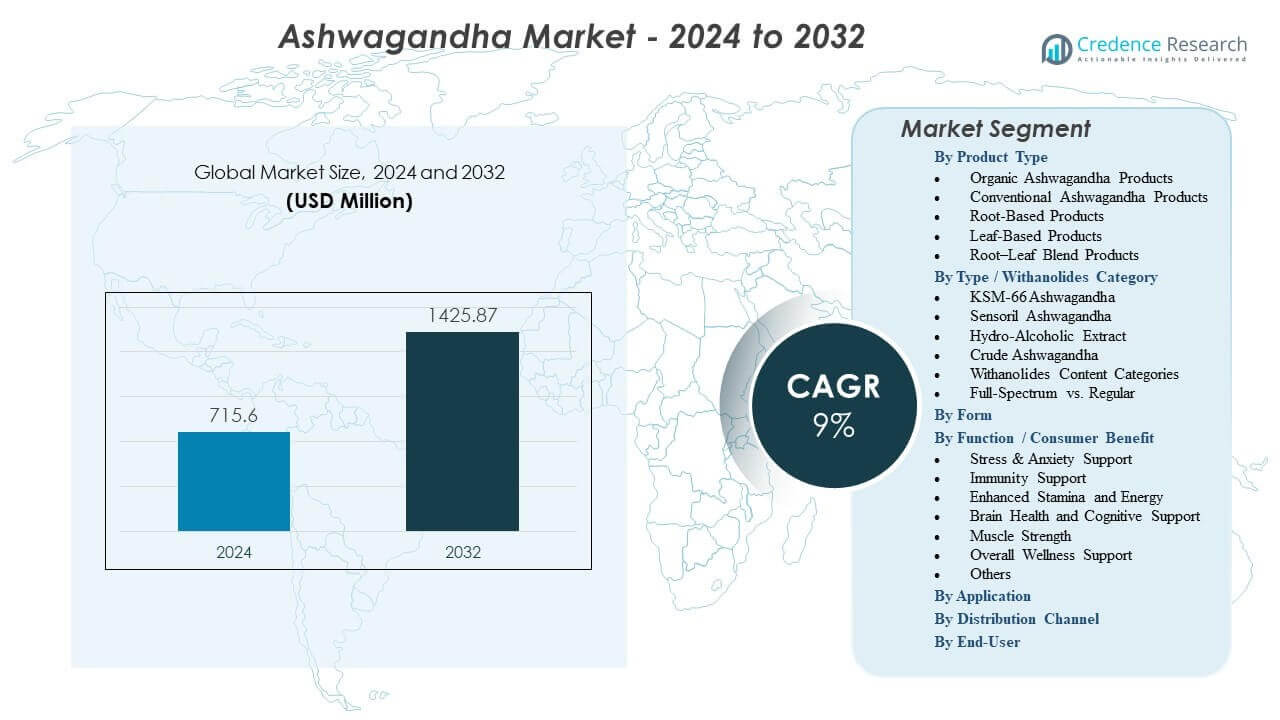
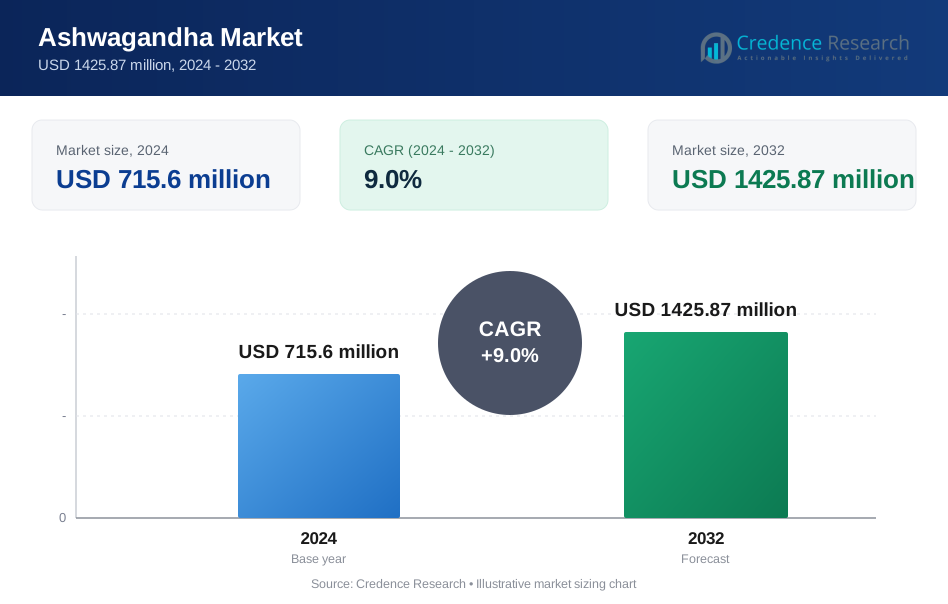
The Ashwagandha Market is projected to grow from USD 715.6 million in 2024 to an estimated USD 1425.87 million by 2032, with a compound annual growth rate (CAGR) of 9.0% from 2024 to 2032.
| REPORT ATTRIBUTE | DETAILS |
|---|---|
| Historical Period | 2020-2023 |
| Base Year | 2024 |
| Forecast Period | 2025-2032 |
| Ashwagandha Market Size 2024 | USD 715.6 million |
| Ashwagandha Market, CAGR | 9.0% |
| Ashwagandha Market Size 2032 | USD 1425.87 million |
Growth drivers include rising focus on preventive wellness, higher acceptance of adaptogenic herbs, and strong consumer trust in plant-based ingredients. Companies invest in organic sourcing, quality certifications, and full-spectrum extraction to support product credibility. Innovation in functional formats encourages broader usage among young adults who want easy, convenient solutions. Fitness communities promote ashwagandha for stamina, recovery, and stress balance, expanding its appeal across active users. E-commerce platforms increase accessibility and influence buying decisions through verified reviews and transparent labeling. This combination of wellness culture, product innovation, and digital reach supports continuous market momentum.
North America leads the Ashwagandha Market due to strong supplement adoption and widespread interest in natural stress-relief solutions. Europe follows with growing demand for clean-label herbal formulations supported by established wellness trends across major countries. Asia Pacific emerges rapidly because India drives supply strength and cultural familiarity with traditional botanicals. Latin America shows consistent adoption as consumers explore plant-based wellness products, while the Middle East and Africa gain traction through expanding retail access. This global spread reflects rising awareness, diversified product offerings, and broader acceptance of adaptogenic herbs across both mature and developing markets.
Ashwagandha Market Insights:
- The Ashwagandha Market is projected to grow from USD 715.6 million in 2024 to USD 1425.87 million by 2032, supported by a 9.0% CAGR during the forecast period.
- Rising demand for natural stress-relief, immunity support, and clean-label herbal products drives steady consumer adoption across wellness-focused groups.
- Limited raw material consistency, varying withanolide levels, and regulatory scrutiny over health claims create restraints for manufacturers and new entrants.
- North America leads due to strong supplement usage patterns, while Europe shows growing interest in clean-label herbal formats supported by wellness-oriented consumer behavior.
- Asia Pacific emerges quickly because of deep traditional use and strong domestic production in India, with Latin America and the Middle East showing rising adoption through expanding retail access.
Ashwagandha Market Drivers
Growing Consumer Focus on Stress Relief and Daily Wellness Support
Demand grows because more people seek natural solutions for stress and fatigue. Interest rises across young adults who want herbal support for work pressure and sleep issues. The Ashwagandha Market benefits from higher trust in traditional plant-based remedies. Brands position ashwagandha as a core adaptogen for routine wellness needs. Product makers highlight mood balance and relaxation benefits to attract new users. Clinical data helps improve credibility among buyers across global markets. Retailers expand visibility through premium placement in health aisles. Consumers respond to simple claims that connect emotional well-being with natural ingredients. Strong messaging supports continuous market adoption.
- For instance, Himalaya Wellness distributes its ashwagandha supplements through more than 100,000 retail outlets worldwide.
Expansion of Product Formats Across Lifestyle and Nutrition Categories
Companies scale product development to meet broad consumer preferences. New formats enter capsules, powders, gummies, beverages, and ready-to-mix blends. The Ashwagandha Market gains traction when brands pair the herb with vitamins and minerals. It helps create multifunction stress-relief solutions for active buyers. Innovation teams test flavors and textures to improve daily consumption. Convenience-focused users choose quick-dissolve forms or on-the-go packets. Retailers report steady demand for clean-label herbal combinations across wellness shelves. Digital brands promote customizable dosage formats for diverse age groups. Format variety improves retention among regular users.
- For instance, Four Sigmatic introduced adaptogenic drink mixes containing ashwagandha and expanded distribution across 20,000+ stores.
Rise of Preventive Health Culture and Stronger Supplement Awareness
Preventive living drives steady interest in daily herbal routines. Users turn toward natural adaptogens for long-term health support. The Ashwagandha Market gains momentum when consumers shift toward self-care habits. It fits well into routines built around immunity, mental clarity, and balanced energy. Governments promote wellness programs that raise herbal supplement visibility. Health practitioners highlight safe dosing guidelines to help first-time users. Fitness communities discuss adaptogens in stress-management and recovery practices. Media coverage shapes strong user awareness about plant-based options. Brands benefit from clear messaging tied to holistic well-being.
Growing Influence of E-Commerce Platforms and Global Digital Marketing
Online retail boosts product reach across major regions. Shoppers compare brands through reviews, certification labels, and potency claims. The Ashwagandha Market expands when digital platforms highlight verified quality badges. It encourages users to try premium or organic-grade versions. Global marketing teams use targeted campaigns to attract health-conscious buyers. Influencers share practical usage routines that increase visibility among young users. Subscription models help maintain continuous product demand. Search tools guide customers toward clinically supported formulations. Digital transparency strengthens trust across new and returning shoppers.
Ashwagandha Market Trends
Rising Demand for Clean-Label Herbal Supplements with Verified Purity Standards
Clean-label interest increases across global wellness consumers. Buyers check ingredient sources to confirm safety and purity. The Ashwagandha Market benefits when suppliers share detailed sourcing and farming practices. It drives consistent adoption among educated supplement buyers. Many brands shift toward organic certification to improve product appeal. Users prefer minimal additive content in herbal formulations. Transparency creates confidence among skeptical first-time shoppers. Clear labeling influences purchase behavior across online channels. Third-party testing becomes a standard expectation across premium products.
Integration of Ashwagandha Into Functional Foods and Beverage Innovations
Food and beverage makers expand botanical inclusion across new categories. Users respond well to juices, lattes, bars, and fortified snacks featuring ashwagandha. The Ashwagandha Market grows when taste profiles improve in ready-to-drink forms. It allows companies to reach buyers who seek wellness benefits without capsules. Functional blends create daily-use habits among busy consumers. Culinary brands test flavor pairings to ensure smooth integration. Retailers support placement in wellness beverage aisles. Cross-category launches help brands gain new visibility. These formats appeal to younger lifestyle-driven consumers.
- For instance, Rebbl’s ashwagandha-infused beverages report strong demand in natural food stores across the U.S.
Growing Role of Scientific Research in Influencing Consumer Perception
Clinical studies shape product confidence across the supplement sector. Researchers explore stress balance, cognitive support, and sleep quality outcomes. The Ashwagandha Market improves its presence when evidence strengthens brand claims. It encourages doctors and nutritionists to reference herbal options. Users trust products supported by quantified results. Scientific communication guides product positioning across premium lines. Media outlets cover new findings that reach global audiences. Retailers highlight clinically supported variants on top shelves. Evidence-based messaging becomes a strong marketing tool.
Increasing Popularity of Personalized Nutrition and Tailored Wellness Solutions
Personalization gains momentum across digital health ecosystems. Apps help users track stress patterns and choose suitable supplement types. The Ashwagandha Market adapts when brands offer dosage options for unique lifestyle needs. It supports flexible consumption styles for active and sedentary users. Companies test customized blends for sleep, focus, or calmness. Platforms use data insights to guide buyers toward targeted formulations. Subscription programs simplify routine management for long-term users. Personalized bundles attract repeat customers across online channels. This trend strengthens tailored wellness adoption.
- For instance, HUM Nutrition formulates targeted blends using standardized ashwagandha for mood and focus support.
Ashwagandha Market Challenges Analysis
Supply Chain Variability and Quality Control Limitations Across Global Markets
Supply challenges appear when farming conditions shift across key producing regions. Variation in root potency impacts consistency in final product strength. The Ashwagandha Market faces hurdles when purity standards differ among suppliers. It creates uncertainty for brands that rely on stable raw material quality. Certification gaps reduce confidence among educated buyers. Testing delays slow production timelines across international markets. Pricing pressure increases when sourcing becomes unpredictable. Retailers demand stronger documentation to assure product integrity. Quality control issues require continuous oversight from manufacturers.
Regulatory Complexity and Rising Scrutiny of Herbal Health Claims
Regulatory barriers emerge when countries tighten rules around supplement messaging. Agencies expect brands to prove the accuracy of wellness claims. The Ashwagandha Market experiences scrutiny when companies overstate benefits. It forces product makers to update formulas and revise labeling. Compliance teams manage strict documentation before market entry. Delays appear when health authorities request more clinical evidence. Users may hesitate when rules create confusion around safe use. Brands respond by investing in clear education and verified testing. Regulation shapes long-term credibility across global regions.
Ashwagandha Market Opportunities
Expansion Into New Lifestyle Categories and Broader Consumer Segments
Brands explore new markets by targeting fitness users, working professionals, and aging populations. Wellness routines expand across urban and rural communities. The Ashwagandha Market gains reach when companies introduce accessible, low-cost product versions. It helps increase adoption in price-sensitive regions. New blends for focus, calmness, and vitality attract diverse buyers. Retailers open shelf space for multipurpose herbal solutions. Companies test gentle formulas for beginners to enter the category. Broader demographic coverage supports long-term category expansion. Growth potential rises across emerging regions.
High Potential in Premium, Organic, and Sustainably Sourced Product Lines
Premium demand rises when users seek potent and clean formulations. Organic-grade herbs attract buyers who prioritize purity and transparent sourcing. The Ashwagandha Market strengthens its appeal when brands invest in sustainable farming. It helps companies differentiate in crowded supplement aisles. Fair-trade models encourage trust among conscious consumers. Eco-focused packaging supports brand identity across digital platforms. Retailers highlight high-quality herbal lines to match rising wellness expectations. Sustainable cultivation practices open new avenues for innovation. Premium positioning improves margins across leading brands.
Ashwagandha Market Segmentation Analysis:
By Product Type
Organic products gain strong traction because buyers link clean-label sourcing with higher trust. Brands highlight chemical-free farming to support premium positioning. The Ashwagandha Market benefits from rising interest in natural wellness routines across young and older users. Conventional variants maintain wide adoption due to lower pricing and easy availability across retail lines. Root-based products dominate demand because they offer higher withanolide concentration favored by supplement makers. Leaf-based extracts gain moderate uptake in blends that target broad wellness needs. Root–leaf mixes support balanced potency levels across functional beverages, powders, and gummies.
By Type / Withanolides Category
KSM-66 drives strong preference because companies promote it for consistent potency and production standards. Sensoril attracts users who want a higher withanolide profile for stress-support formulas. The Ashwagandha Market uses hydro-alcoholic extracts to serve brands that prioritize absorption and stability. Crude ashwagandha supports traditional use cases across general wellness routines. Withanolide-based segmentation helps product makers target different strength requirements across consumer groups. Full-spectrum extracts support natural compound synergy that appeals to holistic health buyers. Regular extracts maintain demand across price-sensitive segments.
By Form
Powder forms attract users who prefer flexible dosing and mixable formats. Capsules and pills remain dominant because they offer convenience, accuracy, and trust for routine use. The Ashwagandha Market sees increased uptake in liquid extracts for faster absorption and on-the-go routines. Gummies and chewables appeal to younger users who want pleasant flavors and simple consumption. Each form aligns with different lifestyle needs across global markets. It helps manufacturers diversify offerings across premium and entry-level ranges. Retailers support wide visibility for all formats across online and physical shelves.
By Function / Consumer Benefit
Stress and anxiety support drives strong consumer interest in adaptogenic products. Immunity support strengthens demand during seasonal health periods and general wellness cycles. The Ashwagandha Market grows when brands highlight stamina and energy benefits across fitness and work-life groups. Brain health gains traction among students and professionals who want focus support. Muscle strength formulations attract athletes who seek natural performance enhancers. Overall wellness blends reach wide audiences across preventive health buyers. Other functions cover sleep balance and lifestyle-driven routines that attract new customers. Each benefit area influences product positioning and user expectations.
By Application
Dietary supplements lead because they offer clear dosing and targeted health outcomes. Food and beverage makers integrate ashwagandha into fortified drinks, chocolates, and functional snacks. The Ashwagandha Market gains strategic depth in pharmaceuticals that explore therapeutic use cases. Sports nutrition brands add performance blends for endurance and muscle recovery. Cosmetics and personal care lines introduce topical products that use antioxidant properties. Other applications expand across wellness teas and natural formulations for daily routines. Each application supports broader category penetration across regional markets. It helps companies address diverse user needs with tailored solutions.
- For instance, NOW Foods produces certified non-GMO ashwagandha capsules distributed in over 70 countries.
By Distribution Channel
B2B bulk supply supports ingredient flow across supplement, beverage, and cosmetics manufacturers. Retail channels maintain steady sales due to strong presence in health stores and supermarkets. The Ashwagandha Market gains momentum through online platforms that offer reviews, certifications, and subscription options. Pharmacies stock standardized formulations to meet regulated health demands. Supermarkets drive impulse purchases through visible placement near wellness products. Specialty stores attract premium buyers who want expert guidance. Each channel influences pricing, visibility, and brand loyalty. It helps producers tailor distribution mixes across regions.
- For instance, Sabinsa supplies standardized ashwagandha extracts to more than 30 international nutraceutical brands.
By End-User
Health-conscious individuals form the largest share because they prioritize daily wellness and natural remedies. Athletes and fitness users seek support for recovery, energy, and muscle tone. The Ashwagandha Market expands when older adults adopt supplements for mobility, cognitive support, and vitality. Commercial buyers include food makers, supplement brands, and pharma processors that require bulk ingredients. Each user group shapes product formulation and marketing direction. It guides companies toward targeted benefits and diversified product lines. Strong adoption across these groups supports stable market growth.
Segmentation:
By Product Type
- Organic Ashwagandha Products
- Conventional Ashwagandha Products
- Root-Based Products
- Leaf-Based Products
- Root–Leaf Blend Products
By Type / Withanolides Category
- KSM-66 Ashwagandha
- Sensoril Ashwagandha
- Hydro-Alcoholic Extract
- Crude Ashwagandha
- Withanolides Content Categories (e.g., 1%, 2%, 2.5%, 5%, 10%, Others)
- Full-Spectrum vs. Regular
By Form
- Powder
- Capsules and Pills
- Liquid Extracts
- Gummies and Chewables
By Function / Consumer Benefit
- Stress & Anxiety Support
- Immunity Support
- Enhanced Stamina and Energy
- Brain Health and Cognitive Support
- Muscle Strength
- Overall Wellness Support
- Others
By Application
- Dietary Supplements
- Food and Beverages
- Pharmaceuticals
- Sports Nutrition
- Cosmetics and Personal Care
- Other Applications
By Distribution Channel
- B2B (Bulk)
- B2C (Retail)
- Online Retail Platforms
- Pharmacies
- Supermarkets
- Specialty Health and Wellness Stores
By End-User
- Health-Conscious Individuals
- Athletes and Fitness Enthusiasts
- Older Adults
- Commercial Buyers
By Region
- North America
- U.S.
- Canada
- Mexico
- Europe
- Germany
- France
- U.K.
- Italy
- Spain
- Rest of Europe
- Asia Pacific
- China
- Japan
- India
- South Korea
- South-east Asia
- Rest of Asia Pacific
- Latin America
- Brazil
- Argentina
- Rest of Latin America
- Middle East & Africa
- GCC Countries
- South Africa
- Rest of the Middle East and Africa
Regional Analysis:
North America holds around 35% share of the Ashwagandha Market due to strong supplement adoption and high interest in natural stress-support products. Consumers rely on standardized extracts with verified potency, which strengthens premium sales. Retailers expand shelf space for botanical supplements across pharmacies and grocery chains. Online channels drive rapid penetration among younger users who want clean-label formats. The Ashwagandha Market grows in this region through strong product innovation and transparent sourcing practices. It benefits from high awareness of adaptogenic ingredients.
Europe captures nearly 25% share and shows sustained growth driven by clean-label preferences and wider acceptance of plant-based wellness products. Buyers seek organic and full-spectrum extracts to meet quality and safety expectations. Regulatory clarity supports stable category expansion across major countries. Brands gain traction through formulations that target stress management and cognitive wellness. The Ashwagandha Market strengthens in Europe due to rising demand for functional nutrition. It attracts both traditional supplement users and new lifestyle-focused consumers.
Asia Pacific accounts for around 30% share, driven by deep cultural familiarity with herbal remedies and expanding nutraceutical use. India leads consumption due to strong domestic production and high trust in traditional practices. China and Southeast Asia show rising interest in adaptogenic herbs linked to mental wellness and immunity. Latin America holds roughly 6%, supported by growing preventive health awareness. The Middle East and Africa represent nearly 4%, with steady interest in herbal formulations. The Ashwagandha Market gains long-term potential across these emerging regions, and it benefits from rising investments in distribution and brand visibility.
Key Player Analysis:
- Dabur Ltd.
- Emami Ltd.
- Gaia Herbs
- Himalaya Wellness Company
- KSM-66 Ashwagandha (Ixoreal Biomed)
- Natreon Inc. (Sensoril)
- Organic India
- Patanjali Ayurved
- Arjuna Natural Pvt Ltd (Shoden)
- Sabinsa Corporation
- Nature’s Way
- NOW Foods
Competitive Analysis:
Key companies operate in a highly fragmented environment where ingredient suppliers, herbal product brands, and nutraceutical manufacturers compete for quality leadership. The Ashwagandha Market includes firms that differentiate through standardized extracts, clinical validation, and diversified applications. It pushes companies to invest in higher withanolide concentrations, sustainable sourcing, and traceability programs to gain consumer trust. Leading suppliers such as Ixoreal Biomed, Natreon, and Arjuna Natural influence global demand through proprietary extracts with strong research backing. Consumer-focused brands expand portfolios across powders, capsules, and gummies to reach broader audiences. Pricing pressure shapes competition between premium organic producers and mass-market retail brands. Digital visibility supports rapid brand scaling across regions, and companies use certifications and third-party testing to strengthen credibility.
Recent Developments:
- In November 2025, Dabur India launched Dabur Ventures, an investment platform allocating up to INR 5 billion (US$56 million) for stakes in health, Ayurveda, and wellness food businesses, aligning with premiumization and digital transformation strategies in the sector.
- In November 2025, Gaia Herbs announced a partnership with Floradix, rooted in herbal tradition to enhance product offerings and consumer access in the wellness market.
- In May 2025, Natural Remedies launched Ashwa.30, a next-generation ashwagandha extract standardized to 15% withanolides for stress relief, energy boost, and endurance enhancement with a low 30 mg daily dose.
Report Coverage:
The research report offers an in-depth analysis based on Product Type, Type / Withanolides Category, Form, Function / Consumer Benefit, Application, Distribution Channel, End-User and Region. It details leading market players, providing an overview of their business, product offerings, investments, revenue streams, and key applications. Additionally, the report includes insights into the competitive environment, SWOT analysis, current market trends, as well as the primary drivers and constraints. Furthermore, it discusses various factors that have driven market expansion in recent years. The report also explores market dynamics, regulatory scenarios, and technological advancements that are shaping the industry. It assesses the impact of external factors and global economic changes on market growth. Lastly, it provides strategic recommendations for new entrants and established companies to navigate the complexities of the market.
Future Outlook:
- Demand strengthens due to rising interest in natural stress-support and daily wellness routines.
- Product innovation expands into functional beverages, gummies, and high-potency extract blends.
- Brands invest in transparent sourcing and clean-label standards to build wider consumer trust.
- Online channels support rapid market penetration through subscription models and targeted outreach.
- Clinical research improves credibility for cognitive, immunity, and stamina-support claims.
- Premium full-spectrum extracts gain traction among wellness-focused users seeking higher purity.
- Adoption rises in sports nutrition through performance, recovery, and vitality formulations.
- Food and beverage companies test new formats that integrate adaptogenic benefits into daily diets.
- Global suppliers improve withanolide standardization to meet evolving regulatory expectations.
- Emerging markets adopt botanical supplements faster due to stronger preventive health awareness.
Request a Free Sample
Fill in your details and we'll send you a free sample report.
- Sample data tables & charts
- Research methodology
Need a Custom Version of This Report?
Tailor the scope, geography, or segments to your exact requirements.
- Custom geography or segment scope
- Direct access to our analyst team
Frequently Asked Questions
What is the current market size for the Ashwagandha Market, and what is its projected size in 2032?
At what Compound Annual Growth Rate is the Ashwagandha Market projected to grow between 2024 and 2032?
Which Ashwagandha Market segment held the largest share in 2024?
What are the primary factors fueling the growth of the Ashwagandha Market?
Who are the leading companies in the Ashwagandha Market?
Which region commanded the largest share of the Ashwagandha Market in 2024?
Table of Content
Chapter 1. Report Introduction
- 1.1 Report Description & Purpose
- 1.1.1 Report Title & Market Definition
- 1.1.2 Unique Selling Propositions (USP) & Key Differentiators
- 1.1.3 Value Proposition for Stakeholders
- 1.2 Research Objectives
- 1.2.1 Market Sizing Objectives (Volume & Revenue)
- 1.2.2 Segmentation Objectives
- 1.2.3 Competitive Intelligence Objectives
- 1.2.4 Forecast & Scenario Objectives
- 1.3 Report Scope
- 1.3.1 Ashwagandha Scope – Types & Subtypes Covered
- 1.3.2 Geographic Scope – Regions & Countries Covered
- 1.3.3 Historical Period, Base Year & Forecast Period (2024; forecast to 2032)
- 1.3.4 Inclusions & Exclusions
- 1.4 HS Code & Classification Framework
- 1.5 Currency, Units & Pricing Basis
- 1.6 Target Stakeholders
- 1.7 Limitations & Assumptions
Chapter 2. Executive Summary
- 2.1 Global Ashwagandha Market Snapshot
- 2.1.1 Market Size – Historical (2024) & Forecast (2024-2032) (2024: USD 715.6 million → 2032: USD 1425.87 million)
- 2.1.2 Volume & Revenue – Global Totals
- 2.1.3 Key Market Highlights – Top Five Facts
- 2.2 Ashwagandha Market Segmentation Snapshot
- 2.2.1 Market Split by Region – 2024 vs. 2032
- 2.3 Competitive Snapshot
- 2.3.1 Top 10 Players by Revenue Share – 2024
- 2.3.2 Top 10 Players by Volume Share – 2024
- 2.3.3 Recent Strategic Developments (18-Month Summary)
- 2.4 Key Investment Highlights & Strategic Conclusions
Chapter 3. Ashwagandha Market Dynamics & Industry Analysis
- 3.1 Market Overview & Context
- 3.1.1 Ashwagandha Market Position in the Broader Automotive Value Chain
- 3.1.2 OEM vs. Replacement Market Dynamics
- 3.1.3 Market Maturity & Development Stage by Region
- 3.2 Ashwagandha Market Drivers
- 3.3 Ashwagandha Market Restraints & Challenges
- 3.4 Ashwagandha Market Opportunities
- 3.5 Porter's Five Forces Analysis
- 3.5.1 Threat of New Entrants
- 3.5.2 Bargaining Power of Suppliers
- 3.5.3 Bargaining Power of Buyers
- 3.5.4 Threat of Substitutes
- 3.5.5 Competitive Rivalry – Intensity Assessment
- 3.6 Ashwagandha Value Chain Analysis
- 3.6.1 Upstream – Raw Material/Input Suppliers
- 3.6.1.1 Raw Material/Input 1
- 3.6.1.2 Raw Material/Input 2
- 3.6.1.3 Raw Material/Input 3
- 3.6.2 Midstream – Production/Manufacturing/Service Delivery
- 3.6.2.1 Production/Process Overview
- 3.6.2.2 Key Facility Locations & Capacity by Manufacturer
- 3.6.3 Downstream – Distribution & End Consumer
- 3.6.3.1 Primary Channel – B2B/OEM
- 3.6.3.2 Secondary Channels – Dealer, Retail, Online, Direct
- 3.6.4 Value Chain Profitability Analysis
- 3.6.1 Upstream – Raw Material/Input Suppliers
- 3.7 PESTEL Analysis
- 3.7.1 Political Factors
- 3.7.2 Economic Factors
- 3.7.3 Social Factors
- 3.7.4 Technological Factors
- 3.7.5 Environmental Factors
- 3.7.6 Legal Factors
- 3.8 Ashwagandha Supply Chain Analysis
- 3.8.1 Raw Material/Input Supply Risk Assessment
- 3.8.2 Manufacturing Concentration Risk (Geographic Exposure)
- 3.8.3 Trade Disruption Impact Analysis
- 3.9 Regulatory & Policy Landscape
Note: The regulatory and policy landscape section covers regulations based on their applicability to the market, Ashwagandha category, geography, and scope of the study. Only regulatory frameworks with a material impact on operations, compliance, trade, sustainability, or market access are analyzed in detail.
Chapter 4. Key Investment Pockets & Opportunity Analysis
- 4.1 Ashwagandha Market Attractiveness Analysis
- 4.1.1 By Region – Investment Attractiveness Matrix (Volume × CAGR)
- 4.2 Absolute Revenue Growth Opportunity
- 4.2.1 By Region – Absolute USD Growth Through 2032
- 4.3 Incremental Volume Opportunity
- 4.3.1 By Region – Incremental Volume Through 2032
- 4.3.2 Segment – Incremental Volume
- 4.4 Emerging Submarket Opportunity Deep Dive (Subject to Applicability)
- 4.5 Emerging Market Opportunity Scorecards
- 4.5.1 United States
- 4.5.2 Europe
- 4.5.3 Asia
- 4.5.4 Middle East & Africa
Note: Emerging Market Opportunity Scorecards will be included based on relevance and strategic importance. Regions listed are indicative and may vary depending on data availability and market dynamics.
Chapter 5. Ashwagandha Import-Export Analysis & Trade Flows
- 5.1 Global Trade Overview
- 5.1.1 Global Export Value by Country (2024)
- 5.1.2 Global Export Volume by Country (2024)
- 5.1.3 Global Import Value by Country (2024)
- 5.1.4 Global Import Volume by Country (2024)
- 5.1.5 Net Trade Balance by Country (2024)
- 5.2 Export Analysis – Segment
- 5.2.1 Type 1 (HS Code)
- 5.2.2 Type 2 (HS Code)
- 5.2.3 Type 3 (HS Code)
- 5.2.4 Type 4 (HS Code)
- 5.2.5 Type 5 (HS Code)
- 5.3 Import Analysis – Segment
- 5.3.1 Type 1 (HS Code)
- 5.3.2 Type 2 (HS Code)
- 5.3.3 Type 3 (HS Code)
- 5.3.4 Type 4 (HS Code)
- 5.3.5 Type 5 (HS Code)
- 5.4 Average Unit Trade Prices
- 5.4.1 Average Export Price – Segment & Country
- 5.4.2 Average Import Price – Segment & Source Country
- 5.4.3 Price Trends (2024)
- 5.5 Key Trade Route Analysis
- 5.5.1 Trade Route 1
- 5.5.2 Trade Route 2
- 5.5.3 Trade Route 3
- 5.5.4 Trade Route 4
- 5.5.5 Trade Route 5
- 5.6 Trade Policy Impact Assessment
- 5.6.1 US Anti-Dumping & Section 301 Tariffs
- 5.6.2 EU Customs Union Impact
- 5.6.3 Major Free Trade Agreements
- 5.6.4 USMCA Rules of Origin
Note: Trade policy analysis will be included only where relevant to the Ashwagandha market.
Chapter 6. Competitive Landscape & Company Benchmarking
- 6.1 Ashwagandha Market Concentration & Structure
- 6.1.1 Herfindahl-Hirschman Index (HHI) – vs. 2024
- 6.1.2 Tier 1, Tier 2 & Tier 3 Market Structure
- 6.1.3 Global, Regional & Local Player Dynamics
- 6.2 Ashwagandha Market Share Analysis – 2024
- 6.2.1 Global Revenue Share by Company
- 6.2.2 Global Volume Share by Company
- 6.2.3 Regional Revenue Share
- 6.2.4 Market Share Evolution ( vs. 2024)
- 6.2.5 OEM Segment Share by Company
- 6.2.6 Replacement Segment Share by Company
- 6.3 Production/Delivery Capacity & Facility Analysis
- 6.3.1 Global Installed Capacity
- 6.3.2 Capacity Utilization Rates
- 6.3.3 Production/Output Volume
- 6.3.4 Facility Locations & Capacity Map
- 6.3.5 Planned Capacity Additions
- 6.4 Ashwagandha Competitive Benchmarking Matrix
- 6.4.1 Revenue, Volume, CAGR & Profitability Comparison
- 6.4.2 Channel Revenue Mix
- 6.4.3 Geographic Revenue Exposure
- 6.4.4 R&D Intensity
- 6.4.5 Sustainability Maturity
- 6.5 Strategic Developments in Ashwagandha (Last 24 Months)
- 6.5.1 Mergers, Acquisitions & Divestments
- 6.5.2 New Ashwagandha Launches
- 6.5.3 Facility Expansions
- 6.5.4 Strategic Alliances, Joint Ventures & Partnerships
- 6.5.5 Distribution Expansion & Market Entry
- 6.5.6 Sustainability & ESG Initiatives
- 6.6 Competitive Strategy Mapping
- 6.6.1 Leader, Challenger, Follower & Niche Classification
- 6.6.2 Pricing Strategy Comparison
- 6.6.3 Channel Strategy Matrix
Note: Strategic developments are included based on their materiality and the availability of reliable information.
Chapter 7. Global Ashwagandha Market – By Distribution Channel
- 7.1 Segment Overview
- 7.1.1 Volume & Revenue Split by Channel (2024 & 2032)
- 7.1.2 Channel Mix Evolution (2024-2032)
Chapter 8. Regional Market Analysis – Global Overview
- 8.1 Global Regional Overview
- 8.1.1 Regional Volume Share
- 8.1.2 Regional Revenue Share
- 8.1.3 Regional Volume by Region
- 8.1.4 Regional Revenue by Region
- 8.1.5 Regional Forecast Through 2032
- 8.2 Cross-Regional Segment Analysis
- 8.2.1 By Distribution Channel
- 8.2.2 By Brand/Price Tier
Chapter 9. North America Ashwagandha Market
- 9.1 United States
- 9.2 Canada
- 9.3 Mexico
Chapter 10. Europe Ashwagandha Market
- 10.1 Germany
- 10.2 France
- 10.3 Italy
- 10.4 United Kingdom
- 10.5 Spain
- 10.6 Poland
- 10.7 Russia
- 10.8 Netherlands
- 10.9 Belgium
- 10.10 Sweden
- 10.11 Denmark
- 10.12 Norway
- 10.13 Rest of Europe
Chapter 11. Asia Pacific Ashwagandha Market
- 11.1 China
- 11.2 India
- 11.3 Japan
- 11.4 South Korea
- 11.5 Thailand
- 11.6 Indonesia
- 11.7 Vietnam
- 11.8 Malaysia
- 11.9 Australia
- 11.10 Rest of Asia Pacific
Chapter 12. Latin America Ashwagandha Market
- 12.1 Brazil
- 12.2 Argentina
- 12.3 Colombia
- 12.4 Chile
- 12.5 Rest of Latin America
Chapter 13. Middle East Ashwagandha Market
- 13.1 Saudi Arabia
- 13.2 United Arab Emirates
- 13.3 Turkey
- 13.4 Israel
- 13.5 Iran
- 13.6 Rest of the Middle East
Chapter 14. Africa Ashwagandha Market
- 14.1 South Africa
- 14.2 Egypt
- 14.3 Nigeria
- 14.4 Morocco
- 14.5 Rest of Africa
Chapter 15. Ashwagandha Company Profiles
- 15.1 [Company 01]
- 15.1.1 Company Overview
- 15.1.2 Key Management Personnel
- 15.1.3 Products & Services Portfolio
- 15.1.4 Financial Performance
- 15.1.5 Key Market Focus & Geographic Presence
- 15.1.6 Recent Developments & Strategic Initiatives
Note: The company profile list is preliminary and may change based on research findings, market developments, data availability, and client requirements.
Chapter 16. Appendices
- Appendix A – List of Abbreviations & Acronyms
- Appendix B – Industry Classification Code Reference – Full Series
- Appendix C – Production & Capacity Data Tables
- Appendix D – End-Use & Demand Base Tables
- Appendix E – Consumption & Replacement Rate Assumptions
- Appendix F – ASP Reference Tables
- Appendix G – Manufacturing & Facility Database
- Appendix H – Import-Export Data Tables
- Appendix I – Regulatory Summary Tables
- Appendix J – Primary Research Participant List (Anonymized)
- Appendix K – Primary Research Questionnaire Framework
- Appendix L – Data Sources & Bibliography
- Appendix M – Market Size Divergence & Source Comparison
Chapter 17. Research Methodology
- 17.1 Research Framework & Philosophy
- 17.2 Secondary Research – Sources, Hierarchy & Data Extraction
- 17.3 Data Modeling – Bottom-Up & Top-Down Market Sizing
- 17.4 Primary Research – Stakeholder Framework, LOI & Sample Sizes
- 17.5 Forecast Methodology – Regression, Scenario & Sensitivity Analysis
- 17.6 Quality Control – Four-Layer Validation Framework
- 17.7 Limitations & Standard Assumptions
- 17.8 Disclaimer
