Market Overview
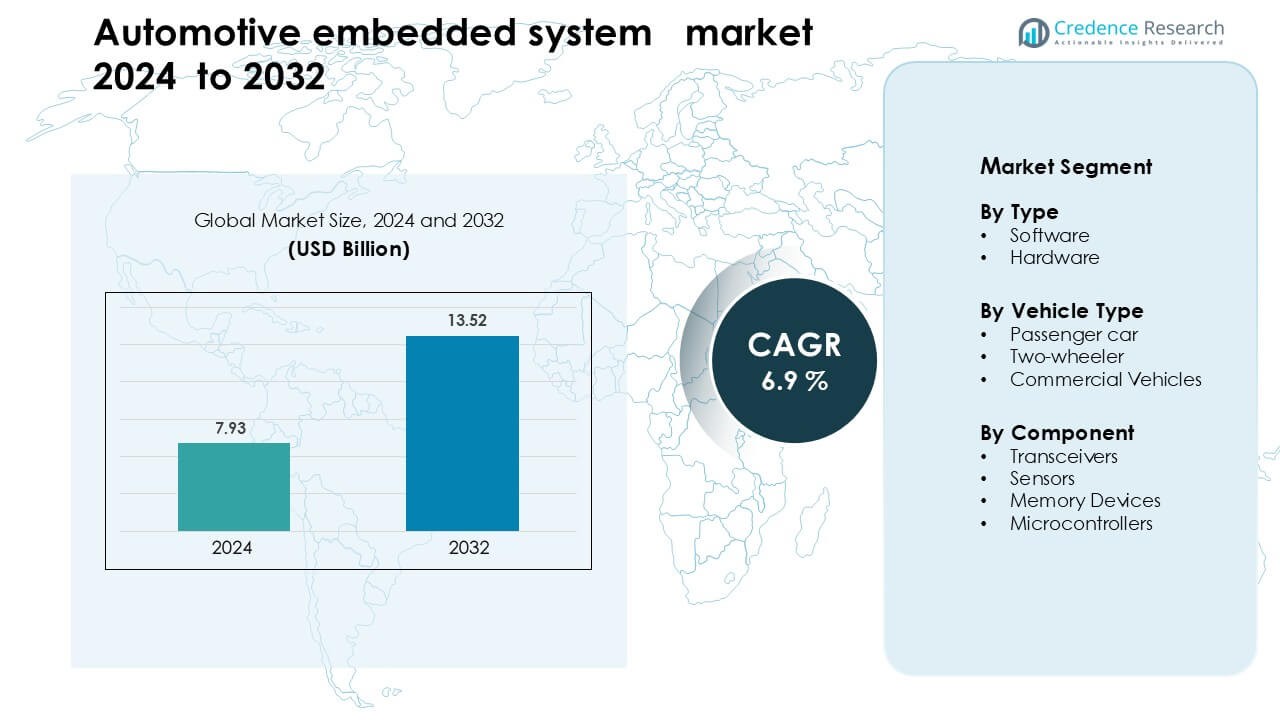
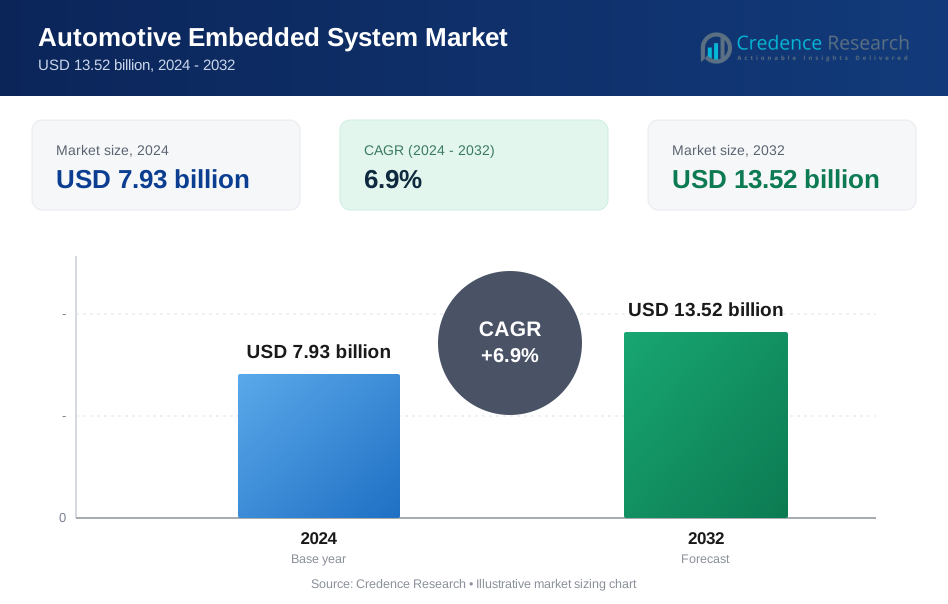
Automotive embedded system market was valued at USD 7.93 billion in 2024 and is anticipated to reach USD 13.52 billion by 2032, growing at a CAGR of 6.9% during the forecast period.
| REPORT ATTRIBUTE | DETAILS |
|---|---|
| Historical Period | 2020-2023 |
| Base Year | 2024 |
| Forecast Period | 2025-2032 |
| Automotive Embedded System Market Size 2024 | USD 7.93 Billion |
| Automotive Embedded System Market, CAGR | 6.9% |
| Automotive Embedded System Market Size 2032 | USD 13.52 Billion |
The automotive embedded system market is driven by major players including Texas Instruments, Harman International, Denso, Hella KGaA Hueck & Co., Infineon Technologies, Toshiba, Magna International, Mitsubishi Electric, Continental AG, and Valeo. These companies lead through strong portfolios in microcontrollers, sensors, power electronics, and software-defined vehicle platforms. They support advanced safety systems, electrification, and connected vehicle architectures, which increase embedded content across all vehicle classes. Asia Pacific remained the leading region in 2024 with about 38% share, supported by high vehicle production, strong semiconductor capacity, and rapid EV adoption in China, Japan, and South Korea.
Market Insights
- Automotive embedded system market was valued at USD 7.93 billion in 2024 and is anticipated to reach USD 13.52 billion by 2032, growing at a CAGR of 6.9 % during the forecast period
- Rising demand for ADAS, electrification, and vehicle connectivity is fueling growth; sensors and software combine to account for the largest components by share.
- The embedded software segment held over 70% share by type and the sensors segment led by component share, reflecting shifts toward real-time data processing and safety systems.
- Key restraints include rising system complexity and cybersecurity challenges, which drive higher integration cost and slower development cycles.
- Asia Pacific leads the market with about 38% share in 2024, driven by strong vehicle production and EV uptake; Europe and North America follow.
Market Segmentation Analysis:
By Type
Software dominated the automotive embedded system market in 2024 with about 58% share. Automakers relied on software to manage ADAS, infotainment, battery systems, and powertrain controls. Demand grew as vehicles used complex algorithms for safety, navigation, and energy management. Over-the-air updates also pushed adoption because manufacturers reduced workshop visits and improved system reliability. Hardware gained steady growth due to rising electronic control units and semiconductor content, but software stayed ahead thanks to higher integration in connected and autonomous vehicles.
- For instance, BlackBerry’s QNX software is embedded in over 255 million vehicles worldwide, powering critical systems such as digital cockpits, ADAS, and hypervisors.
By Vehicle Type
Passenger cars led the market in 2024 with nearly 64% share. Buyers increased adoption of embedded features such as advanced safety, digital dashboards, and smart connectivity. Carmakers integrated more sensors, controllers, and software functions to meet regulatory standards and improve user comfort. Two-wheelers showed strong movement in regions with rising electric bikes, while commercial vehicles adopted embedded systems to improve fleet efficiency. Passenger cars remained dominant due to higher feature density and faster adoption of intelligent driving functions.
- For instance, Horizon Robotics’ Journey 6 chip designed for ADAS in passenger cars has secured orders and strategic partnerships with major Tier 1 suppliers, including Bosch and Denso. While the initial mass production with Bosch for a new multi-purpose camera is scheduled for mid-2026, the Journey 6E/M platforms are powering Bosch's mid-segment ADAS family, with the first production model set to launch in June 2025.
By Component
Microcontrollers held the largest share in 2024 with around 37% of the component segment. Automotive brands used microcontrollers to operate engine control units, battery systems, braking modules, and infotainment networks. These chips offered reliable performance, low power use, and strong safety features, making them essential for vehicle electronics. Sensors grew quickly due to rising ADAS installations, while memory devices expanded with higher data storage needs. Transceivers gained traction in connected cars, yet microcontrollers remained central due to broad use across all embedded architectures.
Key Growth Drivers
Growing Demand for Advanced Safety and ADAS Features
The automotive embedded system market grows rapidly due to rising adoption of advanced driver-assistance systems. Carmakers add lane-assist, adaptive cruise control, collision warnings, and automated braking to meet global safety rules. Each safety function needs sensors, software, controllers, and real-time data processing, which boosts demand for embedded platforms. Governments also push stricter crash-avoidance standards, increasing the use of electronic control units in mass-market vehicles. Buyers expect more intelligent safety features even in entry models, which encourages manufacturers to integrate advanced embedded electronics across all price segments. This shift strengthens long-term growth as vehicles become more automated and connected.
- For instance, Mobileye has shipped over 200 million EyeQ SoCs to date, powering ADAS functions like emergency braking and lane keeping across hundreds of car models.
Rapid Shift Toward Electrification
Electric vehicles accelerate the need for embedded systems because battery monitoring, charging control, thermal balancing, and power management all depend on integrated electronics. EV makers use microcontrollers, advanced software, and high-accuracy sensors to manage battery health and optimize range. The rise of fast-charging networks also increases demand for embedded solutions that support safe, efficient energy transfer. Automakers develop specialized control units for inverters, motors, and regenerative braking, which pushes embedded content per vehicle much higher than in conventional models. As EV adoption expands worldwide, embedded platforms become essential for safety, efficiency, and performance across all electric segments.
- For instance, Infineon’s AURIX TC4x microcontroller (with its built-in Parallel Processing Unit) is used by Eatron, enabling real-time AI-based battery diagnostics and remaining useful life (RUL) prediction for 400-V and 800-V EV packs.
Growth of Connected and Software-Defined Vehicles
Connected vehicles rely on embedded systems to support real-time communication, telematics, diagnostics, and remote updates. Automakers shift toward software-defined designs that use centralized computing and flexible architectures. This shift increases reliance on embedded processors, sensors, and communication modules that manage continuous data flow. Over-the-air updates reduce maintenance costs and improve system performance, leading to higher customer satisfaction. Carmakers also use cloud-linked embedded systems to introduce new digital services, enabling revenue from subscriptions and in-car apps. Rising demand for seamless connectivity across infotainment, safety, and predictive maintenance continues to strengthen this driver.
Key Trend and Opportunity
Adoption of Centralized Computing Architectures
Automotive brands move away from distributed ECUs toward centralized, high-performance computing units. This trend reduces vehicle wiring, improves processing speed, and supports advanced functions such as autonomous driving and real-time decision-making. Centralized architectures allow manufacturers to simplify software development and push faster updates across multiple vehicle domains. The shift also enables scalable platforms that support a wide range of models with shared hardware blocks. As vehicles gain more intelligence, centralized computing becomes a foundational element for future designs, improving efficiency and lowering long-term integration costs.
- For instance, General Motors announced a new centralized compute platform (for both EVs and ICE vehicles) that consolidates dozens of ECUs into a unified computing core using a liquid-cooled unit powered by NVIDIA processors.
Rising Use of AI and Edge Processing
Embedded systems increasingly integrate AI capabilities to support image recognition, predictive maintenance, and driver-monitoring functions. Edge processing helps vehicles analyze data locally with low latency, which enhances safety and response time. This shift creates opportunities for semiconductor suppliers, as demand grows for AI-optimized chips and high-speed memory. Automakers invest in embedded architectures capable of running neural networks directly inside the vehicle, reducing reliance on cloud processing. As autonomous and semi-autonomous functions expand, AI-enabled embedded systems will unlock new commercial possibilities across mobility, logistics, and premium passenger vehicles.
- For instance, Li Auto uses two NVIDIA DRIVE Orin processors in its AD Max system, combining for 508 trillion operations per second (TOPS) of AI compute to power real-time sensor fusion and driving intelligence.
Key Challenge
Cybersecurity Risks in Connected Vehicles
Connected cars face rising cyber threats as more components communicate over networks. Embedded systems must protect millions of data exchanges each second, including navigation, safety, and vehicle-to-cloud communication. Weak security can expose vehicles to hacking or unauthorized control, pushing automakers to invest heavily in encryption, intrusion detection, and secure software layers. Meeting these requirements increases development cost and slows deployment cycles. Ensuring long-term protection across the entire vehicle lifespan remains a major hurdle for manufacturers and suppliers.
Growing Complexity and Integration Costs
Modern vehicles use hundreds of embedded components, making integration difficult and expensive. Developing software that coordinates sensors, processors, memory units, and communication modules demands high technical expertise. The complexity increases validation timelines and raises production costs for automakers. Supply-chain issues in semiconductors also create fluctuations in component availability. Managing this complexity while ensuring high performance, low power use, and compliance with safety standards remains a significant challenge for the industry.
Regional Analysis
North America
North America held about 34% share of the automotive embedded system market in 2024. The region benefited from strong adoption of ADAS, telematics, and connected vehicle platforms across premium and mid-range models. Automakers used advanced controllers and sensor-based systems to meet strict safety rules set by NHTSA and Transport Canada. Rising production of electric vehicles strengthened demand for battery-management electronics and high-performance computing units. Technology suppliers in the U.S. also pushed innovation in software-defined vehicle platforms. This steady shift toward intelligent mobility kept North America a leading market with high embedded content per vehicle.
Europe
Europe accounted for nearly 28% share of the automotive embedded system market in 2024. Strict EU emission policies and strong focus on vehicle safety promoted higher use of sensors, microcontrollers, and software-driven systems. Germany, France, and the U.K. supported embedded growth through strong automotive manufacturing bases and rapid electrification. Carmakers added advanced powertrain controls, ADAS modules, and connectivity platforms to meet regulatory benchmarks. The region’s push toward autonomous mobility and centralized computing also accelerated embedded adoption. Europe’s strong R&D ecosystem ensured continuous innovation, supporting stable market expansion.
Asia Pacific
Asia Pacific led the global market with around 38% share in 2024. China, Japan, and South Korea expanded production of electric and hybrid vehicles, which rely heavily on embedded controllers and battery electronics. High vehicle output and strong semiconductor manufacturing capabilities supported faster integration of advanced systems. Carmakers deployed telematics, infotainment, and ADAS features across mass-market models to meet rising consumer expectations. Government incentives for EV adoption further boosted demand for embedded platforms. Asia Pacific’s cost-efficient manufacturing and rapid technology adoption kept the region the fastest-growing market.
Latin America
Latin America held about 6% share in 2024. The region saw gradual adoption of embedded systems as automakers added more safety and connectivity features in new models. Demand grew in Brazil and Mexico due to higher production volumes and improving regulatory standards. Embedded controllers supported emissions compliance and enhanced braking and stability systems. Growth remained moderate because of economic constraints, but rising interest in digital dashboards and basic ADAS functions helped expand market penetration. Increasing investments by global OEMs continued to support long-term opportunities in the region.
Middle East & Africa
Middle East & Africa captured nearly 4% share of the market in 2024. Adoption rose as governments pushed advanced safety norms and fuel-efficiency standards in key countries such as the UAE, Saudi Arabia, and South Africa. The market expanded with rising imports of premium vehicles that offered ADAS, telematics, and infotainment systems. Local assembly growth in North Africa also supported embedded component demand. However, limited EV infrastructure and lower purchasing power slowed wider adoption. Increasing connectivity requirements and gradual modernization of vehicle fleets are expected to strengthen future growth in the region.
Market Segmentations:
By Type
- Software
- Hardware
By Vehicle Type
- Passenger car
- Two-wheeler
- Commercial Vehicles
By Component
- Transceivers
- Sensors
- Memory Devices
- Microcontrollers
By Geography
- North America
- U.S.
- Canada
- Mexico
- Europe
- Germany
- France
- U.K.
- Italy
- Spain
- Rest of Europe
- Asia Pacific
- China
- Japan
- India
- South Korea
- South-east Asia
- Rest of Asia Pacific
- Latin America
- Brazil
- Argentina
- Rest of Latin America
- Middle East & Africa
- GCC Countries
- South Africa
- Rest of the Middle East and Africa
Competitive Landscape
The competitive landscape of the automotive embedded system market is shaped by leading companies such as Texas Instruments, Harman International, Denso, Hella KGaA Hueck & Co., Infineon Technologies, Toshiba, Magna International, Mitsubishi Electric, Continental AG, and Valeo. These firms strengthen their positions by expanding semiconductor production, advancing software-defined vehicle platforms, and developing high-performance controllers for ADAS, powertrain, and connectivity functions. Suppliers invest in AI-enabled chips, sensor fusion systems, and centralized computing architectures to support autonomous driving and electrification. Strategic partnerships with automakers help accelerate integration of telematics, infotainment, and battery-management technologies. Continuous R&D in microcontrollers, sensors, memory devices, and communication modules enables companies to increase system reliability and reduce latency in real-time vehicle operations. As vehicles become more connected and software-driven, competition intensifies around cybersecurity, edge processing capability, and scalable embedded architectures.
Key Player Analysis
- Texas Instruments
- Harman International
- Denso
- Hella KGaA Hueck & Co.
- Infineon Technologies
- Toshiba
- Magna International
- Mitsubishi Electric
- Continental AG
- Valeo
Recent Developments
- In December 2024, Harman Automotive launched Ready CQuence Loop and Ready Link Marketplace for software-defined vehicles. The tools virtualize development and distribution of in-vehicle software, accelerating embedded feature deployment.
- In 2024, Texas Instruments introduced new C2000 microcontrollers with edge AI for automotive real-time control. These microcontrollers target safety-critical embedded applications and support ASIL D functional safety levels.
Report Coverage
The research report offers an in-depth analysis based on Type, Vehicle Type, Component and Geography. It details leading market players, providing an overview of their business, product offerings, investments, revenue streams, and key applications. Additionally, the report includes insights into the competitive environment, SWOT analysis, current market trends, as well as the primary drivers and constraints. Furthermore, it discusses various factors that have driven market expansion in recent years. The report also explores market dynamics, regulatory scenarios, and technological advancements that are shaping the industry. It assesses the impact of external factors and global economic changes on market growth. Lastly, it provides strategic recommendations for new entrants and established companies to navigate the complexities of the market.
Future Outlook
- Embedded systems will gain higher adoption as vehicles move toward software-defined architectures.
- Automakers will integrate more centralized computing units to support advanced automation.
- ADAS and autonomous driving will push strong demand for high-accuracy sensors and controllers.
- Electric vehicle growth will expand the need for advanced battery-management electronics.
- Over-the-air updates will become standard across most new passenger and commercial models.
- AI-enabled embedded platforms will strengthen real-time decision-making inside vehicles.
- Cybersecurity solutions will expand as connected vehicle risks continue to rise.
- Memory and processing requirements will increase due to richer connectivity and infotainment features.
- Semiconductor innovation will remain crucial as automakers seek smaller, faster, and energy-efficient chips.
- Asia Pacific will continue leading market expansion due to EV production strength and large-scale manufacturing.
Request a Free Sample
Fill in your details and we'll send you a free sample report.
- Sample data tables & charts
- Research methodology
Market Dynamics
Expansion of Advanced Driver-Assistance Systems (ADAS)
Automakers are integrating more ADAS features such as lane-keeping, adaptive cruise control, and automated emergency braking to comply with global safety regulations and meet consumer expectations, driving demand for embedded systems that enable real-time data processing and control.
Electrification and Battery Management
The rapid adoption of electric vehicles requires sophisticated embedded systems for battery monitoring, charging control, and power management, significantly increasing the embedded content per vehicle and fueling market growth.
Growth of Connected and Software-Defined Vehicles
The shift toward connected vehicles and software-defined architectures is increasing the need for embedded processors, sensors, and communication modules that support telematics, over-the-air updates, and new digital services, enhancing vehicle functionality and customer experience.
Adoption of Centralized Computing Architectures
Automotive manufacturers are moving from distributed ECUs to centralized, high-performance computing units, which streamline software development, reduce wiring complexity, and enable advanced automation and real-time decision-making, boosting demand for advanced embedded platforms.
Integration of AI and Edge Processing
The incorporation of AI and edge processing in embedded systems enables advanced functions such as image recognition, predictive maintenance, and driver monitoring, supporting the evolution toward autonomous and semi-autonomous vehicles and creating new commercial opportunities.
Need a Custom Version of This Report?
Tailor the scope, geography, or segments to your exact requirements.
- Custom geography or segment scope
- Direct access to our analyst team
Frequently Asked Questions
What is the current market size for Automotive embedded system market, and what is its projected size in 2032?
At what Compound Annual Growth Rate is Automotive embedded system market projected to grow between 2025 and 2032?
Which Automotive embedded system market segment held the largest share in 2024?
What are the primary factors fueling the growth of Automotive embedded system market?
Who are the leading companies in Automotive embedded system market?
Which region commanded the largest share of Automotive embedded system market?
Table of Content
Chapter 1 Market Segmentation
- 1.1 Segmentation Framework
- 1.1.1 Product and Service Classification
- 1.1.2 Application and End-Use Classification
- 1.1.3 Technology and Solution Classification
- 1.1.4 Customer and Distribution Channel Classification
- 1.1.5 Geographic Segmentation
- 1.1.6 Market Segment Definitions and Boundaries
- 1.2 By Type
- 1.2.1 Software
- 1.2.2 Hardware
- 1.3 By Component
- 1.3.1 Transceivers
- 1.3.2 Sensors
- 1.3.3 Memory Devices
- 1.3.4 Microcontrollers
- 1.4 By Vehicle Type
- 1.4.1 Passenger car
- 1.4.2 Two-wheeler
- 1.4.3 Commercial Vehicles
Chapter 2 Introduction
- 2.1 Report Objectives and Scope
- 2.2 Product Definition and Industry Terminology
- 2.3 Market Inclusions and Exclusions
- 2.4 Research Process
- 2.4.1 Primary Research and Expert Interviews
- 2.4.2 Secondary Research and Source Review
- 2.4.3 Top-Down and Bottom-Up Estimation
- 2.4.4 Data Triangulation and Verification
- 2.5 Market Size Measurement Basis
- 2.5.1 2024: USD 7.93 billion → 2032: USD 13.52 billion
- 2.6 Historical and Forecast Reference Periods
- 2.6.1 Base Year: 2024
- 2.6.2 Forecast Period: 2024-2032
- 2.7 Research Assumptions and Limitations
Chapter 3 Executive Summary
- 3.1 Market Snapshot and Key Findings
- 3.2 Base-Year Market Size, 2024
- 3.3 Forecast Market Size, 2032
- 3.4 Revenue and Volume Growth Outlook
- 3.5 Key Demand and Supply Indicators
- 3.6 Leading Market Segments
- 3.7 Fastest-Growing Market Opportunities
- 3.8 Regional Performance Highlights
- 3.9 Technology and Industry Transformation
- 3.10 Competitive Landscape Summary
- 3.11 Analyst View and Strategic Implications
Chapter 4 Global Automotive Embedded System Market Trends and Developments
- 4.1 Historical Industry Development
- 4.2 Recent Market Trends and Developments
- 4.3 Demand and Customer Behavior Trends
- 4.4 Technology and Product Innovation
- 4.5 Artificial Intelligence, Automation and Digitalization
- 4.6 Local Manufacturing and Supply Chain Realignment
- 4.7 Industry Partnerships, Mergers and Acquisitions
- 4.8 Sustainability and Circular Economy Developments
- 4.9 Government and Private Sector Investment Trends
- 4.10 Emerging Business Models and Commercialization
- 4.11 Industry Developments and Announcements
Chapter 5 Global Automotive Embedded System Market Production, Supply and Demand Analysis
- 5.1 Demand Trend and Consumption Analysis
- 5.2 Demand Forecast, 2024-2032
- 5.3 Production and Output Trend
- 5.4 Production and Output Forecast, 2024-2032
- 5.5 Installed Capacity and Capacity Utilization
- 5.6 Company-Wise Production Plants and Statistics
- 5.6.1 Installed Production Capacity
- 5.6.2 Actual Production
- 5.6.3 Planned Capacity and Expansion Targets
- 5.7 Supply Chain Structure and Procurement Trends
- 5.8 Supply-Demand Gap and Bottlenecks
- 5.9 Import Dependence and Sourcing Structure
- 5.10 Contract Manufacturing and Outsourcing
- 5.11 Regional Supply and Demand Concentration
Chapter 6 Global Automotive Embedded System Market Pricing Analysis
- 6.1 Pricing Structure and Measurement
- 6.2 Historical Pricing Trends
- 6.3 Pricing Outlook, 2024-2032
- 6.4 Average Selling Price and Unit Economics
- 6.5 Pricing by Product and Market Segment
- 6.6 Geographic Pricing Differences
- 6.7 Key Input, Energy, Labor and Logistics Costs
- 6.8 Contract Pricing and Purchasing Models
- 6.9 Pricing Sensitivity and Competitive Positioning
- 6.10 Price, Margin and Profitability Implications
Chapter 7 Global Automotive Embedded System Market Dynamics
- 7.1 Market Growth Drivers
- 7.1.1 Demand-Side Drivers
- 7.1.2 Technology and Innovation Drivers
- 7.1.3 Infrastructure and Investment Drivers
- 7.1.4 Regulatory and Policy Drivers
- 7.2 Market Restraints
- 7.2.1 Cost and Affordability Constraints
- 7.2.2 Technology and Adoption Barriers
- 7.2.3 Supply Chain and Operational Constraints
- 7.3 Market Challenges
- 7.3.1 Competitive Pressure and Margin Erosion
- 7.3.2 Skills, Infrastructure and Implementation Gaps
- 7.4 Emerging Market Opportunities
- 7.5 Market Dynamics Impact and Time-Horizon Assessment
Chapter 8 Global Automotive Embedded System Value Chain Analysis
- 8.1 Industry Value Chain Overview
- 8.2 Upstream Suppliers and Critical Inputs
- 8.3 Technology and Component Providers
- 8.4 Manufacturing or Service Delivery
- 8.5 Distribution, Channel Partners and Integrators
- 8.6 Downstream Applications and End Users
- 8.7 Value Addition and Profit Pools
- 8.8 Vertical Integration and Outsourcing
- 8.9 Supplier Concentration and Risk
- 8.10 Supply Chain Localization and Resilience
Chapter 9 Global Automotive Embedded System Market Regulations and Policies
- 9.1 Relevant Laws, Standards and Compliance Frameworks
- 9.2 Product, Service, Safety and Quality Requirements
- 9.3 Government Policies, Incentives and Subsidies
- 9.4 Imports, Exports and Trade Barriers
- 9.5 Public Procurement and Local Content Requirements
- 9.6 Environmental and Sustainability Compliance
- 9.7 Upcoming Policy Changes and Market Implications
Chapter 10 Global Automotive Embedded System Market Hotspots and Opportunities
- 10.1 Market Opportunity Mapping and Growth Hotspots
- 10.2 High-Growth Applications and Customer Groups
- 10.3 Underserved Markets and White-Space Opportunities
- 10.4 Emerging Technology and Product Opportunities
- 10.5 New Capacity and Investment Hotspots
- 10.6 Market Entry and Expansion Opportunities
- 10.7 Distribution and Partnership Opportunities
- 10.8 Near-Term and Long-Term Commercial Potential
- 10.9 Opportunity Attractiveness and Execution Risks
Chapter 11 Global Automotive Embedded System Market Outlook, 2024-2032
- 11.1 Market Size and Analysis
- 11.1.1 Revenue (Market Measurement: 2024: USD 7.93 billion → 2032: USD 13.52 billion)
- 11.1.2 Market Volume and Quantity Sold
- 11.1.3 Historical Market Size
- 11.1.4 Base-Year Market Size, 2024
- 11.2 Market Forecast, 2024-2032
- 11.2.1 Revenue Forecast to 2032
- 11.2.2 Volume Forecast to 2032
- 11.2.3 CAGR and Year-on-Year Growth
- 11.2.4 Incremental Revenue Opportunity
- 11.3 Forecast Assumptions and Scenario Analysis
- 11.3.1 Base-Case Forecast
- 11.3.2 Optimistic and Conservative Scenarios
- 11.3.3 Technology, Pricing and Policy Sensitivities
- 11.4 Market Attractiveness and Growth Outlook
Chapter 12 Global Automotive Embedded System Market Segmentation and Outlook
- 12.1 Segmentation Summary and Market Shares, 2024
- 12.2 Largest and Fastest-Growing Segments
- 12.3 By Type - Market Size and Forecast, 2024-2032
- 12.3.1 Segment Definition and Scope
- 12.3.2 Historical Market Size
- 12.3.3 Revenue Forecast, 2024-2032
- 12.3.4 Volume Forecast, 2024-2032
- 12.3.5 Base-Year Market Share, 2024
- 12.3.6 Segment CAGR and Growth Drivers
- 12.3.7 Subsegment Market Size and Forecast
- 12.3.7.1 Software
- 12.3.7.2 Hardware
- 12.3.8 Subsegment Pricing and Adoption Trends
- 12.3.9 Leading Suppliers and Competition
- 12.3.10 Regional Demand and Opportunities
- 12.4 By Component - Market Size and Forecast, 2024-2032
- 12.4.1 Segment Definition and Scope
- 12.4.2 Historical Market Size
- 12.4.3 Revenue Forecast, 2024-2032
- 12.4.4 Volume Forecast, 2024-2032
- 12.4.5 Base-Year Market Share, 2024
- 12.4.6 Segment CAGR and Growth Drivers
- 12.4.7 Subsegment Market Size and Forecast
- 12.4.7.1 Transceivers
- 12.4.7.2 Sensors
- 12.4.7.3 Memory Devices
- 12.4.7.4 Microcontrollers
- 12.4.8 Subsegment Pricing and Adoption Trends
- 12.4.9 Leading Suppliers and Competition
- 12.4.10 Regional Demand and Opportunities
- 12.5 By Vehicle Type - Market Size and Forecast, 2024-2032
- 12.5.1 Segment Definition and Scope
- 12.5.2 Historical Market Size
- 12.5.3 Revenue Forecast, 2024-2032
- 12.5.4 Volume Forecast, 2024-2032
- 12.5.5 Base-Year Market Share, 2024
- 12.5.6 Segment CAGR and Growth Drivers
- 12.5.7 Subsegment Market Size and Forecast
- 12.5.7.1 Passenger car
- 12.5.7.2 Two-wheeler
- 12.5.7.3 Commercial Vehicles
- 12.5.8 Subsegment Pricing and Adoption Trends
- 12.5.9 Leading Suppliers and Competition
- 12.5.10 Regional Demand and Opportunities
- 12.6 Segment Growth Comparison
- 12.7 Segment Attractiveness and Priority Matrix
Chapter 13 Global Automotive Embedded System Geographic Market Outlook, 2024-2032
- 13.1 Regional Market Size and Share, 2024
- 13.2 Regional Market Forecast, 2024-2032
- 13.3 Regional Pricing, Production and Demand Differences
- 13.4 North America
- 13.4.1 United States
- 13.4.2 Canada
- 13.4.3 Mexico
- 13.5 Europe
- 13.5.1 Germany
- 13.5.2 France
- 13.5.3 Italy
- 13.5.4 United Kingdom
- 13.5.5 Spain
- 13.5.6 Poland
- 13.5.7 Russia
- 13.5.8 Netherlands
- 13.5.9 Belgium
- 13.5.10 Sweden
- 13.5.11 Denmark
- 13.5.12 Norway
- 13.5.13 Rest of Europe
- 13.6 Asia Pacific
- 13.6.1 China
- 13.6.2 India
- 13.6.3 Japan
- 13.6.4 South Korea
- 13.6.5 Thailand
- 13.6.6 Indonesia
- 13.6.7 Vietnam
- 13.6.8 Malaysia
- 13.6.9 Australia
- 13.6.10 Rest of Asia Pacific
- 13.7 Latin America
- 13.7.1 Brazil
- 13.7.2 Argentina
- 13.7.3 Colombia
- 13.7.4 Chile
- 13.7.5 Rest of Latin America
- 13.8 Middle East
- 13.8.1 Saudi Arabia
- 13.8.2 United Arab Emirates
- 13.8.3 Turkey
- 13.8.4 Israel
- 13.8.5 Iran
- 13.8.6 Rest of the Middle East
- 13.9 Africa
- 13.9.1 South Africa
- 13.9.2 Egypt
- 13.9.3 Nigeria
- 13.9.4 Morocco
- 13.9.5 Rest of Africa
- 13.10 Regional Investment, Policy and Supply Chain Differences
- 13.11 Regional Competitive Landscape
- 13.12 Geographic Growth Hotspots
Chapter 14 Global Automotive Embedded System Technology, Innovation and Sustainability Outlook
- 14.1 Technology Landscape and Maturity
- 14.2 Product, Process and Service Innovation
- 14.3 AI, Automation and Digital Tools in the Industry
- 14.4 Technology Adoption and Performance Benchmarking
- 14.5 Innovation Pipeline and R&D Investment
- 14.6 Patent and Intellectual Property Trends
- 14.7 Energy Efficiency and Resource Management
- 14.8 Sustainability, Recycling and Circularity
- 14.9 Technology Roadmap, 2024-2032
- 14.10 Risks of Obsolescence and Technology Substitution
Chapter 15 Global Automotive Embedded System Market Key Strategic Imperatives
- 15.1 Growth and Market Entry Priorities
- 15.2 High-Return Products and Segments
- 15.3 Pricing, Profitability and Cost Optimization
- 15.4 Technology Investment and Product Differentiation
- 15.5 Supply Chain Localization and Resilience
- 15.6 Distribution and Customer Acquisition
- 15.7 Partnership, Acquisition and Capacity Strategy
- 15.8 Regional Expansion Priorities
- 15.9 Short-, Medium- and Long-Term Actions
Chapter 16 Competition Outlook
- 16.1 Industry Competition Characteristics
- 16.2 Market Structure and Concentration
- 16.3 Market Share and Competitive Positioning, 2024
- 16.4 Company-Wise Revenue and Product Benchmarking
- 16.5 Production and Service Capacity Benchmarking
- 16.6 Technology, Pricing and Differentiation
- 16.7 Regional Footprint and Distribution Strength
- 16.8 Mergers, Acquisitions and Strategic Alliances
- 16.9 New Entrants and Competitive Threats
- 16.10 Porter's Five Forces and Industry Attractiveness
- 16.11 Competitive Outlook, 2024-2032
Chapter 17 Company Profiles
- 17.1 Company Coverage and Selection Criteria
- 17.2 Texas Instruments
- 17.2.1 Business Description
- 17.2.2 Company Ownership and Geographic Presence
- 17.2.3 Product and Service Portfolio
- 17.2.4 Manufacturing and Operating Footprint
- 17.2.5 Production Capacity and Expansion Plans
- 17.2.6 Financial Performance and Investment
- 17.2.7 Market Share and Competitive Position
- 17.2.8 Technology and Innovation Capabilities
- 17.2.9 Strategic Alliances or Partnerships
- 17.2.10 Recent Developments
- 17.2.11 Growth Strategy and Outlook
- 17.3 Harman International
- 17.4 Denso
- 17.5 Hella KGaA Hueck & Co.
- 17.6 Infineon Technologies
- 17.7 Toshiba
- 17.8 Magna International
- 17.9 Mitsubishi Electric
- 17.10 Continental AG
- 17.11 Valeo
- 17.12 Other Relevant Market Participants
Note: Every listed company is profiled on the structure shown under the first company. The company list is preliminary and may change based on research findings, market developments, data availability and client requirements.
Chapter 18 Disclaimer
- 18.1 Research and Forecast Disclaimer
- 18.2 Data Source and Estimation Limitations
Note: The depth of individual sections depends on data availability for this market. Volume, capacity, trade and other unit-based metrics are included where applicable.