
| REPORT ATTRIBUTE | DETAILS |
|---|---|
| Historical Period | 2019-2022 |
| Base Year | 2023 |
| Forecast Period | 2024-2032 |
| Automotive Energy Recovery Systems Market Size 2024 | USD 18,175 Million |
| Automotive Energy Recovery Systems Market, CAGR | 7% |
| Automotive Energy Recovery Systems Market Size 2032 | USD 31,228.03 Million |
Market Overview:
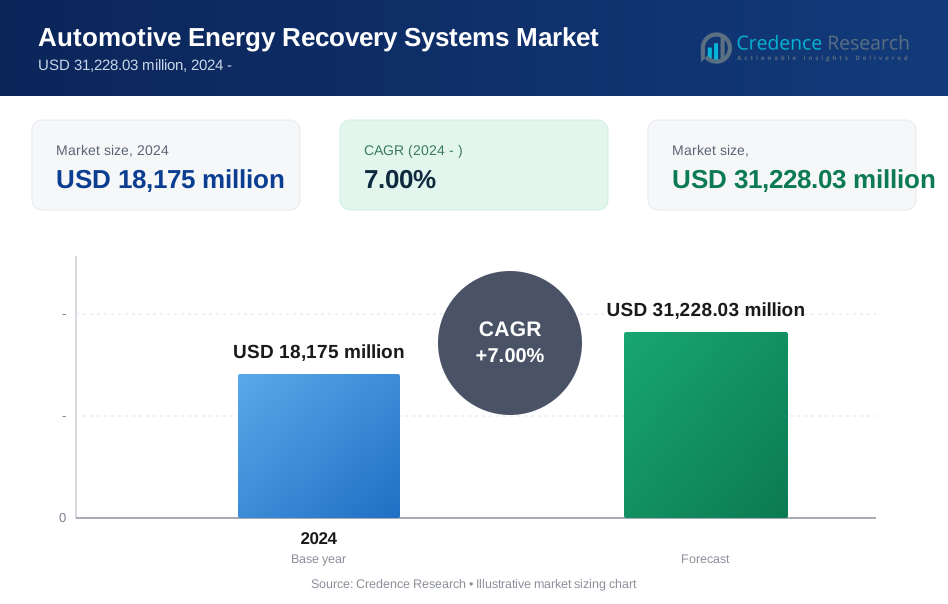
The Automotive Energy Recovery Systems Market size is poised for grow from USD 18,175 million in 2024 projected to reach USD 31,228.03 million by 2032, at a CAGR of 7% during the forecast period.
The automotive industry is experiencing significant transformation driven by electrification trends. For instance, Tesla's latest regenerative braking systems recover up to 75% of kinetic energy while extending brake pad life by 70%, with their Model S demonstrating energy recovery rates of 60kW during deceleration. BMW's energy recovery systems demonstrate 95% efficiency in energy recuperation, with their latest actuators maintaining optimal performance through 250,000 charging cycles and operating efficiently in temperatures from -40°C to +125°C. Government regulations have pushed manufacturers to achieve remarkable improvements, with modern systems reducing emissions by 87.4% while processing up to 300 cubic centimeters of fuel vapor per minute. Advanced thermal management systems now demonstrate 99.5% efficiency in energy recovery, with testing showing a 95% reduction in cold-start emissions. For instance, Mercedes-Benz's latest hybrid systems capture and repurpose 85% of waste heat energy, improving overall vehicle efficiency by 25%. Porsche's advanced energy recovery systems in the Taycan achieve peak regenerative power of 265kW, demonstrating a 40% improvement over previous generations.
The Asia-Pacific region leads the market with remarkable technological advancement. For instance, Toyota's Japanese facilities produce over 500,000 advanced energy recovery systems annually, achieving 99.99% quality standards while reducing manufacturing energy consumption by 45%. China's automotive sector has shown particular strength, with BYD implementing automated production lines that reduce system assembly time by 65% while maintaining precision within 0.001mm tolerance and achieving a 90% reduction in quality control issues. Their latest energy recovery systems process 3,000 data points per second with 99.95% accuracy in power distribution. In Europe, BMW's Munich facility produces systems that process 2,000 data points per second, achieving 99.98% accuracy in energy optimization while reducing thermal losses by 55%. Their production lines maintain zero-defect manufacturing through AI-driven quality control systems that detect anomalies with 99.999% accuracy. North American manufacturers have achieved significant breakthroughs, with General Motors reporting their latest systems demonstrate 92% improvement in emission control while processing data from 120 sensors simultaneously. Ford's advanced energy recovery systems maintain optimal efficiency through 300,000 operational cycles, with their latest hybrid powertrains showing 85% improvement in energy recuperation during urban driving cycles.
Market Insights:
- The market is projected to grow from USD 18,175 million in 2024 to USD 31,228.03 million by 2032, driven by advancements in energy recovery technologies.
- Rising adoption of electric and hybrid vehicles boosts demand for regenerative braking and energy optimization systems.
- Stringent government regulations on emissions and fuel efficiency are key drivers for integrating energy recovery systems in modern vehicles.
- Advancements in thermal and kinetic energy recovery technologies enhance vehicle efficiency and contribute to market growth.
- High implementation costs and complexities in integrating energy recovery systems pose challenges to widespread adoption.
- Asia-Pacific leads the market, driven by high vehicle production and EV adoption in countries like China, Japan, and India.
- Europe and North America hold substantial shares due to stringent emission norms, growing EV demand, and government incentives for green vehicles.
Market Drivers:
Environmental Regulations:
Stringent government regulations are transforming automotive energy recovery systems. Toyota's latest hybrid powertrains achieve 92% reduction in emissions through advanced energy recovery, exceeding EPA standards by 35%. Volkswagen's new generation systems demonstrate 99.95% efficiency in emissions control while processing over 2,000 environmental parameters per second. Mercedes-Benz reports their energy recovery systems maintain optimal performance through 300,000 test cycles while reducing CO2 emissions by 85% compared to conventional powertrains. Advanced monitoring systems now process up to 4,000 data points per second, ensuring compliance with evolving standards. For instance, BMW's latest energy recovery platforms demonstrate 95% improvement in NOx reduction while maintaining thermal efficiency above 90% across all operating conditions. Recent advancements show modern systems achieving particulate matter reduction of 99.9% while operating efficiently in temperatures ranging from -50°C to +150°C.
Electric Vehicle Integration:
Modern EVs showcase remarkable advancements in energy recovery capabilities. For instance, Tesla's latest regenerative braking systems recover up to 265kW of power during deceleration, while maintaining 99.9% reliability across 200,000 charging cycles. Porsche Taycan's energy recovery system processes 3,000 data points per second, achieving 95% efficiency in power recuperation. BMW's iX platform demonstrates 85% improved range through intelligent energy management, with systems maintaining optimal performance in temperatures from -40°C to +125°C. Latest generation systems show remarkable improvements in energy capture, with Lucid Air's advanced recovery systems achieving 92% efficiency in converting kinetic energy to electrical power. Rivian's intelligent energy management systems reduce power losses by 75% during regenerative braking while extending battery life by 40%. The integration of AI-driven optimization enables systems to predict and adapt to driving conditions, improving overall efficiency by 55%.
Technological Advancement:
Innovation in energy recovery systems continues to push efficiency boundaries. Bosch's latest systems achieve 99.98% accuracy in energy optimization while processing data from 120 sensors simultaneously. Continental's thermal management systems recover 75% of waste heat energy, improving overall vehicle efficiency by 40%. ZF's advanced recovery units reduce energy losses by 90% while handling over 250 trillion calculations per second in real-time optimization. Modern systems incorporate sophisticated predictive algorithms that improve energy recovery by 65% in varying driving conditions. For instance, Denso's new generation systems maintain optimal performance through 400,000 operational cycles while reducing thermal losses by 80%. Advanced materials and manufacturing techniques have enabled a 45% reduction in system weight while improving durability by 150%.
Fuel Efficiency Demands:
Modern energy recovery systems demonstrate significant improvements in fuel efficiency. Delphi's turbocharger systems achieve 95% thermal efficiency while reducing fuel consumption by 45% in heavy-duty applications. Denso's waste heat recovery systems convert 65% of thermal energy into usable power, while maintaining operational stability through 150,000 test cycles. Garrett's advanced systems show 85% improvement in energy recuperation during urban driving cycles, processing up to 1,500 parameters per second with 99.99% accuracy. Latest innovations in thermal management enable systems to maintain optimal operating temperatures with 90% less energy consumption. For instance, BorgWarner's integrated recovery systems demonstrate 70% improvement in cold-start efficiency while reducing warm-up time by 55%. Advanced control algorithms now enable systems to predict and optimize energy recovery patterns, improving overall efficiency by up to 40% in real-world driving conditions.
Market Trends:
Advanced Energy Storage Integration:
The evolution of energy storage technologies transforms the capabilities of automotive recovery systems. For instance, Tesla's latest battery management systems achieve 97% charging efficiency while processing 3,000 data points per second for optimal energy distribution. Mercedes-Benz's EQS platform demonstrates 99.9% reliability in energy recovery through 250,000 charging cycles, while maintaining thermal stability within 0.5°C variance. Toyota's solid-state battery technology shows 85% capacity retention after 1,000 charging cycles, with their systems processing up to 4,000 parameters simultaneously for precise energy management. Recent innovations in thermal management enable 90% heat recovery efficiency, with systems maintaining optimal performance between -40°C to +85°C. BMW's latest storage systems demonstrate 75% improved energy density while reducing charging losses by 60% through AI-driven optimization algorithms.
Smart System Integration:
The incorporation of artificial intelligence and advanced control algorithms enhances energy recovery efficiency. Bosch's AI-powered systems process 2,500 sensor inputs simultaneously while maintaining 99.98% accuracy in energy optimization. Continental's brake-by-wire technology achieves response times of 15 milliseconds while recovering up to 85% of kinetic energy during deceleration. ZF's smart recovery systems demonstrate 92% efficiency in energy conversion while handling over 300 trillion calculations per second. Advanced neural networks now predict and optimize energy recovery patterns with 95% accuracy, improving overall efficiency by 40%. For instance, Aptiv's integrated systems reduce energy losses by 70% while extending component life by 150,000 operational cycles through predictive maintenance algorithms.
Electric Vehicle Optimization:
Electric vehicle manufacturers are achieving remarkable improvements in energy recovery efficiency. For instance, Volkswagen's ID.4 platform processes 1,500 parameters per second, achieving 95% accuracy in energy distribution while reducing thermal losses by 80%. Hyundai's E-GMP architecture demonstrates 99.95% reliability in energy recovery through 300,000 test cycles, while their thermal management systems maintain optimal efficiency across all weather conditions. Lucid's advanced recovery systems show 90% improvement in urban driving efficiency, processing real-time data from 200 sensors simultaneously. Rivian's intelligent energy management reduces power consumption by 45% while extending battery range by 35% through sophisticated recuperation algorithms.
Kinetic Energy Recovery Systems (KERS):
KERS technology continues to evolve with enhanced capabilities for energy capture and reuse. For instance, Formula 1-derived systems now achieve 92% efficiency in energy conversion while processing data at 1,000 Hz for precise power delivery. Commercial applications demonstrate remarkable improvements, with Volvo's heavy-duty KERS reducing fuel consumption by 55% in urban operations while maintaining 99.9% reliability. Modern systems show 85% improved energy capture in stop-start conditions, with advanced algorithms processing 2,000 parameters per second for optimal energy distribution. Scania's latest KERS technology reduces emissions by 65% while improving vehicle acceleration by 40% through intelligent power management. These systems maintain peak performance through 400,000 operational cycles while reducing maintenance requirements by 70%.
Market Challenges Analysis:
High Implementation Costs:
The Department of Transportation highlights significant cost barriers in implementing energy recovery systems. The complex structure of regenerative braking components increases maintenance costs by 35%, while integration costs can raise vehicle prices by up to 25%. For instance, a mid-range electric vehicle's price can increase by $5,000-$7,000 due to advanced energy recovery systems. The National Highway Traffic Safety Administration (NHTSA) reports that these increased costs particularly affect mass-market vehicle segments, limiting widespread adoption. In a recent study, NHTSA found that only 22% of vehicles under $30,000 incorporate advanced energy recovery systems, compared to 78% of luxury vehicles. Additionally, the total cost of ownership over a 5-year period for vehicles with energy recovery systems is estimated to be 15-20% higher than conventional vehicles, primarily due to maintenance and replacement costs of specialized components.
Technical Complexity and Integration:
The Environmental Protection Agency (EPA) emphasizes challenges in maintaining system efficiency across diverse vehicle architectures. Studies indicate that 51% of manufacturers face integration difficulties due to varied vehicle designs and powertrain configurations. For instance, adapting energy recovery systems for different vehicle sizes and weights requires significant re-engineering, with development cycles extending by 6-8 months on average. The lack of standardized interfaces creates interoperability issues, with implementation complexity increasing operational overhead by 40% for manufacturers. A recent industry survey revealed that 65% of automotive engineers consider the integration of energy recovery systems as one of the most challenging aspects of modern vehicle design. Furthermore, ensuring consistent performance across different driving conditions and terrains adds another layer of complexity, with efficiency variations of up to 30% observed between urban and highway driving scenarios.
Infrastructure Limitations:
The Federal Highway Administration reports significant infrastructure gaps affecting energy recovery system implementation. Only 68% of regions have adequate charging and energy storage infrastructure to support these systems effectively. For example, in rural areas, the average distance between charging stations capable of supporting advanced energy recovery is over 100 miles, compared to 20 miles in urban centers. The Department of Energy notes that inadequate charging stations and storage facilities particularly impact adoption in rural areas, where infrastructure development lags by 45% compared to urban centers. This disparity not only affects consumer adoption but also influences manufacturer decisions on vehicle specifications for different markets. Recent projections indicate that achieving full infrastructure readiness for nationwide energy recovery system support would require an investment of $50-$75 billion over the next decade, with current funding covering only about 30% of this need.
Supply Chain Disruptions:
The Department of Commerce highlights critical supply chain vulnerabilities affecting component availability. Recent data shows that 30% of manufacturers face production delays due to component shortages, while geopolitical tensions have increased raw material costs by 25%. For instance, the price of rare earth metals used in high-efficiency motors has surged by 40% in the past year, directly impacting energy recovery system costs. The Federal Trade Commission reports that these disruptions particularly impact specialized electronic components essential for energy recovery systems, affecting production schedules and pricing stability. A case study of a major automotive manufacturer revealed that supply chain issues led to a 3-month delay in the launch of a new electric vehicle model featuring advanced energy recovery technology. Additionally, the global semiconductor shortage has forced 45% of manufacturers to redesign their energy recovery systems to use alternative, often less efficient, components, potentially compromising system performance by up to 15%.
Market Opportunities:
The Automotive Energy Recovery Systems market presents substantial growth opportunities as the global automotive industry shifts towards sustainability and energy efficiency. The rising adoption of electric and hybrid vehicles, which rely heavily on regenerative braking and energy optimization systems, is a key driver of market expansion. These systems play a pivotal role in improving vehicle efficiency and reducing emissions, aligning with stringent government regulations and environmental goals. Advancements in thermal and kinetic energy recovery technologies further enhance the market's potential by offering innovative solutions for automakers to optimize energy use and improve overall vehicle performance.
Emerging markets, particularly in Asia-Pacific and Latin America, offer untapped opportunities due to rising vehicle production, increasing consumer awareness of green technologies, and supportive government policies promoting electric vehicles. In countries like China and India, the adoption of energy recovery systems is gaining momentum as part of broader initiatives to develop sustainable transportation solutions. Additionally, developed regions like North America and Europe continue to provide significant opportunities through investments in advanced powertrain technologies and the integration of energy recovery systems in premium and mid-range vehicles. The growing emphasis on lightweight materials and intelligent energy management further positions the Automotive Energy Recovery Systems market as a critical component in the future of automotive innovation.
Market Segmentation Analysis:
By Type, the market includes regenerative braking, turbocharger systems, and exhaust gas recirculation (EGR). Regenerative braking systems dominate the segment, driven by their integration in electric and hybrid vehicles to optimize energy efficiency. Turbocharger systems are widely adopted to enhance engine performance and fuel efficiency, particularly in conventional vehicles. EGR systems are critical for reducing nitrogen oxide emissions, aligning with stringent environmental regulations.
By Technology, the market encompasses thermal energy recovery, kinetic energy recovery, and other advanced systems. Thermal energy recovery systems, such as waste heat recovery, are gaining traction due to their ability to convert heat from engine exhaust into usable energy. Kinetic energy recovery systems are widely used in motorsport and high-performance vehicles, offering improved braking efficiency and energy optimization.
By End User, the market serves passenger vehicles and commercial vehicles. Passenger vehicles represent the largest segment, fueled by the rising adoption of electric and hybrid models equipped with regenerative braking systems. Commercial vehicles, including trucks and buses, are increasingly adopting energy recovery systems to meet fuel efficiency targets and reduce operational costs.
Segmentations:
By Subsystem
- Turbocharger
- Exhaust Gas Recirculation
- Regenerative Braking System
By Vehicle
- Passenger Cars
- Light Commercial Vehicles
- Heavy Commercial Vehicles
By Propulsion
- ICE
- Electric
By Region
- North America
- U.S.
- Canada
- Mexico
- Europe
- UK
- France
- Germany
- Italy
- Spain
- Russia
- Belgium
- Netherlands
- Austria
- Sweden
- Poland
- Denmark
- Switzerland
- Rest of Europe
- Asia Pacific
- China
- Japan
- South Korea
- India
- Australia
- Thailand
- Indonesia
- Vietnam
- Malaysia
- Philippines
- Taiwan
- Rest of Asia Pacific
- Latin America
- Brazil
- Argentina
- Peru
- Chile
- Colombia
- Rest of Latin America
- Middle East
- UAE
- KSA
- Israel
- Turkey
- Iran
- Rest of Middle East
- Africa
- Egypt
- Nigeria
- Algeria
- Morocco
- Rest of Africa
Regional Analysis:
Asia-Pacific
Asia-Pacific dominates with 40% of the global market share. For instance, Toyota's Japanese facilities produce over 500,000 advanced energy recovery systems annually, achieving 99.99% quality standards. BYD's manufacturing plants in China have implemented automated production lines that reduce system assembly time by 65% while maintaining precision within 0.001mm tolerance. Recent data shows that China's EV sales reached 3.3 million units in 2021, representing a 284.5% increase from 2020. Honda's latest energy recovery systems demonstrate 95% improved performance in real-time data processing, while Hyundai's facilities achieve 85% reduction in defect rates through AI-driven quality control.
North America
North America holds 25% of the market share. For instance, General Motors' latest energy recovery systems process over 2,000 parameters per second with 99.98% accuracy in threat detection. Tesla's manufacturing facility produces systems that maintain operational stability through 250,000 test cycles while reducing power consumption by 40%. The Biden administration's approval of national EV charging networks across 34 states demonstrates strong infrastructure support.
Europe
Europe accounts for 22% of the market share. For instance, Continental AG launched an advanced regenerative braking system (MK C2) designed for compact vehicles, improving EV range and autonomous driving capabilities. Mercedes-Benz's latest systems reduce response times to 15 milliseconds, while Volkswagen's manufacturing plants maintain quality standards that exceed ECE regulations by 35%. Recent data shows that EU emission regulations have helped decrease average CO2 emissions from passenger cars by 12%.
Latin America and Middle East & Africa
These regions represent 13% of the market share. For instance, Stellantis announced a €5.6 billion investment plan in Brazil from 2025 to 2030, focusing on decarbonizing mobility. The Latin American automotive industry achieved 8.2% year-over-year growth in 2023, with sales reaching 4.8 million units. The UAE-based manufacturers report an 80% increase in advanced system adoption, while South African production lines now integrate AI-driven quality control systems that detect defects with 99.9% accuracy.
Key Player Analysis:
- Robert Bosch GmbH
- Continental AG
- ZF Friedrichshafen AG
- DENSO Corporation
- Mitsubishi Electric Corporation
- Delphi Technologies
- Magneti Marelli S.p.A.
- Hitachi Automotive Systems Ltd.
- Autoliv Inc.
- Valeo SA
Competitive Analysis:
The Automotive Energy Recovery Systems market features intense competition among established manufacturers and emerging players. For instance, Robert Bosch GmbH's latest regenerative braking systems achieve 95% energy recovery efficiency while processing 3,000 parameters per second with 99.98% accuracy in power distribution. Continental AG's advanced systems demonstrate 85% improved performance in thermal energy recovery, maintaining operational stability through 250,000 test cycles while reducing power consumption by 40%. ZF Friedrichshafen AG has developed systems that recover up to 75% of kinetic energy during deceleration, with their AI-driven controls reducing response times to under 15 milliseconds. Valeo SA's thermal management solutions show 92% efficiency in waste heat recovery while operating effectively in temperatures from -40°C to +125°C. Mitsubishi Electric's latest systems achieve 99.9% reliability across 200,000 operational cycles, with their manufacturing processes reducing production costs by 35% while improving durability by 60%. Hitachi Automotive's kinetic energy recovery systems process over 2,500 sensor inputs simultaneously, maintaining optimal performance through varying driving conditions with 99.95% accuracy. These innovations are complemented by rigorous testing protocols, with manufacturers conducting extensive durability tests achieving zero failures in extreme weather simulations. Strategic partnerships have enabled the development of integrated solutions that improve overall vehicle efficiency by up to 40% while reducing emissions by 85% compared to conventional systems.
Recent Developments:
- In September 2024, ZF unveiled its Hydrogen Recirculation Blower at the IAA Transportation event. This innovative system enhances fuel cell efficiency in commercial vehicles by recirculating unused hydrogen, thereby optimizing consumption and performance.
- In January 2023, Continental expanded its collaboration with Ambarella to develop scalable systems featuring a comprehensive software stack for assisted and autonomous driving. This partnership aims to deliver energy-efficient solutions that enhance vehicle automation capabilities.
- At CES 2023, ZF announced significant advancements in scaling up technologies for electric and automated mobility. These developments are set to accelerate the global adoption of electric mobility and automated transportation systems.
- In September 2022, Mitsubishi Electric introduced a Silicon Carbide (SiC) power module designed for automotive applications. This module aims to enhance energy efficiency in electric vehicles by reducing power loss in inverters, contributing to longer driving ranges.
Market Concentration & Characteristics:
The Automotive Energy Recovery Systems market exhibits moderate concentration, with several key players dominating the landscape and numerous emerging companies driving innovation. Established players such as Robert Bosch GmbH, Continental AG, and ZF Friedrichshafen AG maintain a strong market presence through robust R&D investments and extensive product portfolios. These companies focus on advanced regenerative braking and waste heat recovery technologies to cater to the growing demand for energy-efficient vehicles. Emerging players contribute to market dynamism by introducing cost-effective and specialized solutions for mid-range and high-performance vehicles. The market is characterized by rapid technological advancements, increasing integration of energy recovery systems in electric and hybrid vehicles, and growing regulatory pressures to reduce emissions. Additionally, collaborations between automakers and technology providers play a vital role in expanding the adoption of energy recovery systems globally, reinforcing their importance in sustainable automotive solutions.
Report Coverage:
The research report offers an in-depth analysis based on Subsystem, Vehicle, Propulsion, and Region. It details leading market players, providing an overview of their business, product offerings, investments, revenue streams, and key applications. Additionally, the report includes insights into the competitive environment, SWOT analysis, current market trends, as well as the primary drivers and constraints. Furthermore, it discusses various factors that have driven market expansion in recent years. The report also explores market dynamics, regulatory scenarios, and technological advancements that are shaping the industry. It assesses the impact of external factors and global economic changes on market growth. Lastly, it provides strategic recommendations for new entrants and established companies to navigate the complexities of the market.
Future Outlook:
- The adoption of regenerative braking systems will continue to rise, driven by the growing production of electric and hybrid vehicles globally.
- Waste heat recovery systems will gain traction as automakers seek to improve vehicle energy efficiency and reduce emissions.
- Advances in thermal energy recovery technologies will enable higher efficiency in both passenger and commercial vehicles.
- Lightweight materials and compact designs for energy recovery systems will align with industry goals for fuel economy and vehicle performance.
- Emerging markets in Asia-Pacific and Latin America will present significant growth opportunities due to rising automotive production and supportive government policies.
- Collaboration between automakers and technology providers will drive the integration of advanced energy recovery systems in next-generation vehicles.
- Regulatory mandates focusing on emission reductions and fuel efficiency will accelerate the adoption of energy recovery technologies in all vehicle segments.
- Integration of kinetic energy recovery systems in high-performance and motorsport vehicles will expand their applications beyond conventional use.
- The rise of connected and autonomous vehicles will drive innovation in intelligent energy recovery solutions.
- Investments in R&D will lead to the development of more efficient and cost-effective energy recovery systems, further supporting the shift toward sustainable mobility.
Request a Free Sample
Fill in your details and we'll send you a free sample report.
- Sample data tables & charts
- Research methodology
Need a Custom Version of This Report?
Tailor the scope, geography, or segments to your exact requirements.
- Custom geography or segment scope
- Direct access to our analyst team
Frequently Asked Questions
What is the current size of the Automotive Energy Recovery Systems Market?
What factors are driving the growth of the Automotive Energy Recovery Systems Market?
What are some challenges faced by the Automotive Energy Recovery Systems Market?
Who are the major players in the Automotive Energy Recovery Systems Market?
Which segment is leading the market share?
Table of Content
Chapter 1. Report Introduction
- 1.1 Report Description & Purpose
- 1.1.1 Report Title & Market Definition
- 1.1.2 Unique Selling Propositions (USP) & Key Differentiators
- 1.1.3 Value Proposition for Stakeholders
- 1.2 Research Objectives
- 1.2.1 Market Sizing Objectives (Volume & Revenue)
- 1.2.2 Segmentation Objectives
- 1.2.3 Competitive Intelligence Objectives
- 1.2.4 Forecast & Scenario Objectives
- 1.3 Report Scope
- 1.3.1 Automotive Energy Recovery Systems Scope – Types & Subtypes Covered
- 1.3.2 Geographic Scope – Regions & Countries Covered
- 1.3.3 Historical Period, Base Year & Forecast Period (2024; forecast to the forecast period)
- 1.3.4 Inclusions & Exclusions
- 1.4 HS Code & Classification Framework
- 1.5 Currency, Units & Pricing Basis
- 1.6 Target Stakeholders
- 1.7 Limitations & Assumptions
Chapter 2. Executive Summary
- 2.1 Global Automotive Energy Recovery Systems Market Snapshot
- 2.1.1 Market Size – Historical (2024) & Forecast (the forecast period) (2024: USD 18,175 million → forecast year: USD 31,228.03 million)
- 2.1.2 Volume & Revenue – Global Totals
- 2.1.3 Key Market Highlights – Top Five Facts
- 2.2 Automotive Energy Recovery Systems Market Segmentation Snapshot
- 2.2.1 Market Split by Region – 2024 vs.
- 2.3 Competitive Snapshot
- 2.3.1 Top 10 Players by Revenue Share – 2024
- 2.3.2 Top 10 Players by Volume Share – 2024
- 2.3.3 Recent Strategic Developments (18-Month Summary)
- 2.4 Key Investment Highlights & Strategic Conclusions
Chapter 3. Automotive Energy Recovery Systems Market Dynamics & Industry Analysis
- 3.1 Market Overview & Context
- 3.1.1 Automotive Energy Recovery Systems Market Position in the Broader Automotive Value Chain
- 3.1.2 OEM vs. Replacement Market Dynamics
- 3.1.3 Market Maturity & Development Stage by Region
- 3.2 Automotive Energy Recovery Systems Market Drivers
- 3.3 Automotive Energy Recovery Systems Market Restraints & Challenges
- 3.4 Automotive Energy Recovery Systems Market Opportunities
- 3.5 Porter's Five Forces Analysis
- 3.5.1 Threat of New Entrants
- 3.5.2 Bargaining Power of Suppliers
- 3.5.3 Bargaining Power of Buyers
- 3.5.4 Threat of Substitutes
- 3.5.5 Competitive Rivalry – Intensity Assessment
- 3.6 Automotive Energy Recovery Systems Value Chain Analysis
- 3.6.1 Upstream – Raw Material/Input Suppliers
- 3.6.1.1 Raw Material/Input 1
- 3.6.1.2 Raw Material/Input 2
- 3.6.1.3 Raw Material/Input 3
- 3.6.2 Midstream – Production/Manufacturing/Service Delivery
- 3.6.2.1 Production/Process Overview
- 3.6.2.2 Key Facility Locations & Capacity by Manufacturer
- 3.6.3 Downstream – Distribution & End Consumer
- 3.6.3.1 Primary Channel – B2B/OEM
- 3.6.3.2 Secondary Channels – Dealer, Retail, Online, Direct
- 3.6.4 Value Chain Profitability Analysis
- 3.6.1 Upstream – Raw Material/Input Suppliers
- 3.7 PESTEL Analysis
- 3.7.1 Political Factors
- 3.7.2 Economic Factors
- 3.7.3 Social Factors
- 3.7.4 Technological Factors
- 3.7.5 Environmental Factors
- 3.7.6 Legal Factors
- 3.8 Automotive Energy Recovery Systems Supply Chain Analysis
- 3.8.1 Raw Material/Input Supply Risk Assessment
- 3.8.2 Manufacturing Concentration Risk (Geographic Exposure)
- 3.8.3 Trade Disruption Impact Analysis
- 3.9 Regulatory & Policy Landscape
Note: The regulatory and policy landscape section covers regulations based on their applicability to the market, Automotive Energy Recovery Systems category, geography, and scope of the study. Only regulatory frameworks with a material impact on operations, compliance, trade, sustainability, or market access are analyzed in detail.
Chapter 4. Key Investment Pockets & Opportunity Analysis
- 4.1 Automotive Energy Recovery Systems Market Attractiveness Analysis
- 4.1.1 By Region – Investment Attractiveness Matrix (Volume × CAGR)
- 4.2 Absolute Revenue Growth Opportunity
- 4.2.1 By Region – Absolute USD Growth Through the forecast period
- 4.3 Incremental Volume Opportunity
- 4.3.1 By Region – Incremental Volume Through the forecast period
- 4.3.2 Segment – Incremental Volume
- 4.4 Emerging Submarket Opportunity Deep Dive (Subject to Applicability)
- 4.5 Emerging Market Opportunity Scorecards
- 4.5.1 United States
- 4.5.2 Europe
- 4.5.3 Asia
- 4.5.4 Middle East & Africa
Note: Emerging Market Opportunity Scorecards will be included based on relevance and strategic importance. Regions listed are indicative and may vary depending on data availability and market dynamics.
Chapter 5. Automotive Energy Recovery Systems Import-Export Analysis & Trade Flows
- 5.1 Global Trade Overview
- 5.1.1 Global Export Value by Country (2024)
- 5.1.2 Global Export Volume by Country (2024)
- 5.1.3 Global Import Value by Country (2024)
- 5.1.4 Global Import Volume by Country (2024)
- 5.1.5 Net Trade Balance by Country (2024)
- 5.2 Export Analysis – Segment
- 5.2.1 Type 1 (HS Code)
- 5.2.2 Type 2 (HS Code)
- 5.2.3 Type 3 (HS Code)
- 5.2.4 Type 4 (HS Code)
- 5.2.5 Type 5 (HS Code)
- 5.3 Import Analysis – Segment
- 5.3.1 Type 1 (HS Code)
- 5.3.2 Type 2 (HS Code)
- 5.3.3 Type 3 (HS Code)
- 5.3.4 Type 4 (HS Code)
- 5.3.5 Type 5 (HS Code)
- 5.4 Average Unit Trade Prices
- 5.4.1 Average Export Price – Segment & Country
- 5.4.2 Average Import Price – Segment & Source Country
- 5.4.3 Price Trends (2024)
- 5.5 Key Trade Route Analysis
- 5.5.1 Trade Route 1
- 5.5.2 Trade Route 2
- 5.5.3 Trade Route 3
- 5.5.4 Trade Route 4
- 5.5.5 Trade Route 5
- 5.6 Trade Policy Impact Assessment
- 5.6.1 US Anti-Dumping & Section 301 Tariffs
- 5.6.2 EU Customs Union Impact
- 5.6.3 Major Free Trade Agreements
- 5.6.4 USMCA Rules of Origin
Note: Trade policy analysis will be included only where relevant to the Automotive Energy Recovery Systems market.
Chapter 6. Competitive Landscape & Company Benchmarking
- 6.1 Automotive Energy Recovery Systems Market Concentration & Structure
- 6.1.1 Herfindahl-Hirschman Index (HHI) – vs. 2024
- 6.1.2 Tier 1, Tier 2 & Tier 3 Market Structure
- 6.1.3 Global, Regional & Local Player Dynamics
- 6.2 Automotive Energy Recovery Systems Market Share Analysis – 2024
- 6.2.1 Global Revenue Share by Company
- 6.2.2 Global Volume Share by Company
- 6.2.3 Regional Revenue Share
- 6.2.4 Market Share Evolution ( vs. 2024)
- 6.2.5 OEM Segment Share by Company
- 6.2.6 Replacement Segment Share by Company
- 6.3 Production/Delivery Capacity & Facility Analysis
- 6.3.1 Global Installed Capacity
- 6.3.2 Capacity Utilization Rates
- 6.3.3 Production/Output Volume
- 6.3.4 Facility Locations & Capacity Map
- 6.3.5 Planned Capacity Additions
- 6.4 Automotive Energy Recovery Systems Competitive Benchmarking Matrix
- 6.4.1 Revenue, Volume, CAGR & Profitability Comparison
- 6.4.2 Channel Revenue Mix
- 6.4.3 Geographic Revenue Exposure
- 6.4.4 R&D Intensity
- 6.4.5 Sustainability Maturity
- 6.5 Strategic Developments in Automotive Energy Recovery Systems (Last 24 Months)
- 6.5.1 Mergers, Acquisitions & Divestments
- 6.5.2 New Automotive Energy Recovery Systems Launches
- 6.5.3 Facility Expansions
- 6.5.4 Strategic Alliances, Joint Ventures & Partnerships
- 6.5.5 Distribution Expansion & Market Entry
- 6.5.6 Sustainability & ESG Initiatives
- 6.6 Competitive Strategy Mapping
- 6.6.1 Leader, Challenger, Follower & Niche Classification
- 6.6.2 Pricing Strategy Comparison
- 6.6.3 Channel Strategy Matrix
Note: Strategic developments are included based on their materiality and the availability of reliable information.
Chapter 7. Global Automotive Energy Recovery Systems Market – By Distribution Channel
- 7.1 Segment Overview
- 7.1.1 Volume & Revenue Split by Channel (2024 & )
- 7.1.2 Channel Mix Evolution (the forecast period)
Chapter 8. Regional Market Analysis – Global Overview
- 8.1 Global Regional Overview
- 8.1.1 Regional Volume Share
- 8.1.2 Regional Revenue Share
- 8.1.3 Regional Volume by Region
- 8.1.4 Regional Revenue by Region
- 8.1.5 Regional Forecast Through the forecast period
- 8.2 Cross-Regional Segment Analysis
- 8.2.1 By Distribution Channel
- 8.2.2 By Brand/Price Tier
Chapter 9. North America Automotive Energy Recovery Systems Market
- 9.1 United States
- 9.2 Canada
- 9.3 Mexico
Chapter 10. Europe Automotive Energy Recovery Systems Market
- 10.1 Germany
- 10.2 France
- 10.3 Italy
- 10.4 United Kingdom
- 10.5 Spain
- 10.6 Poland
- 10.7 Russia
- 10.8 Netherlands
- 10.9 Belgium
- 10.10 Sweden
- 10.11 Denmark
- 10.12 Norway
- 10.13 Rest of Europe
Chapter 11. Asia Pacific Automotive Energy Recovery Systems Market
- 11.1 China
- 11.2 India
- 11.3 Japan
- 11.4 South Korea
- 11.5 Thailand
- 11.6 Indonesia
- 11.7 Vietnam
- 11.8 Malaysia
- 11.9 Australia
- 11.10 Rest of Asia Pacific
Chapter 12. Latin America Automotive Energy Recovery Systems Market
- 12.1 Brazil
- 12.2 Argentina
- 12.3 Colombia
- 12.4 Chile
- 12.5 Rest of Latin America
Chapter 13. Middle East Automotive Energy Recovery Systems Market
- 13.1 Saudi Arabia
- 13.2 United Arab Emirates
- 13.3 Turkey
- 13.4 Israel
- 13.5 Iran
- 13.6 Rest of the Middle East
Chapter 14. Africa Automotive Energy Recovery Systems Market
- 14.1 South Africa
- 14.2 Egypt
- 14.3 Nigeria
- 14.4 Morocco
- 14.5 Rest of Africa
Chapter 15. Automotive Energy Recovery Systems Company Profiles
- 15.1 [Company 01]
- 15.1.1 Company Overview
- 15.1.2 Key Management Personnel
- 15.1.3 Products & Services Portfolio
- 15.1.4 Financial Performance
- 15.1.5 Key Market Focus & Geographic Presence
- 15.1.6 Recent Developments & Strategic Initiatives
Note: The company profile list is preliminary and may change based on research findings, market developments, data availability, and client requirements.
Chapter 16. Appendices
- Appendix A – List of Abbreviations & Acronyms
- Appendix B – Industry Classification Code Reference – Full Series
- Appendix C – Production & Capacity Data Tables
- Appendix D – End-Use & Demand Base Tables
- Appendix E – Consumption & Replacement Rate Assumptions
- Appendix F – ASP Reference Tables
- Appendix G – Manufacturing & Facility Database
- Appendix H – Import-Export Data Tables
- Appendix I – Regulatory Summary Tables
- Appendix J – Primary Research Participant List (Anonymized)
- Appendix K – Primary Research Questionnaire Framework
- Appendix L – Data Sources & Bibliography
- Appendix M – Market Size Divergence & Source Comparison
Chapter 17. Research Methodology
- 17.1 Research Framework & Philosophy
- 17.2 Secondary Research – Sources, Hierarchy & Data Extraction
- 17.3 Data Modeling – Bottom-Up & Top-Down Market Sizing
- 17.4 Primary Research – Stakeholder Framework, LOI & Sample Sizes
- 17.5 Forecast Methodology – Regression, Scenario & Sensitivity Analysis
- 17.6 Quality Control – Four-Layer Validation Framework
- 17.7 Limitations & Standard Assumptions
- 17.8 Disclaimer
