
Market Overview
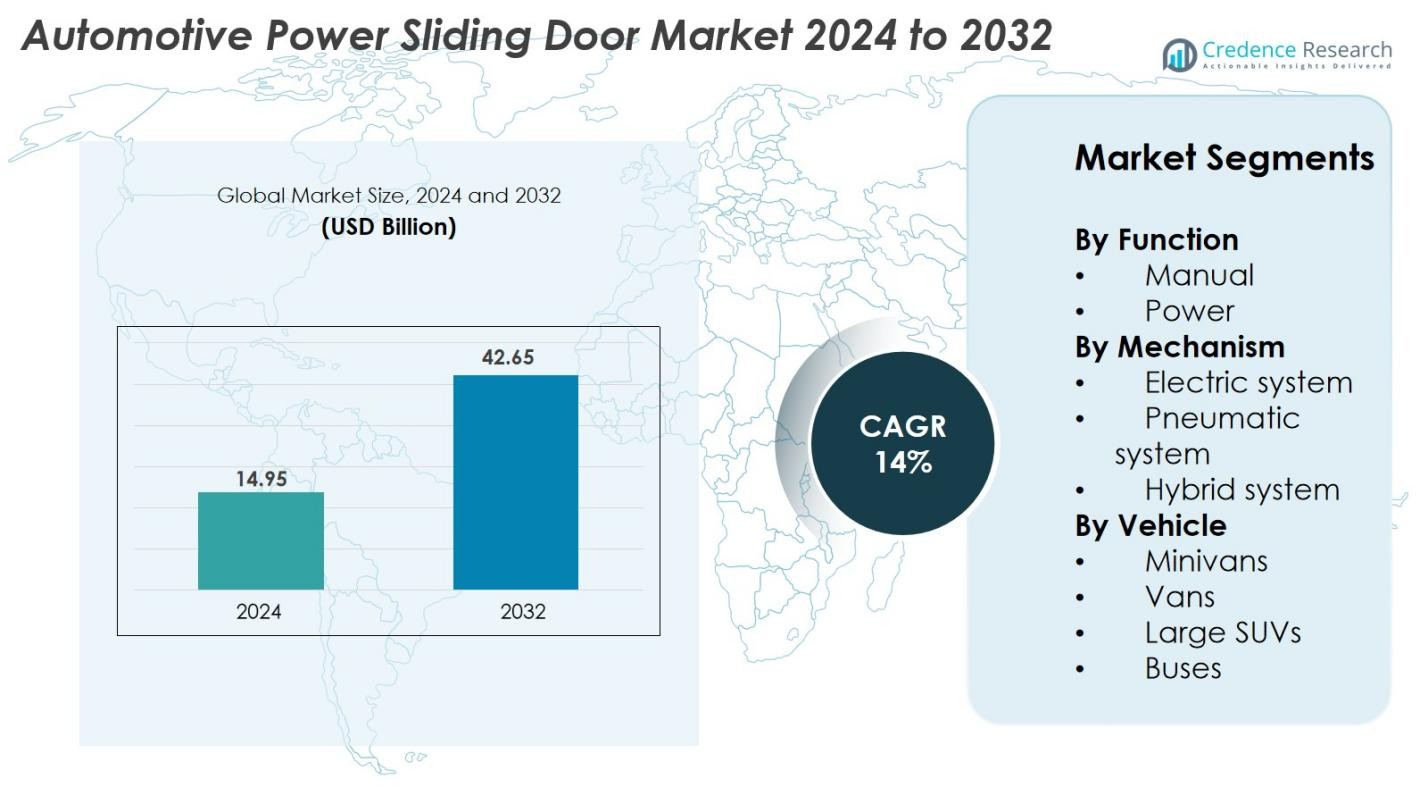
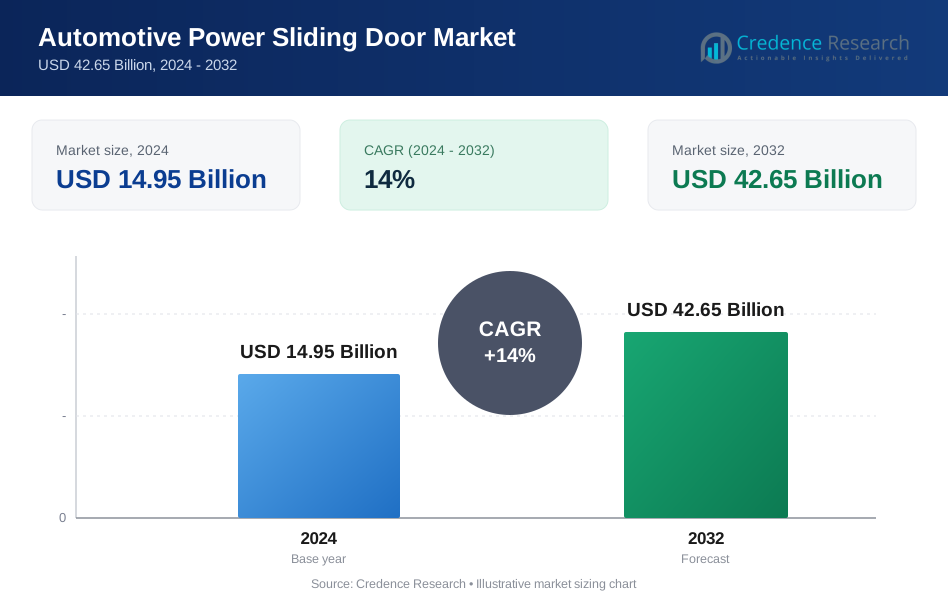
The Automotive Power Sliding Door Market size was valued at USD 14.95 Billion in 2024 and is anticipated to reach USD 42.65 Billion by 2032, at a CAGR of 14% during the forecast period.
| REPORT ATTRIBUTE | DETAILS |
|---|---|
| Historical Period | 2020-2023 |
| Base Year | 2024 |
| Forecast Period | 2025-2032 |
| Automotive Power Sliding Door Market Size 2024 | USD 14.95 Billion |
| Automotive Power Sliding Door Market, CAGR | 14% |
| Automotive Power Sliding Door Market Size 2032 | USD 42.65 Billion |
The Automotive Power Sliding Door Market is led by major players including Aisin Seiki, Aptiv, Bosch, Brose, Denso, Johnson, Kiekert AG, Magna, Valeo SA, and ZF Friedrichshafen, all of which play a central role in supplying advanced actuation, sensor, and electronic control systems to global OEMs. These companies strengthen competitiveness through innovation in electric mechanisms, safety enhancements, and integration with EV platforms. North America remains the leading region, commanding a 34% market share in 2024, driven by high adoption in SUVs, minivans, and premium vehicles. Asia-Pacific and Europe also exhibit strong growth due to expanding vehicle production and rising demand for automated convenience features.
Market Insights
- The Automotive Power Sliding Door market reached USD 14.95 Billion in 2024 and is projected to hit USD 42.65 Billion by 2032, expanding at a CAGR of 14%.
- Growing demand for comfort, safety, and automated door technology in minivans and SUVs continues to drive market expansion, with the power function segment holding a 68% share.
- Advanced trends such as sensor-based mechanisms, AI-assisted controls, and integration with electric and smart vehicle platforms are shaping product innovation.
- The competitive landscape features companies like Aisin Seiki, Aptiv, Bosch, Brose, Denso, Johnson, Kiekert AG, Magna, Valeo, and ZF Friedrichshafen, all focusing on enhanced durability and automation efficiency while addressing cost and maintenance restraints.
- Regionally, North America leads with a 34% share, followed by Asia-Pacific at 29% and Europe at 28%, supported by strong adoption in minivans, commercial vans, and premium vehicles across these markets.
Market Segmentation Analysis
By Function
The Automotive Power Sliding Door Market is segmented into manual and power functions, with the power segment dominating the market with a 68% share in 2024. Its leadership is driven by the rising integration of comfort-oriented features, advanced convenience systems, and increasing adoption of automatic door technologies in premium and mid-range vehicles. Automakers are rapidly incorporating powered sliding doors to enhance passenger accessibility, improve safety through anti-pinch sensors, and support hands-free operations. Growing consumer inclination toward technologically advanced vehicles and expanding applications in family-oriented models further strengthen the dominance of powered systems.
- For Instance, Kia equipped the Carnival’s sliding side doors with a “One-Touch Power Sliding Doors” function and hands-free operation capability, and its automatic reversal system will trigger a chime if resistance is detected during closing
By Mechanism
Based on mechanism, the market includes electric systems, pneumatic systems, and hybrid systems, with the electric system segment holding the largest share at 57% in 2024. Its dominance is fueled by higher reliability, smoother operational control, and compatibility with modern automotive electronics. Electric mechanisms offer enhanced energy efficiency, reduced maintenance needs, and seamless integration with vehicle control modules. Increasing electrification of vehicle components, expanding use in hybrid and electric vehicles, and OEM preference for lightweight, precision-driven actuation technologies continue to propel demand for electric mechanisms over pneumatic and hybrid alternatives.
- For instance, Toyota’s Sienna model offers dual power sliding side doors and liftgate with hands-free activation via a kicking motion, enhancing accessibility and convenience.
By Vehicle
In terms of vehicle type, the market is segmented into minivans, vans, large SUVs, and buses, with minivans leading the market with a 46% share in 2024. This dominance is attributed to the high adoption of sliding doors in family and passenger mobility vehicles, where ease of entry, increased cabin accessibility, and enhanced passenger safety are key priorities. Growing demand for multi-purpose vehicles, rising urban mobility needs, and improved functionality for transporting families and groups contribute to the strong presence of sliding doors in minivans. OEMs also emphasize adding power sliding systems to boost convenience and market appeal in this segment.
Key Growth Drivers
Rising Demand for Convenience and Comfort Features
The demand for enhanced comfort and easy accessibility in modern vehicles is a major growth driver for the Automotive Power Sliding Door market. Consumers increasingly prioritize convenience features that simplify entry and exit, especially in family-oriented vehicles such as minivans and large SUVs. Power sliding doors offer hands-free operation, improved safety through anti-pinch technology, and smoother functionality—all aligned with urban mobility needs. Automakers integrate these systems as standard or premium upgrades to differentiate models in competitive segments. Rapid urbanization, rising disposable incomes, growing vehicle replacement rates, and the shift toward advanced sensor-enabled vehicle technologies further boost adoption. As OEMs continue enhancing the in-vehicle experience with automation, power-operated sliding doors will see accelerated demand.
- For instance, in the Kia Carnival the Smart Sliding Door with Auto Open detects the key-fob holder standing 20 inch (50 cm) behind the vehicle for more than 3 seconds, then triggers hazard lights to blink and a chime to sound before opening.
Growing Adoption of Electrification and Smart Vehicle Architecture
The transition toward vehicle electrification and intelligent automotive systems significantly drives the adoption of power sliding doors. Electric vehicles, hybrid models, and next-generation smart cars increasingly rely on electronically controlled systems that integrate seamlessly with digital vehicle architectures. Power sliding doors support programmable operation, remote access, energy-efficient actuation, and predictive diagnostics through advanced control modules. Their compatibility with ADAS, IoT-based features, and connected ecosystems aligns with the automotive industry’s shift toward digitalization. As EV manufacturers emphasize modern cabin accessibility and futuristic design, the demand for automated doors strengthens. Ride-sharing fleets, mobility service providers, and commercial operators also adopt these technologies to enhance safety and operational convenience, further fueling market expansion.
- For instance, Toyota equips its hybrid Sienna platform with an electronically actuated sliding-door motor running on a 12-volt system and linked to a control ECU processing over 100 diagnostic signals for predictive maintenance.
Increasing Penetration of Premium and Luxury Vehicles
The expansion of premium and luxury vehicle segments also drives the Automotive Power Sliding Door market. High-end vehicle manufacturers increasingly incorporate automated door systems as part of upscale comfort packages and luxury design elements. These doors offer silent operation, advanced safety, and personalized settings, making them attractive to affluent consumers. Rising disposable incomes in Asia-Pacific, the Middle East, and North America have boosted demand for premium SUVs and executive minivans that commonly integrate power sliding doors. Corporate mobility fleets, chauffeur-driven premium shuttles, and luxury transport services also contribute to rising adoption. As automakers differentiate vehicles through advanced comfort and automation features, power sliding doors continue gaining prominence in luxury and premium lineup strategies.
Key Trends & Opportunities
Integration of Sensor-Based and AI-Assisted Door Control Systems
A leading trend shaping the market is the integration of sensor technologies, AI-driven controls, and smart automation into power sliding door systems. Automakers increasingly adopt radar sensors, proximity detectors, obstacle-recognition modules, and gesture-based access features to improve user convenience and safety. These technologies enhance operational intelligence, enabling doors to adjust speed, halt automatically, or perform predictive maintenance checks using AI diagnostics. With the industry's growing transition to autonomous and semi-autonomous vehicles, smart access systems are becoming essential components of next-generation mobility architectures. The rise of smartphone-based digital keys, connected vehicle platforms, and IoT-enabled components further expands opportunities for advanced smart door systems.
- For instance, BMW’s Digital Key Plus uses an ultra-wideband (UWB) chip capable of transmitting location data with accuracy under 10 centimeters, enabling precise proximity-based automatic door activation.
Expanding Use in Commercial Mobility and Shared Transportation
Commercial mobility platforms and shared transportation services create promising opportunities for power sliding door deployment. Ride-sharing fleets, urban shuttle vans, autonomous pods, and corporate transport services prefer these systems for their reliability, ease of use, and passenger safety benefits. Power sliding doors support high-frequency entry and exit cycles, reduce manual intervention, and enhance boarding efficiency—critical features for mobility operators. With the rise of smart city initiatives and the widespread adoption of electric vans for last-mile connectivity, automated doors are becoming a preferred choice. Enhanced safety compliance, accessibility for elderly and disabled passengers, and improved passenger experience further strengthen demand across commercial mobility networks.
- For instance, Wabtec Corporation’s ETO Door Actuator for transit-bus applications uses a motor operating at 12–24 V DC, is rated for 1,000,000 duty cycles and a service distance of 600,000 miles
Key Challenges
High Cost of Integration and Maintenance Complexity
A major challenge for the Automotive Power Sliding Door market is the high cost associated with the advanced components required for system integration. Power sliding doors rely on sophisticated actuators, sensors, wiring harnesses, electronic controllers, and safety modules, all of which increase manufacturing and installation expenses. Emerging markets and budget vehicle segments often avoid these systems due to cost sensitivity. Maintenance complexity is another limitation, as repairs require specialized diagnostics and skilled technicians. Failures in control modules, tracks, or sensors can lead to operational issues, reducing user confidence. Limited aftermarket service capabilities and proprietary OEM technologies further complicate long-term maintenance.
Reliability Issues in Extreme Climates and Heavy Usage Conditions
Environmental sensitivity and performance reliability in harsh climates pose significant challenges. In extremely cold regions, mechanisms can freeze or slow down, while dusty or sandy environments may obstruct sliding tracks and sensor pathways. High humidity can also affect electronic components, leading to premature wear or failures. These issues are particularly problematic for commercial fleets and high-usage vehicles, where operational consistency is crucial. Ensuring durability in harsh conditions requires advanced sealing, reinforced materials, and weather-resistant electronic systems, all of which increase system cost. Reliability concerns often lead customers in demanding environments to prefer traditional manual doors over power-operated alternatives.
Regional Analysis
North America
North America dominated the Automotive Power Sliding Door market with a 34% share in 2024, driven by strong adoption in minivans, SUVs, and premium vehicles. The region benefits from high consumer preference for convenience features, advanced safety technologies, and automated vehicle components. Major automakers integrate power sliding doors into family-oriented and luxury models, strengthening market penetration. Growing demand for electric vehicles and increasing investment in connected mobility also support adoption. The presence of leading OEMs and technology suppliers accelerates innovation, firmly positioning North America as a key market for power sliding door systems.
Europe
Europe accounted for 28% of the market in 2024, supported by a strong automotive manufacturing base and high adoption of premium vehicles. The region’s focus on passenger safety, intelligent mobility, and strict regulatory standards drives the integration of automated sliding doors in minivans, vans, and luxury SUVs. Germany, France, and the UK remain major contributors, backed by rising EV sales and advancing commercial mobility solutions. Growing demand for automated accessibility features in both private and commercial fleets continues to push adoption across Europe, reinforcing the region’s strategic importance to the global market.
Asia-Pacific
Asia-Pacific held a 29% market share in 2024, emerging as one of the fastest-growing regions due to expanding vehicle production and rising demand for technologically advanced passenger models. China, Japan, and South Korea lead adoption, supported by strong manufacturing ecosystems and rapid electrification trends. Increasing urbanization, improving consumer incomes, and growing popularity of MPVs and large SUVs accelerate demand for automated sliding doors. OEMs in the region are incorporating smart comfort features to stay competitive. The region’s expanding EV sector and commercial mobility networks are expected to drive robust long-term growth.
Latin America
Latin America captured a 5% market share in 2024, with growth supported by the rising use of minivans and vans in corporate, school, and shuttle transport services. Brazil and Mexico lead regional demand as economic conditions gradually improve and urban mobility needs expand. While cost sensitivity limits widespread adoption, the demand for enhanced passenger comfort and safety in mid-range SUVs and commercial fleets is increasing. OEMs introducing new feature-rich models in the region are also supporting market expansion. Gradual modernization of the transport sector is expected to strengthen adoption in the coming years.
Middle East & Africa
The Middle East & Africa region accounted for 4% of the market in 2024, driven by strong demand for premium SUVs and luxury passenger vehicles in markets such as the UAE and Saudi Arabia. Rising consumer preference for comfort-oriented features supports adoption in high-end vehicle segments. In Africa, urban mobility growth and expanding commercial transport fleets, particularly vans and minibuses, are fueling moderate uptake. Harsh climatic conditions require robust and durable automated systems, influencing OEM product strategies. Economic improvements and increasing availability of advanced vehicle models are expected to support steady market growth across the region.
Market Segmentations
By Function
- Manual
- Power
By Mechanism
- Electric system
- Pneumatic system
- Hybrid system
By Vehicle
- Minivans
- Vans
- Large SUVs
- Buses
By Geography
- North America
- U.S.
- Canada
- Mexico
- Europe
- Germany
- France
- U.K.
- Italy
- Spain
- Rest of Europe
- Asia Pacific
- China
- Japan
- India
- South Korea
- South-east Asia
- Rest of Asia Pacific
- Latin America
- Brazil
- Argentina
- Rest of Latin America
- Middle East & Africa
- GCC Countries
- South Africa
- Rest of the Middle East and Africa
Competitive Landscape
The competitive landscape of the Automotive Power Sliding Door market is characterized by strong participation from leading global automotive component manufacturers that focus on enhancing door automation, safety, and convenience technologies. Key players such as Aisin Seiki, Bosch, Brose, Denso, Magna, Valeo, Aptiv, Johnson Electric, Kiekert AG, and ZF Friedrichshafen dominate the market through advanced electromechanical systems, sensor-integrated actuation technologies, and strong OEM partnerships. These companies actively invest in R&D to improve reliability, reduce system weight, and enhance energy efficiency to align with vehicle electrification trends. Strategic collaborations with automotive manufacturers, expansion of regional production facilities, and development of intelligent door control modules strengthen their market presence. Competition intensifies as suppliers focus on integrating AI-based safety features, enhancing durability for commercial mobility fleets, and customizing systems for electric SUVs, minivans, and premium vehicles. This innovation-driven environment continues to shape the market’s technological direction and growth trajectory.
Key Player Analysis
- Valeo SA
- Kiekert AG
- Brose
- Aisin Seiki
- Magna
- Denso
- ZF Friedrichshafen
- Johnson
- Aptive
- Bosch
Recent Developments
- In April 2025, Brose Gruppe (Brose) presented versatile 48 V system solutions for vehicles including components for door systems, seat drives, thermal management, and chassis motors, aimed at future electrified vehicle architectures.
- In April 2025, Magna announced what it termed “modular SmartAccess power doors” among its exhibit innovations at Auto Shanghai 2025 signalling an upcoming systems-level offering in power sliding / power door access.
- In March 2023, Magna International Inc. launched its SmartAccess™ power door system including its power door drive unit, SmartLatch™ with cinch actuator, and first-to-market integrated Haptronik™ software with the system used on the rear opposing doors of the Ferrari Purosangue.
Report Coverage
The research report offers an in-depth analysis based on Function, Mechanism, Vehicle and Geography. It details leading market players, providing an overview of their business, product offerings, investments, revenue streams, and key applications. Additionally, the report includes insights into the competitive environment, SWOT analysis, current market trends, as well as the primary drivers and constraints. Furthermore, it discusses various factors that have driven market expansion in recent years. The report also explores market dynamics, regulatory scenarios, and technological advancements that are shaping the industry. It assesses the impact of external factors and global economic changes on market growth. Lastly, it provides strategic recommendations for new entrants and established companies to navigate the complexities of the market.
Future Outlook
- The market will continue expanding as automakers integrate advanced comfort and accessibility features into new vehicle models.
- Increasing adoption of electric and hybrid vehicles will drive higher usage of electronically controlled power sliding door systems.
- Growing demand for premium SUVs, minivans, and luxury passenger vehicles will strengthen market penetration globally.
- Technological advancements in sensors, AI-based controls, and smart door automation will enhance product reliability and user safety.
- Commercial mobility services, including shuttles and ride-sharing fleets, will increasingly adopt power sliding doors for efficiency.
- OEMs will focus on lightweight components and energy-efficient mechanisms to improve vehicle performance and reduce power consumption.
- Expansion of connected vehicle ecosystems will enable remote and smartphone-based door control functionalities.
- Improving economic conditions in emerging markets will support gradual adoption across mid-range vehicle segments.
- Manufacturers will invest in durable, climate-resistant mechanisms to address performance issues in extreme environments.
- Asia-Pacific will solidify its position as a major growth hub due to rising production capacity and increasing consumer preference for automated features.
Request a Free Sample
Fill in your details and we'll send you a free sample report.
- Sample data tables & charts
- Research methodology
Need a Custom Version of This Report?
Tailor the scope, geography, or segments to your exact requirements.
- Custom geography or segment scope
- Direct access to our analyst team
Frequently Asked Questions
What is the current market size for the Automotive Power Sliding Door Market, and what is its projected size in 2032?
At what Compound Annual Growth Rate is the Automotive Power Sliding Door Market projected to grow between 2025 and 2032?
Which Automotive Power Sliding Door Market segment held the largest share in 2024?
What are the primary factors fueling the growth of the Automotive Power Sliding Door Market?
Who are the leading companies in the Automotive Power Sliding Door Market?
Which region commanded the largest share of the Automotive Power Sliding Door Market in 2024?
Table of Content
Chapter 1. Report Introduction
- 1.1 Report Description & Purpose
- 1.1.1 Report Title & Market Definition
- 1.1.2 Unique Selling Propositions (USP) & Key Differentiators
- 1.1.3 Value Proposition for Stakeholders
- 1.2 Research Objectives
- 1.2.1 Market Sizing Objectives (Volume & Revenue)
- 1.2.2 Segmentation Objectives
- 1.2.3 Competitive Intelligence Objectives
- 1.2.4 Forecast & Scenario Objectives
- 1.3 Report Scope
- 1.3.1 Automotive Power Sliding Door Scope – Types & Subtypes Covered
- 1.3.2 Geographic Scope – Regions & Countries Covered
- 1.3.3 Historical Period, Base Year & Forecast Period (2024; forecast to 2032)
- 1.3.4 Inclusions & Exclusions
- 1.4 HS Code & Classification Framework
- 1.5 Currency, Units & Pricing Basis
- 1.6 Target Stakeholders
- 1.7 Limitations & Assumptions
Chapter 2. Executive Summary
- 2.1 Global Automotive Power Sliding Door Market Snapshot
- 2.1.1 Market Size – Historical (2024) & Forecast (2024-2032) (2024: USD 14.95 Billion → 2032: USD 42.65 Billion)
- 2.1.2 Volume & Revenue – Global Totals
- 2.1.3 Key Market Highlights – Top Five Facts
- 2.2 Automotive Power Sliding Door Market Segmentation Snapshot
- 2.2.1 Market Split by Region – 2024 vs. 2032
- 2.3 Competitive Snapshot
- 2.3.1 Top 10 Players by Revenue Share – 2024
- 2.3.2 Top 10 Players by Volume Share – 2024
- 2.3.3 Recent Strategic Developments (18-Month Summary)
- 2.4 Key Investment Highlights & Strategic Conclusions
Chapter 3. Automotive Power Sliding Door Market Dynamics & Industry Analysis
- 3.1 Market Overview & Context
- 3.1.1 Automotive Power Sliding Door Market Position in the Broader Automotive Value Chain
- 3.1.2 OEM vs. Replacement Market Dynamics
- 3.1.3 Market Maturity & Development Stage by Region
- 3.2 Automotive Power Sliding Door Market Drivers
- 3.3 Automotive Power Sliding Door Market Restraints & Challenges
- 3.4 Automotive Power Sliding Door Market Opportunities
- 3.5 Porter's Five Forces Analysis
- 3.5.1 Threat of New Entrants
- 3.5.2 Bargaining Power of Suppliers
- 3.5.3 Bargaining Power of Buyers
- 3.5.4 Threat of Substitutes
- 3.5.5 Competitive Rivalry – Intensity Assessment
- 3.6 Automotive Power Sliding Door Value Chain Analysis
- 3.6.1 Upstream – Raw Material/Input Suppliers
- 3.6.1.1 Raw Material/Input 1
- 3.6.1.2 Raw Material/Input 2
- 3.6.1.3 Raw Material/Input 3
- 3.6.2 Midstream – Production/Manufacturing/Service Delivery
- 3.6.2.1 Production/Process Overview
- 3.6.2.2 Key Facility Locations & Capacity by Manufacturer
- 3.6.3 Downstream – Distribution & End Consumer
- 3.6.3.1 Primary Channel – B2B/OEM
- 3.6.3.2 Secondary Channels – Dealer, Retail, Online, Direct
- 3.6.4 Value Chain Profitability Analysis
- 3.6.1 Upstream – Raw Material/Input Suppliers
- 3.7 PESTEL Analysis
- 3.7.1 Political Factors
- 3.7.2 Economic Factors
- 3.7.3 Social Factors
- 3.7.4 Technological Factors
- 3.7.5 Environmental Factors
- 3.7.6 Legal Factors
- 3.8 Automotive Power Sliding Door Supply Chain Analysis
- 3.8.1 Raw Material/Input Supply Risk Assessment
- 3.8.2 Manufacturing Concentration Risk (Geographic Exposure)
- 3.8.3 Trade Disruption Impact Analysis
- 3.9 Regulatory & Policy Landscape
Note: The regulatory and policy landscape section covers regulations based on their applicability to the market, Automotive Power Sliding Door category, geography, and scope of the study. Only regulatory frameworks with a material impact on operations, compliance, trade, sustainability, or market access are analyzed in detail.
Chapter 4. Key Investment Pockets & Opportunity Analysis
- 4.1 Automotive Power Sliding Door Market Attractiveness Analysis
- 4.1.1 By Region – Investment Attractiveness Matrix (Volume × CAGR)
- 4.2 Absolute Revenue Growth Opportunity
- 4.2.1 By Region – Absolute USD Growth Through 2032
- 4.3 Incremental Volume Opportunity
- 4.3.1 By Region – Incremental Volume Through 2032
- 4.3.2 Segment – Incremental Volume
- 4.4 Emerging Submarket Opportunity Deep Dive (Subject to Applicability)
- 4.5 Emerging Market Opportunity Scorecards
- 4.5.1 United States
- 4.5.2 Europe
- 4.5.3 Asia
- 4.5.4 Middle East & Africa
Note: Emerging Market Opportunity Scorecards will be included based on relevance and strategic importance. Regions listed are indicative and may vary depending on data availability and market dynamics.
Chapter 5. Automotive Power Sliding Door Import-Export Analysis & Trade Flows
- 5.1 Global Trade Overview
- 5.1.1 Global Export Value by Country (2024)
- 5.1.2 Global Export Volume by Country (2024)
- 5.1.3 Global Import Value by Country (2024)
- 5.1.4 Global Import Volume by Country (2024)
- 5.1.5 Net Trade Balance by Country (2024)
- 5.2 Export Analysis – Segment
- 5.2.1 Type 1 (HS Code)
- 5.2.2 Type 2 (HS Code)
- 5.2.3 Type 3 (HS Code)
- 5.2.4 Type 4 (HS Code)
- 5.2.5 Type 5 (HS Code)
- 5.3 Import Analysis – Segment
- 5.3.1 Type 1 (HS Code)
- 5.3.2 Type 2 (HS Code)
- 5.3.3 Type 3 (HS Code)
- 5.3.4 Type 4 (HS Code)
- 5.3.5 Type 5 (HS Code)
- 5.4 Average Unit Trade Prices
- 5.4.1 Average Export Price – Segment & Country
- 5.4.2 Average Import Price – Segment & Source Country
- 5.4.3 Price Trends (2024)
- 5.5 Key Trade Route Analysis
- 5.5.1 Trade Route 1
- 5.5.2 Trade Route 2
- 5.5.3 Trade Route 3
- 5.5.4 Trade Route 4
- 5.5.5 Trade Route 5
- 5.6 Trade Policy Impact Assessment
- 5.6.1 US Anti-Dumping & Section 301 Tariffs
- 5.6.2 EU Customs Union Impact
- 5.6.3 Major Free Trade Agreements
- 5.6.4 USMCA Rules of Origin
Note: Trade policy analysis will be included only where relevant to the Automotive Power Sliding Door market.
Chapter 6. Competitive Landscape & Company Benchmarking
- 6.1 Automotive Power Sliding Door Market Concentration & Structure
- 6.1.1 Herfindahl-Hirschman Index (HHI) – vs. 2024
- 6.1.2 Tier 1, Tier 2 & Tier 3 Market Structure
- 6.1.3 Global, Regional & Local Player Dynamics
- 6.2 Automotive Power Sliding Door Market Share Analysis – 2024
- 6.2.1 Global Revenue Share by Company
- 6.2.2 Global Volume Share by Company
- 6.2.3 Regional Revenue Share
- 6.2.4 Market Share Evolution ( vs. 2024)
- 6.2.5 OEM Segment Share by Company
- 6.2.6 Replacement Segment Share by Company
- 6.3 Production/Delivery Capacity & Facility Analysis
- 6.3.1 Global Installed Capacity
- 6.3.2 Capacity Utilization Rates
- 6.3.3 Production/Output Volume
- 6.3.4 Facility Locations & Capacity Map
- 6.3.5 Planned Capacity Additions
- 6.4 Automotive Power Sliding Door Competitive Benchmarking Matrix
- 6.4.1 Revenue, Volume, CAGR & Profitability Comparison
- 6.4.2 Channel Revenue Mix
- 6.4.3 Geographic Revenue Exposure
- 6.4.4 R&D Intensity
- 6.4.5 Sustainability Maturity
- 6.5 Strategic Developments in Automotive Power Sliding Door (Last 24 Months)
- 6.5.1 Mergers, Acquisitions & Divestments
- 6.5.2 New Automotive Power Sliding Door Launches
- 6.5.3 Facility Expansions
- 6.5.4 Strategic Alliances, Joint Ventures & Partnerships
- 6.5.5 Distribution Expansion & Market Entry
- 6.5.6 Sustainability & ESG Initiatives
- 6.6 Competitive Strategy Mapping
- 6.6.1 Leader, Challenger, Follower & Niche Classification
- 6.6.2 Pricing Strategy Comparison
- 6.6.3 Channel Strategy Matrix
Note: Strategic developments are included based on their materiality and the availability of reliable information.
Chapter 7. Global Automotive Power Sliding Door Market – By Distribution Channel
- 7.1 Segment Overview
- 7.1.1 Volume & Revenue Split by Channel (2024 & 2032)
- 7.1.2 Channel Mix Evolution (2024-2032)
Chapter 8. Regional Market Analysis – Global Overview
- 8.1 Global Regional Overview
- 8.1.1 Regional Volume Share
- 8.1.2 Regional Revenue Share
- 8.1.3 Regional Volume by Region
- 8.1.4 Regional Revenue by Region
- 8.1.5 Regional Forecast Through 2032
- 8.2 Cross-Regional Segment Analysis
- 8.2.1 By Distribution Channel
- 8.2.2 By Brand/Price Tier
Chapter 9. North America Automotive Power Sliding Door Market
- 9.1 United States
- 9.2 Canada
- 9.3 Mexico
Chapter 10. Europe Automotive Power Sliding Door Market
- 10.1 Germany
- 10.2 France
- 10.3 Italy
- 10.4 United Kingdom
- 10.5 Spain
- 10.6 Poland
- 10.7 Russia
- 10.8 Netherlands
- 10.9 Belgium
- 10.10 Sweden
- 10.11 Denmark
- 10.12 Norway
- 10.13 Rest of Europe
Chapter 11. Asia Pacific Automotive Power Sliding Door Market
- 11.1 China
- 11.2 India
- 11.3 Japan
- 11.4 South Korea
- 11.5 Thailand
- 11.6 Indonesia
- 11.7 Vietnam
- 11.8 Malaysia
- 11.9 Australia
- 11.10 Rest of Asia Pacific
Chapter 12. Latin America Automotive Power Sliding Door Market
- 12.1 Brazil
- 12.2 Argentina
- 12.3 Colombia
- 12.4 Chile
- 12.5 Rest of Latin America
Chapter 13. Middle East Automotive Power Sliding Door Market
- 13.1 Saudi Arabia
- 13.2 United Arab Emirates
- 13.3 Turkey
- 13.4 Israel
- 13.5 Iran
- 13.6 Rest of the Middle East
Chapter 14. Africa Automotive Power Sliding Door Market
- 14.1 South Africa
- 14.2 Egypt
- 14.3 Nigeria
- 14.4 Morocco
- 14.5 Rest of Africa
Chapter 15. Automotive Power Sliding Door Company Profiles
- 15.1 [Company 01]
- 15.1.1 Company Overview
- 15.1.2 Key Management Personnel
- 15.1.3 Products & Services Portfolio
- 15.1.4 Financial Performance
- 15.1.5 Key Market Focus & Geographic Presence
- 15.1.6 Recent Developments & Strategic Initiatives
Note: The company profile list is preliminary and may change based on research findings, market developments, data availability, and client requirements.
Chapter 16. Appendices
- Appendix A – List of Abbreviations & Acronyms
- Appendix B – Industry Classification Code Reference – Full Series
- Appendix C – Production & Capacity Data Tables
- Appendix D – End-Use & Demand Base Tables
- Appendix E – Consumption & Replacement Rate Assumptions
- Appendix F – ASP Reference Tables
- Appendix G – Manufacturing & Facility Database
- Appendix H – Import-Export Data Tables
- Appendix I – Regulatory Summary Tables
- Appendix J – Primary Research Participant List (Anonymized)
- Appendix K – Primary Research Questionnaire Framework
- Appendix L – Data Sources & Bibliography
- Appendix M – Market Size Divergence & Source Comparison
Chapter 17. Research Methodology
- 17.1 Research Framework & Philosophy
- 17.2 Secondary Research – Sources, Hierarchy & Data Extraction
- 17.3 Data Modeling – Bottom-Up & Top-Down Market Sizing
- 17.4 Primary Research – Stakeholder Framework, LOI & Sample Sizes
- 17.5 Forecast Methodology – Regression, Scenario & Sensitivity Analysis
- 17.6 Quality Control – Four-Layer Validation Framework
- 17.7 Limitations & Standard Assumptions
- 17.8 Disclaimer
