
| REPORT ATTRIBUTE | DETAILS |
|---|---|
| Historical Period | 2019-2022 |
| Base Year | 2023 |
| Forecast Period | 2024-2032 |
| Brazil Dental Diagnostics and Surgical Equipment Market Size 2024 | USD 309.35 million |
| Brazil Dental Diagnostics and Surgical Equipment Market, CAGR | 7.83% |
| Brazil Dental Diagnostics and Surgical Equipment Market Size 2032 | USD 630.00 million |
Market Overview
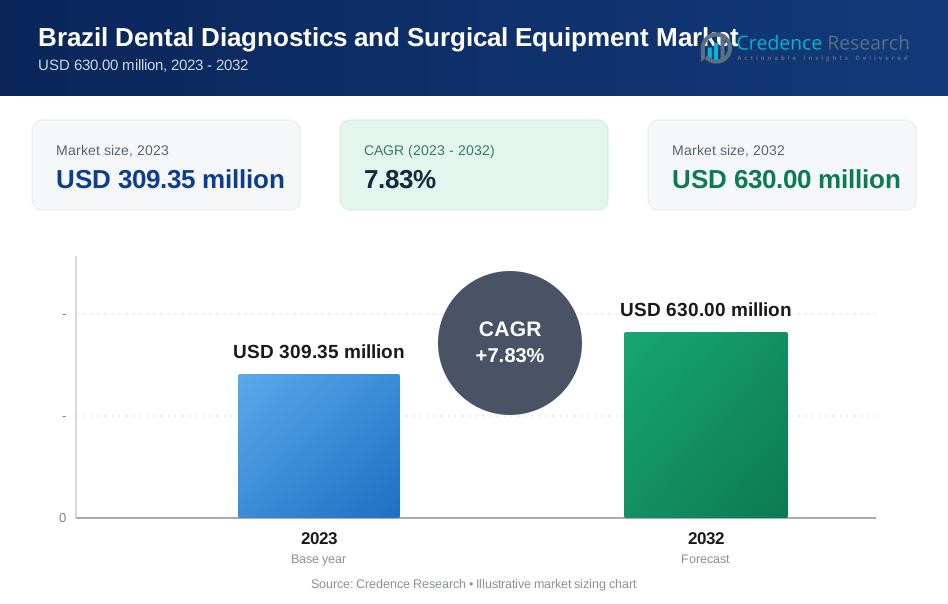
The Brazil Dental Diagnostics and Surgical Equipment market is projected to grow from USD 309.35 million in 2023 to an estimated USD 630.00 million by 2032, reflecting a robust compound annual growth rate (CAGR) of 7.83% from 2024 to 2032. This growth trajectory underscores the rising demand for advanced dental diagnostics and surgical equipment in Brazil, driven by increasing awareness of oral health, a growing aging population, and advancements in dental technology.
Key drivers for the market include a surge in dental disorders such as cavities, periodontal diseases, and oral cancer, prompting the adoption of cutting-edge diagnostic tools and surgical solutions. Emerging trends such as the integration of digital imaging technologies, minimally invasive surgical techniques, and the rising popularity of cosmetic dentistry significantly influence market dynamics. Additionally, the shift towards patient-centric care and personalized treatment approaches is expected to propel demand for innovative dental equipment.
Geographically, the market exhibits significant growth in urban centers such as São Paulo and Rio de Janeiro, where access to advanced healthcare services is higher. However, rural areas are also witnessing gradual improvements due to government-led healthcare initiatives. Key players in the Brazil Dental Diagnostics and Surgical Equipment market include industry leaders such as Dentsply Sirona, 3M, Carestream Dental, Danaher Corporation, and Planmeca, who continuously focus on technological advancements and strategic collaborations to strengthen their market presence.
Market Insights
- The Brazil Dental Diagnostics and Surgical Equipment market is projected to grow from USD 309.35 million in 2023 to USD 630.00 million by 2032, with a CAGR of 7.83% from 2024 to 2032.
- Rising prevalence of dental conditions like cavities, periodontal diseases, and oral cancer is driving the demand for advanced diagnostic and surgical tools.
- Innovations in digital imaging technologies, CAD/CAM systems, and minimally invasive surgical techniques are significantly boosting market growth.
- Healthcare programs aimed at improving dental care accessibility, especially in underserved regions, are expanding the market for dental equipment.
- The high cost of advanced dental equipment remains a key challenge, limiting accessibility for smaller practices and rural areas.
- The Southeast region, particularly cities like São Paulo and Rio de Janeiro, accounts for the largest market share, while rural areas are gradually experiencing improvements.
- Growing interest in aesthetic procedures such as teeth whitening, veneers, and implants is fueling the demand for advanced dental surgical equipment.
Market Drivers
Rising Prevalence of Dental Disorders
Brazil faces a significant burden of dental disorders, with almost 100 million Brazilians experiencing at least one oral disorder in 2019, equating to a prevalence of 45.3%. This high prevalence is largely attributed to poor oral hygiene, dietary habits rich in sugar, and tobacco use. These factors contribute to conditions such as cavities, periodontal diseases, and oral cancer. As a result, there is an increasing demand for early and accurate diagnostic tools like dental X-rays and 3D imaging systems, which are essential for effective diagnosis and treatment planning. Public health campaigns aimed at raising awareness about oral hygiene are also encouraging more people to seek professional dental care.
Advancements in Dental Technology
Technological advancements are revolutionizing the dental industry in Brazil. The integration of digital imaging, CAD/CAM systems, and artificial intelligence (AI) is enhancing diagnostic accuracy and streamlining surgical procedures. For example, digital radiography and 3D imaging systems provide precise visualization of dental structures, facilitating better treatment planning. Additionally, minimally invasive surgical tools such as laser dentistry and ultrasonic devices have improved patient comfort and reduced recovery times. These innovations are becoming increasingly popular among both practitioners and patients.
Growing Geriatric Population and Rising Aesthetic Awareness
The aging population in Brazil significantly contributes to the growth of the dental diagnostics and surgical equipment market. 85.9% of Brazilian seniors require some form of oral treatment. Older adults are more prone to dental issues like tooth loss and gum diseases, necessitating frequent check-ups and interventions. Specialized diagnostic tools for geriatric dentistry help meet the needs of this demographic effectively. Furthermore, there is a growing focus on aesthetic dentistry among younger demographics, driving the demand for procedures like teeth whitening and dental implants. This trend is bolstered by the increasing popularity of cosmetic enhancements.
Improved Healthcare Infrastructure and Government Initiatives
The Brazilian government’s efforts to expand access to dental care through programs like "Brazil Sorridente" (Smiling Brazil) have significantly improved the country’s oral healthcare landscape. These initiatives aim to provide comprehensive dental services, especially in underserved rural and semi-urban areas. Public and private investments in modernizing healthcare facilities have enhanced the availability of advanced dental diagnostic and surgical tools. Furthermore, partnerships between private players and government bodies have fostered the adoption of innovative dental technologies in public healthcare settings, creating a favorable environment for market growth.
Market Trends
Adoption of Digital Dental Technologies
Digital transformation in the dental sector is a prominent trend in Brazil, revolutionizing diagnostics and treatments. Advanced technologies like digital radiography, 3D imaging systems, and intraoral scanners are becoming standard in dental practices. These tools offer higher accuracy, better image quality, and quicker diagnostics, significantly enhancing clinical efficiency. For instance, cone-beam computed tomography (CBCT) has gained traction for its ability to provide detailed three-dimensional views of dental structures, aiding in complex procedures like implant placement and orthodontic treatments. The integration of computer-aided design and manufacturing (CAD/CAM) systems also supports precision in crafting dental prosthetics, further boosting their adoption. The Brazilian market is seeing a shift towards these technologies as practitioners seek to improve patient outcomes and streamline operations.
Rising Popularity of Minimally Invasive Dental Procedures
The preference for minimally invasive dental treatments is on the rise due to their reduced recovery times, enhanced patient comfort, and improved clinical outcomes. Procedures employing laser dentistry, ultrasonic scalers, and advanced surgical tools are increasingly being utilized for applications such as periodontal surgeries, cavity preparation, and root canal treatments. This trend aligns with the growing demand for patient-centric care, where patients seek less discomfort and faster healing. Additionally, innovations in biomaterials for dental implants and restorations, such as bioceramics and zirconia, are supporting this trend by offering durable and aesthetically pleasing solutions. These advancements are particularly appealing to patients who prioritize comfort and efficiency in their dental care.
Growing Focus on Cosmetic Dentistry
Cosmetic dentistry is emerging as a significant trend in Brazil, driven by rising disposable incomes and a heightened emphasis on aesthetics among the population. Treatments such as teeth whitening, veneers, dental bonding, and smile makeovers are becoming increasingly popular. This trend is particularly prevalent among younger demographics who value oral aesthetics as part of their overall appearance. Dental clinics and practitioners are incorporating advanced tools like LED whitening systems and digital smile design software to meet this demand. Furthermore, the influence of social media and the increasing availability of financing options for cosmetic procedures are further driving this trend. As a result, more individuals are investing in cosmetic enhancements to boost their confidence and social presence.
Expansion of Tele-dentistry and Remote Consultations
The adoption of tele-dentistry has gained momentum in Brazil, particularly in response to the challenges posed by the COVID-19 pandemic. Remote consultations have proven invaluable for initial assessments, follow-ups, and oral health education, especially in rural and underserved regions where access to dental care may be limited. Dental practitioners are leveraging video conferencing tools, digital records, and AI-powered diagnostic applications to enhance patient engagement and streamline care delivery. This trend is expected to continue growing as healthcare providers and patients recognize the convenience and cost-effectiveness of tele-dentistry services. The expansion of tele-dentistry is transforming how dental care is accessed and delivered across diverse populations in Brazil.
Market Challenges
High Costs of Advanced Equipment and Limited Affordability
One of the primary challenges facing the Brazil Dental Diagnostics and Surgical Equipment market is the high cost of advanced dental technologies and equipment. Tools such as digital imaging systems, CAD/CAM devices, and laser surgical tools require significant investment, making them inaccessible to many smaller clinics and practitioners. Furthermore, Brazil’s socioeconomic disparities limit the affordability of advanced dental procedures for a large portion of the population. Even with government initiatives to improve healthcare access, the cost barrier often restricts the adoption of innovative solutions in public dental facilities. This challenge is exacerbated by fluctuations in currency exchange rates, which impact the import costs of high-end equipment and materials, further driving up prices.
Uneven Distribution of Dental Care Services
The uneven distribution of dental care services across Brazil poses another significant challenge. While urban centers such as São Paulo and Rio de Janeiro benefit from well-equipped dental clinics and advanced technologies, rural and remote areas often lack basic dental care infrastructure. Limited access to trained professionals, diagnostic tools, and surgical equipment in these regions hinders the overall growth of the market. Although government programs like "Brazil Sorridente" aim to address these disparities, implementation challenges and resource constraints persist. The shortage of skilled dental professionals further compounds the issue, making it difficult to meet the growing demand for quality dental diagnostics and surgical interventions across the country.
Market Opportunities
Expansion of Dental Tourism
Brazil is becoming an increasingly popular destination for dental tourism due to its high-quality dental care services at competitive prices. The country’s well-established healthcare infrastructure, skilled dental professionals, and advanced diagnostic and surgical capabilities attract international patients seeking affordable and effective dental treatments, particularly cosmetic and implant procedures. This growing influx of dental tourists presents a significant opportunity for the market, as dental clinics and equipment suppliers can capitalize on the demand for advanced diagnostic tools and surgical equipment. By focusing on providing world-class services tailored to international patients, businesses in the dental sector can expand their market reach and increase revenue streams.
Government Initiatives and Public-Private Partnerships
Government initiatives aimed at improving dental care access, such as the "Brazil Sorridente" program, provide a substantial opportunity for growth in the Brazil Dental Diagnostics and Surgical Equipment market. These programs, designed to expand oral healthcare services in underserved areas, create demand for both basic and advanced dental equipment. Additionally, the Brazilian government’s focus on public health and oral hygiene awareness has led to increased funding for healthcare infrastructure development. Public-private partnerships offer further opportunities for equipment suppliers to collaborate with government entities and local dental practices, ensuring that the latest diagnostic and surgical technologies are accessible in both urban and rural areas, thereby fostering overall market expansion.
Market Segmentation Analysis
By Product
The Brazil Dental Diagnostics and Surgical Equipment market is segmented into various categories. The Dental Diagnostic Equipment segment includes tools such as X-ray machines, CT scanners, and intraoral cameras, which are seeing strong growth due to increasing awareness of oral health and rising dental disorders. The Dental Surgical Equipment segment, comprising tools like dental lasers, handpieces, and forceps, is driven by the growing demand for minimally invasive surgeries and aesthetic dental procedures. Additionally, while Chronic Back Pain, Cancer Pain, and Migraine are primarily classified under pain management, they represent a niche segment that influences a patient's oral health, leading to a need for specialized dental care and treatments.
By drug Class
The Brazil Dental Diagnostics and Surgical Equipment market includes several key segments driven by technological advancements. CAD/CAM systems, essential for producing precise dental restorations and prosthetics, are improving the accuracy and efficiency of dental procedures, making them a rapidly growing segment. Instrument delivery systems, which automate the delivery of dental instruments during surgeries, are in demand for their ability to enhance workflow, safety, and precision. Extra oral radiology equipment, such as panoramic X-rays and Cone Beam Computed Tomography (CBCT), is expanding as dental practices increasingly adopt advanced diagnostic tools for detailed imaging. Additionally, the niche market for antidepressants, used to manage pain and anxiety during dental procedures, supports patient comfort, contributing indirectly to the overall dental care experience.
Segments
Based on Product
- Dental Diagnostic Equipment
- Dental Surgical Equipment
- Chronic Back Pain
- Cancer Pain
- Migraine
Based on Drug Class
- CAD/CAM Systems
- Instrument Delivery Systems
- Extra Oral Radiology Equipment
- Antidepressants
Based on Dental Surgical Equipment
- Dental Lasers
- Dental Handpieces
- Dental Forceps & Pliers
- Others
Based on End Users
- Solo Practices
- DSO/Group Practices
Based on Region
- Southeast
- Northeast and South
- North and Central-West
Regional Analysis
Southeast Region (45%)
The Southeast region holds the largest market share of approximately 45% in the Brazil Dental Diagnostics and Surgical Equipment market. This dominance is driven by the presence of major metropolitan areas such as São Paulo, Rio de Janeiro, and Belo Horizonte. These cities are home to a high concentration of dental professionals and advanced healthcare facilities, fueling the demand for both diagnostic and surgical dental equipment. Additionally, the region has a higher disposable income and greater awareness of oral health, contributing to the growing adoption of advanced dental technologies. The Southeast also attracts international dental tourists, further boosting market growth for high-end equipment and services.
South Region (25%)
The South region accounts for around 25% of the market share. It includes key states such as Paraná, Santa Catarina, and Rio Grande do Sul, where healthcare infrastructure is well-developed, and dental care services are highly regarded. The growing number of dental practitioners in this region, combined with increased awareness of dental hygiene, creates significant demand for dental diagnostic and surgical equipment. In particular, cities like Porto Alegre and Curitiba have seen a rise in the adoption of cutting-edge dental technologies, such as digital imaging and CAD/CAM systems. The South region also benefits from the expansion of private dental clinics and group practices, contributing to market growth.
Key players
- 3M Healthcare Company
- A-dec Inc.
- Danaher Corporation
- DCI International
- GC Corporation
- Dentsply Sirona
- Angelus Dental
- ZimVie Inc.
Competitive Analysis
In this competitive landscape, 3M Healthcare Company (now operating as Solventum following its spin-off) offers a diverse portfolio of dental solutions, including adhesives and restorative materials, leveraging its extensive expertise in healthcare technology. A-dec Inc. specializes in dental operatory equipment, providing ergonomic dental chairs and delivery systems that enhance clinical efficiency. Danaher Corporation operates through its subsidiaries, delivering advanced dental imaging and diagnostic equipment, thereby strengthening its market position. DCI International focuses on manufacturing dental components and equipment, emphasizing innovation and quality to meet evolving dental practice needs. GC Corporation, a Japanese entity, supplies a wide range of dental materials, including cements and composites, known for their reliability and performance. Dentsply Sirona stands as a global leader, offering comprehensive dental products and technologies, from imaging systems to treatment centers, driving advancements in dental care. Angelus Dental, a Brazilian company, specializes in endodontic and restorative products, catering specifically to the Latin American market. ZimVie Inc. provides dental implants and related surgical instruments, focusing on innovative solutions for oral rehabilitation.
Recent Developments
- In June 2022, 3M Healthcare Company launched Pearl's Second Opinion, a clinical chairside AI software to assist dentists in identifying dental conditions like tooth decay and root abscesses.
- In February 2024, ZimVie Inc. launched the TSX Implant in the Asia Pacific region, showing their commitment to global market expansion.
- In March 2023, Dentsply Sirona introduced the DS OmniTaper Implant System at the AO Annual Meeting, featuring an intuitive drilling protocol and pre-mounted TempBase for immediate restorations.
- In March 2024, GC Corporation launched the GC Initial LiSi Block, a new lithium disilicate CAD/CAM block designed for high-strength aesthetic restorations.
- In April 2024, A-Dec Inc. introduced the A-Dec 500 LED, a new dental light system with advanced LED technology for enhanced illumination and energy efficiency.
Market Concentration and Characteristics
The Brazil Dental Diagnostics and Surgical Equipment market exhibits a moderate level of concentration, with several key players dominating the space, such as 3M Healthcare, Danaher Corporation, Dentsply Sirona, and A-dec Inc. These companies are significant contributors to the market due to their strong brand presence, technological innovations, and comprehensive product portfolios. The market is characterized by a mix of multinational corporations and local manufacturers, with global players focusing on advanced dental technologies like CAD/CAM systems, dental lasers, and digital imaging solutions. While larger players hold a substantial market share, there is also room for regional and smaller players to offer specialized products, such as endodontic tools and dental consumables. This dynamic mix fosters a competitive environment where innovation, quality, and customer service are critical to capturing market share. The ongoing development of dental infrastructure, particularly in underserved regions, further drives market diversification and opportunities for growth.
Report Coverage
The research report offers an in-depth analysis based on Product, Drug Class, Dental Surgical Equipment, End Users and Region. It details leading market players, providing an overview of their business, product offerings, investments, revenue streams, and key applications. Additionally, the report includes insights into the competitive environment, SWOT analysis, current market trends, as well as the primary drivers and constraints. Furthermore, it discusses various factors that have driven market expansion in recent years. The report also explores market dynamics, regulatory scenarios, and technological advancements that are shaping the industry. It assesses the impact of external factors and global economic changes on market growth. Lastly, it provides strategic recommendations for new entrants and established companies to navigate the complexities of the market.
Future Outlook
- As dental professionals seek precision and efficiency, the adoption of advanced diagnostic and surgical tools like digital imaging systems and CAD/CAM technologies is expected to rise.
- Growing awareness about oral health and preventive care will lead to increased demand for diagnostic equipment, such as intraoral scanners and radiography tools.
- With a rising interest in aesthetic dentistry, procedures like teeth whitening, veneers, and implants will drive the demand for advanced dental surgical equipment.
- Brazil’s reputation as a dental tourism hub will continue to attract international patients, further boosting the need for high-quality diagnostic and surgical equipment.
- The integration of artificial intelligence (AI) and digital workflows into dental diagnostics will enhance treatment planning and patient outcomes, increasing market adoption.
- Government programs aimed at improving dental care accessibility, especially in underserved regions, will drive the demand for affordable diagnostic and surgical equipment.
- An increasing elderly population will contribute to the demand for dental procedures related to tooth loss, periodontal diseases, and oral cancer, benefiting the market for surgical and diagnostic tools.
- The growth of Dental Service Organizations (DSOs) and multi-location dental practices will increase demand for standardized, high-quality equipment to serve a larger patient base.
- Government efforts to improve dental healthcare in rural areas will lead to more dental clinics and healthcare facilities, expanding the market for essential equipment in these regions.
- Ongoing advancements in minimally invasive dental surgery, such as laser and ultrasonic treatments, will continue to drive demand for specialized surgical tools, shaping the market's future.
Request a Free Sample
Fill in your details and we'll send you a free sample report.
- Sample data tables & charts
- Research methodology
Need a Custom Version of This Report?
Tailor the scope, geography, or segments to your exact requirements.
- Custom geography or segment scope
- Direct access to our analyst team
Frequently Asked Questions
What is the projected market size of the Brazil Dental Diagnostics and Surgical Equipment market in 2023 and 2032?
What are the main drivers of growth in the Brazil Dental Diagnostics and Surgical Equipment market?
How is the demand for dental equipment evolving in Brazil’s rural areas?
What role do key players play in the Brazil Dental Diagnostics and Surgical Equipment market?
How is the aging population affecting the dental equipment market in Brazil?
Table of Content
Chapter 1. Report Introduction
- 1.1 Report Description & Purpose
- 1.1.1 Report Title & Market Definition
- 1.1.2 Unique Selling Propositions (USP) & Key Differentiators
- 1.1.3 Value Proposition for Stakeholders
- 1.2 Research Objectives
- 1.2.1 Market Sizing Objectives (Volume & Revenue)
- 1.2.2 Segmentation Objectives
- 1.2.3 Competitive Intelligence Objectives
- 1.2.4 Forecast & Scenario Objectives
- 1.3 Report Scope
- 1.3.1 Brazil Dental Diagnostics and Surgical Equipment Scope – Types & Subtypes Covered
- 1.3.2 Geographic Scope – Regions & Countries Covered
- 1.3.3 Historical Period, Base Year & Forecast Period (2023; forecast to 2032)
- 1.3.4 Inclusions & Exclusions
- 1.4 HS Code & Classification Framework
- 1.5 Currency, Units & Pricing Basis
- 1.6 Target Stakeholders
- 1.7 Limitations & Assumptions
Chapter 2. Executive Summary
- 2.1 Global Brazil Dental Diagnostics and Surgical Equipment Market Snapshot
- 2.1.1 Market Size – Historical (2023) & Forecast (2023-2032) (2023: USD 309.35 million → 2032: USD 630.00 million)
- 2.1.2 Volume & Revenue – Global Totals
- 2.1.3 Key Market Highlights – Top Five Facts
- 2.2 Brazil Dental Diagnostics and Surgical Equipment Market Segmentation Snapshot
- 2.2.1 Market Split by Region – 2023 vs. 2032
- 2.3 Competitive Snapshot
- 2.3.1 Top 10 Players by Revenue Share – 2023
- 2.3.2 Top 10 Players by Volume Share – 2023
- 2.3.3 Recent Strategic Developments (18-Month Summary)
- 2.4 Key Investment Highlights & Strategic Conclusions
Chapter 3. Brazil Dental Diagnostics and Surgical Equipment Market Dynamics & Industry Analysis
- 3.1 Market Overview & Context
- 3.1.1 Brazil Dental Diagnostics and Surgical Equipment Market Position in the Broader Automotive Value Chain
- 3.1.2 OEM vs. Replacement Market Dynamics
- 3.1.3 Market Maturity & Development Stage by Region
- 3.2 Brazil Dental Diagnostics and Surgical Equipment Market Drivers
- 3.3 Brazil Dental Diagnostics and Surgical Equipment Market Restraints & Challenges
- 3.4 Brazil Dental Diagnostics and Surgical Equipment Market Opportunities
- 3.5 Porter's Five Forces Analysis
- 3.5.1 Threat of New Entrants
- 3.5.2 Bargaining Power of Suppliers
- 3.5.3 Bargaining Power of Buyers
- 3.5.4 Threat of Substitutes
- 3.5.5 Competitive Rivalry – Intensity Assessment
- 3.6 Brazil Dental Diagnostics and Surgical Equipment Value Chain Analysis
- 3.6.1 Upstream – Raw Material/Input Suppliers
- 3.6.1.1 Raw Material/Input 1
- 3.6.1.2 Raw Material/Input 2
- 3.6.1.3 Raw Material/Input 3
- 3.6.2 Midstream – Production/Manufacturing/Service Delivery
- 3.6.2.1 Production/Process Overview
- 3.6.2.2 Key Facility Locations & Capacity by Manufacturer
- 3.6.3 Downstream – Distribution & End Consumer
- 3.6.3.1 Primary Channel – B2B/OEM
- 3.6.3.2 Secondary Channels – Dealer, Retail, Online, Direct
- 3.6.4 Value Chain Profitability Analysis
- 3.6.1 Upstream – Raw Material/Input Suppliers
- 3.7 PESTEL Analysis
- 3.7.1 Political Factors
- 3.7.2 Economic Factors
- 3.7.3 Social Factors
- 3.7.4 Technological Factors
- 3.7.5 Environmental Factors
- 3.7.6 Legal Factors
- 3.8 Brazil Dental Diagnostics and Surgical Equipment Supply Chain Analysis
- 3.8.1 Raw Material/Input Supply Risk Assessment
- 3.8.2 Manufacturing Concentration Risk (Geographic Exposure)
- 3.8.3 Trade Disruption Impact Analysis
- 3.9 Regulatory & Policy Landscape
Note: The regulatory and policy landscape section covers regulations based on their applicability to the market, Brazil Dental Diagnostics and Surgical Equipment category, geography, and scope of the study. Only regulatory frameworks with a material impact on operations, compliance, trade, sustainability, or market access are analyzed in detail.
Chapter 4. Key Investment Pockets & Opportunity Analysis
- 4.1 Brazil Dental Diagnostics and Surgical Equipment Market Attractiveness Analysis
- 4.1.1 By Region – Investment Attractiveness Matrix (Volume × CAGR)
- 4.2 Absolute Revenue Growth Opportunity
- 4.2.1 By Region – Absolute USD Growth Through 2032
- 4.3 Incremental Volume Opportunity
- 4.3.1 By Region – Incremental Volume Through 2032
- 4.3.2 Segment – Incremental Volume
- 4.4 Emerging Submarket Opportunity Deep Dive (Subject to Applicability)
- 4.5 Emerging Market Opportunity Scorecards
- 4.5.1 United States
- 4.5.2 Europe
- 4.5.3 Asia
- 4.5.4 Middle East & Africa
Note: Emerging Market Opportunity Scorecards will be included based on relevance and strategic importance. Regions listed are indicative and may vary depending on data availability and market dynamics.
Chapter 5. Brazil Dental Diagnostics and Surgical Equipment Import-Export Analysis & Trade Flows
- 5.1 Global Trade Overview
- 5.1.1 Global Export Value by Country (2023)
- 5.1.2 Global Export Volume by Country (2023)
- 5.1.3 Global Import Value by Country (2023)
- 5.1.4 Global Import Volume by Country (2023)
- 5.1.5 Net Trade Balance by Country (2023)
- 5.2 Export Analysis – Segment
- 5.2.1 Type 1 (HS Code)
- 5.2.2 Type 2 (HS Code)
- 5.2.3 Type 3 (HS Code)
- 5.2.4 Type 4 (HS Code)
- 5.2.5 Type 5 (HS Code)
- 5.3 Import Analysis – Segment
- 5.3.1 Type 1 (HS Code)
- 5.3.2 Type 2 (HS Code)
- 5.3.3 Type 3 (HS Code)
- 5.3.4 Type 4 (HS Code)
- 5.3.5 Type 5 (HS Code)
- 5.4 Average Unit Trade Prices
- 5.4.1 Average Export Price – Segment & Country
- 5.4.2 Average Import Price – Segment & Source Country
- 5.4.3 Price Trends (2023)
- 5.5 Key Trade Route Analysis
- 5.5.1 Trade Route 1
- 5.5.2 Trade Route 2
- 5.5.3 Trade Route 3
- 5.5.4 Trade Route 4
- 5.5.5 Trade Route 5
- 5.6 Trade Policy Impact Assessment
- 5.6.1 US Anti-Dumping & Section 301 Tariffs
- 5.6.2 EU Customs Union Impact
- 5.6.3 Major Free Trade Agreements
- 5.6.4 USMCA Rules of Origin
Note: Trade policy analysis will be included only where relevant to the Brazil Dental Diagnostics and Surgical Equipment market.
Chapter 6. Competitive Landscape & Company Benchmarking
- 6.1 Brazil Dental Diagnostics and Surgical Equipment Market Concentration & Structure
- 6.1.1 Herfindahl-Hirschman Index (HHI) – vs. 2023
- 6.1.2 Tier 1, Tier 2 & Tier 3 Market Structure
- 6.1.3 Global, Regional & Local Player Dynamics
- 6.2 Brazil Dental Diagnostics and Surgical Equipment Market Share Analysis – 2023
- 6.2.1 Global Revenue Share by Company
- 6.2.2 Global Volume Share by Company
- 6.2.3 Regional Revenue Share
- 6.2.4 Market Share Evolution ( vs. 2023)
- 6.2.5 OEM Segment Share by Company
- 6.2.6 Replacement Segment Share by Company
- 6.3 Production/Delivery Capacity & Facility Analysis
- 6.3.1 Global Installed Capacity
- 6.3.2 Capacity Utilization Rates
- 6.3.3 Production/Output Volume
- 6.3.4 Facility Locations & Capacity Map
- 6.3.5 Planned Capacity Additions
- 6.4 Brazil Dental Diagnostics and Surgical Equipment Competitive Benchmarking Matrix
- 6.4.1 Revenue, Volume, CAGR & Profitability Comparison
- 6.4.2 Channel Revenue Mix
- 6.4.3 Geographic Revenue Exposure
- 6.4.4 R&D Intensity
- 6.4.5 Sustainability Maturity
- 6.5 Strategic Developments in Brazil Dental Diagnostics and Surgical Equipment (Last 24 Months)
- 6.5.1 Mergers, Acquisitions & Divestments
- 6.5.2 New Brazil Dental Diagnostics and Surgical Equipment Launches
- 6.5.3 Facility Expansions
- 6.5.4 Strategic Alliances, Joint Ventures & Partnerships
- 6.5.5 Distribution Expansion & Market Entry
- 6.5.6 Sustainability & ESG Initiatives
- 6.6 Competitive Strategy Mapping
- 6.6.1 Leader, Challenger, Follower & Niche Classification
- 6.6.2 Pricing Strategy Comparison
- 6.6.3 Channel Strategy Matrix
Note: Strategic developments are included based on their materiality and the availability of reliable information.
Chapter 7. Global Brazil Dental Diagnostics and Surgical Equipment Market – By Distribution Channel
- 7.1 Segment Overview
- 7.1.1 Volume & Revenue Split by Channel (2023 & 2032)
- 7.1.2 Channel Mix Evolution (2023-2032)
Chapter 8. Regional Market Analysis – Global Overview
- 8.1 Global Regional Overview
- 8.1.1 Regional Volume Share
- 8.1.2 Regional Revenue Share
- 8.1.3 Regional Volume by Region
- 8.1.4 Regional Revenue by Region
- 8.1.5 Regional Forecast Through 2032
- 8.2 Cross-Regional Segment Analysis
- 8.2.1 By Distribution Channel
- 8.2.2 By Brand/Price Tier
Chapter 9. North America Brazil Dental Diagnostics and Surgical Equipment Market
- 9.1 United States
- 9.2 Canada
- 9.3 Mexico
Chapter 10. Europe Brazil Dental Diagnostics and Surgical Equipment Market
- 10.1 Germany
- 10.2 France
- 10.3 Italy
- 10.4 United Kingdom
- 10.5 Spain
- 10.6 Poland
- 10.7 Russia
- 10.8 Netherlands
- 10.9 Belgium
- 10.10 Sweden
- 10.11 Denmark
- 10.12 Norway
- 10.13 Rest of Europe
Chapter 11. Asia Pacific Brazil Dental Diagnostics and Surgical Equipment Market
- 11.1 China
- 11.2 India
- 11.3 Japan
- 11.4 South Korea
- 11.5 Thailand
- 11.6 Indonesia
- 11.7 Vietnam
- 11.8 Malaysia
- 11.9 Australia
- 11.10 Rest of Asia Pacific
Chapter 12. Latin America Brazil Dental Diagnostics and Surgical Equipment Market
- 12.1 Brazil
- 12.2 Argentina
- 12.3 Colombia
- 12.4 Chile
- 12.5 Rest of Latin America
Chapter 13. Middle East Brazil Dental Diagnostics and Surgical Equipment Market
- 13.1 Saudi Arabia
- 13.2 United Arab Emirates
- 13.3 Turkey
- 13.4 Israel
- 13.5 Iran
- 13.6 Rest of the Middle East
Chapter 14. Africa Brazil Dental Diagnostics and Surgical Equipment Market
- 14.1 South Africa
- 14.2 Egypt
- 14.3 Nigeria
- 14.4 Morocco
- 14.5 Rest of Africa
Chapter 15. Brazil Dental Diagnostics and Surgical Equipment Company Profiles
- 15.1 [Company 01]
- 15.1.1 Company Overview
- 15.1.2 Key Management Personnel
- 15.1.3 Products & Services Portfolio
- 15.1.4 Financial Performance
- 15.1.5 Key Market Focus & Geographic Presence
- 15.1.6 Recent Developments & Strategic Initiatives
Note: The company profile list is preliminary and may change based on research findings, market developments, data availability, and client requirements.
Chapter 16. Appendices
- Appendix A – List of Abbreviations & Acronyms
- Appendix B – Industry Classification Code Reference – Full Series
- Appendix C – Production & Capacity Data Tables
- Appendix D – End-Use & Demand Base Tables
- Appendix E – Consumption & Replacement Rate Assumptions
- Appendix F – ASP Reference Tables
- Appendix G – Manufacturing & Facility Database
- Appendix H – Import-Export Data Tables
- Appendix I – Regulatory Summary Tables
- Appendix J – Primary Research Participant List (Anonymized)
- Appendix K – Primary Research Questionnaire Framework
- Appendix L – Data Sources & Bibliography
- Appendix M – Market Size Divergence & Source Comparison
Chapter 17. Research Methodology
- 17.1 Research Framework & Philosophy
- 17.2 Secondary Research – Sources, Hierarchy & Data Extraction
- 17.3 Data Modeling – Bottom-Up & Top-Down Market Sizing
- 17.4 Primary Research – Stakeholder Framework, LOI & Sample Sizes
- 17.5 Forecast Methodology – Regression, Scenario & Sensitivity Analysis
- 17.6 Quality Control – Four-Layer Validation Framework
- 17.7 Limitations & Standard Assumptions
- 17.8 Disclaimer
