
Calcium Channel Blocker Market Overview:
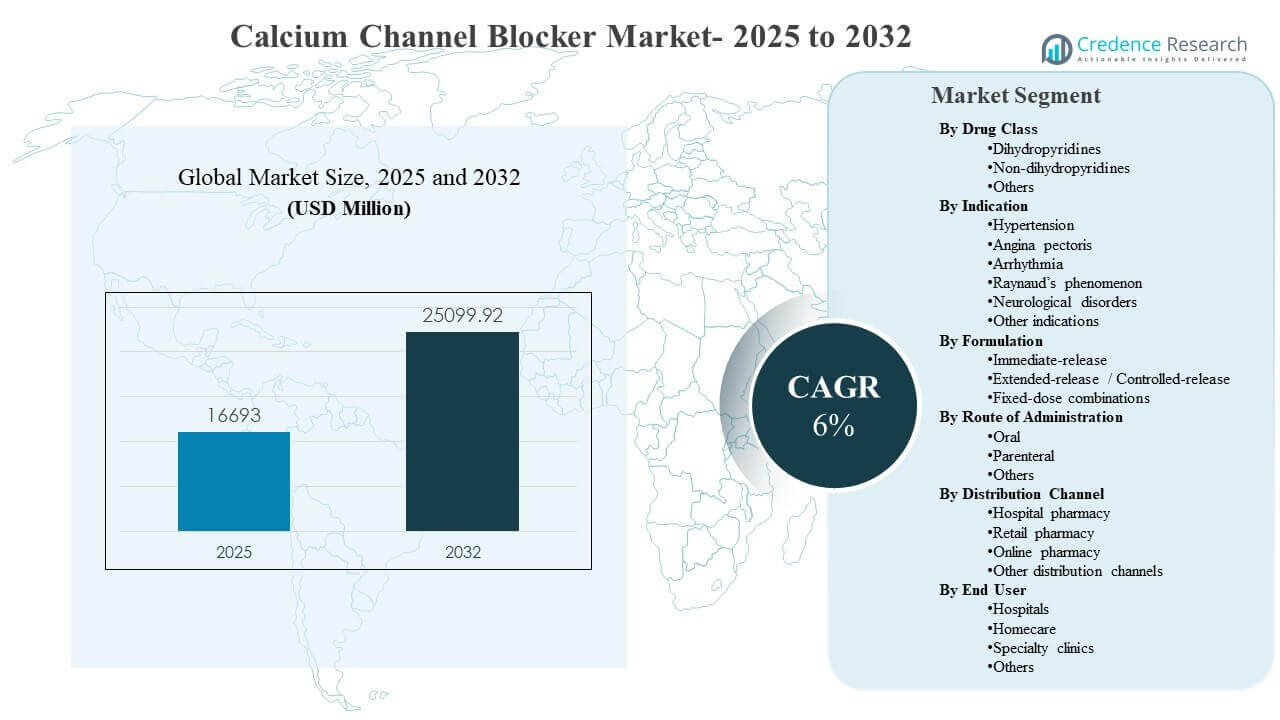
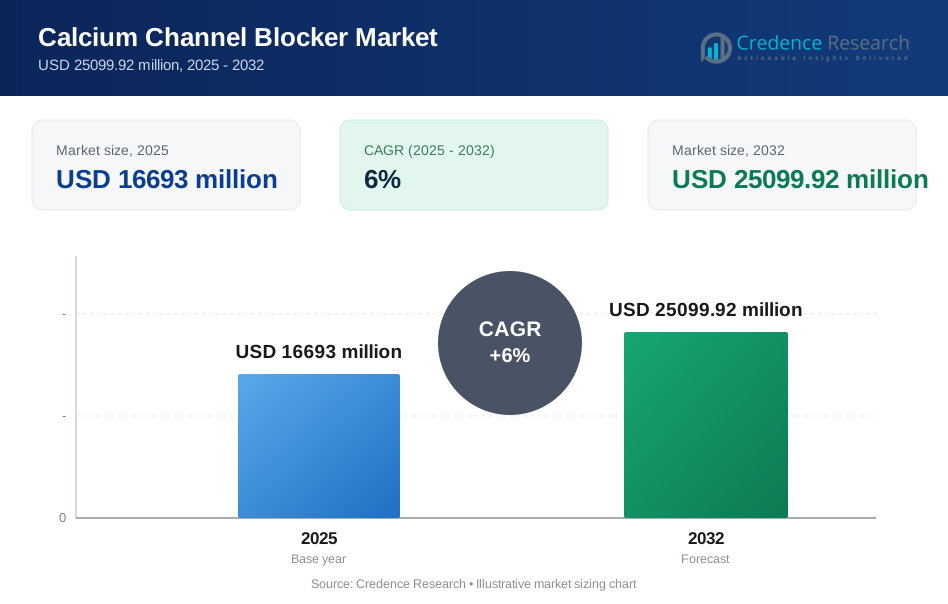
The global Calcium Channel Blocker Market size was estimated at USD 16693 million in 2025 and is expected to reach USD 25099.92 million by 2032, growing at a CAGR of 6% from 2025 to 2032. Rising long-term antihypertensive therapy volumes continue to expand demand as clinical practice increasingly relies on calcium channel blockers for first-line and add-on blood pressure control across broad patient groups. Demand is also supported by ongoing generic substitution, once-daily adherence preferences, and growing use of combination regimens that improve persistence across chronic cardiovascular care pathways.
| REPORT ATTRIBUTE | DETAILS |
|---|---|
| Historical Period | 2020-2024 |
| Base Year | 2025 |
| Forecast Period | 2026-2032 |
| Calcium Channel Blocker Market Size 2025 | USD 16693 million |
| Calcium Channel Blocker Market, CAGR | 6% |
| Calcium Channel Blocker Market Size 2032 | USD 25099.92 million |
Key Market Trends & Insights
- North America accounted for 38.6% share in 2025, supported by high treatment intensity and broad chronic prescription volumes.
- Dihydropyridines accounted for 61.2% share in 2025, reflecting strong positioning in routine hypertension maintenance therapy.
- Hypertension represented 69.9% share in 2025, keeping indication demand concentrated in primary-care prescribing channels.
- Extended-release / controlled-release formulations held 54.3% share in 2025, supported by once-daily dosing and adherence benefits.
- Hospital pharmacies are projected to witness strong growth supported by expanding protocol-driven inpatient and acute-care demand.
Segment Analysis
The Calcium Channel Blocker Market is shaped by high-volume chronic prescribing in hypertension and broad availability of low-cost generics, which keeps refills and adherence-centric formulations structurally important. Dihydropyridines dominate due to wide use in daily blood pressure management and strong physician familiarity, while non-dihydropyridines continue to expand in rhythm and rate-control adjacent use. Extended-release products remain preferred where stable 24-hour coverage and simplified dosing are prioritized, supporting continued demand from older and multi-morbidity populations.
Channel dynamics reinforce the market’s maintenance-therapy profile. Retail pharmacy demand is supported by recurring refills and substitution-driven dispensing, while hospital pharmacy growth is strengthened by acute blood pressure management, inpatient cardiovascular case mix, and formulary-led purchasing patterns. Combination regimens and fixed-dose combinations expand steadily as providers seek improved adherence and faster blood pressure normalization, supporting incremental value growth across mature and emerging markets.
By Drug Class Insights
Dihydropyridines accounted for the largest share of 61.2% in 2025. Dihydropyridines lead because these therapies align well with common hypertension management pathways and are widely used as first-line options in routine practice. Broad generic availability supports affordability and encourages high substitution, sustaining volumes across both public and private channels. Once-daily dosing options and predictable tolerability profiles reinforce persistent use in long-term cardiovascular care.
By Indication Insights
Hypertension accounted for the largest share of 69.9% in 2025. Hypertension leads because the treated patient pool is large and therapy duration is long, generating recurring demand over multiple years. Primary-care initiation patterns drive high prescription volumes and continued refills, especially for established generic molecules. Combination therapy adoption supports ongoing expansion as clinicians aim to improve control rates and reduce pill burden.
By Formulation Insights
Extended-release / Controlled-release accounted for the largest share of 54.3% in 2025. Extended-release formulations lead because once-daily regimens improve adherence in chronic therapy and support smoother pharmacokinetic coverage over 24 hours. Reduced dosing frequency is especially important for older patients and those with multiple comorbidities who manage polypharmacy. Stable blood pressure control and convenience remain core reasons payers and providers sustain preference for controlled-release formats.
By Route of Administration Insights
Oral administration dominates real-world utilization because calcium channel blockers are primarily used for long-term outpatient management, where daily dosing and refill continuity drive recurring demand. Parenteral use is concentrated in acute-care settings for rapid blood pressure control or specific inpatient needs, making the channel smaller but clinically important. The route mix is shaped by care setting, clinical urgency, and protocol-based hospital use patterns.
By Distribution Channel Insights
Retail pharmacy accounted for the largest share of 46.4% in 2025. Retail pharmacy leads because chronic hypertension management depends on monthly refills and substitution-driven dispensing, which channels the majority of demand into community access points. High generic penetration strengthens retail volumes as patients and payers prioritize affordability. Growth in hospital pharmacy is supported by inpatient cardiovascular case mix and tighter formulary management for acute and complex presentations.
By End User Insights
Hospitals remain a central end user because inpatient cardiovascular episodes, acute blood pressure management, and protocol-based prescribing drive consistent utilization in institutional settings. Homecare use grows in parallel with chronic disease prevalence and adherence-focused regimens that shift long-term management to outpatient environments. Specialty clinics contribute through cardiology-led optimization of regimens for complex cases, including combination therapy escalation and monitoring.
Calcium Channel Blocker Market Drivers
Rising Chronic Hypertension Burden and Long-Term Therapy Needs
The Calcium Channel Blocker Market is driven by sustained growth in chronic hypertension treatment volumes across aging and increasingly urbanized populations. Long-duration therapy requirements create recurring demand through refills and therapy intensification cycles over time. Broad clinical reliance on calcium channel blockers for first-line and add-on control supports stable prescription baselines. Primary-care prescribing scale strengthens volume demand, and routine follow-up visits reinforce continuation. These dynamics collectively expand utilization across mature and emerging healthcare systems.
- For instance, Pfizer's amlodipine besylate (Norvasc), evaluated for safety in more than 11,000 patients across U.S. and foreign clinical trials, saw its generic equivalent reach approximately 71 million prescription fills in the United States in 2022 nearly double the 37 million fills recorded in 2004 illustrating the compounding scale of long-term primary-care prescribing for this molecule over successive therapy cycles.
Broad Generic Availability and Cost-Driven Substitution
High generic penetration strengthens affordability and supports wide patient access, especially in large price-sensitive markets. Generic substitution expands volumes through payer-led formularies and pharmacy-level interchangeability where permitted. Competitive pricing increases adherence potential by lowering monthly out-of-pocket costs, supporting long-term persistence. Larger procurement contracts increasingly favor suppliers with reliable quality systems and steady distribution. This driver supports stable market growth even when molecule-level innovation is limited.
Preference for Once-Daily Regimens and Controlled-Release Formats
Adherence priorities support adoption of extended-release products, particularly for patients managing multi-morbidity and complex medication routines. Once-daily dosing improves persistence and reduces missed doses, which supports better control in chronic management pathways. Controlled-release formats also help maintain smoother exposure profiles, reinforcing physician comfort for long-term use. Convenience-driven prescribing supports stable demand across retail and ambulatory settings. These factors elevate the role of formulation strategy in market value growth.
- For instance, amlodipine's engineered pharmacokinetic profile characterized by a plasma half-life of 35–50 hours and a trough-to-peak ratio that remains above 50% even 72 hours after the last active dose enables Pfizer's Norvasc formulation to sustain antihypertensive effect beyond a single dosing interval.
Expanding Use of Combination Therapy and Fixed-Dose Combinations
Combination therapy adoption supports market expansion as clinicians seek faster control and improved outcomes in patients who require more than monotherapy. Fixed-dose combinations help reduce pill burden and simplify chronic regimens, improving persistence in real-world practice. Prescribing pathways increasingly favor early combination approaches for higher-risk profiles. Formulary strategies and payer preferences also support combinations when adherence improvements reduce downstream care costs. This driver contributes to faster growth in combination-focused product lines.
Calcium Channel Blocker Market Challenges
Price competition remains a persistent challenge because many key calcium channel blocker molecules are mature and widely available in generic form. Aggressive bidding and substitution pressure can compress margins and shift volume toward the lowest-cost compliant suppliers. Procurement decisions increasingly depend on supply reliability and regulatory track record, raising the cost of quality and compliance. Channel inventory swings can also occur after quality issues, creating short-term volatility. These factors limit pricing power and raise operational risk.
- For instance, following the patent expiry of amlodipine, generic entry shaved up to 70% off treatment costs across several major markets, triggering intense procurement driven substitution and forcing formulators including Indian and Chinese API suppliers who now account for a majority of global API output—to compete primarily on price in tender rounds.
Quality compliance and impurity controls create additional risk, particularly as regulators maintain strong scrutiny of manufacturing practices for chronic cardiovascular medicines. Recalls or warning letters can disrupt supply continuity and trigger rapid switching by payers, pharmacies, and hospitals. Supplier qualification cycles may become longer and more demanding, adding complexity for manufacturers and distributors. Batch-release constraints and remediation timelines can create shortages in specific strengths or formulations. This challenge raises the importance of robust manufacturing governance.
Calcium Channel Blocker Market Trends and Opportunities
Fixed-dose combinations are gaining momentum as providers prioritize simplified regimens that improve persistence and reduce pill burden in multi-morbidity populations. Opportunities expand where combination pathways are adopted earlier in treatment escalation and where payers recognize adherence-linked benefits. Manufacturers can differentiate through stable supply, optimized dose ratios, and patient-friendly product formats. Portfolio strategies that align combinations with broad hypertension treatment protocols can support sustained growth. These trends support incremental value expansion beyond commodity generics.
- For instance, George Medicines reported that its once-daily GMRx2 single-pill triple combination for hypertension lowered home systolic blood pressure by 31 mmHg after 6 months versus 26 mmHg with standard care, while 81% of patients achieved clinic-measured blood pressure control within 1 month versus 55% on standard care, with control rates still at 82% versus 72% at 6 months.
Extended-release innovation remains an opportunity area as adherence and convenience continue to shape prescribing decisions in chronic cardiovascular therapy. Reformulations that deliver smoother exposure, fewer daily doses, and consistent control can sustain preference across large outpatient populations. Distribution partnerships and pharmacy access strategies can expand reach for high-volume products. Emerging markets also offer growth through improved diagnosis and treatment coverage expansion. These dynamics support continued opportunities across formulation, access, and supply reliability.
Regional Insights
North America
North America accounted for 38.6% share in 2025, supported by strong chronic prescription volumes, high diagnosis and treatment intensity, and broad access to long-term cardiovascular therapies. Generic substitution and established retail dispensing infrastructure reinforce stable demand across outpatient channels. Hospital utilization remains important for acute blood pressure management and inpatient cardiovascular case mix. Formulary control and compliance expectations influence supplier selection and contract stability across major buyers.
Europe
Europe represented 26.9% share in 2025, supported by established hypertension management pathways and high utilization of cost-effective generic medicines. Broad coverage and standardized care protocols drive stable prescribing volumes across primary care and specialist settings. Demand remains anchored in long-term outpatient management, with controlled-release formats supporting adherence-driven prescribing. Regional procurement and reimbursement structures continue to shape pricing and portfolio positioning.
Asia Pacific
Asia Pacific accounted for 23.4% share in 2025, reflecting large patient volumes and expanding treatment access across major markets. Growth is supported by improved diagnosis, rising healthcare utilization, and wider adoption of long-term antihypertensive therapy. Pricing remains generally lower than North America and Europe, but scale supports strong volume demand. Retail channels and increasing chronic disease management capacity strengthen continued market expansion.
Latin America
Latin America held 7.2% share in 2025, supported by improving access to chronic cardiovascular therapy in urban and private healthcare settings. Generic penetration supports affordability, but reimbursement variability and uneven access across countries can constrain therapy persistence. Retail pharmacies remain important for refill continuity, while hospital use supports acute-care demand. Expansion opportunities are linked to improved treatment coverage and stable supply of essential generics.
Middle East & Africa
Middle East & Africa accounted for 3.9% share in 2025, reflecting uneven treatment access and variability in healthcare infrastructure across markets. Demand is concentrated in higher-access countries and urban centers where chronic disease management pathways are more established. Public procurement and affordability constraints shape product mix and supplier positioning. Growth opportunities align with improving diagnosis rates, guideline adoption, and expanding access to long-term antihypertensive therapy.
Competitive Landscape
The Calcium Channel Blocker Market is highly competitive due to mature molecule portfolios, strong genericization, and high substitution across major indications such as hypertension and angina. Manufacturers compete on supply reliability, regulatory compliance, breadth of strengths and formulations, and contracting capability across retail and institutional channels. Differentiation increasingly comes from controlled-release formats, fixed-dose combinations, and consistent availability across high-volume SKUs. Channel strategy, distribution depth, and quality governance remain decisive for sustaining large tenders and pharmacy relationships.
Pfizer Inc. maintains relevance through established cardiovascular portfolios, commercial scale, and experience in navigating regulated markets with consistent manufacturing and distribution standards. The company’s approach typically emphasizes portfolio continuity, channel coverage, and alignment with payer and provider needs in chronic cardiovascular care. Market positioning benefits from strong compliance frameworks and the ability to support large-scale procurement requirements. Strategic focus on therapeutic breadth and supply resilience supports competitive stability in mature drug classes.
The industry research and growth report includes detailed analyses of the competitive landscape of the market and information about key companies, including:
- Pfizer Inc.
- Viatris Inc. (Mylan)
- Teva Pharmaceutical Industries Ltd.
- Sun Pharmaceutical Industries Ltd.
- Novartis AG
- Bausch Health
- Zydus Group
- Lupin
- GSK (GlaxoSmithKline)
- Glenmark Pharmaceuticals
- Amneal Pharmaceuticals
- Covis Pharma
- Sofgen
- Dr. Reddy’s Laboratories
Qualitative and quantitative analysis of companies has been conducted to help clients understand the wider business environment as well as the strengths and weaknesses of key industry players. Data is qualitatively analyzed to categorize companies as pure play, category-focused, industry-focused, and diversified; it is quantitatively analyzed to categorize companies as dominant, leading, strong, tentative, and weak.
Recent Developments
- In August 2025, George Medicines and Piramal Pharma Solutions reported a partnership update around WIDAPLIK, a hypertension therapy that combines telmisartan, amlodipine, and indapamide in one pill, with Piramal supporting formulation development and manufacturing for the program.
- In May 2024, Akums Drugs & Pharmaceuticals introduced a new fixed-dose combination of amlodipine, telmisartan, and metoprolol extended-release tablets for hypertension management after receiving DCGI approval.
Report Scope
| Report Attribute | Details |
| Market size value in 2025 | USD 16693 million |
| Revenue forecast in 2032 | USD 25099.92 million |
| Growth rate (CAGR) | 6% (2025–2032) |
| Base year | 2025 |
| Forecast period | 2026-2032 |
| Quantitative units | USD million |
| Segments covered | By Drug Class Outlook: Dihydropyridines; Non-dihydropyridines (Phenylalkylamines; Benzothiazepines/Benzothizepines); Others; By Indication Outlook: Hypertension; Angina pectoris; Arrhythmia; Raynaud’s phenomenon; Neurological disorders; Other indications; By Formulation Outlook: Immediate-release; Extended-release / Controlled-release; Fixed-dose combinations; By Route of Administration Outlook: Oral; Parenteral; Others; By Distribution Channel Outlook: Hospital pharmacy; Retail pharmacy; Online pharmacy; Other distribution channels; By End User Outlook: Hospitals; Homecare; Specialty clinics; Others |
| Regional scope | North America, Europe, Asia Pacific, Latin America, Middle East & Africa |
| Key companies profiled | Pfizer Inc.; Viatris Inc. (Mylan); Teva Pharmaceutical Industries Ltd.; Sun Pharmaceutical Industries Ltd.; Novartis AG; Bausch Health; Zydus Group; Lupin; GSK (GlaxoSmithKline); Glenmark Pharmaceuticals; Amneal Pharmaceuticals; Covis Pharma; Sofgen; Dr. Reddy’s Laboratories |
| No. of Pages | 340 |
By Segmentation
By Drug Class
- Dihydropyridines (e.g., amlodipine, nifedipine, felodipine, nicardipine)
- Non-dihydropyridines [Phenylalkylamines (e.g., verapamil), Benzothiazepines / Benzothizepines (e.g., diltiazem)]
- Others
By Indication
- Hypertension
- Angina pectoris
- Arrhythmia
- Raynaud’s phenomenon
- Neurological disorders
- Other indications
By Formulation
- Immediate-release
- Extended-release / Controlled-release
- Fixed-dose combinations
By Route Of Administration
- Oral
- Parenteral
- Others
By Distribution Channel
- Hospital pharmacy
- Retail pharmacy
- Online pharmacy
- Other distribution channels
By End User
- Hospitals
- Homecare
- Specialty clinics
- Others
By Region
- North America
- U.S.
- Canada
- Mexico
- Europe
- Germany
- France
- U.K.
- Italy
- Spain
- Rest of Europe
- Asia Pacific
- China
- Japan
- India
- South Korea
- South-east Asia
- Rest of Asia Pacific
- Latin America
- Brazil
- Argentina
- Rest of Latin America
- Middle East & Africa
- GCC Countries
- South Africa
- Rest of the Middle East and Africa
Request a Free Sample
Fill in your details and we'll send you a free sample report.
- Sample data tables & charts
- Research methodology
Need a Custom Version of This Report?
Tailor the scope, geography, or segments to your exact requirements.
- Custom geography or segment scope
- Direct access to our analyst team
Frequently Asked Questions
What is the market size of the Calcium Channel Blocker Market in 2025 and 2032?
What is the CAGR for the Calcium Channel Blocker Market during 2025–2032?
Which segment is the largest in the Calcium Channel Blocker Market?
What factors are driving growth in the Calcium Channel Blocker Market?
Who are the leading companies in the Calcium Channel Blocker Market?
Which region leads the Calcium Channel Blocker Market?
Table of Content
Chapter 1. Report Introduction
- 1.1 Report Description & Purpose
- 1.1.1 Report Title & Market Definition
- 1.1.2 Unique Selling Propositions (USP) & Key Differentiators
- 1.1.3 Value Proposition for Stakeholders
- 1.2 Research Objectives
- 1.2.1 Market Sizing Objectives (Volume & Revenue)
- 1.2.2 Segmentation Objectives
- 1.2.3 Competitive Intelligence Objectives
- 1.2.4 Forecast & Scenario Objectives
- 1.3 Report Scope
- 1.3.1 Calcium Channel Blocker Scope – Types & Subtypes Covered
- 1.3.2 Geographic Scope – Regions & Countries Covered
- 1.3.3 Historical Period, Base Year & Forecast Period (2025; forecast to 2032)
- 1.3.4 Inclusions & Exclusions
- 1.4 HS Code & Classification Framework
- 1.5 Currency, Units & Pricing Basis
- 1.6 Target Stakeholders
- 1.7 Limitations & Assumptions
Chapter 2. Executive Summary
- 2.1 Global Calcium Channel Blocker Market Snapshot
- 2.1.1 Market Size – Historical (2025) & Forecast (2025-2032) (2025: USD 16693 million → 2032: USD 25099.92 million)
- 2.1.2 Volume & Revenue – Global Totals
- 2.1.3 Key Market Highlights – Top Five Facts
- 2.2 Calcium Channel Blocker Market Segmentation Snapshot
- 2.2.1 Market Split by Region – 2025 vs. 2032
- 2.3 Competitive Snapshot
- 2.3.1 Top 10 Players by Revenue Share – 2025
- 2.3.2 Top 10 Players by Volume Share – 2025
- 2.3.3 Recent Strategic Developments (18-Month Summary)
- 2.4 Key Investment Highlights & Strategic Conclusions
Chapter 3. Calcium Channel Blocker Market Dynamics & Industry Analysis
- 3.1 Market Overview & Context
- 3.1.1 Calcium Channel Blocker Market Position in the Broader Automotive Value Chain
- 3.1.2 OEM vs. Replacement Market Dynamics
- 3.1.3 Market Maturity & Development Stage by Region
- 3.2 Calcium Channel Blocker Market Drivers
- 3.3 Calcium Channel Blocker Market Restraints & Challenges
- 3.4 Calcium Channel Blocker Market Opportunities
- 3.5 Porter's Five Forces Analysis
- 3.5.1 Threat of New Entrants
- 3.5.2 Bargaining Power of Suppliers
- 3.5.3 Bargaining Power of Buyers
- 3.5.4 Threat of Substitutes
- 3.5.5 Competitive Rivalry – Intensity Assessment
- 3.6 Calcium Channel Blocker Value Chain Analysis
- 3.6.1 Upstream – Raw Material/Input Suppliers
- 3.6.1.1 Raw Material/Input 1
- 3.6.1.2 Raw Material/Input 2
- 3.6.1.3 Raw Material/Input 3
- 3.6.2 Midstream – Production/Manufacturing/Service Delivery
- 3.6.2.1 Production/Process Overview
- 3.6.2.2 Key Facility Locations & Capacity by Manufacturer
- 3.6.3 Downstream – Distribution & End Consumer
- 3.6.3.1 Primary Channel – B2B/OEM
- 3.6.3.2 Secondary Channels – Dealer, Retail, Online, Direct
- 3.6.4 Value Chain Profitability Analysis
- 3.6.1 Upstream – Raw Material/Input Suppliers
- 3.7 PESTEL Analysis
- 3.7.1 Political Factors
- 3.7.2 Economic Factors
- 3.7.3 Social Factors
- 3.7.4 Technological Factors
- 3.7.5 Environmental Factors
- 3.7.6 Legal Factors
- 3.8 Calcium Channel Blocker Supply Chain Analysis
- 3.8.1 Raw Material/Input Supply Risk Assessment
- 3.8.2 Manufacturing Concentration Risk (Geographic Exposure)
- 3.8.3 Trade Disruption Impact Analysis
- 3.9 Regulatory & Policy Landscape
Note: The regulatory and policy landscape section covers regulations based on their applicability to the market, Calcium Channel Blocker category, geography, and scope of the study. Only regulatory frameworks with a material impact on operations, compliance, trade, sustainability, or market access are analyzed in detail.
Chapter 4. Key Investment Pockets & Opportunity Analysis
- 4.1 Calcium Channel Blocker Market Attractiveness Analysis
- 4.1.1 By Region – Investment Attractiveness Matrix (Volume × CAGR)
- 4.2 Absolute Revenue Growth Opportunity
- 4.2.1 By Region – Absolute USD Growth Through 2032
- 4.3 Incremental Volume Opportunity
- 4.3.1 By Region – Incremental Volume Through 2032
- 4.3.2 Segment – Incremental Volume
- 4.4 Emerging Submarket Opportunity Deep Dive (Subject to Applicability)
- 4.5 Emerging Market Opportunity Scorecards
- 4.5.1 United States
- 4.5.2 Europe
- 4.5.3 Asia
- 4.5.4 Middle East & Africa
Note: Emerging Market Opportunity Scorecards will be included based on relevance and strategic importance. Regions listed are indicative and may vary depending on data availability and market dynamics.
Chapter 5. Calcium Channel Blocker Import-Export Analysis & Trade Flows
- 5.1 Global Trade Overview
- 5.1.1 Global Export Value by Country (2025)
- 5.1.2 Global Export Volume by Country (2025)
- 5.1.3 Global Import Value by Country (2025)
- 5.1.4 Global Import Volume by Country (2025)
- 5.1.5 Net Trade Balance by Country (2025)
- 5.2 Export Analysis – Segment
- 5.2.1 Type 1 (HS Code)
- 5.2.2 Type 2 (HS Code)
- 5.2.3 Type 3 (HS Code)
- 5.2.4 Type 4 (HS Code)
- 5.2.5 Type 5 (HS Code)
- 5.3 Import Analysis – Segment
- 5.3.1 Type 1 (HS Code)
- 5.3.2 Type 2 (HS Code)
- 5.3.3 Type 3 (HS Code)
- 5.3.4 Type 4 (HS Code)
- 5.3.5 Type 5 (HS Code)
- 5.4 Average Unit Trade Prices
- 5.4.1 Average Export Price – Segment & Country
- 5.4.2 Average Import Price – Segment & Source Country
- 5.4.3 Price Trends (2025)
- 5.5 Key Trade Route Analysis
- 5.5.1 Trade Route 1
- 5.5.2 Trade Route 2
- 5.5.3 Trade Route 3
- 5.5.4 Trade Route 4
- 5.5.5 Trade Route 5
- 5.6 Trade Policy Impact Assessment
- 5.6.1 US Anti-Dumping & Section 301 Tariffs
- 5.6.2 EU Customs Union Impact
- 5.6.3 Major Free Trade Agreements
- 5.6.4 USMCA Rules of Origin
Note: Trade policy analysis will be included only where relevant to the Calcium Channel Blocker market.
Chapter 6. Competitive Landscape & Company Benchmarking
- 6.1 Calcium Channel Blocker Market Concentration & Structure
- 6.1.1 Herfindahl-Hirschman Index (HHI) – vs. 2025
- 6.1.2 Tier 1, Tier 2 & Tier 3 Market Structure
- 6.1.3 Global, Regional & Local Player Dynamics
- 6.2 Calcium Channel Blocker Market Share Analysis – 2025
- 6.2.1 Global Revenue Share by Company
- 6.2.2 Global Volume Share by Company
- 6.2.3 Regional Revenue Share
- 6.2.4 Market Share Evolution ( vs. 2025)
- 6.2.5 OEM Segment Share by Company
- 6.2.6 Replacement Segment Share by Company
- 6.3 Production/Delivery Capacity & Facility Analysis
- 6.3.1 Global Installed Capacity
- 6.3.2 Capacity Utilization Rates
- 6.3.3 Production/Output Volume
- 6.3.4 Facility Locations & Capacity Map
- 6.3.5 Planned Capacity Additions
- 6.4 Calcium Channel Blocker Competitive Benchmarking Matrix
- 6.4.1 Revenue, Volume, CAGR & Profitability Comparison
- 6.4.2 Channel Revenue Mix
- 6.4.3 Geographic Revenue Exposure
- 6.4.4 R&D Intensity
- 6.4.5 Sustainability Maturity
- 6.5 Strategic Developments in Calcium Channel Blocker (Last 24 Months)
- 6.5.1 Mergers, Acquisitions & Divestments
- 6.5.2 New Calcium Channel Blocker Launches
- 6.5.3 Facility Expansions
- 6.5.4 Strategic Alliances, Joint Ventures & Partnerships
- 6.5.5 Distribution Expansion & Market Entry
- 6.5.6 Sustainability & ESG Initiatives
- 6.6 Competitive Strategy Mapping
- 6.6.1 Leader, Challenger, Follower & Niche Classification
- 6.6.2 Pricing Strategy Comparison
- 6.6.3 Channel Strategy Matrix
Note: Strategic developments are included based on their materiality and the availability of reliable information.
Chapter 7. Global Calcium Channel Blocker Market – By Distribution Channel
- 7.1 Segment Overview
- 7.1.1 Volume & Revenue Split by Channel (2025 & 2032)
- 7.1.2 Channel Mix Evolution (2025-2032)
Chapter 8. Regional Market Analysis – Global Overview
- 8.1 Global Regional Overview
- 8.1.1 Regional Volume Share
- 8.1.2 Regional Revenue Share
- 8.1.3 Regional Volume by Region
- 8.1.4 Regional Revenue by Region
- 8.1.5 Regional Forecast Through 2032
- 8.2 Cross-Regional Segment Analysis
- 8.2.1 By Distribution Channel
- 8.2.2 By Brand/Price Tier
Chapter 9. North America Calcium Channel Blocker Market
- 9.1 United States
- 9.2 Canada
- 9.3 Mexico
Chapter 10. Europe Calcium Channel Blocker Market
- 10.1 Germany
- 10.2 France
- 10.3 Italy
- 10.4 United Kingdom
- 10.5 Spain
- 10.6 Poland
- 10.7 Russia
- 10.8 Netherlands
- 10.9 Belgium
- 10.10 Sweden
- 10.11 Denmark
- 10.12 Norway
- 10.13 Rest of Europe
Chapter 11. Asia Pacific Calcium Channel Blocker Market
- 11.1 China
- 11.2 India
- 11.3 Japan
- 11.4 South Korea
- 11.5 Thailand
- 11.6 Indonesia
- 11.7 Vietnam
- 11.8 Malaysia
- 11.9 Australia
- 11.10 Rest of Asia Pacific
Chapter 12. Latin America Calcium Channel Blocker Market
- 12.1 Brazil
- 12.2 Argentina
- 12.3 Colombia
- 12.4 Chile
- 12.5 Rest of Latin America
Chapter 13. Middle East Calcium Channel Blocker Market
- 13.1 Saudi Arabia
- 13.2 United Arab Emirates
- 13.3 Turkey
- 13.4 Israel
- 13.5 Iran
- 13.6 Rest of the Middle East
Chapter 14. Africa Calcium Channel Blocker Market
- 14.1 South Africa
- 14.2 Egypt
- 14.3 Nigeria
- 14.4 Morocco
- 14.5 Rest of Africa
Chapter 15. Calcium Channel Blocker Company Profiles
- 15.1 [Company 01]
- 15.1.1 Company Overview
- 15.1.2 Key Management Personnel
- 15.1.3 Products & Services Portfolio
- 15.1.4 Financial Performance
- 15.1.5 Key Market Focus & Geographic Presence
- 15.1.6 Recent Developments & Strategic Initiatives
Note: The company profile list is preliminary and may change based on research findings, market developments, data availability, and client requirements.
Chapter 16. Appendices
- Appendix A – List of Abbreviations & Acronyms
- Appendix B – Industry Classification Code Reference – Full Series
- Appendix C – Production & Capacity Data Tables
- Appendix D – End-Use & Demand Base Tables
- Appendix E – Consumption & Replacement Rate Assumptions
- Appendix F – ASP Reference Tables
- Appendix G – Manufacturing & Facility Database
- Appendix H – Import-Export Data Tables
- Appendix I – Regulatory Summary Tables
- Appendix J – Primary Research Participant List (Anonymized)
- Appendix K – Primary Research Questionnaire Framework
- Appendix L – Data Sources & Bibliography
- Appendix M – Market Size Divergence & Source Comparison
Chapter 17. Research Methodology
- 17.1 Research Framework & Philosophy
- 17.2 Secondary Research – Sources, Hierarchy & Data Extraction
- 17.3 Data Modeling – Bottom-Up & Top-Down Market Sizing
- 17.4 Primary Research – Stakeholder Framework, LOI & Sample Sizes
- 17.5 Forecast Methodology – Regression, Scenario & Sensitivity Analysis
- 17.6 Quality Control – Four-Layer Validation Framework
- 17.7 Limitations & Standard Assumptions
- 17.8 Disclaimer
