
Cancer Stem Cells Market Overview:
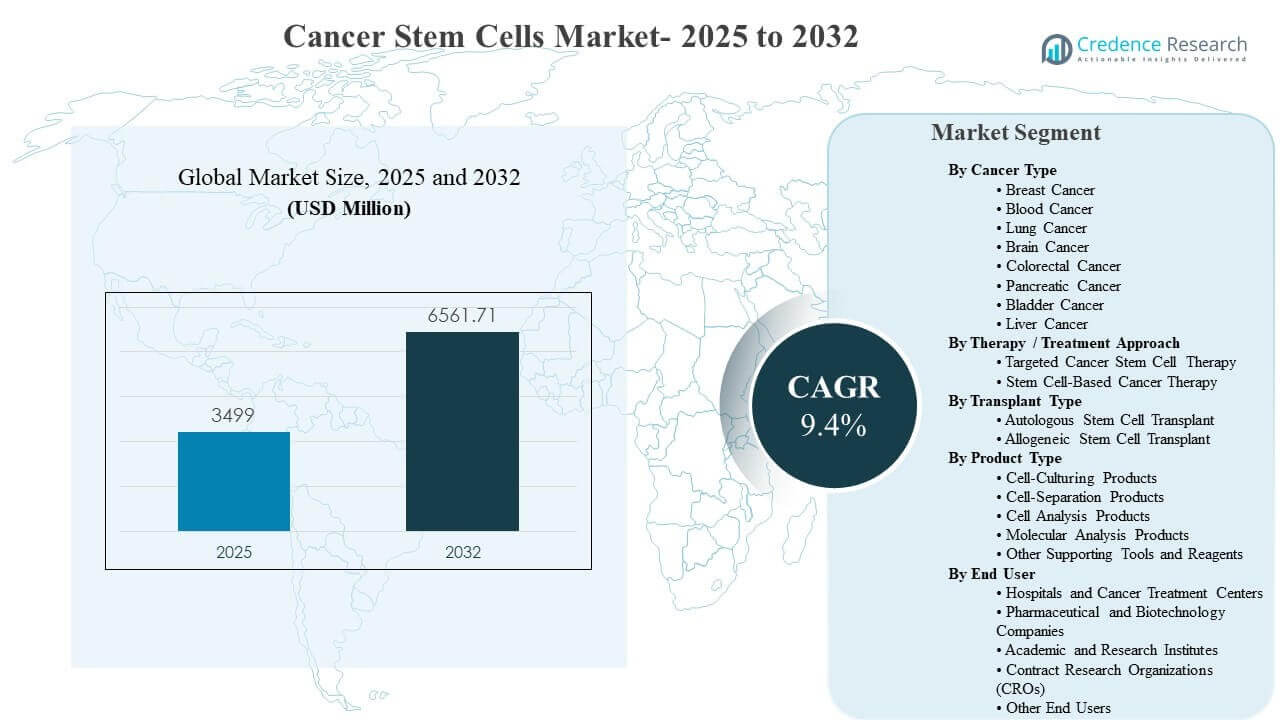
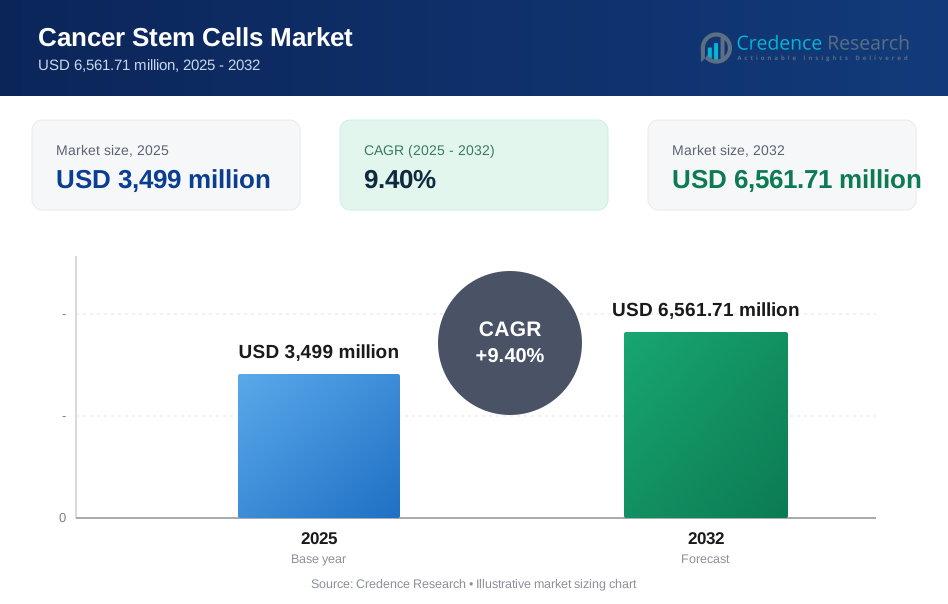
The global Cancer Stem Cells Market size was estimated at USD 3,499 million in 2025 and is expected to reach USD 6,561.71 million by 2032, growing at a CAGR of 9.4% from 2025 to 2032. Growth is primarily driven by rising oncology drug discovery and translational research efforts focused on recurrence and treatment resistance, which increase demand for CSC-enriched models, pathway assays, and characterization workflows. Expansion of advanced tumor modeling platforms and broader clinical trial activity across major oncology indications further accelerates adoption across research and clinical ecosystems.
| REPORT ATTRIBUTE | DETAILS |
|---|---|
| Historical Period | 2020-2024 |
| Base Year | 2025 |
| Forecast Period | 2026-2032 |
| Cancer Stem Cells Market Size 2025 | USD 3,499 million |
| Cancer Stem Cells Market, CAGR | 9.4% |
| Cancer Stem Cells Market Size 2032 | USD 6,561.71 million |
Key Market Trends & Insights
- The Cancer Stem Cells Market is projected to expand at 9.4% CAGR (2025–2032), reflecting sustained investment in relapse-prevention and resistance-focused oncology R&D.
- Targeted Cancer Stem Cell (CSC) Therapy accounted for the largest share of 55.2% in 2025, supported by prioritization of pathway-directed strategies in advanced disease settings.
- Autologous Stem Cell Transplant represented 49.6% in 2025, reflecting strong clinical familiarity, established protocols, and broad availability across oncology centers.
- Cell-Culturing Products held 31.0% in 2025, indicating that culture media, matrices, and standardized growth systems remain the highest-frequency purchasing area.
- Asia Pacific captured 27.6% in 2025, highlighting rapid scaling of oncology research capacity and increasing uptake of advanced cell analysis and tumor modeling workflows.
Segment Analysis
Cancer Stem Cells Market segmentation reflects the balance between discovery-stage biology and translation into clinically meaningful interventions. Demand is rising for reproducible CSC enrichment workflows, including defined culture systems, consistent processing tools, and robust analytical platforms that reduce variability across studies. Buyers increasingly favor end-to-end solutions that connect sample handling, culture, phenotyping, and molecular profiling to support decision-making in preclinical development and biomarker discovery.
Cancer Stem Cells Market growth also reflects growing integration of CSC hypotheses into therapy design, particularly in settings where relapse risk remains high. Target validation and combination therapy evaluation are pushing adoption of advanced assays that can differentiate tumor-initiating populations and measure functional responses beyond bulk tumor shrinkage. Across research and clinical environments, purchasing decisions are increasingly influenced by standardization, scalability, and compatibility with multi-omics and high-throughput workflows.
By Cancer Type Insights
Breast Cancer accounted for the largest share of 23.1% in 2025. Breast oncology research remains highly active in tumor heterogeneity and relapse biology, which expands demand for CSC isolation, phenotyping, and pathway interrogation. Strong translational pipelines and extensive biomarker programs encourage use of CSC models to evaluate resistance mechanisms. Broad availability of patient-derived samples and established model systems further supports sustained segment leadership.
By Therapy / Treatment Approach Insights
Targeted Cancer Stem Cell (CSC) Therapy accounted for the largest share of 55.2% in 2025. Targeted approaches lead because CSC-focused pathway inhibition is increasingly positioned as a direct method to reduce recurrence and therapy resistance. Improved characterization of CSC niches and surface markers enables better stratification and supports targeted program design. Combination strategies that align CSC targeting with precision oncology and immuno-oncology approaches continue to strengthen clinical and preclinical interest.
By Transplant Type Insights
Autologous Stem Cell Transplant accounted for the largest share of 49.6% in 2025. Autologous procedures remain common due to mature protocols, wider availability in oncology centers, and streamlined operational workflows versus donor-dependent alternatives. Consistent clinical familiarity supports continued utilization in eligible patient groups across hematologic malignancies. Improvements in cell processing and supportive care further reinforce adoption and procedural throughput in high-volume treatment settings.
By Product Type Insights
Cell-Culturing Products accounted for the largest share of 31.0% in 2025. Culture systems lead because CSC enrichment, organoid generation, and functional assays depend heavily on optimized media, supplements, and matrices. Standardization needs across discovery and translational programs increase preference for defined, reproducible culture workflows. High frequency of consumable usage and repeat purchasing cycles strengthens revenue concentration in culturing-focused product lines.
By End User Insights
Hospitals and cancer treatment centers, pharmaceutical and biotechnology companies, academic and research institutes, and contract research organizations all contribute meaningfully to Cancer Stem Cells Market demand. Hospitals and cancer centers support translational research and trial participation, which increases adoption of CSC assays and profiling workflows. Pharmaceutical and biotechnology companies drive spending through pipeline expansion and the need for predictive tumor models. Academic institutes and CROs sustain usage through discovery research, outsourced experimentation, and scalable assay services aligned with sponsor requirements.
Cancer Stem Cells Market Drivers
Rising Focus on Relapse and Treatment Resistance
Cancer Stem Cells Market growth is supported by increasing clinical emphasis on recurrence prevention and resistance management across major cancer indications. CSC biology is frequently investigated as a contributor to tumor re-initiation, prompting higher investment in CSC-enriched models and functional assays. Drug developers adopt CSC profiling to validate targets and identify escape pathways earlier in development. Research teams also integrate CSC endpoints into translational programs to improve therapy selection and post-treatment monitoring strategies.
- For instance, Tempus’ FDA-approved xT CDx profiles 648 genes in solid tumors and includes microsatellite instability assessment together with a tumor-normal matched sequencing approach, giving developers a broad molecular framework for identifying resistance-associated variants earlier in oncology programs.
Expansion of Translational Oncology and Biomarker Programs
Cancer Stem Cells Market demand rises as biomarker-driven oncology programs expand across diagnostics, trial design, and therapeutic development. Laboratories increasingly rely on CSC markers and pathway signatures to refine patient stratification and evaluate response mechanisms. Translational workflows favor platforms that can connect culture-based enrichment with molecular analysis and phenotypic readouts. Growing availability of patient-derived samples and biobanking activity further increases experimentation volume across tumor types.
- For instance, Foundation Medicine’s FoundationOne CDx interrogates 324 genes, and published validation for the assay covered more than 30,000 test results, highlighting the scale at which biomarker platforms are being integrated into precision-oncology workflows.
Growth in Advanced Tumor Modeling and 3D Culture Adoption
Cancer Stem Cells Market momentum is strengthened by wider adoption of 3D tumor models, organoids, and microenvironment-mimicking systems. CSC studies benefit from models that preserve heterogeneity and enable functional testing under conditions closer to in-vivo biology. Purchasers prioritize culture reagents and matrices that improve reproducibility and support scalable screening. These trends raise recurring consumable demand and reinforce investment in complementary analysis and separation tools.
Increasing Outsourcing and Scale-Up of Oncology R&D
Cancer Stem Cells Market expansion is supported by greater outsourcing of specialized assays and model development to CROs and research partners. Sponsors seek scalable, standardized workflows that can be replicated across programs and geographies, which increases demand for validated kits, protocols, and integrated platforms. CRO capacity growth encourages tool adoption that accelerates turnaround time and supports high-throughput studies. This outsourcing trend also broadens adoption beyond large pharma into emerging biotech and academic collaborations.
Cancer Stem Cells Market Challenges
Cancer Stem Cells Market faces challenges related to biological complexity and variability across tumor types, patient samples, and microenvironment influences. CSC definitions and marker sets can differ across studies, creating inconsistencies in enrichment outcomes and cross-study comparability. Limited standardization in sample handling, culture conditions, and analytical thresholds can increase noise in results and slow translation into clinically validated workflows. These factors raise validation burden for tool providers and users.
- For instance, NanoString reported that its CosMx Spatial Molecular Imager whole-transcriptome prototype can analyze almost 19,000 genes at true single-cell and subcellular resolution, which shows how increasingly high-dimensional tumor profiling can intensify the need for standardized CSC marker selection, sample preparation, and analytical cutoffs across studies.
Cancer Stem Cells Market growth is also constrained by cost and operational barriers associated with advanced cell processing and multi-omics analysis. High-quality culture systems, specialized reagents, and high-sensitivity analytics can be expensive for smaller laboratories and resource-limited institutions. Skilled personnel requirements and strict quality controls increase operating complexity, particularly for assays intended for translational or regulated environments. Budget constraints can delay adoption and extend procurement cycles for premium platforms.
Market Trends and Opportunities
Cancer Stem Cells Market trends increasingly favor reproducible, defined culture systems and standardized workflows that reduce variability in CSC enrichment and functional assays. Buyers are shifting toward synthetic or fully defined matrices and media systems that support consistent 3D growth and downstream profiling. Broader integration of multi-parameter analytics, including genomics, proteomics, and phenotypic readouts, is improving interpretability and enabling better target validation. These shifts create opportunities for bundled solutions and workflow-based product positioning.
- For instance, Corning reports that its spheroid microplates are available in 96-, 384-, and 1536-well formats, that most cell lines form spheroids within 24 hours, and that DU 145 doxorubicin dose-response screening in its 384-well format achieved R2 values of 0.91 at 48 hours and 0.92 at 72 hours, highlighting the value of standardized 3D culture platforms for reproducible downstream testing.
Cancer Stem Cells Market opportunities are emerging in combination therapy evaluation and precision oncology applications that link CSC profiling with therapeutic selection. Organizations increasingly test CSC-targeted strategies alongside immunotherapy, targeted therapy, and conventional regimens to reduce relapse risk. Expansion of outsourced research services and cross-institution collaborations increases demand for scalable assay platforms and standardized kits. Continued growth in Asia Pacific research capacity also opens expansion pathways for suppliers and service providers.
Regional Insights
North America
North America accounted for 39.1% in 2025, supported by strong oncology R&D intensity and mature translational research infrastructure. The region benefits from high clinical trial activity, broad adoption of advanced tumor modeling, and strong procurement capacity across research institutions. Biopharma pipeline depth encourages investment in CSC profiling tools, functional assays, and analytics platforms. Concentration of specialized laboratories and service providers supports faster technology diffusion.
Europe
Europe held 22.3% in 2025, reflecting established oncology research ecosystems and sustained funding for translational programs. Strong academic networks and biopharma presence support continued demand for CSC assays, culture systems, and molecular analysis tools. Regulatory-aligned research practices encourage standardization and adoption of reproducible workflows. Cross-border collaborations further increase use of comparable platforms across multi-center studies.
Asia Pacific
Asia Pacific captured 27.6% in 2025, driven by rapid scaling of oncology infrastructure and increasing investment in advanced research capabilities. Expanding trial footprints and growing adoption of cell analysis technologies strengthen demand for CSC-related platforms. Regional growth is supported by increasing biopharma activity and wider availability of research talent. Rising focus on precision oncology and biomarker discovery accelerates uptake of standardized culture and profiling systems.
Latin America
Latin America represented 7.4% in 2025, supported by gradual expansion of oncology services and improving clinical research participation. Research investment is increasing in key hubs, which supports adoption of CSC assays and supporting reagents. Demand is concentrated in larger academic centers and hospitals participating in collaborative studies. Procurement sensitivity remains higher than in mature markets, favoring scalable and cost-efficient solutions.
Middle East & Africa
Middle East & Africa accounted for 3.6% in 2025, with adoption concentrated in select centers of excellence and emerging oncology hubs. Investment in research infrastructure is increasing, but access to specialized CSC workflows remains uneven across countries. High-cost tools and limited specialist availability can slow widespread deployment. Partnerships with global research networks support gradual capability building and adoption over time.
Competitive Landscape
Cancer Stem Cells Market competition is shaped by end-to-end workflow positioning across culture, separation, analysis, and molecular profiling. Vendors differentiate through reproducibility, standardization, and compatibility with 3D models and multi-omics pipelines that reduce experimental variability. Strategic focus includes expanding consumables portfolios, strengthening assay performance, and supporting scalable adoption through validated protocols. Partnerships with research institutions and service providers also help accelerate workflow integration in translational settings.
AbbVie Inc. participates in competitive momentum through oncology pipeline development and technology collaborations that strengthen next-generation therapeutic approaches. AbbVie Inc. leverages partnerships to expand modality breadth and enhance tumor-targeted strategies that can align with CSC-driven relapse and resistance themes. Continued progress across advanced biotherapeutic platforms supports broader integration into oncology research ecosystems. This approach reinforces AbbVie Inc. positioning in innovation-driven segments with high translational relevance.
The industry research and growth report includes detailed analyses of the competitive landscape of the market and information about key companies, including:
- AbbVie Inc.
- Bio-Techne (R&D Systems, Inc.)
- Bionomics
- FUJIFILM Irvine Scientific
- Lineage Cell Therapeutics, Inc.
- Lonza Group AG
- MacroGenics, Inc.
- Merck KGaA
- Miltenyi Biotec
- OncoMed Pharmaceuticals, Inc.
- PromoCell GmbH
- Sino Biological, Inc.
- Stemline Therapeutics, Inc.
- STEMCELL Technologies
- Thermo Fisher Scientific, Inc.
Qualitative and quantitative analysis of companies has been conducted to help clients understand the wider business environment as well as the strengths and weaknesses of key industry players. Data is qualitatively analyzed to categorize companies as pure play, category-focused, industry-focused, and diversified; it is quantitatively analyzed to categorize companies as dominant, leading, strong, tentative, and weak.
Recent Developments
- In February 2025, Swarm Oncology entered a strategic partnership with Cellex Cell Professionals to support the development and commercialization of T-cell therapies for advanced solid cancers. Under the partnership, Cellex will provide cellular starting material, process transfer, GMP manufacturing, quality control, and regulatory support to help accelerate Swarm’s therapies toward clinical trials in 2026
- In March 2025, AstraZeneca announced that it would acquire Belgium-based EsoBiotec for up to $1 billion to expand its in vivo cell therapy capabilities, especially for cancer applications. AstraZeneca said EsoBiotec’s platform can genetically modify immune cells directly inside the body in a much shorter timeframe than conventional cell therapy approaches, and the transaction included $425 million upfront plus up to $575 million in milestone payments.
- In June 2025, STEMCELL Technologies announced the acquisition of Cellular Highways Ltd from TTP Group Ltd, adding the Highway1 cell sorter and proprietary VACS cell-sorting technology to its portfolio. The company said the acquisition strengthens its position in cell therapy research and biomanufacturing by enabling faster, gentler, and sterile sorting of fragile cells for research and therapeutic development.
Report Scope
| Report Attribute | Details |
| Market size value in 2025 | USD 3499 million |
| Revenue forecast in 2032 | USD 6561.71 million |
| Growth rate (CAGR) | 9.4% (2025–2032) |
| Base year | 2025 |
| Forecast period | 2026-2032 |
| Quantitative units | USD million |
| Segments covered | By Cancer Type Outlook: Breast Cancer, Blood Cancer, Lung Cancer, Brain Cancer, Colorectal Cancer, Pancreatic Cancer, Bladder Cancer, Liver Cancer, Other Cancer Types; By Therapy / Treatment Approach Outlook: Targeted Cancer Stem Cell (CSC) Therapy, Stem Cell-Based Cancer Therapy; By Transplant Type Outlook: Autologous Stem Cell Transplant, Allogeneic Stem Cell Transplant; By Product Type Outlook: Cell-Culturing Products, Cell-Separation Products, Cell Analysis Products, Molecular Analysis Products, Other Supporting Tools and Reagents; By End User Outlook: Hospitals and Cancer Treatment Centers, Pharmaceutical and Biotechnology Companies, Academic and Research Institutes, Contract Research Organizations (CROs), Other End Users |
| Regional scope | North America, Europe, Asia Pacific, Latin America, Middle East & Africa |
| Key companies profiled | AbbVie Inc.; Bio-Techne (R&D Systems, Inc.); Bionomics; FUJIFILM Irvine Scientific; Lineage Cell Therapeutics, Inc.; Lonza Group AG; MacroGenics, Inc.; Merck KGaA; Miltenyi Biotec; OncoMed Pharmaceuticals, Inc.; PromoCell GmbH; Sino Biological, Inc.; Stemline Therapeutics, Inc.; STEMCELL Technologies; Thermo Fisher Scientific, Inc. |
| No.of Pages | 338 |
Segmentation
By Cancer Type
- Breast Cancer
- Blood Cancer
- Lung Cancer
- Brain Cancer
- Colorectal Cancer
- Pancreatic Cancer
- Bladder Cancer
- Liver Cancer
- Other Cancer Types
By Therapy / Treatment Approach
- Targeted Cancer Stem Cell (CSC) Therapy
- Stem Cell-Based Cancer Therapy
By Transplant Type
- Autologous Stem Cell Transplant
- Allogeneic Stem Cell Transplant
By Product Type
- Cell-Culturing Products
- Cell-Separation Products
- Cell Analysis Products
- Molecular Analysis Products
- Other Supporting Tools and Reagents
By End User
- Hospitals and Cancer Treatment Centers
- Pharmaceutical and Biotechnology Companies
- Academic and Research Institutes
- Contract Research Organizations (CROs)
- Other End Users
By Region
- North America
- U.S.
- Canada
- Mexico
- Europe
- Germany
- France
- U.K.
- Italy
- Spain
- Rest of Europe
- Asia Pacific
- China
- Japan
- India
- South Korea
- South-east Asia
- Rest of Asia Pacific
- Latin America
- Brazil
- Argentina
- Rest of Latin America
- Middle East & Africa
- GCC Countries
- South Africa
- Rest of the Middle East and Africa
Request a Free Sample
Fill in your details and we'll send you a free sample report.
- Sample data tables & charts
- Research methodology
Need a Custom Version of This Report?
Tailor the scope, geography, or segments to your exact requirements.
- Custom geography or segment scope
- Direct access to our analyst team
Frequently Asked Questions
What is the Cancer Stem Cells Market size in 2025 and forecast for 2032?
What is the CAGR for the Cancer Stem Cells Market during 2025–2032?
Which segment is the largest in the Cancer Stem Cells Market?
What factors are driving growth in the Cancer Stem Cells Market?
Who are the leading companies in the Cancer Stem Cells Market?
Which region leads the Cancer Stem Cells Market in 2025?
Table of Content
Chapter 1. Report Introduction
- 1.1 Report Description & Purpose
- 1.1.1 Report Title & Market Definition
- 1.1.2 Unique Selling Propositions (USP) & Key Differentiators
- 1.1.3 Value Proposition for Stakeholders
- 1.2 Research Objectives
- 1.2.1 Market Sizing Objectives (Volume & Revenue)
- 1.2.2 Segmentation Objectives
- 1.2.3 Competitive Intelligence Objectives
- 1.2.4 Forecast & Scenario Objectives
- 1.3 Report Scope
- 1.3.1 Cancer Stem Cells Scope – Types & Subtypes Covered
- 1.3.2 Geographic Scope – Regions & Countries Covered
- 1.3.3 Historical Period, Base Year & Forecast Period (2025; forecast to 2032)
- 1.3.4 Inclusions & Exclusions
- 1.4 HS Code & Classification Framework
- 1.5 Currency, Units & Pricing Basis
- 1.6 Target Stakeholders
- 1.7 Limitations & Assumptions
Chapter 2. Executive Summary
- 2.1 Global Cancer Stem Cells Market Snapshot
- 2.1.1 Market Size – Historical (2025) & Forecast (2025-2032) (2025: USD 3,499 million → 2032: USD 6,561.71 million)
- 2.1.2 Volume & Revenue – Global Totals
- 2.1.3 Key Market Highlights – Top Five Facts
- 2.2 Cancer Stem Cells Market Segmentation Snapshot
- 2.2.1 Market Split by Region – 2025 vs. 2032
- 2.3 Competitive Snapshot
- 2.3.1 Top 10 Players by Revenue Share – 2025
- 2.3.2 Top 10 Players by Volume Share – 2025
- 2.3.3 Recent Strategic Developments (18-Month Summary)
- 2.4 Key Investment Highlights & Strategic Conclusions
Chapter 3. Cancer Stem Cells Market Dynamics & Industry Analysis
- 3.1 Market Overview & Context
- 3.1.1 Cancer Stem Cells Market Position in the Broader Automotive Value Chain
- 3.1.2 OEM vs. Replacement Market Dynamics
- 3.1.3 Market Maturity & Development Stage by Region
- 3.2 Cancer Stem Cells Market Drivers
- 3.3 Cancer Stem Cells Market Restraints & Challenges
- 3.4 Cancer Stem Cells Market Opportunities
- 3.5 Porter's Five Forces Analysis
- 3.5.1 Threat of New Entrants
- 3.5.2 Bargaining Power of Suppliers
- 3.5.3 Bargaining Power of Buyers
- 3.5.4 Threat of Substitutes
- 3.5.5 Competitive Rivalry – Intensity Assessment
- 3.6 Cancer Stem Cells Value Chain Analysis
- 3.6.1 Upstream – Raw Material/Input Suppliers
- 3.6.1.1 Raw Material/Input 1
- 3.6.1.2 Raw Material/Input 2
- 3.6.1.3 Raw Material/Input 3
- 3.6.2 Midstream – Production/Manufacturing/Service Delivery
- 3.6.2.1 Production/Process Overview
- 3.6.2.2 Key Facility Locations & Capacity by Manufacturer
- 3.6.3 Downstream – Distribution & End Consumer
- 3.6.3.1 Primary Channel – B2B/OEM
- 3.6.3.2 Secondary Channels – Dealer, Retail, Online, Direct
- 3.6.4 Value Chain Profitability Analysis
- 3.6.1 Upstream – Raw Material/Input Suppliers
- 3.7 PESTEL Analysis
- 3.7.1 Political Factors
- 3.7.2 Economic Factors
- 3.7.3 Social Factors
- 3.7.4 Technological Factors
- 3.7.5 Environmental Factors
- 3.7.6 Legal Factors
- 3.8 Cancer Stem Cells Supply Chain Analysis
- 3.8.1 Raw Material/Input Supply Risk Assessment
- 3.8.2 Manufacturing Concentration Risk (Geographic Exposure)
- 3.8.3 Trade Disruption Impact Analysis
- 3.9 Regulatory & Policy Landscape
Note: The regulatory and policy landscape section covers regulations based on their applicability to the market, Cancer Stem Cells category, geography, and scope of the study. Only regulatory frameworks with a material impact on operations, compliance, trade, sustainability, or market access are analyzed in detail.
Chapter 4. Key Investment Pockets & Opportunity Analysis
- 4.1 Cancer Stem Cells Market Attractiveness Analysis
- 4.1.1 By Region – Investment Attractiveness Matrix (Volume × CAGR)
- 4.2 Absolute Revenue Growth Opportunity
- 4.2.1 By Region – Absolute USD Growth Through 2032
- 4.3 Incremental Volume Opportunity
- 4.3.1 By Region – Incremental Volume Through 2032
- 4.3.2 Segment – Incremental Volume
- 4.4 Emerging Submarket Opportunity Deep Dive (Subject to Applicability)
- 4.5 Emerging Market Opportunity Scorecards
- 4.5.1 United States
- 4.5.2 Europe
- 4.5.3 Asia
- 4.5.4 Middle East & Africa
Note: Emerging Market Opportunity Scorecards will be included based on relevance and strategic importance. Regions listed are indicative and may vary depending on data availability and market dynamics.
Chapter 5. Cancer Stem Cells Import-Export Analysis & Trade Flows
- 5.1 Global Trade Overview
- 5.1.1 Global Export Value by Country (2025)
- 5.1.2 Global Export Volume by Country (2025)
- 5.1.3 Global Import Value by Country (2025)
- 5.1.4 Global Import Volume by Country (2025)
- 5.1.5 Net Trade Balance by Country (2025)
- 5.2 Export Analysis – Segment
- 5.2.1 Type 1 (HS Code)
- 5.2.2 Type 2 (HS Code)
- 5.2.3 Type 3 (HS Code)
- 5.2.4 Type 4 (HS Code)
- 5.2.5 Type 5 (HS Code)
- 5.3 Import Analysis – Segment
- 5.3.1 Type 1 (HS Code)
- 5.3.2 Type 2 (HS Code)
- 5.3.3 Type 3 (HS Code)
- 5.3.4 Type 4 (HS Code)
- 5.3.5 Type 5 (HS Code)
- 5.4 Average Unit Trade Prices
- 5.4.1 Average Export Price – Segment & Country
- 5.4.2 Average Import Price – Segment & Source Country
- 5.4.3 Price Trends (2025)
- 5.5 Key Trade Route Analysis
- 5.5.1 Trade Route 1
- 5.5.2 Trade Route 2
- 5.5.3 Trade Route 3
- 5.5.4 Trade Route 4
- 5.5.5 Trade Route 5
- 5.6 Trade Policy Impact Assessment
- 5.6.1 US Anti-Dumping & Section 301 Tariffs
- 5.6.2 EU Customs Union Impact
- 5.6.3 Major Free Trade Agreements
- 5.6.4 USMCA Rules of Origin
Note: Trade policy analysis will be included only where relevant to the Cancer Stem Cells market.
Chapter 6. Competitive Landscape & Company Benchmarking
- 6.1 Cancer Stem Cells Market Concentration & Structure
- 6.1.1 Herfindahl-Hirschman Index (HHI) – vs. 2025
- 6.1.2 Tier 1, Tier 2 & Tier 3 Market Structure
- 6.1.3 Global, Regional & Local Player Dynamics
- 6.2 Cancer Stem Cells Market Share Analysis – 2025
- 6.2.1 Global Revenue Share by Company
- 6.2.2 Global Volume Share by Company
- 6.2.3 Regional Revenue Share
- 6.2.4 Market Share Evolution ( vs. 2025)
- 6.2.5 OEM Segment Share by Company
- 6.2.6 Replacement Segment Share by Company
- 6.3 Production/Delivery Capacity & Facility Analysis
- 6.3.1 Global Installed Capacity
- 6.3.2 Capacity Utilization Rates
- 6.3.3 Production/Output Volume
- 6.3.4 Facility Locations & Capacity Map
- 6.3.5 Planned Capacity Additions
- 6.4 Cancer Stem Cells Competitive Benchmarking Matrix
- 6.4.1 Revenue, Volume, CAGR & Profitability Comparison
- 6.4.2 Channel Revenue Mix
- 6.4.3 Geographic Revenue Exposure
- 6.4.4 R&D Intensity
- 6.4.5 Sustainability Maturity
- 6.5 Strategic Developments in Cancer Stem Cells (Last 24 Months)
- 6.5.1 Mergers, Acquisitions & Divestments
- 6.5.2 New Cancer Stem Cells Launches
- 6.5.3 Facility Expansions
- 6.5.4 Strategic Alliances, Joint Ventures & Partnerships
- 6.5.5 Distribution Expansion & Market Entry
- 6.5.6 Sustainability & ESG Initiatives
- 6.6 Competitive Strategy Mapping
- 6.6.1 Leader, Challenger, Follower & Niche Classification
- 6.6.2 Pricing Strategy Comparison
- 6.6.3 Channel Strategy Matrix
Note: Strategic developments are included based on their materiality and the availability of reliable information.
Chapter 7. Global Cancer Stem Cells Market – By Distribution Channel
- 7.1 Segment Overview
- 7.1.1 Volume & Revenue Split by Channel (2025 & 2032)
- 7.1.2 Channel Mix Evolution (2025-2032)
Chapter 8. Regional Market Analysis – Global Overview
- 8.1 Global Regional Overview
- 8.1.1 Regional Volume Share
- 8.1.2 Regional Revenue Share
- 8.1.3 Regional Volume by Region
- 8.1.4 Regional Revenue by Region
- 8.1.5 Regional Forecast Through 2032
- 8.2 Cross-Regional Segment Analysis
- 8.2.1 By Distribution Channel
- 8.2.2 By Brand/Price Tier
Chapter 9. North America Cancer Stem Cells Market
- 9.1 United States
- 9.2 Canada
- 9.3 Mexico
Chapter 10. Europe Cancer Stem Cells Market
- 10.1 Germany
- 10.2 France
- 10.3 Italy
- 10.4 United Kingdom
- 10.5 Spain
- 10.6 Poland
- 10.7 Russia
- 10.8 Netherlands
- 10.9 Belgium
- 10.10 Sweden
- 10.11 Denmark
- 10.12 Norway
- 10.13 Rest of Europe
Chapter 11. Asia Pacific Cancer Stem Cells Market
- 11.1 China
- 11.2 India
- 11.3 Japan
- 11.4 South Korea
- 11.5 Thailand
- 11.6 Indonesia
- 11.7 Vietnam
- 11.8 Malaysia
- 11.9 Australia
- 11.10 Rest of Asia Pacific
Chapter 12. Latin America Cancer Stem Cells Market
- 12.1 Brazil
- 12.2 Argentina
- 12.3 Colombia
- 12.4 Chile
- 12.5 Rest of Latin America
Chapter 13. Middle East Cancer Stem Cells Market
- 13.1 Saudi Arabia
- 13.2 United Arab Emirates
- 13.3 Turkey
- 13.4 Israel
- 13.5 Iran
- 13.6 Rest of the Middle East
Chapter 14. Africa Cancer Stem Cells Market
- 14.1 South Africa
- 14.2 Egypt
- 14.3 Nigeria
- 14.4 Morocco
- 14.5 Rest of Africa
Chapter 15. Cancer Stem Cells Company Profiles
- 15.1 [Company 01]
- 15.1.1 Company Overview
- 15.1.2 Key Management Personnel
- 15.1.3 Products & Services Portfolio
- 15.1.4 Financial Performance
- 15.1.5 Key Market Focus & Geographic Presence
- 15.1.6 Recent Developments & Strategic Initiatives
Note: The company profile list is preliminary and may change based on research findings, market developments, data availability, and client requirements.
Chapter 16. Appendices
- Appendix A – List of Abbreviations & Acronyms
- Appendix B – Industry Classification Code Reference – Full Series
- Appendix C – Production & Capacity Data Tables
- Appendix D – End-Use & Demand Base Tables
- Appendix E – Consumption & Replacement Rate Assumptions
- Appendix F – ASP Reference Tables
- Appendix G – Manufacturing & Facility Database
- Appendix H – Import-Export Data Tables
- Appendix I – Regulatory Summary Tables
- Appendix J – Primary Research Participant List (Anonymized)
- Appendix K – Primary Research Questionnaire Framework
- Appendix L – Data Sources & Bibliography
- Appendix M – Market Size Divergence & Source Comparison
Chapter 17. Research Methodology
- 17.1 Research Framework & Philosophy
- 17.2 Secondary Research – Sources, Hierarchy & Data Extraction
- 17.3 Data Modeling – Bottom-Up & Top-Down Market Sizing
- 17.4 Primary Research – Stakeholder Framework, LOI & Sample Sizes
- 17.5 Forecast Methodology – Regression, Scenario & Sensitivity Analysis
- 17.6 Quality Control – Four-Layer Validation Framework
- 17.7 Limitations & Standard Assumptions
- 17.8 Disclaimer
