
Cardiac AI Monitoring and Diagnostics Market Overview:
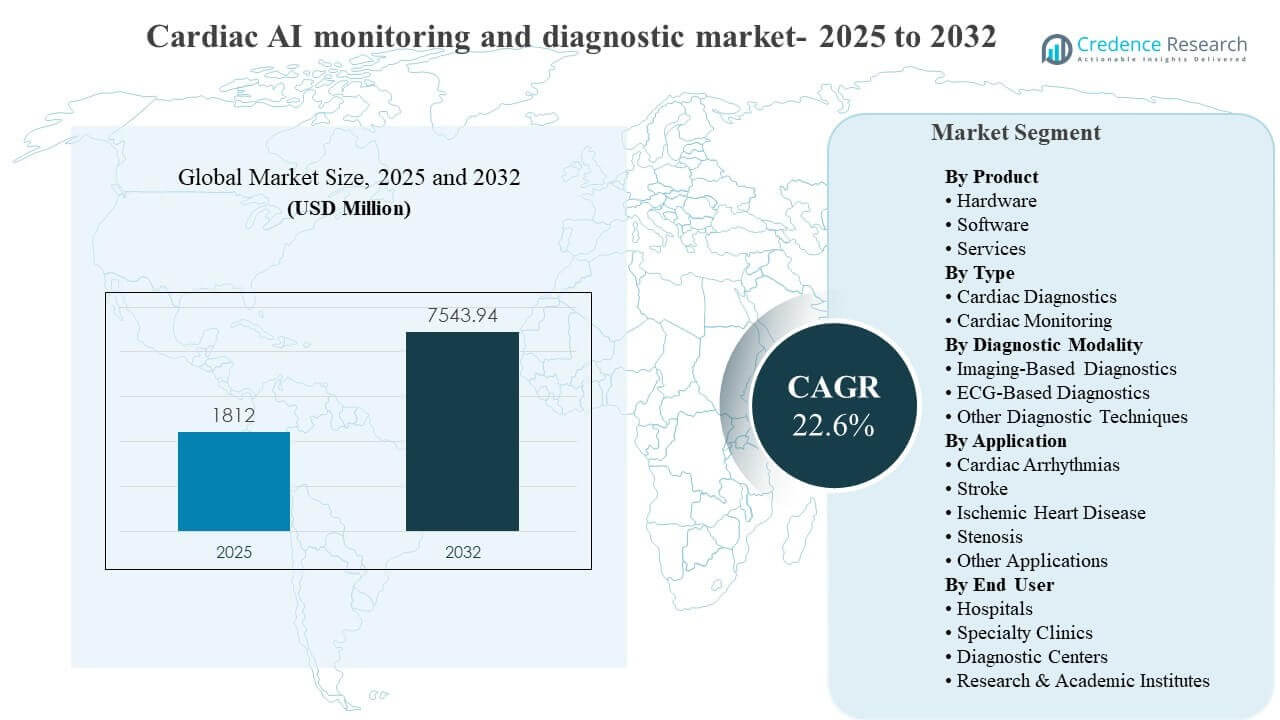
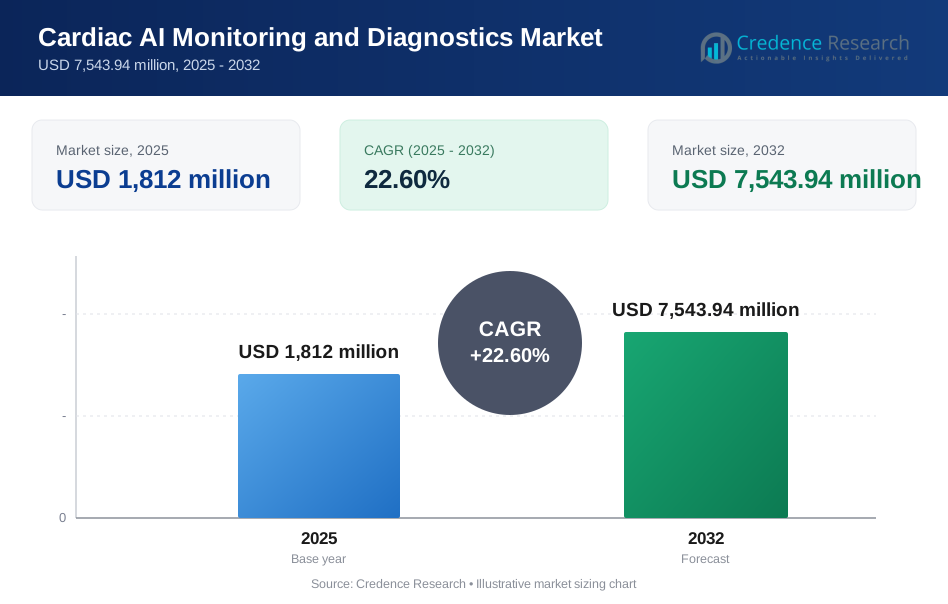
The global Cardiac AI monitoring and diagnostic market size was estimated at USD 1,812 million in 2025 and is expected to reach USD 7,543.94 million by 2032, growing at a CAGR of 22.6% from 2025 to 2032. The Cardiac AI monitoring and diagnostic market is expanding due to rising demand for faster, more standardized interpretation of ECG and cardiac imaging data across high-volume clinical pathways. Adoption is also supported by broader deployment of connected monitoring devices and workflow-integrated software that enables longitudinal cardiac risk tracking across care settings.
| REPORT ATTRIBUTE | DETAILS |
|---|---|
| Historical Period | 2020-2024 |
| Base Year | 2025 |
| Forecast Period | 2026-2032 |
| Cardiac AI Monitoring and Diagnostics Market Size 2025 | USD 1,812 million |
| Cardiac AI Monitoring and Diagnostics Market , CAGR | 22.6% |
| Cardiac AI Monitoring and Diagnostics Market Size 2032 | USD 7,543.94 million |
Key Market Trends & Insights
- The Cardiac AI monitoring and diagnostic market is projected to expand from USD 1,812 million (2025) to USD 7,543.94 million (2032) at a 22.6% CAGR (2025–2032).
- Software accounted for the largest share of 46.8% in 2025, reflecting strong preference for scalable, workflow-integrated AI platforms.
- Cardiac Diagnostics led the market by type with 54.4% share in 2025, supported by demand for decision support in imaging and ECG interpretation pathways.
- Cardiac Arrhythmias represented 33.7% share in 2025 by application, underpinned by high ECG volumes and clinical need for rapid triage and alerting.
- North America held 33.5% share in 2025, reflecting higher clinical AI uptake and broader deployment of connected cardiac monitoring programs.
Segment Analysis
The Cardiac AI monitoring and diagnostic market shows strong momentum across software-led analytics, AI-enabled ECG interpretation, and imaging decision support, driven by growing clinical workloads and the need for consistent, high-throughput analysis. The Cardiac AI monitoring and diagnostic market increasingly relies on multi-source data pipelines that combine ECG signals, imaging inputs, wearable streams, and EHR context to improve detection and monitoring performance across patient cohorts. The Cardiac AI monitoring and diagnostic market also benefits from hospital demand for enterprise-grade platforms that integrate with existing clinical systems and reduce manual review time for cardiology teams.
The Cardiac AI monitoring and diagnostic market is also shifting toward longitudinal care models, where continuous monitoring and risk stratification create recurring value beyond one-time diagnostics. The Cardiac AI monitoring and diagnostic market continues to see higher adoption in arrhythmia workflows due to immediate clinical actionability, large data volumes, and clear operational benefits in triage and follow-up. The Cardiac AI monitoring and diagnostic market is expected to broaden into additional cardiovascular conditions as clinical validation expands and care pathways adopt more AI-supported decision frameworks.
By Product Insights
Software accounted for the largest share of 46.8% in 2025. Software leadership in the Cardiac AI monitoring and diagnostic market is supported by scalable deployment across existing ECG and imaging infrastructure without requiring full hardware refresh cycles. Software platforms in the Cardiac AI monitoring and diagnostic market also enable frequent model updates, cybersecurity controls, and analytics dashboards through subscription models. Software adoption strengthens when integration with PACS, EHR, and cardiology workflow tools reduces friction for clinical teams.
By Type Insights
Cardiac Diagnostics accounted for the largest share of 54.4% in 2025. Cardiac Diagnostics leadership in the Cardiac AI monitoring and diagnostic market reflects high demand for standardized interpretation and reduced variability across imaging and ECG-driven diagnostic steps. Cardiac Diagnostics solutions in the Cardiac AI monitoring and diagnostic market also fit established clinical pathways where decision support can shorten time-to-diagnosis. Cardiac Diagnostics adoption is further supported by hospital priorities to improve throughput and clinician efficiency in cardiology departments.
By Diagnostic Modality Insights
Imaging-Based Diagnostics represent a core modality within the Cardiac AI monitoring and diagnostic market due to the need for automated measurements, segmentation, and consistent interpretation across complex imaging studies. ECG-Based Diagnostics remain foundational to the Cardiac AI monitoring and diagnostic market because continuous and ambulatory ECG monitoring generates high volumes of signals requiring rapid analysis. The Cardiac AI monitoring and diagnostic market is increasingly adopting hybrid approaches that combine imaging, ECG, and other clinical signals to improve performance in detection and monitoring workflows.
By Application Insights
Cardiac Arrhythmias accounted for the largest share of 33.7% in 2025. Cardiac Arrhythmias lead the Cardiac AI monitoring and diagnostic market because arrhythmia detection and classification align closely with high-frequency ECG use cases and time-sensitive clinical decisions. Arrhythmia-focused solutions in the Cardiac AI monitoring and diagnostic market also benefit from remote monitoring models that support earlier alerts and more efficient follow-up pathways. Cardiac Arrhythmias demand remains strong due to clinical emphasis on reducing missed events and improving care continuity.
By End User Insights
Hospitals accounted for the largest share of 26.1% in 2025. Hospitals lead the Cardiac AI monitoring and diagnostic market due to enterprise deployment needs, high diagnostic volumes, and stronger integration capacity for AI within clinical workflows. Hospital adoption in the Cardiac AI monitoring and diagnostic market is reinforced by demand for automation of time-intensive tasks such as ECG review, imaging measurements, and prioritization of abnormal findings. Hospitals also support broader AI utilization through multi-department coordination across cardiology, radiology, and emergency care settings.
Cardiac AI Monitoring and Diagnostics Market Drivers
Rising Cardiac Diagnostic Workload And Need For Faster Interpretation
The Cardiac AI monitoring and diagnostic market is driven by increasing diagnostic volumes across ECG, imaging, and ambulatory monitoring workflows. Clinical teams face pressure to interpret large datasets rapidly without compromising consistency and accuracy. The Cardiac AI monitoring and diagnostic market benefits from AI automation that reduces manual review time and supports standardized outputs across sites. Faster triage and decision support help hospitals manage throughput constraints and improve timing of clinical intervention.
Expansion Of Connected Monitoring And Longitudinal Care Pathways
The Cardiac AI monitoring and diagnostic market gains momentum from rising use of wearables, patches, and remote monitoring programs that generate continuous cardiac datasets. Continuous monitoring increases clinical value when AI converts raw signals into actionable alerts and risk insights. The Cardiac AI monitoring and diagnostic market also aligns with chronic disease management goals that prioritize early detection and ongoing follow-up. Longitudinal care models strengthen demand for integrated software platforms that unify diagnostics and monitoring insights.
- For instance, iRhythm’s Zio service supports up to 14 days of continuous ECG monitoring, and public reports on the platform cite nearly 8 million reports since inception and around 1.8 billion hours of curated ECG data, underscoring the scale of longitudinal signal analysis now being operationalized in arrhythmia care.
Shift Toward Workflow-Integrated Enterprise AI Platforms
The Cardiac AI monitoring and diagnostic market is expanding as providers prioritize solutions that integrate into existing PACS, EHR, and cardiology workflow systems. Integration reduces implementation friction and increases clinician trust through consistent user experiences. The Cardiac AI monitoring and diagnostic market benefits when AI outputs appear within standard reading and reporting environments, which supports higher utilization rates. Enterprise platforms also enable governance, auditing, and scalable deployment across multi-site health systems.
Growing Emphasis On Standardization And Decision Support In Cardiology
The Cardiac AI monitoring and diagnostic market is supported by demand for consistent interpretation and reduced variability across complex cardiovascular studies. Decision support tools help standardize measurements, flag abnormalities, and guide downstream diagnostic pathways. The Cardiac AI monitoring and diagnostic market also benefits from clinical priorities to reduce missed events in time-sensitive conditions and improve adherence to protocolized care. Standardization supports quality improvement goals across hospitals, specialty clinics, and diagnostic networks.
- For instance, Ultromics’ EchoGo Heart Failure detects HFpEF from a single apical 4-chamber echocardiogram clip in about 30 minutes and reported 90% sensitivity and 86% specificity, with no significant differences between readings in the company’s cited results.
Cardiac AI Monitoring and Diagnostics Market Challenges
The Cardiac AI monitoring and diagnostic market faces adoption barriers linked to validation expectations, workflow fit, and clinician trust. Clinical teams require strong evidence across diverse populations and care settings before scaling AI use in high-stakes decision pathways. The Cardiac AI monitoring and diagnostic market also encounters integration complexity when legacy systems vary by site and interoperability remains uneven. Procurement cycles can lengthen when buyers require multi-stakeholder alignment across IT, clinical leadership, and compliance functions.
The Cardiac AI monitoring and diagnostic market must also manage data privacy, cybersecurity, and model governance risks across cloud and hybrid deployments. Continuous monitoring and imaging workflows generate sensitive patient data that raises compliance and security requirements. The Cardiac AI monitoring and diagnostic market can face performance drift when data distributions change across geographies, devices, and protocols. Sustained outcomes require ongoing monitoring, re-validation, and clear accountability for model updates and clinical responsibility.
- For instance, Ultromics reported that its EchoGo Amyloidosis model achieved an AUC of 0.93, with 85% sensitivity and 93% specificity in external validation across 2,719 patients, after tuning on 7,666 patients, underscoring how cardiac AI systems must be continually assessed across sites and datasets to maintain dependable performance when protocols and imaging environments differ.
Cardiac AI Monitoring and Diagnostics Market Trends and Opportunities
The Cardiac AI monitoring and diagnostic market is trending toward multi-modal analytics that combine ECG, imaging, wearable signals, and clinical context for stronger prediction and triage. Multi-modal approaches enable broader use cases across arrhythmia, ischemic pathways, and structural heart assessment. The Cardiac AI monitoring and diagnostic market also benefits from cloud-native delivery models that speed deployment and support continuous improvement cycles. Subscription models create opportunities for recurring revenue while improving access to new features across installed customer bases.
- For instance, Eko Health’s platform combines heart sound and ECG analysis, flags murmurs, atrial fibrillation, and low ejection fraction in 15 seconds, stores each exam in the cloud, and the company reports 9 FDA clearances along with 99% sensitivity and 97% specificity for AFib detection.
The Cardiac AI monitoring and diagnostic market shows expanding opportunity in decentralized care, where remote monitoring and outpatient diagnostics require scalable AI support. Diagnostic centers and specialty clinics increasingly seek AI tools to improve throughput and reduce reliance on scarce specialists. The Cardiac AI monitoring and diagnostic market can also expand through partnerships that embed AI into imaging devices, monitoring platforms, and clinical workflow suites. Broader alignment with value-based care goals supports demand for tools that improve early detection and reduce downstream adverse events.
Regional Insights
North America
North America accounted for 33.5% share in 2025 in the Cardiac AI monitoring and diagnostic market. North America leadership is supported by higher adoption of digital health solutions, wider deployment of connected monitoring programs, and stronger integration of AI into hospital workflows. The Cardiac AI monitoring and diagnostic market in North America also benefits from enterprise purchasing capacity and faster scaling across large health system networks.
Europe
Europe represented 21.0% share in 2025 in the Cardiac AI monitoring and diagnostic market. Europe demand is supported by established cardiology networks and continued modernization of diagnostic infrastructure across major markets. The Cardiac AI monitoring and diagnostic market in Europe often sees structured evaluation and procurement cycles, which supports steady adoption of validated solutions integrated into clinical pathways.
Asia Pacific
Asia Pacific captured 25.9% share in 2025 in the Cardiac AI monitoring and diagnostic market. Asia Pacific expansion is supported by large patient volumes, growing investment in hospital digitization, and increasing adoption of remote monitoring solutions in urban centers. The Cardiac AI monitoring and diagnostic market in Asia Pacific also benefits from expanding access to diagnostics and rising demand for scalable clinical decision support tools.
Latin America
Latin America held 11.7% share in 2025 in the Cardiac AI monitoring and diagnostic market. Latin America adoption is influenced by affordability constraints and uneven distribution of advanced diagnostic infrastructure, with stronger uptake in private networks and major metropolitan areas. The Cardiac AI monitoring and diagnostic market in Latin America grows when software-first deployments improve capacity without requiring extensive hardware upgrades.
Middle East & Africa
Middle East & Africa accounted for 7.9% share in 2025 in the Cardiac AI monitoring and diagnostic market. Middle East & Africa demand is supported by modernization of tertiary care systems and digital health investment in selected markets. The Cardiac AI monitoring and diagnostic market in the region remains smaller overall due to variable access and budget constraints, but targeted deployment in advanced centers supports incremental growth.
Competitive Landscape
The Cardiac AI monitoring and diagnostic market remains competitive across large medtech and imaging incumbents, specialized AI vendors, and emerging clinical intelligence platforms. Competition centers on clinical validation depth, breadth of use cases across ECG and imaging, workflow integration with enterprise systems, and scalable deployment through cloud and hybrid models. Product differentiation also depends on interpretability, governance capabilities, and the ability to support longitudinal monitoring and population-level risk stratification.
Koninklijke Philips N.V. maintains a strong presence in the Cardiac AI monitoring and diagnostic market through workflow-centric cardiovascular platforms and imaging-adjacent AI capabilities. Koninklijke Philips N.V. positions offerings around clinical workflow integration, standardization of measurements, and scalable enterprise deployment across hospitals and multi-site networks. Koninklijke Philips N.V. continues to advance platform capabilities that support analysis consistency and operational efficiency across cardiac imaging and clinical decision support pathways.
The industry research and growth report includes detailed analyses of the competitive landscape of the market and information about key companies, including:
- Koninklijke Philips N.V.
- GE HealthCare Technologies
- Medtronic plc
- Siemens Healthineers AG
- iRhythm Technologies, Inc.
- Abbott Laboratories
- Boston Scientific Corporation
- AliveCor, Inc.
- HeartFlow, Inc.
- Cleerly, Inc.
- Viz.ai, Inc.
- Tempus AI, Inc.
- Ultromics Limited
- IDOVEN, S.L.
Qualitative and quantitative analysis of companies has been conducted to help clients understand the wider business environment as well as the strengths and weaknesses of key industry players. Data is qualitatively analyzed to categorize companies as pure play, category-focused, industry-focused, and diversified; it is quantitatively analyzed to categorize companies as dominant, leading, strong, tentative, and weak.
Recent Developments
- In July 2025, AliveCor launched its AI-powered Kardia 12L ECG system in India, introducing what it described as the world’s first handheld 12-lead ECG with a single-cable design for detecting life-threatening cardiac conditions, including heart attack. In the same announcement, AliveCor said the device had received CDSCO approval in India and can detect 35 cardiac determinations, including arrhythmias and ischemic conditions.
- In July 2025, Royal Philips launched the Philips ECG AI Marketplace, a platform designed to give cardiac care teams centralized access to multiple AI-powered diagnostic tools within Philips’ ECG ecosystem. Philips also said Anumana became the first company on the platform, with its FDA-cleared ECG-AI LEF algorithm added to help identify reduced ejection fraction as an early indicator of heart failure.
- In December 2025, Philips announced an agreement to acquire SpectraWAVE Inc., adding AI-supported coronary intravascular imaging and AI-enabled angio-based physiological assessment technologies to its cardiac portfolio. Philips said the deal would expand its coronary intervention offering through SpectraWAVE’s HyperVue Imaging System and X1-FFR technology.
- In January 2026, Cardio Diagnostics signed an agreement with Aimil and Dr. Lal PathLabs to introduce its PrecisionCHD coronary heart disease test in India, marking the company’s first expansion outside the United States. The company said the partnership is intended to accelerate commercial rollout in India during 2026 and widen access to its AI-powered cardiovascular diagnostics
Report Scope
| Report Attribute | Details |
| Market size value in 2025 | USD 1812 million |
| Revenue forecast in 2032 | USD 7543.94 million |
| Growth rate (CAGR) | 22.6% (2025–2032) |
| Base year | 2025 |
| Forecast period | 2026–2032 |
| Quantitative units | USD million |
| Segments covered | By Product Outlook: Hardware, Software, Services; By Type Outlook: Cardiac Diagnostics, Cardiac Monitoring; By Diagnostic Modality Outlook: Imaging-Based Diagnostics, ECG-Based Diagnostics, Other Diagnostic Techniques; By Application Outlook: Cardiac Arrhythmias, Stroke, Ischemic Heart Disease, Stenosis, Other Applications; By End User Outlook: Hospitals, Specialty Clinics, Diagnostic Centers, Research & Academic Institutes |
| Regional scope | North America, Europe, Asia Pacific, Latin America, Middle East & Africa |
| Key companies profiled | Koninklijke Philips N.V.; GE HealthCare Technologies; Medtronic plc; Siemens Healthineers AG; iRhythm Technologies, Inc.; Abbott Laboratories; Boston Scientific Corporation; AliveCor, Inc.; HeartFlow, Inc.; Cleerly, Inc.; Viz.ai, Inc.; Tempus AI, Inc.; Ultromics Limited; IDOVEN, S.L. |
| No.of Pages | 332 |
Segmentation
By Product
- Hardware
- Software
- Services
By Type
- Cardiac Diagnostics
- Cardiac Monitoring
By Diagnostic Modality
- Imaging-Based Diagnostics
- ECG-Based Diagnostics
- Other Diagnostic Techniques
By Application
- Cardiac Arrhythmias
- Stroke
- Ischemic Heart Disease
- Stenosis
- Other Applications
By End User
- Hospitals
- Specialty Clinics
- Diagnostic Centers
- Research & Academic Institutes
By Region
- North America
- U.S.
- Canada
- Mexico
- Europe
- Germany
- France
- U.K.
- Italy
- Spain
- Rest of Europe
- Asia Pacific
- China
- Japan
- India
- South Korea
- South-east Asia
- Rest of Asia Pacific
- Latin America
- Brazil
- Argentina
- Rest of Latin America
- Middle East & Africa
- GCC Countries
- South Africa
- Rest of the Middle East and Africa
Request a Free Sample
Fill in your details and we'll send you a free sample report.
- Sample data tables & charts
- Research methodology
Need a Custom Version of This Report?
Tailor the scope, geography, or segments to your exact requirements.
- Custom geography or segment scope
- Direct access to our analyst team
Frequently Asked Questions
What is the market size of the Cardiac AI monitoring and diagnostic market in 2025 and 2032?
What is the CAGR for the Cardiac AI monitoring and diagnostic market during 2025–2032?
Which segment leads the Cardiac AI monitoring and diagnostic market by product in 2025?
What are the key growth factors for the Cardiac AI monitoring and diagnostic market?
Who are the leading companies in the Cardiac AI monitoring and diagnostic market?
Which region leads the Cardiac AI monitoring and diagnostic market in 2025?
Table of Content
Chapter 1. Report Introduction
- 1.1 Report Description & Purpose
- 1.1.1 Report Title & Market Definition
- 1.1.2 Unique Selling Propositions (USP) & Key Differentiators
- 1.1.3 Value Proposition for Stakeholders
- 1.2 Research Objectives
- 1.2.1 Market Sizing Objectives (Volume & Revenue)
- 1.2.2 Segmentation Objectives
- 1.2.3 Competitive Intelligence Objectives
- 1.2.4 Forecast & Scenario Objectives
- 1.3 Report Scope
- 1.3.1 Cardiac AI Monitoring and Diagnostics Scope – Types & Subtypes Covered
- 1.3.2 Geographic Scope – Regions & Countries Covered
- 1.3.3 Historical Period, Base Year & Forecast Period (2025; forecast to 2032)
- 1.3.4 Inclusions & Exclusions
- 1.4 HS Code & Classification Framework
- 1.5 Currency, Units & Pricing Basis
- 1.6 Target Stakeholders
- 1.7 Limitations & Assumptions
Chapter 2. Executive Summary
- 2.1 Global Cardiac AI Monitoring and Diagnostics Market Snapshot
- 2.1.1 Market Size – Historical (2025) & Forecast (2025-2032) (2025: USD 1,812 million → 2032: USD 7,543.94 million)
- 2.1.2 Volume & Revenue – Global Totals
- 2.1.3 Key Market Highlights – Top Five Facts
- 2.2 Cardiac AI Monitoring and Diagnostics Market Segmentation Snapshot
- 2.2.1 Market Split by Region – 2025 vs. 2032
- 2.3 Competitive Snapshot
- 2.3.1 Top 10 Players by Revenue Share – 2025
- 2.3.2 Top 10 Players by Volume Share – 2025
- 2.3.3 Recent Strategic Developments (18-Month Summary)
- 2.4 Key Investment Highlights & Strategic Conclusions
Chapter 3. Cardiac AI Monitoring and Diagnostics Market Dynamics & Industry Analysis
- 3.1 Market Overview & Context
- 3.1.1 Cardiac AI Monitoring and Diagnostics Market Position in the Broader Automotive Value Chain
- 3.1.2 OEM vs. Replacement Market Dynamics
- 3.1.3 Market Maturity & Development Stage by Region
- 3.2 Cardiac AI Monitoring and Diagnostics Market Drivers
- 3.3 Cardiac AI Monitoring and Diagnostics Market Restraints & Challenges
- 3.4 Cardiac AI Monitoring and Diagnostics Market Opportunities
- 3.5 Porter's Five Forces Analysis
- 3.5.1 Threat of New Entrants
- 3.5.2 Bargaining Power of Suppliers
- 3.5.3 Bargaining Power of Buyers
- 3.5.4 Threat of Substitutes
- 3.5.5 Competitive Rivalry – Intensity Assessment
- 3.6 Cardiac AI Monitoring and Diagnostics Value Chain Analysis
- 3.6.1 Upstream – Raw Material/Input Suppliers
- 3.6.1.1 Raw Material/Input 1
- 3.6.1.2 Raw Material/Input 2
- 3.6.1.3 Raw Material/Input 3
- 3.6.2 Midstream – Production/Manufacturing/Service Delivery
- 3.6.2.1 Production/Process Overview
- 3.6.2.2 Key Facility Locations & Capacity by Manufacturer
- 3.6.3 Downstream – Distribution & End Consumer
- 3.6.3.1 Primary Channel – B2B/OEM
- 3.6.3.2 Secondary Channels – Dealer, Retail, Online, Direct
- 3.6.4 Value Chain Profitability Analysis
- 3.6.1 Upstream – Raw Material/Input Suppliers
- 3.7 PESTEL Analysis
- 3.7.1 Political Factors
- 3.7.2 Economic Factors
- 3.7.3 Social Factors
- 3.7.4 Technological Factors
- 3.7.5 Environmental Factors
- 3.7.6 Legal Factors
- 3.8 Cardiac AI Monitoring and Diagnostics Supply Chain Analysis
- 3.8.1 Raw Material/Input Supply Risk Assessment
- 3.8.2 Manufacturing Concentration Risk (Geographic Exposure)
- 3.8.3 Trade Disruption Impact Analysis
- 3.9 Regulatory & Policy Landscape
Note: The regulatory and policy landscape section covers regulations based on their applicability to the market, Cardiac AI Monitoring and Diagnostics category, geography, and scope of the study. Only regulatory frameworks with a material impact on operations, compliance, trade, sustainability, or market access are analyzed in detail.
Chapter 4. Key Investment Pockets & Opportunity Analysis
- 4.1 Cardiac AI Monitoring and Diagnostics Market Attractiveness Analysis
- 4.1.1 By Region – Investment Attractiveness Matrix (Volume × CAGR)
- 4.2 Absolute Revenue Growth Opportunity
- 4.2.1 By Region – Absolute USD Growth Through 2032
- 4.3 Incremental Volume Opportunity
- 4.3.1 By Region – Incremental Volume Through 2032
- 4.3.2 Segment – Incremental Volume
- 4.4 Emerging Submarket Opportunity Deep Dive (Subject to Applicability)
- 4.5 Emerging Market Opportunity Scorecards
- 4.5.1 United States
- 4.5.2 Europe
- 4.5.3 Asia
- 4.5.4 Middle East & Africa
Note: Emerging Market Opportunity Scorecards will be included based on relevance and strategic importance. Regions listed are indicative and may vary depending on data availability and market dynamics.
Chapter 5. Cardiac AI Monitoring and Diagnostics Import-Export Analysis & Trade Flows
- 5.1 Global Trade Overview
- 5.1.1 Global Export Value by Country (2025)
- 5.1.2 Global Export Volume by Country (2025)
- 5.1.3 Global Import Value by Country (2025)
- 5.1.4 Global Import Volume by Country (2025)
- 5.1.5 Net Trade Balance by Country (2025)
- 5.2 Export Analysis – Segment
- 5.2.1 Type 1 (HS Code)
- 5.2.2 Type 2 (HS Code)
- 5.2.3 Type 3 (HS Code)
- 5.2.4 Type 4 (HS Code)
- 5.2.5 Type 5 (HS Code)
- 5.3 Import Analysis – Segment
- 5.3.1 Type 1 (HS Code)
- 5.3.2 Type 2 (HS Code)
- 5.3.3 Type 3 (HS Code)
- 5.3.4 Type 4 (HS Code)
- 5.3.5 Type 5 (HS Code)
- 5.4 Average Unit Trade Prices
- 5.4.1 Average Export Price – Segment & Country
- 5.4.2 Average Import Price – Segment & Source Country
- 5.4.3 Price Trends (2025)
- 5.5 Key Trade Route Analysis
- 5.5.1 Trade Route 1
- 5.5.2 Trade Route 2
- 5.5.3 Trade Route 3
- 5.5.4 Trade Route 4
- 5.5.5 Trade Route 5
- 5.6 Trade Policy Impact Assessment
- 5.6.1 US Anti-Dumping & Section 301 Tariffs
- 5.6.2 EU Customs Union Impact
- 5.6.3 Major Free Trade Agreements
- 5.6.4 USMCA Rules of Origin
Note: Trade policy analysis will be included only where relevant to the Cardiac AI Monitoring and Diagnostics market.
Chapter 6. Competitive Landscape & Company Benchmarking
- 6.1 Cardiac AI Monitoring and Diagnostics Market Concentration & Structure
- 6.1.1 Herfindahl-Hirschman Index (HHI) – vs. 2025
- 6.1.2 Tier 1, Tier 2 & Tier 3 Market Structure
- 6.1.3 Global, Regional & Local Player Dynamics
- 6.2 Cardiac AI Monitoring and Diagnostics Market Share Analysis – 2025
- 6.2.1 Global Revenue Share by Company
- 6.2.2 Global Volume Share by Company
- 6.2.3 Regional Revenue Share
- 6.2.4 Market Share Evolution ( vs. 2025)
- 6.2.5 OEM Segment Share by Company
- 6.2.6 Replacement Segment Share by Company
- 6.3 Production/Delivery Capacity & Facility Analysis
- 6.3.1 Global Installed Capacity
- 6.3.2 Capacity Utilization Rates
- 6.3.3 Production/Output Volume
- 6.3.4 Facility Locations & Capacity Map
- 6.3.5 Planned Capacity Additions
- 6.4 Cardiac AI Monitoring and Diagnostics Competitive Benchmarking Matrix
- 6.4.1 Revenue, Volume, CAGR & Profitability Comparison
- 6.4.2 Channel Revenue Mix
- 6.4.3 Geographic Revenue Exposure
- 6.4.4 R&D Intensity
- 6.4.5 Sustainability Maturity
- 6.5 Strategic Developments in Cardiac AI Monitoring and Diagnostics (Last 24 Months)
- 6.5.1 Mergers, Acquisitions & Divestments
- 6.5.2 New Cardiac AI Monitoring and Diagnostics Launches
- 6.5.3 Facility Expansions
- 6.5.4 Strategic Alliances, Joint Ventures & Partnerships
- 6.5.5 Distribution Expansion & Market Entry
- 6.5.6 Sustainability & ESG Initiatives
- 6.6 Competitive Strategy Mapping
- 6.6.1 Leader, Challenger, Follower & Niche Classification
- 6.6.2 Pricing Strategy Comparison
- 6.6.3 Channel Strategy Matrix
Note: Strategic developments are included based on their materiality and the availability of reliable information.
Chapter 7. Global Cardiac AI Monitoring and Diagnostics Market – By Distribution Channel
- 7.1 Segment Overview
- 7.1.1 Volume & Revenue Split by Channel (2025 & 2032)
- 7.1.2 Channel Mix Evolution (2025-2032)
Chapter 8. Regional Market Analysis – Global Overview
- 8.1 Global Regional Overview
- 8.1.1 Regional Volume Share
- 8.1.2 Regional Revenue Share
- 8.1.3 Regional Volume by Region
- 8.1.4 Regional Revenue by Region
- 8.1.5 Regional Forecast Through 2032
- 8.2 Cross-Regional Segment Analysis
- 8.2.1 By Distribution Channel
- 8.2.2 By Brand/Price Tier
Chapter 9. North America Cardiac AI Monitoring and Diagnostics Market
- 9.1 United States
- 9.2 Canada
- 9.3 Mexico
Chapter 10. Europe Cardiac AI Monitoring and Diagnostics Market
- 10.1 Germany
- 10.2 France
- 10.3 Italy
- 10.4 United Kingdom
- 10.5 Spain
- 10.6 Poland
- 10.7 Russia
- 10.8 Netherlands
- 10.9 Belgium
- 10.10 Sweden
- 10.11 Denmark
- 10.12 Norway
- 10.13 Rest of Europe
Chapter 11. Asia Pacific Cardiac AI Monitoring and Diagnostics Market
- 11.1 China
- 11.2 India
- 11.3 Japan
- 11.4 South Korea
- 11.5 Thailand
- 11.6 Indonesia
- 11.7 Vietnam
- 11.8 Malaysia
- 11.9 Australia
- 11.10 Rest of Asia Pacific
Chapter 12. Latin America Cardiac AI Monitoring and Diagnostics Market
- 12.1 Brazil
- 12.2 Argentina
- 12.3 Colombia
- 12.4 Chile
- 12.5 Rest of Latin America
Chapter 13. Middle East Cardiac AI Monitoring and Diagnostics Market
- 13.1 Saudi Arabia
- 13.2 United Arab Emirates
- 13.3 Turkey
- 13.4 Israel
- 13.5 Iran
- 13.6 Rest of the Middle East
Chapter 14. Africa Cardiac AI Monitoring and Diagnostics Market
- 14.1 South Africa
- 14.2 Egypt
- 14.3 Nigeria
- 14.4 Morocco
- 14.5 Rest of Africa
Chapter 15. Cardiac AI Monitoring and Diagnostics Company Profiles
- 15.1 [Company 01]
- 15.1.1 Company Overview
- 15.1.2 Key Management Personnel
- 15.1.3 Products & Services Portfolio
- 15.1.4 Financial Performance
- 15.1.5 Key Market Focus & Geographic Presence
- 15.1.6 Recent Developments & Strategic Initiatives
Note: The company profile list is preliminary and may change based on research findings, market developments, data availability, and client requirements.
Chapter 16. Appendices
- Appendix A – List of Abbreviations & Acronyms
- Appendix B – Industry Classification Code Reference – Full Series
- Appendix C – Production & Capacity Data Tables
- Appendix D – End-Use & Demand Base Tables
- Appendix E – Consumption & Replacement Rate Assumptions
- Appendix F – ASP Reference Tables
- Appendix G – Manufacturing & Facility Database
- Appendix H – Import-Export Data Tables
- Appendix I – Regulatory Summary Tables
- Appendix J – Primary Research Participant List (Anonymized)
- Appendix K – Primary Research Questionnaire Framework
- Appendix L – Data Sources & Bibliography
- Appendix M – Market Size Divergence & Source Comparison
Chapter 17. Research Methodology
- 17.1 Research Framework & Philosophy
- 17.2 Secondary Research – Sources, Hierarchy & Data Extraction
- 17.3 Data Modeling – Bottom-Up & Top-Down Market Sizing
- 17.4 Primary Research – Stakeholder Framework, LOI & Sample Sizes
- 17.5 Forecast Methodology – Regression, Scenario & Sensitivity Analysis
- 17.6 Quality Control – Four-Layer Validation Framework
- 17.7 Limitations & Standard Assumptions
- 17.8 Disclaimer
