
Ceftiofur Market Overview:
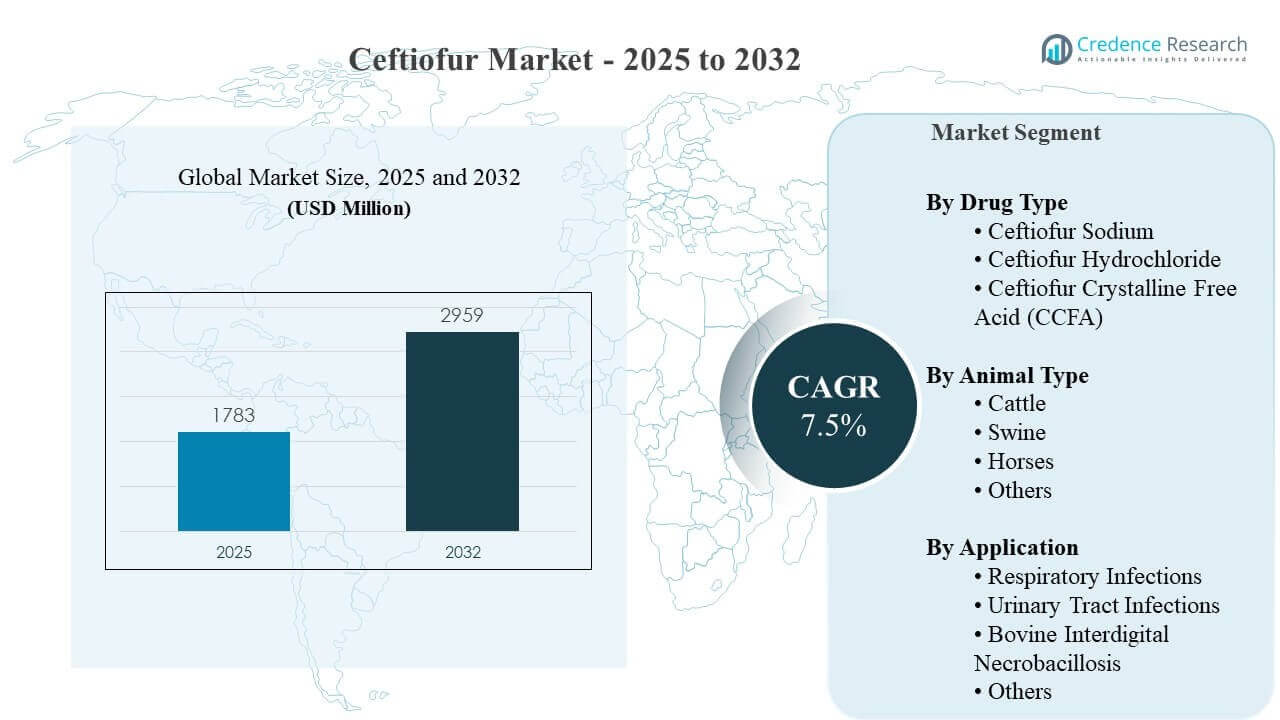
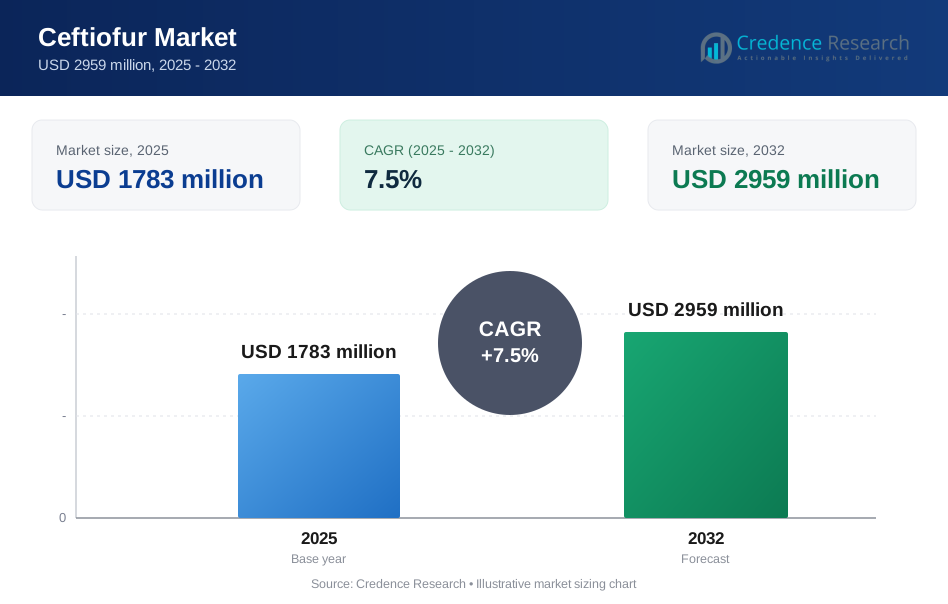
The global Ceftiofur Market size was estimated at USD 1783 million in 2025 and is expected to reach USD 2959 million by 2032, growing at a CAGR of 7.5% from 2025 to 2032. Demand is primarily strengthened by the need to control high-impact bacterial infections in commercial livestock systems, where rapid clinical response and predictable treatment protocols protect productivity and reduce loss events. North America and Asia Pacific remain the most material consumption centers due to scale of cattle and swine production, established veterinary prescribing pathways, and strong distribution access for injectable anti-infectives.
| REPORT ATTRIBUTE | DETAILS |
|---|---|
| Historical Period | 2020-2024 |
| Base Year | 2025 |
| Forecast Period | 2026-2032 |
| Ceftiofur Market Size 2025 | USD 1783 million |
| Ceftiofur Market, CAGR | 7.5% |
| Ceftiofur Market Size 2032 | USD 2959 million |
Key Market Trends & Insights
- The Ceftiofur Market is projected to expand at 7.5% CAGR (2025–2032), reflecting sustained use across food-animal infection management protocols.
- Ceftiofur Sodium accounted for the largest share of 58.3% in 2025, supported by broad usage across common livestock indications and established procurement familiarity.
- Cattle represented the leading animal type with 53.6% share in 2025, indicating strong pull from bovine disease management programs in beef and dairy settings.
- North America held 34.7% share in 2025, driven by high veterinary drug spending intensity and large-scale commercial cattle and swine operations.
- Asia Pacific reached 28.6% share in 2025, supported by expanding commercial farming scale and rising veterinary access in major livestock-producing economies.
Segment Analysis
Ceftiofur Market demand is shaped by protocol-based purchasing in livestock medicine, where product selection aligns with target pathogens, route of administration, and treatment convenience in herd settings. Veterinary stakeholders prioritize consistent clinical performance, predictable dosing behavior, and supply continuity across seasons of higher disease incidence. Disease burden patterns in bovine and swine respiratory conditions and other high-frequency bacterial infections keep ceftiofur-based therapies relevant in farm treatment algorithms. Stewardship expectations and withdrawal-time compliance further influence formulation choice and on-farm use practices.
Segment performance also reflects operational realities in commercial farms, including labor availability, handling frequency, and the need to minimize stress events during treatment. Longer-acting formulations can reduce the number of administrations required in large herds and support adherence to treatment schedules, particularly in high-throughput operations. In parallel, generic availability and tender-based procurement in some markets increase price competition, pushing manufacturers to differentiate through quality consistency, channel coverage, and customer support to veterinary networks.
By Drug Type Insights
Ceftiofur Sodium accounted for the largest share of 58.3% in 2025. Broad applicability across common livestock bacterial infections supports repeat purchasing, especially where treatment protocols favor established injectable formats. Ceftiofur sodium products also fit routine clinic and on-farm workflows due to familiar handling and dosing practices. Procurement continuity is reinforced by availability across branded and generic options, enabling buyers to balance cost, supply reliability, and veterinary preference.
By Animal Type Insights
Cattle accounted for the largest share of 53.6% in 2025. High cattle population throughput in beef feedlots and dairy farms creates steady demand for effective anti-infectives used in economically significant infections. Bovine health programs often emphasize rapid intervention to limit productivity losses, which supports consistent consumption of ceftiofur-based products where appropriate. Strong veterinary service penetration and established distribution channels in major cattle regions further reinforce bovine-led demand.
By Application Insights
Respiratory infections remain a central demand driver for ceftiofur use because respiratory disease episodes can spread quickly and create high productivity losses in both cattle and swine systems. Treatment protocols in commercial operations typically prioritize fast-acting, reliable injectable antimicrobials aligned to veterinary oversight and farm compliance needs. Bovine interdigital necrobacillosis management also supports targeted purchasing in cattle-heavy regions where lameness reduction is economically important. Urinary tract infections and other bacterial indications contribute additional, more episodic demand depending on species mix and local veterinary practice patterns.
Ceftiofur Market Drivers
High economic impact of bacterial disease events in commercial livestock
Commercial cattle and swine operations face material productivity losses when bacterial infections disrupt weight gain, milk yield, feed conversion, or survival rates. Veterinary-led treatment protocols prioritize fast clinical response to stabilize animal performance and reduce downstream complications. Ceftiofur-based therapies remain relevant in treatment pathways where broad-spectrum coverage and established usage patterns fit farm needs. Increasing intensity of production systems and higher animal throughput further sustain baseline demand for effective injectable anti-infectives.
Expansion and modernization of livestock production and veterinary access
Growth in organized livestock farming increases standardization of health management and expands routine veterinary intervention. Larger farm units typically adopt structured disease management programs with defined treatment protocols and preferred product lists. Improved veterinary service reach and wider availability of animal health products through distributors strengthen access to ceftiofur formulations. As farm operations scale, purchasing becomes more systematic, supporting repeat demand tied to herd size and expected disease incidence.
- For instance, Huvepharma highlights the scale needed to support wider veterinary access, stating that its distribution network covers more than 90 countries across 6 continents, which reflects the kind of geographic reach that helps animal health suppliers serve expanding livestock systems and distributor-led markets.
Preference for predictable administration and compliance-friendly treatment formats
Farm operators value treatment options that integrate smoothly with handling routines, minimize labor burden, and reduce animal stress from repeated administration. Long-acting or convenient formulations can support adherence to veterinary instructions and improve completion of dosing schedules. Reliable administration characteristics help farms maintain consistent outcomes in high-volume settings. These operational considerations influence product selection and can sustain demand even when stewardship constraints shape usage conditions.
- For instance, Ceva’s Cevaxel-RTU is built around practical, compliance-friendly use: it is a 50 mg/ml ceftiofur injectable for cattle and pigs, carries a zero-hour milk withdrawal in cattle, and lists meat withdrawal periods of 8 days in cattle and 5 days in pigs, demonstrating how treatment convenience and clear compliance parameters support use in structured farm routines.
Established supplier networks and broad portfolio participation by animal health companies
A wide set of animal health manufacturers and distributors supports product availability across regions and farm types. Strong channel presence improves product access, reduces stockout risk, and supports farmer confidence in supply continuity. Portfolio breadth across formulations and packaging sizes enables suppliers to serve varied farm needs and procurement models. Competitive activity also supports product education and field support to veterinary decision-makers, reinforcing adoption in protocol-driven purchasing environments.
Ceftiofur Market Challenges
Antimicrobial stewardship pressure continues to intensify across multiple regions, increasing scrutiny on antibiotic selection, usage frequency, and compliance documentation. Tighter prescribing rules and monitoring can reduce discretionary usage and shift demand toward more controlled, veterinary-supervised protocols. Residue and withdrawal-time compliance requirements raise the operational burden for farms, particularly in export-oriented supply chains. These constraints can limit growth in some segments even when disease burden remains substantial.
- For instance, Norbrook’s Cefenil RTU label highlights strict stewardship compliance, with a 4-day pre-slaughter withdrawal period for swine and a 3-day period for cattle following labeled treatment. The supporting residue studies used 5 mg/kg for 3 consecutive days in swine and 2.2 mg/kg for 5 consecutive days in cattle, showing how ceftiofur use is closely tied to documented dosing and withdrawal control.
Pricing pressure is also a persistent challenge in markets with higher generic penetration and tender-based procurement. Buyers may prioritize cost over brand, which compresses margins and increases the importance of manufacturing efficiency and distribution scale. Supply continuity risk, regulatory lifecycle changes, and formulation-specific handling needs can further complicate consistent market execution. Competitive differentiation increasingly depends on reliability, quality consistency, and channel strength rather than simple portfolio presence.
Ceftiofur Market Trends and Opportunities
A gradual shift toward more structured herd health programs creates opportunities for suppliers that provide protocol-aligned product support, veterinary education, and consistent availability. As livestock operations scale, demand patterns favor suppliers that can serve large accounts with predictable logistics, packaging options, and customer service. Portfolio strategies that align ceftiofur formulations with broader anti-infective and supportive-care offerings can strengthen account penetration. These dynamics support growth opportunities tied to farm consolidation and modernization.
- For instance, Zoetis positions its ceftiofur portfolio around workflow efficiency: the official EXCEDE for Swine label specifies a single intramuscular dose of 5.0 mg/kg, and the product’s effectiveness was confirmed in a multi-location field study involving 706 pigs, highlighting how lower-handling treatment protocols can better fit standardized herd-health programs at larger commercial operations.
Regional growth in Asia Pacific creates opportunities linked to expanding commercial livestock production, improving veterinary access, and rising focus on productivity outcomes. Suppliers that tailor go-to-market strategies to local distribution structures and regulatory expectations can improve adoption. Opportunities also emerge from improved disease surveillance, better diagnostic pathways, and more disciplined treatment initiation in farms. These factors can support steady expansion even under stewardship frameworks when use remains appropriate and compliant.
Regional Insights
North America
North America accounted for 34.7% share in 2025, supported by large-scale cattle and swine industries and high adoption of standardized veterinary treatment protocols. Strong distribution networks and established prescribing pathways support consistent access to ceftiofur formulations. Compliance requirements and food supply-chain standards also drive disciplined use within monitored programs.
Europe
Europe represented 24.1% share in 2025, reflecting meaningful livestock production combined with comparatively stricter stewardship and monitoring environments. Demand remains supported by regulated veterinary practice and structured farm health management, with purchasing influenced by compliance requirements and procurement discipline. Product positioning often emphasizes appropriate-use alignment and reliable supply.
Asia Pacific
Asia Pacific captured 28.6% share in 2025, driven by large livestock populations and increasing commercialization of animal production systems. Expansion of veterinary access and modernization of farm management support higher use of protocol-based infection control. Market growth is also supported by rising focus on productivity, biosecurity, and improving distribution reach in major economies.
Latin America
Latin America held 7.9% share in 2025, supported by sizable cattle industries and expanding organized livestock operations in key countries. Purchasing tends to be more price-sensitive in many markets, increasing the role of generics and distributor reach. Demand growth is linked to modernization of farm practices and improving veterinary services.
Middle East & Africa
Middle East & Africa accounted for 4.7% share in 2025, reflecting more fragmented livestock systems and comparatively lower penetration of structured veterinary protocols in many areas. Demand concentrates in pockets with commercial production and stronger veterinary distribution coverage. Improving access to veterinary services and gradual farm modernization support incremental growth.
Competitive Landscape
Competition in the Ceftiofur Market is shaped by portfolio breadth, regulatory compliance capabilities, and distribution strength across livestock-heavy regions. Manufacturers compete through formulation availability, supply reliability, and alignment with veterinary treatment protocols that influence repeat purchasing. Product access through veterinary clinics, distributors, and farm channels remains a key differentiator, particularly where large accounts require consistent delivery and standardized packaging. Pricing competitiveness increases in markets with stronger generic penetration, making operational efficiency and channel scale important.
Zoetis Inc. maintains a strong position in livestock anti-infectives by leveraging broad farm-channel presence and established veterinary relationships. Zoetis Inc. also benefits from the ability to support protocol-driven purchasing with field education, distribution continuity, and complementary portfolio alignment across cattle health needs. Product confidence is reinforced by consistent availability and the ability to serve large commercial operations with repeat demand patterns. Competitive advantage also depends on navigating stewardship expectations while maintaining appropriate-use positioning for bovine disease management.
The industry research and growth report includes detailed analyses of the competitive landscape of the market and information about key companies, including:
- Zoetis Inc.
- Merck Animal Health
- Ceva Santé Animale
- HIPRA S.A.
- Hester Biosciences Ltd.
- Norbrook Laboratories Ltd.
- Vetoquinol S.A.
- Boehringer Ingelheim Animal Health
- Virbac SA
- Huvepharma EOOD
- Phibro Animal Health Corporation
- Intas Pharmaceuticals Ltd.
- Cadila Pharmaceuticals Ltd.
- Pfizer Inc.
- AN PharmaTech Co. Ltd.
Qualitative and quantitative analysis of companies has been conducted to help clients understand the wider business environment as well as the strengths and weaknesses of key industry players. Data is qualitatively analyzed to categorize companies as pure play, category-focused, industry-focused, and diversified; it is quantitatively analyzed to categorize companies as dominant, leading, strong, tentative, and weak.
Recent Developments
- In February 2025, Zoetis Inc. expanded its cattle anti-infective portfolio by acquiring marketing rights to Loncor 300 (florfenicol) from Elanco Animal Health, strengthening its position alongside its flagship ceftiofur products Excede and Naxcel, though this acquisition adds a complementary amphenicol antibiotic rather than a new ceftiofur formulation itself.
Report Scope
| Report Attribute | Details |
| Market size value in 2025 | USD 1783 million |
| Revenue forecast in 2032 | USD 2959 million |
| Growth rate (CAGR) | 7.5% (2025–2032) |
| Base year | 2025 |
| Forecast period | 2026-2032 |
| Quantitative units | USD million |
| Segments covered | By Drug Type Outlook: Ceftiofur Sodium, Ceftiofur Hydrochloride, Ceftiofur Crystalline Free Acid (CCFA); By Animal Type Outlook: Cattle, Swine, Horses, Others; By Application Outlook: Respiratory Infections, Urinary Tract Infections, Bovine Interdigital Necrobacillosis, Others |
| Regional scope | North America, Europe, Asia Pacific, Latin America, Middle East & Africa |
| Key companies profiled | Zoetis Inc.; Merck Animal Health; Ceva Santé Animale; HIPRA S.A.; Hester Biosciences Ltd.; Norbrook Laboratories Ltd.; Vetoquinol S.A.; Boehringer Ingelheim Animal Health; Virbac SA; Huvepharma EOOD; Phibro Animal Health Corporation; Intas Pharmaceuticals Ltd.; Cadila Pharmaceuticals Ltd.; Pfizer Inc.; AN PharmaTech Co. Ltd. |
| No.of Pages | 332 |
Segmentation
By Drug Type
- Ceftiofur Sodium
- Ceftiofur Hydrochloride
- Ceftiofur Crystalline Free Acid (CCFA)
By Animal Type
- Cattle
- Swine
- Horses
- Others
By Application
- Respiratory Infections
- Urinary Tract Infections
- Bovine Interdigital Necrobacillosis
- Others
By Region
- North America
- U.S.
- Canada
- Mexico
- Europe
- Germany
- France
- U.K.
- Italy
- Spain
- Rest of Europe
- Asia Pacific
- China
- Japan
- India
- South Korea
- South-east Asia
- Rest of Asia Pacific
- Latin America
- Brazil
- Argentina
- Rest of Latin America
- Middle East & Africa
- GCC Countries
- South Africa
- Rest of the Middle East and Africa
Request a Free Sample
Fill in your details and we'll send you a free sample report.
- Sample data tables & charts
- Research methodology
Need a Custom Version of This Report?
Tailor the scope, geography, or segments to your exact requirements.
- Custom geography or segment scope
- Direct access to our analyst team
Frequently Asked Questions
What is the current size and future forecast for the Ceftiofur Market?
What is the CAGR for the Ceftiofur Market during 2025–2032?
Which segment is the largest by drug type?
What factors are driving growth in the Ceftiofur Market?
Which companies are leading in the Ceftiofur Market?
Which region leads the Ceftiofur Market?
Table of Content
Chapter 1. Report Introduction
- 1.1 Report Description & Purpose
- 1.1.1 Report Title & Market Definition
- 1.1.2 Unique Selling Propositions (USP) & Key Differentiators
- 1.1.3 Value Proposition for Stakeholders
- 1.2 Research Objectives
- 1.2.1 Market Sizing Objectives (Volume & Revenue)
- 1.2.2 Segmentation Objectives
- 1.2.3 Competitive Intelligence Objectives
- 1.2.4 Forecast & Scenario Objectives
- 1.3 Report Scope
- 1.3.1 Ceftiofur Scope – Types & Subtypes Covered
- 1.3.2 Geographic Scope – Regions & Countries Covered
- 1.3.3 Historical Period, Base Year & Forecast Period (2025; forecast to 2032)
- 1.3.4 Inclusions & Exclusions
- 1.4 HS Code & Classification Framework
- 1.5 Currency, Units & Pricing Basis
- 1.6 Target Stakeholders
- 1.7 Limitations & Assumptions
Chapter 2. Executive Summary
- 2.1 Global Ceftiofur Market Snapshot
- 2.1.1 Market Size – Historical (2025) & Forecast (2025-2032) (2025: USD 1783 million → 2032: USD 2959 million)
- 2.1.2 Volume & Revenue – Global Totals
- 2.1.3 Key Market Highlights – Top Five Facts
- 2.2 Ceftiofur Market Segmentation Snapshot
- 2.2.1 Market Split by Region – 2025 vs. 2032
- 2.3 Competitive Snapshot
- 2.3.1 Top 10 Players by Revenue Share – 2025
- 2.3.2 Top 10 Players by Volume Share – 2025
- 2.3.3 Recent Strategic Developments (18-Month Summary)
- 2.4 Key Investment Highlights & Strategic Conclusions
Chapter 3. Ceftiofur Market Dynamics & Industry Analysis
- 3.1 Market Overview & Context
- 3.1.1 Ceftiofur Market Position in the Broader Automotive Value Chain
- 3.1.2 OEM vs. Replacement Market Dynamics
- 3.1.3 Market Maturity & Development Stage by Region
- 3.2 Ceftiofur Market Drivers
- 3.3 Ceftiofur Market Restraints & Challenges
- 3.4 Ceftiofur Market Opportunities
- 3.5 Porter's Five Forces Analysis
- 3.5.1 Threat of New Entrants
- 3.5.2 Bargaining Power of Suppliers
- 3.5.3 Bargaining Power of Buyers
- 3.5.4 Threat of Substitutes
- 3.5.5 Competitive Rivalry – Intensity Assessment
- 3.6 Ceftiofur Value Chain Analysis
- 3.6.1 Upstream – Raw Material/Input Suppliers
- 3.6.1.1 Raw Material/Input 1
- 3.6.1.2 Raw Material/Input 2
- 3.6.1.3 Raw Material/Input 3
- 3.6.2 Midstream – Production/Manufacturing/Service Delivery
- 3.6.2.1 Production/Process Overview
- 3.6.2.2 Key Facility Locations & Capacity by Manufacturer
- 3.6.3 Downstream – Distribution & End Consumer
- 3.6.3.1 Primary Channel – B2B/OEM
- 3.6.3.2 Secondary Channels – Dealer, Retail, Online, Direct
- 3.6.4 Value Chain Profitability Analysis
- 3.6.1 Upstream – Raw Material/Input Suppliers
- 3.7 PESTEL Analysis
- 3.7.1 Political Factors
- 3.7.2 Economic Factors
- 3.7.3 Social Factors
- 3.7.4 Technological Factors
- 3.7.5 Environmental Factors
- 3.7.6 Legal Factors
- 3.8 Ceftiofur Supply Chain Analysis
- 3.8.1 Raw Material/Input Supply Risk Assessment
- 3.8.2 Manufacturing Concentration Risk (Geographic Exposure)
- 3.8.3 Trade Disruption Impact Analysis
- 3.9 Regulatory & Policy Landscape
Note: The regulatory and policy landscape section covers regulations based on their applicability to the market, Ceftiofur category, geography, and scope of the study. Only regulatory frameworks with a material impact on operations, compliance, trade, sustainability, or market access are analyzed in detail.
Chapter 4. Key Investment Pockets & Opportunity Analysis
- 4.1 Ceftiofur Market Attractiveness Analysis
- 4.1.1 By Region – Investment Attractiveness Matrix (Volume × CAGR)
- 4.2 Absolute Revenue Growth Opportunity
- 4.2.1 By Region – Absolute USD Growth Through 2032
- 4.3 Incremental Volume Opportunity
- 4.3.1 By Region – Incremental Volume Through 2032
- 4.3.2 Segment – Incremental Volume
- 4.4 Emerging Submarket Opportunity Deep Dive (Subject to Applicability)
- 4.5 Emerging Market Opportunity Scorecards
- 4.5.1 United States
- 4.5.2 Europe
- 4.5.3 Asia
- 4.5.4 Middle East & Africa
Note: Emerging Market Opportunity Scorecards will be included based on relevance and strategic importance. Regions listed are indicative and may vary depending on data availability and market dynamics.
Chapter 5. Ceftiofur Import-Export Analysis & Trade Flows
- 5.1 Global Trade Overview
- 5.1.1 Global Export Value by Country (2025)
- 5.1.2 Global Export Volume by Country (2025)
- 5.1.3 Global Import Value by Country (2025)
- 5.1.4 Global Import Volume by Country (2025)
- 5.1.5 Net Trade Balance by Country (2025)
- 5.2 Export Analysis – Segment
- 5.2.1 Type 1 (HS Code)
- 5.2.2 Type 2 (HS Code)
- 5.2.3 Type 3 (HS Code)
- 5.2.4 Type 4 (HS Code)
- 5.2.5 Type 5 (HS Code)
- 5.3 Import Analysis – Segment
- 5.3.1 Type 1 (HS Code)
- 5.3.2 Type 2 (HS Code)
- 5.3.3 Type 3 (HS Code)
- 5.3.4 Type 4 (HS Code)
- 5.3.5 Type 5 (HS Code)
- 5.4 Average Unit Trade Prices
- 5.4.1 Average Export Price – Segment & Country
- 5.4.2 Average Import Price – Segment & Source Country
- 5.4.3 Price Trends (2025)
- 5.5 Key Trade Route Analysis
- 5.5.1 Trade Route 1
- 5.5.2 Trade Route 2
- 5.5.3 Trade Route 3
- 5.5.4 Trade Route 4
- 5.5.5 Trade Route 5
- 5.6 Trade Policy Impact Assessment
- 5.6.1 US Anti-Dumping & Section 301 Tariffs
- 5.6.2 EU Customs Union Impact
- 5.6.3 Major Free Trade Agreements
- 5.6.4 USMCA Rules of Origin
Note: Trade policy analysis will be included only where relevant to the Ceftiofur market.
Chapter 6. Competitive Landscape & Company Benchmarking
- 6.1 Ceftiofur Market Concentration & Structure
- 6.1.1 Herfindahl-Hirschman Index (HHI) – vs. 2025
- 6.1.2 Tier 1, Tier 2 & Tier 3 Market Structure
- 6.1.3 Global, Regional & Local Player Dynamics
- 6.2 Ceftiofur Market Share Analysis – 2025
- 6.2.1 Global Revenue Share by Company
- 6.2.2 Global Volume Share by Company
- 6.2.3 Regional Revenue Share
- 6.2.4 Market Share Evolution ( vs. 2025)
- 6.2.5 OEM Segment Share by Company
- 6.2.6 Replacement Segment Share by Company
- 6.3 Production/Delivery Capacity & Facility Analysis
- 6.3.1 Global Installed Capacity
- 6.3.2 Capacity Utilization Rates
- 6.3.3 Production/Output Volume
- 6.3.4 Facility Locations & Capacity Map
- 6.3.5 Planned Capacity Additions
- 6.4 Ceftiofur Competitive Benchmarking Matrix
- 6.4.1 Revenue, Volume, CAGR & Profitability Comparison
- 6.4.2 Channel Revenue Mix
- 6.4.3 Geographic Revenue Exposure
- 6.4.4 R&D Intensity
- 6.4.5 Sustainability Maturity
- 6.5 Strategic Developments in Ceftiofur (Last 24 Months)
- 6.5.1 Mergers, Acquisitions & Divestments
- 6.5.2 New Ceftiofur Launches
- 6.5.3 Facility Expansions
- 6.5.4 Strategic Alliances, Joint Ventures & Partnerships
- 6.5.5 Distribution Expansion & Market Entry
- 6.5.6 Sustainability & ESG Initiatives
- 6.6 Competitive Strategy Mapping
- 6.6.1 Leader, Challenger, Follower & Niche Classification
- 6.6.2 Pricing Strategy Comparison
- 6.6.3 Channel Strategy Matrix
Note: Strategic developments are included based on their materiality and the availability of reliable information.
Chapter 7. Global Ceftiofur Market – By Distribution Channel
- 7.1 Segment Overview
- 7.1.1 Volume & Revenue Split by Channel (2025 & 2032)
- 7.1.2 Channel Mix Evolution (2025-2032)
Chapter 8. Regional Market Analysis – Global Overview
- 8.1 Global Regional Overview
- 8.1.1 Regional Volume Share
- 8.1.2 Regional Revenue Share
- 8.1.3 Regional Volume by Region
- 8.1.4 Regional Revenue by Region
- 8.1.5 Regional Forecast Through 2032
- 8.2 Cross-Regional Segment Analysis
- 8.2.1 By Distribution Channel
- 8.2.2 By Brand/Price Tier
Chapter 9. North America Ceftiofur Market
- 9.1 United States
- 9.2 Canada
- 9.3 Mexico
Chapter 10. Europe Ceftiofur Market
- 10.1 Germany
- 10.2 France
- 10.3 Italy
- 10.4 United Kingdom
- 10.5 Spain
- 10.6 Poland
- 10.7 Russia
- 10.8 Netherlands
- 10.9 Belgium
- 10.10 Sweden
- 10.11 Denmark
- 10.12 Norway
- 10.13 Rest of Europe
Chapter 11. Asia Pacific Ceftiofur Market
- 11.1 China
- 11.2 India
- 11.3 Japan
- 11.4 South Korea
- 11.5 Thailand
- 11.6 Indonesia
- 11.7 Vietnam
- 11.8 Malaysia
- 11.9 Australia
- 11.10 Rest of Asia Pacific
Chapter 12. Latin America Ceftiofur Market
- 12.1 Brazil
- 12.2 Argentina
- 12.3 Colombia
- 12.4 Chile
- 12.5 Rest of Latin America
Chapter 13. Middle East Ceftiofur Market
- 13.1 Saudi Arabia
- 13.2 United Arab Emirates
- 13.3 Turkey
- 13.4 Israel
- 13.5 Iran
- 13.6 Rest of the Middle East
Chapter 14. Africa Ceftiofur Market
- 14.1 South Africa
- 14.2 Egypt
- 14.3 Nigeria
- 14.4 Morocco
- 14.5 Rest of Africa
Chapter 15. Ceftiofur Company Profiles
- 15.1 [Company 01]
- 15.1.1 Company Overview
- 15.1.2 Key Management Personnel
- 15.1.3 Products & Services Portfolio
- 15.1.4 Financial Performance
- 15.1.5 Key Market Focus & Geographic Presence
- 15.1.6 Recent Developments & Strategic Initiatives
Note: The company profile list is preliminary and may change based on research findings, market developments, data availability, and client requirements.
Chapter 16. Appendices
- Appendix A – List of Abbreviations & Acronyms
- Appendix B – Industry Classification Code Reference – Full Series
- Appendix C – Production & Capacity Data Tables
- Appendix D – End-Use & Demand Base Tables
- Appendix E – Consumption & Replacement Rate Assumptions
- Appendix F – ASP Reference Tables
- Appendix G – Manufacturing & Facility Database
- Appendix H – Import-Export Data Tables
- Appendix I – Regulatory Summary Tables
- Appendix J – Primary Research Participant List (Anonymized)
- Appendix K – Primary Research Questionnaire Framework
- Appendix L – Data Sources & Bibliography
- Appendix M – Market Size Divergence & Source Comparison
Chapter 17. Research Methodology
- 17.1 Research Framework & Philosophy
- 17.2 Secondary Research – Sources, Hierarchy & Data Extraction
- 17.3 Data Modeling – Bottom-Up & Top-Down Market Sizing
- 17.4 Primary Research – Stakeholder Framework, LOI & Sample Sizes
- 17.5 Forecast Methodology – Regression, Scenario & Sensitivity Analysis
- 17.6 Quality Control – Four-Layer Validation Framework
- 17.7 Limitations & Standard Assumptions
- 17.8 Disclaimer
