
Cell Harvesting Market Overview:
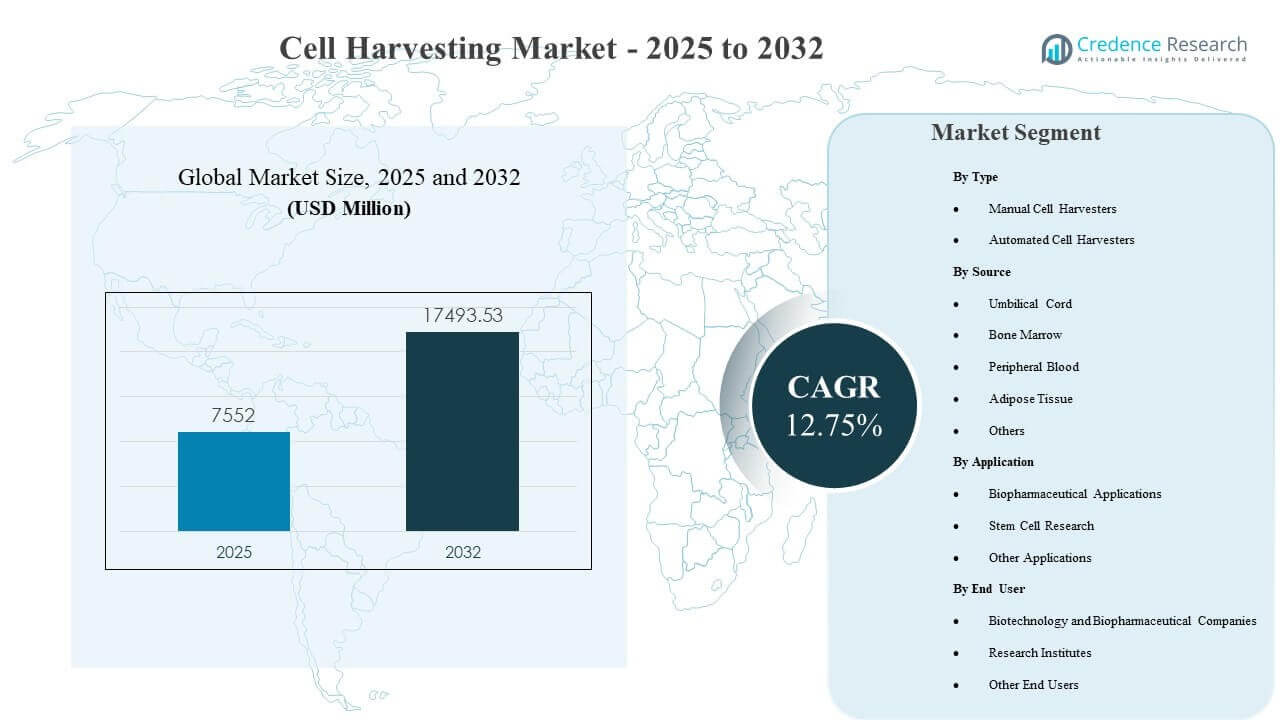
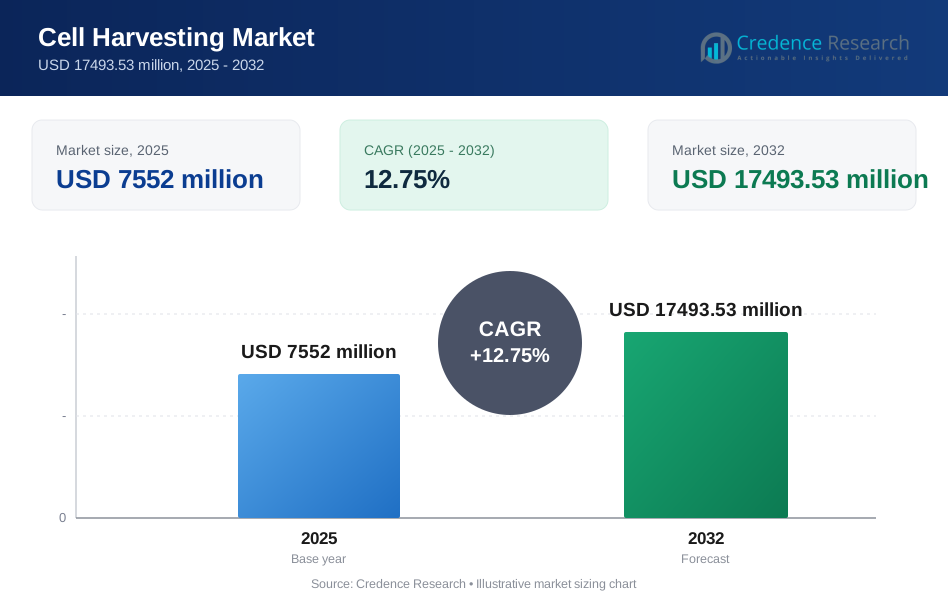
The global Cell Harvesting Market size was estimated at USD 7552 million in 2025 and is expected to reach USD 17493.53 million by 2032, growing at a CAGR of 12.75% from 2025 to 2032. Growth momentum is primarily driven by rising adoption of automated and closed processing workflows that improve reproducibility, reduce contamination risk, and support higher-throughput bioprocessing needs. North America and Asia Pacific remain the most influential regions for demand generation due to strong biopharmaceutical manufacturing footprints and expanding advanced therapy development activity.
| REPORT ATTRIBUTE | DETAILS |
|---|---|
| Historical Period | 2020-2024 |
| Base Year | 2025 |
| Forecast Period | 2026-2032 |
| Cell Harvesting Market Size 2025 | USD 7552 million |
| Cell Harvesting Market, CAGR | 12.75% |
| Cell Harvesting Market Size 2032 | USD 17493.53 million |
Key Market Trends & Insights
- Automated Cell Harvesters accounted for 58.9% share in 2025, reflecting rapid migration toward standardized and scalable harvesting workflows.
- Biopharmaceutical Applications represented 44.8% share in 2025, supported by sustained biologics production expansion and tighter process control needs.
- Biotechnology and Biopharmaceutical Companies contributed 47.6% share in 2025, driven by commercialization-focused procurement and GMP-aligned process requirements.
- North America accounted for 33.1% share in 2025, underpinned by mature biomanufacturing infrastructure and high automation penetration.
- The Cell Harvesting Market is projected to expand at 12.75% CAGR from 2025 to 2032, increasing from USD 7552 million to USD 17493.53 million.
Segment Analysis
The Cell Harvesting Market continues to evolve toward higher automation, closed-system processing, and workflow standardization to meet stricter quality and scale requirements. Automated harvesting is gaining preference because automated harvesting reduces operator variability and supports consistent cell recovery across batches. Procurement decisions increasingly prioritize integration readiness with upstream and downstream bioprocessing steps, especially in biologics and advanced therapy workflows.
Source-driven demand is shaped by collection feasibility, cell yield requirements, and the suitability of each biological source for downstream applications. Peripheral blood and bone marrow remain central to established hematology and immune-cell workflows, while adipose tissue and umbilical cord sourcing are increasingly linked to regenerative medicine and translational research needs. End users are also placing greater emphasis on traceability, sterility assurance, and scalable throughput as manufacturing-grade processes become more common across therapy development pipelines.
By Type Insights
Automated Cell Harvesters accounted for the largest share of 58.9% in 2025. Automated Cell Harvesters lead because automated platforms improve repeatability and reduce variability across operators and sites. Automated Cell Harvesters also support higher throughput and better process control, which aligns with manufacturing-grade requirements. Automated Cell Harvesters strengthen contamination control through closed or semi-closed workflows and reduce manual handling steps.
By Source Insights
Umbilical Cord, Bone Marrow, Peripheral Blood, and Adipose Tissue demand is shaped by accessibility, yield, and downstream use requirements. Peripheral blood and bone marrow sourcing remains important for established clinical and immunology workflows, supported by mature collection and processing practices. Umbilical cord sourcing retains relevance in cell banking and translational pipelines where early-life sample availability is critical. Adipose tissue sourcing continues to gain attention in regenerative medicine programs that require scalable access to adult stem cell populations.
By Application Insights
Biopharmaceutical Applications accounted for the largest share of 44.8% in 2025. Biopharmaceutical Applications lead because biologics production depends on reliable harvesting and clarification steps to maintain product quality and batch consistency. Biopharmaceutical Applications also benefit from automation adoption that reduces downtime and improves throughput for large-volume processing. Biopharmaceutical Applications favor standardized workflows that support compliance expectations and reduce deviation risk in regulated environments.
By End User Insights
Biotechnology and Biopharmaceutical Companies accounted for the largest share of 47.6% in 2025. Biotechnology and Biopharmaceutical Companies lead due to strong demand for scalable and validated harvesting workflows supporting commercial production. Biotechnology and Biopharmaceutical Companies also prioritize automation compatibility and closed processing to reduce quality risk during scale-up. Biotechnology and Biopharmaceutical Companies invest in integrated platforms that streamline operations and improve consistency across manufacturing campaigns.
Cell Harvesting Market Drivers
Expansion Of Biologics Manufacturing And Process Scale-Up
Biologics pipeline growth continues to increase demand for consistent cell harvesting and clarification performance across larger batch volumes. The Cell Harvesting Market benefits from higher emphasis on standardization and traceability in manufacturing operations. Automated workflows reduce operator dependence and support repeatable outcomes across shifts and multi-site production. Investment in process intensification and tighter quality controls reinforces the need for robust harvesting systems aligned with regulated manufacturing expectations.
- For instance, Sartorius's Ksep 50 fluidized bed centrifuge achieved greater than 90% cell recovery across cell densities ranging from less than 1 million cells/mL to over 100 million cells/mL, reduced cell processing time by 50% in closed harvest processes, and demonstrated 99% cell recovery during final harvest clarification in scaled-up biomanufacturing operations while maintaining low harvest turbidities of 4 NTU and 95% antibody recovery.
Automation Adoption For Reproducibility And Contamination Control
The Cell Harvesting Market is supported by growing preference for automated, closed, and semi-closed processing to reduce contamination risk. Automated Cell Harvesters improve run-to-run consistency and reduce manual handling steps that introduce variability. Manufacturing teams also value reduced hands-on time and simplified training requirements that automation enables. These factors collectively raise adoption in commercial biologics and advanced therapy manufacturing environments.
- For instance, Terumo Blood and Cell Technologies' Quantum Flex Cell Expansion System automated over 90% of manual steps from isolation to harvest for bone marrow-derived MSCs, reduced in-process labor needs from 2 FTEs (18 hours) per batch to 1 FTE for 10 batches per year, and expanded as few as 6 million CD3+ T cells to over 2 billion viable cells in 8 days with 95% viability at harvest while enabling operation in Grade C cleanrooms through its functionally closed architecture.
Growth In Cell And Gene Therapy And Regenerative Medicine Activity
Advanced therapy development increases demand for gentle handling, viability preservation, and consistent recovery during harvesting and processing. The Cell Harvesting Market benefits from expanding translational programs that require scalable workflow design from research to manufacturing. Standardized harvesting platforms enable better comparability across studies and reduce rework caused by inconsistent processing. Increasing manufacturing readiness in therapy pipelines supports further investment in integrated harvesting and processing solutions.
Rising R&D Intensity In Academic And Translational Ecosystems
Research institutes continue to expand adoption of standardized cell processing workflows to improve experimental reproducibility and reduce operator bias. The Cell Harvesting Market gains from higher demand for platforms supporting multiple source materials and flexible protocols. Research groups also value systems that integrate with downstream analytics and cell characterization workflows. Collaboration between research centers and industry partners strengthens demand for scalable and transfer-ready harvesting approaches.
Cell Harvesting Market Challenges
The Cell Harvesting Market faces adoption barriers linked to high capital expenditure, validation effort, and workflow change management in regulated environments. Automated systems often require process redesign, staff training, and integration with upstream and downstream equipment, which can extend implementation timelines. Budget constraints across smaller laboratories also limit access to premium platforms and support services. Procurement decisions frequently weigh upfront cost against long-term gains in reproducibility and throughput.
- For instance, Thermo Fisher Scientific’s Gibco CTS Rotea Counterflow Centrifugation System requires a capital outlay of ~USD 250,000–300,000 and typically needs 8–12 weeks for installation qualification (IQ), operational qualification (OQ), and performance qualification (PQ) validation in GMP facilities, while demanding 40–60 hours of operator training before release for clinical manufacturing.
Operational complexity also remains a challenge because biological variability across source types can require protocol tailoring and tighter control of process parameters. The Cell Harvesting Market must address concerns around cell viability preservation, yield consistency, and sterility assurance across different workflows. Supply chain reliability for consumables and single-use components can disrupt continuity for high-throughput operations. Alignment between equipment specifications and facility constraints can also restrict deployment options for some end users.
Cell Harvesting Market Trends and Opportunities
The Cell Harvesting Market is seeing increased demand for closed processing, modular automation, and scalable platform architectures that support expansion from R&D to manufacturing. Vendors are positioning systems as integrated platforms that reduce touchpoints and improve consistency across workflows. Digital monitoring and data capture are also becoming more important for traceability and deviation management. These factors create opportunities for platforms that combine automation, connectivity, and standardized consumable ecosystems.
- For instance, Miltenyi Biotec's CliniMACS Prodigy platform, deployed across 36 GMP manufacturing runs for allogeneic NK cell therapy in 2024–2025, achieved 89% batch success rate with >94% cell viability and 47–62% CD34⁺ recovery from cord blood, while its integrated software captured 100% of critical process parameters for EU Annex 1 compliance across all runs.
Growth opportunities also emerge from expanding therapy manufacturing capacity in Asia Pacific and increasing investment in bioprocessing infrastructure across emerging markets. The Cell Harvesting Market can benefit from demand for flexible solutions that handle multiple source materials and varying batch sizes. Partnerships between equipment suppliers and consumable providers can accelerate adoption by validating end-to-end workflow performance. Training, service, and application support offerings also create differentiation opportunities for suppliers.
Regional Insights
North America
North America accounted for 33.1% share in 2025, supported by mature biopharmaceutical manufacturing and strong adoption of automation-oriented processing. The region demonstrates high demand for scalable harvesting workflows aligned with regulated quality requirements. Advanced therapy development activity also supports investment in closed and standardized processing systems. Vendor presence and service infrastructure further strengthen adoption across commercial and research environments.
Europe
Europe captured 23.3% share in 2025, driven by established bioprocessing capabilities and steady upgrades toward standardized manufacturing workflows. Regulatory alignment and emphasis on quality systems increase demand for validated harvesting approaches. Research intensity across academic networks also supports demand for reproducible and transferable workflows. Procurement patterns often favor solutions with proven performance across diverse source materials and applications.
Asia Pacific
Asia Pacific represented 31.9% share in 2025, reflecting rapid expansion of biologics capacity and increasing investment in advanced therapy ecosystems. Manufacturing scale-up priorities support adoption of automation that improves throughput and reduces variability. Regional demand is also shaped by growing contract manufacturing activity and expanding research infrastructure. Supplier strategies commonly emphasize scalability, cost efficiency, and deployment flexibility across different facility profiles.
Latin America
Latin America held 6.8% share in 2025, supported by selective growth in biopharmaceutical manufacturing and increasing adoption in research centers. Infrastructure concentration in a limited number of hubs shapes uneven adoption patterns across countries. Demand is improving where laboratories prioritize standardized workflows for reproducibility and collaboration. Growth potential remains tied to investment in bioprocessing capacity and access to supplier support networks.
Middle East & Africa
Middle East and Africa accounted for 4.9% share in 2025, with adoption focused on select research and healthcare innovation hubs. Limited large-scale manufacturing footprint constrains broader deployment of advanced harvesting platforms. Demand is gradually increasing as bioprocessing capabilities expand and academic collaborations grow. Opportunities strengthen where funding, training, and service availability improve access to standardized cell processing solutions.
Competitive Landscape
The Cell Harvesting Market remains competitive with a strong focus on automation, closed processing, workflow standardization, and integration readiness with broader bioprocessing systems. Leading suppliers emphasize platform-based differentiation through scalability, consumable ecosystems, and service support that accelerates deployment. Competitive positioning also reflects application breadth across biologics manufacturing, stem cell workflows, and research-grade processing needs. Partnerships, platform enhancements, and manufacturing enablement initiatives continue to shape differentiation.
PerkinElmer focuses on enabling standardized workflows that support reliable cell processing and downstream analytical readiness across research and applied life science settings. PerkinElmer strategy commonly emphasizes workflow usability, repeatable outcomes, and compatibility with broader laboratory ecosystems that support end-to-end execution. PerkinElmer positioning is strengthened where customers require integrated solutions that support consistent handling and scalable workflow design. PerkinElmer also benefits from broad customer reach across academic and industrial research environments.
The industry research and growth report includes detailed analyses of the competitive landscape of the market and information about key companies, including:
- PerkinElmer
- Sartorius AG
- Terumo Corporation
- Terumo BCT
- Danaher Corporation
- Thermo Fisher Scientific
- TOMTEC
- Brandel
- Cox Scientific
- Arthrex
- Avita Medical
Qualitative and quantitative analysis of companies has been conducted to help clients understand the wider business environment as well as the strengths and weaknesses of key industry players. Data is qualitatively analyzed to categorize companies as pure play, category-focused, industry-focused, and diversified; it is quantitatively analyzed to categorize companies as dominant, leading, strong, tentative, and weak.
Recent Developments
- In May 2024, AVITA Medical, Inc. received U.S. FDA premarket approval for its RECELL GO System, a next-generation autologous cell harvesting device designed to treat thermal burn injuries and full-thickness skin conditions. The company commercially launched the system in top U.S. burn treatment centers in June 2024, and later secured CE Mark approval in September 2025 to enable commercialization across Europe, including Germany and Italy.
- In November 2024, Rousselot (a Darling Ingredients brand) and IamFluidics jointly launched a novel research-grade dissolvable microcarrier for adherent cell culturing that achieves over 90% cell harvesting efficiency, significantly reducing cell loss compared to traditional non-dissolvable microcarriers. This product streamlines scale-up processes for advanced cell therapies, biologics manufacturing, and cultured meat production by combining Rousselot's high-quality denatured collagen with IamFluidics' microparticle technology.
- In April 2025, Thermo Fisher Scientific Inc. inaugurated its 6,000-square-foot Advanced Therapies Collaboration Center in Greater San Diego to support the evolution and capitalization of cell therapies, including harvesting workflows. Later, in February 2025, Swarm Oncology Ltd. announced a strategic partnership with Cellex Cell Professionals GmbH to accelerate manufacturing and clinical development of T cell therapies, with Cellex supplying cellular starting material and overseeing GMP manufacturing and quality control.
Report Scope
| Report Attribute | Details |
| Market size value in 2025 | USD 7552 million |
| Revenue forecast in 2032 | USD 17493.53 million |
| Growth rate (CAGR) | 12.75% (2025–2032) |
| Base year | 2025 |
| Forecast period | 2026–2032 |
| Quantitative units | USD million |
| Segments covered | By Type Outlook: Manual Cell Harvesters, Automated Cell Harvesters; By Source Outlook: Umbilical Cord, Bone Marrow, Peripheral Blood, Adipose Tissue, Others; By Application Outlook: Biopharmaceutical Applications, Stem Cell Research, Other Applications; By End User Outlook: Biotechnology and Biopharmaceutical Companies, Research Institutes, Other End Users |
| Regional scope | North America, Europe, Asia Pacific, Latin America, Middle East & Africa |
| Key companies profiled | PerkinElmer, Sartorius AG, Terumo Corporation, Terumo BCT, Danaher Corporation, Thermo Fisher Scientific, TOMTEC, Brandel, Cox Scientific, Arthrex, Avita Medical |
| No. of Pages | 328 |
By Segmentation
By Type
- Manual Cell Harvesters
- Automated Cell Harvesters
By Source
- Umbilical Cord
- Bone Marrow
- Peripheral Blood
- Adipose Tissue
- Others
By Application
- Biopharmaceutical Applications
- Stem Cell Research
- Other Applications
By End User
- Biotechnology and Biopharmaceutical Companies
- Research Institutes
- Other End Users
By Region
- North America
- U.S.
- Canada
- Mexico
- Europe
- Germany
- France
- U.K.
- Italy
- Spain
- Rest of Europe
- Asia Pacific
- China
- Japan
- India
- South Korea
- South-east Asia
- Rest of Asia Pacific
- Latin America
- Brazil
- Argentina
- Rest of Latin America
- Middle East & Africa
- GCC Countries
- South Africa
- Rest of the Middle East and Africa
Request a Free Sample
Fill in your details and we'll send you a free sample report.
- Sample data tables & charts
- Research methodology
Need a Custom Version of This Report?
Tailor the scope, geography, or segments to your exact requirements.
- Custom geography or segment scope
- Direct access to our analyst team
Frequently Asked Questions
What is the market size of the Cell Harvesting Market in 2025 and the forecast for 2032?
What is the CAGR for the Cell Harvesting Market during 2025–2032?
Which segment leads the Cell Harvesting Market by type in 2025?
What are the key growth factors supporting the Cell Harvesting Market?
Which companies are profiled as key players in the Cell Harvesting Market?
Which region leads the Cell Harvesting Market in 2025?
Table of Content
Chapter 1. Report Introduction
- 1.1 Report Description & Purpose
- 1.1.1 Report Title & Market Definition
- 1.1.2 Unique Selling Propositions (USP) & Key Differentiators
- 1.1.3 Value Proposition for Stakeholders
- 1.2 Research Objectives
- 1.2.1 Market Sizing Objectives (Volume & Revenue)
- 1.2.2 Segmentation Objectives
- 1.2.3 Competitive Intelligence Objectives
- 1.2.4 Forecast & Scenario Objectives
- 1.3 Report Scope
- 1.3.1 Cell Harvesting Scope – Types & Subtypes Covered
- 1.3.2 Geographic Scope – Regions & Countries Covered
- 1.3.3 Historical Period, Base Year & Forecast Period (2025; forecast to 2032)
- 1.3.4 Inclusions & Exclusions
- 1.4 HS Code & Classification Framework
- 1.5 Currency, Units & Pricing Basis
- 1.6 Target Stakeholders
- 1.7 Limitations & Assumptions
Chapter 2. Executive Summary
- 2.1 Global Cell Harvesting Market Snapshot
- 2.1.1 Market Size – Historical (2025) & Forecast (2025-2032) (2025: USD 7552 million → 2032: USD 17493.53 million)
- 2.1.2 Volume & Revenue – Global Totals
- 2.1.3 Key Market Highlights – Top Five Facts
- 2.2 Cell Harvesting Market Segmentation Snapshot
- 2.2.1 Market Split by Region – 2025 vs. 2032
- 2.3 Competitive Snapshot
- 2.3.1 Top 10 Players by Revenue Share – 2025
- 2.3.2 Top 10 Players by Volume Share – 2025
- 2.3.3 Recent Strategic Developments (18-Month Summary)
- 2.4 Key Investment Highlights & Strategic Conclusions
Chapter 3. Cell Harvesting Market Dynamics & Industry Analysis
- 3.1 Market Overview & Context
- 3.1.1 Cell Harvesting Market Position in the Broader Automotive Value Chain
- 3.1.2 OEM vs. Replacement Market Dynamics
- 3.1.3 Market Maturity & Development Stage by Region
- 3.2 Cell Harvesting Market Drivers
- 3.3 Cell Harvesting Market Restraints & Challenges
- 3.4 Cell Harvesting Market Opportunities
- 3.5 Porter's Five Forces Analysis
- 3.5.1 Threat of New Entrants
- 3.5.2 Bargaining Power of Suppliers
- 3.5.3 Bargaining Power of Buyers
- 3.5.4 Threat of Substitutes
- 3.5.5 Competitive Rivalry – Intensity Assessment
- 3.6 Cell Harvesting Value Chain Analysis
- 3.6.1 Upstream – Raw Material/Input Suppliers
- 3.6.1.1 Raw Material/Input 1
- 3.6.1.2 Raw Material/Input 2
- 3.6.1.3 Raw Material/Input 3
- 3.6.2 Midstream – Production/Manufacturing/Service Delivery
- 3.6.2.1 Production/Process Overview
- 3.6.2.2 Key Facility Locations & Capacity by Manufacturer
- 3.6.3 Downstream – Distribution & End Consumer
- 3.6.3.1 Primary Channel – B2B/OEM
- 3.6.3.2 Secondary Channels – Dealer, Retail, Online, Direct
- 3.6.4 Value Chain Profitability Analysis
- 3.6.1 Upstream – Raw Material/Input Suppliers
- 3.7 PESTEL Analysis
- 3.7.1 Political Factors
- 3.7.2 Economic Factors
- 3.7.3 Social Factors
- 3.7.4 Technological Factors
- 3.7.5 Environmental Factors
- 3.7.6 Legal Factors
- 3.8 Cell Harvesting Supply Chain Analysis
- 3.8.1 Raw Material/Input Supply Risk Assessment
- 3.8.2 Manufacturing Concentration Risk (Geographic Exposure)
- 3.8.3 Trade Disruption Impact Analysis
- 3.9 Regulatory & Policy Landscape
Note: The regulatory and policy landscape section covers regulations based on their applicability to the market, Cell Harvesting category, geography, and scope of the study. Only regulatory frameworks with a material impact on operations, compliance, trade, sustainability, or market access are analyzed in detail.
Chapter 4. Key Investment Pockets & Opportunity Analysis
- 4.1 Cell Harvesting Market Attractiveness Analysis
- 4.1.1 By Region – Investment Attractiveness Matrix (Volume × CAGR)
- 4.2 Absolute Revenue Growth Opportunity
- 4.2.1 By Region – Absolute USD Growth Through 2032
- 4.3 Incremental Volume Opportunity
- 4.3.1 By Region – Incremental Volume Through 2032
- 4.3.2 Segment – Incremental Volume
- 4.4 Emerging Submarket Opportunity Deep Dive (Subject to Applicability)
- 4.5 Emerging Market Opportunity Scorecards
- 4.5.1 United States
- 4.5.2 Europe
- 4.5.3 Asia
- 4.5.4 Middle East & Africa
Note: Emerging Market Opportunity Scorecards will be included based on relevance and strategic importance. Regions listed are indicative and may vary depending on data availability and market dynamics.
Chapter 5. Cell Harvesting Import-Export Analysis & Trade Flows
- 5.1 Global Trade Overview
- 5.1.1 Global Export Value by Country (2025)
- 5.1.2 Global Export Volume by Country (2025)
- 5.1.3 Global Import Value by Country (2025)
- 5.1.4 Global Import Volume by Country (2025)
- 5.1.5 Net Trade Balance by Country (2025)
- 5.2 Export Analysis – Segment
- 5.2.1 Type 1 (HS Code)
- 5.2.2 Type 2 (HS Code)
- 5.2.3 Type 3 (HS Code)
- 5.2.4 Type 4 (HS Code)
- 5.2.5 Type 5 (HS Code)
- 5.3 Import Analysis – Segment
- 5.3.1 Type 1 (HS Code)
- 5.3.2 Type 2 (HS Code)
- 5.3.3 Type 3 (HS Code)
- 5.3.4 Type 4 (HS Code)
- 5.3.5 Type 5 (HS Code)
- 5.4 Average Unit Trade Prices
- 5.4.1 Average Export Price – Segment & Country
- 5.4.2 Average Import Price – Segment & Source Country
- 5.4.3 Price Trends (2025)
- 5.5 Key Trade Route Analysis
- 5.5.1 Trade Route 1
- 5.5.2 Trade Route 2
- 5.5.3 Trade Route 3
- 5.5.4 Trade Route 4
- 5.5.5 Trade Route 5
- 5.6 Trade Policy Impact Assessment
- 5.6.1 US Anti-Dumping & Section 301 Tariffs
- 5.6.2 EU Customs Union Impact
- 5.6.3 Major Free Trade Agreements
- 5.6.4 USMCA Rules of Origin
Note: Trade policy analysis will be included only where relevant to the Cell Harvesting market.
Chapter 6. Competitive Landscape & Company Benchmarking
- 6.1 Cell Harvesting Market Concentration & Structure
- 6.1.1 Herfindahl-Hirschman Index (HHI) – vs. 2025
- 6.1.2 Tier 1, Tier 2 & Tier 3 Market Structure
- 6.1.3 Global, Regional & Local Player Dynamics
- 6.2 Cell Harvesting Market Share Analysis – 2025
- 6.2.1 Global Revenue Share by Company
- 6.2.2 Global Volume Share by Company
- 6.2.3 Regional Revenue Share
- 6.2.4 Market Share Evolution ( vs. 2025)
- 6.2.5 OEM Segment Share by Company
- 6.2.6 Replacement Segment Share by Company
- 6.3 Production/Delivery Capacity & Facility Analysis
- 6.3.1 Global Installed Capacity
- 6.3.2 Capacity Utilization Rates
- 6.3.3 Production/Output Volume
- 6.3.4 Facility Locations & Capacity Map
- 6.3.5 Planned Capacity Additions
- 6.4 Cell Harvesting Competitive Benchmarking Matrix
- 6.4.1 Revenue, Volume, CAGR & Profitability Comparison
- 6.4.2 Channel Revenue Mix
- 6.4.3 Geographic Revenue Exposure
- 6.4.4 R&D Intensity
- 6.4.5 Sustainability Maturity
- 6.5 Strategic Developments in Cell Harvesting (Last 24 Months)
- 6.5.1 Mergers, Acquisitions & Divestments
- 6.5.2 New Cell Harvesting Launches
- 6.5.3 Facility Expansions
- 6.5.4 Strategic Alliances, Joint Ventures & Partnerships
- 6.5.5 Distribution Expansion & Market Entry
- 6.5.6 Sustainability & ESG Initiatives
- 6.6 Competitive Strategy Mapping
- 6.6.1 Leader, Challenger, Follower & Niche Classification
- 6.6.2 Pricing Strategy Comparison
- 6.6.3 Channel Strategy Matrix
Note: Strategic developments are included based on their materiality and the availability of reliable information.
Chapter 7. Global Cell Harvesting Market – By Distribution Channel
- 7.1 Segment Overview
- 7.1.1 Volume & Revenue Split by Channel (2025 & 2032)
- 7.1.2 Channel Mix Evolution (2025-2032)
Chapter 8. Regional Market Analysis – Global Overview
- 8.1 Global Regional Overview
- 8.1.1 Regional Volume Share
- 8.1.2 Regional Revenue Share
- 8.1.3 Regional Volume by Region
- 8.1.4 Regional Revenue by Region
- 8.1.5 Regional Forecast Through 2032
- 8.2 Cross-Regional Segment Analysis
- 8.2.1 By Distribution Channel
- 8.2.2 By Brand/Price Tier
Chapter 9. North America Cell Harvesting Market
- 9.1 United States
- 9.2 Canada
- 9.3 Mexico
Chapter 10. Europe Cell Harvesting Market
- 10.1 Germany
- 10.2 France
- 10.3 Italy
- 10.4 United Kingdom
- 10.5 Spain
- 10.6 Poland
- 10.7 Russia
- 10.8 Netherlands
- 10.9 Belgium
- 10.10 Sweden
- 10.11 Denmark
- 10.12 Norway
- 10.13 Rest of Europe
Chapter 11. Asia Pacific Cell Harvesting Market
- 11.1 China
- 11.2 India
- 11.3 Japan
- 11.4 South Korea
- 11.5 Thailand
- 11.6 Indonesia
- 11.7 Vietnam
- 11.8 Malaysia
- 11.9 Australia
- 11.10 Rest of Asia Pacific
Chapter 12. Latin America Cell Harvesting Market
- 12.1 Brazil
- 12.2 Argentina
- 12.3 Colombia
- 12.4 Chile
- 12.5 Rest of Latin America
Chapter 13. Middle East Cell Harvesting Market
- 13.1 Saudi Arabia
- 13.2 United Arab Emirates
- 13.3 Turkey
- 13.4 Israel
- 13.5 Iran
- 13.6 Rest of the Middle East
Chapter 14. Africa Cell Harvesting Market
- 14.1 South Africa
- 14.2 Egypt
- 14.3 Nigeria
- 14.4 Morocco
- 14.5 Rest of Africa
Chapter 15. Cell Harvesting Company Profiles
- 15.1 [Company 01]
- 15.1.1 Company Overview
- 15.1.2 Key Management Personnel
- 15.1.3 Products & Services Portfolio
- 15.1.4 Financial Performance
- 15.1.5 Key Market Focus & Geographic Presence
- 15.1.6 Recent Developments & Strategic Initiatives
Note: The company profile list is preliminary and may change based on research findings, market developments, data availability, and client requirements.
Chapter 16. Appendices
- Appendix A – List of Abbreviations & Acronyms
- Appendix B – Industry Classification Code Reference – Full Series
- Appendix C – Production & Capacity Data Tables
- Appendix D – End-Use & Demand Base Tables
- Appendix E – Consumption & Replacement Rate Assumptions
- Appendix F – ASP Reference Tables
- Appendix G – Manufacturing & Facility Database
- Appendix H – Import-Export Data Tables
- Appendix I – Regulatory Summary Tables
- Appendix J – Primary Research Participant List (Anonymized)
- Appendix K – Primary Research Questionnaire Framework
- Appendix L – Data Sources & Bibliography
- Appendix M – Market Size Divergence & Source Comparison
Chapter 17. Research Methodology
- 17.1 Research Framework & Philosophy
- 17.2 Secondary Research – Sources, Hierarchy & Data Extraction
- 17.3 Data Modeling – Bottom-Up & Top-Down Market Sizing
- 17.4 Primary Research – Stakeholder Framework, LOI & Sample Sizes
- 17.5 Forecast Methodology – Regression, Scenario & Sensitivity Analysis
- 17.6 Quality Control – Four-Layer Validation Framework
- 17.7 Limitations & Standard Assumptions
- 17.8 Disclaimer
