
Market Overview
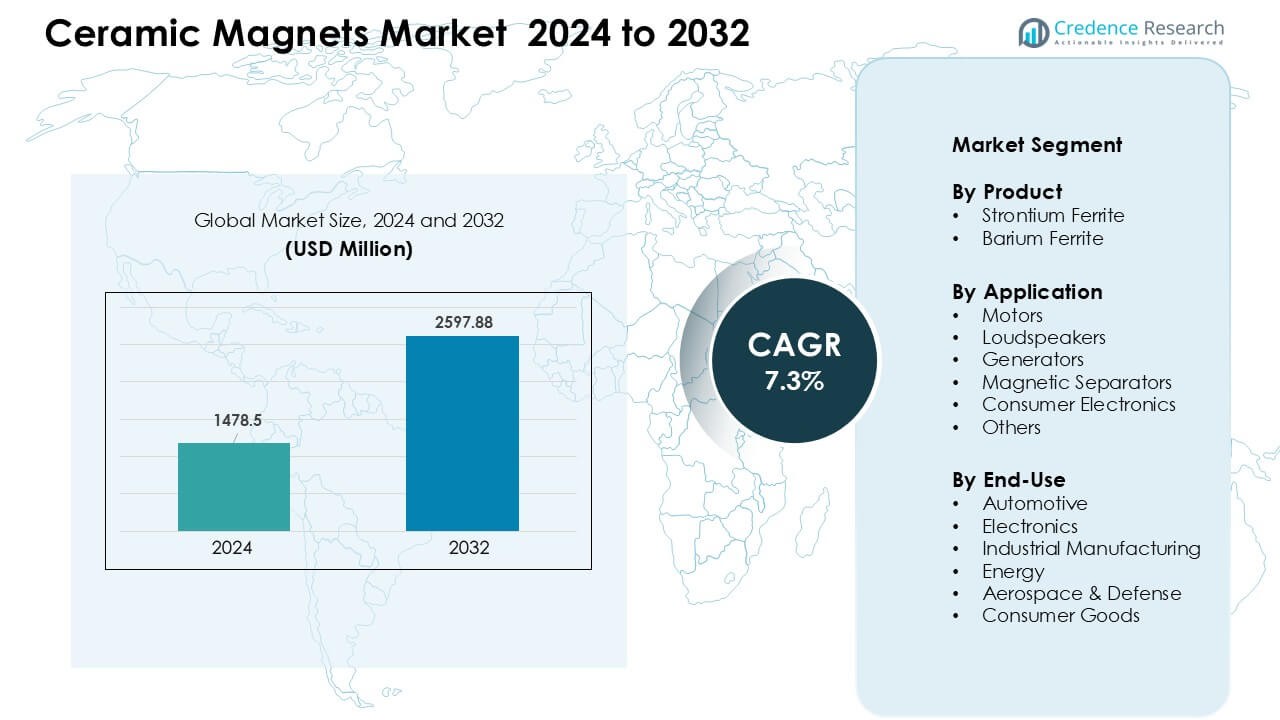
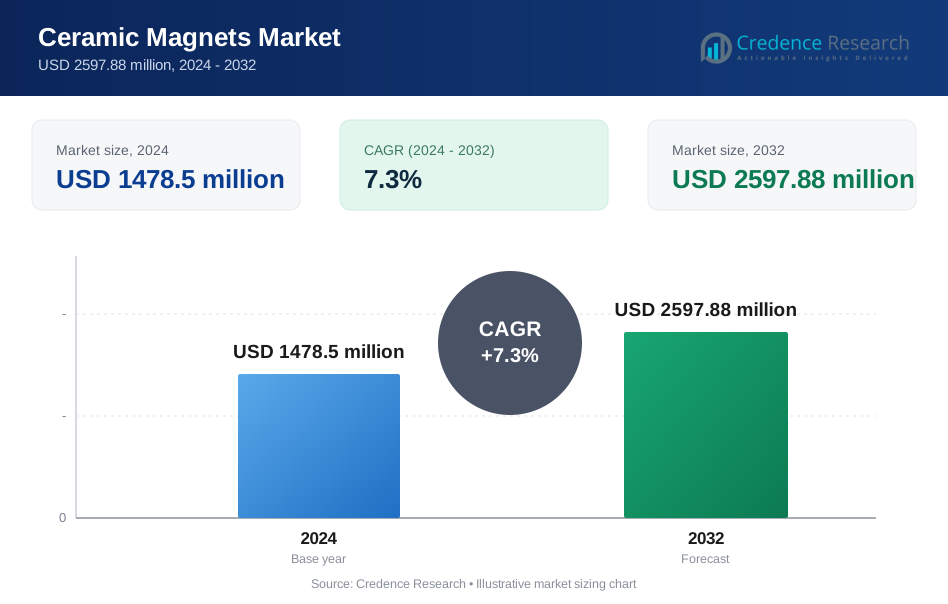
Ceramic Magnets Market was valued at USD 1478.5 million in 2024 and is anticipated to reach USD 2597.88 million by 2032, growing at a CAGR of 7.3% during the forecast period.
| REPORT ATTRIBUTE | DETAILS |
|---|---|
| Historical Period | 2020-2023 |
| Base Year | 2024 |
| Forecast Period | 2025-2032 |
| Ceramic Magnets Market Size 2024 | USD 1478.5 Million |
| Ceramic Magnets Market, CAGR | 7.3% |
| Ceramic Magnets Market Size 2032 | USD 2597.88 Million |
Asia-Pacific led the Ceramic Magnets Market in 2024 with about 42% share, driven by large-scale production of motors, consumer electronics, and automotive components. Key companies shaping the market include TDK Corporation, Hitachi Metals, Adams Magnetic Products, Arnold Magnetic Technologies, DMEGC, Ningbo Yunsheng, Galaxy Magnets, Sinomag, Ningbo Ketian Magnet, and Eclipse Magnetics. These players focus on high-volume ferrite magnet manufacturing, cost-efficient processing, and performance improvements through advanced sintering and material refinement. Strong partnerships with automotive, appliance, and industrial OEMs support wider adoption, while capacity expansion in China and Japan strengthens the region’s leadership in global ceramic magnet supply.
Market Insight
- The Ceramic Magnets Market was valued at USD 1478.5 million in 2024 and is projected to reach USD 2597.88 million by 2032, growing at a CAGR of 7.3%.
- Demand grew as automotive and electronics manufacturers increased use of ferrite magnets in motors, sensors, speakers, and appliance components due to low cost and strong thermal stability.
- Major trends include rising adoption of cost-optimized motor designs, higher use in energy-efficient systems, and expansion of ceramic magnets in automation and small industrial equipment.
- Competition intensified among leading players such as TDK Corporation, Hitachi Metals, Adams Magnetic Products, Arnold Magnetic Technologies, DMEGC, and Ningbo Yunsheng, supported by capacity expansion and improved ferrite magnet processing.
- Asia-Pacific held the largest share at 42%, followed by Europe at 26%, while the motors segment dominated applications with 42% share, supported by strong production of automotive and appliance-related motor systems.
 Market Segmentation Analysis:
By Product
Strontium ferrite held the dominant share in 2024 with the Ceramic Magnets Market. Manufacturers preferred this material due to its strong magnetic properties, cost-effective production, and widespread availability. Demand stayed high in automotive, consumer electronics, and industrial applications because strontium ferrite supports stable performance in high-temperature environments. Barium ferrite continued to serve niche uses in recording media and electromagnetic components, but its share remained smaller due to lower magnetic strength compared to strontium ferrite and reduced adoption in modern electronics.
- For instance, a recent academic study on sintered SrFe₁₂O₁₉ magnets achieved a coercivity of 164 kA/m along with a relative density of 93%, demonstrating that modern sintering processes can yield high-density, robust strontium-ferrite magnets suitable for industrial use.
By Application
Motors accounted for the largest share in 2024 with about 42% of the Ceramic Magnets Market. Electric motors in automotive systems, HVAC units, household appliances, and industrial machinery relied heavily on ceramic magnets due to low cost and high demagnetization resistance. Loudspeakers and generators followed with steady demand from audio equipment makers and power-generation devices. Magnetic separators grew in process industries such as recycling and mining, while consumer electronics saw stable use in sensors and compact devices. Other applications expanded gradually with increased automation needs.
- For instance, in mining and recycling operations, ceramic-magnet-based separators are widely used the reliability and durability of ferrite magnets make them ideal to separate ferrous impurities from ore or recycled materials without frequent replacement or demagnetization issues.
By End-Use
Automotive remained the dominant end-use segment in 2024 with close to 36% share. Ceramic magnets supported power windows, ABS systems, electric pumps, ignition modules, and hybrid vehicle components, which kept demand strong across global vehicle production. Electronics ranked next due to rising use in sensors, speakers, and small motors. Industrial manufacturing used ceramic magnets in conveyors, robotics, and machinery controls. Energy applications expanded with wind-turbine systems and small generators, while aerospace and consumer goods segments added niche but growing demand for lightweight and durable magnetic parts.
Key Growth Drivers
Rising Demand from Automotive and EV Applications
Automotive producers increased adoption of ceramic magnets due to their low cost, stable magnetic strength, and wide temperature tolerance. Electric motors, power windows, ABS systems, fuel pumps, ignition modules, and hybrid vehicle systems rely on ferrite magnets for reliable operation. As electric vehicle production expands globally, automakers prefer ceramic magnets for non-critical motor assemblies because they reduce system cost and require less complex manufacturing. EV traction motors depend more on rare-earth magnets, but ceramic magnets still support auxiliary systems that occupy a significant part of the vehicle bill of materials. Increased production of two-wheel EVs and compact hybrid systems also boosts demand. The global shift toward fuel efficiency and electrification continues to expand usage across automotive electronics, thermal management systems, and onboard actuators. These factors together strengthen ceramic magnet consumption and create a stable long-term growth path.
- For instance, Ola Electric (an Indian EV manufacturer) recently announced development of a ferrite-magnet based motor for two-wheelers to reduce dependence on rare-earth materials underlining that ferrite magnets remain advantageous for cost-sensitive mobility segments.
Growth in Consumer Electronics and Small Motor Production
Consumer electronics manufacturers use ceramic magnets in speakers, sensors, cooling fans, timers, and small electric motors, which keeps demand steady as device shipments grow. Ferrite magnets offer strong corrosion resistance, high coercivity, and very low cost, making them suitable for mass-produced appliances, personal electronics, and household equipment. The rise in smart-home devices, compact audio products, and handheld gadgets supports broader adoption. Small motors used in fans, mixers, washing machines, HVAC units, and robotic appliances rely heavily on ceramic magnets because the material provides stable magnetic behavior and supports high-volume production. Emerging segments such as smart wearables, micro-mobility products, and low-power mechatronic systems also integrate ferrite magnets for efficient functionality. This continuous expansion in small appliance and electronics manufacturing reinforces global market growth and widens the customer base.
- For instance, many mid-range and budget-segment loudspeakers and home/audio systems continue to use ferrite magnets because they deliver adequate magnetic field strength (typically around 0.2–0.5 Tesla) for speaker voice-coil operation, while keeping production costs low.
Industrial Automation and Manufacturing Expansion
Industrial automation accelerated the use of ceramic magnets in robotic systems, conveyors, magnetic separators, pumps, and processing machinery. Factories require reliable and affordable magnetic components that withstand heat, vibration, and long duty cycles. Ceramic magnets meet these needs and support automation upgrades in sectors such as metals, food processing, recycling, and packaging. Magnetic separators using ferrite magnets help improve material purity and reduce operational costs, which drives adoption in bulk-handling industries. As industrial modernization continues in emerging economies, manufacturers invest in automated systems that depend on motors, sensors, and actuators built with ceramic magnets. Global growth in machine tools, HVAC systems, and industrial fans adds further demand. The broader movement toward smart factories and predictive maintenance increases the installation of motors and sensing units, reinforcing ceramic magnet consumption across heavy and light industries.
Key Trends & Opportunities
Shift Toward Cost-Optimized Motor Designs
Manufacturers increasingly develop cost-optimized motors for appliances, automotive systems, and industrial machinery to balance performance with affordability. Ceramic magnets play a key role in this shift because they reduce material cost while maintaining functional magnetic performance. Many companies replace rare-earth magnets in non-critical systems with strontium ferrite to reduce dependency on volatile rare-earth supply chains. This trend opens new opportunities in fan motors, BLDC motors, pumps, and auxiliary automotive components. Innovation in ferrite magnet molding, sintering, and grain-alignment methods also enhances performance, allowing ceramic magnets to serve broader applications. As manufacturers seek lower-cost alternatives without compromising reliability, ceramic magnets gain stronger appeal in both mature and emerging markets.
- For instance, recent research combining FeCo nanowires with strontium-hexaferrite powder produced a bonded magnet with coercivity above 199 kA/m and remanence ratio above 0.76 delivering roughly 20 % higher remanence and ~48 % greater energy product than conventional pure hexaferrite magnets, making them competitive candidates for rare-earth-free motor designs.
Growing Adoption in Renewable Energy and Energy-Efficient Systems
Renewable energy and energy-efficient technologies create new possibilities for ceramic magnet usage, especially in small wind generators, micro-turbines, and auxiliary energy-conversion devices. Ferrite magnets provide corrosion resistance and stable magnetic strength, making them suitable for harsh outdoor environments. The push for energy-efficient appliances and industrial systems supports higher production of motors and blowers using ceramic magnets. HVAC units, ventilation systems, and heat pumps increasingly rely on ferrite-based motors to meet energy-efficiency norms. Expanding investments in distributed power systems and low-voltage energy devices offer emerging opportunities for ceramic magnets. As sustainability regulations grow stronger, energy-saving motor technologies will further increase the integration of ceramic magnets across several sectors.
- For instance, a prototype of a permanent-magnet generator for small wind turbines (using ferrite rather than rare-earth magnets) has been demonstrated illustrating that ceramic magnets can be used in renewable-energy generators where cost and corrosion resistance matter more than maximum magnetic flux.
Key Challenges
Competition from Rare-Earth Magnets in High-Performance Applications
High-performance electronics, EV traction motors, aerospace systems, and advanced robotics prefer rare-earth magnets such as neodymium-iron-boron (NdFeB) due to stronger magnetic density and greater efficiency. This creates a major challenge for ceramic magnets, which cannot match these high magnetic strength requirements. As industries pursue smaller, lighter, and more energy-efficient systems, demand may shift toward rare-earth solutions for critical applications. Ceramic magnets remain relevant for cost-sensitive uses, but face limitations in achieving high torque, miniaturization, and power-dense designs. This performance gap restricts penetration into premium markets.
Fluctuating Raw Material Quality and Manufacturing Constraints
Ceramic magnets depend on consistent availability of iron oxide and strontium carbonate, and fluctuations in raw material quality affect magnetic performance and overall reliability. Manufacturing processes such as sintering, molding, and grain alignment require strict control to maintain uniformity across large volumes. Any deviation can lower magnetic strength or increase defect rates, raising operational costs for producers. Production also demands energy-intensive processes, which expose manufacturers to rising energy prices and environmental compliance challenges. These constraints limit the ability to scale production rapidly and maintain price stability in competitive global markets.
Regional Analysis
North America
North America held about 22% of the Ceramic Magnets Market in 2024, supported by strong demand from automotive, HVAC, consumer appliances, and industrial automation sectors. The U.S. led adoption due to high production of small motors, sensors, and loudspeakers. Growth in EV component manufacturing and renewable energy systems increased the use of ferrite magnets in auxiliary motors and generators. The presence of automation equipment manufacturers and ongoing upgrades in industrial machinery supported steady consumption. Advancements in robotics, smart home devices, and warehouse automation reinforced regional demand for cost-efficient ceramic magnets across multiple end-use segments.
Europe
Europe accounted for nearly 26% of the Ceramic Magnets Market in 2024, driven by strong automotive production, energy-efficient appliance manufacturing, and industrial automation. Germany, France, and Italy remained leading users due to advanced motor systems and high adoption of ferrite magnets in HVAC units, power tools, and robotic systems. EU regulations promoting sustainability and reduced rare-earth dependency supported wider use of ceramic magnets in non-critical motor assemblies. Renewable energy applications, such as small wind generators and micro-turbines, also increased usage. Strong demand from consumer electronics, industrial equipment, and electric mobility further boosted regional growth.
Asia-Pacific
Asia-Pacific dominated the Ceramic Magnets Market in 2024 with nearly 42% share, driven by large-scale production of consumer electronics, automotive components, small motors, and appliances. China, Japan, South Korea, and India led manufacturing due to robust supply chains, established ferrite magnet producers, and high-volume electronics output. Expanding EV production in China and India drove rising use of ceramic magnets in auxiliary motors and automotive electronics. Industrial automation, robotics, and energy-efficient appliances continued to accelerate demand. The region also benefited from cost-effective raw material availability and rapid industrial growth across manufacturing, HVAC, and robotics applications.
Latin America
Latin America held close to 6% share of the Ceramic Magnets Market in 2024, supported by increasing adoption in automotive components, household appliances, and industrial machinery. Brazil and Mexico led demand due to expanding vehicle assembly operations, rising use of small motors, and growing investments in manufacturing automation. Appliance production in Brazil and Argentina also contributed to higher consumption of ferrite magnets in compressors, fans, and audio equipment. Mining and recycling industries adopted magnetic separators, boosting industrial usage. Gradual growth in renewable energy and small-scale generators offered emerging opportunities within the region’s developing markets.
Middle East & Africa
The Middle East & Africa region accounted for around 4% of the Ceramic Magnets Market in 2024, driven by increasing demand in industrial equipment, HVAC systems, and automotive components. Countries such as the UAE, Saudi Arabia, and South Africa adopted ceramic magnets in fans, pumps, and automation systems to support expanding commercial and industrial infrastructure. Mining operations in Africa used magnetic separators for material processing, contributing to steady industrial demand. Growth in consumer appliances and small motors supported broader adoption. Although the market size remains smaller than other regions, infrastructure expansion and industrialization continue to create new opportunities.
Market Segmentations:
By Product
- Strontium Ferrite
- Barium Ferrite
By Application
- Motors
- Loudspeakers
- Generators
- Magnetic Separators
- Consumer Electronics
- Others
By End-Use
- Automotive
- Electronics
- Industrial Manufacturing
- Energy
- Aerospace & Defense
- Consumer Goods
By Geography
- North America
- U.S.
- Canada
- Mexico
- Europe
- Germany
- France
- U.K.
- Italy
- Spain
- Rest of Europe
- Asia Pacific
- China
- Japan
- India
- South Korea
- South-east Asia
- Rest of Asia Pacific
- Latin America
- Brazil
- Argentina
- Rest of Latin America
- Middle East & Africa
- GCC Countries
- South Africa
- Rest of the Middle East and Africa
Competitive Landscape
The Ceramic Magnets Market features strong competition led by companies such as TDK Corporation, Hitachi Metals, Adams Magnetic Products, Ningbo Yunsheng, Arnold Magnetic Technologies, DMEGC, Galaxy Magnets, Sinomag, Ningbo Ketian Magnet, and Eclipse Magnetics. These companies focus on high-volume ferrite magnet production, material refinement, and improved sintering technologies to strengthen performance and reduce defects. Many firms expand capacity in Asia-Pacific to meet rising demand from automotive, consumer electronics, and industrial automation sectors. Strategic priorities include cost optimization, raw material security, and advanced molding processes. Leading manufacturers also invest in customized magnet shapes for motors, loudspeakers, and sensors, supporting diverse end-use applications. Partnerships with automotive and electronics OEMs help secure long-term contracts, while continuous development of corrosion-resistant and high-coercivity ferrite grades enhances global competitiveness.
Key Player Analysis
- Adams Magnetic Products Co.
- Earth-Panda Advance Magnetic Material Co., Ltd.
- Arnold Magnetic Technologies
- Daido Steel Co., Ltd.
- Eclipse Magnetics Ltd.
- Electron Energy Corp.
- Goudsmit Magnetics Group
- Hangzhou Permanent Magnet Group
- Magnequench International, LLC
- Ningbo Yunsheng Co., Ltd.
Recent Developments
- In October 2025, Goudsmit Magnetics Group Goudsmit issued an update on new Chinese export restrictions on rare-earth magnets, warning customers of lead-time delays for HRE-containing magnets due to export licensing requirements.
- In June 2025, Ningbo Yunsheng Co., Ltd. Ningbo Yunsheng announced that a portion (5,000 mt capacity) of its 15,000 mt High-Performance Rare Earth Permanent Magnet Intelligent Manufacturing Project became operational. The capacity expansion aims to raise production scale and strengthen market share.
- In April 2025, China introduced new, tighter export controls requiring special licenses for seven medium-to-heavy rare earth elements, as well as related compounds, metals, and magnets.
Report Coverage
The research report offers an in-depth analysis based on Product, Application, End-Use and Geography. It details leading market players, providing an overview of their business, product offerings, investments, revenue streams, and key applications. Additionally, the report includes insights into the competitive environment, SWOT analysis, current market trends, as well as the primary drivers and constraints. Furthermore, it discusses various factors that have driven market expansion in recent years. The report also explores market dynamics, regulatory scenarios, and technological advancements that are shaping the industry. It assesses the impact of external factors and global economic changes on market growth. Lastly, it provides strategic recommendations for new entrants and established companies to navigate the complexities of the market.
Future Outlook
- Demand for ceramic magnets will rise as automotive and appliance makers expand motor and sensor production.
- EV adoption will boost use in auxiliary motors and vehicle electronics.
- Consumer electronics growth will support higher consumption in speakers, fans, and compact devices.
- Industrial automation will increase magnet use in conveyors, pumps, and robotic systems.
- Manufacturers will invest in improved ferrite grades with better coercivity and durability.
- Cost pressure will encourage substitution of rare-earth magnets in non-critical applications.
- Energy-efficient HVAC and home appliances will drive broader magnet adoption.
- Emerging markets will expand production capacity to meet rising regional demand.
- Magnetic separator usage will grow across recycling, mining, and process industries.
- Innovation in molding and sintering processes will enhance performance and support new applications.
Request a Free Sample
Fill in your details and we'll send you a free sample report.
- Sample data tables & charts
- Research methodology
Need a Custom Version of This Report?
Tailor the scope, geography, or segments to your exact requirements.
- Custom geography or segment scope
- Direct access to our analyst team
Frequently Asked Questions
What is the current market size for Ceramic Magnets Market, and what is its projected size in 2032?
At what Compound Annual Growth Rate is Ceramic Magnets Market projected to grow between 2024 and 2032?
Which Ceramic Magnets Market segment held the largest share in 2024?
What are the primary factors fueling the growth of Ceramic Magnets Market?
Who are the leading companies in Ceramic Magnets Market?
Which region commanded the largest share of Ceramic Magnets Market?
Table of Content
Chapter 1. Report Introduction
- 1.1 Report Description & Purpose
- 1.1.1 Report Title & Market Definition
- 1.1.2 Unique Selling Propositions (USP) & Key Differentiators
- 1.1.3 Value Proposition for Stakeholders
- 1.2 Research Objectives
- 1.2.1 Market Sizing Objectives (Volume & Revenue)
- 1.2.2 Segmentation Objectives
- 1.2.3 Competitive Intelligence Objectives
- 1.2.4 Forecast & Scenario Objectives
- 1.3 Report Scope
- 1.3.1 Ceramic Magnets Scope – Types & Subtypes Covered
- 1.3.2 Geographic Scope – Regions & Countries Covered
- 1.3.3 Historical Period, Base Year & Forecast Period (2024; forecast to 2032)
- 1.3.4 Inclusions & Exclusions
- 1.4 HS Code & Classification Framework
- 1.5 Currency, Units & Pricing Basis
- 1.6 Target Stakeholders
- 1.7 Limitations & Assumptions
Chapter 2. Executive Summary
- 2.1 Global Ceramic Magnets Market Snapshot
- 2.1.1 Market Size – Historical (2024) & Forecast (2024-2032) (2024: USD 1478.5 million → 2032: USD 2597.88 million)
- 2.1.2 Volume & Revenue – Global Totals
- 2.1.3 Key Market Highlights – Top Five Facts
- 2.2 Ceramic Magnets Market Segmentation Snapshot
- 2.2.1 Market Split by Region – 2024 vs. 2032
- 2.3 Competitive Snapshot
- 2.3.1 Top 10 Players by Revenue Share – 2024
- 2.3.2 Top 10 Players by Volume Share – 2024
- 2.3.3 Recent Strategic Developments (18-Month Summary)
- 2.4 Key Investment Highlights & Strategic Conclusions
Chapter 3. Ceramic Magnets Market Dynamics & Industry Analysis
- 3.1 Market Overview & Context
- 3.1.1 Ceramic Magnets Market Position in the Broader Automotive Value Chain
- 3.1.2 OEM vs. Replacement Market Dynamics
- 3.1.3 Market Maturity & Development Stage by Region
- 3.2 Ceramic Magnets Market Drivers
- 3.3 Ceramic Magnets Market Restraints & Challenges
- 3.4 Ceramic Magnets Market Opportunities
- 3.5 Porter's Five Forces Analysis
- 3.5.1 Threat of New Entrants
- 3.5.2 Bargaining Power of Suppliers
- 3.5.3 Bargaining Power of Buyers
- 3.5.4 Threat of Substitutes
- 3.5.5 Competitive Rivalry – Intensity Assessment
- 3.6 Ceramic Magnets Value Chain Analysis
- 3.6.1 Upstream – Raw Material/Input Suppliers
- 3.6.1.1 Raw Material/Input 1
- 3.6.1.2 Raw Material/Input 2
- 3.6.1.3 Raw Material/Input 3
- 3.6.2 Midstream – Production/Manufacturing/Service Delivery
- 3.6.2.1 Production/Process Overview
- 3.6.2.2 Key Facility Locations & Capacity by Manufacturer
- 3.6.3 Downstream – Distribution & End Consumer
- 3.6.3.1 Primary Channel – B2B/OEM
- 3.6.3.2 Secondary Channels – Dealer, Retail, Online, Direct
- 3.6.4 Value Chain Profitability Analysis
- 3.6.1 Upstream – Raw Material/Input Suppliers
- 3.7 PESTEL Analysis
- 3.7.1 Political Factors
- 3.7.2 Economic Factors
- 3.7.3 Social Factors
- 3.7.4 Technological Factors
- 3.7.5 Environmental Factors
- 3.7.6 Legal Factors
- 3.8 Ceramic Magnets Supply Chain Analysis
- 3.8.1 Raw Material/Input Supply Risk Assessment
- 3.8.2 Manufacturing Concentration Risk (Geographic Exposure)
- 3.8.3 Trade Disruption Impact Analysis
- 3.9 Regulatory & Policy Landscape
Note: The regulatory and policy landscape section covers regulations based on their applicability to the market, Ceramic Magnets category, geography, and scope of the study. Only regulatory frameworks with a material impact on operations, compliance, trade, sustainability, or market access are analyzed in detail.
Chapter 4. Key Investment Pockets & Opportunity Analysis
- 4.1 Ceramic Magnets Market Attractiveness Analysis
- 4.1.1 By Region – Investment Attractiveness Matrix (Volume × CAGR)
- 4.2 Absolute Revenue Growth Opportunity
- 4.2.1 By Region – Absolute USD Growth Through 2032
- 4.3 Incremental Volume Opportunity
- 4.3.1 By Region – Incremental Volume Through 2032
- 4.3.2 Segment – Incremental Volume
- 4.4 Emerging Submarket Opportunity Deep Dive (Subject to Applicability)
- 4.5 Emerging Market Opportunity Scorecards
- 4.5.1 United States
- 4.5.2 Europe
- 4.5.3 Asia
- 4.5.4 Middle East & Africa
Note: Emerging Market Opportunity Scorecards will be included based on relevance and strategic importance. Regions listed are indicative and may vary depending on data availability and market dynamics.
Chapter 5. Ceramic Magnets Import-Export Analysis & Trade Flows
- 5.1 Global Trade Overview
- 5.1.1 Global Export Value by Country (2024)
- 5.1.2 Global Export Volume by Country (2024)
- 5.1.3 Global Import Value by Country (2024)
- 5.1.4 Global Import Volume by Country (2024)
- 5.1.5 Net Trade Balance by Country (2024)
- 5.2 Export Analysis – Segment
- 5.2.1 Type 1 (HS Code)
- 5.2.2 Type 2 (HS Code)
- 5.2.3 Type 3 (HS Code)
- 5.2.4 Type 4 (HS Code)
- 5.2.5 Type 5 (HS Code)
- 5.3 Import Analysis – Segment
- 5.3.1 Type 1 (HS Code)
- 5.3.2 Type 2 (HS Code)
- 5.3.3 Type 3 (HS Code)
- 5.3.4 Type 4 (HS Code)
- 5.3.5 Type 5 (HS Code)
- 5.4 Average Unit Trade Prices
- 5.4.1 Average Export Price – Segment & Country
- 5.4.2 Average Import Price – Segment & Source Country
- 5.4.3 Price Trends (2024)
- 5.5 Key Trade Route Analysis
- 5.5.1 Trade Route 1
- 5.5.2 Trade Route 2
- 5.5.3 Trade Route 3
- 5.5.4 Trade Route 4
- 5.5.5 Trade Route 5
- 5.6 Trade Policy Impact Assessment
- 5.6.1 US Anti-Dumping & Section 301 Tariffs
- 5.6.2 EU Customs Union Impact
- 5.6.3 Major Free Trade Agreements
- 5.6.4 USMCA Rules of Origin
Note: Trade policy analysis will be included only where relevant to the Ceramic Magnets market.
Chapter 6. Competitive Landscape & Company Benchmarking
- 6.1 Ceramic Magnets Market Concentration & Structure
- 6.1.1 Herfindahl-Hirschman Index (HHI) – vs. 2024
- 6.1.2 Tier 1, Tier 2 & Tier 3 Market Structure
- 6.1.3 Global, Regional & Local Player Dynamics
- 6.2 Ceramic Magnets Market Share Analysis – 2024
- 6.2.1 Global Revenue Share by Company
- 6.2.2 Global Volume Share by Company
- 6.2.3 Regional Revenue Share
- 6.2.4 Market Share Evolution ( vs. 2024)
- 6.2.5 OEM Segment Share by Company
- 6.2.6 Replacement Segment Share by Company
- 6.3 Production/Delivery Capacity & Facility Analysis
- 6.3.1 Global Installed Capacity
- 6.3.2 Capacity Utilization Rates
- 6.3.3 Production/Output Volume
- 6.3.4 Facility Locations & Capacity Map
- 6.3.5 Planned Capacity Additions
- 6.4 Ceramic Magnets Competitive Benchmarking Matrix
- 6.4.1 Revenue, Volume, CAGR & Profitability Comparison
- 6.4.2 Channel Revenue Mix
- 6.4.3 Geographic Revenue Exposure
- 6.4.4 R&D Intensity
- 6.4.5 Sustainability Maturity
- 6.5 Strategic Developments in Ceramic Magnets (Last 24 Months)
- 6.5.1 Mergers, Acquisitions & Divestments
- 6.5.2 New Ceramic Magnets Launches
- 6.5.3 Facility Expansions
- 6.5.4 Strategic Alliances, Joint Ventures & Partnerships
- 6.5.5 Distribution Expansion & Market Entry
- 6.5.6 Sustainability & ESG Initiatives
- 6.6 Competitive Strategy Mapping
- 6.6.1 Leader, Challenger, Follower & Niche Classification
- 6.6.2 Pricing Strategy Comparison
- 6.6.3 Channel Strategy Matrix
Note: Strategic developments are included based on their materiality and the availability of reliable information.
Chapter 7. Global Ceramic Magnets Market – By Distribution Channel
- 7.1 Segment Overview
- 7.1.1 Volume & Revenue Split by Channel (2024 & 2032)
- 7.1.2 Channel Mix Evolution (2024-2032)
Chapter 8. Regional Market Analysis – Global Overview
- 8.1 Global Regional Overview
- 8.1.1 Regional Volume Share
- 8.1.2 Regional Revenue Share
- 8.1.3 Regional Volume by Region
- 8.1.4 Regional Revenue by Region
- 8.1.5 Regional Forecast Through 2032
- 8.2 Cross-Regional Segment Analysis
- 8.2.1 By Distribution Channel
- 8.2.2 By Brand/Price Tier
Chapter 9. North America Ceramic Magnets Market
- 9.1 United States
- 9.2 Canada
- 9.3 Mexico
Chapter 10. Europe Ceramic Magnets Market
- 10.1 Germany
- 10.2 France
- 10.3 Italy
- 10.4 United Kingdom
- 10.5 Spain
- 10.6 Poland
- 10.7 Russia
- 10.8 Netherlands
- 10.9 Belgium
- 10.10 Sweden
- 10.11 Denmark
- 10.12 Norway
- 10.13 Rest of Europe
Chapter 11. Asia Pacific Ceramic Magnets Market
- 11.1 China
- 11.2 India
- 11.3 Japan
- 11.4 South Korea
- 11.5 Thailand
- 11.6 Indonesia
- 11.7 Vietnam
- 11.8 Malaysia
- 11.9 Australia
- 11.10 Rest of Asia Pacific
Chapter 12. Latin America Ceramic Magnets Market
- 12.1 Brazil
- 12.2 Argentina
- 12.3 Colombia
- 12.4 Chile
- 12.5 Rest of Latin America
Chapter 13. Middle East Ceramic Magnets Market
- 13.1 Saudi Arabia
- 13.2 United Arab Emirates
- 13.3 Turkey
- 13.4 Israel
- 13.5 Iran
- 13.6 Rest of the Middle East
Chapter 14. Africa Ceramic Magnets Market
- 14.1 South Africa
- 14.2 Egypt
- 14.3 Nigeria
- 14.4 Morocco
- 14.5 Rest of Africa
Chapter 15. Ceramic Magnets Company Profiles
- 15.1 [Company 01]
- 15.1.1 Company Overview
- 15.1.2 Key Management Personnel
- 15.1.3 Products & Services Portfolio
- 15.1.4 Financial Performance
- 15.1.5 Key Market Focus & Geographic Presence
- 15.1.6 Recent Developments & Strategic Initiatives
Note: The company profile list is preliminary and may change based on research findings, market developments, data availability, and client requirements.
Chapter 16. Appendices
- Appendix A – List of Abbreviations & Acronyms
- Appendix B – Industry Classification Code Reference – Full Series
- Appendix C – Production & Capacity Data Tables
- Appendix D – End-Use & Demand Base Tables
- Appendix E – Consumption & Replacement Rate Assumptions
- Appendix F – ASP Reference Tables
- Appendix G – Manufacturing & Facility Database
- Appendix H – Import-Export Data Tables
- Appendix I – Regulatory Summary Tables
- Appendix J – Primary Research Participant List (Anonymized)
- Appendix K – Primary Research Questionnaire Framework
- Appendix L – Data Sources & Bibliography
- Appendix M – Market Size Divergence & Source Comparison
Chapter 17. Research Methodology
- 17.1 Research Framework & Philosophy
- 17.2 Secondary Research – Sources, Hierarchy & Data Extraction
- 17.3 Data Modeling – Bottom-Up & Top-Down Market Sizing
- 17.4 Primary Research – Stakeholder Framework, LOI & Sample Sizes
- 17.5 Forecast Methodology – Regression, Scenario & Sensitivity Analysis
- 17.6 Quality Control – Four-Layer Validation Framework
- 17.7 Limitations & Standard Assumptions
- 17.8 Disclaimer
