
Cerebral Protection System Market Overview:
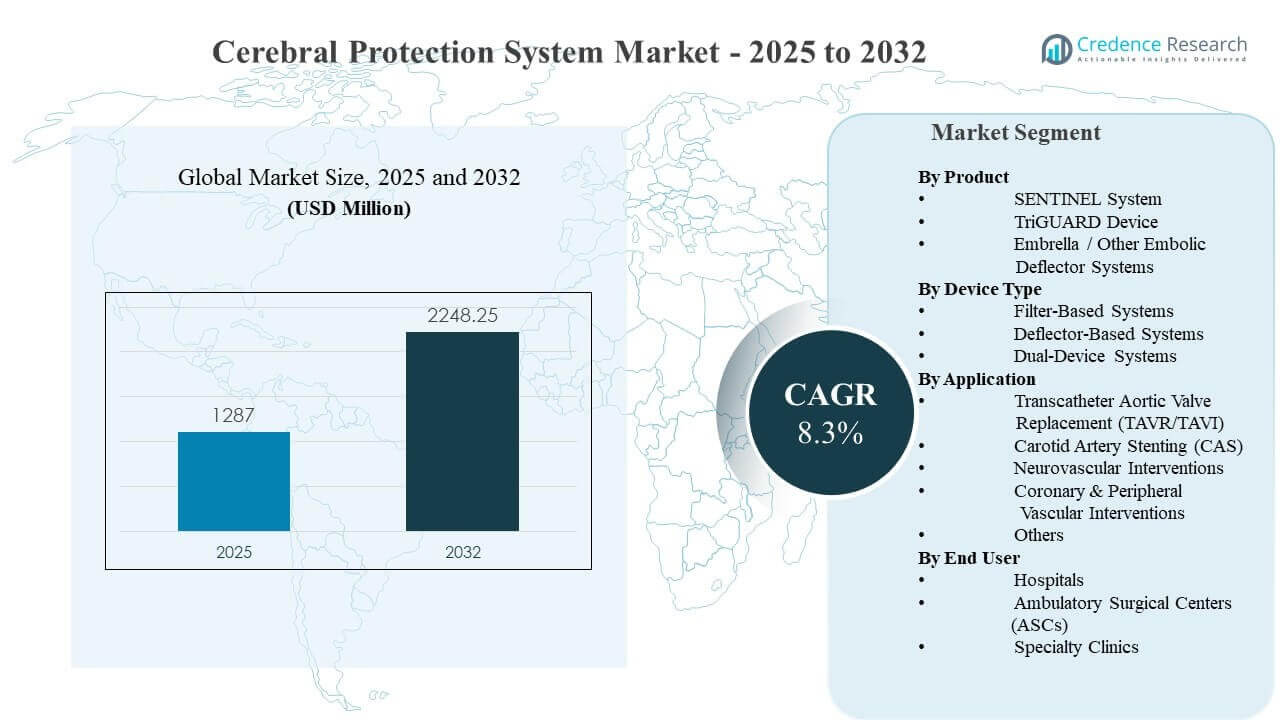
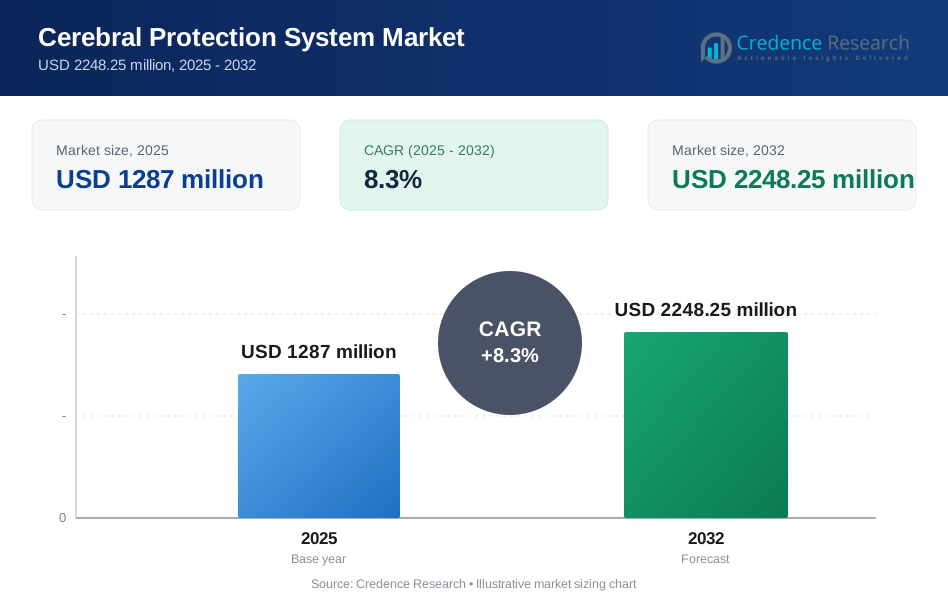
The global cerebral protection system market size was estimated at USD 1287 million in 2025 and is expected to reach USD 2248.25 million by 2032, growing at a CAGR of 8.3% from 2025 to 2032. Growth momentum is primarily supported by increasing structural heart procedure volumes, especially TAVR/TAVI, where stroke-risk mitigation has become a core quality metric for high-volume centers. North America continues to act as a major adoption and revenue anchor due to mature cath lab infrastructure and broader access to premium interventional technologies, with emerging demand building in Asia Pacific as more centers scale complex interventions and procedural standardization.
| REPORT ATTRIBUTE | DETAILS |
|---|---|
| Historical Period | 2020-2024 |
| Base Year | 2025 |
| Forecast Period | 2026-2032 |
| Cerebral Protection System Market Size 2025 | USD 1287 million |
| Cerebral Protection System Market, CAGR | 8.3% |
| Cerebral Protection System Market Size 2032 | USD 2248.25 million |
Key Market Trends & Insights
- The cerebral protection system market is projected to expand from USD 1287 million (2025) to USD 2248.25 million (2032), reflecting an 8.3% CAGR over 2025–2032.
- SENTINEL System remained the leading product in 2025 with an adjusted share of 86.5%, reflecting strong penetration in structural heart pathways.
- Filter-Based Systems led device-type adoption in 2025 with an adjusted share of 48.9%, supported by clinician familiarity and debris-capture positioning.
- Hospitals represented the leading end-user setting in 2025 with an adjusted share of 52.3%, aligned with concentration of complex TAVR/TAVI and neurovascular case volumes.
- North America held the largest regional share in 2025 at an adjusted 31.8%, indicating continued concentration of high-value procedures and established clinical adoption.
Segment Analysis
Cerebral protection system market demand is closely tied to procedure growth where embolic risk is clinically meaningful, particularly structural heart interventions and complex carotid or neurovascular procedures. Clinical workflow adoption is influenced by the balance between additional device steps and perceived stroke-risk reduction benefits, which makes ease-of-use, deliverability, and compatibility with common access routes key procurement criteria. Hospital protocols often favor standardized use in higher-risk cohorts, which supports recurring utilization in centers running large procedure volumes and quality-driven outcomes programs.
Purchasing behavior in the cerebral protection system market also reflects evidence evolution, reimbursement alignment, and physician preference across interventional cardiology and vascular teams. Health systems increasingly focus on complication avoidance, shortened length of stay, and downstream neuro-rehabilitation costs, which elevates interest in technologies that reduce embolic load during high-risk procedures. Device manufacturers respond through design iterations that improve apposition, reduce profile, and simplify deployment in anatomies that challenge consistent coverage.
By Product Insights
SENTINEL System accounted for the largest share of 86.5% in 2025. SENTINEL System leadership is supported by strong center familiarity in structural heart programs and established ordering pathways across high-volume hospitals. SENTINEL System adoption benefits from fit within common TAVR/TAVI workflows and sustained institutional preference for solutions that integrate into standard cath lab setups. SENTINEL System positioning is reinforced by ongoing clinical evidence generation and the operational value of using a widely recognized platform in protocolized care settings.
By Device Type Insights
Filter-Based Systems accounted for the largest share of 48.9% in 2025. Filter-Based Systems remain widely utilized because debris-capture logic is intuitive for clinicians and aligns with procedural safety narratives. Filter-Based Systems typically benefit from procedural familiarity in catheter-based interventions and established training pathways across interventional teams. Filter-Based Systems demand is supported by continued product refinements that improve deliverability and stability while maintaining protection coverage during key procedural steps.
By Application Insights
Cerebral protection system market adoption by application is driven by where embolic burden is most clinically relevant and where center protocols prioritize neurological outcomes. TAVR/TAVI continues to be the most visible demand driver due to stroke-risk sensitivity in elderly patient populations and increasing procedural volumes in major heart centers. Carotid artery stenting and neurovascular interventions contribute demand where patient selection favors protection use, particularly in complex lesions and high-risk anatomies. Coronary and peripheral vascular interventions and other applications typically show more selective adoption based on embolic risk assessment and procedural economics.
By End User Insights
Hospitals accounted for the largest share of 52.3% in 2025. Hospitals dominate utilization because hospitals concentrate multidisciplinary teams, imaging support, and intensive monitoring capacity for complex structural heart and vascular cases. Hospitals also lead adoption because hospitals are more likely to formalize clinical pathways, enabling consistent device utilization when stroke prevention is a performance priority. Ambulatory surgical centers and specialty clinics are expanding participation as outpatient intervention pathways broaden, but hospitals remain the primary setting for high-acuity and high-complexity procedures.
Market Drivers
Expanding Structural Heart Procedure Volumes
Cerebral protection system market growth is strongly linked to rising volumes of catheter-based valve interventions, particularly TAVR/TAVI in aging populations. More hospitals are expanding structural heart programs and adding trained teams, which increases the addressable procedure pool for embolic protection. Hospital quality metrics increasingly emphasize neurological outcomes, which elevates demand for procedural risk-reduction tools. Device utilization rises when clinical pathways standardize protection use for specific patient cohorts and anatomy-driven risk profiles.
Focus on Stroke Risk Mitigation and Patient Safety
Cerebral protection system market adoption improves when clinicians and hospital committees prioritize preventing peri-procedural stroke and silent ischemic lesions. Stroke-related outcomes carry significant clinical and economic consequences, including longer hospitalization and downstream rehabilitation needs. This cost-of-complication focus supports spending on protection devices when value frameworks recognize avoided adverse events. Physician preference also strengthens use when deployment reliability and procedural integration remain consistent across routine workflows.
Device Design Improvements and Workflow Compatibility
Cerebral protection system market expansion benefits from iterative improvements that enhance deliverability, access compatibility, and device stability across varied anatomies. Lower profile systems and refined anchoring mechanisms reduce friction for physicians who manage procedure time constraints. Improved device usability supports broader adoption beyond early adopters, especially in centers scaling procedure throughput. Manufacturers also invest in clinical data generation to align product claims with hospital procurement requirements and pathway-based care standards.
- For instance, Keystone Heart’s TriGUARD 3 uses a self-expanding nitinol frame with an ultra-thin polymer mesh measuring 115 x 145 micrometers, is loaded through an 8F sheath, and is designed to protect all three major cerebral vessels without requiring separate pigtail access, which directly strengthens workflow compatibility in TAVR settings.
Expanding Interventional Capacity in Emerging Regions
Cerebral protection system market growth accelerates as emerging markets expand cath lab capacity and invest in advanced intervention capabilities. More centers are adopting complex carotid, neurovascular, and structural heart procedures, which increases the opportunity for embolic protection utilization. Training programs, specialist recruitment, and equipment standardization support faster diffusion of procedural best practices. Regional distributors and local commercialization partnerships also reduce adoption barriers by improving access, service support, and clinician education.
- For instance, Venus Medtech stated that the registered China study for its Venus A-valve included 101 procedures at leading institutions, achieved a 95% implantation success rate, and reported a 12-month composite rate of all-cause mortality or severe stroke of 7.1%, illustrating how locally validated structural-heart technologies can help build procedural confidence in emerging intervention markets.
Cerebral Protection System Market Challenges
Cerebral protection system market adoption can be constrained by mixed perceptions on outcome magnitude across procedure types and patient groups, which can slow routine protocolization. Evidence interpretation varies across providers and hospital committees, especially when endpoints differ between trials and real-world registries. Additional device steps may increase procedure complexity, especially in lower-volume centers, which can limit uptake. Budget scrutiny remains significant when hospitals evaluate incremental cost versus perceived benefit in defined clinical cohorts.
Cerebral protection system market expansion also faces operational and access barriers related to training needs, anatomy-dependent deliverability, and varying reimbursement environments. Some centers may limit use to high-risk cases due to cost containment practices and supply chain standardization constraints. Competition from alternative procedural strategies and evolving clinical guidelines can reshape adoption patterns. Product differentiation remains challenging where multiple devices claim similar protective intent, pushing vendors to invest heavily in data, service, and workflow integration.
- For instance, Silk Road Medical’s ENROUTE Transcarotid Neuroprotection System uses direct carotid access with temporary flow reversal, and in the ROADSTER study its intention-to-treat population of 141 patients recorded a 1.4% 30-day all-stroke rate and a 3.5% composite rate of stroke, death, or myocardial infarction, demonstrating how alternative protection platforms can compete on procedural design and reported outcomes.
Cerebral Protection System Market Trends and Opportunities
Cerebral protection system market opportunity is growing around targeted-use protocols that identify patients most likely to benefit from embolic protection, supporting more efficient utilization. Hospitals are increasingly adopting risk stratification and pathway-driven care, which can translate into standardized device use within defined indications. Technology upgrades that improve coverage and reduce deployment time can drive incremental penetration in procedure-heavy centers. Commercial opportunities also expand through integrated solution offerings that bundle support tools, training, and post-procedure analytics.
- For instance, Boston Scientific’s SENTINEL Cerebral Protection System protects 90% of cerebral blood flow during TAVR, captured debris in 99% of patients, achieved 94.4% delivery and retrieval success with 0.1% vascular complications, and showed a 60% relative reduction in disabling stroke in the PROTECTED TAVR study.
Cerebral protection system market innovation trends include next-generation deflection concepts, improved dual-device approaches, and refinement of capture mechanisms to address varied embolic sources. Vendors are prioritizing designs that reduce operator variability and support consistent positioning across anatomies. Geographic expansion is supported by growth in Asia Pacific and selective acceleration in Latin America as interventional capacity scales. Partnerships with hospitals, training networks, and distributors can reduce barriers and support durable clinical adoption.
Regional Insights
North America
Cerebral protection system market in North America held an adjusted 31.8% share in 2025, supported by mature structural heart programs and high interventional procedure volumes. North America demand benefits from protocol-driven adoption in high-volume hospitals and strong availability of premium devices through established supply chains. North America growth is reinforced by focus on patient safety endpoints and institutional quality metrics tied to neurological outcomes. North America also sees faster diffusion of training and clinical evidence into purchasing decisions across large heart centers.
Europe
Cerebral protection system market in Europe accounted for an adjusted 26.4% share in 2025, supported by expanding TAVR adoption and structured care pathways in major health systems. Europe adoption benefits from multidisciplinary decision-making and standardized procedural protocols across high-volume centers. Europe demand is influenced by procurement frameworks that emphasize evidence strength and predictable workflow integration. Europe growth is further supported by gradual expansion of complex vascular interventions in aging populations.
Asia Pacific
Cerebral protection system market in Asia Pacific reached an adjusted 18.3% share in 2025, reflecting growing procedure capacity and rising adoption of advanced interventional technologies. Asia Pacific demand improves as more hospitals build structural heart and neurovascular programs and invest in cath lab modernization. Asia Pacific growth is supported by increasing specialist training, higher diagnosis rates, and improved access to tertiary care. Asia Pacific also benefits from a growing private hospital segment that accelerates technology adoption in key urban hubs.
Latin America
Cerebral protection system market in Latin America represented an adjusted 17.1% share in 2025, driven by expanding interventional cardiology access and selective growth of TAVR capability. Latin America adoption is often led by private hospital networks and reference centers that prioritize procedural differentiation and patient outcomes. Latin America demand is supported by improving distributor coverage and gradual clinician training expansion. Latin America growth is expected to be uneven across countries due to reimbursement variability and differences in tertiary care availability.
Middle East & Africa
Cerebral protection system market in the Middle East & Africa recorded an adjusted 6.4% share in 2025, supported by concentration of high-acuity care in tertiary hospitals and GCC-based centers. Middle East & Africa adoption is driven by stepwise rollout of structural heart and vascular intervention programs in key metros. Middle East & Africa demand benefits from capital investment in specialized cardiac facilities and recruitment of interventional expertise. Middle East & Africa growth remains constrained by uneven infrastructure depth and limited access outside major referral hubs.
Competitive Landscape
Cerebral protection system market competition is shaped by clinical evidence strength, device deployability, and the ability to integrate into high-throughput cath lab workflows. Companies compete through portfolio positioning across interventional cardiology and vascular segments, clinical training support, and pathway-focused contracting with hospital systems. Product differentiation increasingly centers on protection coverage consistency, procedural simplicity, and compatibility with common access strategies. Commercial scale and distribution strength remain decisive, especially in regions where tendering and standardized procurement influence vendor selection.
Boston Scientific maintains a leading competitive position through the SENTINEL cerebral protection platform, supported by broad visibility within structural heart programs and sustained engagement with high-volume hospital centers. Boston Scientific emphasizes clinical evidence generation, physician education, and workflow integration to reinforce protocol-based adoption where neurological outcomes are a priority. Boston Scientific also benefits from established interventional sales channels that support device access and service responsiveness across major cardiac institutions.
The industry research and growth report includes detailed analyses of the competitive landscape of the market and information about key companies, including:
- Boston Scientific
- Keystone Heart
- Medtronic
- Edwards Lifesciences
- InspireMD
- Cordis
- Cardiovascular Systems
- Cardinal Health
- Lepu Medical Technology
- Abbott Laboratories
Qualitative and quantitative analysis of companies has been conducted to help clients understand the wider business environment as well as the strengths and weaknesses of key industry players. Data is qualitatively analyzed to categorize companies as pure play, category-focused, industry-focused, and diversified; it is quantitatively analyzed to categorize companies as dominant, leading, strong, tentative, and weak.
Recent Developments
- In March 2026, Emboline announced a $20 million growth-capital deal with Trinity Capital to support the commercial introduction of its Emboliner embolic protection system, making this the clearest recent partnership-style update in the space.
- In April 2024, Emboline announced the acquisition of a significant embolic protection intellectual property portfolio from SWAT Medical AB. The company said the deal strengthened its patent position in aortic embolic protection, including debris-deflector and full-body debris capture-and-removal filter technologies relevant to cerebral protection applications in interventional cardiology.
- In November 2024, EmStop reported completion of the CAPTURE-1 early-feasibility study for its embolic protection system. According to the report, the study milestone supports EmStop’s plan to commercialize an integrated embolic protection platform intended for protected TAVR and focused on full cerebral protection for left-heart catheter procedures.
Report Scope
| Report Attribute | Details |
| Market size value in 2025 | USD 1287 million |
| Revenue forecast in 2032 | USD 2248.25 million |
| Growth rate (CAGR) | 8.3% (2025–2032) |
| Base year | 2025 |
| Forecast period | 2026-2032 |
| Quantitative units | USD million |
| Segments covered | By Product Outlook: SENTINEL System, TriGUARD Device, Embrella / Other Embolic Deflector Systems; By Device Type Outlook: Filter-Based Systems, Deflector-Based Systems, Dual-Device Systems; By Application Outlook: Transcatheter Aortic Valve Replacement (TAVR/TAVI), Carotid Artery Stenting (CAS), Neurovascular Interventions, Coronary & Peripheral Vascular Interventions, Others; By End User Outlook: Hospitals, Ambulatory Surgical Centers (ASCs), Specialty Clinics |
| Regional scope | North America, Europe, Asia Pacific, Latin America, Middle East & Africa |
| Key companies profiled | Boston Scientific; Keystone Heart; Medtronic; Edwards Lifesciences; InspireMD; Cordis; Cardiovascular Systems; Cardinal Health; Lepu Medical Technology; Abbott Laboratories |
| No. of Pages | 326 |
Segmentation
By Product
- SENTINEL System
- TriGUARD Device
- Embrella / Other Embolic Deflector Systems
By Device Type
- Filter-Based Systems
- Deflector-Based Systems
- Dual-Device Systems
By Application
- Transcatheter Aortic Valve Replacement (TAVR/TAVI)
- Carotid Artery Stenting (CAS)
- Neurovascular Interventions
- Coronary & Peripheral Vascular Interventions
- Others
By End User
- Hospitals
- Ambulatory Surgical Centers (ASCs)
- Specialty Clinics
By Region
- North America
- U.S.
- Canada
- Mexico
- Europe
- Germany
- France
- U.K.
- Italy
- Spain
- Rest of Europe
- Asia Pacific
- China
- Japan
- India
- South Korea
- South-east Asia
- Rest of Asia Pacific
- Latin America
- Brazil
- Argentina
- Rest of Latin America
- Middle East & Africa
- GCC Countries
- South Africa
- Rest of the Middle East and Africa
Request a Free Sample
Fill in your details and we'll send you a free sample report.
- Sample data tables & charts
- Research methodology
Need a Custom Version of This Report?
Tailor the scope, geography, or segments to your exact requirements.
- Custom geography or segment scope
- Direct access to our analyst team
Frequently Asked Questions
What is the current size and forecast of the cerebral protection system market?
What is the CAGR for the cerebral protection system market during the forecast period?
Which segment is the largest in the cerebral protection system market?
What factors are driving growth in the cerebral protection system market?
Who are the leading companies in the cerebral protection system market?
Which region leads the cerebral protection system market?
Table of Content
Chapter 1. Report Introduction
- 1.1 Report Description & Purpose
- 1.1.1 Report Title & Market Definition
- 1.1.2 Unique Selling Propositions (USP) & Key Differentiators
- 1.1.3 Value Proposition for Stakeholders
- 1.2 Research Objectives
- 1.2.1 Market Sizing Objectives (Volume & Revenue)
- 1.2.2 Segmentation Objectives
- 1.2.3 Competitive Intelligence Objectives
- 1.2.4 Forecast & Scenario Objectives
- 1.3 Report Scope
- 1.3.1 Cerebral Protection System Scope – Types & Subtypes Covered
- 1.3.2 Geographic Scope – Regions & Countries Covered
- 1.3.3 Historical Period, Base Year & Forecast Period (2025; forecast to 2032)
- 1.3.4 Inclusions & Exclusions
- 1.4 HS Code & Classification Framework
- 1.5 Currency, Units & Pricing Basis
- 1.6 Target Stakeholders
- 1.7 Limitations & Assumptions
Chapter 2. Executive Summary
- 2.1 Global Cerebral Protection System Market Snapshot
- 2.1.1 Market Size – Historical (2025) & Forecast (2025-2032) (2025: USD 1287 million → 2032: USD 2248.25 million)
- 2.1.2 Volume & Revenue – Global Totals
- 2.1.3 Key Market Highlights – Top Five Facts
- 2.2 Cerebral Protection System Market Segmentation Snapshot
- 2.2.1 Market Split by Region – 2025 vs. 2032
- 2.3 Competitive Snapshot
- 2.3.1 Top 10 Players by Revenue Share – 2025
- 2.3.2 Top 10 Players by Volume Share – 2025
- 2.3.3 Recent Strategic Developments (18-Month Summary)
- 2.4 Key Investment Highlights & Strategic Conclusions
Chapter 3. Cerebral Protection System Market Dynamics & Industry Analysis
- 3.1 Market Overview & Context
- 3.1.1 Cerebral Protection System Market Position in the Broader Automotive Value Chain
- 3.1.2 OEM vs. Replacement Market Dynamics
- 3.1.3 Market Maturity & Development Stage by Region
- 3.2 Cerebral Protection System Market Drivers
- 3.3 Cerebral Protection System Market Restraints & Challenges
- 3.4 Cerebral Protection System Market Opportunities
- 3.5 Porter's Five Forces Analysis
- 3.5.1 Threat of New Entrants
- 3.5.2 Bargaining Power of Suppliers
- 3.5.3 Bargaining Power of Buyers
- 3.5.4 Threat of Substitutes
- 3.5.5 Competitive Rivalry – Intensity Assessment
- 3.6 Cerebral Protection System Value Chain Analysis
- 3.6.1 Upstream – Raw Material/Input Suppliers
- 3.6.1.1 Raw Material/Input 1
- 3.6.1.2 Raw Material/Input 2
- 3.6.1.3 Raw Material/Input 3
- 3.6.2 Midstream – Production/Manufacturing/Service Delivery
- 3.6.2.1 Production/Process Overview
- 3.6.2.2 Key Facility Locations & Capacity by Manufacturer
- 3.6.3 Downstream – Distribution & End Consumer
- 3.6.3.1 Primary Channel – B2B/OEM
- 3.6.3.2 Secondary Channels – Dealer, Retail, Online, Direct
- 3.6.4 Value Chain Profitability Analysis
- 3.6.1 Upstream – Raw Material/Input Suppliers
- 3.7 PESTEL Analysis
- 3.7.1 Political Factors
- 3.7.2 Economic Factors
- 3.7.3 Social Factors
- 3.7.4 Technological Factors
- 3.7.5 Environmental Factors
- 3.7.6 Legal Factors
- 3.8 Cerebral Protection System Supply Chain Analysis
- 3.8.1 Raw Material/Input Supply Risk Assessment
- 3.8.2 Manufacturing Concentration Risk (Geographic Exposure)
- 3.8.3 Trade Disruption Impact Analysis
- 3.9 Regulatory & Policy Landscape
Note: The regulatory and policy landscape section covers regulations based on their applicability to the market, Cerebral Protection System category, geography, and scope of the study. Only regulatory frameworks with a material impact on operations, compliance, trade, sustainability, or market access are analyzed in detail.
Chapter 4. Key Investment Pockets & Opportunity Analysis
- 4.1 Cerebral Protection System Market Attractiveness Analysis
- 4.1.1 By Region – Investment Attractiveness Matrix (Volume × CAGR)
- 4.2 Absolute Revenue Growth Opportunity
- 4.2.1 By Region – Absolute USD Growth Through 2032
- 4.3 Incremental Volume Opportunity
- 4.3.1 By Region – Incremental Volume Through 2032
- 4.3.2 Segment – Incremental Volume
- 4.4 Emerging Submarket Opportunity Deep Dive (Subject to Applicability)
- 4.5 Emerging Market Opportunity Scorecards
- 4.5.1 United States
- 4.5.2 Europe
- 4.5.3 Asia
- 4.5.4 Middle East & Africa
Note: Emerging Market Opportunity Scorecards will be included based on relevance and strategic importance. Regions listed are indicative and may vary depending on data availability and market dynamics.
Chapter 5. Cerebral Protection System Import-Export Analysis & Trade Flows
- 5.1 Global Trade Overview
- 5.1.1 Global Export Value by Country (2025)
- 5.1.2 Global Export Volume by Country (2025)
- 5.1.3 Global Import Value by Country (2025)
- 5.1.4 Global Import Volume by Country (2025)
- 5.1.5 Net Trade Balance by Country (2025)
- 5.2 Export Analysis – Segment
- 5.2.1 Type 1 (HS Code)
- 5.2.2 Type 2 (HS Code)
- 5.2.3 Type 3 (HS Code)
- 5.2.4 Type 4 (HS Code)
- 5.2.5 Type 5 (HS Code)
- 5.3 Import Analysis – Segment
- 5.3.1 Type 1 (HS Code)
- 5.3.2 Type 2 (HS Code)
- 5.3.3 Type 3 (HS Code)
- 5.3.4 Type 4 (HS Code)
- 5.3.5 Type 5 (HS Code)
- 5.4 Average Unit Trade Prices
- 5.4.1 Average Export Price – Segment & Country
- 5.4.2 Average Import Price – Segment & Source Country
- 5.4.3 Price Trends (2025)
- 5.5 Key Trade Route Analysis
- 5.5.1 Trade Route 1
- 5.5.2 Trade Route 2
- 5.5.3 Trade Route 3
- 5.5.4 Trade Route 4
- 5.5.5 Trade Route 5
- 5.6 Trade Policy Impact Assessment
- 5.6.1 US Anti-Dumping & Section 301 Tariffs
- 5.6.2 EU Customs Union Impact
- 5.6.3 Major Free Trade Agreements
- 5.6.4 USMCA Rules of Origin
Note: Trade policy analysis will be included only where relevant to the Cerebral Protection System market.
Chapter 6. Competitive Landscape & Company Benchmarking
- 6.1 Cerebral Protection System Market Concentration & Structure
- 6.1.1 Herfindahl-Hirschman Index (HHI) – vs. 2025
- 6.1.2 Tier 1, Tier 2 & Tier 3 Market Structure
- 6.1.3 Global, Regional & Local Player Dynamics
- 6.2 Cerebral Protection System Market Share Analysis – 2025
- 6.2.1 Global Revenue Share by Company
- 6.2.2 Global Volume Share by Company
- 6.2.3 Regional Revenue Share
- 6.2.4 Market Share Evolution ( vs. 2025)
- 6.2.5 OEM Segment Share by Company
- 6.2.6 Replacement Segment Share by Company
- 6.3 Production/Delivery Capacity & Facility Analysis
- 6.3.1 Global Installed Capacity
- 6.3.2 Capacity Utilization Rates
- 6.3.3 Production/Output Volume
- 6.3.4 Facility Locations & Capacity Map
- 6.3.5 Planned Capacity Additions
- 6.4 Cerebral Protection System Competitive Benchmarking Matrix
- 6.4.1 Revenue, Volume, CAGR & Profitability Comparison
- 6.4.2 Channel Revenue Mix
- 6.4.3 Geographic Revenue Exposure
- 6.4.4 R&D Intensity
- 6.4.5 Sustainability Maturity
- 6.5 Strategic Developments in Cerebral Protection System (Last 24 Months)
- 6.5.1 Mergers, Acquisitions & Divestments
- 6.5.2 New Cerebral Protection System Launches
- 6.5.3 Facility Expansions
- 6.5.4 Strategic Alliances, Joint Ventures & Partnerships
- 6.5.5 Distribution Expansion & Market Entry
- 6.5.6 Sustainability & ESG Initiatives
- 6.6 Competitive Strategy Mapping
- 6.6.1 Leader, Challenger, Follower & Niche Classification
- 6.6.2 Pricing Strategy Comparison
- 6.6.3 Channel Strategy Matrix
Note: Strategic developments are included based on their materiality and the availability of reliable information.
Chapter 7. Global Cerebral Protection System Market – By Distribution Channel
- 7.1 Segment Overview
- 7.1.1 Volume & Revenue Split by Channel (2025 & 2032)
- 7.1.2 Channel Mix Evolution (2025-2032)
Chapter 8. Regional Market Analysis – Global Overview
- 8.1 Global Regional Overview
- 8.1.1 Regional Volume Share
- 8.1.2 Regional Revenue Share
- 8.1.3 Regional Volume by Region
- 8.1.4 Regional Revenue by Region
- 8.1.5 Regional Forecast Through 2032
- 8.2 Cross-Regional Segment Analysis
- 8.2.1 By Distribution Channel
- 8.2.2 By Brand/Price Tier
Chapter 9. North America Cerebral Protection System Market
- 9.1 United States
- 9.2 Canada
- 9.3 Mexico
Chapter 10. Europe Cerebral Protection System Market
- 10.1 Germany
- 10.2 France
- 10.3 Italy
- 10.4 United Kingdom
- 10.5 Spain
- 10.6 Poland
- 10.7 Russia
- 10.8 Netherlands
- 10.9 Belgium
- 10.10 Sweden
- 10.11 Denmark
- 10.12 Norway
- 10.13 Rest of Europe
Chapter 11. Asia Pacific Cerebral Protection System Market
- 11.1 China
- 11.2 India
- 11.3 Japan
- 11.4 South Korea
- 11.5 Thailand
- 11.6 Indonesia
- 11.7 Vietnam
- 11.8 Malaysia
- 11.9 Australia
- 11.10 Rest of Asia Pacific
Chapter 12. Latin America Cerebral Protection System Market
- 12.1 Brazil
- 12.2 Argentina
- 12.3 Colombia
- 12.4 Chile
- 12.5 Rest of Latin America
Chapter 13. Middle East Cerebral Protection System Market
- 13.1 Saudi Arabia
- 13.2 United Arab Emirates
- 13.3 Turkey
- 13.4 Israel
- 13.5 Iran
- 13.6 Rest of the Middle East
Chapter 14. Africa Cerebral Protection System Market
- 14.1 South Africa
- 14.2 Egypt
- 14.3 Nigeria
- 14.4 Morocco
- 14.5 Rest of Africa
Chapter 15. Cerebral Protection System Company Profiles
- 15.1 [Company 01]
- 15.1.1 Company Overview
- 15.1.2 Key Management Personnel
- 15.1.3 Products & Services Portfolio
- 15.1.4 Financial Performance
- 15.1.5 Key Market Focus & Geographic Presence
- 15.1.6 Recent Developments & Strategic Initiatives
Note: The company profile list is preliminary and may change based on research findings, market developments, data availability, and client requirements.
Chapter 16. Appendices
- Appendix A – List of Abbreviations & Acronyms
- Appendix B – Industry Classification Code Reference – Full Series
- Appendix C – Production & Capacity Data Tables
- Appendix D – End-Use & Demand Base Tables
- Appendix E – Consumption & Replacement Rate Assumptions
- Appendix F – ASP Reference Tables
- Appendix G – Manufacturing & Facility Database
- Appendix H – Import-Export Data Tables
- Appendix I – Regulatory Summary Tables
- Appendix J – Primary Research Participant List (Anonymized)
- Appendix K – Primary Research Questionnaire Framework
- Appendix L – Data Sources & Bibliography
- Appendix M – Market Size Divergence & Source Comparison
Chapter 17. Research Methodology
- 17.1 Research Framework & Philosophy
- 17.2 Secondary Research – Sources, Hierarchy & Data Extraction
- 17.3 Data Modeling – Bottom-Up & Top-Down Market Sizing
- 17.4 Primary Research – Stakeholder Framework, LOI & Sample Sizes
- 17.5 Forecast Methodology – Regression, Scenario & Sensitivity Analysis
- 17.6 Quality Control – Four-Layer Validation Framework
- 17.7 Limitations & Standard Assumptions
- 17.8 Disclaimer
