
| REPORT ATTRIBUTE | DETAILS |
|---|---|
| Historical Period | 2020-2023 |
| Base Year | 2024 |
| Forecast Period | 2025-2032 |
| China Parking Management Software Market Size 2024 | USD 630.82 million |
| China Parking Management Software Market , CAGR | 9.84% |
| China Parking Management Software Market Size 2032 | USD 1336.73 million |
Market Overview:
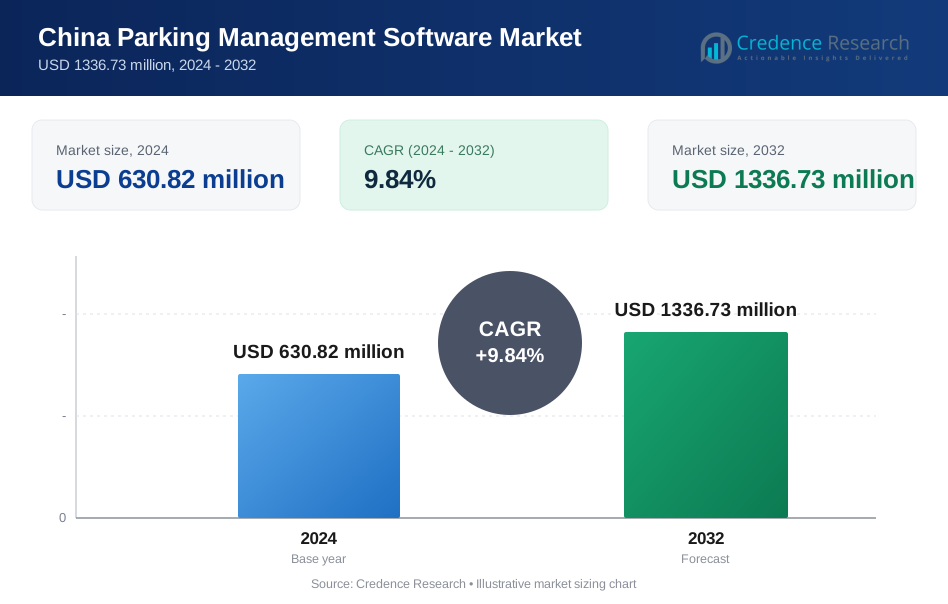
The China Parking Management Software Market is projected to grow from USD 630.82 million in 2024 to an estimated USD 1336.73 million by 2032, with a compound annual growth rate (CAGR) of 9.84% from 2024 to 2032.
The growth of the China Parking Management Software Market is driven by several key factors. Increasing vehicle ownership, fueled by the country’s expanding middle class and economic development, has heightened the demand for efficient parking solutions. As urban populations continue to grow, particularly in major cities, the demand for effective parking management becomes critical to address congestion and optimize space usage. Furthermore, China’s commitment to smart city initiatives and technological advancements in urban mobility is accelerating the adoption of parking management software. This software not only streamlines parking operations but also supports the government’s vision of intelligent transportation systems that improve overall urban efficiency.
Regionally, the market exhibits varying levels of demand based on urban development. In Tier 1 cities such as Beijing, Shanghai, and Guangzhou, parking management software is essential due to the high vehicle density and limited parking spaces. These cities face significant challenges in managing traffic and parking, and the software offers solutions like real-time space monitoring, dynamic pricing, and automated enforcement of parking regulations. Meanwhile, as urbanization spreads to Tier 2 and Tier 3 cities, the demand for structured parking solutions is also on the rise, creating opportunities for parking management systems to prevent future congestion and facilitate sustainable urban planning. The government’s focus on infrastructure development and investments in smart city projects further accelerates the integration of advanced parking solutions across the country.
Market Insights:
- The China Parking Management Software Market is projected to grow from USD 630.82 million in 2024 to USD 1336.73 million by 2032, with a CAGR of 9.84%.
- Rising vehicle ownership, driven by China’s growing middle class, is significantly increasing the demand for efficient parking management solutions.
- Rapid urbanization and traffic congestion in major cities are intensifying the need for advanced parking systems to optimize limited space.
- Smart city initiatives are accelerating the adoption of parking management software, aligning with China's broader goals of enhancing urban mobility and sustainability.
- Government investments in infrastructure and technology are supporting the growth of parking management systems, promoting smarter, more efficient urban environments.
- High initial investment costs for advanced solutions like AI and IoT remain a challenge for some cities and private operators.
- The market faces concern over data privacy and security, particularly regarding the handling of sensitive information such as payment data and vehicle details.
Market Drivers:
Rising Vehicle Ownership
The growth of the China Parking Management Software Market is strongly driven by the increasing number of vehicles in the country. As China’s middle class continues to expand, more individuals are able to purchase vehicles, leading to a sharp rise in the number of cars on the road. For instance, by 2025, parking demand in China is expected to reach 600 million spots, yet only about 250 million parking spaces exist, highlighting the need for efficient parking solutions. This surge in vehicle ownership has created an acute need for effective parking management solutions to accommodate the growing demand for parking spaces. In urban centers, where vehicle density is high, parking management software is essential for optimizing available parking spots, streamlining the parking process, and ensuring that cities can cope with the growing number of vehicles.
Urbanization and Traffic Congestion
Urbanization in China is advancing rapidly, with more people migrating from rural areas to major cities. This trend has resulted in an increased population in urban areas, contributing to challenges related to space management, including parking. As more vehicles flood the streets of densely populated cities, traffic congestion and the scarcity of parking spaces have become critical issues. Parking management software plays a crucial role in alleviating these challenges by offering real-time data on parking availability, enabling efficient use of limited space, and reducing traffic caused by drivers searching for parking.
Smart City Developments
China’s ongoing push to develop smart cities has significantly contributed to the demand for parking management solutions. The Chinese government has been investing heavily in the integration of advanced technologies to improve the functionality and sustainability of urban environments. For instance, GreenPeak Technologies and Dusun Electron have launched a smart parking application that guides drivers to available parking spaces using wireless sensors and cloud infrastructure, enhancing parking efficiency in cities like Wux. Parking management software fits well into these smart city initiatives by utilizing data analytics, IoT devices, and real-time monitoring to optimize parking facilities. These technologies not only streamline parking operations but also enhance the overall efficiency of urban mobility, making cities more livable and reducing the environmental impact of unnecessary traffic.
Government Policies and Infrastructure Investment
Government policies and infrastructure investments have created a favorable environment for the growth of parking management software in China. As part of the government's broader agenda to modernize infrastructure and support sustainable urban development, there has been a significant push to integrate technology-driven solutions in various sectors, including transportation. The development of intelligent transportation systems, which include parking management solutions, aligns with national goals for improving urban mobility and reducing congestion. The implementation of such software is supported by favorable government policies, creating a conducive market environment for the widespread adoption of parking management systems across the country.
Market Trends:
Increased Integration of Artificial Intelligence (AI) and Machine Learning
One of the key trends shaping the China Parking Management Software Market is the growing integration of artificial intelligence (AI) and machine learning technologies. AI is playing a pivotal role in enhancing the efficiency and functionality of parking management systems. By leveraging AI, parking software can predict parking availability, optimize space utilization, and provide dynamic pricing based on demand patterns. Machine learning algorithms continuously improve the system’s ability to anticipate peak parking times and suggest optimal parking spots. As technology continues to evolve, AI-powered parking management systems are becoming more accurate and reliable, offering real-time data that helps both drivers and city planners manage parking more effectively.
Cloud-Based Solutions
Another prominent trend is the increasing adoption of cloud-based parking management software in China. Cloud technology offers several advantages, including scalability, flexibility, and ease of maintenance. Parking operators can easily scale their systems to accommodate growing urban populations or expanding facilities without significant infrastructure investments. For example, cloud computing acts as the central data storage and processing hub in smart parking solutions, ensuring all information is updated across the system, allowing for seamless and efficient parking systems. Cloud-based solutions also enable real-time data processing and remote management, allowing for seamless monitoring and control of parking spaces. This trend is driving the shift away from traditional on-premise solutions toward more agile and cost-effective cloud platforms, making it easier for cities and private operators to implement and maintain advanced parking management systems.
Rise of Contactless Payment and Digitalization
As part of China’s broader digital transformation, the parking management software market is witnessing a rise in contactless payment systems. With the increasing preference for digital payments across various sectors, the integration of digital payment solutions within parking management systems has become essential. Parking users can now conveniently pay for parking through mobile apps, QR codes, or even facial recognition technology. This trend not only streamlines the parking process but also reduces the need for physical cash handling, making parking experiences more convenient for both consumers and operators. The growing emphasis on contactless payments aligns with China’s push toward a cashless society and is a significant trend influencing the parking management software market.
Focus on Sustainability and Smart Parking Solutions
Sustainability is another driving trend in the China Parking Management Software Market. As environmental concerns grow, cities are increasingly focusing on green initiatives, including the optimization of parking facilities to reduce emissions and energy consumption. Smart parking systems, powered by IoT sensors, provide real-time data that helps reduce the time spent searching for parking spaces, thereby lowering vehicle emissions. For example, smart parking technologies have been shown to reduce the time taken to park by 43%, resulting in a 30% reduction in polluting gas emissions. Furthermore, these systems are designed to support the integration of electric vehicle (EV) charging stations, ensuring that parking management software can adapt to the needs of future transportation. As cities strive for sustainability, the demand for parking management software that supports eco-friendly practices and efficient resource utilization continues to rise.
Market Challenges Analysis:
High Initial Investment Costs
One of the key challenges facing the China Parking Management Software Market is the high initial investment required to implement advanced parking solutions. The development and deployment of parking management systems, particularly those incorporating cutting-edge technologies like AI, IoT, and cloud-based platforms, often require substantial upfront capital. For cities or private operators, these high implementation costs can pose a significant barrier, particularly in regions where budget constraints are an issue. Despite the long-term benefits of improved efficiency and revenue generation, the financial burden of adopting such solutions can deter some stakeholders from making the necessary investments.
Data Privacy and Security Concerns
As parking management software increasingly incorporates real-time data collection, cloud storage, and user-specific information, data privacy and security concerns are becoming more prevalent. In China, the handling of sensitive data, such as personal payment information and vehicle details, requires strict compliance with privacy laws and regulations. Any breach or mishandling of this data can result in significant legal and reputational consequences. Additionally, the complex integration of IoT devices and cloud-based systems raises the risk of cyberattacks, which can jeopardize the safety and reliability of parking management systems. Addressing these concerns is essential to maintaining user trust and ensuring the continued growth of the market.
Complexity of Integration with Existing Infrastructure
Integrating new parking management software with existing infrastructure, such as traditional parking systems, can be a complex and time-consuming process. Many cities in China still rely on older, manual parking management methods, and transitioning to a fully automated, digital system requires significant adjustments. Compatibility issues between new and legacy systems can lead to operational disruptions, additional costs, and extended implementation timelines. For example, ParkingPass.com emphasizes the importance of compatibility with existing infrastructure to ensure a smooth transition to digital parking management. This integration challenge is particularly pronounced in older urban areas where the infrastructure may not be optimized for modern, technology-driven solutions.
Regulatory and Policy Barriers
Regulatory and policy barriers also present challenges for the growth of the parking management software market. In China, while there is significant government support for smart city initiatives, the regulatory framework surrounding the deployment of new technologies can be inconsistent or slow to evolve. Changes in regulations, especially those related to data usage, urban planning, and parking policies, may cause uncertainty for market players. Navigating these evolving legal landscapes can delay the adoption of new systems and complicate the process for developers and operators looking to implement parking management solutions.
Market Opportunities:
The China Parking Management Software Market presents significant growth opportunities driven by the rapid urbanization and the increasing number of vehicles in urban centers. As China continues to experience large-scale migration from rural areas to cities, the demand for efficient parking solutions will only intensify. This provides an opportunity for parking management software to expand its reach across Tier 1, Tier 2, and Tier 3 cities, addressing the increasing pressure on urban infrastructure. The adoption of advanced technologies such as AI, IoT, and cloud computing creates a unique opportunity for software providers to offer innovative solutions that optimize parking space utilization, streamline parking processes, and reduce traffic congestion. Furthermore, as cities look to modernize and improve urban mobility, integrating parking management solutions into smart city initiatives will be a key growth driver, enabling software providers to capitalize on government investments in urban development and sustainability.
Another opportunity lies in the growing emphasis on sustainability and green technologies. With increasing environmental awareness, the demand for parking management systems that can accommodate electric vehicles (EVs) and support sustainable practices is on the rise. As China works to reduce its carbon footprint, integrating EV charging stations into parking management systems provides a valuable opportunity for growth. Additionally, the shift toward digital payments and contactless solutions presents a lucrative opportunity for software developers to offer seamless, user-friendly payment systems within parking management platforms. This trend aligns with China’s broader move toward a cashless society, positioning parking management software providers to capitalize on this transformation in the payment landscape.
Market Segmentation Analysis:
The China Parking Management Software Market is segmented based on solution type, application, end-user, and deployment model, each contributing uniquely to the market’s overall growth.
By Solution Segment
The market is largely driven by several solution types, with access control, revenue management, and parking security and surveillance being the most prominent. Access control systems ensure the secure entry and exit of vehicles, while revenue management solutions are crucial for optimizing parking fees and enhancing operational efficiency. Parking security and surveillance solutions provide real-time monitoring, ensuring safety and compliance with regulations. Parking reservation management solutions cater to the growing demand for pre-booked parking, especially in congested urban areas. Analytics solutions are gaining traction, providing valuable insights into parking patterns and usage, further improving operational decision-making.
By Application Segment
The market is divided into on-premise and cloud-based applications. Cloud-based solutions are becoming increasingly popular due to their scalability, flexibility, and ease of maintenance. These solutions enable real-time data processing and remote management of parking spaces, offering greater efficiency and convenience. On-premise solutions, though less common, still hold a significant share in regions where local data storage and control are preferred.
By End-User Segment
The market is categorized into residential, commercial, and government sectors. Residential end-users are adopting parking management software to address parking challenges in housing complexes. Commercial establishments and office buildings are also key adopters, optimizing parking spaces for employees and visitors. Government and municipalities are investing heavily in parking management systems to improve urban mobility, manage public parking infrastructure, and support smart city initiatives.
By Deployment Segment
Both on-premise and cloud-based deployments are common, with cloud-based systems gradually taking the lead due to their cost-effectiveness, scalability, and ease of integration with other smart city technologies. However, on-premise solutions remain relevant in certain regions that prioritize data security and local control over cloud-based systems.
Segmentation:
By Solution Segment
- Access Control
- Revenue Management
- Parking Security and Surveillance
- Parking Reservation Management
- Analytics Solutions
By Application Segment
- On-Premise
- Cloud-Based
By End-User Segment
- Residential
- Commercial
- Government and Municipalities
By Deployment Segment
- On-Premise
- Cloud-Based
Regional Analysis:
The China Parking Management Software Market exhibits significant regional variations, driven by factors such as urbanization, vehicle density, and infrastructure development. The market is primarily concentrated in Tier 1 cities, with substantial growth potential in Tier 2 and Tier 3 cities as urbanization accelerates. Each region has its unique characteristics and challenges, which influence the adoption and deployment of parking management solutions.
Tier 1 Cities
Tier 1 cities, including Beijing, Shanghai, Guangzhou, and Shenzhen, dominate the China Parking Management Software Market, accounting for a significant share of the overall market. These cities have high vehicle ownership rates, dense populations, and limited parking space, creating a strong demand for advanced parking management solutions. The market share for Tier 1 cities is estimated to be around 50-55% of the total market, driven by the adoption of smart city initiatives and the integration of technologies such as AI, IoT, and cloud computing. These cities face critical issues related to traffic congestion, pollution, and the optimization of parking space, making parking management software a crucial tool for urban planners and private operators alike. The government’s push to develop smart city infrastructure further supports the growth of parking management solutions in these regions.
Tier 2 and Tier 3 Cities
While Tier 1 cities continue to lead in terms of market share, Tier 2 and Tier 3 cities are rapidly catching up. These cities, which include rapidly growing urban centers like Chengdu, Hangzhou, and Xi’an, represent a growing opportunity for parking management software providers. As urban populations increase and vehicle ownership rises, the need for effective parking solutions becomes more pronounced. The market share for Tier 2 and Tier 3 cities is currently estimated at around 30-35%, but this is expected to grow significantly in the coming years. In these regions, parking management systems are particularly valuable for preempting future congestion issues and ensuring sustainable urban development. The government’s emphasis on infrastructure development and the expansion of smart city projects in these regions is expected to accelerate the adoption of parking management software.
Emerging Regional Markets
Emerging regions, particularly in the western and central parts of China, are expected to account for approximately 10-15% of the market share. These regions are experiencing rapid urban growth and increasing vehicle ownership, which presents an opportunity for the deployment of advanced parking solutions. However, challenges such as limited budgets, slower adoption of technology, and a lack of existing infrastructure may slow the pace of adoption compared to more developed areas. Nevertheless, as these regions continue to develop and urbanize, they represent a promising market for parking management software, with long-term growth potential as part of China’s broader urbanization trend.
Key Player Analysis:
- Amano Corporation
- TIBA Parking Systems
- Smart Parking Limited
- AppyParking
- Kapsch TrafficCom AG
- Hangzhou Hikvision Digital Technology Co., Ltd.
- Fujica System Co., Ltd.
- GET My Parking
- Secure Parking Corporation
- Nippon Parking Development Co., Ltd.
Competitive Analysis:
The China Parking Management Software Market is highly competitive, with numerous players vying for market share by offering diverse and innovative solutions. Key market participants include global companies such as Siemens, Amano Corporation, and Parkopedia, as well as prominent local players like EasyPark and Baidu’s Apollo Smart Parking. These companies differentiate themselves through product offerings ranging from access control systems to analytics solutions that optimize parking operations. The market is characterized by a focus on integrating cutting-edge technologies such as artificial intelligence, machine learning, and cloud-based solutions to enhance efficiency, streamline parking processes, and reduce operational costs. Local players have an advantage in terms of understanding regional needs and regulatory requirements, while global companies bring advanced technological capabilities and broader resources. The competition is intensifying as the demand for smart city initiatives and sustainable urban mobility increases, prompting players to innovate continuously to maintain their market position.
Recent Developments:
- In October 2023, HUB Parking Technologylaunched a new product called J4Pay, a mobile QR-based payment solution designed to enhance the parking experience by providing drivers with a quick, easy, and secure method to pay for parking directly from their mobile devices.
- In April 2024, Parking Management Company (PMC)acquired Bird Dog Parking, a U.S.-based parking company. This acquisition aimed to expand PMC's service offerings and market presence in the Southeast by incorporating Bird Dog's 33 locations across Tennessee, Alabama, and Missouri into PMC's portfolio. The move aligns with PMC's strategy to enhance its commercial technology and valet services.
- In October 2023, Parking Management Company (PMC)also acquired ParkPoolr, a technology-based company specializing in booking and payment management for parking at commercial properties. This acquisition enabled PMC to enter 21 new markets and integrate ParkPoolr's technology into its existing suite of solutions, further streamlining the parking process for clients.
- In February 2023, Parqourlaunched its all-in-one parking management solution, leveraging license plate recognition technology to offer a seamless and contactless parking experience. This solution helps parking lot owners optimize revenue, increase security, and improve customer service through dynamic pricing and real-time analytics.
Market Concentration & Characteristics:
The China Parking Management Software Market is moderately concentrated, with a mix of established global players and emerging local companies competing for market share. While global giants such as Siemens and Amano Corporation lead in technological innovation and advanced solution offerings, local players like EasyPark and Baidu's Apollo Smart Parking have a strong presence due to their understanding of regional market dynamics and regulatory landscapes. This combination of international and domestic players fosters a competitive environment where innovation, pricing strategies, and customer relationships play a critical role in gaining market share. The market is characterized by a growing demand for integrated solutions that combine artificial intelligence, cloud computing, and data analytics to improve parking efficiency and optimize space utilization. As cities evolve into smart cities, parking management software providers are increasingly focusing on offering scalable, flexible, and user-friendly solutions that can adapt to various urban environments and meet the specific needs of residential, commercial, and governmental sectors.
Report Coverage:
The research report offers an in-depth analysis based on By Solution Segment, By Application Segment, By End-User Segment and By Deployment Segment. It details leading market players, providing an overview of their business, product offerings, investments, revenue streams, and key applications. Additionally, the report includes insights into the competitive environment, SWOT analysis, current market trends, as well as the primary drivers and constraints. Furthermore, it discusses various factors that have driven market expansion in recent years. The report also explores market dynamics, regulatory scenarios, and technological advancements that are shaping the industry. It assesses the impact of external factors and global economic changes on market growth. Lastly, it provides strategic recommendations for new entrants and established companies to navigate the complexities of the market.
Future Outlook:
- The market is expected to experience rapid growth due to increasing urbanization and vehicle ownership in China.
- Rising demand for smart city initiatives will accelerate the adoption of advanced parking management solutions.
- Cloud-based solutions will dominate, driven by their scalability, flexibility, and cost-effectiveness.
- AI and machine learning will continue to improve system efficiency, optimizing space usage and revenue management.
- The integration of electric vehicle charging stations will enhance the demand for parking management software.
- Contactless payment systems and digitalization will streamline user experiences and further drive market growth.
- Tier 2 and Tier 3 cities will see increased adoption as urbanization spreads to less-developed regions.
- Government support for smart infrastructure and sustainability will create favorable conditions for market expansion.
- Local players will continue to gain ground due to their understanding of regional needs and regulatory compliance.
- Increased competition will drive continuous innovation, resulting in more advanced and user-friendly parking management systems.
Request a Free Sample
Fill in your details and we'll send you a free sample report.
- Sample data tables & charts
- Research methodology
Need a Custom Version of This Report?
Tailor the scope, geography, or segments to your exact requirements.
- Custom geography or segment scope
- Direct access to our analyst team
Frequently Asked Questions
What is the current size of the China Parking Management Software Market?
What factors are driving the growth of the China Parking Management Software Market?
What are some challenges faced by the China Parking Management Software Market?
Who are the major players in the China Parking Management Software Market?
Which segment is leading the China Parking Management Software Market share?
Table of Content
Chapter 1. Report Introduction
- 1.1 Report Description & Purpose
- 1.1.1 Report Title & Market Definition
- 1.1.2 Unique Selling Propositions (USP) & Key Differentiators
- 1.1.3 Value Proposition for Stakeholders
- 1.2 Research Objectives
- 1.2.1 Market Sizing Objectives (Volume & Revenue)
- 1.2.2 Segmentation Objectives
- 1.2.3 Competitive Intelligence Objectives
- 1.2.4 Forecast & Scenario Objectives
- 1.3 Report Scope
- 1.3.1 China Parking Management Software Scope – Types & Subtypes Covered
- 1.3.2 Geographic Scope – Regions & Countries Covered
- 1.3.3 Historical Period, Base Year & Forecast Period (2024; forecast to 2032)
- 1.3.4 Inclusions & Exclusions
- 1.4 HS Code & Classification Framework
- 1.5 Currency, Units & Pricing Basis
- 1.6 Target Stakeholders
- 1.7 Limitations & Assumptions
Chapter 2. Executive Summary
- 2.1 Global China Parking Management Software Market Snapshot
- 2.1.1 Market Size – Historical (2024) & Forecast (2024-2032) (2024: USD 630.82 million → 2032: USD 1336.73 million)
- 2.1.2 Volume & Revenue – Global Totals
- 2.1.3 Key Market Highlights – Top Five Facts
- 2.2 China Parking Management Software Market Segmentation Snapshot
- 2.2.1 Market Split by Region – 2024 vs. 2032
- 2.3 Competitive Snapshot
- 2.3.1 Top 10 Players by Revenue Share – 2024
- 2.3.2 Top 10 Players by Volume Share – 2024
- 2.3.3 Recent Strategic Developments (18-Month Summary)
- 2.4 Key Investment Highlights & Strategic Conclusions
Chapter 3. China Parking Management Software Market Dynamics & Industry Analysis
- 3.1 Market Overview & Context
- 3.1.1 China Parking Management Software Market Position in the Broader Automotive Value Chain
- 3.1.2 OEM vs. Replacement Market Dynamics
- 3.1.3 Market Maturity & Development Stage by Region
- 3.2 China Parking Management Software Market Drivers
- 3.3 China Parking Management Software Market Restraints & Challenges
- 3.4 China Parking Management Software Market Opportunities
- 3.5 Porter's Five Forces Analysis
- 3.5.1 Threat of New Entrants
- 3.5.2 Bargaining Power of Suppliers
- 3.5.3 Bargaining Power of Buyers
- 3.5.4 Threat of Substitutes
- 3.5.5 Competitive Rivalry – Intensity Assessment
- 3.6 China Parking Management Software Value Chain Analysis
- 3.6.1 Upstream – Raw Material/Input Suppliers
- 3.6.1.1 Raw Material/Input 1
- 3.6.1.2 Raw Material/Input 2
- 3.6.1.3 Raw Material/Input 3
- 3.6.2 Midstream – Production/Manufacturing/Service Delivery
- 3.6.2.1 Production/Process Overview
- 3.6.2.2 Key Facility Locations & Capacity by Manufacturer
- 3.6.3 Downstream – Distribution & End Consumer
- 3.6.3.1 Primary Channel – B2B/OEM
- 3.6.3.2 Secondary Channels – Dealer, Retail, Online, Direct
- 3.6.4 Value Chain Profitability Analysis
- 3.6.1 Upstream – Raw Material/Input Suppliers
- 3.7 PESTEL Analysis
- 3.7.1 Political Factors
- 3.7.2 Economic Factors
- 3.7.3 Social Factors
- 3.7.4 Technological Factors
- 3.7.5 Environmental Factors
- 3.7.6 Legal Factors
- 3.8 China Parking Management Software Supply Chain Analysis
- 3.8.1 Raw Material/Input Supply Risk Assessment
- 3.8.2 Manufacturing Concentration Risk (Geographic Exposure)
- 3.8.3 Trade Disruption Impact Analysis
- 3.9 Regulatory & Policy Landscape
Note: The regulatory and policy landscape section covers regulations based on their applicability to the market, China Parking Management Software category, geography, and scope of the study. Only regulatory frameworks with a material impact on operations, compliance, trade, sustainability, or market access are analyzed in detail.
Chapter 4. Key Investment Pockets & Opportunity Analysis
- 4.1 China Parking Management Software Market Attractiveness Analysis
- 4.1.1 By Region – Investment Attractiveness Matrix (Volume × CAGR)
- 4.2 Absolute Revenue Growth Opportunity
- 4.2.1 By Region – Absolute USD Growth Through 2032
- 4.3 Incremental Volume Opportunity
- 4.3.1 By Region – Incremental Volume Through 2032
- 4.3.2 Segment – Incremental Volume
- 4.4 Emerging Submarket Opportunity Deep Dive (Subject to Applicability)
- 4.5 Emerging Market Opportunity Scorecards
- 4.5.1 United States
- 4.5.2 Europe
- 4.5.3 Asia
- 4.5.4 Middle East & Africa
Note: Emerging Market Opportunity Scorecards will be included based on relevance and strategic importance. Regions listed are indicative and may vary depending on data availability and market dynamics.
Chapter 5. China Parking Management Software Import-Export Analysis & Trade Flows
- 5.1 Global Trade Overview
- 5.1.1 Global Export Value by Country (2024)
- 5.1.2 Global Export Volume by Country (2024)
- 5.1.3 Global Import Value by Country (2024)
- 5.1.4 Global Import Volume by Country (2024)
- 5.1.5 Net Trade Balance by Country (2024)
- 5.2 Export Analysis – Segment
- 5.2.1 Type 1 (HS Code)
- 5.2.2 Type 2 (HS Code)
- 5.2.3 Type 3 (HS Code)
- 5.2.4 Type 4 (HS Code)
- 5.2.5 Type 5 (HS Code)
- 5.3 Import Analysis – Segment
- 5.3.1 Type 1 (HS Code)
- 5.3.2 Type 2 (HS Code)
- 5.3.3 Type 3 (HS Code)
- 5.3.4 Type 4 (HS Code)
- 5.3.5 Type 5 (HS Code)
- 5.4 Average Unit Trade Prices
- 5.4.1 Average Export Price – Segment & Country
- 5.4.2 Average Import Price – Segment & Source Country
- 5.4.3 Price Trends (2024)
- 5.5 Key Trade Route Analysis
- 5.5.1 Trade Route 1
- 5.5.2 Trade Route 2
- 5.5.3 Trade Route 3
- 5.5.4 Trade Route 4
- 5.5.5 Trade Route 5
- 5.6 Trade Policy Impact Assessment
- 5.6.1 US Anti-Dumping & Section 301 Tariffs
- 5.6.2 EU Customs Union Impact
- 5.6.3 Major Free Trade Agreements
- 5.6.4 USMCA Rules of Origin
Note: Trade policy analysis will be included only where relevant to the China Parking Management Software market.
Chapter 6. Competitive Landscape & Company Benchmarking
- 6.1 China Parking Management Software Market Concentration & Structure
- 6.1.1 Herfindahl-Hirschman Index (HHI) – vs. 2024
- 6.1.2 Tier 1, Tier 2 & Tier 3 Market Structure
- 6.1.3 Global, Regional & Local Player Dynamics
- 6.2 China Parking Management Software Market Share Analysis – 2024
- 6.2.1 Global Revenue Share by Company
- 6.2.2 Global Volume Share by Company
- 6.2.3 Regional Revenue Share
- 6.2.4 Market Share Evolution ( vs. 2024)
- 6.2.5 OEM Segment Share by Company
- 6.2.6 Replacement Segment Share by Company
- 6.3 Production/Delivery Capacity & Facility Analysis
- 6.3.1 Global Installed Capacity
- 6.3.2 Capacity Utilization Rates
- 6.3.3 Production/Output Volume
- 6.3.4 Facility Locations & Capacity Map
- 6.3.5 Planned Capacity Additions
- 6.4 China Parking Management Software Competitive Benchmarking Matrix
- 6.4.1 Revenue, Volume, CAGR & Profitability Comparison
- 6.4.2 Channel Revenue Mix
- 6.4.3 Geographic Revenue Exposure
- 6.4.4 R&D Intensity
- 6.4.5 Sustainability Maturity
- 6.5 Strategic Developments in China Parking Management Software (Last 24 Months)
- 6.5.1 Mergers, Acquisitions & Divestments
- 6.5.2 New China Parking Management Software Launches
- 6.5.3 Facility Expansions
- 6.5.4 Strategic Alliances, Joint Ventures & Partnerships
- 6.5.5 Distribution Expansion & Market Entry
- 6.5.6 Sustainability & ESG Initiatives
- 6.6 Competitive Strategy Mapping
- 6.6.1 Leader, Challenger, Follower & Niche Classification
- 6.6.2 Pricing Strategy Comparison
- 6.6.3 Channel Strategy Matrix
Note: Strategic developments are included based on their materiality and the availability of reliable information.
Chapter 7. Global China Parking Management Software Market – By Distribution Channel
- 7.1 Segment Overview
- 7.1.1 Volume & Revenue Split by Channel (2024 & 2032)
- 7.1.2 Channel Mix Evolution (2024-2032)
Chapter 8. Regional Market Analysis – Global Overview
- 8.1 Global Regional Overview
- 8.1.1 Regional Volume Share
- 8.1.2 Regional Revenue Share
- 8.1.3 Regional Volume by Region
- 8.1.4 Regional Revenue by Region
- 8.1.5 Regional Forecast Through 2032
- 8.2 Cross-Regional Segment Analysis
- 8.2.1 By Distribution Channel
- 8.2.2 By Brand/Price Tier
Chapter 9. North America China Parking Management Software Market
- 9.1 United States
- 9.2 Canada
- 9.3 Mexico
Chapter 10. Europe China Parking Management Software Market
- 10.1 Germany
- 10.2 France
- 10.3 Italy
- 10.4 United Kingdom
- 10.5 Spain
- 10.6 Poland
- 10.7 Russia
- 10.8 Netherlands
- 10.9 Belgium
- 10.10 Sweden
- 10.11 Denmark
- 10.12 Norway
- 10.13 Rest of Europe
Chapter 11. Asia Pacific China Parking Management Software Market
- 11.1 China
- 11.2 India
- 11.3 Japan
- 11.4 South Korea
- 11.5 Thailand
- 11.6 Indonesia
- 11.7 Vietnam
- 11.8 Malaysia
- 11.9 Australia
- 11.10 Rest of Asia Pacific
Chapter 12. Latin America China Parking Management Software Market
- 12.1 Brazil
- 12.2 Argentina
- 12.3 Colombia
- 12.4 Chile
- 12.5 Rest of Latin America
Chapter 13. Middle East China Parking Management Software Market
- 13.1 Saudi Arabia
- 13.2 United Arab Emirates
- 13.3 Turkey
- 13.4 Israel
- 13.5 Iran
- 13.6 Rest of the Middle East
Chapter 14. Africa China Parking Management Software Market
- 14.1 South Africa
- 14.2 Egypt
- 14.3 Nigeria
- 14.4 Morocco
- 14.5 Rest of Africa
Chapter 15. China Parking Management Software Company Profiles
- 15.1 [Company 01]
- 15.1.1 Company Overview
- 15.1.2 Key Management Personnel
- 15.1.3 Products & Services Portfolio
- 15.1.4 Financial Performance
- 15.1.5 Key Market Focus & Geographic Presence
- 15.1.6 Recent Developments & Strategic Initiatives
Note: The company profile list is preliminary and may change based on research findings, market developments, data availability, and client requirements.
Chapter 16. Appendices
- Appendix A – List of Abbreviations & Acronyms
- Appendix B – Industry Classification Code Reference – Full Series
- Appendix C – Production & Capacity Data Tables
- Appendix D – End-Use & Demand Base Tables
- Appendix E – Consumption & Replacement Rate Assumptions
- Appendix F – ASP Reference Tables
- Appendix G – Manufacturing & Facility Database
- Appendix H – Import-Export Data Tables
- Appendix I – Regulatory Summary Tables
- Appendix J – Primary Research Participant List (Anonymized)
- Appendix K – Primary Research Questionnaire Framework
- Appendix L – Data Sources & Bibliography
- Appendix M – Market Size Divergence & Source Comparison
Chapter 17. Research Methodology
- 17.1 Research Framework & Philosophy
- 17.2 Secondary Research – Sources, Hierarchy & Data Extraction
- 17.3 Data Modeling – Bottom-Up & Top-Down Market Sizing
- 17.4 Primary Research – Stakeholder Framework, LOI & Sample Sizes
- 17.5 Forecast Methodology – Regression, Scenario & Sensitivity Analysis
- 17.6 Quality Control – Four-Layer Validation Framework
- 17.7 Limitations & Standard Assumptions
- 17.8 Disclaimer
