Coconut Shell Charcoal Market Overview:
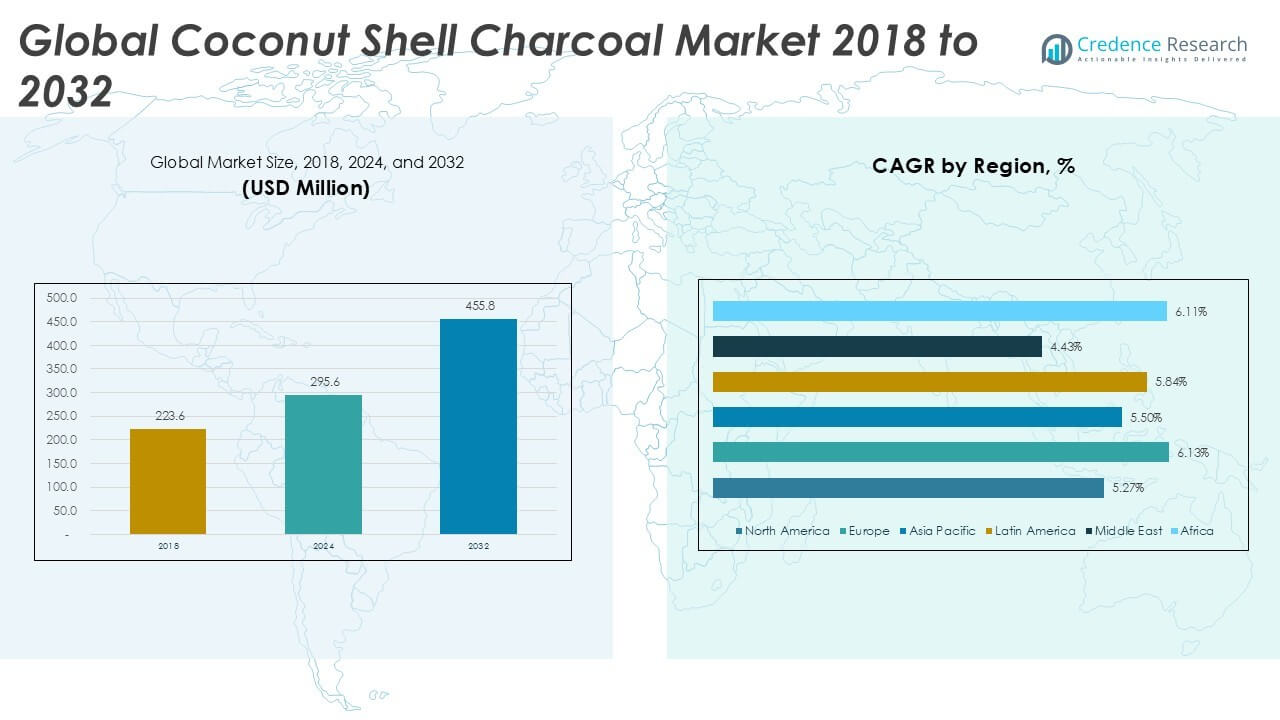
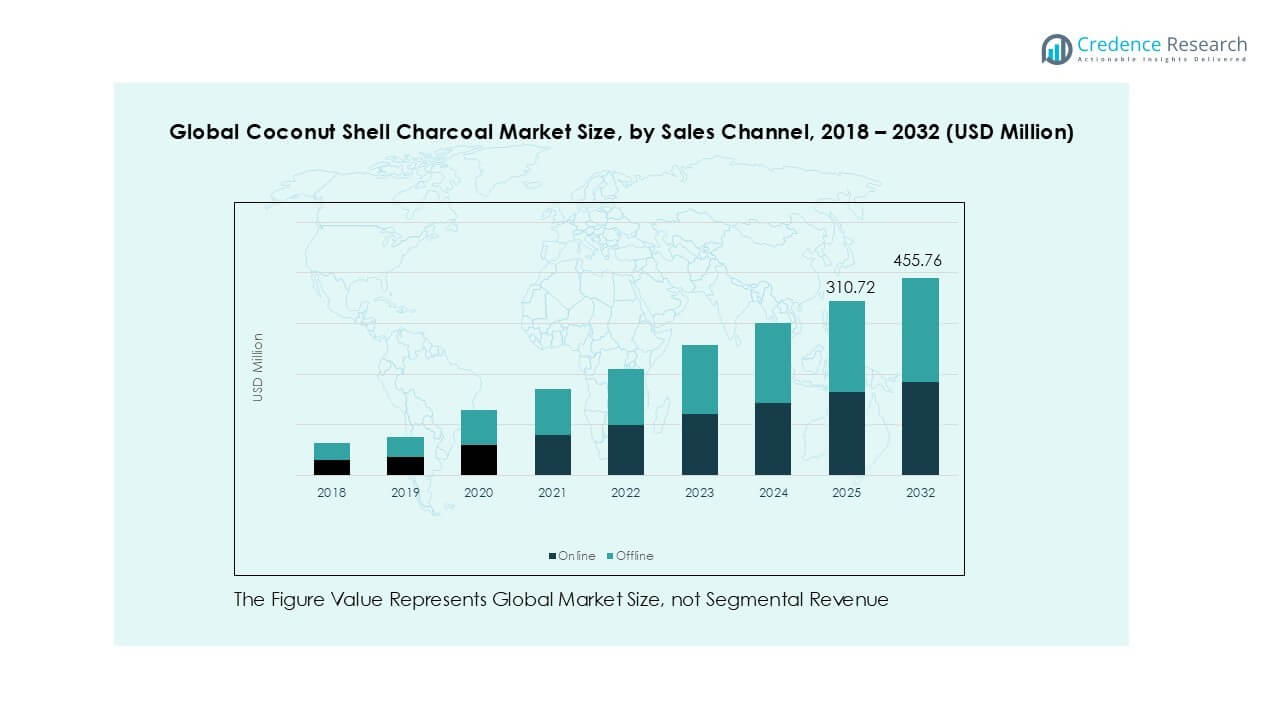
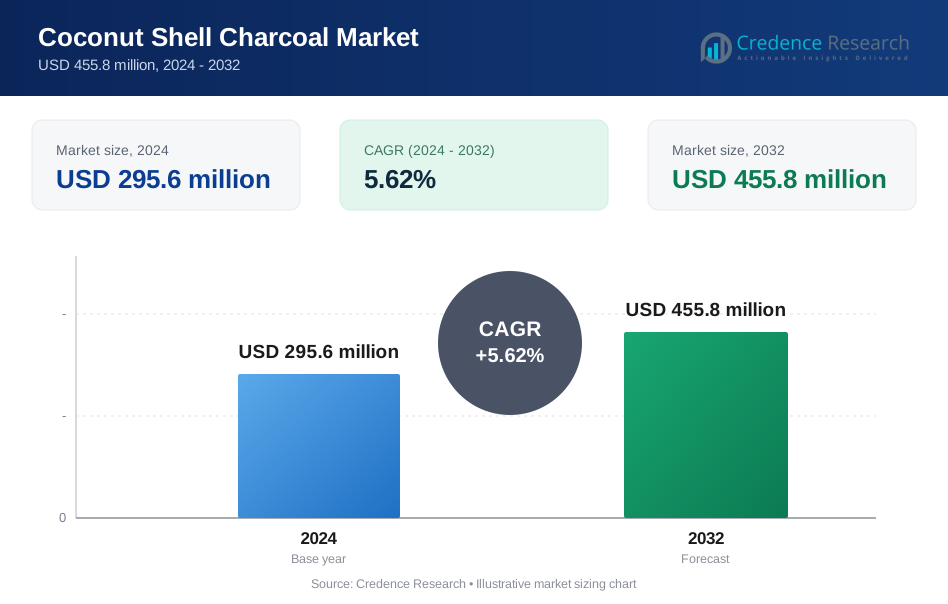
The Global Coconut Shell Charcoal market size was valued at USD 223.6 million in 2018 to USD 295.6 million in 2024 and is anticipated to reach USD 455.8 million by 2032, at a CAGR of 5.62% during the forecast period.
| REPORT ATTRIBUTE | DETAILS |
|---|---|
| Historical Period | 2020-2023 |
| Base Year | 2024 |
| Forecast Period | 2025-2032 |
| Coconut Shell Charcoal Market Size 2024 | USD 295.6 million |
| Coconut Shell Charcoal Market, CAGR | 5.62% |
| Coconut Shell Charcoal Market Size 2032 | USD 455.8 million |
Top players in the global coconut shell charcoal market include ArSta Eco, Bakulan Nusantara, HEAT BEADS, MICBAC, Geewin Exim Pvt Ltd, Raj Carbon, and Baracoco. These companies have established themselves through strong export capabilities, consistent product quality, and targeted offerings across cooking fuel, industrial use, and activated carbon segments. Southeast Asia, led by countries like Indonesia, the Philippines, and India, dominates production due to abundant coconut availability and low-cost processing. Asia Pacific held the largest regional market share at 33.0% in 2024, driven by domestic consumption and export-oriented manufacturing. Europe followed with 27.8%, fueled by rising demand for shisha and eco-friendly grilling fuels.
Coconut Shell Charcoal Market Insights
- The global coconut shell charcoal market reached USD 295.6 million in 2024 and is projected to hit USD 455.8 million by 2032, registering a CAGR of 5.62%.
- Rising demand for renewable and clean-burning fuels in cooking, metallurgy, and industrial boilers is driving market growth.
- A key trend is the increasing use of high-purity coconut charcoal in activated carbon production for water filtration and air purification, especially across Europe and Asia Pacific.
- The market is moderately fragmented with strong export players like ArSta Eco, Bakulan Nusantara, and MICBAC, competing on quality, grade variety, and regional compliance.
- Asia Pacific leads with a 33.0% share in 2024, followed by Europe at 27.8% and North America at 18.8%, while briquettes charcoal remains the dominant product segment due to uniform burn performance and global export preference.
Coconut Shell Charcoal Market Segmentation Analysis:
By Product Type:
Briquettes Charcoal holds the largest market share in the global coconut shell charcoal market by product type. Its dominance is driven by high energy density, uniform shape, and consistent burning performance, making it ideal for both household and industrial use. Briquettes are preferred for export due to ease in packaging and transportation. Lump charcoal, though popular in niche markets for its natural appeal and quicker ignition, lacks consistency in shape and burn duration. The “Others” segment includes powdered forms and mixed composites, used mainly in specific industrial processes or as additives.
- For instance, Coco Charcoal Indonesia produces coconut shell charcoal briquettes with a fixed carbon content above 75%. The briquettes deliver calorific values around 7,200 kcal per kilogram
By Purity Segment:
Standard purity coconut shell charcoal dominates the market due to its widespread use in cooking and heating applications, especially in developing regions. This segment benefits from lower production costs and high availability. High-purity charcoal, though smaller in share, is rapidly growing, supported by its demand in metallurgical industries, activated carbon production, and premium cooking fuel markets. High-purity grades are processed to remove volatile matter, ensuring higher carbon content and cleaner burn, making them suitable for applications requiring minimal contaminants and consistent performance under high heat conditions.
- For instance, PT Coco Charcoal Indonesia supplies high-purity coconut shell charcoal with carbon content reaching 85 grams per 100 grams. Volatile matter levels are reduced below 15 grams per 100 grams through secondary carbonization.
By Application Segment:
Cooking Fuel leads the global market by application, accounting for the highest share due to large-scale residential and commercial use in Asia-Pacific and Africa. The demand is supported by the growing need for smokeless, long-burning, and renewable biomass fuel alternatives. Industrial Fuel is another significant segment, particularly in metallurgy and cement industries, where high calorific value and sustainability are prioritized. The “Others” segment includes use in water purification, air filtration, and incense manufacturing, where coconut shell charcoal’s porous structure and absorptive capacity drive adoption.
Coconut Shell Charcoal Market Key Growth Drivers
Rising Demand for Sustainable and Renewable Fuel Alternatives
The global push for carbon-neutral energy has fueled the adoption of biomass-derived fuels like coconut shell charcoal. This charcoal serves as an eco-friendly replacement for fossil fuels in residential and industrial settings. Its production uses agricultural waste, reducing environmental impact and promoting waste valorization. Markets in Asia-Pacific, Africa, and Latin America are increasingly shifting toward renewable energy sources for domestic cooking and heating. Governments and NGOs promote biomass briquettes as cleaner alternatives to firewood and coal, aiding rural energy access and reducing deforestation. Coconut shell charcoal’s high calorific value, low smoke emissions, and renewability make it a preferred solution for eco-conscious consumers. Industrial users also favor it for boiler fuel due to stable combustion properties. These factors, combined with rising awareness of sustainable fuels and carbon footprint reduction targets, continue to drive strong demand in both emerging and developed economies.
- For instance, PT Coco Charcoal Indonesia produces coconut shell charcoal briquettes with calorific values reaching 7,000 kilocalories per kilogram.
Expanding Industrial Use in Metallurgy, Water Treatment, and Filtration
Coconut shell charcoal is gaining traction across various industrial applications due to its high carbon content and adsorptive capacity. In metallurgy, high-purity charcoal is used as a reducing agent for smelting and foundry operations, offering cleaner combustion than coal. The growing adoption of activated carbon from coconut shell charcoal is another strong growth driver, especially in water purification, gold recovery, and air filtration. The Asia-Pacific and Middle East regions are witnessing rapid infrastructure development, pushing demand for filtration and environmental control systems. The cosmetics and pharmaceutical industries also utilize activated coconut charcoal in detox formulations and personal care products. Industrial users prefer coconut shell charcoal for its uniform granule structure, low ash content, and long shelf life. This multifunctional use across sectors enhances its commercial value and contributes to sustained demand growth from large-volume buyers and manufacturers globally.
- For instance, Jacobi Carbons manufactures activated carbon from coconut shell charcoal with iodine numbers exceeding 1,000 milligrams per gram.
Export-Oriented Production Growth in Key Coconut-Producing Economies
Major coconut-producing countries like Indonesia, the Philippines, India, and Sri Lanka have emerged as global supply hubs for coconut shell charcoal. These nations benefit from abundant raw material availability and low-cost labor, enabling them to scale up charcoal production efficiently. Export markets in Europe, the Middle East, and North America increasingly demand briquettes and activated charcoal for grilling, shisha, and filtration uses. Producers in Southeast Asia capitalize on established trade routes and bilateral trade agreements to access new markets. Rising investment in carbonization kilns, clean processing technologies, and quality certification systems has improved product consistency and export value. Exporters also offer customized sizes and packaging to meet buyer specifications. This export-oriented growth is further supported by favorable government policies, such as export subsidies and rural development incentives. The result is a robust supply chain network that positions these countries as reliable exporters in the global coconut shell charcoal market.
Coconut Shell Charcoal Market Key Trends & Opportunities
Growing Penetration of Coconut Charcoal in Shisha and Barbecue Markets
The popularity of coconut shell charcoal is rising rapidly in premium barbecue and shisha (hookah) markets. Unlike traditional wood-based charcoal, coconut charcoal burns longer, produces minimal smoke, and generates less ash-qualities that appeal strongly to hospitality, catering, and recreational users. Middle Eastern and European countries are key growth hubs for coconut briquettes used in shisha lounges and restaurants. Manufacturers cater to these segments by offering cube-shaped briquettes with precise moisture content and consistent heat output. This niche is expanding due to health and performance advantages over quick-light charcoal. Product innovations such as odorless combustion, branded packaging, and bulk shipments have further enhanced appeal. Online platforms and specialty distributors make these products more accessible to retail consumers, especially in urban centers. This trend offers sustained growth potential for producers who can meet the exacting standards of premium leisure and hospitality markets.
- For instance, Coco Nara produces 100% natural coconut charcoal briquettes designed for shisha use, offering a clean burn with sessions typically lasting between 60 and 90 minutes per coal. To ensure stable ignition and prevent sparking, these briquettes maintain a low moisture content of less than 5% to 6%.
Rising Preference for Clean-Label and Organic Products in End-User Industries
End-use industries like personal care, food, and pharmaceuticals are adopting coconut-based activated charcoal in response to consumer demand for clean-label and natural ingredients. Activated coconut shell charcoal is increasingly used in face masks, toothpaste, dietary supplements, and detox beverages. Its high porosity and non-toxic profile meet regulatory and consumer requirements in both food-grade and cosmetic-grade applications. Clean-label trends across North America and Europe drive this expansion, with manufacturers marketing coconut-derived ingredients as “vegan,” “organic,” and “chemical-free.” Functional beverages and wellness brands also promote activated charcoal for gut health and detox benefits. This shift opens new value-added product opportunities for coconut shell charcoal processors, particularly those investing in high-purity and food-safe manufacturing processes. Brands leveraging these benefits gain a competitive edge in premium wellness and sustainable consumer product segments.
Coconut Shell Charcoal Market Key Challenges
Supply Chain Disruptions Due to Seasonal Raw Material Availability
Coconut shell charcoal production heavily relies on the availability of mature coconuts, which fluctuates seasonally and by region. Coconut harvesting cycles, weather events, and crop diseases can limit shell supply, disrupting production schedules and causing price volatility. Many small-scale producers lack storage infrastructure for year-round raw material access. Transportation delays and inconsistent shell collection systems also affect procurement reliability. Exporters often face delays due to port congestion, customs issues, or packaging compliance. These supply chain bottlenecks lead to missed export deadlines and loss of buyer confidence. Maintaining consistent product quality becomes difficult when raw material shortages force the use of mixed or lower-grade shells. To address this challenge, producers must invest in raw material warehousing, integrated farming partnerships, and predictive procurement systems to stabilize supply throughout the year.
Lack of Standardized Quality and Certification in Emerging Markets
The absence of uniform product standards and certification systems poses a significant barrier for coconut shell charcoal producers, particularly in emerging economies. Many small and medium manufacturers operate informally and lack access to international certification such as ISO, FSC, or HACCP. As a result, they struggle to penetrate regulated markets in Europe and North America that demand strict quality, safety, and sustainability documentation. Inconsistent moisture levels, ash content, and packaging quality affect customer satisfaction and repeat orders. Buyers increasingly seek traceability and eco-labels, which smaller exporters may be unable to provide. The lack of training, testing labs, and export compliance infrastructure further complicates the situation. To remain competitive, market players must invest in quality control processes, third-party certifications, and product standardization to meet global expectations and unlock premium pricing opportunities.
Coconut Shell Charcoal Market Regional Analysis
North America
North America accounted for USD 53.91 million in 2018 and reached USD 69.86 million in 2024, with projections hitting USD 104.82 million by 2032, growing at a CAGR of 5.27%. The region held approximately 18.8% of the global market share in 2024. Demand is primarily driven by barbecue fuel and activated carbon applications. The U.S. dominates regional consumption due to a mature grilling culture, high adoption of sustainable products, and strong retail distribution. Product innovations and growing interest in natural air and water purification systems also support growth across both residential and commercial sectors.
Europe
Europe held a market size of USD 60.37 million in 2018, which increased to USD 82.21 million in 2024 and is forecast to reach USD 131.71 million by 2032, registering a CAGR of 6.13%. It captured roughly 27.8% of the global market share in 2024. The region leads in demand for coconut shell charcoal used in shisha, grilling, and activated carbon products. Germany, the UK, and France are key importers due to consumer preference for clean-burning, eco-friendly fuels. Strict environmental regulations and high standards for water and air purification further support the uptake of premium-grade charcoal.
Asia Pacific
Asia Pacific dominated the market with USD 74.31 million in 2018, rising to USD 97.51 million in 2024, and projected to reach USD 148.90 million by 2032 at a CAGR of 5.50%. It held the largest market share globally at 33.0% in 2024. The region benefits from abundant coconut supply and strong domestic consumption across cooking, industrial, and export-oriented production. India, Indonesia, the Philippines, and Sri Lanka are major players. Government support for rural biomass usage, large-scale activated carbon production, and a growing export base contribute to Asia Pacific's leadership in both volume and value.
Latin America
Latin America reached a market value of USD 22.30 million in 2024, up from USD 16.66 million in 2018, and is expected to touch USD 34.96 million by 2032 at a CAGR of 5.84%. It represented around 7.5% of the global market share in 2024. Countries like Brazil and Colombia are emerging users, supported by increasing demand for clean cooking fuels and sustainable alternatives to wood charcoal. Coconut-producing coastal areas are developing small-scale processing hubs for local consumption and regional exports. The region’s growing health awareness and rural energy programs are expected to fuel further expansion.
Middle East
The Middle East market stood at USD 10.69 million in 2018 and grew to USD 13.27 million in 2024, with forecasts indicating USD 18.69 million by 2032, reflecting a CAGR of 4.43%. In 2024, it held about 4.5% of the global share. The demand is largely driven by shisha and barbecue consumption in Gulf countries, with premium briquettes gaining popularity. Imports dominate the market due to limited domestic coconut production. Consumer preference for low-smoke, high-heat charcoal is boosting interest in coconut-based alternatives. Growth is steady but constrained by dependency on imports and price sensitivity in bulk procurement.
Africa
Africa recorded USD 7.67 million in 2018, rising to USD 10.43 million in 2024, and is projected to reach USD 16.68 million by 2032, growing at a CAGR of 6.11%. The region accounted for around 3.5% of the global market share in 2024. High adoption of coconut shell charcoal for cooking fuel, especially in West and East Africa, is driving demand. Efforts to replace wood-based charcoal and reduce indoor air pollution are encouraging uptake. Nigeria, Kenya, and Tanzania are major contributors, benefiting from growing coconut production and off-grid energy needs in rural areas. Charcoal entrepreneurship is also gaining traction.
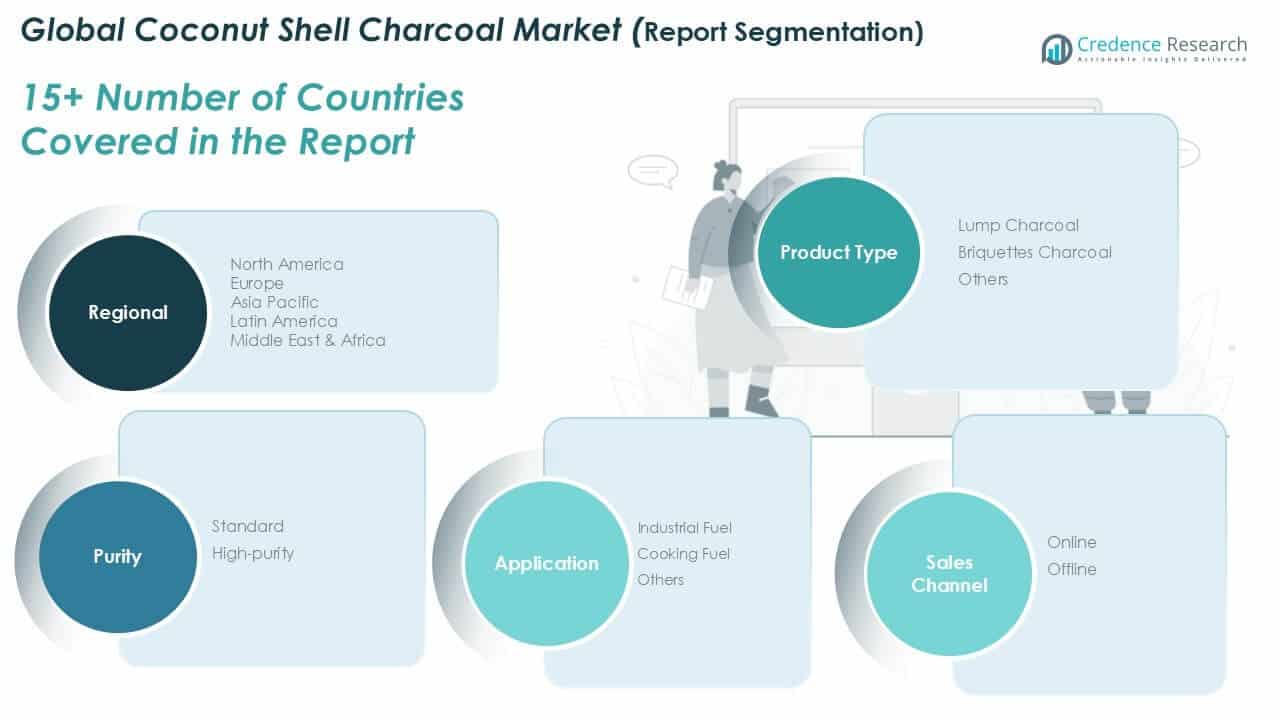
Coconut Shell Charcoal Market Segmentations:
By Product Type:
- Lump Charcoal
- Briquettes Charcoal
- Others
By Purity Segment:
- Standard
- High-purity
By Application Segment:
- Industrial Fuel
- Cooking Fuel
- Others
By Distribution Channel:
- Online
- Offline
By Geography
- North America
- U.S.
- Canada
- Mexico
- Europe
- Germany
- France
- U.K.
- Italy
- Spain
- Rest of Europe
- Asia Pacific
- China
- Japan
- India
- South Korea
- South-east Asia
- Rest of Asia Pacific
- Latin America
- Brazil
- Argentina
- Rest of Latin America
- Middle East & Africa
- GCC Countries
- South Africa
- Rest of the Middle East and Africa
Competitive Landscape
The global coconut shell charcoal market features a moderately fragmented landscape, with a mix of established regional producers and emerging exporters. Key players such as ArSta Eco, Bakulan Nusantara, HEAT BEADS, and MICBAC lead the market with strong production capabilities, consistent quality, and export networks. Southeast Asian firms benefit from proximity to coconut sources and cost-efficient labor, positioning them as dominant suppliers. Companies focus on expanding product portfolios, offering high-purity grades and value-added products like activated carbon and shisha briquettes. Strategic moves such as capacity expansions, private labeling partnerships, and product certifications are common across leading players. Smaller firms and local enterprises compete through flexible pricing and niche applications. The growing emphasis on traceability, eco-certifications, and clean-label demand is driving investment in quality control and compliance infrastructure. Market competition is intensifying as global demand rises and buyers seek reliable, certified, and sustainable sources for both industrial and consumer-grade applications.
Key Player Analysis
- ArSta Eco
- Bakulan Nusantara
- HEAT BEADS
- Geewin Exim Pvt Ltd
- MICBAC
- Raj Carbon
- Baracoco
- Other Key Players
Recent Developments
- In July 2023, a European energy company announced the integration of coconut shell-based activated carbon into its filtration units, improving efficiency in industrial wastewater treatment by 18%.
- In 2023, Coconut shell charcoal is being utilized by organizations like Calgon Carbon as a natural resource for the production of activated carbon, which has applications in water filtration, air purging, and clinical equipment.
Report Coverage
The research report offers an in-depth analysis based on Product Type, Purity Segment, Application Segment, Distribution Channel and Geography. It details leading market players, providing an overview of their business, product offerings, investments, revenue streams, and key applications. Additionally, the report includes insights into the competitive environment, SWOT analysis, current market trends, as well as the primary drivers and constraints. Furthermore, it discusses various factors that have driven market expansion in recent years. The report also explores market dynamics, regulatory scenarios, and technological advancements that are shaping the industry. It assesses the impact of external factors and global economic changes on market growth. Lastly, it provides strategic recommendations for new entrants and established companies to navigate the complexities of the market.
Future Outlook
- Demand for coconut shell charcoal will grow due to rising use in eco-friendly fuel alternatives.
- Export opportunities will expand as global buyers seek sustainable and low-emission charcoal options.
- Activated carbon applications will drive high-purity charcoal production across industrial sectors.
- Shisha and barbecue markets will create steady demand for briquettes in Europe and the Middle East.
- Southeast Asia will remain the dominant production hub due to raw material access and low costs.
- Clean-label trends will boost adoption of coconut charcoal in personal care and wellness products.
- Online retail and bulk packaging will improve market accessibility and global distribution reach.
- Investments in certification, moisture control, and ash reduction will support premium segment growth.
- Supply chain efficiency and raw material storage will become critical for year-round production.
- Market consolidation is expected as key players strengthen global footprints and product portfolios.
Request a Free Sample
Fill in your details and we'll send you a free sample report.
- Sample data tables & charts
- Research methodology
Need a Custom Version of This Report?
Tailor the scope, geography, or segments to your exact requirements.
- Custom geography or segment scope
- Direct access to our analyst team
Frequently Asked Questions
What is the current market size for the Global Coconut Shell Charcoal market, and what is its projected size in 2032?
At what Compound Annual Growth Rate is the Global Coconut Shell Charcoal market projected to grow between 2024 and 2032?
Which Global Coconut Shell Charcoal market segment held the largest share in 2024?
What are the primary factors fueling the growth of the Global Coconut Shell Charcoal market?
Who are the leading companies in the Global Coconut Shell Charcoal market?
Which region commanded the largest share of the Global Coconut Shell Charcoal market in 2024?
Table of Content
Chapter 1 Market Segmentation
- 1.1 Segmentation Framework
- 1.1.1 Product and Service Classification
- 1.1.2 Application and End-Use Classification
- 1.1.3 Technology and Solution Classification
- 1.1.4 Customer and Distribution Channel Classification
- 1.1.5 Geographic Segmentation
- 1.1.6 Market Segment Definitions and Boundaries
Chapter 2 Introduction
- 2.1 Report Objectives and Scope
- 2.2 Product Definition and Industry Terminology
- 2.3 Market Inclusions and Exclusions
- 2.4 Research Process
- 2.4.1 Primary Research and Expert Interviews
- 2.4.2 Secondary Research and Source Review
- 2.4.3 Top-Down and Bottom-Up Estimation
- 2.4.4 Data Triangulation and Verification
- 2.5 Market Size Measurement Basis
- 2.5.1 2024: USD 295.6 million → 2032: USD 455.8 million
- 2.6 Historical and Forecast Reference Periods
- 2.6.1 Base Year: 2024
- 2.6.2 Forecast Period: 2024-2032
- 2.7 Research Assumptions and Limitations
Chapter 3 Executive Summary
- 3.1 Market Snapshot and Key Findings
- 3.2 Base-Year Market Size, 2024
- 3.3 Forecast Market Size, 2032
- 3.4 Revenue and Volume Growth Outlook
- 3.5 Key Demand and Supply Indicators
- 3.6 Leading Market Segments
- 3.7 Fastest-Growing Market Opportunities
- 3.8 Regional Performance Highlights
- 3.9 Technology and Industry Transformation
- 3.10 Competitive Landscape Summary
- 3.11 Analyst View and Strategic Implications
Chapter 4 Global Coconut Shell Charcoal Market Trends and Developments
- 4.1 Historical Industry Development
- 4.2 Recent Market Trends and Developments
- 4.3 Demand and Customer Behavior Trends
- 4.4 Technology and Product Innovation
- 4.5 Artificial Intelligence, Automation and Digitalization
- 4.6 Local Manufacturing and Supply Chain Realignment
- 4.7 Industry Partnerships, Mergers and Acquisitions
- 4.8 Sustainability and Circular Economy Developments
- 4.9 Government and Private Sector Investment Trends
- 4.10 Emerging Business Models and Commercialization
- 4.11 Industry Developments and Announcements
Chapter 5 Global Coconut Shell Charcoal Market Production, Supply and Demand Analysis
- 5.1 Demand Trend and Consumption Analysis
- 5.2 Demand Forecast, 2024-2032
- 5.3 Production and Output Trend
- 5.4 Production and Output Forecast, 2024-2032
- 5.5 Installed Capacity and Capacity Utilization
- 5.6 Company-Wise Production Plants and Statistics
- 5.6.1 Installed Production Capacity
- 5.6.2 Actual Production
- 5.6.3 Planned Capacity and Expansion Targets
- 5.7 Supply Chain Structure and Procurement Trends
- 5.8 Supply-Demand Gap and Bottlenecks
- 5.9 Import Dependence and Sourcing Structure
- 5.10 Contract Manufacturing and Outsourcing
- 5.11 Regional Supply and Demand Concentration
Chapter 6 Global Coconut Shell Charcoal Market Pricing Analysis
- 6.1 Pricing Structure and Measurement
- 6.2 Historical Pricing Trends
- 6.3 Pricing Outlook, 2024-2032
- 6.4 Average Selling Price and Unit Economics
- 6.5 Pricing by Product and Market Segment
- 6.6 Geographic Pricing Differences
- 6.7 Key Input, Energy, Labor and Logistics Costs
- 6.8 Contract Pricing and Purchasing Models
- 6.9 Pricing Sensitivity and Competitive Positioning
- 6.10 Price, Margin and Profitability Implications
Chapter 7 Global Coconut Shell Charcoal Market Dynamics
- 7.1 Market Growth Drivers
- 7.1.1 Demand-Side Drivers
- 7.1.2 Technology and Innovation Drivers
- 7.1.3 Infrastructure and Investment Drivers
- 7.1.4 Regulatory and Policy Drivers
- 7.2 Market Restraints
- 7.2.1 Cost and Affordability Constraints
- 7.2.2 Technology and Adoption Barriers
- 7.2.3 Supply Chain and Operational Constraints
- 7.3 Market Challenges
- 7.3.1 Competitive Pressure and Margin Erosion
- 7.3.2 Skills, Infrastructure and Implementation Gaps
- 7.4 Emerging Market Opportunities
- 7.5 Market Dynamics Impact and Time-Horizon Assessment
Chapter 8 Global Coconut Shell Charcoal Value Chain Analysis
- 8.1 Industry Value Chain Overview
- 8.2 Upstream Suppliers and Critical Inputs
- 8.3 Technology and Component Providers
- 8.4 Manufacturing or Service Delivery
- 8.5 Distribution, Channel Partners and Integrators
- 8.6 Downstream Applications and End Users
- 8.7 Value Addition and Profit Pools
- 8.8 Vertical Integration and Outsourcing
- 8.9 Supplier Concentration and Risk
- 8.10 Supply Chain Localization and Resilience
Chapter 9 Global Coconut Shell Charcoal Market Regulations and Policies
- 9.1 Relevant Laws, Standards and Compliance Frameworks
- 9.2 Product, Service, Safety and Quality Requirements
- 9.3 Government Policies, Incentives and Subsidies
- 9.4 Imports, Exports and Trade Barriers
- 9.5 Public Procurement and Local Content Requirements
- 9.6 Environmental and Sustainability Compliance
- 9.7 Upcoming Policy Changes and Market Implications
Chapter 10 Global Coconut Shell Charcoal Market Hotspots and Opportunities
- 10.1 Market Opportunity Mapping and Growth Hotspots
- 10.2 High-Growth Applications and Customer Groups
- 10.3 Underserved Markets and White-Space Opportunities
- 10.4 Emerging Technology and Product Opportunities
- 10.5 New Capacity and Investment Hotspots
- 10.6 Market Entry and Expansion Opportunities
- 10.7 Distribution and Partnership Opportunities
- 10.8 Near-Term and Long-Term Commercial Potential
- 10.9 Opportunity Attractiveness and Execution Risks
Chapter 11 Global Coconut Shell Charcoal Market Outlook, 2024-2032
- 11.1 Market Size and Analysis
- 11.1.1 Revenue (Market Measurement: 2024: USD 295.6 million → 2032: USD 455.8 million)
- 11.1.2 Market Volume and Quantity Sold
- 11.1.3 Historical Market Size
- 11.1.4 Base-Year Market Size, 2024
- 11.2 Market Forecast, 2024-2032
- 11.2.1 Revenue Forecast to 2032
- 11.2.2 Volume Forecast to 2032
- 11.2.3 CAGR and Year-on-Year Growth
- 11.2.4 Incremental Revenue Opportunity
- 11.3 Forecast Assumptions and Scenario Analysis
- 11.3.1 Base-Case Forecast
- 11.3.2 Optimistic and Conservative Scenarios
- 11.3.3 Technology, Pricing and Policy Sensitivities
- 11.4 Market Attractiveness and Growth Outlook
Chapter 12 Global Coconut Shell Charcoal Market Segmentation and Outlook
- 12.1 Segmentation Summary and Market Shares, 2024
- 12.2 Largest and Fastest-Growing Segments
- 12.3 Segment Growth Comparison
- 12.4 Segment Attractiveness and Priority Matrix
Chapter 13 Global Coconut Shell Charcoal Geographic Market Outlook, 2024-2032
- 13.1 Regional Market Size and Share, 2024
- 13.2 Regional Market Forecast, 2024-2032
- 13.3 Regional Pricing, Production and Demand Differences
- 13.4 North America
- 13.4.1 United States
- 13.4.2 Canada
- 13.4.3 Mexico
- 13.5 Europe
- 13.5.1 Germany
- 13.5.2 France
- 13.5.3 Italy
- 13.5.4 United Kingdom
- 13.5.5 Spain
- 13.5.6 Poland
- 13.5.7 Russia
- 13.5.8 Netherlands
- 13.5.9 Belgium
- 13.5.10 Sweden
- 13.5.11 Denmark
- 13.5.12 Norway
- 13.5.13 Rest of Europe
- 13.6 Asia Pacific
- 13.6.1 China
- 13.6.2 India
- 13.6.3 Japan
- 13.6.4 South Korea
- 13.6.5 Thailand
- 13.6.6 Indonesia
- 13.6.7 Vietnam
- 13.6.8 Malaysia
- 13.6.9 Australia
- 13.6.10 Rest of Asia Pacific
- 13.7 Latin America
- 13.7.1 Brazil
- 13.7.2 Argentina
- 13.7.3 Colombia
- 13.7.4 Chile
- 13.7.5 Rest of Latin America
- 13.8 Middle East
- 13.8.1 Saudi Arabia
- 13.8.2 United Arab Emirates
- 13.8.3 Turkey
- 13.8.4 Israel
- 13.8.5 Iran
- 13.8.6 Rest of the Middle East
- 13.9 Africa
- 13.9.1 South Africa
- 13.9.2 Egypt
- 13.9.3 Nigeria
- 13.9.4 Morocco
- 13.9.5 Rest of Africa
- 13.10 Regional Investment, Policy and Supply Chain Differences
- 13.11 Regional Competitive Landscape
- 13.12 Geographic Growth Hotspots
Chapter 14 Global Coconut Shell Charcoal Technology, Innovation and Sustainability Outlook
- 14.1 Technology Landscape and Maturity
- 14.2 Product, Process and Service Innovation
- 14.3 AI, Automation and Digital Tools in the Industry
- 14.4 Technology Adoption and Performance Benchmarking
- 14.5 Innovation Pipeline and R&D Investment
- 14.6 Patent and Intellectual Property Trends
- 14.7 Energy Efficiency and Resource Management
- 14.8 Sustainability, Recycling and Circularity
- 14.9 Technology Roadmap, 2024-2032
- 14.10 Risks of Obsolescence and Technology Substitution
Chapter 15 Global Coconut Shell Charcoal Market Key Strategic Imperatives
- 15.1 Growth and Market Entry Priorities
- 15.2 High-Return Products and Segments
- 15.3 Pricing, Profitability and Cost Optimization
- 15.4 Technology Investment and Product Differentiation
- 15.5 Supply Chain Localization and Resilience
- 15.6 Distribution and Customer Acquisition
- 15.7 Partnership, Acquisition and Capacity Strategy
- 15.8 Regional Expansion Priorities
- 15.9 Short-, Medium- and Long-Term Actions
Chapter 16 Competition Outlook
- 16.1 Industry Competition Characteristics
- 16.2 Market Structure and Concentration
- 16.3 Market Share and Competitive Positioning, 2024
- 16.4 Company-Wise Revenue and Product Benchmarking
- 16.5 Production and Service Capacity Benchmarking
- 16.6 Technology, Pricing and Differentiation
- 16.7 Regional Footprint and Distribution Strength
- 16.8 Mergers, Acquisitions and Strategic Alliances
- 16.9 New Entrants and Competitive Threats
- 16.10 Porter's Five Forces and Industry Attractiveness
- 16.11 Competitive Outlook, 2024-2032
Chapter 17 Company Profiles
- 17.1 Company Coverage and Selection Criteria
- 17.2 Leading Market Participants – Standard Profile Structure
- 17.2.1 Business Description
- 17.2.2 Company Ownership and Geographic Presence
- 17.2.3 Product and Service Portfolio
- 17.2.4 Manufacturing and Operating Footprint
- 17.2.5 Production Capacity and Expansion Plans
- 17.2.6 Financial Performance and Investment
- 17.2.7 Market Share and Competitive Position
- 17.2.8 Technology and Innovation Capabilities
- 17.2.9 Strategic Alliances or Partnerships
- 17.2.10 Recent Developments
- 17.2.11 Growth Strategy and Outlook
- 17.3 Other Relevant Market Participants
Note: Every listed company is profiled on the structure shown under the first company. The company list is preliminary and may change based on research findings, market developments, data availability and client requirements.
Chapter 18 Disclaimer
- 18.1 Research and Forecast Disclaimer
- 18.2 Data Source and Estimation Limitations
Note: The depth of individual sections depends on data availability for this market. Volume, capacity, trade and other unit-based metrics are included where applicable.