Market Overview
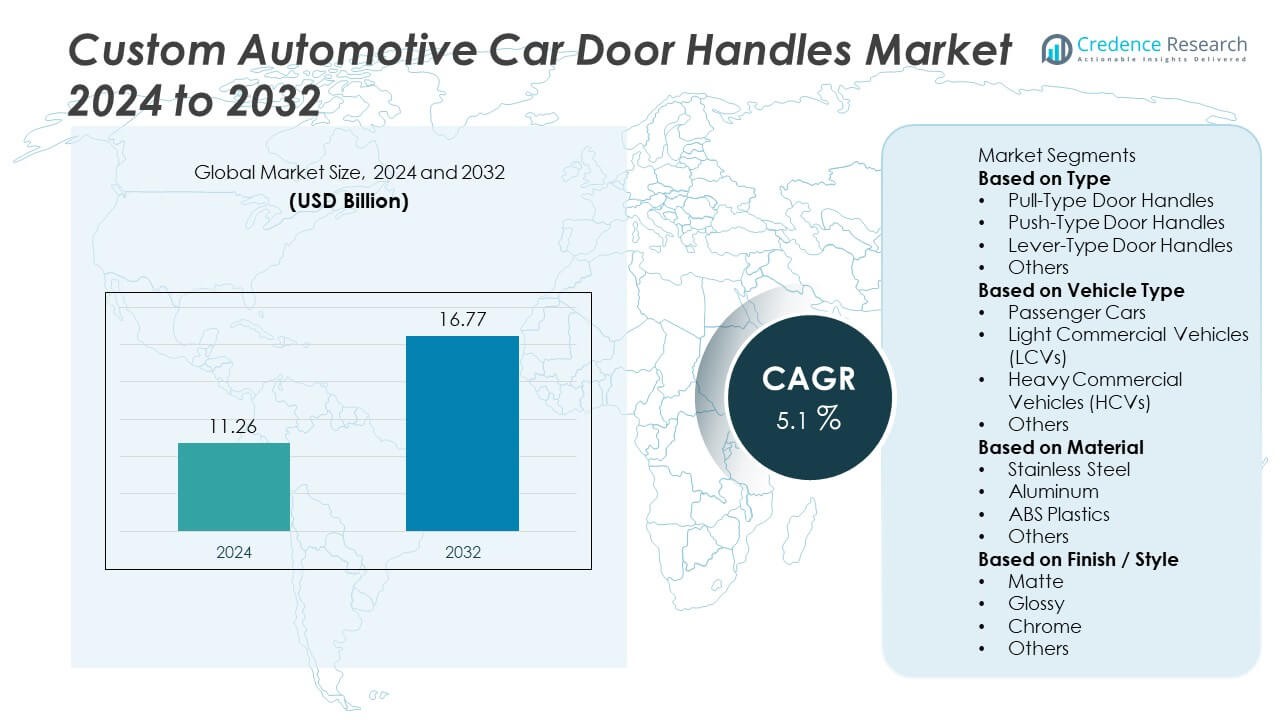
Custom Automotive Car Door Handles market size reached USD 11.26 billion in 2024 and is projected to rise to USD 16.77 billion by 2032, supported by a 5.1% CAGR during the forecast period.
| REPORT ATTRIBUTE | DETAILS |
|---|---|
| Historical Period | 2020-2023 |
| Base Year | 2024 |
| Forecast Period | 2025-2032 |
| Custom Automotive Car Door Handles Market Size 2024 | USD 11.26 Billion |
| Custom Automotive Car Door Handles Market, CAGR | 5.1% |
| Custom Automotive Car Door Handles Market Size 2032 | USD 16.77 Billion |
The Custom Automotive Car Door Handles market is driven by leading players such as Huf Hülsbeck & Fürst, ITW Automotive, Aisin Corporation, Magna International, Valeo, Witte Automotive, Toyota Boshoku Corporation, Grupo Antolin, Hyundai Mobis, and Mitsui Kinzoku. These companies expand their presence through advanced materials, improved ergonomic designs, and integration of smart entry technologies that enhance vehicle aesthetics and functionality. Their focus on lightweight components, corrosion-resistant finishes, and customization options supports strong adoption across passenger and premium vehicles. North America leads the market with a 36% share, supported by high demand for advanced styling features, while Europe follows with a 29% share driven by strong luxury car production.
Market Insights
- The Custom Automotive Car Door Handles market reached USD 11.26 billion in 2024 and is projected to reach USD 16.77 billion by 2032 at a 5.1% CAGR, driven by rising vehicle customization demand.
- Growth is supported by strong adoption of pull-type handles with a 46% share and increasing use of ABS plastic materials holding a 48% share, as automakers seek lightweight and durable components.
- Key trends include the shift toward smart, flush-mounted, and sensor-based door handles, driven by EV expansion and rising demand for premium exterior styling.
- Competition intensifies as leading players focus on advanced materials, corrosion-resistant finishes, and OEM partnerships to strengthen global presence, while cost pressures challenge high-end customization.
- Regionally, North America leads with a 36% share, followed by Europe at 29% and Asia Pacific at 27%, supported by strong automotive production, aftermarket customization, and rapid EV growth.
Market Segmentation Analysis:
By Type
Pull-type door handles lead this segment with a 46% share, driven by their wide use in passenger cars and strong compatibility with both traditional and modern door designs. Automakers prefer pull-type handles because they offer better grip, simple mechanics, and higher durability in daily usage. Push-type and lever-type handles gain steady adoption in commercial fleets that prioritize functional and cost-efficient hardware. Custom and specialty designs rise in premium models as styling becomes a key differentiator. Growing demand for enhanced aesthetics, improved ergonomics, and personalization supports stronger interest in high-end custom handle types.
- For instance, Huf Hülsbeck & Fürst is a global automotive supplier that develops and produces passive entry systems, including door handles with integrated capacitive touch sensors, for numerous global car manufacturers such as Daimler, BMW, and Ford.
By Vehicle Type
Passenger cars dominate this segment with a 61% share, supported by rising customization demand across sedans, SUVs, and hatchbacks. Manufacturers invest in customized door handle designs to meet growing consumer preference for premium looks, improved comfort, and advanced entry systems. Light commercial vehicles adopt sturdy and functional handle designs that tolerate frequent use, while heavy commercial vehicles emphasize operational durability and safety. Growth in electric and luxury vehicles increases adoption of sleek, lightweight, and flush-mounted designs. Rising global vehicle production and personalization trends further strengthen segment performance.
- For instance, Valeo supplies a gear shift actuator with a response time of less than 60 milliseconds (< 60 ms) for automatic transmissions, or a park lock actuator with a typical response time of 300 milliseconds. Valeo also produces flap actuators with a response time of less than 100 milliseconds (< 100 ms).
By Material
ABS plastics hold the dominant position with a 48% share, driven by their cost efficiency, light weight, and strong moldability for custom designs. Automakers favor ABS due to its durability, corrosion resistance, and ability to support complex shapes and finishes. Stainless steel remains popular in premium and high-wear applications where strength and long-term reliability are key. Aluminum grows due to rising demand for lightweight components in fuel-efficient and electric vehicles. Custom finishes, chrome coatings, and color-matched designs boost adoption across multiple vehicle categories, supporting wider material diversification in the market.
Key Growth Drivers
Rising Demand for Vehicle Customization
Growing consumer interest in personalized vehicle styling drives strong demand for custom automotive door handles. Buyers seek unique finishes, sculpted designs, and premium looks that enhance both aesthetics and brand identity. Automakers and aftermarket suppliers respond with wider customization options, including chrome, matte, carbon fiber, and color-matched variants. The trend is strongest in passenger cars and luxury vehicles where visual differentiation influences purchase decisions. Online customization platforms and accessory marketplaces further boost adoption by offering easy access to tailored designs.
- For instance, Mitsui Kinzoku produces zinc alloys used in various automotive components, which are subjected to general endurance and material performance testing to meet industry standards.
Expansion of Electric and Premium Vehicles
Electric vehicles and premium car segments accelerate growth as manufacturers adopt sleek, lightweight, and modern door handle designs. EV makers integrate flush-fit and aerodynamic handles to improve efficiency and align with futuristic styling. Premium brands demand high-quality materials such as aluminum, stainless steel, and carbon fiber to enhance user experience. Smart entry systems, including sensor-based and automatic pop-out handles, become more common. This shift toward advanced exterior components increases the need for custom solutions tailored to high-tech vehicle architectures.
- For instance, automotive suppliers like the Huf Group have developed flush door handles for electric cars (such as the Porsche Taycan) which include features like an "ice breaking function" to ensure reliable access even in extreme cold.
Increasing Adoption of Durable and Lightweight Materials
Demand for lightweight components pushes manufacturers to invest in advanced materials for custom door handles. ABS plastics, aluminum, and composite materials gain traction due to their low weight, high strength, and design flexibility. These materials support fuel-efficiency goals and improve long-term durability in both passenger and commercial vehicles. Automakers seek custom solutions that offer improved corrosion resistance, better grip comfort, and compatibility with modern door mechanisms. Material innovation also supports broader adoption of premium finishes and ergonomic designs.
Key Trends & Opportunities
Growth of Smart and Touchless Door Handle Technologies
Smart entry systems create new opportunities as automakers shift toward electronic and touchless handles. Keyless access, proximity sensors, and auto-present mechanisms gain popularity in high-end vehicles and EVs. This transition increases demand for customizable electronic housings, integrated lighting, and branded illuminated handles. Aftermarket players explore opportunities in retrofitting older vehicles with advanced handle systems. The rise of connected vehicle platforms also encourages the development of handles that integrate sensors and security features, expanding the market for premium electronic components.
- For instance, Tesla integrated door release buttons on the Cybertruck that are part of a full 48-volt electronic architecture, a departure from the traditional 12-volt systems used in most other vehicles.
Expansion of Aftermarket Customization Channels
The aftermarket sector grows rapidly as consumers seek personalized upgrades beyond OEM offerings. E-commerce platforms enable buyers to access a wide range of finishes, materials, and custom designs at competitive prices. Vehicle enthusiasts drive strong demand for themed, engraved, and performance-inspired door handles. Workshops and custom garages offer installation services that support wider adoption. The trend is strengthened by rising disposable income, growing automotive modification culture, and increased availability of high-quality third-party components.
- For instance, Aisin Corporation supplied aluminum front suspension towers for vehicles like the new Toyota Crown to enhance body rigidity and reduce weight. They use aluminum die-casting for various components, including transmission cases and water pump housings, and perform high-precision machining with tolerances down to the micron level for parts like manual transmission gears.
Key Challenges
High Cost of Premium Materials and Advanced Mechanisms
Premium materials such as aluminum, stainless steel, and carbon fiber increase production costs, limiting adoption in budget vehicles. Smart electronic door handles also require sensors, actuators, and control modules that raise manufacturing expenses. These components demand strict quality testing to ensure durability and safety. Price-sensitive customers in developing markets often prefer standard options, slowing growth for advanced custom designs. OEMs face cost pressures in balancing aesthetics, performance, and affordability across different vehicle segments.
Compatibility and Installation Constraints in Aftermarket Products
Aftermarket door handles often face challenges related to fitting, wiring compatibility, and alignment with factory door mechanisms. Variations in vehicle models and door structures create installation complexity. Incorrect fitting may affect door functionality, security, or weather sealing. Advanced electronic handles require proper integration with vehicle electronics, increasing installation difficulty. These constraints limit adoption among non-expert users and require skilled technicians, slowing market expansion in some regions.
Regional Analysis
North America
North America leads the Custom Automotive Car Door Handles market with a 36% share, driven by strong demand for premium vehicles and high adoption of advanced door handle technologies. Consumers favor customized finishes, smart entry systems, and durable materials across SUVs, trucks, and luxury cars. The region benefits from mature automotive manufacturing, rising EV adoption, and strong aftermarket activity. OEMs focus on lightweight and ergonomic designs that align with safety and styling needs. Growing customization culture and higher disposable income further strengthen market expansion across the U.S. and Canada.
Europe
Europe holds a 29% share, supported by strong production of luxury cars and a growing shift toward advanced design features. Automakers in Germany, Italy, and the UK invest heavily in premium materials such as aluminum, carbon fiber, and chrome-enhanced finishes. Rising EV adoption accelerates demand for flush-fit and aerodynamic handle designs. Strict safety regulations encourage manufacturers to incorporate durable mechanisms with enhanced user comfort. The aftermarket sector also expands due to high interest in personalization. Increasing focus on lightweight components supports wider use of ABS plastics and composite materials.
Asia Pacific
Asia Pacific accounts for a 27% share, driven by large-scale vehicle production and rising consumer interest in customization. China, Japan, and South Korea lead the region with strong OEM manufacturing and high adoption of modern styling features. Growing sales of passenger cars and EVs increase demand for lightweight, durable, and visually appealing door handles. Expanding aftermarket networks support rising modification trends among younger consumers. Rapid urbanization and rising income levels drive demand for premium finishes and ergonomic designs. Local suppliers also boost production capacity, improving accessibility across multiple vehicle categories.
Latin America
Latin America holds a 5% share, influenced by rising automotive production in Brazil and Mexico and increasing adoption of cost-effective custom accessories. Consumers show growing interest in visual upgrades such as chrome finishes, matte designs, and branded custom handles. OEM demand focuses on durable and affordable materials suited for varied environmental conditions. Aftermarket channels gain traction as vehicle owners invest in personalization and replacement components. Economic variability limits high-end adoption but steady growth continues due to expanding vehicle ownership and improving availability of customized products.
Middle East & Africa
Middle East & Africa represent a 3% share, supported by demand for customized and premium automotive styling across the Gulf countries. High adoption of luxury SUVs and off-road vehicles drives interest in durable, corrosion-resistant door handle designs. UAE and Saudi Arabia lead the region with strong preference for chrome, brushed metal, and engraved finishes. The aftermarket sector expands as consumers invest in personalization trends. In Africa, adoption grows slowly due to cost sensitivity, but rising vehicle imports support steady demand. Increasing urbanization and automotive upgrades strengthen long-term market potential.
Market Segmentations:
By Type
- Pull-Type Door Handles
- Push-Type Door Handles
- Lever-Type Door Handles
- Others
By Vehicle Type
- Passenger Cars
- Light Commercial Vehicles (LCVs)
- Heavy Commercial Vehicles (HCVs)
- Others
By Material
- Stainless Steel
- Aluminum
- ABS Plastics
- Others
By Finish / Style
- Matte
- Glossy
- Chrome
- Others
By Geography
- North America
- U.S.
- Canada
- Mexico
- Europe
- Germany
- France
- U.K.
- Italy
- Spain
- Rest of Europe
- Asia Pacific
- China
- Japan
- India
- South Korea
- South-east Asia
- Rest of Asia Pacific
- Latin America
- Brazil
- Argentina
- Rest of Latin America
- Middle East & Africa
- GCC Countries
- South Africa
- Rest of the Middle East and Africa
Competitive Landscape
Competitive landscape in the Custom Automotive Car Door Handles market features key players such as Huf Hülsbeck & Fürst, ITW Automotive, Aisin Corporation, Magna International, Valeo, Witte Automotive, Toyota Boshoku Corporation, Grupo Antolin, Hyundai Mobis, and Mitsui Kinzoku. These companies strengthen their positions by expanding product portfolios that include pull-type, flush-mounted, lever-style, and electronic smart handles tailored for modern vehicle platforms. Leading manufacturers invest in lightweight materials such as ABS plastics, aluminum, and carbon fiber to improve durability and fuel efficiency. Innovation focuses on integrating touchless sensors, illumination modules, and aerodynamic shapes that align with EV and luxury vehicle design trends. Partnerships with global OEMs help enhance supply chain reach and customization capabilities. Companies also expand manufacturing capacity in Asia Pacific to meet rising demand from high-volume automakers. Continuous advancements in ergonomics, anti-corrosion coatings, and design aesthetics further support competitive differentiation across global markets.
Key Player Analysis
- Huf Hülsbeck & Fürst
- ITW Automotive
- Aisin Corporation
- Magna International
- Valeo
- Witte Automotive
- Toyota Boshoku Corporation
- Grupo Antolin
- Hyundai Mobis
- Mitsui Kinzoku (Mitsui Mining & Smelting)
Recent Developments
- In May 2025, Huf Hülsbeck & Fürst underwent a strategic investment when Sodecia Group acquired an initial 30 % stake, strengthening its access-and-authorization system business (which includes door-handle systems).
- In August 2024, Aisin Corporation was granted a patent for a vehicle-door-handle apparatus featuring a rotatable grip with an integrated switch device.
- In March 2023, Magna International launched its “SmartAccess™” power door system, including integrated handle-actuator and software capability, for luxury applications (e.g., the Ferrari Purosangue).
Report Coverage
The research report offers an in-depth analysis based on Type, Vehicle Type, Material, Finish / Style and Geography. It details leading market players, providing an overview of their business, product offerings, investments, revenue streams, and key applications. Additionally, the report includes insights into the competitive environment, SWOT analysis, current market trends, as well as the primary drivers and constraints. Furthermore, it discusses various factors that have driven market expansion in recent years. The report also explores market dynamics, regulatory scenarios, and technological advancements that are shaping the industry. It assesses the impact of external factors and global economic changes on market growth. Lastly, it provides strategic recommendations for new entrants and established companies to navigate the complexities of the market.
Future Outlook
- Demand for customized and visually enhanced door handle designs will continue to rise across passenger vehicles.
- Smart and touchless door handle technologies will gain wider adoption as EV sales increase.
- Lightweight materials such as ABS plastics, aluminum, and composites will see higher usage to support fuel efficiency.
- OEMs will invest more in aerodynamic and flush-mounted handle designs that improve vehicle styling.
- The aftermarket sector will expand as consumers seek affordable personalization and replacement options.
- Integration of LED lighting and sensor modules will become more common in premium handle designs.
- Automation in manufacturing will increase production efficiency and improve product consistency.
- Global suppliers will expand operations in Asia Pacific to meet rising demand from high-volume automakers.
- Partnerships between handle manufacturers and EV brands will strengthen adoption of advanced mechanisms.
- Improved corrosion-resistant coatings and ergonomic designs will shape product innovation across all vehicle segments.

Request a Free Sample
Fill in your details and we'll send you a free sample report.
- Sample data tables & charts
- Research methodology
Market Dynamics
Vehicle Customization Demand
Consumers increasingly seek unique finishes, sculpted designs, and premium looks for their vehicles, driving automakers and aftermarket suppliers to offer a wider range of custom automotive door handle options. This trend is especially strong in passenger and luxury vehicles, where visual differentiation is a key purchase factor.
Expansion of Electric and Premium Vehicles
The growth of electric and premium vehicle segments accelerates demand for sleek, lightweight, and technologically advanced door handles, such as flush-mounted and sensor-based designs. These vehicles require modern styling and smart entry systems, boosting the need for custom solutions.
Adoption of Lightweight and Durable Materials
Automakers are prioritizing lightweight materials like ABS plastics and aluminum to improve fuel efficiency and durability. The ability of these materials to support complex, custom shapes and finishes further drives their adoption in custom door handle manufacturing.
Growth of Smart and Touchless Technologies
The integration of smart entry systems, including keyless access, proximity sensors, and illuminated handles, is becoming more common in high-end and electric vehicles. This trend creates new opportunities for custom electronic and sensor-integrated door handle designs.
Expansion of Aftermarket Customization Channels
The rise of e-commerce and automotive modification culture enables consumers to access and install a wide variety of custom door handles. Aftermarket channels are expanding rapidly, making personalized upgrades more accessible and supporting market growth.
Need a Custom Version of This Report?
Tailor the scope, geography, or segments to your exact requirements.
- Custom geography or segment scope
- Direct access to our analyst team
Frequently Asked Questions
What is the current market size for Custom Automotive Car Door Handles market, and what is its projected size in 2032?
At what Compound Annual Growth Rate is the Custom Automotive Car Door Handles market projected to grow between 2025 and 2032?
Which Custom Automotive Car Door Handles market segment held the largest share in 2024?
What are the primary factors fueling the growth of the Custom Automotive Car Door Handles market?
Who are the leading companies in the Custom Automotive Car Door Handles market?
Which region commanded the largest share of the Custom Automotive Car Door Handles market in 2024?
Table of Content
Chapter 1 Market Segmentation
- 1.1 Segmentation Framework
- 1.1.1 Product and Service Classification
- 1.1.2 Application and End-Use Classification
- 1.1.3 Technology and Solution Classification
- 1.1.4 Customer and Distribution Channel Classification
- 1.1.5 Geographic Segmentation
- 1.1.6 Market Segment Definitions and Boundaries
- 1.2 By Type
- 1.2.1 Pull-Type Door Handles
- 1.2.2 Push-Type Door Handles
- 1.2.3 Lever-Type Door Handles
- 1.2.4 Others
- 1.3 By Material
- 1.3.1 Stainless Steel
- 1.3.2 Aluminum
- 1.3.3 ABS Plastics
- 1.3.4 Others
- 1.4 By Vehicle Type
- 1.4.1 Passenger Cars
- 1.4.2 Light Commercial Vehicles (LCVs)
- 1.4.3 Heavy Commercial Vehicles (HCVs)
- 1.4.4 Others
- 1.5 By Finish / Style
- 1.5.1 Matte
- 1.5.2 Glossy
- 1.5.3 Chrome
- 1.5.4 Others
Chapter 2 Introduction
- 2.1 Report Objectives and Scope
- 2.2 Product Definition and Industry Terminology
- 2.3 Market Inclusions and Exclusions
- 2.4 Research Process
- 2.4.1 Primary Research and Expert Interviews
- 2.4.2 Secondary Research and Source Review
- 2.4.3 Top-Down and Bottom-Up Estimation
- 2.4.4 Data Triangulation and Verification
- 2.5 Market Size Measurement Basis
- 2.5.1 2024: USD 11.26 billion → 2032: USD 16.77 billion
- 2.6 Historical and Forecast Reference Periods
- 2.6.1 Base Year: 2024
- 2.6.2 Forecast Period: 2024-2032
- 2.7 Research Assumptions and Limitations
Chapter 3 Executive Summary
- 3.1 Market Snapshot and Key Findings
- 3.2 Base-Year Market Size, 2024
- 3.3 Forecast Market Size, 2032
- 3.4 Revenue and Volume Growth Outlook
- 3.5 Key Demand and Supply Indicators
- 3.6 Leading Market Segments
- 3.7 Fastest-Growing Market Opportunities
- 3.8 Regional Performance Highlights
- 3.9 Technology and Industry Transformation
- 3.10 Competitive Landscape Summary
- 3.11 Analyst View and Strategic Implications
Chapter 4 Global Custom Automotive Car Door Handles Market Trends and Developments
- 4.1 Historical Industry Development
- 4.2 Recent Market Trends and Developments
- 4.3 Demand and Customer Behavior Trends
- 4.4 Technology and Product Innovation
- 4.5 Artificial Intelligence, Automation and Digitalization
- 4.6 Local Manufacturing and Supply Chain Realignment
- 4.7 Industry Partnerships, Mergers and Acquisitions
- 4.8 Sustainability and Circular Economy Developments
- 4.9 Government and Private Sector Investment Trends
- 4.10 Emerging Business Models and Commercialization
- 4.11 Industry Developments and Announcements
Chapter 5 Global Custom Automotive Car Door Handles Market Production, Supply and Demand Analysis
- 5.1 Demand Trend and Consumption Analysis
- 5.2 Demand Forecast, 2024-2032
- 5.3 Production and Output Trend
- 5.4 Production and Output Forecast, 2024-2032
- 5.5 Installed Capacity and Capacity Utilization
- 5.6 Company-Wise Production Plants and Statistics
- 5.6.1 Installed Production Capacity
- 5.6.2 Actual Production
- 5.6.3 Planned Capacity and Expansion Targets
- 5.7 Supply Chain Structure and Procurement Trends
- 5.8 Supply-Demand Gap and Bottlenecks
- 5.9 Import Dependence and Sourcing Structure
- 5.10 Contract Manufacturing and Outsourcing
- 5.11 Regional Supply and Demand Concentration
Chapter 6 Global Custom Automotive Car Door Handles Market Pricing Analysis
- 6.1 Pricing Structure and Measurement
- 6.2 Historical Pricing Trends
- 6.3 Pricing Outlook, 2024-2032
- 6.4 Average Selling Price and Unit Economics
- 6.5 Pricing by Product and Market Segment
- 6.6 Geographic Pricing Differences
- 6.7 Key Input, Energy, Labor and Logistics Costs
- 6.8 Contract Pricing and Purchasing Models
- 6.9 Pricing Sensitivity and Competitive Positioning
- 6.10 Price, Margin and Profitability Implications
Chapter 7 Global Custom Automotive Car Door Handles Market Dynamics
- 7.1 Market Growth Drivers
- 7.1.1 Demand-Side Drivers
- 7.1.2 Technology and Innovation Drivers
- 7.1.3 Infrastructure and Investment Drivers
- 7.1.4 Regulatory and Policy Drivers
- 7.2 Market Restraints
- 7.2.1 Cost and Affordability Constraints
- 7.2.2 Technology and Adoption Barriers
- 7.2.3 Supply Chain and Operational Constraints
- 7.3 Market Challenges
- 7.3.1 Competitive Pressure and Margin Erosion
- 7.3.2 Skills, Infrastructure and Implementation Gaps
- 7.4 Emerging Market Opportunities
- 7.5 Market Dynamics Impact and Time-Horizon Assessment
Chapter 8 Global Custom Automotive Car Door Handles Value Chain Analysis
- 8.1 Industry Value Chain Overview
- 8.2 Upstream Suppliers and Critical Inputs
- 8.3 Technology and Component Providers
- 8.4 Manufacturing or Service Delivery
- 8.5 Distribution, Channel Partners and Integrators
- 8.6 Downstream Applications and End Users
- 8.7 Value Addition and Profit Pools
- 8.8 Vertical Integration and Outsourcing
- 8.9 Supplier Concentration and Risk
- 8.10 Supply Chain Localization and Resilience
Chapter 9 Global Custom Automotive Car Door Handles Market Regulations and Policies
- 9.1 Relevant Laws, Standards and Compliance Frameworks
- 9.2 Product, Service, Safety and Quality Requirements
- 9.3 Government Policies, Incentives and Subsidies
- 9.4 Imports, Exports and Trade Barriers
- 9.5 Public Procurement and Local Content Requirements
- 9.6 Environmental and Sustainability Compliance
- 9.7 Upcoming Policy Changes and Market Implications
Chapter 10 Global Custom Automotive Car Door Handles Market Hotspots and Opportunities
- 10.1 Market Opportunity Mapping and Growth Hotspots
- 10.2 High-Growth Applications and Customer Groups
- 10.3 Underserved Markets and White-Space Opportunities
- 10.4 Emerging Technology and Product Opportunities
- 10.5 New Capacity and Investment Hotspots
- 10.6 Market Entry and Expansion Opportunities
- 10.7 Distribution and Partnership Opportunities
- 10.8 Near-Term and Long-Term Commercial Potential
- 10.9 Opportunity Attractiveness and Execution Risks
Chapter 11 Global Custom Automotive Car Door Handles Market Outlook, 2024-2032
- 11.1 Market Size and Analysis
- 11.1.1 Revenue (Market Measurement: 2024: USD 11.26 billion → 2032: USD 16.77 billion)
- 11.1.2 Market Volume and Quantity Sold
- 11.1.3 Historical Market Size
- 11.1.4 Base-Year Market Size, 2024
- 11.2 Market Forecast, 2024-2032
- 11.2.1 Revenue Forecast to 2032
- 11.2.2 Volume Forecast to 2032
- 11.2.3 CAGR and Year-on-Year Growth
- 11.2.4 Incremental Revenue Opportunity
- 11.3 Forecast Assumptions and Scenario Analysis
- 11.3.1 Base-Case Forecast
- 11.3.2 Optimistic and Conservative Scenarios
- 11.3.3 Technology, Pricing and Policy Sensitivities
- 11.4 Market Attractiveness and Growth Outlook
Chapter 12 Global Custom Automotive Car Door Handles Market Segmentation and Outlook
- 12.1 Segmentation Summary and Market Shares, 2024
- 12.2 Largest and Fastest-Growing Segments
- 12.3 By Type - Market Size and Forecast, 2024-2032
- 12.3.1 Segment Definition and Scope
- 12.3.2 Historical Market Size
- 12.3.3 Revenue Forecast, 2024-2032
- 12.3.4 Volume Forecast, 2024-2032
- 12.3.5 Base-Year Market Share, 2024
- 12.3.6 Segment CAGR and Growth Drivers
- 12.3.7 Subsegment Market Size and Forecast
- 12.3.7.1 Pull-Type Door Handles
- 12.3.7.2 Push-Type Door Handles
- 12.3.7.3 Lever-Type Door Handles
- 12.3.7.4 Others
- 12.3.8 Subsegment Pricing and Adoption Trends
- 12.3.9 Leading Suppliers and Competition
- 12.3.10 Regional Demand and Opportunities
- 12.4 By Material - Market Size and Forecast, 2024-2032
- 12.4.1 Segment Definition and Scope
- 12.4.2 Historical Market Size
- 12.4.3 Revenue Forecast, 2024-2032
- 12.4.4 Volume Forecast, 2024-2032
- 12.4.5 Base-Year Market Share, 2024
- 12.4.6 Segment CAGR and Growth Drivers
- 12.4.7 Subsegment Market Size and Forecast
- 12.4.7.1 Stainless Steel
- 12.4.7.2 Aluminum
- 12.4.7.3 ABS Plastics
- 12.4.7.4 Others
- 12.4.8 Subsegment Pricing and Adoption Trends
- 12.4.9 Leading Suppliers and Competition
- 12.4.10 Regional Demand and Opportunities
- 12.5 By Vehicle Type - Market Size and Forecast, 2024-2032
- 12.5.1 Segment Definition and Scope
- 12.5.2 Historical Market Size
- 12.5.3 Revenue Forecast, 2024-2032
- 12.5.4 Volume Forecast, 2024-2032
- 12.5.5 Base-Year Market Share, 2024
- 12.5.6 Segment CAGR and Growth Drivers
- 12.5.7 Subsegment Market Size and Forecast
- 12.5.7.1 Passenger Cars
- 12.5.7.2 Light Commercial Vehicles (LCVs)
- 12.5.7.3 Heavy Commercial Vehicles (HCVs)
- 12.5.7.4 Others
- 12.5.8 Subsegment Pricing and Adoption Trends
- 12.5.9 Leading Suppliers and Competition
- 12.5.10 Regional Demand and Opportunities
- 12.6 By Finish / Style - Market Size and Forecast, 2024-2032
- 12.6.1 Segment Definition and Scope
- 12.6.2 Historical Market Size
- 12.6.3 Revenue Forecast, 2024-2032
- 12.6.4 Volume Forecast, 2024-2032
- 12.6.5 Base-Year Market Share, 2024
- 12.6.6 Segment CAGR and Growth Drivers
- 12.6.7 Subsegment Market Size and Forecast
- 12.6.7.1 Matte
- 12.6.7.2 Glossy
- 12.6.7.3 Chrome
- 12.6.7.4 Others
- 12.6.8 Subsegment Pricing and Adoption Trends
- 12.6.9 Leading Suppliers and Competition
- 12.6.10 Regional Demand and Opportunities
- 12.7 Segment Growth Comparison
- 12.8 Segment Attractiveness and Priority Matrix
Chapter 13 Global Custom Automotive Car Door Handles Geographic Market Outlook, 2024-2032
- 13.1 Regional Market Size and Share, 2024
- 13.2 Regional Market Forecast, 2024-2032
- 13.3 Regional Pricing, Production and Demand Differences
- 13.4 North America
- 13.4.1 United States
- 13.4.2 Canada
- 13.4.3 Mexico
- 13.5 Europe
- 13.5.1 Germany
- 13.5.2 France
- 13.5.3 Italy
- 13.5.4 United Kingdom
- 13.5.5 Spain
- 13.5.6 Poland
- 13.5.7 Russia
- 13.5.8 Netherlands
- 13.5.9 Belgium
- 13.5.10 Sweden
- 13.5.11 Denmark
- 13.5.12 Norway
- 13.5.13 Rest of Europe
- 13.6 Asia Pacific
- 13.6.1 China
- 13.6.2 India
- 13.6.3 Japan
- 13.6.4 South Korea
- 13.6.5 Thailand
- 13.6.6 Indonesia
- 13.6.7 Vietnam
- 13.6.8 Malaysia
- 13.6.9 Australia
- 13.6.10 Rest of Asia Pacific
- 13.7 Latin America
- 13.7.1 Brazil
- 13.7.2 Argentina
- 13.7.3 Colombia
- 13.7.4 Chile
- 13.7.5 Rest of Latin America
- 13.8 Middle East
- 13.8.1 Saudi Arabia
- 13.8.2 United Arab Emirates
- 13.8.3 Turkey
- 13.8.4 Israel
- 13.8.5 Iran
- 13.8.6 Rest of the Middle East
- 13.9 Africa
- 13.9.1 South Africa
- 13.9.2 Egypt
- 13.9.3 Nigeria
- 13.9.4 Morocco
- 13.9.5 Rest of Africa
- 13.10 Regional Investment, Policy and Supply Chain Differences
- 13.11 Regional Competitive Landscape
- 13.12 Geographic Growth Hotspots
Chapter 14 Global Custom Automotive Car Door Handles Technology, Innovation and Sustainability Outlook
- 14.1 Technology Landscape and Maturity
- 14.2 Product, Process and Service Innovation
- 14.3 AI, Automation and Digital Tools in the Industry
- 14.4 Technology Adoption and Performance Benchmarking
- 14.5 Innovation Pipeline and R&D Investment
- 14.6 Patent and Intellectual Property Trends
- 14.7 Energy Efficiency and Resource Management
- 14.8 Sustainability, Recycling and Circularity
- 14.9 Technology Roadmap, 2024-2032
- 14.10 Risks of Obsolescence and Technology Substitution
Chapter 15 Global Custom Automotive Car Door Handles Market Key Strategic Imperatives
- 15.1 Growth and Market Entry Priorities
- 15.2 High-Return Products and Segments
- 15.3 Pricing, Profitability and Cost Optimization
- 15.4 Technology Investment and Product Differentiation
- 15.5 Supply Chain Localization and Resilience
- 15.6 Distribution and Customer Acquisition
- 15.7 Partnership, Acquisition and Capacity Strategy
- 15.8 Regional Expansion Priorities
- 15.9 Short-, Medium- and Long-Term Actions
Chapter 16 Competition Outlook
- 16.1 Industry Competition Characteristics
- 16.2 Market Structure and Concentration
- 16.3 Market Share and Competitive Positioning, 2024
- 16.4 Company-Wise Revenue and Product Benchmarking
- 16.5 Production and Service Capacity Benchmarking
- 16.6 Technology, Pricing and Differentiation
- 16.7 Regional Footprint and Distribution Strength
- 16.8 Mergers, Acquisitions and Strategic Alliances
- 16.9 New Entrants and Competitive Threats
- 16.10 Porter's Five Forces and Industry Attractiveness
- 16.11 Competitive Outlook, 2024-2032
Chapter 17 Company Profiles
- 17.1 Company Coverage and Selection Criteria
- 17.2 Huf Hülsbeck & Fürst
- 17.2.1 Business Description
- 17.2.2 Company Ownership and Geographic Presence
- 17.2.3 Product and Service Portfolio
- 17.2.4 Manufacturing and Operating Footprint
- 17.2.5 Production Capacity and Expansion Plans
- 17.2.6 Financial Performance and Investment
- 17.2.7 Market Share and Competitive Position
- 17.2.8 Technology and Innovation Capabilities
- 17.2.9 Strategic Alliances or Partnerships
- 17.2.10 Recent Developments
- 17.2.11 Growth Strategy and Outlook
- 17.3 ITW Automotive
- 17.4 Aisin Corporation
- 17.5 Magna International
- 17.6 Valeo
- 17.7 Witte Automotive
- 17.8 Toyota Boshoku Corporation
- 17.9 Grupo Antolin
- 17.10 Hyundai Mobis
- 17.11 Mitsui Kinzoku
- 17.12 Other Relevant Market Participants
Note: Every listed company is profiled on the structure shown under the first company. The company list is preliminary and may change based on research findings, market developments, data availability and client requirements.
Chapter 18 Disclaimer
- 18.1 Research and Forecast Disclaimer
- 18.2 Data Source and Estimation Limitations
Note: The depth of individual sections depends on data availability for this market. Volume, capacity, trade and other unit-based metrics are included where applicable.