
Market Overview
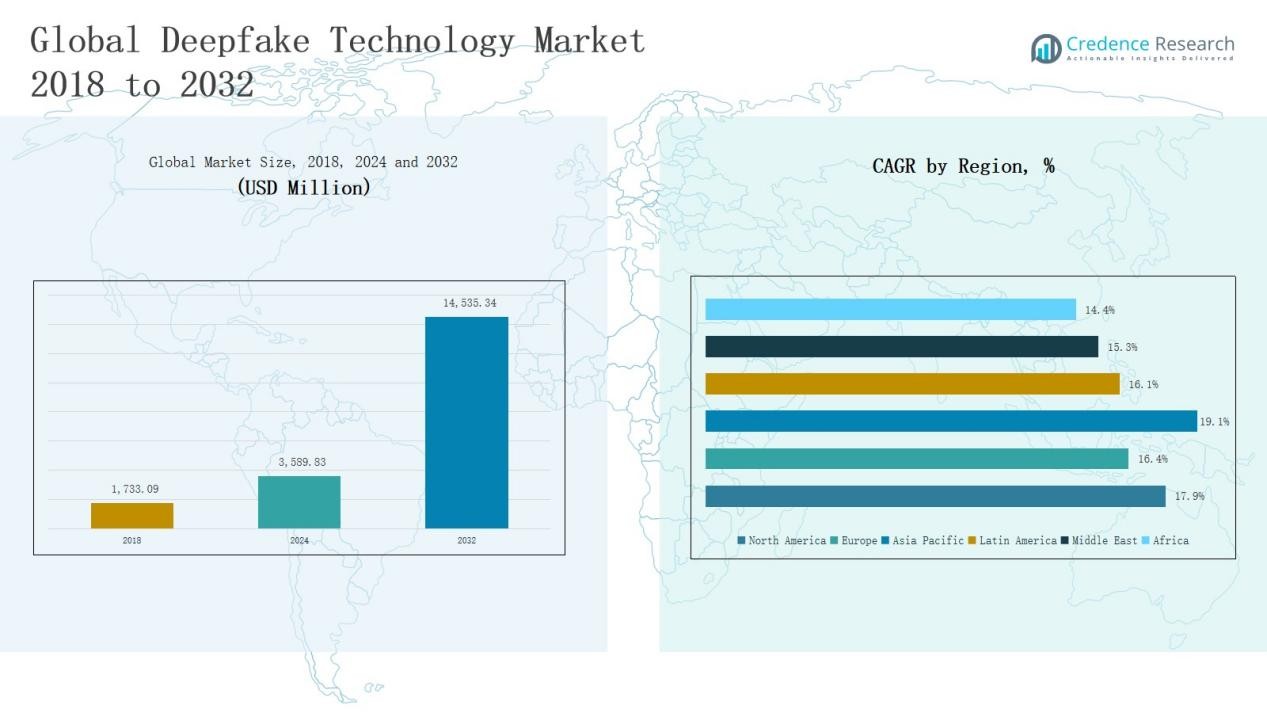
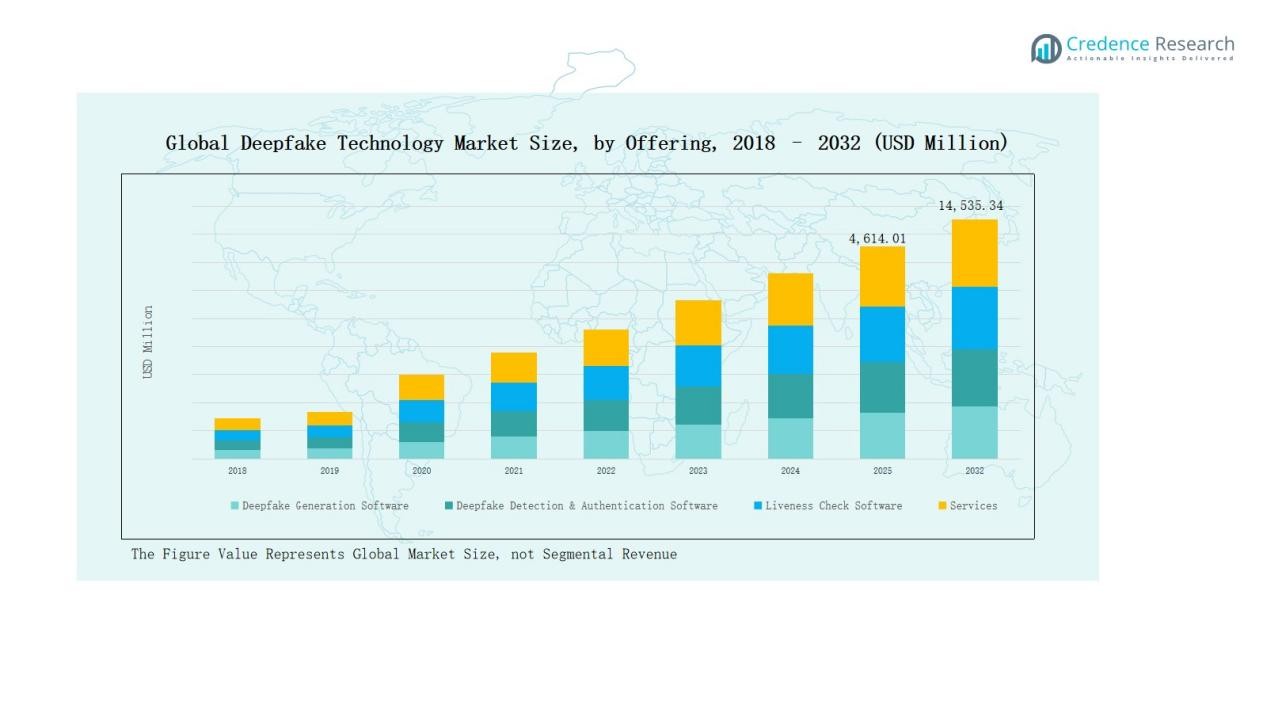
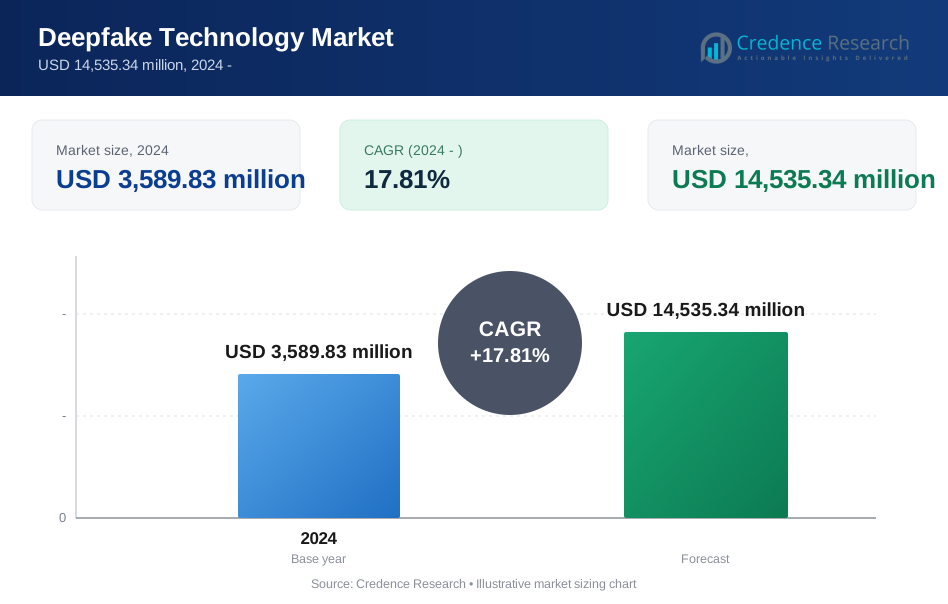
Deepfake Technology Market size was valued at USD 1,733.09 million in 2018 to USD 3,589.83 million in 2024 and is anticipated to reach USD 14,535.34 million by 2032, at a CAGR of 17.81% during the forecast period.
| REPORT ATTRIBUTE | DETAILS |
|---|---|
| Historical Period | 2020-2024 |
| Base Year | 2024 |
| Forecast Period | 2025-2032 |
| Deepfake Technology Market Size 2024 | USD 3,589.83 Million |
| Deepfake Technology Market, CAGR | 17.81% |
| Deepfake Technology Market Size 2032 | USD 14,535.34 Million |
The Deepfake Technology Market is shaped by a mix of global tech leaders and specialized innovators. Major companies such as Microsoft, Google (Alphabet), Meta, and Adobe dominate through advanced AI capabilities and integration of deepfake tools into enterprise solutions. Specialized firms including Deeptrace (Sensity AI), Reality Defender, Truepic, DeepBrain AI, Zao, and Synthesia focus on niche areas like detection, authentication, and synthetic media generation, providing agility and innovation in the competitive landscape. Among regions, North America emerged as the leader with a 37% market share in 2024, supported by a strong AI ecosystem, enterprise adoption, and significant government investment in detection and cybersecurity technologies.
Market Insights
- The Deepfake Technology Market grew from USD 1,733.09 million in 2018 to USD 3,589.83 million in 2024, and is expected to reach USD 14,535.34 million by 2032.
- Deepfake generation software led with 46% share in 2024, driven by rising use in entertainment, social media, and marketing campaigns for creating realistic and personalized content.
- Generative Adversarial Networks (GANs) accounted for 41% share in 2024, remaining the backbone for synthetic content creation, while transformer models gain momentum for real-time voice and video synthesis.
- Enterprises dominated with 49% share in 2024, leveraging deepfake tools for marketing, e-learning, customer engagement, and simulations, with government agencies emerging as a key secondary segment.
- North America led with 37% share in 2024, followed by Asia Pacific at 26% and Europe at 15%, while Latin America, the Middle East, and Africa collectively represented 22% of the global market.
Market Segment Insights
By Offering
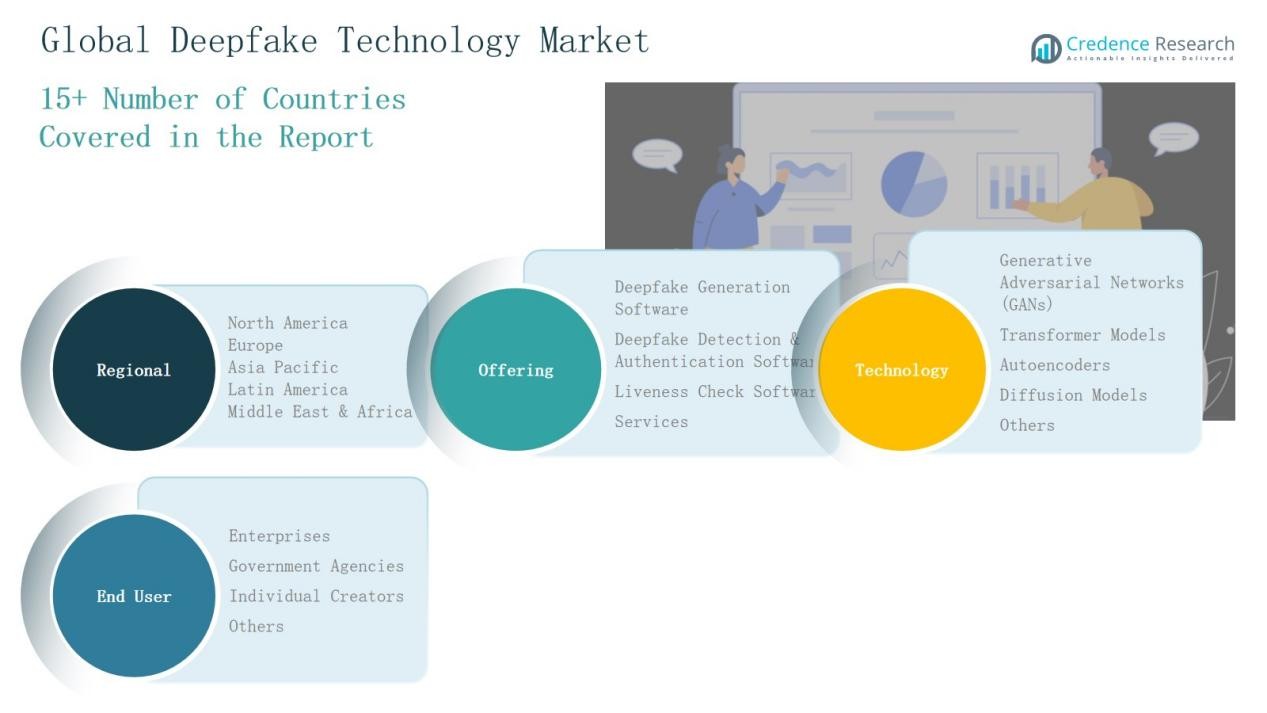
Deepfake generation software dominated the market with a 46% share in 2024. The segment’s growth is driven by rising adoption in entertainment, social media, and marketing campaigns for creating hyper-realistic content. Increasing accessibility of open-source platforms and demand for personalized video content further strengthen its dominance. Detection and authentication software is expanding steadily as organizations invest in tools to combat misinformation and fraud.
- For instance, DeepFaceLab, an open-source tool widely adopted by creators, has become one of the most downloaded frameworks for training deepfake models.
By Technology
Generative Adversarial Networks (GANs) led the technology segment with a 41% share in 2024. GANs remain the backbone of most deepfake applications due to their ability to create highly convincing synthetic images and videos. Their scalability and integration into cloud-based AI platforms drive wider usage across industries. Transformer models are gaining traction, especially for real-time voice and video synthesis, highlighting strong growth potential.
- For insatnce, NVIDIA's StyleGAN3 can generate hyper-realistic faces and has been used in creative fields for virtual avatars, but it functions more as a research tool and foundational technology rather than a widely adopted, out-of-the-box solution.
By End User
Enterprises accounted for the largest share, holding 49% of the market in 2024. Businesses leverage deepfake tools for marketing, customer engagement, training simulations, and virtual assistants. The surge in demand for synthetic media in advertising and e-learning platforms fuels enterprise adoption. Government agencies are increasingly investing in detection technologies to address national security and cybersecurity risks, marking them as a critical secondary segment.
Key Growth Drivers
Rising Adoption in Entertainment and Marketing
The entertainment and marketing industries are driving deepfake technology adoption with innovative applications. Studios and brands increasingly use synthetic media for personalized content, dubbing, and advertising campaigns, reducing production costs and timelines. Demand for immersive experiences and consumer engagement fuels investment in generation software. Global streaming platforms and gaming companies are exploring AI-based avatars and visual effects, accelerating usage. These factors collectively strengthen the role of deepfake solutions as a mainstream tool in creative industries, ensuring consistent revenue growth across this segment.
- For instance, Metaphysic partnered with Creative Artists Agency (CAA) to provide generative AI and face‑swap tools for talent in film, TV, and branded content, enabling more flexible production workflows.
Increasing Demand for Cybersecurity and Fraud Detection
The rise in digital fraud, misinformation, and identity manipulation is boosting demand for deepfake detection tools. Governments, financial institutions, and enterprises are prioritizing investments in authentication and liveness check software. Solutions that verify digital identities and detect manipulated content are gaining prominence in banking, e-commerce, and regulatory sectors. This growing need to safeguard systems from reputational and financial risks accelerates the adoption of AI-driven monitoring solutions. The increasing reliance on digital services and stricter compliance standards further reinforce the significance of detection technologies.
- For instance, Intel’s FakeCatcher technology, unveiled in 2022, detects deepfakes in real time with 96% accuracy by analyzing subtle blood flow changes in pixels.
Advancements in AI and Computing Infrastructure
Continuous advancements in artificial intelligence, cloud computing, and machine learning frameworks are enhancing deepfake technology. Improved training models, particularly GANs and transformer architectures, are enabling more realistic and faster synthetic content creation. Accessible open-source libraries and scalable cloud platforms reduce barriers to adoption for individuals and small enterprises. High-performance GPUs and AI accelerators provide the computational power required for real-time applications. These advancements not only broaden use cases but also expand opportunities for innovation across industries, strengthening overall market growth.
Key Trends & Opportunities
Expansion of Enterprise Applications
Enterprises are adopting deepfake tools for training, advertising, and customer interaction. Virtual assistants and digital avatars powered by synthetic media improve engagement while lowering operational costs. E-learning platforms are leveraging deepfakes for localized and interactive training material. Opportunities also exist in corporate communication, where AI-driven content enhances brand outreach. With enterprises accounting for nearly half of the market share, demand for enterprise-focused solutions will continue rising, making this segment one of the most lucrative opportunities for vendors.
- For instance, BMW used a hyper-realistic digital avatar in its CES 2023 showcase to present vehicle features through an interactive AI assistant.
Growth of Regulatory and Ethical Frameworks
The rapid spread of deepfakes has prompted governments and global organizations to establish ethical standards and regulatory frameworks. These initiatives create opportunities for companies providing detection, authentication, and compliance solutions. As regulations mandate monitoring tools in sectors like media, finance, and security, adoption of responsible deepfake technologies will accelerate. Vendors that align their offerings with transparency and ethical AI practices will benefit from increasing trust. This regulatory momentum represents a long-term growth opportunity in building safe and accountable ecosystems.
- For instance, Adobe’s Content Authenticity Initiative (CAI), backed by partners like The New York Times and Twitter, is embedding provenance and attribution metadata to ensure transparency in digital media.
Key Challenges
Ethical Concerns and Misuse Risks
The misuse of deepfake technology for spreading misinformation, creating fake identities, or producing malicious content remains a major challenge. Growing concerns around privacy violations, political manipulation, and reputational harm have triggered global debate. The lack of clear ownership rights over synthetic content further complicates the issue. Companies face significant reputational risks if their tools are linked to unethical practices. Addressing these challenges requires strong safeguards, transparent frameworks, and cross-industry collaboration to ensure responsible development and deployment.
High Computational and Resource Requirements
Deepfake creation and detection technologies demand significant computing power, advanced GPUs, and storage capacity. These requirements raise costs for both enterprises and individual users, limiting adoption in resource-constrained regions. Training large AI models consumes vast energy, adding to environmental concerns and operational expenses. Smaller organizations struggle to compete with tech giants that dominate the infrastructure landscape. This challenge slows down scalability and increases entry barriers, requiring innovation in cost-efficient algorithms and optimized computing solutions.
Regulatory Uncertainty and Legal Risks
The absence of globally consistent regulations on deepfake usage and ownership poses risks for technology providers. While some regions enforce strict compliance measures, others lack clear frameworks, creating uncertainty for businesses. This fragmented regulatory environment complicates global expansion and adoption strategies. Companies face potential liabilities if their solutions are misused in jurisdictions with evolving laws. Developing flexible compliance approaches and proactive legal safeguards will be crucial for vendors to sustain growth in a rapidly shifting legal landscape.
Regional Analysis
North America
North America dominated the deepfake technology market with a 37% share in 2024, supported by its advanced AI ecosystem and strong adoption across media, entertainment, and cybersecurity sectors. The U.S. remains the largest contributor, driven by heavy investment from tech giants and government initiatives to combat misinformation. The region’s market size grew from USD 750.83 million in 2018 to USD 1,538.96 million in 2024, and it is expected to reach USD 6,248.73 million by 2032, expanding at a CAGR of 17.9%. Demand for detection and authentication tools continues to rise, ensuring sustained market leadership.
Europe
Europe accounted for a 15% share of the global market in 2024, driven by regulatory focus and adoption in creative industries. Countries such as Germany, the UK, and France are investing in both generation and detection technologies, with strong emphasis on ethical AI practices. The market grew from USD 326.61 million in 2018 to USD 639.81 million in 2024, with projections to reach USD 2,358.05 million by 2032, at a CAGR of 16.4%. Europe’s regulatory push and cultural adoption of AI-generated content make it a critical region for balanced growth.
Asia Pacific
Asia Pacific emerged as the fastest-growing region, holding a 26% share in 2024. Growth is fueled by rapid digital adoption, large user bases in China and India, and investments in AI infrastructure. Media, gaming, and social media applications drive demand, while governments in countries like Japan and South Korea explore deepfake detection for security. The regional market expanded from USD 498.19 million in 2018 to USD 1,089.84 million in 2024, with forecasts of USD 4,814.56 million by 2032, reflecting a CAGR of 19.1%. Strong technology ecosystems ensure Asia Pacific remains the leading growth hub.
Latin America
Latin America captured a 9% share of the global market in 2024, with Brazil and Mexico leading adoption. Entertainment, social media engagement, and political monitoring applications drive market growth. Increasing demand for fraud detection tools also adds momentum. The market expanded from USD 83.79 million in 2018 to USD 171.44 million in 2024, and it is expected to reach USD 616.27 million by 2032, at a CAGR of 16.1%. While adoption is moderate compared to other regions, digital transformation and expanding AI investments position Latin America for steady long-term growth.
Middle East
The Middle East held a 7% share in 2024, with GCC countries and Israel driving adoption. Rising demand for AI-based surveillance, fraud prevention, and media applications supports market growth. Investments in advanced technologies are accelerating regional development, particularly in digital identity verification. The market increased from USD 47.57 million in 2018 to USD 89.90 million in 2024, with expectations to reach USD 305.87 million by 2032, reflecting a CAGR of 15.3%. Strong government support for digital innovation enhances adoption across security and enterprise applications.
Africa
Africa represented the smallest market with a 6% share in 2024, but it shows gradual growth due to rising internet penetration and smartphone adoption. Applications in political monitoring, education, and fraud prevention are emerging as key use cases. The market grew from USD 26.10 million in 2018 to USD 59.88 million in 2024, with projections to reach USD 191.87 million by 2032, at a CAGR of 14.4%. Limited infrastructure and high costs remain challenges, yet rising digital adoption positions Africa as an emerging opportunity for long-term development.
Market Segmentations:
By Offering
- Deepfake Generation Software
- Deepfake Detection & Authentication Software
- Liveness Check Software
- Services
By Technology
- Generative Adversarial Networks (GANs)
- Transformer Models
- Autoencoders
- Diffusion Models
- Others
By End User
- Enterprises
- Government Agencies
- Individual Creators
- Others
By Region
North America
- U.S.
- Canada
- Mexico
Europe
- UK
- France
- Germany
- Italy
- Spain
- Russia
- Rest of Europe
Asia Pacific
- China
- Japan
- South Korea
- India
- Australia
- Southeast Asia
- Rest of Asia Pacific
Latin America
- Brazil
- Argentina
- Rest of Latin America
Middle East
- GCC Countries
- Israel
- Turkey
- Rest of Middle East
Africa
- South Africa
- Egypt
- Rest of Africa
Competitive Landscape
The deepfake technology market is moderately consolidated, with global tech giants and specialized startups shaping competition. Leading players such as Microsoft, Google (Alphabet), Meta, and Adobe dominate through advanced AI research, strong financial resources, and integration of deepfake tools into enterprise solutions. Specialized firms like Deeptrace (Sensity AI), Reality Defender, Truepic, and Synthesia focus on niche applications, particularly in detection, authentication, and content generation, offering agile innovation. Companies are actively pursuing strategic partnerships, product launches, and regulatory collaborations to strengthen their market positions. Startups in Asia Pacific, including DeepBrain AI and Zao, are expanding rapidly, leveraging strong regional adoption in social media and entertainment. Competition is further influenced by the dual demand for generation and detection solutions, creating both growth opportunities and reputational risks. Vendors that align with ethical AI practices, regulatory compliance, and enterprise-focused solutions are expected to gain a sustainable edge in this evolving landscape.
Key Players
- Microsoft
- Google (Alphabet)
- Meta (Facebook)
- Adobe Inc.
- Deeptrace (Sensity AI)
- Reality Defender
- DeepBrain AI
- Zao
- Truepic
- Synthesia
Recent Developments
- In April 2025, Accops partnered with pi-labs to integrate facial authentication with AI-based deepfake detection, strengthening real-time fraud prevention.
- In July 2025, Reality Defender launched a public API and free tier, giving developers enterprise-grade deepfake detection tools.
- In August 2025, Innovatrics launched a new deepfake-detection feature. The tool works via API and pairs with their biometric liveness and injection-attack detection systems.
- In early August 2025, Reality Defender struck a deal with ActiveFence. This allowed ActiveFence clients to detect deepfake video, audio, image, and text content via Reality Defender’s API.
Report Coverage
The research report offers an in-depth analysis based on Offering, Technology, End User and Region. It details leading market players, providing an overview of their business, product offerings, investments, revenue streams, and key applications. Additionally, the report includes insights into the competitive environment, SWOT analysis, current market trends, as well as the primary drivers and constraints. Furthermore, it discusses various factors that have driven market expansion in recent years. The report also explores market dynamics, regulatory scenarios, and technological advancements that are shaping the industry. It assesses the impact of external factors and global economic changes on market growth. Lastly, it provides strategic recommendations for new entrants and established companies to navigate the complexities of the market.
Future Outlook
- Enterprises will increasingly adopt deepfake tools for marketing, training, and customer engagement.
- Detection and authentication solutions will see rising demand from governments and financial institutions.
- Advancements in AI models will enhance content realism and reduce generation time.
- Social media platforms will strengthen integration of detection systems to counter misinformation.
- Regulatory frameworks will become stricter, driving adoption of compliance-focused solutions.
- Gaming and entertainment industries will expand use of deepfakes for immersive experiences.
- Voice-based deepfakes will gain traction in virtual assistants and customer service applications.
- Cloud-based platforms will make deepfake tools more accessible to small and mid-sized enterprises.
- Ethical AI practices will play a critical role in building consumer and enterprise trust.
- Regional startups, particularly in Asia Pacific, will emerge as strong innovation drivers.
Request a Free Sample
Fill in your details and we'll send you a free sample report.
- Sample data tables & charts
- Research methodology
Need a Custom Version of This Report?
Tailor the scope, geography, or segments to your exact requirements.
- Custom geography or segment scope
- Direct access to our analyst team
Frequently Asked Questions
What is the current market size for the Deepfake Technology Market, and what is its projected size in 2032?
At what Compound Annual Growth Rate is the Deepfake Technology Market projected to grow between 2025 and 2032?
Which Deepfake Technology Market segment held the largest share in 2024?
What are the primary factors fueling the growth of the Deepfake Technology Market?
Who are the leading companies in the Deepfake Technology Market?
Which region commanded the largest share of the Deepfake Technology Market in 2024?
Table of Content
Chapter 1. Report Introduction
- 1.1 Report Description & Purpose
- 1.1.1 Report Title & Market Definition
- 1.1.2 Unique Selling Propositions (USP) & Key Differentiators
- 1.1.3 Value Proposition for Stakeholders
- 1.2 Research Objectives
- 1.2.1 Market Sizing Objectives (Volume & Revenue)
- 1.2.2 Segmentation Objectives
- 1.2.3 Competitive Intelligence Objectives
- 1.2.4 Forecast & Scenario Objectives
- 1.3 Report Scope
- 1.3.1 Deepfake Technology Scope – Types & Subtypes Covered
- 1.3.2 Geographic Scope – Regions & Countries Covered
- 1.3.3 Historical Period, Base Year & Forecast Period (2024; forecast to the forecast period)
- 1.3.4 Inclusions & Exclusions
- 1.4 HS Code & Classification Framework
- 1.5 Currency, Units & Pricing Basis
- 1.6 Target Stakeholders
- 1.7 Limitations & Assumptions
Chapter 2. Executive Summary
- 2.1 Global Deepfake Technology Market Snapshot
- 2.1.1 Market Size – Historical (2024) & Forecast (the forecast period) (2024: USD 3,589.83 million → forecast year: USD 14,535.34 million)
- 2.1.2 Volume & Revenue – Global Totals
- 2.1.3 Key Market Highlights – Top Five Facts
- 2.2 Deepfake Technology Market Segmentation Snapshot
- 2.2.1 Market Split by Region – 2024 vs.
- 2.3 Competitive Snapshot
- 2.3.1 Top 10 Players by Revenue Share – 2024
- 2.3.2 Top 10 Players by Volume Share – 2024
- 2.3.3 Recent Strategic Developments (18-Month Summary)
- 2.4 Key Investment Highlights & Strategic Conclusions
Chapter 3. Deepfake Technology Market Dynamics & Industry Analysis
- 3.1 Market Overview & Context
- 3.1.1 Deepfake Technology Market Position in the Broader Automotive Value Chain
- 3.1.2 OEM vs. Replacement Market Dynamics
- 3.1.3 Market Maturity & Development Stage by Region
- 3.2 Deepfake Technology Market Drivers
- 3.3 Deepfake Technology Market Restraints & Challenges
- 3.4 Deepfake Technology Market Opportunities
- 3.5 Porter's Five Forces Analysis
- 3.5.1 Threat of New Entrants
- 3.5.2 Bargaining Power of Suppliers
- 3.5.3 Bargaining Power of Buyers
- 3.5.4 Threat of Substitutes
- 3.5.5 Competitive Rivalry – Intensity Assessment
- 3.6 Deepfake Technology Value Chain Analysis
- 3.6.1 Upstream – Raw Material/Input Suppliers
- 3.6.1.1 Raw Material/Input 1
- 3.6.1.2 Raw Material/Input 2
- 3.6.1.3 Raw Material/Input 3
- 3.6.2 Midstream – Production/Manufacturing/Service Delivery
- 3.6.2.1 Production/Process Overview
- 3.6.2.2 Key Facility Locations & Capacity by Manufacturer
- 3.6.3 Downstream – Distribution & End Consumer
- 3.6.3.1 Primary Channel – B2B/OEM
- 3.6.3.2 Secondary Channels – Dealer, Retail, Online, Direct
- 3.6.4 Value Chain Profitability Analysis
- 3.6.1 Upstream – Raw Material/Input Suppliers
- 3.7 PESTEL Analysis
- 3.7.1 Political Factors
- 3.7.2 Economic Factors
- 3.7.3 Social Factors
- 3.7.4 Technological Factors
- 3.7.5 Environmental Factors
- 3.7.6 Legal Factors
- 3.8 Deepfake Technology Supply Chain Analysis
- 3.8.1 Raw Material/Input Supply Risk Assessment
- 3.8.2 Manufacturing Concentration Risk (Geographic Exposure)
- 3.8.3 Trade Disruption Impact Analysis
- 3.9 Regulatory & Policy Landscape
Note: The regulatory and policy landscape section covers regulations based on their applicability to the market, Deepfake Technology category, geography, and scope of the study. Only regulatory frameworks with a material impact on operations, compliance, trade, sustainability, or market access are analyzed in detail.
Chapter 4. Key Investment Pockets & Opportunity Analysis
- 4.1 Deepfake Technology Market Attractiveness Analysis
- 4.1.1 By Region – Investment Attractiveness Matrix (Volume × CAGR)
- 4.2 Absolute Revenue Growth Opportunity
- 4.2.1 By Region – Absolute USD Growth Through the forecast period
- 4.3 Incremental Volume Opportunity
- 4.3.1 By Region – Incremental Volume Through the forecast period
- 4.3.2 Segment – Incremental Volume
- 4.4 Emerging Submarket Opportunity Deep Dive (Subject to Applicability)
- 4.5 Emerging Market Opportunity Scorecards
- 4.5.1 United States
- 4.5.2 Europe
- 4.5.3 Asia
- 4.5.4 Middle East & Africa
Note: Emerging Market Opportunity Scorecards will be included based on relevance and strategic importance. Regions listed are indicative and may vary depending on data availability and market dynamics.
Chapter 5. Deepfake Technology Import-Export Analysis & Trade Flows
- 5.1 Global Trade Overview
- 5.1.1 Global Export Value by Country (2024)
- 5.1.2 Global Export Volume by Country (2024)
- 5.1.3 Global Import Value by Country (2024)
- 5.1.4 Global Import Volume by Country (2024)
- 5.1.5 Net Trade Balance by Country (2024)
- 5.2 Export Analysis – Segment
- 5.2.1 Type 1 (HS Code)
- 5.2.2 Type 2 (HS Code)
- 5.2.3 Type 3 (HS Code)
- 5.2.4 Type 4 (HS Code)
- 5.2.5 Type 5 (HS Code)
- 5.3 Import Analysis – Segment
- 5.3.1 Type 1 (HS Code)
- 5.3.2 Type 2 (HS Code)
- 5.3.3 Type 3 (HS Code)
- 5.3.4 Type 4 (HS Code)
- 5.3.5 Type 5 (HS Code)
- 5.4 Average Unit Trade Prices
- 5.4.1 Average Export Price – Segment & Country
- 5.4.2 Average Import Price – Segment & Source Country
- 5.4.3 Price Trends (2024)
- 5.5 Key Trade Route Analysis
- 5.5.1 Trade Route 1
- 5.5.2 Trade Route 2
- 5.5.3 Trade Route 3
- 5.5.4 Trade Route 4
- 5.5.5 Trade Route 5
- 5.6 Trade Policy Impact Assessment
- 5.6.1 US Anti-Dumping & Section 301 Tariffs
- 5.6.2 EU Customs Union Impact
- 5.6.3 Major Free Trade Agreements
- 5.6.4 USMCA Rules of Origin
Note: Trade policy analysis will be included only where relevant to the Deepfake Technology market.
Chapter 6. Competitive Landscape & Company Benchmarking
- 6.1 Deepfake Technology Market Concentration & Structure
- 6.1.1 Herfindahl-Hirschman Index (HHI) – vs. 2024
- 6.1.2 Tier 1, Tier 2 & Tier 3 Market Structure
- 6.1.3 Global, Regional & Local Player Dynamics
- 6.2 Deepfake Technology Market Share Analysis – 2024
- 6.2.1 Global Revenue Share by Company
- 6.2.2 Global Volume Share by Company
- 6.2.3 Regional Revenue Share
- 6.2.4 Market Share Evolution ( vs. 2024)
- 6.2.5 OEM Segment Share by Company
- 6.2.6 Replacement Segment Share by Company
- 6.3 Production/Delivery Capacity & Facility Analysis
- 6.3.1 Global Installed Capacity
- 6.3.2 Capacity Utilization Rates
- 6.3.3 Production/Output Volume
- 6.3.4 Facility Locations & Capacity Map
- 6.3.5 Planned Capacity Additions
- 6.4 Deepfake Technology Competitive Benchmarking Matrix
- 6.4.1 Revenue, Volume, CAGR & Profitability Comparison
- 6.4.2 Channel Revenue Mix
- 6.4.3 Geographic Revenue Exposure
- 6.4.4 R&D Intensity
- 6.4.5 Sustainability Maturity
- 6.5 Strategic Developments in Deepfake Technology (Last 24 Months)
- 6.5.1 Mergers, Acquisitions & Divestments
- 6.5.2 New Deepfake Technology Launches
- 6.5.3 Facility Expansions
- 6.5.4 Strategic Alliances, Joint Ventures & Partnerships
- 6.5.5 Distribution Expansion & Market Entry
- 6.5.6 Sustainability & ESG Initiatives
- 6.6 Competitive Strategy Mapping
- 6.6.1 Leader, Challenger, Follower & Niche Classification
- 6.6.2 Pricing Strategy Comparison
- 6.6.3 Channel Strategy Matrix
Note: Strategic developments are included based on their materiality and the availability of reliable information.
Chapter 7. Global Deepfake Technology Market – By Distribution Channel
- 7.1 Segment Overview
- 7.1.1 Volume & Revenue Split by Channel (2024 & )
- 7.1.2 Channel Mix Evolution (the forecast period)
Chapter 8. Regional Market Analysis – Global Overview
- 8.1 Global Regional Overview
- 8.1.1 Regional Volume Share
- 8.1.2 Regional Revenue Share
- 8.1.3 Regional Volume by Region
- 8.1.4 Regional Revenue by Region
- 8.1.5 Regional Forecast Through the forecast period
- 8.2 Cross-Regional Segment Analysis
- 8.2.1 By Distribution Channel
- 8.2.2 By Brand/Price Tier
Chapter 9. North America Deepfake Technology Market
- 9.1 United States
- 9.2 Canada
- 9.3 Mexico
Chapter 10. Europe Deepfake Technology Market
- 10.1 Germany
- 10.2 France
- 10.3 Italy
- 10.4 United Kingdom
- 10.5 Spain
- 10.6 Poland
- 10.7 Russia
- 10.8 Netherlands
- 10.9 Belgium
- 10.10 Sweden
- 10.11 Denmark
- 10.12 Norway
- 10.13 Rest of Europe
Chapter 11. Asia Pacific Deepfake Technology Market
- 11.1 China
- 11.2 India
- 11.3 Japan
- 11.4 South Korea
- 11.5 Thailand
- 11.6 Indonesia
- 11.7 Vietnam
- 11.8 Malaysia
- 11.9 Australia
- 11.10 Rest of Asia Pacific
Chapter 12. Latin America Deepfake Technology Market
- 12.1 Brazil
- 12.2 Argentina
- 12.3 Colombia
- 12.4 Chile
- 12.5 Rest of Latin America
Chapter 13. Middle East Deepfake Technology Market
- 13.1 Saudi Arabia
- 13.2 United Arab Emirates
- 13.3 Turkey
- 13.4 Israel
- 13.5 Iran
- 13.6 Rest of the Middle East
Chapter 14. Africa Deepfake Technology Market
- 14.1 South Africa
- 14.2 Egypt
- 14.3 Nigeria
- 14.4 Morocco
- 14.5 Rest of Africa
Chapter 15. Deepfake Technology Company Profiles
- 15.1 [Company 01]
- 15.1.1 Company Overview
- 15.1.2 Key Management Personnel
- 15.1.3 Products & Services Portfolio
- 15.1.4 Financial Performance
- 15.1.5 Key Market Focus & Geographic Presence
- 15.1.6 Recent Developments & Strategic Initiatives
Note: The company profile list is preliminary and may change based on research findings, market developments, data availability, and client requirements.
Chapter 16. Appendices
- Appendix A – List of Abbreviations & Acronyms
- Appendix B – Industry Classification Code Reference – Full Series
- Appendix C – Production & Capacity Data Tables
- Appendix D – End-Use & Demand Base Tables
- Appendix E – Consumption & Replacement Rate Assumptions
- Appendix F – ASP Reference Tables
- Appendix G – Manufacturing & Facility Database
- Appendix H – Import-Export Data Tables
- Appendix I – Regulatory Summary Tables
- Appendix J – Primary Research Participant List (Anonymized)
- Appendix K – Primary Research Questionnaire Framework
- Appendix L – Data Sources & Bibliography
- Appendix M – Market Size Divergence & Source Comparison
Chapter 17. Research Methodology
- 17.1 Research Framework & Philosophy
- 17.2 Secondary Research – Sources, Hierarchy & Data Extraction
- 17.3 Data Modeling – Bottom-Up & Top-Down Market Sizing
- 17.4 Primary Research – Stakeholder Framework, LOI & Sample Sizes
- 17.5 Forecast Methodology – Regression, Scenario & Sensitivity Analysis
- 17.6 Quality Control – Four-Layer Validation Framework
- 17.7 Limitations & Standard Assumptions
- 17.8 Disclaimer
