
| REPORT ATTRIBUTE | DETAILS |
|---|---|
| Historical Period | 2019-2022 |
| Base Year | 2023 |
| Forecast Period | 2024-2032 |
| Digital Signage Market Size 2023 | USD 18945.2 Million |
| Digital Signage Market, CAGR | 7.50% |
| Digital Signage Market Size 2032 | USD 36322.4 Million |
Market Insights
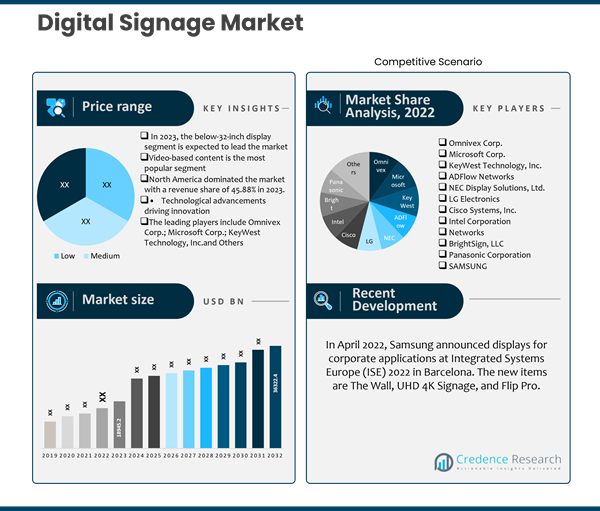
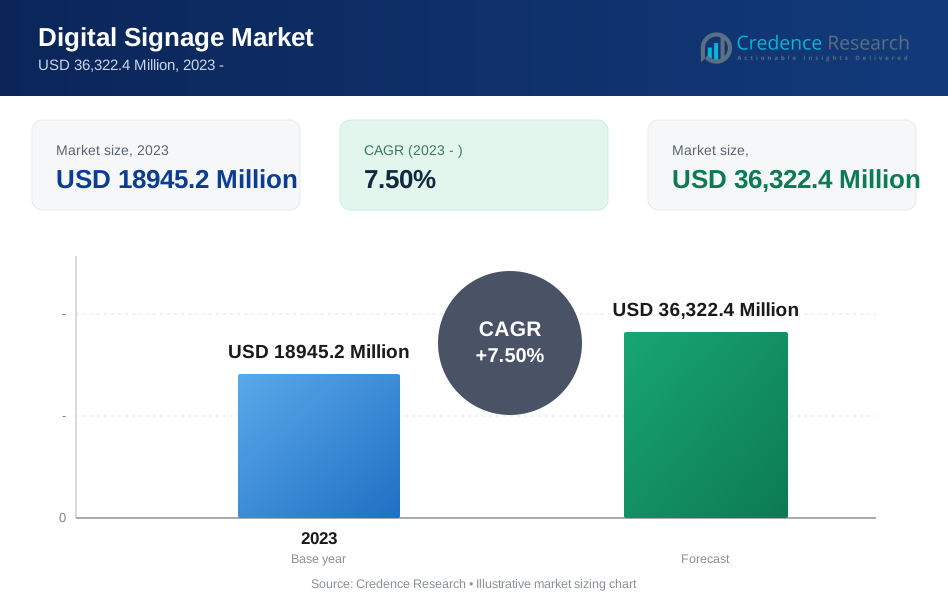
- The global demand for Digital Signage was valued at USD 18945.2 Million in 2023 and is expected to reach USD 36322.4 Million in 2032, growing at a CAGR of 7.50% between 2024 and 2032.
- In 2023, the video walls category had the largest market share of over 26%.
- In 2023, the hardware components category accounted for more than 57% of the market, while software is predicted to be the fastest-growing area over the forecast period.
- In 2023, the retail sector held the largest market share, with more than 19%, and the transportation segment is expected to be the fastest-growing.
- In 2023, the indoor location segment held the largest market share, with more than 71%, while demand from outdoor sites is expected to expand at the fastest CAGR throughout the projected period.
- In 2023, the LED sector had the largest market share, accounting for more than 47%.
- In 2023, the under-32-inch display category is likely to lead the market.
- The most frequent aspect ratio is 16:9.
- Video-based content is the most popular sector, while another key section is image/graphic-based content.
- North America dominated the market with a revenue share of 45.88% in 2023, while Europe's Digital Signage market has the second-largest market share. The Asia-Pacific Digital Signage Market is expected to grow at the fastest CAGR between 2023 and 2032.
Executive Summary
Market Definition
The Digital Signage Market is the industry that uses digital displays, such as LCD or LED panels, to offer dynamic multimedia content in various locations. These digital signs can be seen in public areas, retail businesses, restaurants, transportation hubs, and other locations. The market includes the hardware, software, and services used to create and manage digital signage networks. Digital signage is a modern and entertaining approach to deliver information, adverts, promotions, and other content to a specific audience. It has grown in popularity due to its capacity to captivate attention, efficiently communicate messages, and deliver real-time information.
Market Overview
The global Digital Signage Market has witnessed steady growth in recent years and is expected to grow at a CAGR of 7.50% between 2024 and 2032. The market was valued at USD 18945.2 million in 2023 and is expected to reach USD 36322.4 million in 2032.
The digital signage market is rising rapidly and is likely to continue doing so in the future years. It has become a popular and successful tool for businesses to communicate with their target audience while also conveying information in a dynamic and visually appealing manner.
The market is being driven by a variety of factors, including increased usage of digital signage in retail, transportation, hospitality, and healthcare. Many businesses prefer digital signage because it can give real-time information updates, targeted advertising, and interactive capabilities.
Technological improvements such as better resolution displays, touchscreens, and cloud-based content management systems have all helped to drive industry expansion. Businesses may now create and operate digital signage networks more easily thanks to technological improvements.
Segmentation by Type
- The video walls category held the greatest market share of more than 26% in 2023, and this trend is likely to continue throughout the forecast period. In 2022, the video screens and kiosks categories had the most market share, followed by the video screens segment. Video walls and screens have gained significant market share in shopping malls and other public spaces.
Segmentation by Component
- The hardware components segment held the biggest market share of more than 57% in 2023 and is expected to maintain that position throughout the forecast period. Displays, components used to create a digital panel, banners, and other items are examples of hardware components. In comparison to software, the hardware need is enormous, and as a result, the segment accounts for a significant portion of the business.
- On the other hand, Software is expected to be the fastest-expanding segment over the forecast period.
Segmentation by Application
- In 2023, the retail sector held the highest market share, with more over 19%. The retail industry is the most significant user of digitized advertisements for marketing and promoting items and services. The competition among retailers as a result of the industry's diverse product offers has raised awareness of efficient marketing methods.
- The transportation segment is predicted to be the fastest-growing, expanding at a CAGR of more than 9.8% throughout the forecast period.
Segmentation by Location
- In 2023, the indoor location segment held the greatest market share, with more than 71%. Digital posters are deployed in closed premises such as malls, corporate offices, retail stores, banks, and healthcare clinics.
- However, demand from outdoor locations is predicted to grow at the quickest CAGR over the projection period.
Segmentation by Technology
- In 2023, the LED sector held the greatest market share, accounting for more than 47%. LCD technology is one of the most widely used technologies in the advertising and marketing business.
Segmentation by Size
- In 2023, the below-32-inch display segment is expected to lead the market, accounting for 41% of total sales, attributable to the increased demand for this form of signage in the residential and retail sectors.
- Customers are drawn to 32 to 52-inch screen size digital signages due to rising disposable income and a need for high-quality content-watching experiences.
- The rapidly expanding transportation and advertising sectors will favorably contribute to the growth in demand for displays larger than 52 inches.
Segmentation by Aspect Ratio
- The most commonly used aspect ratio is 16:9. It is commonly used in televisions, monitors, and digital displays. It provides a widescreen format, which is ideal for displaying material.
Segmentation by Content Type
- Video-based content is the most popular segment in the digital signage market. People enjoy seeing dynamic and entertaining videos on displays.
- Another important section is image/graphic-based material. It enables businesses to display visually appealing graphics and images to attract attention.
Segmentation by Region
- North America dominated the market with a revenue share of 45.88% in 2023.
- Europe's Digital Signage market has the second-largest market share.
- The Asia-Pacific Digital Signage Market is predicted to develop at the quickest CAGR between 2023 and 2032
- The rest of the world, including Latin America, the Middle East, and Africa, supplies the remaining demand for Digital Signage.
The North American Digital Signage market dominates due to the growing presence of dedicated product providers and the increasing need for signage in the retail industry. Key market participants are increasing their research and development efforts in order to improve product quality. The government is taking steps to put digital signage in various offices to ensure a constant flow of information.
Europe's Digital Signage market has the second-largest market share due to the continuous development of the manufacturing industry and market players' significant investments in digitization. Furthermore, the German Digital Signage market had the biggest market share, while the UK Digital Signage industry was the fastest-growing in the European region.
On the other hand, the Asia-Pacific Digital Signage Market is expected to expand at the quickest CAGR between 2023 and 2032. This is due to increased adoption of digital signage systems in developing countries, as well as rising housing, commercial, and corporate trends. Furthermore, China's digital signage industry had the biggest market share, while India's digital signage market was the fastest expanding in the Asia-Pacific region.
Key Highlights of the Report
Type, Component, Application, Location, Type, Size, Aspect Ratio, Content Type, and Region segment of the global Digital Signage Market. In 2023, the below-32-inch display sector is predicted to lead the market, with the video walls and interior location components segment accounting for the largest market share. In addition, the most widely used aspect ratio is 16:9, and software is predicted to be the fastest-growing category during the forecast period. Also, video-based content is the most popular component, with North America leading the market growth.
The market's primary drivers are increasing need for dynamic and engaging customer experiences, growing usage of digital signage, and technological improvements. Furthermore, high initial investment and installation costs, privacy issues and data security hazards, and a lack of established metrics for analyzing the performance of digital signage campaigns are the main limitations of the market.
Nonetheless, The North American Digital Signage market is dominant due to the growing presence of dedicated product providers and the increased need for signage in the retail industry. Furthermore, Europe's Digital Signage market has the second-largest market share, while the Asia-Pacific Digital Signage Market is predicted to grow at the fastest CAGR between 2023 and 2032.
What Are The Main Drivers Of The Global Digital Signage Market?
One of the primary drivers of the Digital Signage Market is the growing desire for dynamic and engaging customer experiences. Businesses understand the value of capturing their audience and creating memorable encounters. Digital signage allows you to broadcast dynamic and visually appealing material that catches attention and increases customer engagement. Another factor is the expanding use of digital signs in a variety of industries, including retail and transportation. Businesses use digital signage to give real-time information, market their products and services, and create immersive experiences. This widespread use is boosting the market's growth.
What Are The Major Challenges Faced By The Global Digital Signage Market?
While the Digital Signage Market is experiencing growth, there are also some restraints to consider. One of the main restraints is the high initial investment and installation costs associated with implementing digital signage systems. This can be a barrier for smaller businesses or organizations with limited budgets. Privacy concerns and data security risks are another restraint. As digital signage networks collect and process customer data, there is a need to ensure proper data protection and privacy measures are in place. Addressing these concerns is crucial to maintain trust and comply with data protection regulations..
What Are The Growth Opportunities In The Global Digital Signage Market?
The Digital Signage Market also presents several opportunities for businesses. One opportunity lies in the integration of artificial intelligence (AI) and machine learning (ML) technologies. By leveraging AI and ML algorithms, businesses can deliver personalized content based on user preferences and behavior. This customization enhances the effectiveness of digital signage campaigns and improves the overall customer experience. Another opportunity is the expansion of digital signage networks in emerging markets. As economies grow and infrastructure develops, there is an increasing demand for digital signage solutions. Businesses can tap into these markets and establish a strong presence, offering their products and services to a new customer base.
Market Drivers
Growing Demand For 4K And 8K Monitors
Ultra-HD display resolutions such as 4K and 8K have grown in popularity as consumer behavior has changed. The 4K display makes the represented content on the display crisper and simpler to read, improving consumer contact. Upgrading from a full-HD monitor to a 4K or 8K resolution can provide considerable commercial benefits. It immediately captures the clients' attention, increasing the amount of potential customers for the firm. 4K monitors are adaptable, allowing businesses to manage the complex infrastructure. 8K resolution displays have a panel area of around 7 feet, a contrast ratio of 100,000:1, and a viewing angle of 176 degrees. The display supports up to 104 pixels per inch. It can be used by retailers to allow their customers to view small texts or details while standing close to the screen. The growing need for high-resolution screens is projected to fuel the digital signage market.
Market Restraints
High Cost Of Digital Signage
Despite the growing popularity of digital signage, few organizations are afraid to include it into their marketing and communication strategy. This concern arises mostly from the significant initial hardware cost required to implement digital signs. The pricing of monitors, media players, mounts, and networking equipment all add to the total hardware cost. Furthermore, charges for content generation vary according to the complexity and frequency of changes. Additionally, content management and scheduling features require software platforms or services. Subscription fees are used to pay for content development and management tools including software platforms and services. In addition, expenditures associated with installation and infrastructure, connectivity, maintenance and support, and power and energy consumption all contribute to the high cost of digital signage installation and maintenance, slowing market growth.
Opportunities
Increasing Prevalence Of Diabetes Worldwide
There is an increasing prevalence of diabetes internationally, especially in developing economies as China, and India. Several factors, including rapid urbanization and an increase in sedentary lifestyles, particularly in developing nations, have contributed to the rapidly rising prevalence of diabetes. The International Diabetes Federation estimated that over 425 million adults had diabetes in 2017, with the figure expected to climb to approximately 630 million by 2045.
According to these research, China, India, the United States, Brazil, and Mexico account for approximately 55.0% to 60.0% of the global diabetes population. China and India today account for around 44.0% of the world's diabetic population. Other factors, such as obesity and a lack of understanding about the disease, particularly in emerging nations, are contributing to the rising incidence and prevalence of diabetes.
For instance, the World Health Organization (WHO) estimates that 1.9 billion persons worldwide were overweight in 2016, with 650 million of them obese.
Rising obesity, combined with an increasing number of diabetic patients, is expected to fuel demand for diabetes treatment, driving the expansion of the diabetes management devices market throughout the forecast period.
Competitive Landscape
Key Players
The global Digital Signage Market is highly competitive, with several key players. Some of the major players in the market and their market share are as follows:
- Omnivex Corp.
- Microsoft Corp.
- KeyWest Technology, Inc.
- ADFlow Networks
- NEC Display Solutions, Ltd.
- LG Electronics
- Cisco Systems, Inc.
- Intel Corporation
- BrightSign, LLC
- Panasonic Corporation
- SAMSUNG
- Scala
These organizations prioritize product innovation, Application expansion, and mergers and acquisitions to stay competitive. The global Digital Signage Market's key players continually seek to stay ahead by offering new products and developments.
- In May 27, 2025, ScreenCom BV completed its merger with Blue and Red BV, with the unified company operating as ScreenCom Group and positioning itself as an integrated digital signage + workspace optimization provider.
- In May 2025, ScreenCom Group said it will combine stacks including Samsung MagicINFO and Samsung VXT with TEOS and TDM technologies as part of a “single-source solution” approach.
- In Jan 31, 2024, Samsung announced the global availability of its VXT (Visual eXperience Transformation) digital signage platform at ISE 2024.
Summary of Key Findings
- The rising global prevalence of diabetes is generating demand for monitoring and treatment technologies.
- Type, Component, Application, Location, type, Size, Aspect Ratio, Content Type, and region segment the market.
- The most widely used aspect ratio is 16:9.
- In 2023, the video wall category had the highest market share of more than 26%.
- North America is leading market growth.; the market is highly competitive with key players including Omnivex Corp.; Microsoft Corp.; KeyWest Technology, Inc.; ADFlow Networks and Others.
Future Outlook
- Continued growth and expansion
- Increasing adoption in various industries
- Technological advancements driving innovation
- Rising demand for digital out-of-home advertising
- Enhanced customer engagement and brand visibility
- Targeted messaging and real-time content updates
How CXOs Can Benefit from the Credence Research Digital Signage Market Report
The Credence Research Digital Signage Market Report provides CXOs with a comprehensive overview of the market, including:
- Market size and growth forecast: The report provides detailed estimates of the global Digital Signage Market size, segmented by Type, Component, Application, Location type, Size, Aspect Ratio, Content Type, and region. It also includes forecasts for the market through 2032 based on key trends and drivers.
- Market segmentation: The report segments the Digital Signage Market by Type, Component, Application, Location, type, Size, Aspect Ratio, Content Type, and Region. This segmentation provides CXOs with a granular understanding of the market and the opportunities in each segment.
- Competitive Landscape: The report profiles the key players in the Digital Signage Market and provides insights into their strategies, product offerings, and financial performance. This information can help CXOs to identify and assess their competition.
- Key trends and drivers: The report identifies and analyzes the key trends and drivers that are shaping the Digital Signage Market. This information can help CXOs to make informed decisions about their investments and strategies.
CXOs can use the insights from the Credence Research Digital Signage Market Report to:
- Identify growth opportunities: The report can help CXOs to identify new growth opportunities in the Digital Signage Market. For example, it can provide insights into emerging trends, market dynamics, and competitive landscapes.
- Make informed investment decisions :The report can help CXOs make informed investment decisions about Digital Signage. For example, it provides market analysis and insights into key players, market trends, and growth opportunities.
- Develop competitive strategies: The report can help CXOs develop competitive strategies for their Digital Signage businesses. It provides insights on market trends, customer preferences, and competitor analysis.
- Track market developments: The report can help CXOs monitor market developments and stay ahead of the curve. For example, it provides insights into the latest trends and innovations in the Digital Signage Market.
Overall, the Credence Research Digital Signage Market Report is a valuable resource for CXOs who are looking to gain a deeper understanding of the market and identify opportunities for growth.
Segmentation
By Type:
- Video Walls
- Digital Posters
- Kiosks
- Billboards
- Menu Boards
- Interactive Displays
- Others
By Component:
- Hardware
- Displays (LED, LCD, OLED, etc.)
- Media Players
- Mounts and Installation Components
- Others
- Software
- Content Management Software (CMS)
- Edge Server Software
- Others
- Services
- Installation and Maintenance
- Content Creation and Management
- Others
By Aspect Ratio:
- Retail
- Healthcare
- Transportation
- Hospitality
- Education
- Corporate
- Sports and Entertainment
- Banking and Finance
- Others
By Location:
- Indoor Digital Signage
- Outdoor Digital Signage
By Technology:
- LCD (Liquid Crystal Display)
- LED (Light Emitting Diode)
- Projection
- E-Paper
By Size:
- Below 32 Inches
- 32 to 52 Inches
- Above 52 Inches
By Aspect Ratio:
- 16:9
- 16:10
- 4:3
- Others
By Content Type:
- Text-Based Content
- Image/Graphic-Based Content
- Video-Based Content
- Interactive Content
By Region
- North America
- US
- Canada
- Mexico
- Europe
- Germany
- France
- UK
- Italy
- Spain
- Rest of Europe
- Asia Pacific
- China
- Japan
- India
- South Korea
- South-east Asia
- Rest of Asia Pacific
- Latin America
- Brazil
- Argentina
- Rest of Latin America
- Middle East & Africa
- GCC Countries
- South Africa
- Rest of the Middle East and Africa
Adjacent Markets
In the Digital Signage Market, several adjacent markets have high revenue growth opportunities. The key adjacent markets for Digital Signage Market –
Adjacent Markets |
||
| Video Wall Market | Digital Menu Board Market | Interactive Kiosk Market |
| Retail Analytics Market | Smart Cities Market | Digital Out-of-Home (DOOH) Advertising Market |
| Augmented Reality (AR) Market | Outdoor Advertising Market | Content Management System (CMS) Market |
Request a Free Sample
Fill in your details and we'll send you a free sample report.
- Sample data tables & charts
- Research methodology
Need a Custom Version of This Report?
Tailor the scope, geography, or segments to your exact requirements.
- Custom geography or segment scope
- Direct access to our analyst team
Frequently Asked Questions
What is the current size of the global Digital Signage Market?
What is the expected growth rate of the Digital Signage Market between 2024 and 2032?
Which segment is leading the market share in terms of Location?
Which Aspect Ratio segment governs the demand for Digital Signage in the world?
Which Component segment is expected to post the fastest growth during the forecastperiod?
Which region is fueling the growth of the Digital Signage industry?
Table of Content
Chapter 1. Report Introduction
- 1.1 Report Description & Purpose
- 1.1.1 Report Title & Market Definition
- 1.1.2 Unique Selling Propositions (USP) & Key Differentiators
- 1.1.3 Value Proposition for Stakeholders
- 1.2 Research Objectives
- 1.2.1 Market Sizing Objectives (Volume & Revenue)
- 1.2.2 Segmentation Objectives
- 1.2.3 Competitive Intelligence Objectives
- 1.2.4 Forecast & Scenario Objectives
- 1.3 Report Scope
- 1.3.1 Digital Signage Scope – Types & Subtypes Covered
- 1.3.2 Geographic Scope – Regions & Countries Covered
- 1.3.3 Historical Period, Base Year & Forecast Period (2023; forecast to the forecast period)
- 1.3.4 Inclusions & Exclusions
- 1.4 HS Code & Classification Framework
- 1.5 Currency, Units & Pricing Basis
- 1.6 Target Stakeholders
- 1.7 Limitations & Assumptions
Chapter 2. Executive Summary
- 2.1 Global Digital Signage Market Snapshot
- 2.1.1 Market Size – Historical (2023) & Forecast (the forecast period) (2023: USD 18945.2 Million → forecast year: USD 36,322.4 Million)
- 2.1.2 Volume & Revenue – Global Totals
- 2.1.3 Key Market Highlights – Top Five Facts
- 2.2 Digital Signage Market Segmentation Snapshot
- 2.2.1 Market Split by Region – 2023 vs.
- 2.3 Competitive Snapshot
- 2.3.1 Top 10 Players by Revenue Share – 2023
- 2.3.2 Top 10 Players by Volume Share – 2023
- 2.3.3 Recent Strategic Developments (18-Month Summary)
- 2.4 Key Investment Highlights & Strategic Conclusions
Chapter 3. Digital Signage Market Dynamics & Industry Analysis
- 3.1 Market Overview & Context
- 3.1.1 Digital Signage Market Position in the Broader Automotive Value Chain
- 3.1.2 OEM vs. Replacement Market Dynamics
- 3.1.3 Market Maturity & Development Stage by Region
- 3.2 Digital Signage Market Drivers
- 3.3 Digital Signage Market Restraints & Challenges
- 3.4 Digital Signage Market Opportunities
- 3.5 Porter's Five Forces Analysis
- 3.5.1 Threat of New Entrants
- 3.5.2 Bargaining Power of Suppliers
- 3.5.3 Bargaining Power of Buyers
- 3.5.4 Threat of Substitutes
- 3.5.5 Competitive Rivalry – Intensity Assessment
- 3.6 Digital Signage Value Chain Analysis
- 3.6.1 Upstream – Raw Material/Input Suppliers
- 3.6.1.1 Raw Material/Input 1
- 3.6.1.2 Raw Material/Input 2
- 3.6.1.3 Raw Material/Input 3
- 3.6.2 Midstream – Production/Manufacturing/Service Delivery
- 3.6.2.1 Production/Process Overview
- 3.6.2.2 Key Facility Locations & Capacity by Manufacturer
- 3.6.3 Downstream – Distribution & End Consumer
- 3.6.3.1 Primary Channel – B2B/OEM
- 3.6.3.2 Secondary Channels – Dealer, Retail, Online, Direct
- 3.6.4 Value Chain Profitability Analysis
- 3.6.1 Upstream – Raw Material/Input Suppliers
- 3.7 PESTEL Analysis
- 3.7.1 Political Factors
- 3.7.2 Economic Factors
- 3.7.3 Social Factors
- 3.7.4 Technological Factors
- 3.7.5 Environmental Factors
- 3.7.6 Legal Factors
- 3.8 Digital Signage Supply Chain Analysis
- 3.8.1 Raw Material/Input Supply Risk Assessment
- 3.8.2 Manufacturing Concentration Risk (Geographic Exposure)
- 3.8.3 Trade Disruption Impact Analysis
- 3.9 Regulatory & Policy Landscape
Note: The regulatory and policy landscape section covers regulations based on their applicability to the market, Digital Signage category, geography, and scope of the study. Only regulatory frameworks with a material impact on operations, compliance, trade, sustainability, or market access are analyzed in detail.
Chapter 4. Key Investment Pockets & Opportunity Analysis
- 4.1 Digital Signage Market Attractiveness Analysis
- 4.1.1 By Region – Investment Attractiveness Matrix (Volume × CAGR)
- 4.2 Absolute Revenue Growth Opportunity
- 4.2.1 By Region – Absolute USD Growth Through the forecast period
- 4.3 Incremental Volume Opportunity
- 4.3.1 By Region – Incremental Volume Through the forecast period
- 4.3.2 Segment – Incremental Volume
- 4.4 Emerging Submarket Opportunity Deep Dive (Subject to Applicability)
- 4.5 Emerging Market Opportunity Scorecards
- 4.5.1 United States
- 4.5.2 Europe
- 4.5.3 Asia
- 4.5.4 Middle East & Africa
Note: Emerging Market Opportunity Scorecards will be included based on relevance and strategic importance. Regions listed are indicative and may vary depending on data availability and market dynamics.
Chapter 5. Digital Signage Import-Export Analysis & Trade Flows
- 5.1 Global Trade Overview
- 5.1.1 Global Export Value by Country (2023)
- 5.1.2 Global Export Volume by Country (2023)
- 5.1.3 Global Import Value by Country (2023)
- 5.1.4 Global Import Volume by Country (2023)
- 5.1.5 Net Trade Balance by Country (2023)
- 5.2 Export Analysis – Segment
- 5.2.1 Type 1 (HS Code)
- 5.2.2 Type 2 (HS Code)
- 5.2.3 Type 3 (HS Code)
- 5.2.4 Type 4 (HS Code)
- 5.2.5 Type 5 (HS Code)
- 5.3 Import Analysis – Segment
- 5.3.1 Type 1 (HS Code)
- 5.3.2 Type 2 (HS Code)
- 5.3.3 Type 3 (HS Code)
- 5.3.4 Type 4 (HS Code)
- 5.3.5 Type 5 (HS Code)
- 5.4 Average Unit Trade Prices
- 5.4.1 Average Export Price – Segment & Country
- 5.4.2 Average Import Price – Segment & Source Country
- 5.4.3 Price Trends (2023)
- 5.5 Key Trade Route Analysis
- 5.5.1 Trade Route 1
- 5.5.2 Trade Route 2
- 5.5.3 Trade Route 3
- 5.5.4 Trade Route 4
- 5.5.5 Trade Route 5
- 5.6 Trade Policy Impact Assessment
- 5.6.1 US Anti-Dumping & Section 301 Tariffs
- 5.6.2 EU Customs Union Impact
- 5.6.3 Major Free Trade Agreements
- 5.6.4 USMCA Rules of Origin
Note: Trade policy analysis will be included only where relevant to the Digital Signage market.
Chapter 6. Competitive Landscape & Company Benchmarking
- 6.1 Digital Signage Market Concentration & Structure
- 6.1.1 Herfindahl-Hirschman Index (HHI) – vs. 2023
- 6.1.2 Tier 1, Tier 2 & Tier 3 Market Structure
- 6.1.3 Global, Regional & Local Player Dynamics
- 6.2 Digital Signage Market Share Analysis – 2023
- 6.2.1 Global Revenue Share by Company
- 6.2.2 Global Volume Share by Company
- 6.2.3 Regional Revenue Share
- 6.2.4 Market Share Evolution ( vs. 2023)
- 6.2.5 OEM Segment Share by Company
- 6.2.6 Replacement Segment Share by Company
- 6.3 Production/Delivery Capacity & Facility Analysis
- 6.3.1 Global Installed Capacity
- 6.3.2 Capacity Utilization Rates
- 6.3.3 Production/Output Volume
- 6.3.4 Facility Locations & Capacity Map
- 6.3.5 Planned Capacity Additions
- 6.4 Digital Signage Competitive Benchmarking Matrix
- 6.4.1 Revenue, Volume, CAGR & Profitability Comparison
- 6.4.2 Channel Revenue Mix
- 6.4.3 Geographic Revenue Exposure
- 6.4.4 R&D Intensity
- 6.4.5 Sustainability Maturity
- 6.5 Strategic Developments in Digital Signage (Last 24 Months)
- 6.5.1 Mergers, Acquisitions & Divestments
- 6.5.2 New Digital Signage Launches
- 6.5.3 Facility Expansions
- 6.5.4 Strategic Alliances, Joint Ventures & Partnerships
- 6.5.5 Distribution Expansion & Market Entry
- 6.5.6 Sustainability & ESG Initiatives
- 6.6 Competitive Strategy Mapping
- 6.6.1 Leader, Challenger, Follower & Niche Classification
- 6.6.2 Pricing Strategy Comparison
- 6.6.3 Channel Strategy Matrix
Note: Strategic developments are included based on their materiality and the availability of reliable information.
Chapter 7. Global Digital Signage Market – By Distribution Channel
- 7.1 Segment Overview
- 7.1.1 Volume & Revenue Split by Channel (2023 & )
- 7.1.2 Channel Mix Evolution (the forecast period)
Chapter 8. Regional Market Analysis – Global Overview
- 8.1 Global Regional Overview
- 8.1.1 Regional Volume Share
- 8.1.2 Regional Revenue Share
- 8.1.3 Regional Volume by Region
- 8.1.4 Regional Revenue by Region
- 8.1.5 Regional Forecast Through the forecast period
- 8.2 Cross-Regional Segment Analysis
- 8.2.1 By Distribution Channel
- 8.2.2 By Brand/Price Tier
Chapter 9. North America Digital Signage Market
- 9.1 United States
- 9.2 Canada
- 9.3 Mexico
Chapter 10. Europe Digital Signage Market
- 10.1 Germany
- 10.2 France
- 10.3 Italy
- 10.4 United Kingdom
- 10.5 Spain
- 10.6 Poland
- 10.7 Russia
- 10.8 Netherlands
- 10.9 Belgium
- 10.10 Sweden
- 10.11 Denmark
- 10.12 Norway
- 10.13 Rest of Europe
Chapter 11. Asia Pacific Digital Signage Market
- 11.1 China
- 11.2 India
- 11.3 Japan
- 11.4 South Korea
- 11.5 Thailand
- 11.6 Indonesia
- 11.7 Vietnam
- 11.8 Malaysia
- 11.9 Australia
- 11.10 Rest of Asia Pacific
Chapter 12. Latin America Digital Signage Market
- 12.1 Brazil
- 12.2 Argentina
- 12.3 Colombia
- 12.4 Chile
- 12.5 Rest of Latin America
Chapter 13. Middle East Digital Signage Market
- 13.1 Saudi Arabia
- 13.2 United Arab Emirates
- 13.3 Turkey
- 13.4 Israel
- 13.5 Iran
- 13.6 Rest of the Middle East
Chapter 14. Africa Digital Signage Market
- 14.1 South Africa
- 14.2 Egypt
- 14.3 Nigeria
- 14.4 Morocco
- 14.5 Rest of Africa
Chapter 15. Digital Signage Company Profiles
- 15.1 [Company 01]
- 15.1.1 Company Overview
- 15.1.2 Key Management Personnel
- 15.1.3 Products & Services Portfolio
- 15.1.4 Financial Performance
- 15.1.5 Key Market Focus & Geographic Presence
- 15.1.6 Recent Developments & Strategic Initiatives
Note: The company profile list is preliminary and may change based on research findings, market developments, data availability, and client requirements.
Chapter 16. Appendices
- Appendix A – List of Abbreviations & Acronyms
- Appendix B – Industry Classification Code Reference – Full Series
- Appendix C – Production & Capacity Data Tables
- Appendix D – End-Use & Demand Base Tables
- Appendix E – Consumption & Replacement Rate Assumptions
- Appendix F – ASP Reference Tables
- Appendix G – Manufacturing & Facility Database
- Appendix H – Import-Export Data Tables
- Appendix I – Regulatory Summary Tables
- Appendix J – Primary Research Participant List (Anonymized)
- Appendix K – Primary Research Questionnaire Framework
- Appendix L – Data Sources & Bibliography
- Appendix M – Market Size Divergence & Source Comparison
Chapter 17. Research Methodology
- 17.1 Research Framework & Philosophy
- 17.2 Secondary Research – Sources, Hierarchy & Data Extraction
- 17.3 Data Modeling – Bottom-Up & Top-Down Market Sizing
- 17.4 Primary Research – Stakeholder Framework, LOI & Sample Sizes
- 17.5 Forecast Methodology – Regression, Scenario & Sensitivity Analysis
- 17.6 Quality Control – Four-Layer Validation Framework
- 17.7 Limitations & Standard Assumptions
- 17.8 Disclaimer
