
Market Overview:
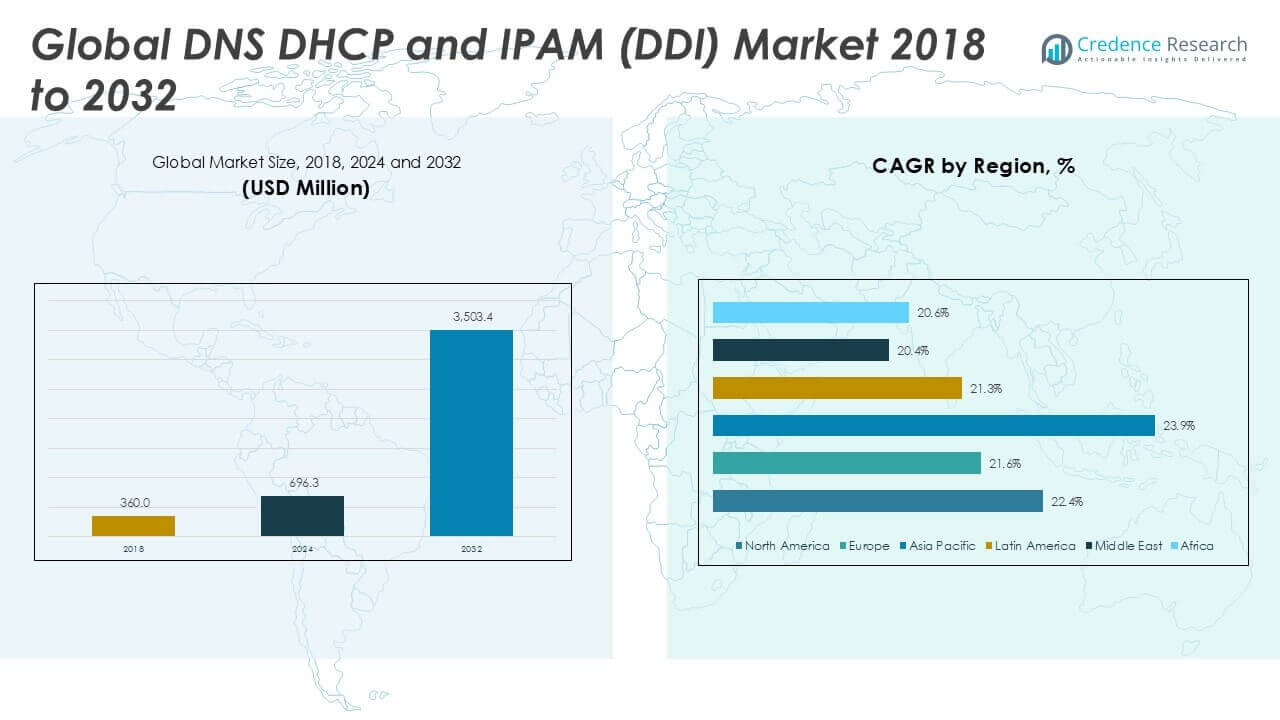
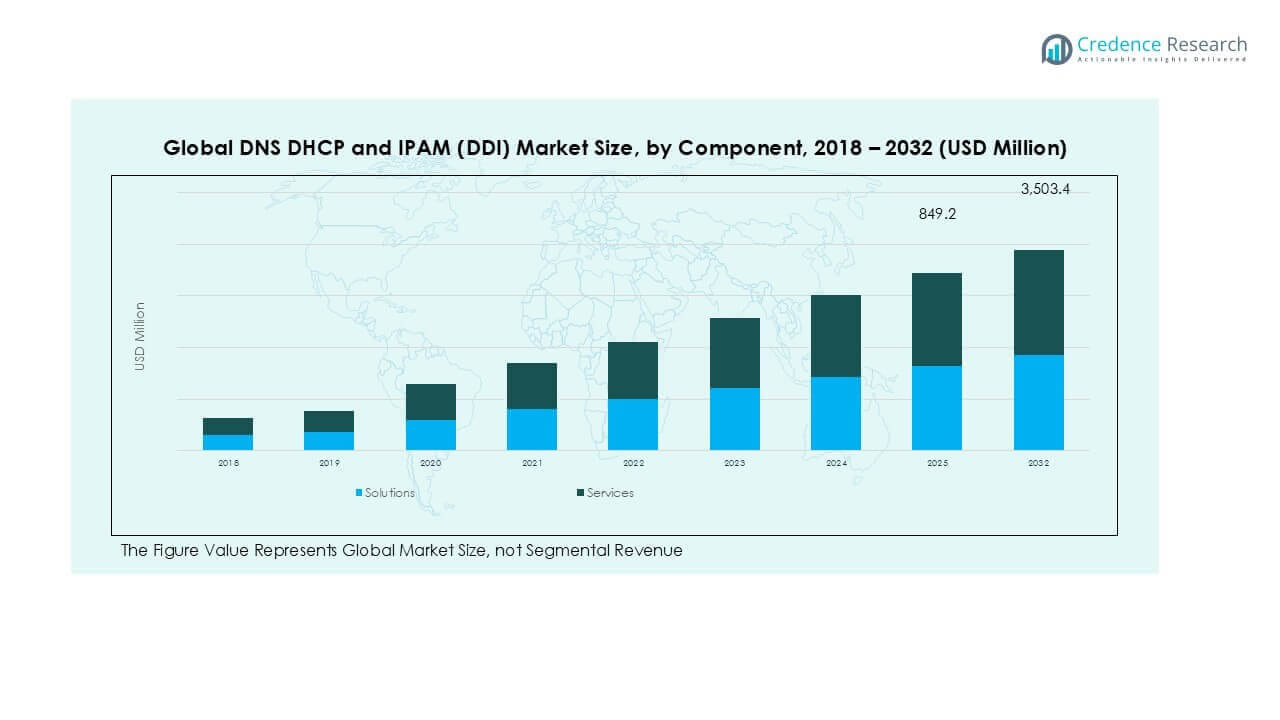
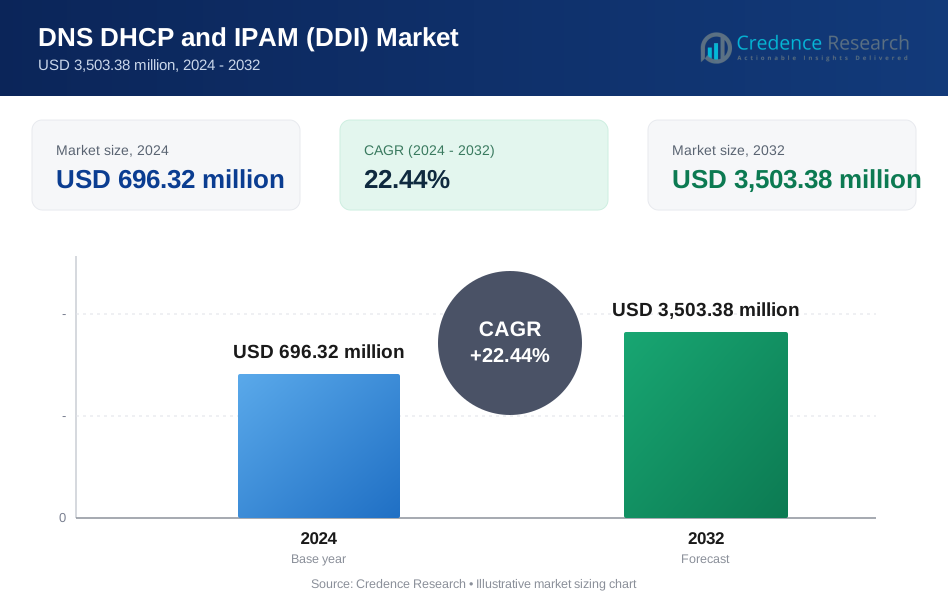
DNS, DHCP, And IPAM (DDI) market size was valued at USD 360.00 million in 2018, grew to USD 696.32 million in 2024, and is anticipated to reach USD 3,503.38 million by 2032, at a CAGR of 22.44% during the forecast period.
| REPORT ATTRIBUTE | DETAILS |
|---|---|
| Historical Period | 2020-2023 |
| Base Year | 2024 |
| Forecast Period | 2025-2032 |
| DNS, DHCP, And IPAM (DDI) Market Size 2024 | USD 696.32 million |
| DNS, DHCP, And IPAM (DDI) Market, CAGR | 22.44% |
| DNS, DHCP, And IPAM (DDI) Market Size 2032 | USD 3,503.38 million |
The DNS, DHCP, and IPAM (DDI) market is led by major players such as BlueCat Networks, Microsoft, Infoblox, Cisco Systems, MEN&MICE, EfficientIP, FusionLayer, TCPWave Inc., and SolarWinds Worldwide, LLC. These companies focus on delivering scalable, cloud-native, and automated DDI solutions to meet growing network complexity and security demands. North America dominated the market with over 35% share in 2024, supported by early adoption of network automation and significant investments in 5G and hybrid cloud infrastructure. Asia Pacific followed with nearly 25% share and the fastest CAGR of 23.9%, driven by rapid digitization, IoT growth, and large-scale data center expansion.
Market Insights
- The DNS, DHCP, and IPAM (DDI) market was valued at USD 696.32 million in 2024 and is projected to reach USD 3,503.38 million by 2032, growing at a CAGR of 22.44%.
- Growth is driven by rising network complexity, cloud adoption, and demand for automated IP management. Enterprises are investing in AI-enabled DDI platforms to improve scalability, reduce errors, and strengthen network security.
- Key trends include integration of DDI with multi-cloud and edge environments, API-driven automation, and adoption of AI/ML for predictive analytics and threat detection.
- Leading players include BlueCat Networks, Microsoft, Infoblox, Cisco Systems, MEN&MICE, EfficientIP, FusionLayer, TCPWave Inc., and SolarWinds, focusing on innovation, partnerships, and cloud-native offerings to gain competitive advantage.
- North America leads with over 35% share, followed by Europe with 26% and Asia Pacific with 25%. Network automation accounts for the largest application share, exceeding 40% in 2024.
Market Segmentation Analysis:
By Component
Solutions dominated the DNS, DHCP, and IPAM market in 2024, holding over 65% share. Demand is driven by enterprises adopting integrated DDI solutions to simplify IP address management and automate network provisioning. Solutions help reduce configuration errors and improve network uptime, making them critical for large-scale IT infrastructures. Vendors are integrating AI-driven analytics and automation features, enabling faster fault detection and improved compliance. Services are growing steadily as enterprises seek managed DDI services and professional support, particularly in hybrid and multi-cloud environments requiring continuous monitoring and optimization.
- For instance, for commercial tower projects in Kuala Lumpur, construction companies often use advanced modular scaffolding systems to increase efficiency and safety. For example, the use of a modular system can reduce erection and dismantling time compared to traditional scaffolding methods.
By Application
Network automation accounted for the largest share, exceeding 40% of the application segment in 2024. Organizations prioritize automation to streamline IP assignments, reduce manual workloads, and ensure faster network provisioning. Growing IoT deployments and connected devices are increasing the complexity of network management, fueling demand for automated DDI tools. Virtualization and cloud applications are the second-largest segment, supported by enterprises migrating workloads to cloud environments. Data center transformation projects and rising network security needs further push adoption, as DDI plays a crucial role in threat detection and secure IP address tracking.
- For instance, in February 2024, APSARA announced a program to replace plastic with bamboo for fencing at temple restoration sites. This was an environmentally motivated initiative to reduce waste and create jobs for local communities, not a large-scale construction technique.
By End-User
Telecom and IT led the end-user segment with more than 35% share in 2024, driven by high dependency on scalable networks and 5G rollout initiatives. These companies deploy DDI solutions to manage millions of IP addresses efficiently and ensure uninterrupted service delivery. BFSI is a rapidly growing end-user segment, supported by strict compliance requirements and cybersecurity priorities. Government and defense agencies adopt DDI for secure communication infrastructure, while healthcare and life sciences organizations integrate solutions to support connected medical devices and telehealth platforms, where uptime, security, and accurate IP tracking are mission-critical.
Market Overview
Rising Network Complexity and Automation Needs
The growing number of connected devices, cloud workloads, and IoT networks is significantly increasing IP address complexity. Enterprises face challenges in managing dynamic IP allocation across hybrid and multi-cloud setups, driving the adoption of integrated DDI solutions. Automated DNS, DHCP, and IPAM tools reduce manual configuration errors, improve scalability, and ensure faster network provisioning. Organizations are adopting AI-driven DDI solutions for predictive analytics and real-time monitoring, enabling proactive issue resolution. This automation trend is particularly strong in sectors such as telecom, IT, and BFSI, where downtime directly impacts customer experience.
- For instance, Infoblox reported that its BloxOne DDI platform managed over 2.5 billion DNS queries per day in 2024 for global enterprise customers.
Accelerated Cloud and Virtualization Adoption
The shift toward cloud-first strategies and virtualized data centers is a major growth driver for the DDI market. Organizations need scalable IP address management and automated DNS/DHCP services to support workload migration, container orchestration, and microservices. DDI solutions ensure seamless connectivity across public, private, and hybrid cloud environments. Vendors are focusing on cloud-native DDI platforms with API integration capabilities to support DevOps teams and accelerate service delivery. This adoption is further fueled by digital transformation initiatives, remote work expansion, and growing demand for agile, software-defined networking environments.
- For instance, NS1's cloud-native DDI platform handles between two to four million API calls per day to support DevOps pipelines across multiple hyperscale environments.
Emphasis on Network Security and Compliance
Enterprises are increasingly concerned about cyber threats targeting DNS infrastructure, such as DNS spoofing and DDoS attacks. DDI solutions play a key role in mitigating these risks by providing centralized visibility, rapid threat detection, and secure IP address management. Regulatory compliance frameworks like GDPR and HIPAA also demand accurate tracking of network assets and data flows. Organizations are investing in secure DDI platforms with built-in threat intelligence and policy enforcement capabilities. The rising number of remote endpoints and distributed networks further increases the need for secure, policy-driven DNS and DHCP configurations.
Key Trends & Opportunities
Integration with AI and Machine Learning
AI-enabled DDI solutions are gaining traction as enterprises look for predictive insights and automated anomaly detection. Machine learning algorithms can forecast IP utilization trends, detect unusual network activity, and trigger automated responses. This reduces downtime and helps IT teams focus on strategic initiatives. Vendors are also embedding AI-driven security analytics to detect DNS-based threats in real time. The combination of automation and intelligence creates significant opportunities for solution providers catering to large, distributed organizations seeking smarter network operations and proactive risk management.
- For instance, Infoblox’s BloxOne Threat Defense processed over 70 billion DNS queries daily in 2024, using ML to block millions of malicious domains in real time.
Expansion of Multi-Cloud and Edge Deployments
With enterprises adopting multi-cloud strategies and edge computing, DDI solutions must support highly distributed architectures. Cloud-native DDI platforms offer centralized control while enabling local resolution at the edge to improve latency and performance. This trend creates opportunities for vendors offering API-driven, container-ready DDI solutions that integrate seamlessly with orchestration platforms like Kubernetes. Growth in edge applications, including IoT and 5G, is further boosting the need for robust IPAM capabilities to manage IP address pools across thousands of devices deployed at remote sites.
Key Challenges
High Deployment and Maintenance Costs
Despite strong adoption drivers, high upfront costs for enterprise-grade DDI solutions can limit penetration among small and medium enterprises. Implementation often requires infrastructure upgrades, skilled resources, and ongoing maintenance contracts. The transition from legacy systems can also create integration complexities and temporary service disruptions. Vendors are addressing this challenge by offering subscription-based pricing models and cloud-delivered solutions to reduce capital expenditure, but cost remains a barrier for organizations with limited budgets or low IT maturity.
Shortage of Skilled IT Professionals
The effective deployment and management of DDI solutions require expertise in network automation, cloud orchestration, and cybersecurity. Many organizations face a shortage of skilled professionals capable of managing large-scale IP address systems and troubleshooting DNS/DHCP issues. This talent gap slows adoption and can lead to misconfigurations or security vulnerabilities. Training programs and managed service offerings are emerging to fill this gap, but enterprises must still invest in workforce development to fully realize the benefits of modern DDI platforms.
Regional Analysis
North America
North America led the DNS, DHCP, and IPAM market in 2024, accounting for over 35% share. The market grew from USD 128.16 million in 2018 to USD 244.82 million in 2024 and is projected to reach USD 1,230.04 million by 2032, registering a CAGR of 22.4%. Growth is driven by early adoption of network automation, strong presence of leading vendors, and rapid deployment of 5G networks. Enterprises in telecom, BFSI, and government sectors invest heavily in secure and automated DDI solutions to manage complex, distributed infrastructures and ensure regulatory compliance.
Europe
Europe held around 26% market share in 2024, rising from USD 97.56 million in 2018 to USD 181.58 million in 2024, with projections of USD 864.47 million by 2032 at a CAGR of 21.6%. Demand is fueled by strict data protection regulations such as GDPR, which require accurate network tracking and secure IP address management. The region is witnessing strong adoption in BFSI, telecom, and public sector networks. Vendors focus on delivering compliance-driven, automated DDI solutions to reduce configuration errors and improve network resilience across hybrid and multi-cloud environments.
Asia Pacific
Asia Pacific is the fastest-growing region, expanding at a CAGR of 23.9% and holding about 25% share in 2024. The market increased from USD 87.55 million in 2018 to USD 176.90 million in 2024 and is forecast to reach USD 982.70 million by 2032. Growth is driven by rapid digitization, rising cloud adoption, and increasing 5G rollouts in countries like China, India, and Japan. Enterprises invest in scalable DDI platforms to support massive IP address pools, IoT devices, and data center expansions, making APAC a key focus for solution providers targeting high-volume networks.
Latin America
Latin America represented nearly 6% share of the market in 2024, growing from USD 23.22 million in 2018 to USD 44.49 million in 2024 and projected to hit USD 208.00 million by 2032 at a CAGR of 21.3%. The region is experiencing steady digital transformation, with telecom and IT sectors driving adoption of automated DDI solutions to manage growing user bases. Cloud adoption and enterprise network expansion in Brazil and Mexico are creating opportunities for vendors to offer cost-effective, cloud-delivered IPAM and DNS security solutions tailored for mid-sized enterprises.
Middle East
The Middle East accounted for about 4% market share in 2024, expanding from USD 10.62 million in 2018 to USD 18.87 million in 2024, with a forecast of USD 82.70 million by 2032 at a CAGR of 20.4%. Growing investment in smart city projects, digital infrastructure, and government digitalization initiatives are boosting demand for DDI solutions. Telecom operators and financial institutions are adopting automated IP address management systems to improve operational efficiency, reduce downtime, and strengthen security across distributed networks, particularly in Gulf countries such as UAE and Saudi Arabia.
Africa
Africa captured roughly 4% of the market in 2024, increasing from USD 12.89 million in 2018 to USD 29.67 million in 2024 and expected to reach USD 135.47 million by 2032, at a CAGR of 20.6%. The region’s growth is supported by rising internet penetration, growing mobile subscriptions, and increased investment in cloud data centers. Governments and telecom providers are implementing automated DDI solutions to enhance network scalability and security. Cost-effective cloud-based offerings are gaining popularity, helping small and medium enterprises manage IP resources efficiently without large infrastructure investments.
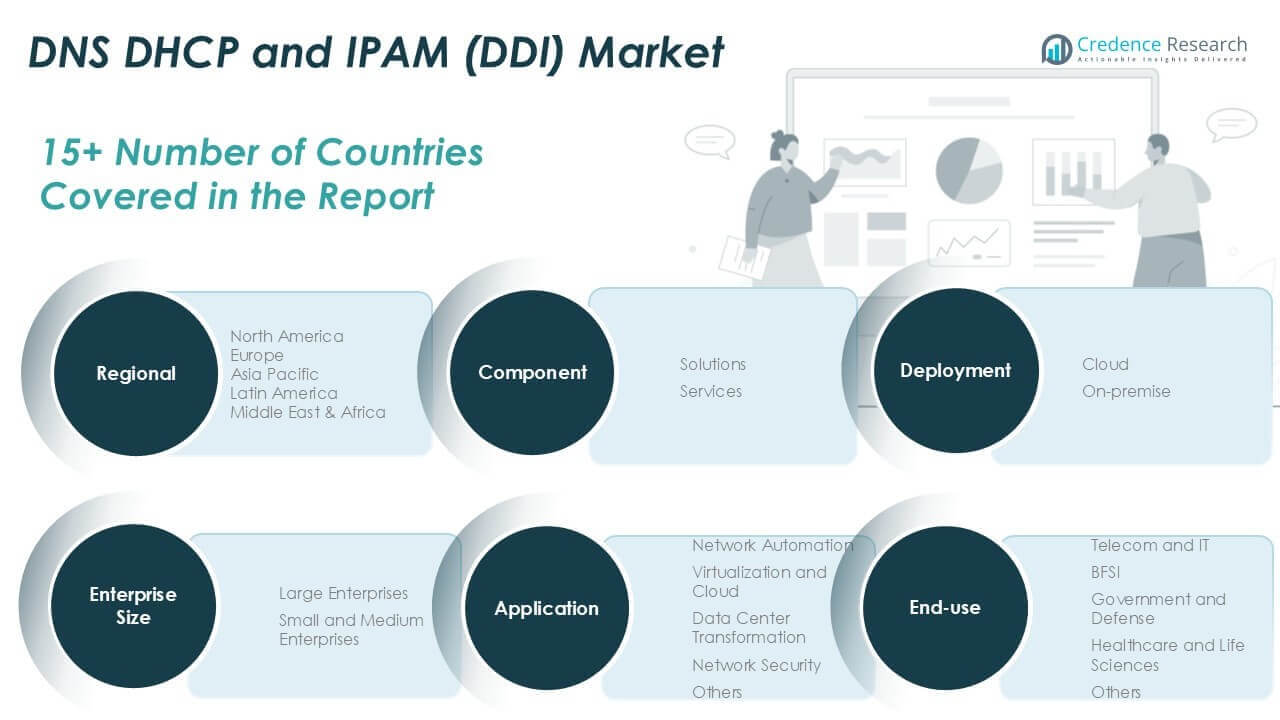
Market Segmentations:
By Component
- Solutions
- Services
By Application
- Network Automation
- Virtualization and Cloud
- Data Center Transformation
- Network Security
- Others
By End-User
- Telecom and IT
- BFSI
- Government and Defense
- Healthcare and Life Sciences
- Others
By Enterprise Size
- Large Enterprises
- Small and Medium Enterprises
By Deployment
- Cloud
- On-premise
By Geography
- North America
- U.S.
- Canada
- Europe
- Germany
- France
- Italy
- U.K.
- Russia
- Rest of Europe
- Asia-Pacific
- India
- China
- Japan
- Rest of Asia-Pacific
- Latin America
- Brazil
- Mexico
- Rest of Latin America
- Middle East and Africa
- GCC Countries
- South Africa
- Rest of Middle East and Africa
Competitive Landscape
The DNS, DHCP, and IPAM market is moderately consolidated, with leading players focusing on innovation and scalability to address growing network complexity. Key companies include BlueCat Networks, Microsoft, Infoblox, Cisco Systems, MEN&MICE, EfficientIP, FusionLayer, TCPWave Inc., and SolarWinds Worldwide, LLC. Infoblox and BlueCat dominate with strong enterprise adoption and advanced automation capabilities, while Microsoft leverages its Azure ecosystem to expand its DDI footprint. Cisco focuses on integrating DDI with its networking solutions, enhancing security and performance. Vendors are investing in cloud-native, API-driven platforms and AI-enabled analytics to offer predictive network insights. Partnerships with telecom providers and managed service providers are increasing, targeting hybrid cloud and multi-cloud deployments. The competition is further shaped by mergers, acquisitions, and strategic alliances designed to strengthen product portfolios and extend global reach. This dynamic environment drives continuous innovation, creating opportunities for customers seeking secure, automated, and scalable DDI solutions.
Key Player Analysis
- BlueCat Networks
- Microsoft
- Infoblox
- Cisco Systems, Inc.
- MEN&MICE
- EfficientIP
- FusionLayer
- TCPWave Inc.
- SolarWinds Worldwide, LLC
Recent Developments
- In April 2025, Infoblox launched Universal DDI for hybrid cloud with integrated security and automation.
- In March 2025, Cisco unveiled AI agents for autonomous network configuration, including DDI workflow automation.
- In February 2023, Cygna Labs, a major market participant in DDI products and services, acquired Nokia’s VitalQIP business and product portfolio. The deal included the acquisition of all the relevant intellectual properties, customer contracts and the entire team of personnel who have worked on the VitalQIP portfolio earlier.
- In January 2023, EfficientIP, a specialist in DDI security and automation, launches its new DNS-based Data Exfiltration Application. Designed as a hands-on web tool, it enables organizations to conduct ethical hacks on their DNS systems, identifying potential vulnerabilities. This proactive approach helps prevent data breaches by strengthening network security defenses
- In June 2022, AmiViz, the Middle East's first enterprise B2B marketplace, partners with EfficientIP, granting Egyptian channel partners access to its DDI solutions. Available through AmiViz's online platforms, including its web portal and mobile app, EfficientIP's DNS, DHCP, and IP address management solutions enhance network infrastructure and security for Egyptian businesses
- In March 2022, EfficientIP unveils SOLIDserver 8.1, the latest version of its DDI suite, offering centralized DNS management and network security for hybrid cloud infrastructures. With features tailored for multi-cloud environments, SOLIDserver 8.1 empowers organizations to enhance agility and operational efficiency, crucial in today's rapidly evolving technological landscape
- In March 2022, EfficientIP announces a pan-European partnership with the Nomios Group, facilitating autonomous delivery of its DDI solutions across key European markets including Germany, Belgium, France, Poland, the Netherlands, and the U.K. This collaboration strengthens EfficientIP's presence and enables seamless access to its innovative DDI automation and security offerings throughout Europe.
Report Coverage
The research report offers an in-depth analysis based on Component, Application, End-User, Enterprise Size, Deployment and Geography. It details leading market players, providing an overview of their business, product offerings, investments, revenue streams, and key applications. Additionally, the report includes insights into the competitive environment, SWOT analysis, current market trends, as well as the primary drivers and constraints. Furthermore, it discusses various factors that have driven market expansion in recent years. The report also explores market dynamics, regulatory scenarios, and technological advancements that are shaping the industry. It assesses the impact of external factors and global economic changes on market growth. Lastly, it provides strategic recommendations for new entrants and established companies to navigate the complexities of the market.
Future Outlook
- The market will witness rapid adoption of AI-driven DDI solutions for predictive analytics.
- Cloud-native and SaaS-based DDI platforms will dominate future deployments.
- Multi-cloud and hybrid network environments will drive demand for centralized IP address management.
- Edge computing growth will create opportunities for low-latency, distributed DDI solutions.
- Integration with zero-trust security frameworks will become a standard requirement.
- Telecom and IT sectors will remain key adopters with 5G network expansion.
- SMEs will increasingly choose subscription-based DDI solutions to lower upfront costs.
- Automation will reduce manual configurations, enhancing network efficiency and uptime.
- Vendors will focus on API-ready platforms supporting DevOps and container orchestration.
- Emerging markets in Asia Pacific and Latin America will drive the highest growth rates.
Request a Free Sample
Fill in your details and we'll send you a free sample report.
- Sample data tables & charts
- Research methodology
Need a Custom Version of This Report?
Tailor the scope, geography, or segments to your exact requirements.
- Custom geography or segment scope
- Direct access to our analyst team
Frequently Asked Questions
What is the current market size for DNS, DHCP, And IPAM (DDI) market, and what is its projected size in 2032?
At what Compound Annual Growth Rate is the DNS, DHCP, And IPAM (DDI) market projected to grow between 2025 and 2032?
Which DNS, DHCP, And IPAM (DDI) market segment held the largest share in 2024?
What are the primary factors fueling the growth of the DNS, DHCP, And IPAM (DDI) market?
Who are the leading companies in the DNS, DHCP, And IPAM (DDI) market?
Table of Content
Chapter 1. Report Introduction
- 1.1 Report Description & Purpose
- 1.1.1 Report Title & Market Definition
- 1.1.2 Unique Selling Propositions (USP) & Key Differentiators
- 1.1.3 Value Proposition for Stakeholders
- 1.2 Research Objectives
- 1.2.1 Market Sizing Objectives (Volume & Revenue)
- 1.2.2 Segmentation Objectives
- 1.2.3 Competitive Intelligence Objectives
- 1.2.4 Forecast & Scenario Objectives
- 1.3 Report Scope
- 1.3.1 DNS DHCP and IPAM (DDI) Scope – Types & Subtypes Covered
- 1.3.2 Geographic Scope – Regions & Countries Covered
- 1.3.3 Historical Period, Base Year & Forecast Period (2024; forecast to 2032)
- 1.3.4 Inclusions & Exclusions
- 1.4 HS Code & Classification Framework
- 1.5 Currency, Units & Pricing Basis
- 1.6 Target Stakeholders
- 1.7 Limitations & Assumptions
Chapter 2. Executive Summary
- 2.1 Global DNS DHCP and IPAM (DDI) Market Snapshot
- 2.1.1 Market Size – Historical (2024) & Forecast (2024-2032) (2024: USD 696.32 million → 2032: USD 3,503.38 million)
- 2.1.2 Volume & Revenue – Global Totals
- 2.1.3 Key Market Highlights – Top Five Facts
- 2.2 DNS DHCP and IPAM (DDI) Market Segmentation Snapshot
- 2.2.1 Market Split by Region – 2024 vs. 2032
- 2.3 Competitive Snapshot
- 2.3.1 Top 10 Players by Revenue Share – 2024
- 2.3.2 Top 10 Players by Volume Share – 2024
- 2.3.3 Recent Strategic Developments (18-Month Summary)
- 2.4 Key Investment Highlights & Strategic Conclusions
Chapter 3. DNS DHCP and IPAM (DDI) Market Dynamics & Industry Analysis
- 3.1 Market Overview & Context
- 3.1.1 DNS DHCP and IPAM (DDI) Market Position in the Broader Automotive Value Chain
- 3.1.2 OEM vs. Replacement Market Dynamics
- 3.1.3 Market Maturity & Development Stage by Region
- 3.2 DNS DHCP and IPAM (DDI) Market Drivers
- 3.3 DNS DHCP and IPAM (DDI) Market Restraints & Challenges
- 3.4 DNS DHCP and IPAM (DDI) Market Opportunities
- 3.5 Porter's Five Forces Analysis
- 3.5.1 Threat of New Entrants
- 3.5.2 Bargaining Power of Suppliers
- 3.5.3 Bargaining Power of Buyers
- 3.5.4 Threat of Substitutes
- 3.5.5 Competitive Rivalry – Intensity Assessment
- 3.6 DNS DHCP and IPAM (DDI) Value Chain Analysis
- 3.6.1 Upstream – Raw Material/Input Suppliers
- 3.6.1.1 Raw Material/Input 1
- 3.6.1.2 Raw Material/Input 2
- 3.6.1.3 Raw Material/Input 3
- 3.6.2 Midstream – Production/Manufacturing/Service Delivery
- 3.6.2.1 Production/Process Overview
- 3.6.2.2 Key Facility Locations & Capacity by Manufacturer
- 3.6.3 Downstream – Distribution & End Consumer
- 3.6.3.1 Primary Channel – B2B/OEM
- 3.6.3.2 Secondary Channels – Dealer, Retail, Online, Direct
- 3.6.4 Value Chain Profitability Analysis
- 3.6.1 Upstream – Raw Material/Input Suppliers
- 3.7 PESTEL Analysis
- 3.7.1 Political Factors
- 3.7.2 Economic Factors
- 3.7.3 Social Factors
- 3.7.4 Technological Factors
- 3.7.5 Environmental Factors
- 3.7.6 Legal Factors
- 3.8 DNS DHCP and IPAM (DDI) Supply Chain Analysis
- 3.8.1 Raw Material/Input Supply Risk Assessment
- 3.8.2 Manufacturing Concentration Risk (Geographic Exposure)
- 3.8.3 Trade Disruption Impact Analysis
- 3.9 Regulatory & Policy Landscape
Note: The regulatory and policy landscape section covers regulations based on their applicability to the market, DNS DHCP and IPAM (DDI) category, geography, and scope of the study. Only regulatory frameworks with a material impact on operations, compliance, trade, sustainability, or market access are analyzed in detail.
Chapter 4. Key Investment Pockets & Opportunity Analysis
- 4.1 DNS DHCP and IPAM (DDI) Market Attractiveness Analysis
- 4.1.1 By Region – Investment Attractiveness Matrix (Volume × CAGR)
- 4.2 Absolute Revenue Growth Opportunity
- 4.2.1 By Region – Absolute USD Growth Through 2032
- 4.3 Incremental Volume Opportunity
- 4.3.1 By Region – Incremental Volume Through 2032
- 4.3.2 Segment – Incremental Volume
- 4.4 Emerging Submarket Opportunity Deep Dive (Subject to Applicability)
- 4.5 Emerging Market Opportunity Scorecards
- 4.5.1 United States
- 4.5.2 Europe
- 4.5.3 Asia
- 4.5.4 Middle East & Africa
Note: Emerging Market Opportunity Scorecards will be included based on relevance and strategic importance. Regions listed are indicative and may vary depending on data availability and market dynamics.
Chapter 5. DNS DHCP and IPAM (DDI) Import-Export Analysis & Trade Flows
- 5.1 Global Trade Overview
- 5.1.1 Global Export Value by Country (2024)
- 5.1.2 Global Export Volume by Country (2024)
- 5.1.3 Global Import Value by Country (2024)
- 5.1.4 Global Import Volume by Country (2024)
- 5.1.5 Net Trade Balance by Country (2024)
- 5.2 Export Analysis – Segment
- 5.2.1 Type 1 (HS Code)
- 5.2.2 Type 2 (HS Code)
- 5.2.3 Type 3 (HS Code)
- 5.2.4 Type 4 (HS Code)
- 5.2.5 Type 5 (HS Code)
- 5.3 Import Analysis – Segment
- 5.3.1 Type 1 (HS Code)
- 5.3.2 Type 2 (HS Code)
- 5.3.3 Type 3 (HS Code)
- 5.3.4 Type 4 (HS Code)
- 5.3.5 Type 5 (HS Code)
- 5.4 Average Unit Trade Prices
- 5.4.1 Average Export Price – Segment & Country
- 5.4.2 Average Import Price – Segment & Source Country
- 5.4.3 Price Trends (2024)
- 5.5 Key Trade Route Analysis
- 5.5.1 Trade Route 1
- 5.5.2 Trade Route 2
- 5.5.3 Trade Route 3
- 5.5.4 Trade Route 4
- 5.5.5 Trade Route 5
- 5.6 Trade Policy Impact Assessment
- 5.6.1 US Anti-Dumping & Section 301 Tariffs
- 5.6.2 EU Customs Union Impact
- 5.6.3 Major Free Trade Agreements
- 5.6.4 USMCA Rules of Origin
Note: Trade policy analysis will be included only where relevant to the DNS DHCP and IPAM (DDI) market.
Chapter 6. Competitive Landscape & Company Benchmarking
- 6.1 DNS DHCP and IPAM (DDI) Market Concentration & Structure
- 6.1.1 Herfindahl-Hirschman Index (HHI) – vs. 2024
- 6.1.2 Tier 1, Tier 2 & Tier 3 Market Structure
- 6.1.3 Global, Regional & Local Player Dynamics
- 6.2 DNS DHCP and IPAM (DDI) Market Share Analysis – 2024
- 6.2.1 Global Revenue Share by Company
- 6.2.2 Global Volume Share by Company
- 6.2.3 Regional Revenue Share
- 6.2.4 Market Share Evolution ( vs. 2024)
- 6.2.5 OEM Segment Share by Company
- 6.2.6 Replacement Segment Share by Company
- 6.3 Production/Delivery Capacity & Facility Analysis
- 6.3.1 Global Installed Capacity
- 6.3.2 Capacity Utilization Rates
- 6.3.3 Production/Output Volume
- 6.3.4 Facility Locations & Capacity Map
- 6.3.5 Planned Capacity Additions
- 6.4 DNS DHCP and IPAM (DDI) Competitive Benchmarking Matrix
- 6.4.1 Revenue, Volume, CAGR & Profitability Comparison
- 6.4.2 Channel Revenue Mix
- 6.4.3 Geographic Revenue Exposure
- 6.4.4 R&D Intensity
- 6.4.5 Sustainability Maturity
- 6.5 Strategic Developments in DNS DHCP and IPAM (DDI) (Last 24 Months)
- 6.5.1 Mergers, Acquisitions & Divestments
- 6.5.2 New DNS DHCP and IPAM (DDI) Launches
- 6.5.3 Facility Expansions
- 6.5.4 Strategic Alliances, Joint Ventures & Partnerships
- 6.5.5 Distribution Expansion & Market Entry
- 6.5.6 Sustainability & ESG Initiatives
- 6.6 Competitive Strategy Mapping
- 6.6.1 Leader, Challenger, Follower & Niche Classification
- 6.6.2 Pricing Strategy Comparison
- 6.6.3 Channel Strategy Matrix
Note: Strategic developments are included based on their materiality and the availability of reliable information.
Chapter 7. Global DNS DHCP and IPAM (DDI) Market – By Distribution Channel
- 7.1 Segment Overview
- 7.1.1 Volume & Revenue Split by Channel (2024 & 2032)
- 7.1.2 Channel Mix Evolution (2024-2032)
Chapter 8. Regional Market Analysis – Global Overview
- 8.1 Global Regional Overview
- 8.1.1 Regional Volume Share
- 8.1.2 Regional Revenue Share
- 8.1.3 Regional Volume by Region
- 8.1.4 Regional Revenue by Region
- 8.1.5 Regional Forecast Through 2032
- 8.2 Cross-Regional Segment Analysis
- 8.2.1 By Distribution Channel
- 8.2.2 By Brand/Price Tier
Chapter 9. North America DNS DHCP and IPAM (DDI) Market
- 9.1 United States
- 9.2 Canada
- 9.3 Mexico
Chapter 10. Europe DNS DHCP and IPAM (DDI) Market
- 10.1 Germany
- 10.2 France
- 10.3 Italy
- 10.4 United Kingdom
- 10.5 Spain
- 10.6 Poland
- 10.7 Russia
- 10.8 Netherlands
- 10.9 Belgium
- 10.10 Sweden
- 10.11 Denmark
- 10.12 Norway
- 10.13 Rest of Europe
Chapter 11. Asia Pacific DNS DHCP and IPAM (DDI) Market
- 11.1 China
- 11.2 India
- 11.3 Japan
- 11.4 South Korea
- 11.5 Thailand
- 11.6 Indonesia
- 11.7 Vietnam
- 11.8 Malaysia
- 11.9 Australia
- 11.10 Rest of Asia Pacific
Chapter 12. Latin America DNS DHCP and IPAM (DDI) Market
- 12.1 Brazil
- 12.2 Argentina
- 12.3 Colombia
- 12.4 Chile
- 12.5 Rest of Latin America
Chapter 13. Middle East DNS DHCP and IPAM (DDI) Market
- 13.1 Saudi Arabia
- 13.2 United Arab Emirates
- 13.3 Turkey
- 13.4 Israel
- 13.5 Iran
- 13.6 Rest of the Middle East
Chapter 14. Africa DNS DHCP and IPAM (DDI) Market
- 14.1 South Africa
- 14.2 Egypt
- 14.3 Nigeria
- 14.4 Morocco
- 14.5 Rest of Africa
Chapter 15. DNS DHCP and IPAM (DDI) Company Profiles
- 15.1 [Company 01]
- 15.1.1 Company Overview
- 15.1.2 Key Management Personnel
- 15.1.3 Products & Services Portfolio
- 15.1.4 Financial Performance
- 15.1.5 Key Market Focus & Geographic Presence
- 15.1.6 Recent Developments & Strategic Initiatives
Note: The company profile list is preliminary and may change based on research findings, market developments, data availability, and client requirements.
Chapter 16. Appendices
- Appendix A – List of Abbreviations & Acronyms
- Appendix B – Industry Classification Code Reference – Full Series
- Appendix C – Production & Capacity Data Tables
- Appendix D – End-Use & Demand Base Tables
- Appendix E – Consumption & Replacement Rate Assumptions
- Appendix F – ASP Reference Tables
- Appendix G – Manufacturing & Facility Database
- Appendix H – Import-Export Data Tables
- Appendix I – Regulatory Summary Tables
- Appendix J – Primary Research Participant List (Anonymized)
- Appendix K – Primary Research Questionnaire Framework
- Appendix L – Data Sources & Bibliography
- Appendix M – Market Size Divergence & Source Comparison
Chapter 17. Research Methodology
- 17.1 Research Framework & Philosophy
- 17.2 Secondary Research – Sources, Hierarchy & Data Extraction
- 17.3 Data Modeling – Bottom-Up & Top-Down Market Sizing
- 17.4 Primary Research – Stakeholder Framework, LOI & Sample Sizes
- 17.5 Forecast Methodology – Regression, Scenario & Sensitivity Analysis
- 17.6 Quality Control – Four-Layer Validation Framework
- 17.7 Limitations & Standard Assumptions
- 17.8 Disclaimer
