
| REPORT ATTRIBUTE | DETAILS |
|---|---|
| Historical Period | 2020-2023 |
| Base Year | 2024 |
| Forecast Period | 2025-2032 |
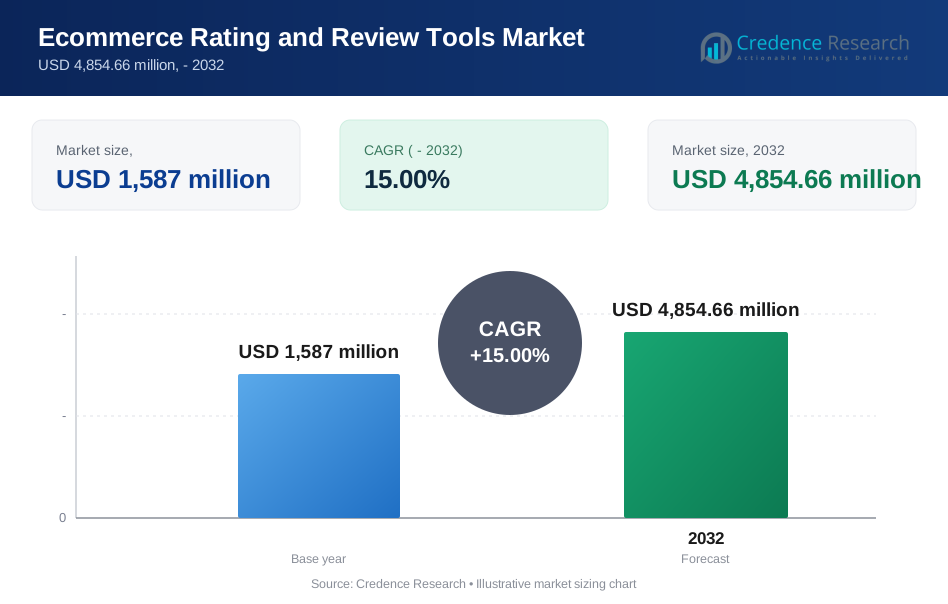
| Ecommerce Rating and Review Tools Market Size 2024 | USD 1,587 Million |
| Ecommerce Rating and Review Tools Market, CAGR | 15% |
| Ecommerce Rating and Review Tools Market Size 2032 | USD 4,854.66 Million |
Market Overview:
The Ecommerce Rating and Review Tools Market is projected to grow from USD 1,587 million in 2024 to USD 4,854.66 million by 2032, reflecting a compound annual growth rate (CAGR) of 15%.
The Ecommerce Rating and Review Tools Market is primarily driven by the increasing reliance on customer feedback for purchasing decisions and the growing demand for personalized shopping experiences. As more consumers turn to online reviews and ratings for product validation, businesses are integrating advanced tools to enhance credibility and trust. The rise of social proof, particularly on e-commerce platforms, has made ratings and reviews essential for both customer engagement and brand reputation. Additionally, the increasing adoption of artificial intelligence and machine learning technologies is enabling more accurate sentiment analysis and personalized recommendations. Trends include the integration of multi-channel review systems, which aggregate feedback across social media, websites, and other platforms, providing businesses with comprehensive insights. The rise in mobile shopping and the expanding reach of e-commerce globally further contribute to the growing demand for effective review management tools. As companies strive to enhance customer trust, these tools are becoming indispensable for maintaining competitive advantage in the digital marketplace.
The geographical landscape of the Ecommerce Rating and Review Tools Market spans North America, Europe, Asia Pacific, Latin America, and the Middle East & Africa, each playing a crucial role in the market’s expansion. North America leads with the highest market share in 2024, driven by advanced digital infrastructure and widespread adoption among e-commerce platforms. Europe follows, fueled by stringent consumer transparency regulations and growing online retail presence. Asia Pacific is witnessing rapid growth due to rising digital adoption in countries like India and China. Latin America and the Middle East & Africa are emerging regions, showing increasing interest in digital feedback tools. Prominent players such as Trustpilot, Bazaarvoice, Yotpo, Reviews.co.uk, Feefo, eKomi, PowerReviews, and Yelp are actively strengthening their presence across these regions through product innovation, localization strategies, and strategic partnerships.
Market Insights:
- The market is projected to grow from USD 1,587 million in 2024 to USD 4,854.66 million by 2032, with a CAGR of 15%, reflecting strong and sustained demand across global markets.
- Rising consumer reliance on customer reviews for purchasing decisions is fueling adoption, as businesses increasingly recognize the importance of feedback in enhancing trust and influencing buying behavior.
- AI and machine learning integration are transforming the market by enabling advanced sentiment analysis, fraud detection, and personalized product recommendations based on user-generated content.
- There is significant growth in multi-channel review systems, allowing companies to gather and manage reviews from websites, social media, and third-party platforms in a unified interface.
- The global expansion of e-commerce, particularly in Asia Pacific, Latin America, and the Middle East & Africa, is boosting demand for scalable, cloud-based review tools.
- North America leads the market with a 36% share in 2024, followed by Europe at 28%, Asia-Pacific at 22%, and the Rest of the World at 14%, driven by regional digital maturity and consumer expectations.
- Leading players such as Trustpilot, Bazaarvoice, Yotpo, Reviews.co.uk, Feefo, eKomi, PowerReviews, and Yelp are competing on innovation, regional expansion, and AI capabilities to gain market share.
Market Drivers:
Growing Importance of Customer Feedback:
One of the primary drivers of the Ecommerce Rating and Review Tools Market is the increasing importance of customer feedback in the purchasing process. Today, more consumers rely on online reviews to validate their decisions, with many considering ratings and reviews as trustworthy sources of information before making a purchase. For instance, Trustpilot emphasizes transparency and authenticity by allowing companies to collect and showcase verified customer reviews, which strengthens online credibility and improves customer trust. This trend has pushed businesses to adopt robust review management systems to maintain positive customer perceptions and enhance their credibility. As consumers become more discerning and informed, the need for tools that efficiently collect, manage, and display reviews has intensified, driving market growth.
Rising Demand for Personalization:
Personalization is another key factor fueling the Ecommerce Rating and Review Tools Market. With the vast amount of data available, businesses are increasingly leveraging reviews to provide tailored shopping experiences. The ability to analyze customer sentiments and preferences allows businesses to refine product recommendations, customize offerings, and improve customer satisfaction. For instance, Yotpo employs AI-powered sentiment analysis and review aggregation to process thousands of customer reviews, providing actionable insights that help e-commerce brands identify trends and improve product offerings, with seamless integration into major e-commerce platforms. Review tools powered by artificial intelligence (AI) and machine learning can analyze customer feedback at scale, offering deep insights that help companies understand individual customer needs, preferences, and behaviors. As consumers increasingly expect personalized experiences, the demand for sophisticated rating and review tools continues to rise.
Growing E-commerce Adoption:
The rapid growth of e-commerce, particularly in emerging markets, has created a strong demand for effective review systems. As more consumers turn to online shopping for convenience, businesses across various sectors are recognizing the need for tools that allow them to manage customer feedback efficiently. With e-commerce becoming more competitive, companies are integrating review systems as a strategic component of their marketing and sales strategies. This expansion of online shopping globally has contributed significantly to the growth of the Ecommerce Rating and Review Tools Market, as businesses seek to capture and analyze customer feedback to stay ahead of their competition.
Enhanced Trust and Brand Reputation:
Consumer trust plays a crucial role in online shopping, and ratings and reviews are pivotal in building that trust. Positive reviews not only boost a company’s credibility but also influence purchasing decisions, while negative reviews, if not properly managed, can damage a brand’s reputation. Ecommerce Rating and Review Tools allow businesses to monitor, respond to, and manage reviews effectively, which helps them maintain a positive image and improve customer satisfaction. The ability to demonstrate social proof through customer feedback is an essential driver of growth, as it directly impacts customer acquisition, retention, and loyalty.
Market Trends:
Integration of Artificial Intelligence and Machine Learning:
A significant trend in the Ecommerce Rating and Review Tools Market is the integration of artificial intelligence (AI) and machine learning (ML) technologies. These tools are increasingly being used to analyze customer reviews and ratings in real-time, providing businesses with actionable insights into customer sentiment. AI-powered systems can detect patterns in customer feedback, identify trends, and even predict customer behavior, enabling companies to enhance their products and services based on real-time data. This technological evolution has made review management more efficient and effective, allowing businesses to act on customer feedback more swiftly.
Focus on Multi-Channel Integration:
With the growing number of online sales platforms, there is an increasing demand for multi-channel integration in review tools. Businesses are now seeking solutions that can consolidate reviews from various sources, including websites, social media, and third-party review platforms, into a unified system. For instance, Whatagraph enables businesses to bring in data from over 55 marketing channels, allowing them to monitor and report on customer feedback and campaign performance from social media, email, paid advertising, and CRM platforms in a single dashboard. This integration helps companies monitor and manage their reputation across multiple touchpoints, ensuring that customer feedback is consistently addressed regardless of where it is shared. As online shopping continues to expand across diverse platforms, businesses require a comprehensive approach to manage reviews effectively and maintain a positive brand image.
Incorporation of Video and Visual Content in Reviews:
Another current trend is the increasing incorporation of video and visual content in customer reviews. Traditional text-based reviews are now being supplemented with photos, videos, and product demonstrations, offering more authentic and engaging content for potential buyers. For instance, Dollar Shave Club features genuine customer video testimonials that highlight both product quality and brand personality. This trend is driven by the growing importance of visual content in consumer decision-making. Video and visual reviews offer a richer, more interactive experience for customers, making them more likely to trust and engage with the feedback. As a result, Ecommerce Rating and Review Tools are evolving to accommodate these media types, enhancing their value for both businesses and consumers.
Enhanced Customer Engagement Features:
As the demand for better customer experiences grows, businesses are focusing on improving engagement through review tools. Modern systems are increasingly offering features like automated responses, direct communication channels, and customer loyalty integrations. These features enable businesses to engage with customers more meaningfully, whether responding to negative feedback or thanking satisfied customers. The ability to create a dialogue with consumers not only enhances the customer experience but also allows companies to manage their reputation in real-time. This shift toward interactive and engaging review management is setting new standards in customer satisfaction and loyalty.
Market Challenges Analysis:
Managing Fake Reviews and Fraudulent Content:
One of the foremost challenges facing the Ecommerce Rating and Review Tools Market is the growing issue of fake reviews and fraudulent content. The increasing volume of online shopping has made customer reviews and ratings an essential part of the decision-making process. However, this also opens the door for malicious actors to post fake reviews to manipulate public perception, whether for competitive advantage or personal gain. These deceptive practices can severely distort the reliability of feedback systems, making it difficult for both consumers and businesses to differentiate between genuine and manipulated reviews. Businesses are often left scrambling to manage their online reputations, as the authenticity of reviews directly impacts consumer trust. Detecting fake reviews requires advanced technologies, such as AI and machine learning, capable of analyzing patterns and behaviors that suggest fraud. However, even with these technologies, the challenge persists as fraudulent content becomes more sophisticated. This constant battle with authenticity undermines the value of review systems and adds to the operational costs of managing them.
Data Privacy and Security Concerns:
The growing concerns over data privacy and security are another major challenge for the Ecommerce Rating and Review Tools Market. As online review systems collect a vast array of personal data from customers, including feedback, preferences, and sometimes sensitive information, there is an increasing need to safeguard this data from unauthorized access and breaches. With stricter data protection regulations like the GDPR in Europe and the CCPA in California, ecommerce businesses must be highly vigilant in ensuring that customer data is handled securely and transparently. For instance, in October 2024, Hot Topic, a major online retailer, suffered a data breach that exposed over 54 million customer records, including names, email addresses, physical addresses, and partially encrypted credit card details, due to a malware attack on a third-party data service. Non-compliance with these regulations can lead to significant fines and legal repercussions, further complicating the operation of review systems. Beyond the legal implications, any breach of customer data can lead to a loss of trust, which is especially detrimental for businesses that rely on customer feedback for growth and improvement.
Market Opportunities:
The Ecommerce Rating and Review Tools Market presents numerous opportunities driven by the growing need for consumer trust and transparency in online shopping. As more consumers turn to reviews to make informed purchasing decisions, businesses that can effectively manage and leverage customer feedback are likely to gain a competitive edge. The integration of advanced technologies, such as artificial intelligence and machine learning, into rating and review tools opens up new possibilities for businesses to automatically identify trends, assess customer sentiment, and filter out fraudulent content. Additionally, ecommerce platforms are increasingly adopting real-time analytics to monitor reviews and ratings as they are posted, enabling faster responses to customer concerns and enhancing customer satisfaction. This level of agility in responding to consumer feedback strengthens brand loyalty and reputation, offering a significant opportunity for businesses to foster long-term relationships with their customers.
The global shift towards personalized and enhanced customer experiences also presents ample opportunities for the Ecommerce Rating and Review Tools Market. As businesses focus on delivering highly tailored shopping experiences, leveraging customer reviews becomes a crucial component in driving targeted marketing strategies. With the rise of social commerce and user-generated content, ratings and reviews play an even more vital role in influencing consumer behavior. Furthermore, the growth of mobile commerce and the increasing use of voice-enabled devices offer new avenues for capturing customer feedback. By integrating review tools into these platforms, ecommerce businesses can enhance their ability to engage with consumers on multiple touchpoints. The expansion of these technologies into emerging markets, where internet penetration and e-commerce adoption are on the rise, also provides a wealth of untapped potential for market growth.
Market Segmentation Analysis:
By Product Type
The Ecommerce Rating and Review Tools Market is segmented by product type into Automated Review Generation Tools, Review Management Software, Customer Feedback Tools, Sentiment Analysis Tools, and Ratings & Reviews Widgets. Automated review generation tools help businesses gather feedback at scale, while sentiment analysis tools provide deeper insights into customer emotions, boosting customer experience management.
By Deployment Mode
Deployment mode segmentation includes Cloud-Based and On-Premises solutions. Cloud-based tools are favored for their scalability, cost-effectiveness, and ease of integration across multiple devices, whereas on-premises tools are preferred by businesses that require higher control over their data and security. Both deployment modes cater to distinct organizational needs within the market.
By End-User End-users in the Ecommerce Rating and Review Tools Market include Small & Medium Enterprises (SMEs), Large Enterprises, E-commerce Platforms, and Retailers. SMEs typically seek cost-effective review management tools, while large enterprises focus on advanced solutions for comprehensive customer feedback analysis. E-commerce platforms and retailers leverage these tools to enhance customer engagement and drive sales growth.
Segments:
Based on Product Type
- Automated Review Generation Tools
- Review Management Software
- Customer Feedback Tools
- Sentiment Analysis Tools
- Ratings & Reviews Widgets
Based on Deployment Mode
- Cloud-Based
- On-Premises
Based on End-User
- Small & Medium Enterprises (SMEs)
- Large Enterprises
- E-commerce Platforms
- Retailers
Based on Application
- Product Reviews
- Service Reviews
- Business Reputation Management
- Customer Satisfaction Surveys
Based on Functionality
- Review Collection
- Review Monitoring
- Review Analysis
- Review Display
Based on the Geography:
- North America
- U.S.
- Canada
- Mexico
- Europe
- Germany
- France
- U.K.
- Italy
- Spain
- Rest of Europe
- Asia Pacific
- China
- Japan
- India
- South Korea
- South-east Asia
- Rest of Asia Pacific
- Latin America
- Brazil
- Argentina
- Rest of Latin America
- Middle East & Africa
- GCC Countries
- South Africa
- Rest of the Middle East and Africa
Regional Analysis:
North America
North America holds the largest share in the Ecommerce Rating and Review Tools Market, accounting for 36% of the global market in 2024. The region’s dominance is primarily driven by a mature e-commerce ecosystem, high digital adoption rates, and the presence of leading software providers. Businesses in the United States and Canada prioritize customer feedback mechanisms to strengthen online reputation and customer loyalty. The growing trend of personalized shopping experiences has also intensified the demand for advanced sentiment analysis and review management tools. Additionally, a strong regulatory framework supporting transparent digital transactions has accelerated the adoption of trustworthy review platforms.
Europe
Europe captures 28% of the market share in 2024, positioning it as the second-largest region. Countries such as Germany, the United Kingdom, and France are at the forefront of adopting rating and review technologies, especially among fashion, electronics, and consumer goods sectors. The rise of omni-channel retail strategies and increasing reliance on customer feedback in purchasing decisions are fueling demand. European consumers exhibit high awareness regarding product credibility and transparency, compelling businesses to invest in sophisticated feedback solutions. Data privacy laws like GDPR have further emphasized the need for secure, compliant tools, boosting the credibility of trusted vendors.
Asia-Pacific
Asia-Pacific commands 22% of the global market in 2024, driven by the rapid growth of online retail in countries like China, India, Japan, and South Korea. The surge in mobile commerce, coupled with a tech-savvy population, is encouraging businesses to implement review generation and management tools to enhance brand value. As regional e-commerce giants expand operations, the demand for scalable cloud-based review platforms has increased significantly. The evolving digital infrastructure and growing preference for social proof among online shoppers are key growth enablers. Additionally, local enterprises are becoming increasingly competitive by leveraging customer feedback to improve product offerings and service quality.
Rest of the World
The Rest of the World holds a 14% share of the Ecommerce Rating and Review Tools Market in 2024. Regions including Latin America, the Middle East, and Africa are experiencing steady growth, fueled by digital transformation initiatives and the expansion of online retail ecosystems. While market maturity is still developing, increased internet penetration and smartphone usage are contributing to rising consumer engagement. Retailers and e-commerce platforms in these regions are gradually embracing rating and review tools to improve consumer trust, strengthen digital presence, and gain a competitive edge in the evolving online marketplace.
Key Player Analysis:
- Reevoo
- Yotpo
- Feefo
- Trustspot
- PowerReviews
- Kiyoh
- Yelp
- eKomi
- co.uk
- Reziew
- Trustpilot
- Bazaarvoice
Competitive Analysis:
The Ecommerce Rating and Review Tools Market is highly competitive, with leading players including Trustpilot, Feefo, Kiyoh, Bazaarvoice, eKomi, Trustspot, Reevoo, Reziew, Yelp, Reviews.co.uk, Yotpo, and PowerReviews. These companies are driving market growth through continuous innovation, strategic partnerships, and a strong focus on enhancing customer engagement. They offer diverse solutions tailored to different business sizes and industries, ranging from automated review generation and sentiment analysis to real-time feedback integration and customizable review widgets. Market players are also leveraging AI and machine learning to provide more accurate sentiment insights and fraud detection, increasing the reliability and transparency of online reviews. Cloud-based deployment and API integrations are further enhancing scalability and ease of use, enabling businesses to respond to consumer feedback effectively. As competition intensifies, these providers are focusing on global expansion and customer-centric strategies to maintain their competitive edge, while also aligning their platforms with evolving e-commerce trends and consumer expectations.
Recent Developments:
- In December 2023, Trustpilot implemented a blockchain-based review verification system, ensuring data transparency and authenticity.
- In October 2023, PowerReviews launched extended multi-language support, enabling brands to gather, manage, and display reviews in diverse languages.
- In November 2023, Yotpo introduced visual review analysis tools powered by AI. These tools assess customer-submitted images and videos, offering businesses deeper insights into user sentiment and enhancing product authenticity and engagement.
- In January 2024, Bazaarvoice released an AI-driven authenticity engine to identify misleading reviews. The tool uses natural language processing and behavioral analysis to maintain integrity and boost trust in user-generated content.
- In September 2023, Okendo launched integrated social proof features, merging ratings, reviews, and visuals. These components dynamically display throughout ecommerce touchpoints, strengthening customer confidence and improving conversion rates across digital storefronts.
Market Concentration & Characteristics:
The Ecommerce Rating and Review Tools Market exhibits a moderately concentrated structure, characterized by the presence of several established players alongside a growing number of emerging vendors. Dominant companies such as Trustpilot, Yotpo, Bazaarvoice, and PowerReviews maintain significant market influence through extensive client networks, technological innovation, and strategic collaborations. The market is defined by rapid technological evolution, with artificial intelligence, machine learning, and real-time sentiment analysis tools becoming core components of product offerings. High competition encourages continuous feature enhancements, scalability improvements, and user interface optimization. Additionally, the market shows strong customer-centricity, as businesses prioritize tools that enhance brand trust, consumer engagement, and conversion rates. Despite consolidation at the top, new entrants continue to gain traction by offering niche solutions tailored to specific industries or geographies. Cloud-based deployment remains dominant, supporting scalability and cost-efficiency. Overall, the market is dynamic, innovation-driven, and influenced by shifting consumer expectations, regulatory compliance, and expanding global e-commerce penetration.
Report Coverage:
The research report offers an in-depth analysis based on Product Type, Deployment Mode, End-User, Application, Functionality and Geography. It details leading market players, providing an overview of their business, product offerings, investments, revenue streams, and key applications. Additionally, the report includes insights into the competitive environment, SWOT analysis, current market trends, as well as the primary drivers and constraints. Furthermore, it discusses various factors that have driven market expansion in recent years. The report also explores market dynamics, regulatory scenarios, and technological advancements that are shaping the industry. It assesses the impact of external factors and global economic changes on market growth. Lastly, it provides strategic recommendations for new entrants and established companies to navigate the complexities of the market.
Future Outlook:
- The market will continue to grow as businesses increasingly prioritize customer feedback to drive purchasing decisions.
- AI and machine learning will play a central role in automating review analysis and sentiment detection.
- Integration of multi-channel review tools across web, mobile, and social platforms will become standard practice.
- Data privacy and compliance with global regulations will remain key focus areas for vendors and users alike.
- Companies will invest in personalization features powered by customer reviews to enhance user experience.
- Demand for real-time review monitoring and response systems will increase among e-commerce platforms.
- Emerging markets in Asia-Pacific, Latin America, and Africa will witness rapid adoption of review tools.
- Competitive differentiation will rely on customization, integration capabilities, and ease of deployment.
- Strategic partnerships and acquisitions will shape the competitive landscape and drive innovation.
- Consumer trust and transparency will continue to be critical drivers of product and platform adoption.
Request a Free Sample
Fill in your details and we'll send you a free sample report.
- Sample data tables & charts
- Research methodology
Need a Custom Version of This Report?
Tailor the scope, geography, or segments to your exact requirements.
- Custom geography or segment scope
- Direct access to our analyst team
Frequently Asked Questions
What is the current size of the Ecommerce Rating and Review Tools Market?
What factors are driving the growth of the Ecommerce Rating and Review Tools Market?
What are the key segments within the Ecommerce Rating and Review Tools Market?
What are some challenges faced by the Ecommerce Rating and Review Tools Market?
Who are the major players in the Ecommerce Rating and Review Tools Market?
Table of Content
Chapter 1. Report Introduction
- 1.1 Report Description & Purpose
- 1.1.1 Report Title & Market Definition
- 1.1.2 Unique Selling Propositions (USP) & Key Differentiators
- 1.1.3 Value Proposition for Stakeholders
- 1.2 Research Objectives
- 1.2.1 Market Sizing Objectives (Volume & Revenue)
- 1.2.2 Segmentation Objectives
- 1.2.3 Competitive Intelligence Objectives
- 1.2.4 Forecast & Scenario Objectives
- 1.3 Report Scope
- 1.3.1 Ecommerce Rating and Review Tools Scope – Types & Subtypes Covered
- 1.3.2 Geographic Scope – Regions & Countries Covered
- 1.3.3 Historical Period, Base Year & Forecast Period (the historical period; forecast to 2032)
- 1.3.4 Inclusions & Exclusions
- 1.4 HS Code & Classification Framework
- 1.5 Currency, Units & Pricing Basis
- 1.6 Target Stakeholders
- 1.7 Limitations & Assumptions
Chapter 2. Executive Summary
- 2.1 Global Ecommerce Rating and Review Tools Market Snapshot
- 2.1.1 Market Size – Historical (the historical period) & Forecast (2032) (base year: USD 1,587 million → 2032: USD 4,854.66 million)
- 2.1.2 Volume & Revenue – Global Totals
- 2.1.3 Key Market Highlights – Top Five Facts
- 2.2 Ecommerce Rating and Review Tools Market Segmentation Snapshot
- 2.2.1 Market Split by Region – vs. 2032
- 2.3 Competitive Snapshot
- 2.3.1 Top 10 Players by Revenue Share –
- 2.3.2 Top 10 Players by Volume Share –
- 2.3.3 Recent Strategic Developments (18-Month Summary)
- 2.4 Key Investment Highlights & Strategic Conclusions
Chapter 3. Ecommerce Rating and Review Tools Market Dynamics & Industry Analysis
- 3.1 Market Overview & Context
- 3.1.1 Ecommerce Rating and Review Tools Market Position in the Broader Automotive Value Chain
- 3.1.2 OEM vs. Replacement Market Dynamics
- 3.1.3 Market Maturity & Development Stage by Region
- 3.2 Ecommerce Rating and Review Tools Market Drivers
- 3.3 Ecommerce Rating and Review Tools Market Restraints & Challenges
- 3.4 Ecommerce Rating and Review Tools Market Opportunities
- 3.5 Porter's Five Forces Analysis
- 3.5.1 Threat of New Entrants
- 3.5.2 Bargaining Power of Suppliers
- 3.5.3 Bargaining Power of Buyers
- 3.5.4 Threat of Substitutes
- 3.5.5 Competitive Rivalry – Intensity Assessment
- 3.6 Ecommerce Rating and Review Tools Value Chain Analysis
- 3.6.1 Upstream – Raw Material/Input Suppliers
- 3.6.1.1 Raw Material/Input 1
- 3.6.1.2 Raw Material/Input 2
- 3.6.1.3 Raw Material/Input 3
- 3.6.2 Midstream – Production/Manufacturing/Service Delivery
- 3.6.2.1 Production/Process Overview
- 3.6.2.2 Key Facility Locations & Capacity by Manufacturer
- 3.6.3 Downstream – Distribution & End Consumer
- 3.6.3.1 Primary Channel – B2B/OEM
- 3.6.3.2 Secondary Channels – Dealer, Retail, Online, Direct
- 3.6.4 Value Chain Profitability Analysis
- 3.6.1 Upstream – Raw Material/Input Suppliers
- 3.7 PESTEL Analysis
- 3.7.1 Political Factors
- 3.7.2 Economic Factors
- 3.7.3 Social Factors
- 3.7.4 Technological Factors
- 3.7.5 Environmental Factors
- 3.7.6 Legal Factors
- 3.8 Ecommerce Rating and Review Tools Supply Chain Analysis
- 3.8.1 Raw Material/Input Supply Risk Assessment
- 3.8.2 Manufacturing Concentration Risk (Geographic Exposure)
- 3.8.3 Trade Disruption Impact Analysis
- 3.9 Regulatory & Policy Landscape
Note: The regulatory and policy landscape section covers regulations based on their applicability to the market, Ecommerce Rating and Review Tools category, geography, and scope of the study. Only regulatory frameworks with a material impact on operations, compliance, trade, sustainability, or market access are analyzed in detail.
Chapter 4. Key Investment Pockets & Opportunity Analysis
- 4.1 Ecommerce Rating and Review Tools Market Attractiveness Analysis
- 4.1.1 By Region – Investment Attractiveness Matrix (Volume × CAGR)
- 4.2 Absolute Revenue Growth Opportunity
- 4.2.1 By Region – Absolute USD Growth Through 2032
- 4.3 Incremental Volume Opportunity
- 4.3.1 By Region – Incremental Volume Through 2032
- 4.3.2 Segment – Incremental Volume
- 4.4 Emerging Submarket Opportunity Deep Dive (Subject to Applicability)
- 4.5 Emerging Market Opportunity Scorecards
- 4.5.1 United States
- 4.5.2 Europe
- 4.5.3 Asia
- 4.5.4 Middle East & Africa
Note: Emerging Market Opportunity Scorecards will be included based on relevance and strategic importance. Regions listed are indicative and may vary depending on data availability and market dynamics.
Chapter 5. Ecommerce Rating and Review Tools Import-Export Analysis & Trade Flows
- 5.1 Global Trade Overview
- 5.1.1 Global Export Value by Country (the historical period)
- 5.1.2 Global Export Volume by Country (the historical period)
- 5.1.3 Global Import Value by Country (the historical period)
- 5.1.4 Global Import Volume by Country (the historical period)
- 5.1.5 Net Trade Balance by Country (the historical period)
- 5.2 Export Analysis – Segment
- 5.2.1 Type 1 (HS Code)
- 5.2.2 Type 2 (HS Code)
- 5.2.3 Type 3 (HS Code)
- 5.2.4 Type 4 (HS Code)
- 5.2.5 Type 5 (HS Code)
- 5.3 Import Analysis – Segment
- 5.3.1 Type 1 (HS Code)
- 5.3.2 Type 2 (HS Code)
- 5.3.3 Type 3 (HS Code)
- 5.3.4 Type 4 (HS Code)
- 5.3.5 Type 5 (HS Code)
- 5.4 Average Unit Trade Prices
- 5.4.1 Average Export Price – Segment & Country
- 5.4.2 Average Import Price – Segment & Source Country
- 5.4.3 Price Trends (the historical period)
- 5.5 Key Trade Route Analysis
- 5.5.1 Trade Route 1
- 5.5.2 Trade Route 2
- 5.5.3 Trade Route 3
- 5.5.4 Trade Route 4
- 5.5.5 Trade Route 5
- 5.6 Trade Policy Impact Assessment
- 5.6.1 US Anti-Dumping & Section 301 Tariffs
- 5.6.2 EU Customs Union Impact
- 5.6.3 Major Free Trade Agreements
- 5.6.4 USMCA Rules of Origin
Note: Trade policy analysis will be included only where relevant to the Ecommerce Rating and Review Tools market.
Chapter 6. Competitive Landscape & Company Benchmarking
- 6.1 Ecommerce Rating and Review Tools Market Concentration & Structure
- 6.1.1 Herfindahl-Hirschman Index (HHI) – vs.
- 6.1.2 Tier 1, Tier 2 & Tier 3 Market Structure
- 6.1.3 Global, Regional & Local Player Dynamics
- 6.2 Ecommerce Rating and Review Tools Market Share Analysis –
- 6.2.1 Global Revenue Share by Company
- 6.2.2 Global Volume Share by Company
- 6.2.3 Regional Revenue Share
- 6.2.4 Market Share Evolution ( vs. )
- 6.2.5 OEM Segment Share by Company
- 6.2.6 Replacement Segment Share by Company
- 6.3 Production/Delivery Capacity & Facility Analysis
- 6.3.1 Global Installed Capacity
- 6.3.2 Capacity Utilization Rates
- 6.3.3 Production/Output Volume
- 6.3.4 Facility Locations & Capacity Map
- 6.3.5 Planned Capacity Additions
- 6.4 Ecommerce Rating and Review Tools Competitive Benchmarking Matrix
- 6.4.1 Revenue, Volume, CAGR & Profitability Comparison
- 6.4.2 Channel Revenue Mix
- 6.4.3 Geographic Revenue Exposure
- 6.4.4 R&D Intensity
- 6.4.5 Sustainability Maturity
- 6.5 Strategic Developments in Ecommerce Rating and Review Tools (Last 24 Months)
- 6.5.1 Mergers, Acquisitions & Divestments
- 6.5.2 New Ecommerce Rating and Review Tools Launches
- 6.5.3 Facility Expansions
- 6.5.4 Strategic Alliances, Joint Ventures & Partnerships
- 6.5.5 Distribution Expansion & Market Entry
- 6.5.6 Sustainability & ESG Initiatives
- 6.6 Competitive Strategy Mapping
- 6.6.1 Leader, Challenger, Follower & Niche Classification
- 6.6.2 Pricing Strategy Comparison
- 6.6.3 Channel Strategy Matrix
Note: Strategic developments are included based on their materiality and the availability of reliable information.
Chapter 7. Global Ecommerce Rating and Review Tools Market – By Distribution Channel
- 7.1 Segment Overview
- 7.1.1 Volume & Revenue Split by Channel ( & 2032)
- 7.1.2 Channel Mix Evolution (2032)
Chapter 8. Regional Market Analysis – Global Overview
- 8.1 Global Regional Overview
- 8.1.1 Regional Volume Share
- 8.1.2 Regional Revenue Share
- 8.1.3 Regional Volume by Region
- 8.1.4 Regional Revenue by Region
- 8.1.5 Regional Forecast Through 2032
- 8.2 Cross-Regional Segment Analysis
- 8.2.1 By Distribution Channel
- 8.2.2 By Brand/Price Tier
Chapter 9. North America Ecommerce Rating and Review Tools Market
- 9.1 United States
- 9.2 Canada
- 9.3 Mexico
Chapter 10. Europe Ecommerce Rating and Review Tools Market
- 10.1 Germany
- 10.2 France
- 10.3 Italy
- 10.4 United Kingdom
- 10.5 Spain
- 10.6 Poland
- 10.7 Russia
- 10.8 Netherlands
- 10.9 Belgium
- 10.10 Sweden
- 10.11 Denmark
- 10.12 Norway
- 10.13 Rest of Europe
Chapter 11. Asia Pacific Ecommerce Rating and Review Tools Market
- 11.1 China
- 11.2 India
- 11.3 Japan
- 11.4 South Korea
- 11.5 Thailand
- 11.6 Indonesia
- 11.7 Vietnam
- 11.8 Malaysia
- 11.9 Australia
- 11.10 Rest of Asia Pacific
Chapter 12. Latin America Ecommerce Rating and Review Tools Market
- 12.1 Brazil
- 12.2 Argentina
- 12.3 Colombia
- 12.4 Chile
- 12.5 Rest of Latin America
Chapter 13. Middle East Ecommerce Rating and Review Tools Market
- 13.1 Saudi Arabia
- 13.2 United Arab Emirates
- 13.3 Turkey
- 13.4 Israel
- 13.5 Iran
- 13.6 Rest of the Middle East
Chapter 14. Africa Ecommerce Rating and Review Tools Market
- 14.1 South Africa
- 14.2 Egypt
- 14.3 Nigeria
- 14.4 Morocco
- 14.5 Rest of Africa
Chapter 15. Ecommerce Rating and Review Tools Company Profiles
- 15.1 [Company 01]
- 15.1.1 Company Overview
- 15.1.2 Key Management Personnel
- 15.1.3 Products & Services Portfolio
- 15.1.4 Financial Performance
- 15.1.5 Key Market Focus & Geographic Presence
- 15.1.6 Recent Developments & Strategic Initiatives
Note: The company profile list is preliminary and may change based on research findings, market developments, data availability, and client requirements.
Chapter 16. Appendices
- Appendix A – List of Abbreviations & Acronyms
- Appendix B – Industry Classification Code Reference – Full Series
- Appendix C – Production & Capacity Data Tables
- Appendix D – End-Use & Demand Base Tables
- Appendix E – Consumption & Replacement Rate Assumptions
- Appendix F – ASP Reference Tables
- Appendix G – Manufacturing & Facility Database
- Appendix H – Import-Export Data Tables
- Appendix I – Regulatory Summary Tables
- Appendix J – Primary Research Participant List (Anonymized)
- Appendix K – Primary Research Questionnaire Framework
- Appendix L – Data Sources & Bibliography
- Appendix M – Market Size Divergence & Source Comparison
Chapter 17. Research Methodology
- 17.1 Research Framework & Philosophy
- 17.2 Secondary Research – Sources, Hierarchy & Data Extraction
- 17.3 Data Modeling – Bottom-Up & Top-Down Market Sizing
- 17.4 Primary Research – Stakeholder Framework, LOI & Sample Sizes
- 17.5 Forecast Methodology – Regression, Scenario & Sensitivity Analysis
- 17.6 Quality Control – Four-Layer Validation Framework
- 17.7 Limitations & Standard Assumptions
- 17.8 Disclaimer
