| REPORT ATTRIBUTE | DETAILS |
|---|---|
| Historical Period | 2020-2023 |
| Base Year | 2024 |
| Forecast Period | 2025-2032 |
| Electric Vehicle Supply Chain Architecture Market Size 2024 | USD 32,930.0 million |
| Electric Vehicle Supply Chain Architecture Market, CAGR | 10.60% |
| Electric Vehicle Supply Chain Architecture Market Size 2032 | USD 73,728.0 million |
Market Overview
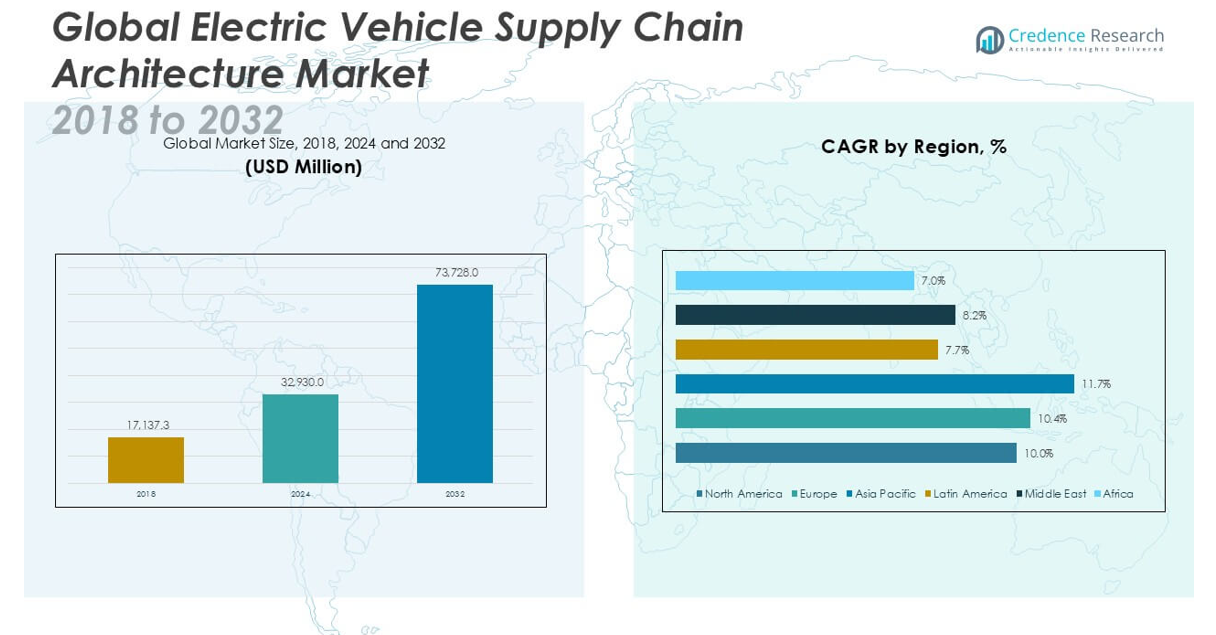
The Electric Vehicle Supply Chain Architecture market size was valued at USD 17,137.3 million in 2018, increased to USD 32,930.0 million in 2024, and is anticipated to reach USD 73,728.0 million by 2032, at a CAGR of 10.60% during the forecast period.
The Electric Vehicle Supply Chain Architecture market is driven by key players such as Contemporary Amperex Technology Co. Limited (CATL), LG Energy Solution, Panasonic Holdings Corporation, BYD Company Limited, Samsung SDI Co., Ltd., and Tesla, Inc. These companies lead the market with strong capabilities in battery manufacturing, advanced supply chain integration, and strategic partnerships with automotive OEMs. Bosch, Aptiv PLC, Denso Corporation, and Magna International Inc. further strengthen the market through their expertise in electronic components and supply chain systems. Asia Pacific holds the dominant position in the global market, capturing approximately 42.0% of the total market share in 2024, supported by large-scale production, government incentives, and rapidly expanding electric vehicle demand in China, Japan, and South Korea.
Market Insights
- The Electric Vehicle Supply Chain Architecture market was valued at USD 32,930.0 million in 2024 and is projected to reach USD 73,728.0 million by 2032, growing at a CAGR of 10.60% during the forecast period.
- Increasing demand for electric vehicles, driven by rising environmental concerns and government incentives, is significantly boosting market growth across all major regions.
- The market is witnessing trends such as the rapid integration of digital supply chain solutions and the shift toward localized supply chains to reduce global disruption risks.
- Asia Pacific holds the largest regional share of around 42.0% in 2024, with the lithium-ion battery segment leading due to its high energy density and widespread adoption in electric vehicles.
- The market faces restraints including limited availability of critical raw materials and complex global logistics, which can create supply shortages and increase operational costs for key players.
Market Segmentation Analysis:
By Battery Type:
The lithium-ion batteries segment dominates the Electric Vehicle Supply Chain Architecture market, accounting for the largest market share in 2024. This dominance is driven by their high energy density, lightweight design, and longer life cycle compared to other battery types. The growing consumer preference for electric vehicles with extended driving range and faster charging capabilities has significantly increased the demand for lithium-ion batteries. Although solid-state batteries are emerging with potential safety and energy efficiency advantages, their market penetration remains limited due to high production costs and technological challenges.
- For instance, Panasonic supplies lithium-ion battery cells for Tesla’s Model 3, which has a battery pack capacity of 50 kWh to 82 kWh, enabling a range of up to 353 miles on a single charge.
By Vehicle Type
Battery Electric Vehicles (BEVs) hold the largest market share in the vehicle type segment of the Electric Vehicle Supply Chain Architecture market. BEVs lead the segment due to rising environmental concerns, stricter emission regulations, and increasing investments by manufacturers in electric vehicle platforms. Governments worldwide are offering substantial subsidies and incentives to promote BEV adoption, further accelerating market growth. While Plug-In Hybrid Electric Vehicles (PHEVs) and Hybrid Electric Vehicles (HEVs) contribute to the segment, BEVs continue to outperform due to advancements in battery technology and expanding charging infrastructure.
- For instance, BYD produced 1,574,822 battery electric vehicles in 2023, surpassing its own hybrid production and reinforcing its position as a BEV leader.
By Sales Channel
The Original Equipment Manufacturer (OEM) segment leads the sales channel in the Electric Vehicle Supply Chain Architecture market, capturing the largest market share. This dominance is supported by the growing collaborations between OEMs and battery suppliers, which enable integrated and efficient supply chains. OEMs offer customized and pre-installed components that ensure compatibility and performance, driving customer preference. The aftermarket segment is expanding as vehicle ownership rises, but it currently trails OEM sales due to limited demand for replacement parts in newer electric vehicles still under warranty.
Market Overview
Growing Demand for Electric Vehicles
The rapid global shift towards electric mobility is significantly driving the Electric Vehicle Supply Chain Architecture market. Rising environmental concerns, stringent emission regulations, and increasing fuel prices have accelerated the adoption of electric vehicles (EVs). Major automotive manufacturers are expanding their EV portfolios to meet consumer demand and comply with regulatory targets. Additionally, government incentives, tax benefits, and subsidies are further encouraging consumers to transition from conventional vehicles to EVs, which is directly boosting the demand for robust and efficient supply chain solutions.
- For instance, Tesla delivered 1,808,581 electric vehicles globally in 2023, marking a substantial increase in EV adoption that directly impacts supply chain demand.
Technological Advancements in Battery Production
Innovations in battery technology, especially lithium-ion and solid-state batteries, are a major growth catalyst for the market. Continuous improvements in battery energy density, safety, and cost reduction are enhancing electric vehicle performance and affordability. These advancements necessitate the development of sophisticated and flexible supply chain architectures to efficiently manage raw material procurement, battery manufacturing, and distribution. Strategic partnerships between battery manufacturers and OEMs are further strengthening the supply chain infrastructure, ensuring timely production and delivery to meet increasing global demand.
- For instance, CATL launched its third-generation cell-to-pack (CTP) battery technology in 2022, achieving a volume utilization efficiency of 72% and supporting ranges exceeding 1,000 kilometers per charge.
Expansion of Charging Infrastructure
The ongoing expansion of public and private electric vehicle charging networks significantly supports market growth. The availability of fast-charging stations and home charging solutions is improving consumer confidence and driving electric vehicle adoption. This infrastructural development requires seamless coordination across multiple supply chain layers, including hardware manufacturers, software providers, and logistics operators. Efficient supply chain systems are critical to meeting the logistical demands of charging infrastructure deployment, thereby creating growth opportunities for supply chain architecture providers within the EV ecosystem.
Key Trends & Opportunities
Rising Integration of Digital Supply Chain Solutions
The adoption of digital technologies such as blockchain, artificial intelligence, and Internet of Things (IoT) is transforming the Electric Vehicle Supply Chain Architecture market. These technologies enable real-time tracking, predictive maintenance, and enhanced transparency across supply chain operations. Companies are leveraging digital platforms to improve decision-making, reduce lead times, and optimize inventory management. This trend presents significant opportunities for supply chain solution providers to offer advanced, data-driven systems that improve efficiency and responsiveness in the electric vehicle sector.
- For instance, Volkswagen implemented its "Industrial Cloud" solution in collaboration with Amazon Web Services, connecting over 30,000 machines and systems across its 122 production sites worldwide for real-time supply chain management.
Increased Focus on Localized Supply Chains
Manufacturers are increasingly shifting towards localized and regional supply chain models to minimize risks related to global disruptions, trade restrictions, and geopolitical tensions. This trend is driving investments in regional production facilities and material sourcing to reduce dependency on international suppliers. Localizing supply chains helps ensure faster delivery times, reduced transportation costs, and greater flexibility to meet regional demand fluctuations. This strategic shift offers opportunities for supply chain architecture providers to design resilient, region-specific solutions.
- For instance, LG Energy Solution invested USD 5.5 billion to build a battery manufacturing complex in Arizona, USA, with a production capacity of 43 GWh per year to support North American EV supply chains.
Key Challenges
Supply Shortages of Critical Raw Materials
The Electric Vehicle Supply Chain Architecture market faces significant challenges due to the limited availability of critical raw materials such as lithium, cobalt, and nickel. These materials are essential for battery manufacturing, and their scarcity can lead to production delays and increased costs. The global competition for these resources further intensifies supply constraints, requiring manufacturers to secure long-term contracts or develop alternative materials. Addressing this challenge is crucial to maintaining supply chain stability and supporting market growth.
Complex Global Logistics and Regulatory Barriers
Managing the global supply chain for electric vehicles involves navigating complex logistics networks and diverse regulatory frameworks. Cross-border trade restrictions, import tariffs, and varying safety standards can create significant bottlenecks and compliance challenges. These complexities increase operational costs and delay product deliveries, posing hurdles for efficient supply chain management. Companies must invest in comprehensive regulatory strategies and logistics planning to overcome these obstacles and ensure smooth supply chain operations across different regions.
High Initial Investment in Infrastructure
Developing an integrated and technologically advanced supply chain architecture requires substantial upfront investment. The cost of establishing regional manufacturing hubs, advanced warehousing, and digital tracking systems can be a barrier for smaller market participants. Additionally, investments in skilled labor, cybersecurity, and sustainable practices further elevate entry costs. This high financial requirement limits market access and can slow the pace of supply chain expansion, particularly in emerging markets with constrained capital resources.
Regional Analysis
North America
In 2024, North America held a market size of USD 7,409.3 million in the Electric Vehicle Supply Chain Architecture market, accounting for approximately 22.5% of the global share. The market grew from USD 4,284.3 million in 2018 and is projected to reach USD 14,598.2 million by 2032, registering a CAGR of 10.0% during the forecast period. The region’s growth is driven by the rapid adoption of electric vehicles, favorable government policies, and robust investments in charging infrastructure and battery production. Strong collaboration between OEMs and technology providers further strengthens the North American supply chain landscape.
Europe
Europe captured around 25.0% of the global Electric Vehicle Supply Chain Architecture market in 2024, with a market size of USD 8,232.5 million, up from USD 4,113.0 million in 2018. The market is expected to reach USD 18,063.4 million by 2032, growing at a CAGR of 10.4%. Europe’s growth is propelled by stringent carbon emission regulations, aggressive EV manufacturing targets, and substantial government incentives. The region’s focus on creating a circular battery economy and expanding localized supply chains enhances its market competitiveness, contributing to its growing market share and supply chain sophistication.
Asia Pacific
Asia Pacific dominates the Electric Vehicle Supply Chain Architecture market with a commanding 42.0% market share in 2024. The market surged from USD 6,752.1 million in 2018 to USD 13,830.6 million in 2024 and is projected to reach USD 33,914.9 million by 2032, at the highest regional CAGR of 11.7%. The region’s leadership is supported by China’s large-scale EV production, aggressive government support, and robust battery manufacturing capabilities. Additionally, increasing EV demand in countries like Japan, South Korea, and India fuels regional growth, making Asia Pacific the core hub of the global EV supply chain.
Latin America
Latin America accounted for about 3.5% of the global Electric Vehicle Supply Chain Architecture market in 2024, with a market size of USD 1,152.6 million, growing from USD 599.8 million in 2018. The market is anticipated to reach USD 2,949.1 million by 2032, expanding at a CAGR of 7.7%. The region’s growth is gradually improving, driven by increasing government initiatives to reduce emissions and rising interest in EV infrastructure development. However, challenges related to high initial investment and limited charging facilities are slowing the market’s pace compared to other regions.
Middle East
The Middle East held approximately 4.9% of the global Electric Vehicle Supply Chain Architecture market in 2024, with a market value of USD 1,613.6 million, up from USD 942.6 million in 2018. The market is expected to grow to USD 3,170.3 million by 2032, registering a CAGR of 8.2%. Growing environmental awareness, coupled with increasing investments in smart city projects and EV adoption, is supporting regional expansion. Although infrastructure challenges persist, countries like the UAE and Saudi Arabia are spearheading electric vehicle initiatives that will contribute to market growth in the coming years.
Africa
Africa contributed about 2.1% to the global Electric Vehicle Supply Chain Architecture market in 2024, with a market size of USD 691.5 million, rising from USD 445.6 million in 2018. The market is projected to reach USD 1,032.2 million by 2032, advancing at a CAGR of 7.0%. The African market is in its early stages, facing infrastructure gaps and affordability constraints. However, increasing urbanization, government interest in sustainable transportation, and emerging investments in EV charging stations are expected to gradually support market growth, albeit at a slower rate compared to other global regions.
Market Segmentations:
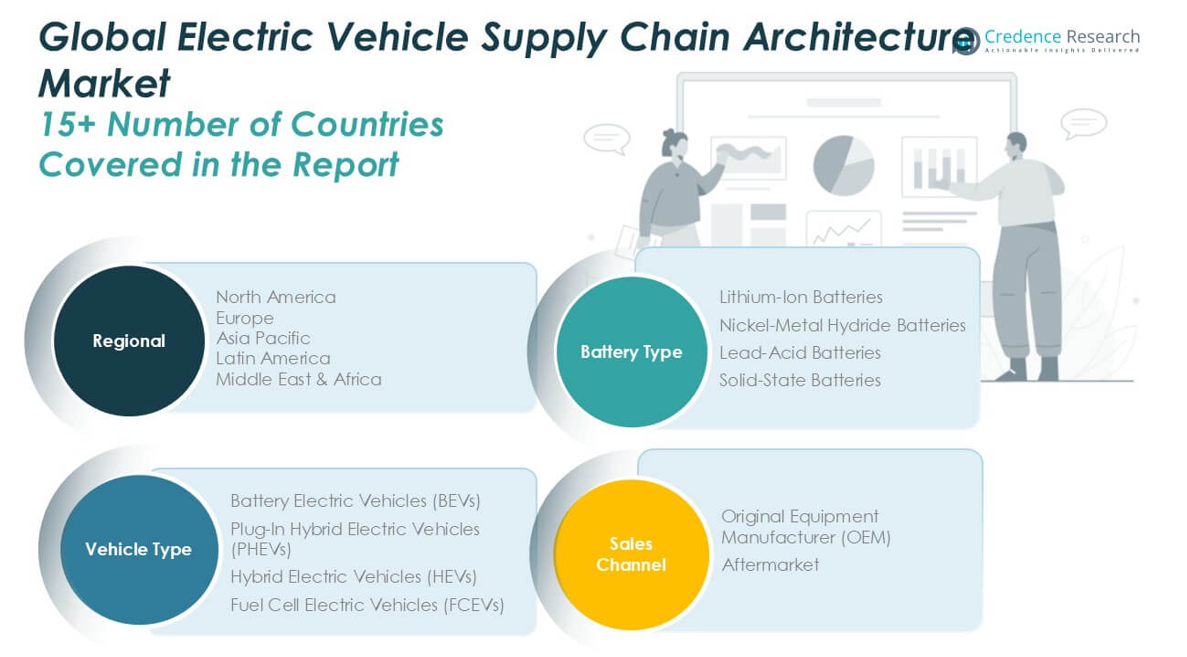
By Battery Type:
- Lithium-Ion Batteries
- Nickel-Metal Hydride Batteries
- Lead-Acid Batteries
- Solid-State Batteries
By Vehicle Type:
- Battery Electric Vehicles (BEVs)
- Plug-In Hybrid Electric Vehicles (PHEVs)
- Hybrid Electric Vehicles (HEVs)
- Fuel Cell Electric Vehicles (FCEVs)
By Sales Channel:
- Original Equipment Manufacturer (OEM)
- Aftermarket
By Geography:
- North America
- U.S.
- Canada
- Mexico
- Europe
- Germany
- France
- U.K.
- Italy
- Spain
- Rest of Europe
- Asia Pacific
- China
- Japan
- India
- South Korea
- South-east Asia
- Rest of Asia Pacific
- Latin America
- Brazil
- Argentina
- Rest of Latin America
- Middle East & Africa
- GCC Countries
- South Africa
- Rest of the Middle East and Africa
Competitive Landscape
The Electric Vehicle Supply Chain Architecture market is highly competitive, with key players focusing on technological innovation, strategic partnerships, and capacity expansion to strengthen their market positions. Companies such as Contemporary Amperex Technology Co. Limited (CATL), LG Energy Solution, Panasonic Holdings Corporation, and BYD Company Limited dominate the battery supply segment, leveraging large-scale production and advanced battery technologies. Automotive leaders like Tesla, Inc., and major component suppliers such as Bosch, Aptiv, and Denso play critical roles in the integrated supply chain, ensuring seamless coordination across manufacturing, assembly, and distribution. The market is witnessing increasing collaboration between OEMs and battery manufacturers to secure long-term supply agreements and mitigate raw material shortages. Additionally, players are investing in regional production facilities to reduce dependency on global logistics and improve responsiveness to market demands. Competitive strategies also include digital supply chain integration and sustainability initiatives aimed at enhancing supply chain transparency and reducing environmental impact.
Key Player Analysis
- Contemporary Amperex Technology Co. Limited (CATL)
- LG Energy Solution
- Panasonic Holdings Corporation
- BYD Company Limited
- Samsung SDI Co., Ltd.
- SK On Co., Ltd.
- Tesla, Inc.
- Robert Bosch GmbH
- Nidec Corporation
- Infineon Technologies AG
- Aptiv PLC
- Denso Corporation
- Magna International Inc.
- Valeo SA
Recent Developments
- In February 2025, Geely Galaxy has introduced the Galaxy L6 EM-i, a compact plug-in hybrid sedan available in five variants with CLTC electric-mode ranges of 60 km and 140 km. Prices range from CNY 79,800 to CNY 106,800.
- In February 2025, Volvo Cars introduced the all-new Volvo EX30 Cross Country, a fully electric compact SUV. It is available for order in selected markets, with deliveries beginning in spring 2025. The vehicle offers a range of up to 427 km and can charge from 10% to 80% in 26 minutes. It features all-wheel drive, increased ground clearance for improved off-road capability, and larger wheels, with an option for 18-inch all-terrain tires.
- In January 2025, Tesla launched the new Model Y in the US and Canada. The Model Y Launch Series, priced at USD 59,990 before options in the US, is set for deliveries starting in March 2025.
- In March 2023, Moscow signed a contract with KAMAZ for 1,000 electric buses. There are also plans to purchase another 200 electric buses from GAZ Group. Moscow currently runs 1,055 electric buses on 79 routes. Moscow plans to install nearly 200 ultra-fast charging stations for the electric buses, open a second electric bus park in the Mitino district northwest of Moscow, and launch 29 more electric bus routes.
- In February 2023, BYD has added two new dealer corporations to its network in the Europe region. Motor Distributors Ltd (MDL) is active in Ireland and will offer BYD models at select locations including Dublin and Cork. RSA is a dealer with whom BYD already works in Norway, and it will offer EVs of Chinese-make in Finland and Iceland. BYD initially launched three EV models in select European countries at the end of 2022. Two more series could follow in 2023.
Market Concentration & Characteristics
The Electric Vehicle Supply Chain Architecture Market is moderately concentrated, with a few dominant players controlling significant market shares, particularly in battery manufacturing and electronic components. It features high entry barriers due to the need for advanced technology, substantial capital investment, and long-term supplier agreements. The market is characterized by rapid technological evolution, complex global logistics, and increasing reliance on digital supply chain management. Strong partnerships between battery manufacturers and automotive OEMs define its structure, enabling streamlined production and secured supply. It operates within a highly regulated environment, driven by emission standards and sustainability goals. Companies prioritize regionalization to reduce logistical risks and improve responsiveness to market demand. The market’s competitive intensity is elevated by continuous innovation in battery chemistry, supply chain transparency, and cost efficiency. It demonstrates significant interdependence across suppliers, logistics providers, and OEMs, which creates vulnerability to raw material shortages and geopolitical disruptions.
Report Coverage
The research report offers an in-depth analysis based on Battery Type, Vehicle Type, Sales Channel and Geography. It details leading market players, providing an overview of their business, product offerings, investments, revenue streams, and key applications. Additionally, the report includes insights into the competitive environment, SWOT analysis, current market trends, as well as the primary drivers and constraints. Furthermore, it discusses various factors that have driven market expansion in recent years. The report also explores market dynamics, regulatory scenarios, and technological advancements that are shaping the industry. It assesses the impact of external factors and global economic changes on market growth. Lastly, it provides strategic recommendations for new entrants and established companies to navigate the complexities of the market.
Future Outlook
- The Electric Vehicle Supply Chain Architecture market is expected to expand steadily with the increasing global adoption of electric vehicles.
- Battery manufacturing will remain the core focus, with continuous advancements in lithium-ion and solid-state technologies.
- Companies will prioritize building regional supply chains to reduce dependence on international logistics and mitigate disruption risks.
- Demand for digital supply chain solutions will grow, driven by the need for real-time tracking and improved transparency.
- Strategic partnerships between OEMs and battery suppliers will strengthen to ensure consistent raw material access and production capacity.
- Governments worldwide will continue to support the market through subsidies, emission regulations, and infrastructure investments.
- The market will experience growing pressure to address critical raw material shortages and develop alternative, sustainable materials.
- Investments in recycling and second-life battery solutions will increase to support circular supply chain models.
- Rapid development of charging infrastructure will continue to create demand for efficient, integrated supply chain networks.
- The competitive landscape will remain intense as established players and new entrants focus on technological innovation and cost optimization.

Request a Free Sample
Fill in your details and we'll send you a free sample report.
- Sample data tables & charts
- Research methodology
Market Dynamics
Expansion of Battery Manufacturing Capabilities
Major investments in lithium-ion and emerging solid-state battery production are enabling higher output, improved performance, and cost reductions, which are essential for scaling electric vehicle supply chains and meeting rising global EV demand.
Government Incentives and Regulatory Support
Substantial subsidies, tax benefits, and strict emission regulations in key markets are accelerating EV adoption, compelling OEMs and suppliers to enhance and localize their supply chain architectures to comply with policy requirements and capture market opportunities.
Integration of Digital Supply Chain Solutions
The adoption of technologies such as IoT, AI, and blockchain is transforming supply chain management by enabling real-time tracking, predictive analytics, and greater transparency, which improves efficiency and responsiveness across the EV supply chain.
Regionalization and Localization of Supply Chains
To mitigate risks from global disruptions and geopolitical tensions, companies are investing in regional production facilities and sourcing strategies, which shortens lead times, reduces costs, and enhances supply chain resilience for electric vehicles.
Rapid Development of Charging Infrastructure
The accelerated rollout of public and private charging networks is driving demand for coordinated supply chain solutions, requiring efficient logistics and integration across hardware, software, and service providers to support widespread EV adoption.
Need a Custom Version of This Report?
Tailor the scope, geography, or segments to your exact requirements.
- Custom geography or segment scope
- Direct access to our analyst team
Frequently Asked Questions
What is the current size of the Electric Vehicle Supply Chain Architecture Market?
What are the key segments within the Electric Vehicle Supply Chain ArchitectureMarket?
What are some challenges faced by the Electric Vehicle Supply Chain Architecture Market?
Who are the major players in the Electric Vehicle Supply Chain Architecture Market?
Table of Content
Chapter 1 Market Segmentation
- 1.1 Segmentation Framework
- 1.1.1 Product and Service Classification
- 1.1.2 Application and End-Use Classification
- 1.1.3 Technology and Solution Classification
- 1.1.4 Customer and Distribution Channel Classification
- 1.1.5 Geographic Segmentation
- 1.1.6 Market Segment Definitions and Boundaries
- 1.2 By Battery Type
- 1.2.1 Lithium-Ion Batteries
- 1.2.2 Nickel-Metal Hydride Batteries
- 1.2.3 Lead-Acid Batteries
- 1.2.4 Solid-State Batteries
- 1.3 By Vehicle Type
- 1.3.1 Battery Electric Vehicles (BEVs)
- 1.3.2 Plug-In Hybrid Electric Vehicles (PHEVs)
- 1.3.3 Hybrid Electric Vehicles (HEVs)
- 1.3.4 Fuel Cell Electric Vehicles (FCEVs)
- 1.4 By Sales Channel
- 1.4.1 Original Equipment Manufacturer (OEM)
- 1.4.2 Aftermarket
Chapter 2 Introduction
- 2.1 Report Objectives and Scope
- 2.2 Product Definition and Industry Terminology
- 2.3 Market Inclusions and Exclusions
- 2.4 Research Process
- 2.4.1 Primary Research and Expert Interviews
- 2.4.2 Secondary Research and Source Review
- 2.4.3 Top-Down and Bottom-Up Estimation
- 2.4.4 Data Triangulation and Verification
- 2.5 Market Size Measurement Basis
- 2.5.1 2024: USD 32,930.0 million → 2032: USD 73,728.0 million
- 2.6 Historical and Forecast Reference Periods
- 2.6.1 Base Year: 2024
- 2.6.2 Forecast Period: 2024-2032
- 2.7 Research Assumptions and Limitations
Chapter 3 Executive Summary
- 3.1 Market Snapshot and Key Findings
- 3.2 Base-Year Market Size, 2024
- 3.3 Forecast Market Size, 2032
- 3.4 Revenue and Volume Growth Outlook
- 3.5 Key Demand and Supply Indicators
- 3.6 Leading Market Segments
- 3.7 Fastest-Growing Market Opportunities
- 3.8 Regional Performance Highlights
- 3.9 Technology and Industry Transformation
- 3.10 Competitive Landscape Summary
- 3.11 Analyst View and Strategic Implications
Chapter 4 Global Electric Vehicle Supply Chain Architecture Market Trends and Developments
- 4.1 Historical Industry Development
- 4.2 Recent Market Trends and Developments
- 4.3 Demand and Customer Behavior Trends
- 4.4 Technology and Product Innovation
- 4.5 Artificial Intelligence, Automation and Digitalization
- 4.6 Local Manufacturing and Supply Chain Realignment
- 4.7 Industry Partnerships, Mergers and Acquisitions
- 4.8 Sustainability and Circular Economy Developments
- 4.9 Government and Private Sector Investment Trends
- 4.10 Emerging Business Models and Commercialization
- 4.11 Industry Developments and Announcements
Chapter 5 Global Electric Vehicle Supply Chain Architecture Market Production, Supply and Demand Analysis
- 5.1 Demand Trend and Consumption Analysis
- 5.2 Demand Forecast, 2024-2032
- 5.3 Production and Output Trend
- 5.4 Production and Output Forecast, 2024-2032
- 5.5 Installed Capacity and Capacity Utilization
- 5.6 Company-Wise Production Plants and Statistics
- 5.6.1 Installed Production Capacity
- 5.6.2 Actual Production
- 5.6.3 Planned Capacity and Expansion Targets
- 5.7 Supply Chain Structure and Procurement Trends
- 5.8 Supply-Demand Gap and Bottlenecks
- 5.9 Import Dependence and Sourcing Structure
- 5.10 Contract Manufacturing and Outsourcing
- 5.11 Regional Supply and Demand Concentration
Chapter 6 Global Electric Vehicle Supply Chain Architecture Market Pricing Analysis
- 6.1 Pricing Structure and Measurement
- 6.2 Historical Pricing Trends
- 6.3 Pricing Outlook, 2024-2032
- 6.4 Average Selling Price and Unit Economics
- 6.5 Pricing by Product and Market Segment
- 6.6 Geographic Pricing Differences
- 6.7 Key Input, Energy, Labor and Logistics Costs
- 6.8 Contract Pricing and Purchasing Models
- 6.9 Pricing Sensitivity and Competitive Positioning
- 6.10 Price, Margin and Profitability Implications
Chapter 7 Global Electric Vehicle Supply Chain Architecture Market Dynamics
- 7.1 Market Growth Drivers
- 7.1.1 Demand-Side Drivers
- 7.1.2 Technology and Innovation Drivers
- 7.1.3 Infrastructure and Investment Drivers
- 7.1.4 Regulatory and Policy Drivers
- 7.2 Market Restraints
- 7.2.1 Cost and Affordability Constraints
- 7.2.2 Technology and Adoption Barriers
- 7.2.3 Supply Chain and Operational Constraints
- 7.3 Market Challenges
- 7.3.1 Competitive Pressure and Margin Erosion
- 7.3.2 Skills, Infrastructure and Implementation Gaps
- 7.4 Emerging Market Opportunities
- 7.5 Market Dynamics Impact and Time-Horizon Assessment
Chapter 8 Global Electric Vehicle Supply Chain Architecture Value Chain Analysis
- 8.1 Industry Value Chain Overview
- 8.2 Upstream Suppliers and Critical Inputs
- 8.3 Technology and Component Providers
- 8.4 Manufacturing or Service Delivery
- 8.5 Distribution, Channel Partners and Integrators
- 8.6 Downstream Applications and End Users
- 8.7 Value Addition and Profit Pools
- 8.8 Vertical Integration and Outsourcing
- 8.9 Supplier Concentration and Risk
- 8.10 Supply Chain Localization and Resilience
Chapter 9 Global Electric Vehicle Supply Chain Architecture Market Regulations and Policies
- 9.1 Relevant Laws, Standards and Compliance Frameworks
- 9.2 Product, Service, Safety and Quality Requirements
- 9.3 Government Policies, Incentives and Subsidies
- 9.4 Imports, Exports and Trade Barriers
- 9.5 Public Procurement and Local Content Requirements
- 9.6 Environmental and Sustainability Compliance
- 9.7 Upcoming Policy Changes and Market Implications
Chapter 10 Global Electric Vehicle Supply Chain Architecture Market Hotspots and Opportunities
- 10.1 Market Opportunity Mapping and Growth Hotspots
- 10.2 High-Growth Applications and Customer Groups
- 10.3 Underserved Markets and White-Space Opportunities
- 10.4 Emerging Technology and Product Opportunities
- 10.5 New Capacity and Investment Hotspots
- 10.6 Market Entry and Expansion Opportunities
- 10.7 Distribution and Partnership Opportunities
- 10.8 Near-Term and Long-Term Commercial Potential
- 10.9 Opportunity Attractiveness and Execution Risks
Chapter 11 Global Electric Vehicle Supply Chain Architecture Market Outlook, 2024-2032
- 11.1 Market Size and Analysis
- 11.1.1 Revenue (Market Measurement: 2024: USD 32,930.0 million → 2032: USD 73,728.0 million)
- 11.1.2 Market Volume and Quantity Sold
- 11.1.3 Historical Market Size
- 11.1.4 Base-Year Market Size, 2024
- 11.2 Market Forecast, 2024-2032
- 11.2.1 Revenue Forecast to 2032
- 11.2.2 Volume Forecast to 2032
- 11.2.3 CAGR and Year-on-Year Growth
- 11.2.4 Incremental Revenue Opportunity
- 11.3 Forecast Assumptions and Scenario Analysis
- 11.3.1 Base-Case Forecast
- 11.3.2 Optimistic and Conservative Scenarios
- 11.3.3 Technology, Pricing and Policy Sensitivities
- 11.4 Market Attractiveness and Growth Outlook
Chapter 12 Global Electric Vehicle Supply Chain Architecture Market Segmentation and Outlook
- 12.1 Segmentation Summary and Market Shares, 2024
- 12.2 Largest and Fastest-Growing Segments
- 12.3 By Battery Type - Market Size and Forecast, 2024-2032
- 12.3.1 Segment Definition and Scope
- 12.3.2 Historical Market Size
- 12.3.3 Revenue Forecast, 2024-2032
- 12.3.4 Volume Forecast, 2024-2032
- 12.3.5 Base-Year Market Share, 2024
- 12.3.6 Segment CAGR and Growth Drivers
- 12.3.7 Subsegment Market Size and Forecast
- 12.3.7.1 Lithium-Ion Batteries
- 12.3.7.2 Nickel-Metal Hydride Batteries
- 12.3.7.3 Lead-Acid Batteries
- 12.3.7.4 Solid-State Batteries
- 12.3.8 Subsegment Pricing and Adoption Trends
- 12.3.9 Leading Suppliers and Competition
- 12.3.10 Regional Demand and Opportunities
- 12.4 By Vehicle Type - Market Size and Forecast, 2024-2032
- 12.4.1 Segment Definition and Scope
- 12.4.2 Historical Market Size
- 12.4.3 Revenue Forecast, 2024-2032
- 12.4.4 Volume Forecast, 2024-2032
- 12.4.5 Base-Year Market Share, 2024
- 12.4.6 Segment CAGR and Growth Drivers
- 12.4.7 Subsegment Market Size and Forecast
- 12.4.7.1 Battery Electric Vehicles (BEVs)
- 12.4.7.2 Plug-In Hybrid Electric Vehicles (PHEVs)
- 12.4.7.3 Hybrid Electric Vehicles (HEVs)
- 12.4.7.4 Fuel Cell Electric Vehicles (FCEVs)
- 12.4.8 Subsegment Pricing and Adoption Trends
- 12.4.9 Leading Suppliers and Competition
- 12.4.10 Regional Demand and Opportunities
- 12.5 By Sales Channel - Market Size and Forecast, 2024-2032
- 12.5.1 Segment Definition and Scope
- 12.5.2 Historical Market Size
- 12.5.3 Revenue Forecast, 2024-2032
- 12.5.4 Volume Forecast, 2024-2032
- 12.5.5 Base-Year Market Share, 2024
- 12.5.6 Segment CAGR and Growth Drivers
- 12.5.7 Subsegment Market Size and Forecast
- 12.5.7.1 Original Equipment Manufacturer (OEM)
- 12.5.7.2 Aftermarket
- 12.5.8 Subsegment Pricing and Adoption Trends
- 12.5.9 Leading Suppliers and Competition
- 12.5.10 Regional Demand and Opportunities
- 12.6 Segment Growth Comparison
- 12.7 Segment Attractiveness and Priority Matrix
Chapter 13 Global Electric Vehicle Supply Chain Architecture Geographic Market Outlook, 2024-2032
- 13.1 Regional Market Size and Share, 2024
- 13.2 Regional Market Forecast, 2024-2032
- 13.3 Regional Pricing, Production and Demand Differences
- 13.4 North America
- 13.4.1 United States
- 13.4.2 Canada
- 13.4.3 Mexico
- 13.5 Europe
- 13.5.1 Germany
- 13.5.2 France
- 13.5.3 Italy
- 13.5.4 United Kingdom
- 13.5.5 Spain
- 13.5.6 Poland
- 13.5.7 Russia
- 13.5.8 Netherlands
- 13.5.9 Belgium
- 13.5.10 Sweden
- 13.5.11 Denmark
- 13.5.12 Norway
- 13.5.13 Rest of Europe
- 13.6 Asia Pacific
- 13.6.1 China
- 13.6.2 India
- 13.6.3 Japan
- 13.6.4 South Korea
- 13.6.5 Thailand
- 13.6.6 Indonesia
- 13.6.7 Vietnam
- 13.6.8 Malaysia
- 13.6.9 Australia
- 13.6.10 Rest of Asia Pacific
- 13.7 Latin America
- 13.7.1 Brazil
- 13.7.2 Argentina
- 13.7.3 Colombia
- 13.7.4 Chile
- 13.7.5 Rest of Latin America
- 13.8 Middle East
- 13.8.1 Saudi Arabia
- 13.8.2 United Arab Emirates
- 13.8.3 Turkey
- 13.8.4 Israel
- 13.8.5 Iran
- 13.8.6 Rest of the Middle East
- 13.9 Africa
- 13.9.1 South Africa
- 13.9.2 Egypt
- 13.9.3 Nigeria
- 13.9.4 Morocco
- 13.9.5 Rest of Africa
- 13.10 Regional Investment, Policy and Supply Chain Differences
- 13.11 Regional Competitive Landscape
- 13.12 Geographic Growth Hotspots
Chapter 14 Global Electric Vehicle Supply Chain Architecture Technology, Innovation and Sustainability Outlook
- 14.1 Technology Landscape and Maturity
- 14.2 Product, Process and Service Innovation
- 14.3 AI, Automation and Digital Tools in the Industry
- 14.4 Technology Adoption and Performance Benchmarking
- 14.5 Innovation Pipeline and R&D Investment
- 14.6 Patent and Intellectual Property Trends
- 14.7 Energy Efficiency and Resource Management
- 14.8 Sustainability, Recycling and Circularity
- 14.9 Technology Roadmap, 2024-2032
- 14.10 Risks of Obsolescence and Technology Substitution
Chapter 15 Global Electric Vehicle Supply Chain Architecture Market Key Strategic Imperatives
- 15.1 Growth and Market Entry Priorities
- 15.2 High-Return Products and Segments
- 15.3 Pricing, Profitability and Cost Optimization
- 15.4 Technology Investment and Product Differentiation
- 15.5 Supply Chain Localization and Resilience
- 15.6 Distribution and Customer Acquisition
- 15.7 Partnership, Acquisition and Capacity Strategy
- 15.8 Regional Expansion Priorities
- 15.9 Short-, Medium- and Long-Term Actions
Chapter 16 Competition Outlook
- 16.1 Industry Competition Characteristics
- 16.2 Market Structure and Concentration
- 16.3 Market Share and Competitive Positioning, 2024
- 16.4 Company-Wise Revenue and Product Benchmarking
- 16.5 Production and Service Capacity Benchmarking
- 16.6 Technology, Pricing and Differentiation
- 16.7 Regional Footprint and Distribution Strength
- 16.8 Mergers, Acquisitions and Strategic Alliances
- 16.9 New Entrants and Competitive Threats
- 16.10 Porter's Five Forces and Industry Attractiveness
- 16.11 Competitive Outlook, 2024-2032
Chapter 17 Company Profiles
- 17.1 Company Coverage and Selection Criteria
- 17.2 Contemporary Amperex Technology Co. Limited (CATL)
- 17.2.1 Business Description
- 17.2.2 Company Ownership and Geographic Presence
- 17.2.3 Product and Service Portfolio
- 17.2.4 Manufacturing and Operating Footprint
- 17.2.5 Production Capacity and Expansion Plans
- 17.2.6 Financial Performance and Investment
- 17.2.7 Market Share and Competitive Position
- 17.2.8 Technology and Innovation Capabilities
- 17.2.9 Strategic Alliances or Partnerships
- 17.2.10 Recent Developments
- 17.2.11 Growth Strategy and Outlook
- 17.3 LG Energy Solution
- 17.4 Panasonic Holdings Corporation
- 17.5 BYD Company Limited
- 17.6 Samsung SDI Co., Ltd.
- 17.7 Tesla, Inc.
- 17.8 Bosch
- 17.9 Aptiv PLC
- 17.10 Denso Corporation
- 17.11 Magna International Inc.
- 17.12 Other Relevant Market Participants
Note: Every listed company is profiled on the structure shown under the first company. The company list is preliminary and may change based on research findings, market developments, data availability and client requirements.
Chapter 18 Disclaimer
- 18.1 Research and Forecast Disclaimer
- 18.2 Data Source and Estimation Limitations
Note: The depth of individual sections depends on data availability for this market. Volume, capacity, trade and other unit-based metrics are included where applicable.