
Market Overview
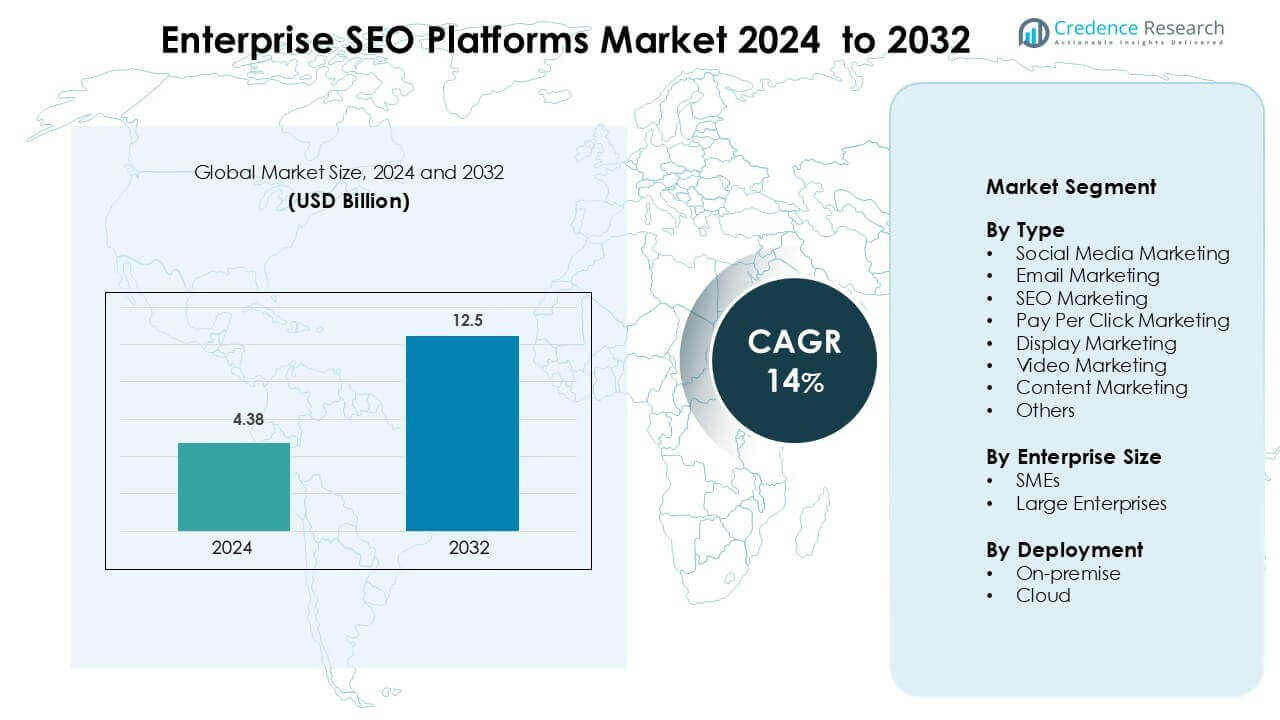
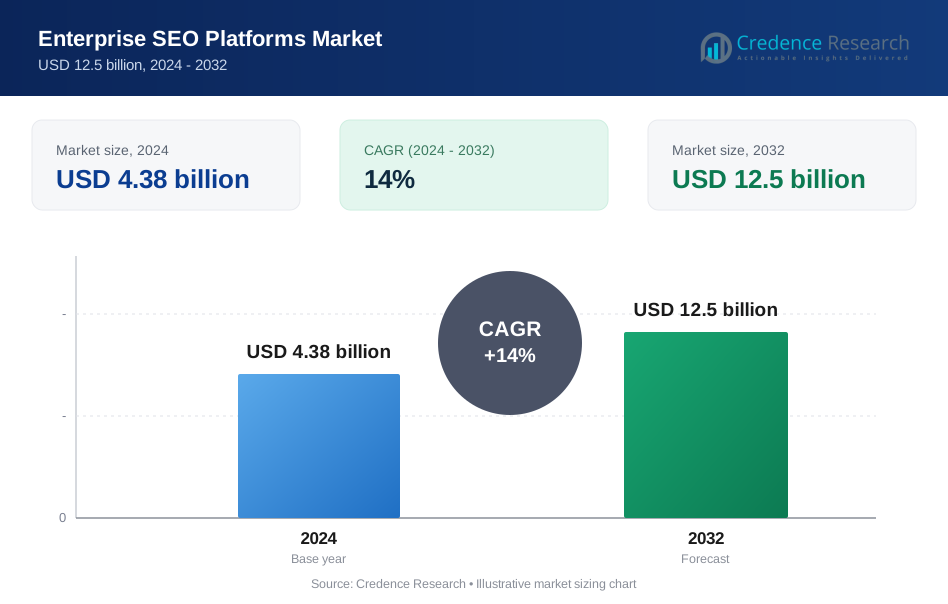
Enterprise SEO Platforms Market was valued at USD 4.38 billion in 2024 and is anticipated to reach USD 12.5 billion by 2032, growing at a CAGR of 14% during the forecast period.
| REPORT ATTRIBUTE | DETAILS |
|---|---|
| Historical Period | 2020-2023 |
| Base Year | 2024 |
| Forecast Period | 2025-2032 |
| Enterprise SEO Platforms Market Size 2024 | USD 4.38 billion |
| Enterprise SEO Platforms Market, CAGR | 14% |
| Enterprise SEO Platforms Market Size 2032 | USD 12.5 billion |
The Enterprise SEO Platforms Market features prominent players such as BrightEdge Technologies, Inc., SEOMoz, Inc., WebFX, Conductor, Screaming Frog Ltd., Semrush, Ahrefs Pte. Ltd., HubSpot, Inc., OuterBox, and Next Net Media. These companies focus on delivering AI-driven analytics, automation, and integrated SEO solutions that enhance enterprise visibility and performance. BrightEdge and Conductor lead in enterprise-grade optimization and analytics, while Semrush and Ahrefs dominate in keyword intelligence and competitive benchmarking. North America leads the global market with a 38% share, driven by high technology adoption, robust digital marketing infrastructure, and the strong presence of key SEO platform providers across the region.
Market Insights
- The Enterprise SEO Platforms Market was valued at USD 4.38 billion in 2024 and is projected to grow at a CAGR of 14 % during the forecast period from 2025 to 2032.
- Growing adoption of AI-driven SEO analytics and automation tools is driving market expansion, enabling enterprises to enhance keyword optimization, reporting efficiency, and online visibility across multiple digital channels.
- Emerging trends include increased focus on voice and visual search optimization, integration of SEO with content and social media marketing, and higher demand for cloud-based deployment models among global enterprises.
- Competitive dynamics are shaped by key players such as BrightEdge Technologies, SEOMoz, Conductor, Semrush, and HubSpot, which prioritize platform innovation, automation, and cross-channel performance tracking to strengthen market presence.
- North America leads the market with a 38% share, followed by Europe with 27% and Asia-Pacific with 23%, while the SEO marketing segment holds the dominant share by type due to its role in driving organic visibility.
Market Segmentation Analysis
By Type
SEO marketing dominates the Enterprise SEO Platforms Market, accounting for the largest share due to its role in driving organic visibility and sustainable digital performance. Businesses invest heavily in SEO tools for keyword optimization, backlink tracking, and performance analytics. The segment benefits from AI-driven content analysis, predictive keyword modeling, and automation that enhance search performance across regions. The integration of analytics dashboards enables enterprises to track ROI effectively. Demand continues to rise as brands prioritize long-term online positioning and cost-efficient digital traffic acquisition strategies.
- For instance, Semrush publicly reported processing over 25 billion keywords in its database and analyzing more than 43 trillion backlinks, giving enterprises large-scale visibility into search performance.
By Enterprise Size
Large enterprises hold the leading share in the Enterprise SEO Platforms Market. Their complex online ecosystems and multi-domain operations require scalable SEO solutions that offer real-time analytics and API integrations. These organizations prioritize advanced automation, cross-departmental reporting, and multi-lingual SEO features to support global operations. Major corporations leverage enterprise-grade tools for managing hundreds of pages and optimizing diverse content portfolios. The segment’s dominance is reinforced by high adoption of AI-based insights and performance benchmarking tools that improve visibility and conversion tracking across multiple digital channels.
- For instance, Adobe Experience Cloud serves over 12,000 enterprise clients globally, integrating SEO, analytics, and automation under a unified platform.
By Deployment
Cloud deployment leads the Enterprise SEO Platforms Market with the largest share, driven by flexibility, scalability, and real-time collaboration. Cloud-based platforms enable teams across regions to manage campaigns efficiently through centralized dashboards and automated updates. The integration of cloud analytics enhances responsiveness and reduces operational delays. Enterprises prefer cloud solutions for their lower infrastructure costs and ease of integration with CRM and CMS systems. Continuous updates, data synchronization, and improved accessibility drive higher adoption compared to on-premise alternatives in the evolving digital ecosystem.
Key Growth Drivers
Rising Focus on Data-Driven Digital Marketing
The growing emphasis on data-driven marketing strategies is a major driver of the Enterprise SEO Platforms Market. Organizations increasingly rely on analytics tools to monitor keyword performance, optimize campaigns, and improve conversion rates. SEO platforms enable enterprises to collect insights from multiple channels, enhancing decision-making accuracy. The integration of AI and machine learning supports predictive analysis, improving content strategies and keyword targeting. As businesses prioritize measurable marketing outcomes, demand for platforms offering comprehensive reporting and automation tools continues to surge. This shift toward data-centric approaches strengthens marketing ROI and long-term digital competitiveness.
- For instance, Google Marketing Platform primarily provides a unified ecosystem by tightly integrating its own set of products, such as Google Analytics 360, Display & Video 360, Search Ads 360, and Campaign Manager 360. This allows for seamless data flow and multi-channel analysis within the Google ecosystem.
Expansion of E-Commerce and Online Branding
The rapid expansion of e-commerce platforms and online retail channels drives the adoption of enterprise-level SEO solutions. Businesses competing in saturated digital markets require advanced SEO tools to maintain visibility and manage large-scale campaigns. Enterprise SEO platforms help optimize product listings, improve page rankings, and track audience engagement across multiple regions. With rising online transactions, companies are investing in localized SEO and multilingual optimization to reach diverse audiences. Continuous algorithm updates from search engines further fuel adoption, as enterprises seek adaptive tools for sustained visibility and performance optimization.
- For instance, Shopify's integrated SEO system supports over 5.5 million live online stores, enabling merchants to automatically generate a sitemap and customize meta tags for improved visibility.
Integration of AI and Automation in SEO Workflows
Artificial intelligence and automation are transforming enterprise SEO operations. Modern platforms integrate AI-driven algorithms that automate repetitive tasks such as site audits, keyword tracking, and competitor analysis. This shift reduces manual workload and increases efficiency across digital marketing teams. Automated content optimization tools enhance relevance and ensure compliance with search engine standards. The growing use of NLP (Natural Language Processing) enables contextual keyword recommendations, while predictive analytics helps forecast ranking performance. As enterprises pursue scalable and intelligent marketing systems, automation becomes a core component for improving productivity and achieving faster SEO results.
Key Trends & Opportunities
Increasing Adoption of Voice and Visual Search Optimization
Voice and visual search optimization present emerging opportunities for enterprise SEO platforms. As consumers shift to voice-enabled assistants and image-based searches, enterprises are adopting tools that support structured data and semantic indexing. SEO platforms now incorporate schema markup and AI-driven voice search analytics to improve visibility in conversational queries. Visual content optimization tools enhance product discoverability in image-based searches, particularly within retail and travel industries. This trend encourages businesses to refine metadata, enhance content accessibility, and capture new digital touchpoints. The integration of these capabilities positions SEO platforms as critical enablers of omnichannel engagement.
- For instance, Google Lens processes over 20 billion visual searches per month, enabling brands to optimize imagery for search relevance and purchase intent.
Growth of Cross-Channel and Integrated Marketing Solutions
The convergence of SEO with social media, email, and content marketing creates strong growth potential for integrated platforms. Enterprises increasingly demand unified dashboards that track campaign performance across multiple channels. Advanced platforms offer end-to-end analytics that correlate SEO metrics with user engagement and conversion data. This integration improves campaign consistency and strategic alignment across marketing teams. As businesses focus on enhancing customer journeys, platforms enabling cross-channel optimization and centralized reporting are gaining prominence. Vendors offering seamless integration with CRM, CMS, and analytics systems will continue to capture substantial market opportunities.
- For instance, HubSpot’s Marketing Hub integrates with over 1,500 third-party applications, allowing enterprises to synchronize SEO, CRM, and email automation under a single analytics framework.
Key Challenges
Constant Search Algorithm Updates and Compliance Complexity
Frequent algorithm updates from major search engines pose a significant challenge for enterprise SEO strategies. Continuous changes in ranking factors demand frequent platform updates and adaptive optimization techniques. Enterprises face risks of ranking losses or content devaluation due to non-compliance with evolving standards. Maintaining technical SEO accuracy across large-scale websites requires advanced monitoring and dedicated expertise. The growing emphasis on E-E-A-T (Experience, Expertise, Authoritativeness, and Trustworthiness) adds another layer of complexity. Vendors must invest in algorithm-responsive tools and training modules to help enterprises maintain consistent online visibility and compliance.
Data Privacy Regulations and Integration Limitations
Stringent data privacy laws, including GDPR and CCPA, challenge enterprise SEO operations that rely on user behavior analytics. Enterprises must ensure data collection practices align with regional compliance frameworks. Additionally, integrating SEO tools with analytics and CRM systems often involves security risks and data transfer complexities. These factors hinder seamless workflow automation and cross-platform data synchronization. Limited interoperability between legacy systems and modern SEO tools can also slow adoption. To overcome this, vendors are focusing on secure APIs, privacy-first analytics, and compliance-focused architecture to maintain customer trust while enabling scalable SEO management.
Regional Analysis
North America
North America holds the largest share of the Enterprise SEO Platforms Market, accounting for 38% in 2024. The region benefits from a mature digital infrastructure, widespread cloud adoption, and strong investments in online branding. Leading enterprises in the U.S. and Canada utilize advanced SEO automation and analytics tools to improve online visibility and campaign performance. The presence of global providers such as Adobe, Conductor, and BrightEdge drives technological innovation. Increased demand for data-driven insights and integration with marketing automation platforms further reinforces North America’s leadership in the enterprise SEO landscape.
Europe
Europe captures 27% of the Enterprise SEO Platforms Market, supported by rapid digital transformation across major economies like Germany, the U.K., and France. The region emphasizes compliance with GDPR and ethical data practices, driving the use of secure SEO analytics tools. European enterprises increasingly invest in multilingual SEO and local search optimization to target regional audiences. Market growth is also fueled by the adoption of AI-based content optimization and performance tracking solutions. The expanding e-commerce ecosystem and digital marketing partnerships continue to strengthen Europe’s competitive position in the global market.
Asia-Pacific
Asia-Pacific accounts for 23% of the Enterprise SEO Platforms Market and shows the fastest growth rate. The region’s expansion is driven by the digitalization of small and medium enterprises and the booming e-commerce industry in China, India, and Japan. Local companies increasingly adopt cloud-based SEO tools for cost efficiency and scalability. Governments’ support for digital transformation initiatives enhances market potential. The rising adoption of AI-powered keyword and content analytics solutions among enterprises seeking cross-border visibility contributes to Asia-Pacific’s rapid market acceleration and strong future growth outlook.
Latin America
Latin America represents 7% of the Enterprise SEO Platforms Market, driven by increasing internet penetration and digital advertising adoption. Countries such as Brazil and Mexico are key contributors, with growing investments from SMEs in SEO and content marketing solutions. Enterprises in the region are prioritizing online visibility to reach expanding digital audiences. Partnerships with global platform providers help local businesses implement modern SEO strategies. Despite infrastructure limitations, the growing focus on brand differentiation and localized optimization drives steady growth across the Latin American enterprise SEO landscape.
Middle East & Africa
The Middle East & Africa hold an emerging 5% share in the Enterprise SEO Platforms Market. The region’s growth is fueled by the rapid expansion of digital marketing ecosystems in the UAE, Saudi Arabia, and South Africa. Enterprises increasingly adopt SEO platforms to strengthen brand positioning and improve digital engagement. Cloud deployment models gain popularity due to affordability and remote access benefits. Government-led digitalization programs and rising e-commerce participation support adoption. Although still in the early growth phase, increasing awareness of digital competitiveness positions MEA as a promising future market.
Market Segmentations
By Type
- Social Media Marketing
- Email Marketing
- SEO Marketing
- Pay Per Click Marketing
- Display Marketing
- Video Marketing
- Content Marketing
- Others
By Enterprise Size
- SMEs
- Large Enterprises
By Deployment
- On-premise
- Cloud
By Geography
- North America
- U.S.
- Canada
- Mexico
- Europe
- Germany
- France
- U.K.
- Italy
- Spain
- Rest of Europe
- Asia Pacific
- China
- Japan
- India
- South Korea
- South-east Asia
- Rest of Asia Pacific
- Latin America
- Brazil
- Argentina
- Rest of Latin America
- Middle East & Africa
- GCC Countries
- South Africa
- Rest of the Middle East and Africa
Competitive Landscape
The competitive landscape of the Enterprise SEO Platforms Market is characterized by intense innovation and strategic expansion among leading players such as BrightEdge Technologies, Inc., SEOMoz, Inc., WebFX, Conductor, Screaming Frog Ltd., Semrush, Ahrefs Pte. Ltd., HubSpot, Inc., OuterBox, and Next Net Media. These companies focus on AI-driven analytics, automation, and content optimization to enhance client performance. BrightEdge and Conductor emphasize enterprise-grade analytics and cloud integration, while Semrush and Ahrefs lead in keyword intelligence and backlink analysis tools. HubSpot and WebFX leverage integrated marketing ecosystems combining SEO with CRM and lead management capabilities. Vendors are investing in automation, voice search optimization, and API-based integrations to improve scalability and user experience. Strategic mergers, partnerships, and platform upgrades continue to shape competition as companies aim to deliver measurable ROI and strengthen global presence. This innovation-driven environment positions technological advancement as the key differentiator in sustaining market leadership.
Key Player Analysis
- BrightEdge Technologies, Inc.
- SEOMoz, Inc.
- WebFX
- Conductor
- Screaming Frog Ltd.
- Semrush
- Ahrefs Pte. Ltd.
- HubSpot, Inc.
- OuterBox
- Next Net Media
Recent Developments
- In June 2024, SEOMoz, Inc. (Moz) introduced Moz AI, a suite of AI‑enabled features (e.g., Search Intent in Keyword Explorer, Domain Search Theme) and updated its API pricing and interface via its MozPro and STAT offerings.
- In August 2023, BrightEdge Technologies, Inc. announced that it surpassed 2,000 customers leveraging its AI‑powered platform, positioning itself as a pioneer in fully automated SEO AI (“Autopilot”)
Report Coverage
The research report offers an in-depth analysis based on Type, Enterprise Size, Deployment and Geography. It details leading market players, providing an overview of their business, product offerings, investments, revenue streams, and key applications. Additionally, the report includes insights into the competitive environment, SWOT analysis, current market trends, as well as the primary drivers and constraints. Furthermore, it discusses various factors that have driven market expansion in recent years. The report also explores market dynamics, regulatory scenarios, and technological advancements that are shaping the industry. It assesses the impact of external factors and global economic changes on market growth. Lastly, it provides strategic recommendations for new entrants and established companies to navigate the complexities of the market.
Future Outlook
- The Enterprise SEO Platforms Market will continue to expand as businesses prioritize digital visibility and performance optimization.
- AI-driven automation will enhance keyword tracking, content recommendations, and predictive analytics for enterprise users.
- Cloud-based deployment will dominate due to scalability, flexibility, and cost-effectiveness in managing large SEO operations.
- Integration with CRM, CMS, and analytics tools will streamline cross-channel campaign management and reporting.
- Voice and visual search optimization will gain traction as enterprises adapt to evolving consumer search behavior.
- Data privacy compliance and secure analytics will become key differentiators for platform providers.
- The rise of multilingual and localized SEO tools will strengthen global brand reach across diverse markets.
- Advanced user behavior analytics will enable enterprises to create personalized and conversion-focused strategies.
- Strategic collaborations and mergers will accelerate innovation and product diversification among major players.
- North America will retain leadership, while Asia-Pacific will record the fastest growth driven by digital transformation.
Request a Free Sample
Fill in your details and we'll send you a free sample report.
- Sample data tables & charts
- Research methodology
Need a Custom Version of This Report?
Tailor the scope, geography, or segments to your exact requirements.
- Custom geography or segment scope
- Direct access to our analyst team
Frequently Asked Questions
What is the current market size for the Enterprise SEO Platforms Market, and what is its projected size in 2032?
At what Compound Annual Growth Rate is the Enterprise SEO Platforms Market projected to grow between 2025 and 2032?
Which Enterprise SEO Platforms Market segment held the largest share in 2024?
What are the primary factors fueling the growth of the Enterprise SEO Platforms Market?
Who are the leading companies in the Enterprise SEO Platforms Market?
Table of Content
Chapter 1. Report Introduction
- 1.1 Report Description & Purpose
- 1.1.1 Report Title & Market Definition
- 1.1.2 Unique Selling Propositions (USP) & Key Differentiators
- 1.1.3 Value Proposition for Stakeholders
- 1.2 Research Objectives
- 1.2.1 Market Sizing Objectives (Volume & Revenue)
- 1.2.2 Segmentation Objectives
- 1.2.3 Competitive Intelligence Objectives
- 1.2.4 Forecast & Scenario Objectives
- 1.3 Report Scope
- 1.3.1 Enterprise SEO Platforms Scope – Types & Subtypes Covered
- 1.3.2 Geographic Scope – Regions & Countries Covered
- 1.3.3 Historical Period, Base Year & Forecast Period (2024; forecast to 2032)
- 1.3.4 Inclusions & Exclusions
- 1.4 HS Code & Classification Framework
- 1.5 Currency, Units & Pricing Basis
- 1.6 Target Stakeholders
- 1.7 Limitations & Assumptions
Chapter 2. Executive Summary
- 2.1 Global Enterprise SEO Platforms Market Snapshot
- 2.1.1 Market Size – Historical (2024) & Forecast (2024-2032) (2024: USD 4.38 billion → 2032: USD 12.5 billion)
- 2.1.2 Volume & Revenue – Global Totals
- 2.1.3 Key Market Highlights – Top Five Facts
- 2.2 Enterprise SEO Platforms Market Segmentation Snapshot
- 2.2.1 Market Split by Region – 2024 vs. 2032
- 2.3 Competitive Snapshot
- 2.3.1 Top 10 Players by Revenue Share – 2024
- 2.3.2 Top 10 Players by Volume Share – 2024
- 2.3.3 Recent Strategic Developments (18-Month Summary)
- 2.4 Key Investment Highlights & Strategic Conclusions
Chapter 3. Enterprise SEO Platforms Market Dynamics & Industry Analysis
- 3.1 Market Overview & Context
- 3.1.1 Enterprise SEO Platforms Market Position in the Broader Automotive Value Chain
- 3.1.2 OEM vs. Replacement Market Dynamics
- 3.1.3 Market Maturity & Development Stage by Region
- 3.2 Enterprise SEO Platforms Market Drivers
- 3.3 Enterprise SEO Platforms Market Restraints & Challenges
- 3.4 Enterprise SEO Platforms Market Opportunities
- 3.5 Porter's Five Forces Analysis
- 3.5.1 Threat of New Entrants
- 3.5.2 Bargaining Power of Suppliers
- 3.5.3 Bargaining Power of Buyers
- 3.5.4 Threat of Substitutes
- 3.5.5 Competitive Rivalry – Intensity Assessment
- 3.6 Enterprise SEO Platforms Value Chain Analysis
- 3.6.1 Upstream – Raw Material/Input Suppliers
- 3.6.1.1 Raw Material/Input 1
- 3.6.1.2 Raw Material/Input 2
- 3.6.1.3 Raw Material/Input 3
- 3.6.2 Midstream – Production/Manufacturing/Service Delivery
- 3.6.2.1 Production/Process Overview
- 3.6.2.2 Key Facility Locations & Capacity by Manufacturer
- 3.6.3 Downstream – Distribution & End Consumer
- 3.6.3.1 Primary Channel – B2B/OEM
- 3.6.3.2 Secondary Channels – Dealer, Retail, Online, Direct
- 3.6.4 Value Chain Profitability Analysis
- 3.6.1 Upstream – Raw Material/Input Suppliers
- 3.7 PESTEL Analysis
- 3.7.1 Political Factors
- 3.7.2 Economic Factors
- 3.7.3 Social Factors
- 3.7.4 Technological Factors
- 3.7.5 Environmental Factors
- 3.7.6 Legal Factors
- 3.8 Enterprise SEO Platforms Supply Chain Analysis
- 3.8.1 Raw Material/Input Supply Risk Assessment
- 3.8.2 Manufacturing Concentration Risk (Geographic Exposure)
- 3.8.3 Trade Disruption Impact Analysis
- 3.9 Regulatory & Policy Landscape
Note: The regulatory and policy landscape section covers regulations based on their applicability to the market, Enterprise SEO Platforms category, geography, and scope of the study. Only regulatory frameworks with a material impact on operations, compliance, trade, sustainability, or market access are analyzed in detail.
Chapter 4. Key Investment Pockets & Opportunity Analysis
- 4.1 Enterprise SEO Platforms Market Attractiveness Analysis
- 4.1.1 By Region – Investment Attractiveness Matrix (Volume × CAGR)
- 4.2 Absolute Revenue Growth Opportunity
- 4.2.1 By Region – Absolute USD Growth Through 2032
- 4.3 Incremental Volume Opportunity
- 4.3.1 By Region – Incremental Volume Through 2032
- 4.3.2 Segment – Incremental Volume
- 4.4 Emerging Submarket Opportunity Deep Dive (Subject to Applicability)
- 4.5 Emerging Market Opportunity Scorecards
- 4.5.1 United States
- 4.5.2 Europe
- 4.5.3 Asia
- 4.5.4 Middle East & Africa
Note: Emerging Market Opportunity Scorecards will be included based on relevance and strategic importance. Regions listed are indicative and may vary depending on data availability and market dynamics.
Chapter 5. Enterprise SEO Platforms Import-Export Analysis & Trade Flows
- 5.1 Global Trade Overview
- 5.1.1 Global Export Value by Country (2024)
- 5.1.2 Global Export Volume by Country (2024)
- 5.1.3 Global Import Value by Country (2024)
- 5.1.4 Global Import Volume by Country (2024)
- 5.1.5 Net Trade Balance by Country (2024)
- 5.2 Export Analysis – Segment
- 5.2.1 Type 1 (HS Code)
- 5.2.2 Type 2 (HS Code)
- 5.2.3 Type 3 (HS Code)
- 5.2.4 Type 4 (HS Code)
- 5.2.5 Type 5 (HS Code)
- 5.3 Import Analysis – Segment
- 5.3.1 Type 1 (HS Code)
- 5.3.2 Type 2 (HS Code)
- 5.3.3 Type 3 (HS Code)
- 5.3.4 Type 4 (HS Code)
- 5.3.5 Type 5 (HS Code)
- 5.4 Average Unit Trade Prices
- 5.4.1 Average Export Price – Segment & Country
- 5.4.2 Average Import Price – Segment & Source Country
- 5.4.3 Price Trends (2024)
- 5.5 Key Trade Route Analysis
- 5.5.1 Trade Route 1
- 5.5.2 Trade Route 2
- 5.5.3 Trade Route 3
- 5.5.4 Trade Route 4
- 5.5.5 Trade Route 5
- 5.6 Trade Policy Impact Assessment
- 5.6.1 US Anti-Dumping & Section 301 Tariffs
- 5.6.2 EU Customs Union Impact
- 5.6.3 Major Free Trade Agreements
- 5.6.4 USMCA Rules of Origin
Note: Trade policy analysis will be included only where relevant to the Enterprise SEO Platforms market.
Chapter 6. Competitive Landscape & Company Benchmarking
- 6.1 Enterprise SEO Platforms Market Concentration & Structure
- 6.1.1 Herfindahl-Hirschman Index (HHI) – vs. 2024
- 6.1.2 Tier 1, Tier 2 & Tier 3 Market Structure
- 6.1.3 Global, Regional & Local Player Dynamics
- 6.2 Enterprise SEO Platforms Market Share Analysis – 2024
- 6.2.1 Global Revenue Share by Company
- 6.2.2 Global Volume Share by Company
- 6.2.3 Regional Revenue Share
- 6.2.4 Market Share Evolution ( vs. 2024)
- 6.2.5 OEM Segment Share by Company
- 6.2.6 Replacement Segment Share by Company
- 6.3 Production/Delivery Capacity & Facility Analysis
- 6.3.1 Global Installed Capacity
- 6.3.2 Capacity Utilization Rates
- 6.3.3 Production/Output Volume
- 6.3.4 Facility Locations & Capacity Map
- 6.3.5 Planned Capacity Additions
- 6.4 Enterprise SEO Platforms Competitive Benchmarking Matrix
- 6.4.1 Revenue, Volume, CAGR & Profitability Comparison
- 6.4.2 Channel Revenue Mix
- 6.4.3 Geographic Revenue Exposure
- 6.4.4 R&D Intensity
- 6.4.5 Sustainability Maturity
- 6.5 Strategic Developments in Enterprise SEO Platforms (Last 24 Months)
- 6.5.1 Mergers, Acquisitions & Divestments
- 6.5.2 New Enterprise SEO Platforms Launches
- 6.5.3 Facility Expansions
- 6.5.4 Strategic Alliances, Joint Ventures & Partnerships
- 6.5.5 Distribution Expansion & Market Entry
- 6.5.6 Sustainability & ESG Initiatives
- 6.6 Competitive Strategy Mapping
- 6.6.1 Leader, Challenger, Follower & Niche Classification
- 6.6.2 Pricing Strategy Comparison
- 6.6.3 Channel Strategy Matrix
Note: Strategic developments are included based on their materiality and the availability of reliable information.
Chapter 7. Global Enterprise SEO Platforms Market – By Distribution Channel
- 7.1 Segment Overview
- 7.1.1 Volume & Revenue Split by Channel (2024 & 2032)
- 7.1.2 Channel Mix Evolution (2024-2032)
Chapter 8. Regional Market Analysis – Global Overview
- 8.1 Global Regional Overview
- 8.1.1 Regional Volume Share
- 8.1.2 Regional Revenue Share
- 8.1.3 Regional Volume by Region
- 8.1.4 Regional Revenue by Region
- 8.1.5 Regional Forecast Through 2032
- 8.2 Cross-Regional Segment Analysis
- 8.2.1 By Distribution Channel
- 8.2.2 By Brand/Price Tier
Chapter 9. North America Enterprise SEO Platforms Market
- 9.1 United States
- 9.2 Canada
- 9.3 Mexico
Chapter 10. Europe Enterprise SEO Platforms Market
- 10.1 Germany
- 10.2 France
- 10.3 Italy
- 10.4 United Kingdom
- 10.5 Spain
- 10.6 Poland
- 10.7 Russia
- 10.8 Netherlands
- 10.9 Belgium
- 10.10 Sweden
- 10.11 Denmark
- 10.12 Norway
- 10.13 Rest of Europe
Chapter 11. Asia Pacific Enterprise SEO Platforms Market
- 11.1 China
- 11.2 India
- 11.3 Japan
- 11.4 South Korea
- 11.5 Thailand
- 11.6 Indonesia
- 11.7 Vietnam
- 11.8 Malaysia
- 11.9 Australia
- 11.10 Rest of Asia Pacific
Chapter 12. Latin America Enterprise SEO Platforms Market
- 12.1 Brazil
- 12.2 Argentina
- 12.3 Colombia
- 12.4 Chile
- 12.5 Rest of Latin America
Chapter 13. Middle East Enterprise SEO Platforms Market
- 13.1 Saudi Arabia
- 13.2 United Arab Emirates
- 13.3 Turkey
- 13.4 Israel
- 13.5 Iran
- 13.6 Rest of the Middle East
Chapter 14. Africa Enterprise SEO Platforms Market
- 14.1 South Africa
- 14.2 Egypt
- 14.3 Nigeria
- 14.4 Morocco
- 14.5 Rest of Africa
Chapter 15. Enterprise SEO Platforms Company Profiles
- 15.1 [Company 01]
- 15.1.1 Company Overview
- 15.1.2 Key Management Personnel
- 15.1.3 Products & Services Portfolio
- 15.1.4 Financial Performance
- 15.1.5 Key Market Focus & Geographic Presence
- 15.1.6 Recent Developments & Strategic Initiatives
Note: The company profile list is preliminary and may change based on research findings, market developments, data availability, and client requirements.
Chapter 16. Appendices
- Appendix A – List of Abbreviations & Acronyms
- Appendix B – Industry Classification Code Reference – Full Series
- Appendix C – Production & Capacity Data Tables
- Appendix D – End-Use & Demand Base Tables
- Appendix E – Consumption & Replacement Rate Assumptions
- Appendix F – ASP Reference Tables
- Appendix G – Manufacturing & Facility Database
- Appendix H – Import-Export Data Tables
- Appendix I – Regulatory Summary Tables
- Appendix J – Primary Research Participant List (Anonymized)
- Appendix K – Primary Research Questionnaire Framework
- Appendix L – Data Sources & Bibliography
- Appendix M – Market Size Divergence & Source Comparison
Chapter 17. Research Methodology
- 17.1 Research Framework & Philosophy
- 17.2 Secondary Research – Sources, Hierarchy & Data Extraction
- 17.3 Data Modeling – Bottom-Up & Top-Down Market Sizing
- 17.4 Primary Research – Stakeholder Framework, LOI & Sample Sizes
- 17.5 Forecast Methodology – Regression, Scenario & Sensitivity Analysis
- 17.6 Quality Control – Four-Layer Validation Framework
- 17.7 Limitations & Standard Assumptions
- 17.8 Disclaimer
