Market Overview:
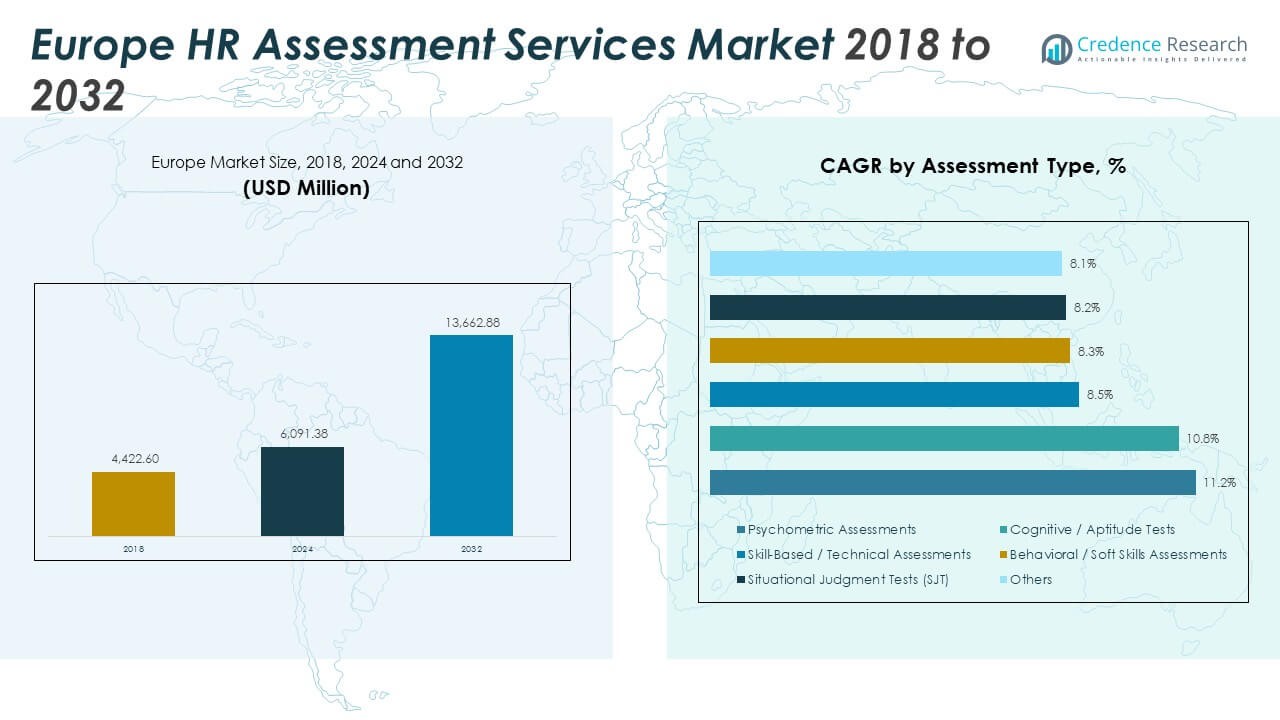
The Europe HR Assessment Services Market size was valued at USD 4,422.60 million in 2018 to USD 6,091.38 million in 2024 and is anticipated to reach USD 13,662.88 million by 2032, at a CAGR of 10.79% during the forecast period.
| REPORT ATTRIBUTE |
DETAILS |
| Historical Period |
2020-2023 |
| Base Year |
2024 |
| Forecast Period |
2025-2032 |
| Europe HR Assessment Services Market Size 2024 |
USD 6,091.38 Million |
| Europe HR Assessment Services Market, CAGR |
10.79% |
| Europe HR Assessment Services Market Size 2032 |
USD 13,662.88 Million |
The market growth is driven by the rising adoption of digital assessment platforms, AI-based evaluation tools, and skill analytics solutions across enterprises. Organizations are focusing on improving hiring accuracy, reducing biases, and optimizing workforce development through data-driven insights. Increasing emphasis on employee engagement, talent mobility, and leadership assessment further supports market expansion across corporate and academic sectors.
Western Europe leads the market due to mature HR technology adoption, advanced corporate ecosystems, and the presence of global service providers. The UK, Germany, and France dominate due to strong demand for psychometric testing and digital recruitment tools. Central and Eastern Europe are emerging as fast-growing regions, driven by workforce digitization, growing outsourcing activities, and increasing investment in talent management infrastructure.
Access crucial information at unmatched prices!
Request your sample report today & start making informed decisions powered by Credence Research Inc.!
Download Sample
Market Insights:
- The Europe HR Assessment Services Market was valued at USD 4,422.60 million in 2018, reached USD 6,091.38 million in 2024, and is projected to attain USD 13,662.88 million by 2032, growing at a CAGR of 10.79% during the forecast period.
- Western Europe leads the market with 55% share, driven by advanced HR technology adoption and a high concentration of multinational corporations in the UK, Germany, and France.
- Southern and Central Europe account for 25% share, supported by modernization of recruitment systems, digital transformation initiatives, and strong demand from the manufacturing and BFSI sectors.
- Eastern and Northern Europe, holding 20% share, represent the fastest-growing region, fueled by expanding workforce digitalization, HR tech startups, and increasing adoption of AI-based assessment tools.
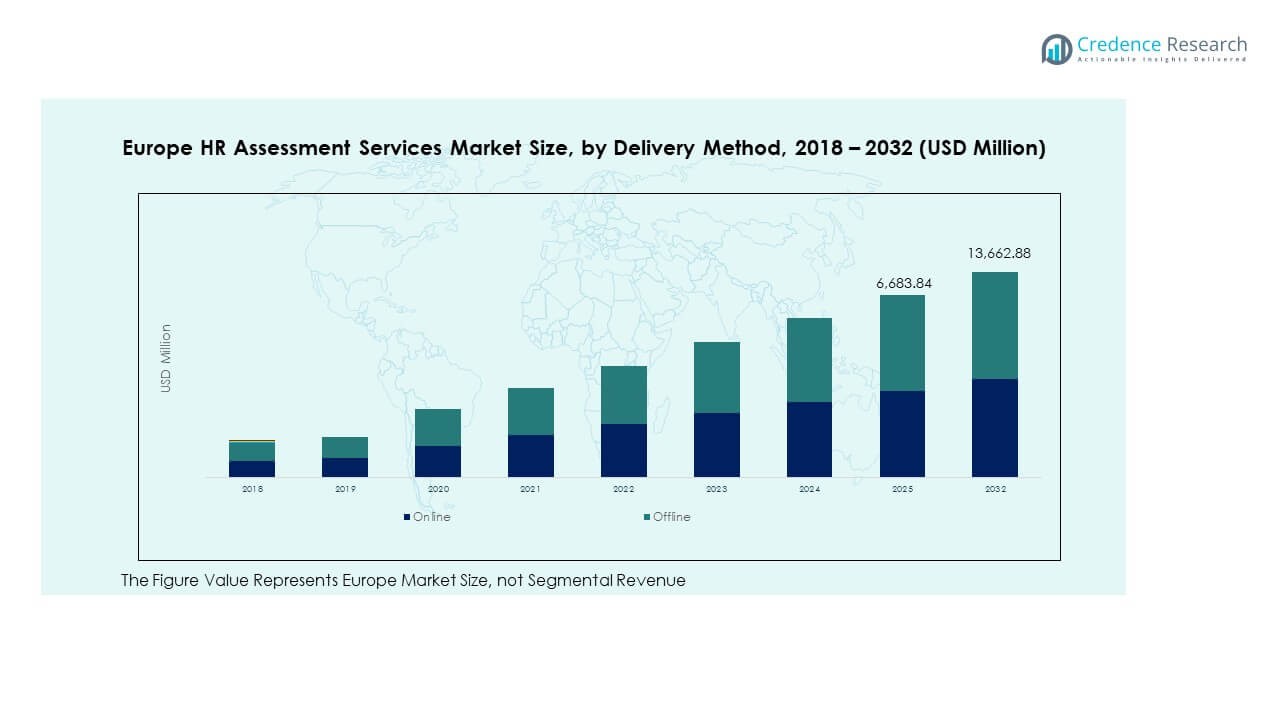
- Based on delivery method, online assessments dominate with around 65% share, while offline assessments account for 35%, reflecting the regional shift toward remote recruitment and digital evaluation platforms.
Market Drivers:
Growing Emphasis on Data-Driven Talent Acquisition and Workforce Analytics
Organizations in the Europe HR Assessment Services Market are increasingly adopting data-driven approaches to enhance hiring accuracy and workforce planning. Employers are prioritizing analytics-backed assessments to evaluate candidates’ cognitive, behavioral, and technical skills more effectively. It supports talent identification by providing predictive insights into employee performance and cultural fit. The growing use of AI-powered tools and psychometric testing solutions helps HR teams reduce bias and make objective hiring decisions. Enterprises are leveraging these assessments to align human capital with long-term business goals. The focus on measurable performance outcomes is driving high demand for structured evaluation frameworks. Companies are now integrating assessment insights into training, onboarding, and career development strategies to ensure workforce optimization.
- For instance, SHL Medical supported the commercial launch of its Molly® platform for 21 combination products across 28 indications by August 2025. Separately, the talent assessment company SHL uses its analytics-backed assessments to evaluate candidates’ skills for employers
Integration of AI, Machine Learning, and Automation in HR Processes
AI and automation technologies are transforming assessment platforms in the Europe HR Assessment Services Market. Machine learning algorithms analyze large datasets to identify patterns that help predict candidate success. Automated scoring systems improve the speed and reliability of evaluations, enhancing operational efficiency for HR departments. Virtual assessment centers and chat-based interviews are gaining adoption due to their scalability and convenience. It enables organizations to conduct assessments across multiple locations with consistent accuracy. AI-driven video analytics now assess communication, confidence, and problem-solving skills in real-time. Automation also reduces manual workload and supports HR professionals in making faster data-backed decisions. The integration of intelligent technologies continues to strengthen assessment precision and user experience.
- For instance, Korn Ferry’s Talent Suite delivered AI-powered assessments and recommendations, leveraging over 10 billion data points, that enabled systematized hiring analytics for large enterprise clients. A 2024 R2 release introduced AI-enhanced content, personalized feedback, and comprehensive talent management tools. These tools, which employ machine learning algorithms to identify patterns and predict candidate success, drive significant improvements in selection and reliability.
Shift Toward Remote Hiring and Virtual Assessment Platforms
The rise of hybrid and remote work models has accelerated the demand for virtual assessments in the Europe HR Assessment Services Market. Companies are using cloud-based testing platforms to evaluate candidates without geographical constraints. It allows employers to assess global talent pools efficiently while maintaining test integrity. The use of secure proctoring tools and adaptive testing enhances fairness and accuracy in virtual environments. Organizations are emphasizing collaboration and communication skills assessment to ensure adaptability in distributed teams. Virtual simulations and gamified tests are improving candidate engagement and experience. The scalability of digital assessment platforms supports continuous workforce evaluation beyond recruitment. Remote assessments are now central to modern HR operations across industries.
Focus on Skill-Based Hiring and Continuous Employee Development
Employers are shifting from qualification-based to skill-based hiring practices in the Europe HR Assessment Services Market. The growing demand for reskilling and upskilling has led to the adoption of adaptive learning and assessment tools. It enables organizations to evaluate employees’ competencies in emerging technologies and soft skills. Skill benchmarking helps HR teams identify capability gaps and create targeted training programs. The focus on lifelong learning ensures alignment with evolving job requirements. Assessments are being integrated into internal mobility and leadership development programs to identify high-potential employees. The trend enhances organizational agility and supports talent retention. Companies that invest in continuous skill evaluation gain a stronger competitive advantage in dynamic labor markets.
Market Trends:
Adoption of Psychometric and Behavioral Assessment Tools for Holistic Evaluation
Employers are increasingly incorporating psychometric and behavioral tests in the Europe HR Assessment Services Market to gain a deeper understanding of candidates. These tools measure personality traits, motivation, and problem-solving abilities, ensuring a balanced view of applicant potential. It supports better cultural alignment and reduces turnover rates. Companies value psychometric data for leadership and succession planning. The trend promotes fairer assessments by emphasizing psychological insights alongside technical proficiency. Behavioral testing also enhances candidate engagement by reflecting real-world challenges. Advanced analytics platforms now interpret these results to support strategic HR decisions. The approach is shaping a more comprehensive view of human capital management.
- For instance, Hogan Assessments, through its distributor and newly merged partner Mavie Work, has facilitated several million leadership and personality tests annually for more than 1,000 client organizations across Europe, supporting succession planning and measurable improvements in talent retention as reported in official releases dated August 2025. These tools measure personality traits, motivation, and problem-solving abilities, ensuring a balanced view of applicant potential.
Expansion of Mobile-Based and On-Demand Assessment Platforms
Mobile-first and on-demand platforms are gaining traction in the Europe HR Assessment Services Market. They offer candidates greater flexibility to complete assessments anytime, increasing accessibility and response rates. The convenience of mobile compatibility strengthens employer branding and applicant experience. It allows HR teams to manage large-scale recruitment drives efficiently. Mobile-enabled testing platforms ensure compatibility with modern remote and hybrid work settings. Organizations are adopting secure mobile applications to maintain test validity and data privacy. Instant feedback mechanisms improve engagement and transparency in evaluation processes. Mobile-based assessment adoption is redefining the future of candidate evaluation and onboarding.
- For instance, Harver’s digital assessment platform delivered mobile-enabled talent evaluation for more than 1,300 customers, including Booking.com, facilitating over 100 million candidate assessments as of recent company data. They offer candidates greater flexibility to complete assessments anytime while leveraging automation and predictive assessments to reduce time-to-hire by around 40% and increase accessibility and response rates.
Growing Role of Predictive Analytics in HR Decision-Making
Predictive analytics is becoming a key differentiator in the Europe HR Assessment Services Market. It helps organizations anticipate workforce performance and retention risks through data modeling. Companies use predictive insights to match candidate profiles with job success indicators. The trend is enhancing decision-making accuracy across recruitment and talent development functions. It assists HR professionals in designing proactive strategies for performance improvement. Data-driven predictions are reducing bad hires and improving productivity metrics. The growing integration of analytics dashboards allows real-time visibility into workforce dynamics. Predictive analytics continues to reshape HR operations toward strategic and evidence-based management.
Increasing Customization and Localization of Assessment Content
Organizations seek localized and role-specific assessment tools to meet diverse regional needs in the Europe HR Assessment Services Market. Customization ensures alignment with cultural and linguistic contexts across countries. It improves fairness, engagement, and relevance in assessment outcomes. Industry-specific modules are being developed to evaluate niche skills required in specialized sectors. Localization enhances compliance with local employment regulations and HR standards. Companies use customized frameworks to assess leadership capabilities and behavioral adaptability. Multilingual support in digital platforms broadens participation across European labor markets. The trend toward tailored assessments is reinforcing inclusivity and organizational fit.
Market Challenges Analysis:
Data Privacy Concerns and Regulatory Compliance in Digital Assessment Platforms
Data protection and compliance remain significant challenges for the Europe HR Assessment Services Market. Strict data privacy laws such as GDPR require organizations to handle candidate information responsibly. It creates additional layers of complexity for HR technology providers managing sensitive personal data. Mismanagement or breaches can damage brand reputation and invite legal penalties. Companies must ensure transparent consent processes and secure data encryption. The use of AI algorithms also raises questions about fairness and data bias. Managing cross-border data storage and transfer regulations adds operational difficulty. Providers must invest in robust compliance frameworks and ethical AI practices to maintain market trust.
High Implementation Costs and Integration Issues with Legacy HR Systems
Implementing advanced HR assessment technologies often requires substantial investment in infrastructure and training. The Europe HR Assessment Services Market faces challenges when integrating new tools with outdated HR systems. It slows digital transformation and limits platform interoperability. Smaller firms struggle with high subscription costs for AI-driven or analytics-based assessment software. Integration gaps can lead to inconsistent data flow between recruitment and talent management functions. Organizations may also face user resistance to adopting unfamiliar technologies. Ensuring seamless system connectivity demands additional technical expertise and vendor support. These challenges hinder market scalability and adoption among resource-limited enterprises.
Market Opportunities:
Expansion of AI-Powered and Skill-Centric Assessment Platforms Across Enterprises
The Europe HR Assessment Services Market is witnessing strong potential through AI-powered and skill-based assessment models. These platforms enhance precision in candidate evaluation and learning measurement. It allows employers to identify skill gaps and improve workforce agility. AI tools enable dynamic test generation and adaptive difficulty levels based on performance. The integration of skill mapping supports long-term organizational planning. Enterprises are investing in AI-driven platforms to strengthen talent analytics capabilities. The rising demand for automated and skill-centric assessments will continue to create major growth opportunities.
Emergence of Strategic Partnerships and Cross-Industry Collaborations in HR Tech
Collaborations between HR tech providers, academic institutions, and corporate enterprises are opening new avenues for the Europe HR Assessment Services Market. These partnerships promote innovation and technology transfer in assessment methodologies. It enables the co-development of specialized testing modules for different industries. Integration with e-learning and talent analytics platforms expands market reach. Partnerships also improve compliance and standardization across regions. Companies adopting collaborative ecosystems enhance user trust and scalability. This trend supports sustainable growth and innovation across the evolving HR assessment landscape.
Market Segmentation Analysis:
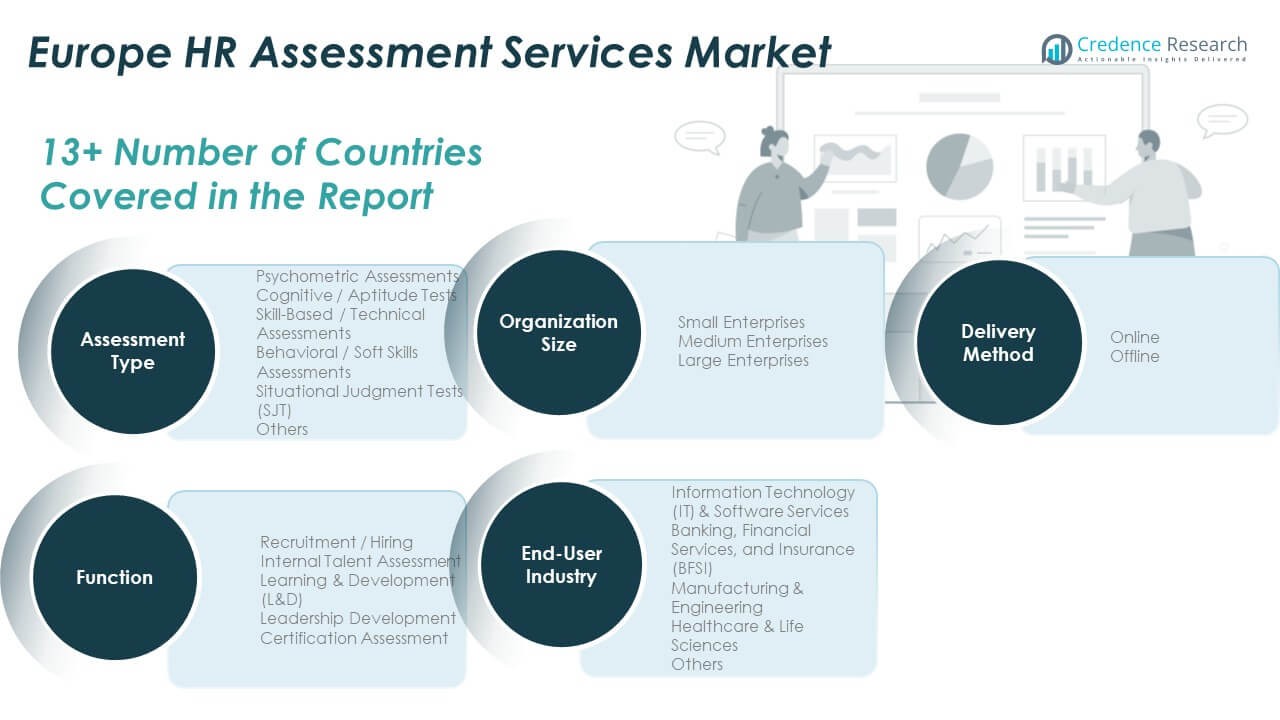
By Assessment Type
The Europe HR Assessment Services Market includes diverse assessment types designed to measure candidate and employee capabilities. Psychometric assessments hold a major share due to their wide use in personality and behavioral evaluation. Cognitive or aptitude tests remain crucial for analytical and problem-solving measurement, while skill-based or technical assessments support job-specific recruitment in IT and engineering fields. Behavioural and soft skills assessments are growing in demand across customer-centric industries. Situational judgment tests (SJT) are used for leadership and managerial role screening. Other niche assessments cater to specialized corporate training and talent development needs.
- For instance, Criteria Corp’s 2025-2026 Hiring Benchmark Report highlights that 74% of surveyed hiring professionals stated it was hard to find high-quality candidates, especially for roles requiring skills like analytical thinking, agility, and emotional intelligence. To help address this, Criteria offers various assessments, including cognitive and behavioral tests.
By Delivery Method
Online assessments dominate the Europe HR Assessment Services Market due to remote recruitment adoption, cost efficiency, and scalability. Offline assessments continue to serve traditional organizations and compliance-driven industries requiring supervised testing environments.
By End-User Industry
The market serves multiple sectors, with IT and software services leading in digital assessment integration. BFSI follows due to high regulatory and competency evaluation needs. Manufacturing and engineering focus on technical testing, while healthcare and life sciences emphasize ethical and behavioral assessments.
By Function
Recruitment and hiring functions account for the largest share, supported by internal talent and leadership assessments. Learning and development programs use continuous assessment frameworks for skill improvement and certification evaluation.
By Organization Size and Country
Large enterprises lead adoption due to advanced HR infrastructures, while medium and small enterprises show rising participation through affordable digital tools. The UK, Germany, and France remain key markets, with Italy, Spain, and Russia showing accelerating growth in digital HR transformation.
Segmentation:
By Assessment Type
- Psychometric Assessments
- Cognitive / Aptitude Tests
- Skill-Based / Technical Assessments
- Behavioural / Soft Skills Assessments
- Situational Judgment Tests (SJT)
- Others
By Delivery Method
By End-User Industry
- Information Technology (IT) & Software Services
- Banking, Financial Services, and Insurance (BFSI)
- Manufacturing & Engineering
- Healthcare & Life Sciences
- Others
By Function
- Recruitment / Hiring
- Internal Talent Assessment
- Learning & Development (L&D)
- Leadership Development
- Certification Assessment
By Organization Size
- Small Enterprises
- Medium Enterprises
- Large Enterprises
By Country
- United Kingdom (UK)
- France
- Germany
- Italy
- Spain
- Russia
- Rest of Europe
Regional Analysis:
Western Europe – Established Market with Dominant Share
Western Europe holds the largest share of the Europe HR Assessment Services Market, accounting for nearly 55% of the regional revenue in 2024. The region benefits from mature HR technology infrastructure, high digital adoption, and a strong presence of multinational corporations. The United Kingdom, Germany, and France are leading contributors, supported by early adoption of AI-based assessment tools and structured talent management frameworks. Enterprises in these countries prioritize psychometric, cognitive, and behavioral evaluations to improve recruitment precision and employee retention. It continues to experience steady demand from corporate, public, and academic institutions emphasizing fair and data-driven hiring. Advanced regulatory frameworks and established HR service providers further strengthen market consolidation across Western Europe.
Southern and Central Europe – Expanding Adoption and Technological Modernization
Southern and Central Europe collectively capture around 25% of the Europe HR Assessment Services Market share. Italy and Spain are driving growth through modernization of workforce evaluation systems and rising acceptance of online testing platforms. Organizations in these regions are investing in cloud-based and multilingual assessment tools to attract diverse talent pools. Manufacturing, healthcare, and BFSI sectors are major adopters, supported by ongoing digital transformation efforts. It is also witnessing strong demand for behavioral and situational assessments among mid-sized enterprises seeking better workforce alignment. Economic recovery and labor upskilling initiatives under EU frameworks are supporting further market penetration.
Eastern and Northern Europe – Emerging Growth Frontier
Eastern and Northern Europe together hold approximately 20% of the Europe HR Assessment Services Market share, reflecting fast-paced adoption of digital HR solutions. Countries such as Russia, Poland, Sweden, and Finland are emerging as high-growth territories. The market expansion is driven by increasing investment in workforce analytics and cross-border talent assessment. It benefits from the growing presence of regional HR tech startups and academic collaborations that focus on localized test content. Governments and private organizations are emphasizing digital capability building, boosting demand for online cognitive and technical assessments. Continued digitalization and global HR outsourcing partnerships are expected to elevate Eastern and Northern Europe’s contribution in the coming years.
Shape Your Report to Specific Countries or Regions & Enjoy 30% Off!
Key Player Analysis:
- SHL
- Thomas International
- Cubiks (now part of PSI Services)
- Talogy (formerly PSI Talent Management)
- Assessio
- Saville Assessment
- Hogan Assessments
- Harver
- Cappfinity
- Mercer
- Korn Ferry
- Wonderlic
- Criteria Corp
Competitive Analysis:
The Europe HR Assessment Services Market is highly competitive, driven by established global players and emerging regional firms. It is defined by innovation in digital platforms, AI integration, and data-driven evaluation methods. Key companies focus on developing adaptive testing tools, behavioral analytics, and psychometric systems to enhance workforce efficiency. Players such as SHL, Mercer, Korn Ferry, Thomas International, and Hogan Assessments maintain strong regional presence through strategic partnerships and localized content delivery. Continuous investment in automation, scalability, and predictive analytics strengthens competitive differentiation and client retention across industries.
Recent Developments:
- In 2025, SHL Medical, a provider of advanced drug delivery systems, expanded its European manufacturing footprint through strategic partnerships with Grünenthal PRO and SteriPack Group to offer final assembly services for its Molly® autoinjector platform. In September 2025, SHL announced a collaboration with Grünenthal PRO to install new pre-validated assembly lines at its Origgio, Italy facility, scheduled to become operational in 2026, enhancing speed-to-market for biopharma clients.
- In 2025, Thomas International expanded its Thomas Perform talent assessment platform into Europe and the Asia Pacific region, enabling businesses across these markets to leverage its science-backed tools for recruitment, employee development, and retention. The platform, recognized for reducing bias and improving hiring outcomes, offers validated insights into behavior, personality, and aptitudes, supporting data-driven people decisions.
Report Coverage:
The research report offers an in-depth analysis based on assessment type, delivery method, end-user industry, function, organization size, and country. It details leading market players, providing an overview of their business, product offerings, investments, revenue streams, and key applications. Additionally, the report includes insights into the competitive environment, SWOT analysis, current market trends, as well as the primary drivers and constraints. Furthermore, it discusses various factors that have driven market expansion in recent years. The report also explores market dynamics, regulatory scenarios, and technological advancements that are shaping the industry. It assesses the impact of external factors and global economic changes on market growth. Lastly, it provides strategic recommendations for new entrants and established companies to navigate the complexities of the market.
Future Outlook:
- Growing adoption of AI and predictive analytics in candidate evaluations.
- Expansion of mobile-based and on-demand assessment platforms.
- Increasing focus on skill-based hiring and workforce reskilling programs.
- Rising use of psychometric and behavioral tools for leadership development.
- Growing integration of HR analytics with enterprise resource planning systems.
- Emergence of new vendors targeting small and medium enterprises.
- Regional localization of assessments to improve inclusivity and compliance.
- Strategic partnerships between HR tech providers and corporate enterprises.
- Strong demand for continuous learning and development assessments.
- Sustained investment in automation and cloud-based delivery infrastructure.



