
Market Overview
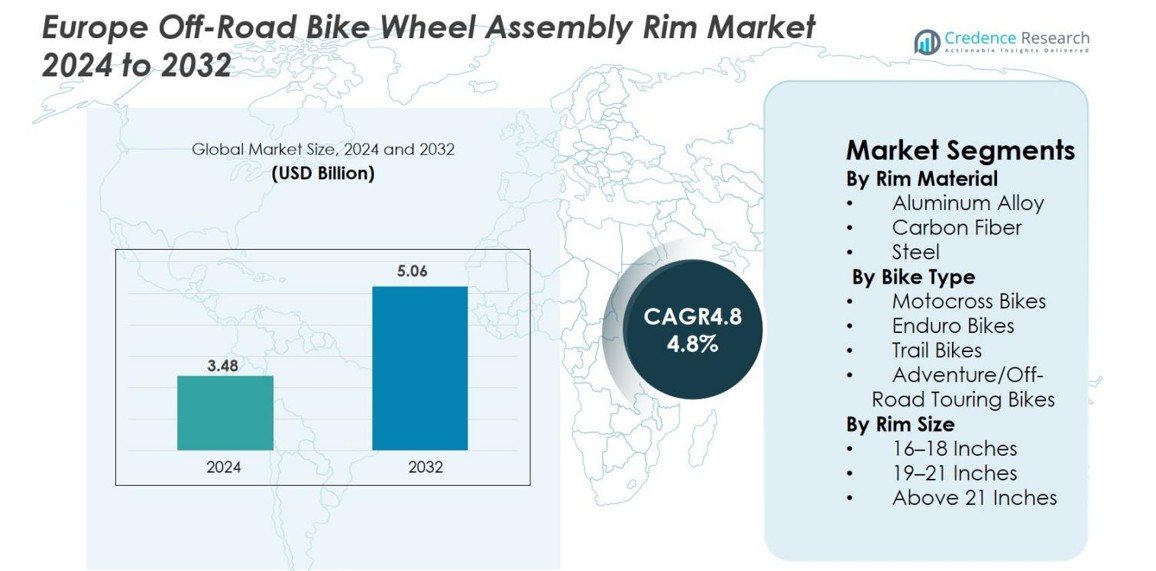
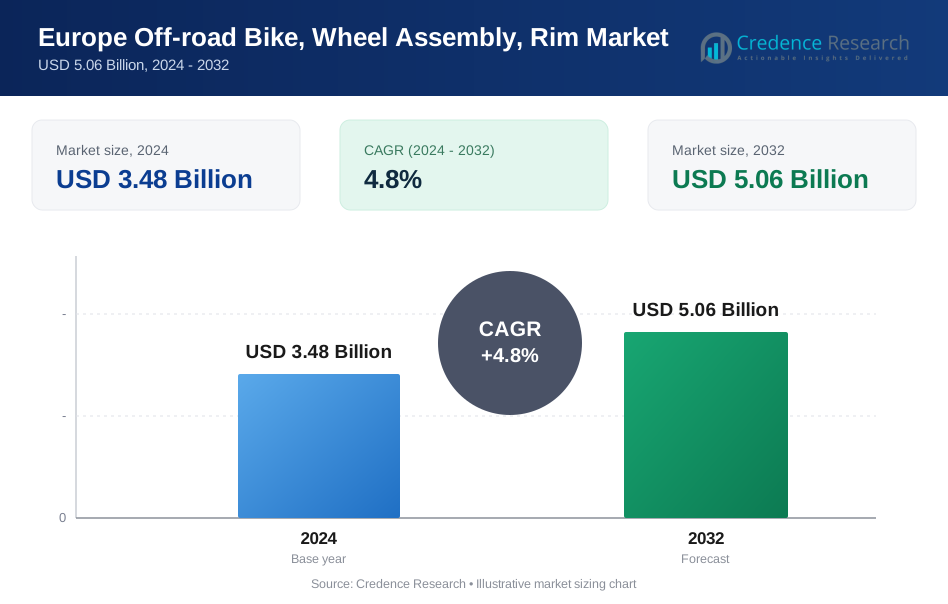
Europe Off-Road Bike Wheel Assembly Rim Market size was valued at USD 3.48 Billion in 2024 and is anticipated to reach USD 5.06 Billion by 2032, at a CAGR of 4.8% during the forecast period.
| REPORT ATTRIBUTE | DETAILS |
|---|---|
| Historical Period | 2020-2023 |
| Base Year | 2024 |
| Forecast Period | 2025-2032 |
| Europe Off-Road Bike Wheel Assembly Rim Market Size 2024 | USD 3.48 Billion |
| Europe Off-Road Bike Wheel Assembly Rim Market, CAGR | 4.8% |
| Europe Off-Road Bike Wheel Assembly Rim Market Size 2032 | USD 5.06 Billion |
Europe Off-Road Bike Wheel Assembly Rim Market is driven by leading manufacturers such as DID Europe, Excel Rim Company, Haan Wheels, Talon Engineering, SM Pro Wheels, Warp 9 Racing, OZ Motorbike, Kite Parts Europe, Z-Wheel, and RK Excel Europe, all focusing on high-strength materials and precision-engineered rim technologies. Western Europe leads the market with a 41.6% share in 2024, supported by a strong motocross and enduro racing ecosystem across Germany, France, and the UK. Northern Europe follows with 23.4% share driven by rugged terrains and high demand for durable, performance-oriented wheel assemblies among recreational and professional riders
Market Insights
- Europe Off-Road Bike Wheel Assembly Rim Market was valued at USD 3.48 Billion in 2024 and is projected to reach USD 5.06 Billion by 2032, registering a CAGR of 4.8%.
- The market grows as rising motocross, enduro, and trail riding activities increase demand for lightweight, durable rims, with aluminum alloy dominating the material segment with a 62.4% share in 2024.
- Key trends include rapid adoption of carbon fiber rims, CNC-engineered components, and customization-driven aftermarket expansion, supporting performance upgrades across professional and recreational segments.
- Leading players such as DID Europe, Excel Rim Company, Haan Wheels, and Talon Engineering strengthen market presence through advanced rim technologies, modular wheel systems, and racing partnerships, enhancing product differentiation.
- Western Europe leads with a 41.6% share, followed by Northern Europe at 23.4%, while 19–21-inch rims remain the dominant rim size segment with a 54.1% share, supported by stability and compatibility with high-performance off-road bikes.
Market Segmentation Analysis
By Rim Material
The Europe Off-Road Bike Wheel Assembly Rim Market is primarily driven by the rising demand for lightweight and high-performance components, with aluminum alloy rims dominating the segment with a 62.4% market share in 2024. Their balance of durability, affordability, and weight efficiency makes them highly preferred across motocross and enduro applications. Carbon fiber rims continue to gain traction due to superior strength-to-weight ratios, supporting premium bike categories, while steel rims maintain relevance in budget and recreational segments. Increasing rider preference for responsive handling and improved shock absorption further accelerates aluminum alloy adoption.
- For instance, the alloy rim produced by Excel (the “Takasago” off-road rim) uses a 7000-series aluminium alloy. This provides roughly 50% higher yield strength than standard 6000-series aluminium rims
By Bike Type
Within the bike type segment, motocross bikes lead the Europe market with a 47.9% share in 2024, supported by strong participation in competitive racing events and frequent component replacement cycles due to high structural impact. Enduro bikes follow with rising demand from long-distance off-road enthusiasts seeking durable wheel assemblies with superior traction. Trail and adventure touring bikes experience steady growth as recreational off-roading expands across Europe. Increased motorsport engagement, improved track infrastructure, and higher demand for performance-oriented wheel systems continue to reinforce motocross dominance.
- For instance, Husqvarna’s FC‑series motocross bikes feature reinforced aluminium rims designed to withstand repeated jumps and rough terrain, demonstrating the importance of durability in motocross applications.
By Rim Size
The rim size segment is dominated by 19–21-inch rims, accounting for 54.1% share in 2024, as these sizes offer optimal stability, shock absorption, and maneuverability essential for motocross and enduro terrains. Their widespread compatibility with professional racing bikes strengthens adoption across OEM and aftermarket channels. The 16–18-inch category maintains moderate demand among youth and mid-segment bikes, while rims above 21 inches cater to specialized adventure and touring models. The shift toward high-performance off-road riding and increasing demand for enhanced front-wheel control continue to propel the dominance of 19–21-inch rims.
Key Growth Drivers
Rising Off-Road Sports Participation and Competitive Racing Activities
The Europe Off-Road Bike Wheel Assembly Rim Market benefits significantly from the growing popularity of motocross, enduro racing, and trail riding across countries such as Germany, France, and the UK. Increasing participation in organized championships and weekend recreational riding drives higher demand for durable and high-performance wheel assemblies that withstand aggressive terrains and high-impact maneuvers. Frequent wheel replacement cycles among professional riders further accelerate market growth. OEMs rapidly introduce lightweight and reinforced rim technologies to enhance maneuverability, stability, and acceleration. Additionally, the expansion of off-road training academies and motorsport clubs continues to increase the adoption of premium wheel systems, reinforcing steady demand across the aftermarket and OEM channels.
- For instance, Europe Dirt Bikes” market is expected to rise driven by rising interest in motocross racing and recreational riding culture.
Strong Demand for Lightweight and High-Strength Rim Materials
A major growth driver for the Europe Off-Road Bike Wheel Assembly Rim Market is the strong shift toward lightweight, high-strength materials such as aluminum alloys and carbon fiber. Riders increasingly prioritize agility, improved suspension response, and reduced rotational mass, making advanced material rims essential for performance enhancement. Aluminum alloy rims remain dominant due to their balance of strength, affordability, and shock absorption, while carbon fiber rims gain traction within premium and racing segments for their superior stiffness-to-weight ratio. Manufacturers invest heavily in improved forging, heat treatment, and composite technologies, enabling better durability under extreme riding conditions. This focus on advanced materials not only boosts product differentiation but also supports long-term market expansion across performance-oriented applications.
- For instance, Excel Rim Company’s “Takasago 7000-series” aluminium rims undergo advanced forging and heat treatment, delivering roughly 50% higher yield strength than standard rims, enhancing durability for motocross and enduro use.
Growing Aftermarket Expansion and Customization Preferences
The rapid expansion of the aftermarket sector is driving sustained growth in the Europe Off-Road Bike Wheel Assembly Rim Market. Riders increasingly seek customized wheel assemblies with enhanced aesthetics, weight reduction, and optimized traction for specific terrains. This trend fuels demand for specialized rims, reinforced hubs, anodized components, and spoke upgrades. Frequent replacements due to wear and tear in competitive riding further strengthen aftermarket sales. Custom fitting services, online retailing, and the availability of brand-specific wheel kits are also boosting market penetration. Moreover, rising consumer preference for tailored riding experiences encourages companies to offer modular wheel components and performance-tuned assemblies, creating significant long-term revenue opportunities.
Key Trends & Opportunities
Advancements in Rim Manufacturing and Digital Engineering Techniques
A key trend shaping the Europe Off-Road Bike Wheel Assembly Rim Market is the increasing adoption of advanced manufacturing technologies such as CNC machining, hydroforming, and robotic spoke lacing. These processes enable superior precision, weight optimization, and enhanced rim integrity. Digital simulation tools allow manufacturers to analyze stress distribution and optimize rim geometry for extreme terrains, improving safety and longevity. Additive manufacturing also emerges as an opportunity for producing custom components and lightweight prototypes. As producers integrate sensor-enabled hubs and smart components, the market moves toward intelligent wheel systems capable of monitoring strain, vibration, and riding conditions, offering new value propositions for competitive and recreational riders.
- For instance, Husqvarna utilizes modern engineering practices, including digital stress simulation (Finite Element Analysis or CAE), in the design of components like wheel rims to optimize their performance and durability.
Rising Transition Toward Premium and Performance-Oriented Wheel Systems
A strong opportunity arises from Europe’s accelerating shift toward premium off-road bikes and high-performance wheel assemblies. Riders increasingly prioritize advanced handling, faster acceleration, and higher durability, pushing demand for carbon fiber rims, reinforced hubs, and precision-spoked systems. Brands are expanding their product portfolios with racing-certified rim technologies and limited-edition performance kits that appeal to professional riders. The trend is supported by the growth of adventure tourism and long-distance off-road expeditions across Europe, where riders prefer lightweight, impact-resistant rims capable of enduring diverse terrains. As consumer expectations elevate, manufacturers offering premium, high-strength solutions capture substantial growth prospects.
- For instance, Husqvarna’s FE 450 and TE 300 models feature reinforced aluminium rims and precision-spoked assemblies designed for professional enduro riders, enhancing handling and durability on long off-road tracks.
Key Challenges
High Cost of Advanced Rim Materials and Manufacturing Technologies
One of the major challenges in the Europe Off-Road Bike Wheel Assembly Rim Market is the high cost associated with advanced materials such as carbon fiber and precision-machined aluminum alloys. The manufacturing processes involved including forging, composite layering, and automated lacing significantly raise production expenses, limiting adoption among cost-sensitive consumers. While high-performance riders readily invest in premium rims, recreational users often opt for budget options, creating a market gap. Additionally, supply chain fluctuations and rising metal prices elevate overall costs, affecting OEM pricing strategies. These cost barriers hinder widespread penetration of advanced rim technologies across mid-range segments.
Frequent Wear, Damage Risk, and Maintenance Requirements
Off-road wheel rims are highly susceptible to damage due to rocks, jumps, uneven terrain, and aggressive riding styles, creating a persistent challenge for both users and manufacturers. Frequent dents, spoke loosening, and rim distortion result in increased maintenance demands and replacement cycles, raising ownership costs for riders. Even advanced materials cannot fully eliminate the impact-related wear associated with intense off-road conditions. This challenge also pressures manufacturers to continually innovate in durability and impact resistance while balancing weight optimization. The need for regular inspections and service appointments further affects user experience, especially for long-distance and competitive riders.
Regional Analysis
Western Europe
Western Europe dominates the Europe Off-Road Bike Wheel Assembly Rim Market with a 41.6% share in 2024, driven by strong motocross and enduro racing cultures in Germany, France, the UK, and the Netherlands. High consumer spending on premium performance bikes and frequent participation in organized motorsport events support substantial adoption of lightweight aluminum and carbon fiber rims. OEM presence, advanced manufacturing facilities, and robust aftermarket distribution channels further strengthen regional demand. Continuous investment in off-road parks, training academies, and racing infrastructure fuels recurring rim replacement cycles and encourages the uptake of premium wheel assemblies among professional and recreational riders.
Northern Europe
Northern Europe holds a 23.4% market share in 2024, driven by active off-road communities in Sweden, Finland, and Norway, where rugged terrains and outdoor sports culture stimulate high demand for durable wheel assemblies. Riders prioritize reinforced aluminum and carbon fiber rims capable of handling rocky trails, harsh weather, and demanding off-road conditions. Strong adventure tourism, particularly long-distance wilderness trail riding, boosts adoption of larger rim sizes and premium wheel systems. Government-backed motorsport initiatives and an affinity for high-performance recreational vehicles further contribute to steady expansion across both OEM and aftermarket segments.
Southern Europe
Southern Europe accounts for a 19.7% market share in 2024, supported by growing off-road biking activity in Italy, Spain, and Portugal. The region’s favorable climate, varied landscapes, and expanding motocross and enduro events drive higher usage of performance-oriented rims. Demand is strong among recreational riders investing in lightweight, shock-absorbing wheel assemblies to improve handling on mountainous and sandy terrains. The aftermarket sector is expanding due to rising customization trends, while local manufacturers and dealerships improve accessibility to advanced rim technologies. Tourism-driven trail riding also plays a key role in supporting continuous market growth.
Eastern Europe
Eastern Europe represents a 15.3% market share in 2024, with strong growth potential driven by increasing affordability of off-road bikes and developing motorsport infrastructure in Poland, Czech Republic, Hungary, and Romania. Riders in this region prioritize durable and cost-effective aluminum rims, though adoption of carbon fiber options is gradually rising within competitive segments. Growing participation in regional motocross leagues and increased penetration of international bike brands fuel demand for replacement wheel assemblies. Expanding adventure touring and recreational trail riding also support market expansion, while improving distribution networks enhance availability of OEM and aftermarket components.
Market Segmentations
By Rim Material
- Aluminum Alloy
- Carbon Fiber
- Steel
By Bike Type
- Motocross Bikes
- Enduro Bikes
- Trail Bikes
- Adventure/Off-Road Touring Bikes
By Rim Size
- 16–18 Inches
- 19–21 Inches
- Above 21 Inches
By Geography
- Western Europe
- Northern Europe
- Southern Europe
- Eastern Europe
Competitive Landscape
The competitive landscape of the Europe Off-Road Bike Wheel Assembly Rim Market is characterized by the strong presence of established manufacturers focusing on advanced material technologies, precision engineering, and performance enhancement. Key players such as DID Europe, Excel Rim Company, Haan Wheels, Talon Engineering, SM Pro Wheels, Warp 9 Racing, Kite Parts Europe, OZ Motorbike, Z-Wheel, and RK Excel Europe continually introduce lightweight and impact-resistant rims tailored for motocross, enduro, trail, and adventure applications. These companies invest in CNC machining, heat-treated aluminum alloys, and carbon composite processes to deliver superior durability and handling. The aftermarket segment remains highly active, driven by consumer demand for customization and frequent rim replacements in competitive sports. Strategic partnerships with racing teams, expansion of distribution networks, and the development of modular wheel kits further strengthen the market positions of leading players.
Key Player Analysis
- DID Europe
- Excel Rim Company
- Haan Wheels
- Talon Engineering Ltd
- Warp 9 Racing
- SM Pro Wheels
- Kite Parts Europe
- Z-Wheel (Dirt Freak)
- OZ Motorbike
- RK Excel Europe
Recent Developments
- In 2025, Haan Wheels began offering custom wheels for the Ducati Desmo450 MX (combining Haan’s hubs with rims from Excel Rim Co. Ltd.).
- In 2025, Talon Engineering launched its “Talon Wheel Builder” an online tool for designing custom off-road motorcycle wheels.
- In June 2025, GW launched a completely new wheelset series including alloy MTB XC, carbon gravel, and road wheelsets along with a full new rim line (both carbon and alloy) to support OEM and aftermarket rim/wheel needs
Report Coverage
The research report offers an in-depth analysis based on Rim Material, Bike Type, Rim Size and Geography. It details leading market players, providing an overview of their business, product offerings, investments, revenue streams, and key applications. Additionally, the report includes insights into the competitive environment, SWOT analysis, current market trends, as well as the primary drivers and constraints. Furthermore, it discusses various factors that have driven market expansion in recent years. The report also explores market dynamics, regulatory scenarios, and technological advancements that are shaping the industry. It assesses the impact of external factors and global economic changes on market growth. Lastly, it provides strategic recommendations for new entrants and established companies to navigate the complexities of the market.
Future Outlook
- The market will experience steady growth as off-road sports participation increases across Europe.
- Adoption of lightweight aluminum and carbon fiber rims will rise due to performance-oriented preferences.
- OEMs will expand product portfolios with advanced rim geometries and reinforced spoke systems.
- Aftermarket sales will grow as riders demand customized wheel assemblies for varied terrains.
- Digital engineering and CNC machining will enhance rim precision and durability.
- Adventure and long-distance trail riding will fuel demand for larger and impact-resistant rim sizes.
- Western Europe will maintain dominance, supported by strong motorsport ecosystems.
- Manufacturers will emphasize modular wheel designs to support easy upgrades and replacements.
- Partnerships with racing teams will accelerate adoption of premium rim technologies.
- Increasing focus on sustainability will drive innovation in recyclable and eco-friendly rim materials.
Request a Free Sample
Fill in your details and we'll send you a free sample report.
- Sample data tables & charts
- Research methodology
Need a Custom Version of This Report?
Tailor the scope, geography, or segments to your exact requirements.
- Custom geography or segment scope
- Direct access to our analyst team
Frequently Asked Questions
What is the current market size for the Europe Off-Road Bike Wheel Assembly Rim Market, and what is its projected size in 2032?
At what Compound Annual Growth Rate is the Europe Off-Road Bike Wheel Assembly Rim Market projected to grow between 2024 and 2032?
Who are the major players in this market?
What are the primary factors fueling the growth of the Europe Off-Road Bike Wheel Assembly Rim Market?
Who are the leading companies in the Europe Off-Road Bike Wheel Assembly Rim Market?
Table of Content
Chapter 1. Report Introduction
- 1.1 Report Description & Purpose
- 1.1.1 Report Title & Market Definition
- 1.1.2 Unique Selling Propositions (USP) & Key Differentiators
- 1.1.3 Value Proposition for Stakeholders
- 1.2 Research Objectives
- 1.2.1 Market Sizing Objectives (Volume & Revenue) (Volume Where Applicable)
- 1.2.2 Segmentation Objectives
- 1.2.3 Competitive Intelligence Objectives
- 1.2.4 Forecast & Scenario Objectives
- 1.3 Report Scope
- 1.3.1 Europe Off-road Bike, Wheel Assembly, Rim Scope – Segments & Subsegments Covered
- 1.3.2 Geographic Scope – Selected Region & Countries Covered
- 1.3.3 Historical Period, Base Year & Forecast Period (2024; forecast to 2032)
- 1.3.4 Inclusions & Exclusions
- 1.4 Industry Classification & Applicable Codes
- 1.5 Currency, Measurement Units & Valuation Basis
- 1.6 Target Stakeholders
- 1.7 Limitations & Assumptions
Chapter 2. Executive Summary
- 2.1 Europe Off-road Bike, Wheel Assembly, Rim Snapshot
- 2.1.1 Market Size – Historical (2024) & Forecast (2024-2032) (2024: USD 3.48 Billion → 2032: USD 5.06 Billion)
- 2.1.2 Volume & Revenue – Regional Totals (Volume Where Applicable)
- 2.1.3 Key Market Highlights – Top Five Facts
- 2.2 Europe Off-road Bike, Wheel Assembly, Rim Segmentation Snapshot
- 2.2.1 Market Split by Country – 2024 vs. 2032
- 2.3 Competitive Snapshot
- 2.3.1 Top 10 Players by Revenue Share – 2024
- 2.3.2 Top 10 Players by Volume Share – 2024 (Volume Where Applicable)
- 2.3.3 Recent Strategic Developments (18-Month Summary)
- 2.4 Key Investment Highlights & Strategic Conclusions
Chapter 3. Europe Off-road Bike, Wheel Assembly, Rim Dynamics & Industry Analysis
- 3.1 Market Overview & Context
- 3.1.1 Europe Off-road Bike, Wheel Assembly, Rim Position in the Broader Industry Value Chain
- 3.1.2 Demand Structure & Purchasing Dynamics
- 3.1.3 Market Maturity & Development Stage by Country
- 3.2 Europe Off-road Bike, Wheel Assembly, Rim Drivers
- 3.3 Europe Off-road Bike, Wheel Assembly, Rim Restraints & Challenges
- 3.4 Europe Off-road Bike, Wheel Assembly, Rim Opportunities
- 3.5 Porter's Five Forces Analysis
- 3.5.1 Threat of New Entrants
- 3.5.2 Bargaining Power of Suppliers
- 3.5.3 Bargaining Power of Buyers
- 3.5.4 Threat of Substitutes
- 3.5.5 Competitive Rivalry – Intensity Assessment
- 3.6 Europe Off-road Bike, Wheel Assembly, Rim Value Chain Analysis
- 3.6.1 Upstream – Key Inputs, Resources & Suppliers
- 3.6.1.1 Key Input/Resource 1
- 3.6.1.2 Key Input/Resource 2
- 3.6.1.3 Key Input/Resource 3
- 3.6.2 Midstream – Core Operations & Value Creation
- 3.6.2.1 Operating Model & Process Overview
- 3.6.2.2 Key Operating Locations & Capabilities by Company
- 3.6.3 Downstream – Market Channels & End Users
- 3.6.3.1 Direct Sales & Customer Engagement Channels
- 3.6.3.2 Indirect Sales, Intermediaries & Partner Channels
- 3.6.4 Value Chain Profitability Analysis
- 3.6.1 Upstream – Key Inputs, Resources & Suppliers
- 3.7 PESTEL Analysis
- 3.7.1 Political Factors
- 3.7.2 Economic Factors
- 3.7.3 Social Factors
- 3.7.4 Technological Factors
- 3.7.5 Environmental Factors
- 3.7.6 Legal Factors
- 3.8 Europe Off-road Bike, Wheel Assembly, Rim Supply Chain Analysis
- 3.8.1 Critical Input & Resource Availability Risk Assessment
- 3.8.2 Supplier & Operational Concentration Risk (Geographic Exposure)
- 3.8.3 Supply & Service Disruption Impact Analysis
- 3.9 Regional & Country Regulatory Landscape
Note: The regulatory and policy landscape section covers regulations based on their applicability to the market, Europe Off-road Bike, Wheel Assembly, Rim category, geography, and scope of the study. Only regulatory frameworks with a material impact on operations, compliance, trade, sustainability, or market access are analyzed in detail.
Chapter 4. Key Investment Pockets & Opportunity Analysis
- 4.1 Europe Off-road Bike, Wheel Assembly, Rim Attractiveness Analysis
- 4.1.1 By Country – Investment Attractiveness Matrix (Market Size × CAGR)
- 4.2 Absolute Revenue Growth Opportunity
- 4.2.1 By Country – Absolute Revenue Growth Through 2032
- 4.3 Incremental Demand Opportunity
- 4.3.1 By Country – Incremental Demand Through 2032
- 4.3.2 Segment – Incremental Demand
- 4.4 Emerging Submarket Opportunity Deep Dive (Subject to Applicability)
- 4.5 Priority Country Opportunity Scorecards
- 4.5.1 Priority Country 1
- 4.5.2 Priority Country 2
- 4.5.3 Priority Country 3
- 4.5.4 Priority Country 4
Note: Priority countries are selected from within the region covered by the study. Numbered entries are indicative and are populated with relevant country names based on market size, growth potential, and strategic relevance.
Chapter 5. Europe Off-road Bike, Wheel Assembly, Rim Cross-Border Trade & Market Access Analysis
- 5.1 Intra-Regional & Extra-Regional Trade Overview
- 5.1.1 Regional Export Value by Country (2024)
- 5.1.2 Regional Export Volume by Country (2024) (Volume Where Applicable)
- 5.1.3 Regional Import Value by Country (2024)
- 5.1.4 Regional Import Volume by Country (2024) (Volume Where Applicable)
- 5.1.5 Net Trade Balance by Country (2024)
- 5.2 Export Analysis – Segment
- 5.2.1 Category 1 (Applicable Classification Code)
- 5.2.2 Category 2 (Applicable Classification Code)
- 5.2.3 Category 3 (Applicable Classification Code)
- 5.2.4 Category 4 (Applicable Classification Code)
- 5.2.5 Category 5 (Applicable Classification Code)
- 5.3 Import Analysis – Segment
- 5.3.1 Category 1 (Applicable Classification Code)
- 5.3.2 Category 2 (Applicable Classification Code)
- 5.3.3 Category 3 (Applicable Classification Code)
- 5.3.4 Category 4 (Applicable Classification Code)
- 5.3.5 Category 5 (Applicable Classification Code)
- 5.4 Cross-Border Pricing & Transaction Benchmarks
- 5.4.1 Export Pricing – Segment & Country
- 5.4.2 Import Pricing – Segment & Source Country
- 5.4.3 Price Trends (2024)
- 5.5 Key Cross-Border Trade & Delivery Routes
- 5.5.1 Cross-Border Trade/Delivery Route 1
- 5.5.2 Cross-Border Trade/Delivery Route 2
- 5.5.3 Cross-Border Trade/Delivery Route 3
- 5.5.4 Cross-Border Trade/Delivery Route 4
- 5.5.5 Cross-Border Trade/Delivery Route 5
- 5.6 Trade Policy & Market Access Impact Assessment
- 5.6.1 Tariff & Non-Tariff Barriers
- 5.6.2 Regional Trade & Economic Integration Frameworks
- 5.6.3 Bilateral & Multilateral Trade Agreements
- 5.6.4 Cross-Border Operating, Licensing & Localization Requirements
Note: Cross-border analysis applies where relevant to Europe Off-road Bike, Wheel Assembly, Rim. Country trade flows distinguish intra-regional activity from trade with markets outside the region. Regional external trade totals exclude intra-regional flows to avoid double counting. Classifications and transaction measures follow the market scope; volume and route analyses apply only where meaningful.
Chapter 6. Competitive Landscape & Company Benchmarking
- 6.1 Europe Off-road Bike, Wheel Assembly, Rim Concentration & Structure
- 6.1.1 Herfindahl-Hirschman Index (HHI) – vs. 2024
- 6.1.2 Leading, Mid-Sized & Emerging Player Structure
- 6.1.3 Global, Regional & Local Player Dynamics
- 6.2 Europe Off-road Bike, Wheel Assembly, Rim Share Analysis – 2024
- 6.2.1 Regional Revenue Share by Company
- 6.2.2 Regional Volume Share by Company (Volume Where Applicable)
- 6.2.3 Company Revenue Share by Country
- 6.2.4 Market Share Evolution ( vs. 2024)
- 6.2.5 Company Market Share by Key Segment
- 6.2.6 Company Market Share by Customer Group
- 6.3 Operating Scale, Capacity & Infrastructure Analysis
- 6.3.1 Regional Operating Scale & Supply Capacity
- 6.3.2 Resource Utilization & Operating Efficiency
- 6.3.3 Output, Service Delivery & Activity Metrics
- 6.3.4 Operating Footprint & Infrastructure Map
- 6.3.5 Planned Operational & Capacity Expansion
- 6.4 Europe Off-road Bike, Wheel Assembly, Rim Competitive Benchmarking Matrix
- 6.4.1 Revenue, Growth, Profitability & Operating Metric Comparison
- 6.4.2 Channel Revenue Mix
- 6.4.3 Revenue Exposure by Country Within the Region
- 6.4.4 R&D Intensity
- 6.4.5 Sustainability Maturity
- 6.5 Strategic Developments in Europe Off-road Bike, Wheel Assembly, Rim (Last 24 Months)
- 6.5.1 Mergers, Acquisitions & Divestments
- 6.5.2 New Products, Services & Solutions in Europe Off-road Bike, Wheel Assembly, Rim
- 6.5.3 Operational & Infrastructure Expansions
- 6.5.4 Strategic Alliances, Joint Ventures & Partnerships
- 6.5.5 Distribution Expansion & Market Entry
- 6.5.6 Sustainability & ESG Initiatives
- 6.6 Competitive Strategy Mapping
- 6.6.1 Leader, Challenger, Follower & Niche Classification
- 6.6.2 Pricing Strategy Comparison
- 6.6.3 Channel Strategy Matrix
Note: Strategic developments are included based on their materiality and the availability of reliable information.
Chapter 7. Europe Off-road Bike, Wheel Assembly, Rim – By Sales & Delivery Channel
- 7.1 Segment Overview
- 7.1.1 Volume & Revenue Split by Channel (2024 & 2032) (Volume Where Applicable)
- 7.1.2 Channel Mix Evolution (2024-2032)
Chapter 8. Country Market Analysis – Regional Overview
- 8.1 Country Market Overview Within the Region
- 8.1.1 Country Volume Share Within the Region (Where Applicable)
- 8.1.2 Country Revenue Share Within the Region
- 8.1.3 Market Volume by Country (Where Applicable)
- 8.1.4 Market Revenue by Country
- 8.1.5 Country Forecasts Through 2032
- 8.2 Cross-Country Segment Analysis
- 8.2.1 By Sales & Delivery Channel
- 8.2.2 By Competitive Positioning & Price Tier
Chapter 9. Europe Off-road Bike, Wheel Assembly, Rim – Priority Country 1
Chapter 10. Europe Off-road Bike, Wheel Assembly, Rim – Priority Country 2
Chapter 11. Europe Off-road Bike, Wheel Assembly, Rim – Priority Country 3
Chapter 12. Europe Off-road Bike, Wheel Assembly, Rim – Priority Country 4
Chapter 13. Europe Off-road Bike, Wheel Assembly, Rim Company Profiles
- 13.1 [Company 01]
- 13.1.1 Company Overview
- 13.1.2 Key Management Personnel
- 13.1.3 Products & Services Portfolio
- 13.1.4 Financial Performance
- 13.1.5 Regional Market Focus & Country Presence
- 13.1.6 Recent Developments & Strategic Initiatives
Note: The company profile list is preliminary and may change based on research findings, market developments, data availability, and client requirements.
Chapter 14. Appendices
- Appendix A – List of Abbreviations & Acronyms
- Appendix B – Industry Classification Code Reference – Full Series
- Appendix C – Supply, Output & Operating Capacity Data Tables
- Appendix D – End-Use & Demand Base Tables
- Appendix E – Demand, Adoption & Usage Assumptions
- Appendix F – Pricing & Revenue Metric Reference Tables
- Appendix G – Company Operations & Infrastructure Database
- Appendix H – Cross-Border Trade & Activity Data Tables (Where Applicable)
- Appendix I – Regulatory Summary Tables
- Appendix J – Primary Research Participant List (Anonymized)
- Appendix K – Primary Research Questionnaire Framework
- Appendix L – Data Sources & Bibliography
- Appendix M – Market Size Divergence & Source Comparison
Chapter 15. Research Methodology
- 15.1 Research Framework & Philosophy
- 15.2 Secondary Research – Sources, Hierarchy & Data Extraction
- 15.3 Data Modeling – Country-Level Estimates & Regional Aggregation
- 15.4 Primary Research – Stakeholder Framework, LOI & Sample Sizes
- 15.5 Forecast Methodology – Regression, Scenario & Sensitivity Analysis
- 15.6 Quality Control – Four-Layer Validation Framework
- 15.7 Limitations & Standard Assumptions
- 15.8 Disclaimer
