
| REPORT ATTRIBUTE | DETAILS |
|---|---|
| Historical Period | 2020-2023 |
| Base Year | 2024 |
| Forecast Period | 2025-2032 |
| Europe Off the Road Tire Market Size 2023 | USD 4,833.83 Million |
| Europe Off the Road Tire Market, CAGR | 3.77% |
| Europe Off the Road Tire Market Size 2032 | USD 6,744.56 Million |
Market Overview:
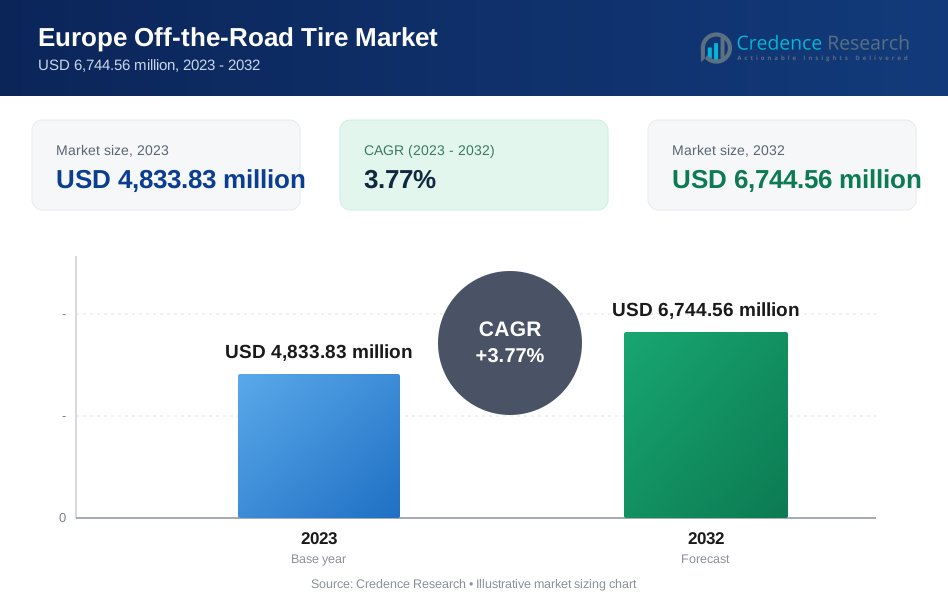
Europe Off-the-Road Tire Market size was valued at USD 4,833.83 million in 2023 and is anticipated to reach USD 6,744.56 million by 2032, at a CAGR of 3.77% during the forecast period (2023-2032).
Several factors are propelling the growth of the Europe OTR tire market. Foremost among these is the surge in infrastructure development projects across the continent, encompassing roads, bridges, and power plants. Such projects necessitate the use of heavy machinery equipped with robust tires capable of operating in demanding environments. Additionally, the agricultural sector's shift towards mechanization has led to increased adoption of tractors and harvesters, further boosting the demand for OTR tires. Technological advancements in tire manufacturing, including the development of puncture-resistant materials and enhanced tread designs, are also contributing to market growth by offering improved durability and performance. Moreover, the growing emphasis on sustainability and environmental regulations is prompting manufacturers to innovate and produce eco-friendly tire solutions. Rising investment in mining exploration and extraction across Europe also strengthens the market's long-term prospects.
Within Europe, Germany stands out as the leading market for OTR tires, driven by its robust construction and industrial sectors. The country's commitment to infrastructure modernization and its strong manufacturing base contribute significantly to the demand for OTR tires. France and the United Kingdom also represent substantial markets, with ongoing investments in infrastructure and agriculture fueling tire demand. In Eastern Europe, countries like Russia are experiencing growth in the mining sector, which in turn drives the need for specialized OTR tires. Southern Europe, including Spain and Italy, is also seeing renewed investments in rural development, creating opportunities for off-road tire manufacturers. Overall, the diverse industrial activities across different European regions underscore the importance of OTR tires in supporting economic development and operational efficiency.
Market Insights:
- The Europe Off-the-Road (OTR) tire market was valued at USD 4,833.83 million in 2023 and is projected to reach USD 6,744.56 million by 2032, growing at a CAGR of 3.77% during the forecast period.
- The Global OTR tire market was valued at USD 18,234 million in 2023 and is expected to grow to USD 27,097.46 million by 2032, at a CAGR of 4.5%.
- Infrastructure development, including roads, bridges, and power plants, is a key driver, as heavy machinery for these projects requires durable and high-performance OTR tires.
- The agricultural sector's shift towards mechanization is expanding the demand for OTR tires as farmers increasingly rely on tractors and harvesters for crop cultivation.
- The growing emphasis on sustainability is prompting tire manufacturers to focus on eco-friendly solutions, including the use of recyclable materials and energy-efficient tire technologies.
- Mining activities across Europe, particularly in countries like Poland and Sweden, are pushing the demand for specialized OTR tires designed for extreme conditions and heavy-duty equipment.
- Technological advancements in tire manufacturing, such as self-sealing technology and smart tires with integrated sensors, are improving tire durability and operational efficiency.
- Germany, France, and the UK lead the Europe OTR tire market due to their strong construction, industrial, and agricultural sectors, while Eastern Europe’s mining boom further supports market growth.
Market Drivers:
Infrastructure Development Initiatives
The ongoing expansion of infrastructure across Europe remains a critical driver of the OTR tire market. Governments in the region are investing heavily in large-scale projects such as road expansions, railway networks, and commercial real estate developments. These projects require robust construction machinery that depends on durable and high-performance off-the-road tires. For instance, in Italy, Pirelli partnered with local construction firms in 2023 to deliver specialized OTR tires for the country’s €3.5 billion motorway expansion, with the company noting a 12% increase in demand for its heavy-duty tire segment. The European Union’s focus on sustainable and smart infrastructure under its Green Deal initiative is also increasing demand for equipment that can operate in complex terrains, thereby bolstering the market for OTR tires. With infrastructure spending projected to grow steadily, especially in countries like Germany, France, and the UK, the requirement for reliable tire solutions is expected to persist through the forecast period.
Agricultural Mechanization and Modernization
Europe’s agricultural sector is undergoing a steady transformation, driven by the adoption of advanced machinery to enhance productivity and efficiency. As farmers increasingly rely on tractors, harvesters, and other heavy-duty equipment for crop cultivation and processing, the demand for OTR tires that can handle diverse and uneven field conditions is rising. The Common Agricultural Policy (CAP) reforms and financial incentives offered by the EU for agricultural modernization are further encouraging farmers to invest in mechanized solutions. These trends are significantly expanding the deployment of off-the-road tires across rural and semi-urban parts of Europe, ensuring a stable demand from the agricultural segment.
Expansion of Mining and Industrial Activities
Although mining in Europe is relatively mature compared to other global regions, ongoing exploration of critical minerals and increased demand for raw materials are contributing to the expansion of the OTR tire market. Countries like Poland, Sweden, and Finland are focusing on extracting lithium, cobalt, and other resources vital for battery production and renewable technologies. For instance, Michelin, for example, has developed eco-friendly OTR tires using advanced materials to comply with EU regulations, and its strategic partnerships ensure widespread market penetration, especially in Germany and France. Mining operations typically require specialized equipment with tires capable of operating under extreme stress and harsh conditions. Additionally, the broader industrial sector, including material handling and waste management, relies on rugged off-the-road tires to maintain operational continuity, further stimulating market growth.
Technological Advancements and Sustainability Trends
Technological innovation in tire design and material composition is playing a pivotal role in enhancing product efficiency and longevity. European tire manufacturers are introducing advanced features such as self-sealing technology, enhanced tread patterns, and smart tire solutions integrated with sensors for real-time performance monitoring. These developments address key industry concerns such as equipment downtime and maintenance costs. At the same time, sustainability has emerged as a strong influencing factor, with increased emphasis on eco-friendly materials and recycling processes. Regulatory pressures and consumer preferences are pushing manufacturers to create low-emission, energy-efficient tires that align with the EU’s environmental targets. These advancements are not only improving product appeal but also reinforcing long-term market competitiveness across Europe.
Market Trends:
Growing Preference for Radial OTR Tires
A significant trend shaping the Europe OTR tire market is the increasing shift from bias-ply to radial tire technology. Radial tires offer superior performance in terms of traction, fuel efficiency, and durability, making them highly suitable for demanding off-road applications. European industries, particularly in construction and material handling, are adopting radial OTR tires to reduce equipment downtime and improve operational efficiency. According to industry reports, radial OTR tire adoption in Europe has grown by over 25% in the past five years, with key markets such as Germany, France, and the Netherlands leading this transition. This trend is expected to continue as companies focus on reducing total cost of ownership and enhancing safety standards on work sites.
OEM Collaboration and Customization
The growing collaboration between Original Equipment Manufacturers (OEMs) and tire producers is another emerging trend in the European market. As machinery becomes more specialized across industries like agriculture, mining, and logistics, tire manufacturers are working closely with OEMs to develop customized tire solutions tailored to specific vehicle and operational requirements. These partnerships allow for seamless integration of tires with heavy equipment, resulting in optimized performance and prolonged tire life. Customized tire solutions are gaining traction among end-users seeking to address site-specific challenges such as load distribution, soil compaction, or terrain variability, further fueling market innovation.
Digitization and Smart Tire Technologies
Digital transformation is influencing the OTR tire market, with the integration of Internet of Things (IoT) and telematics systems into tire management solutions. Smart tires equipped with sensors can now monitor temperature, pressure, and wear in real-time, providing actionable insights to operators and fleet managers. For instance, TMS® launched a new Tire Pressure Monitoring System (TPMS) for industrial and OTR vehicles in 2024, offering real-time monitoring of tire pressure and temperature, with data accessible via a dedicated app for smartphones, tablets, and PCs. This data-driven approach not only enhances safety and maintenance planning but also contributes to increased productivity and cost-efficiency. European fleet operators are increasingly adopting tire monitoring systems to comply with EU safety regulations and improve asset utilization. The trend toward predictive maintenance, enabled by connected tire technologies, is expected to accelerate in the coming years, especially in large-scale construction and mining operations.
Rise of Sustainable Manufacturing Practices
Sustainability is becoming central to tire manufacturing practices in Europe, driven by stringent environmental regulations and corporate social responsibility initiatives. Tire producers are investing in recyclable materials, low rolling resistance designs, and energy-efficient production processes to reduce their environmental footprint. For instance, according to the European Tire Recycling Association (ETRA), Europe achieved a 95% recycling rate for waste tires in 2023, far exceeding the global average of 68%. This shift is also evident in the adoption of circular economy models, where end-of-life tires are being repurposed into new products or energy sources. As end-users place increasing importance on eco-conscious procurement, the demand for sustainable OTR tire solutions is expected to grow steadily across the region.
Market Challenges Analysis:
High Cost of Advanced Tire Technologies One of the primary restraints in the Europe OTR tire market is the high cost associated with advanced tire technologies. Radial and smart OTR tires, while offering superior performance and longevity, come at a premium price compared to traditional bias-ply alternatives. Small and medium-sized enterprises (SMEs), particularly in Eastern and Southern Europe, often face budgetary constraints that limit their ability to invest in high-end tire solutions. Additionally, the integration of sensor-based technologies and specialized compounds increases both the initial purchase cost and ongoing maintenance requirements, posing a barrier to widespread adoption. This pricing challenge can hinder market penetration in less industrialized regions and slow the replacement cycle.
Environmental Regulations and Recycling Complexities While sustainability trends are influencing the market positively, they also present complex challenges. The European Union enforces stringent environmental regulations related to tire production, chemical usage, and end-of-life tire management. For example, the EU’s Circular Economy Action Plan mandates that by 2030, all tires must contain at least 30% recycled materials, and new regulations require the content of polycyclic aromatic hydrocarbons (PAHs) in recycled rubber to be reduced to below 1 mg/kg. Manufacturers are under constant pressure to comply with these evolving standards, which often require significant investments in R&D and compliance infrastructure. Moreover, the recycling of off-the-road tires remains a technical and logistical challenge due to their large size, reinforced construction, and material composition. Inadequate recycling facilities and limited reuse options in certain regions create bottlenecks in tire disposal and sustainability efforts. These regulatory and operational constraints can increase production costs and disrupt supply chain efficiencies, particularly for smaller manufacturers attempting to scale their operations.
Market Opportunities:
The Europe Off-the-Road tire market presents considerable opportunities driven by the region’s increasing investment in renewable energy infrastructure and sustainable industrial practices. The transition towards wind and solar energy installations across Germany, the Netherlands, and the Nordics demands the use of specialized construction and maintenance equipment, fueling demand for durable and high-performance OTR tires. Moreover, the growing emphasis on electric and autonomous machinery in agriculture and construction offers new avenues for tire manufacturers to develop advanced tire models compatible with evolving vehicle technologies. As industries prioritize operational efficiency and reduced carbon footprints, the need for customized and technologically integrated OTR tires is expected to rise significantly.
Additionally, the expansion of digital fleet management and telematics systems creates a favorable environment for smart OTR tires. Companies operating in construction, mining, and logistics are increasingly adopting data-driven tools to optimize equipment usage, reduce downtime, and improve safety. This shift provides tire manufacturers the opportunity to offer sensor-embedded tires that support predictive maintenance and remote monitoring, aligning with the broader digital transformation across European industries. Furthermore, with rising concerns about supply chain resilience and local sourcing, there is an increasing preference for regionally manufactured tires. This trend opens the door for European tire producers to scale operations and meet localized demand with tailored, compliant, and sustainable solutions, strengthening their market position in the coming years.
Market Segmentation Analysis:
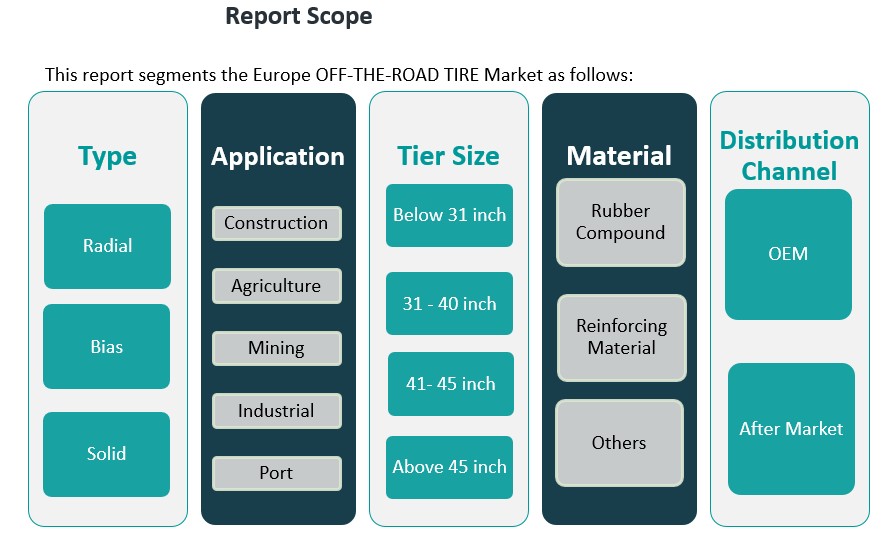
The Europe Off-the-Road tire market is segmented into several categories based on type, application, tire size, material, and distribution channel.
By type, radial tires lead the market due to their superior performance, fuel efficiency, and durability in demanding environments. Bias tires, while gradually declining in usage, remain relevant in cost-sensitive applications. Solid tires are gaining momentum in niche industrial and port operations, where puncture resistance and longevity are essential.
By application, the construction segment dominates the market, driven by extensive infrastructure projects across the region. Agriculture is another significant segment, supported by increased mechanization and modern farming practices, particularly in countries like France and Poland. The mining sector contributes steadily, especially in Northern and Eastern Europe, while industrial and port operations continue to drive specialized demand for heavy-duty tire solutions.
By tire size, the 31–40-inch segment holds a substantial share, favored for mid-sized equipment used in construction and agriculture. However, demand for larger tire sizes (above 45 inches) is rising in mining and large-scale infrastructure projects, requiring robust tires for extreme loads.
By Material-wise, rubber compounds remain the core material due to their flexibility and durability, while reinforcing materials like steel and fabric are essential for structural integrity and performance enhancement.
By distribution channels, the aftermarket segment commands a larger share owing to the frequent replacement cycles in harsh operating conditions. However, OEM partnerships are gaining importance as manufacturers increasingly supply tailor-made solutions directly with machinery, enhancing integration and performance efficiency.
Segmentation:
By Type Segment
- Radial
- Bias
- Solid
By Application Segment
- Construction
- Agriculture
- Mining
- Industrial
- Port
By Tire Size Segment
- Below 31 inch
- 31 - 40 inch
- 41 - 45 inch
- Above 45 inch
By Material Segment
- Rubber Compound
- Reinforcing Material
- Others
By Distribution Channel Segment
- OEM
- After Market
Regional Analysis:
The Europe Off-the-Road (OTR) tire market is diverse, with varying growth dynamics across different regions, driven by industrial activities such as construction, agriculture, mining, and port operations. Europe’s regional OTR market is primarily led by Western Europe, with significant contributions from Eastern and Northern Europe, while Southern Europe is experiencing steady growth.
Western Europe is the largest market in the region, accounting for over 50% of the total market share. Key countries like Germany, France, and the United Kingdom are at the forefront, fueled by their well-established industrial sectors and ongoing infrastructure development projects. Germany, in particular, is the dominant market, driven by the construction, mining, and agriculture sectors. France and the UK also see high demand due to their emphasis on sustainable urbanization, renewable energy infrastructure, and mechanized agriculture. Western Europe’s market growth is further supported by technological advancements and a strong focus on innovation in tire designs, including radial tires and smart tire solutions.
Eastern Europe holds approximately 25% of the market share, with Russia and Poland playing a pivotal role in driving demand, particularly in the mining and agriculture sectors. The region's vast natural resources and expanding industrial base have created a steady demand for heavy-duty OTR tires. Poland’s mining sector, along with growing agricultural mechanization, is contributing to the region's market expansion. Additionally, as infrastructure development continues to grow, the demand for OTR tires is expected to increase steadily, positioning Eastern Europe as a key growth region for the future.
Northern Europe contributes around 15% to the OTR tire market, with countries like Sweden, Finland, and Norway seeing substantial growth in the mining and renewable energy sectors. The demand for tires in these regions is largely driven by the extraction of critical minerals, such as lithium and cobalt, for the global energy transition. Northern Europe’s emphasis on sustainable practices is also driving the demand for eco-friendly tire solutions, further boosting market growth.
Southern Europe, with a market share of 10%, has seen moderate growth in the OTR tire market, particularly in countries like Spain, Italy, and Greece. The region’s demand is primarily driven by agriculture and port operations. While the construction sector is growing, Southern Europe’s market remains smaller compared to other regions, due to slower infrastructure development and more limited industrial activity.
Key Player Analysis:
- Bridgestone
- Michelin
- Goodyear
- Yokohama Tire
- China National Tire & Rubber
- MRF
- Continental AG
- Belshina
- Cheng-Shin Rubber
- Eurotire
Competitive Analysis:
The Europe Off-the-Road (OTR) tire market is highly competitive, with several prominent global and regional players dominating the landscape. Leading companies such as Michelin, Bridgestone, Continental, and Goodyear have a significant market presence due to their robust product portfolios, advanced technology, and extensive distribution networks. These players offer a wide range of OTR tire solutions, including radial, bias, and solid tires, catering to industries such as construction, mining, and agriculture. Additionally, regional players like Nokian Tyres and Pirelli have strengthened their position through local manufacturing capabilities and tailored solutions to meet the specific needs of European markets. The focus on innovation, such as the development of smart tire technology and sustainable tire solutions, is driving competition. Companies are also increasingly forming strategic partnerships with OEMs to provide customized tire solutions, ensuring enhanced performance and reliability for heavy machinery across various sectors.
Recent Developments:
- In December 2024, Bridgestone announced the debut of its new M-Steer 002 and M-Drive 002 truck tyres, specifically designed for fleets operating in both on-road and off-road (mild On/Off) environments. These tyres, featuring advanced compound technology for enhanced durability and performance, will be available across Europe starting January 2025.
- In December 2024, Michelin entered into a definitive agreement to sell its Camso brand’s off-highway tire (OHT) and tracks business to CEAT for approximately $225 million. This acquisition, which includes two manufacturing facilities and global rights to the Camso brand, will allow CEAT to expand its product portfolio in high-margin off-highway tyres and tracks, while Michelin exits activities related to compact line bias tyres and construction tracks in Europe and beyond.
- In February 2025, Yokohama Rubber completed its acquisition of Goodyear’s Off-the-Road (OTR) tire business. This strategic move brings Goodyear’s advanced OTR technologies and product range—serving mining and construction industries—under Yokohama’s umbrella, strengthening its off-highway tire production and market position in Europe and globally.
Market Concentration & Characteristics:
The Europe Off-the-Road (OTR) tire market exhibits a moderate level of concentration, with a few key players holding a significant share. Major global tire manufacturers such as Michelin, Bridgestone, Continental, and Goodyear dominate the market, benefiting from their extensive product portfolios, strong brand recognition, and advanced technological capabilities. These companies control a large portion of the market, particularly in high-demand sectors like construction, mining, and agriculture. However, the market also features notable regional players such as Nokian Tyres and Pirelli, which have established themselves by offering specialized products suited to local needs. The market is characterized by a high degree of technological innovation, with companies investing in tire performance enhancements, smart technologies, and sustainability initiatives. Competitive strategies focus on providing tailored, durable, and cost-effective solutions, fostering partnerships with OEMs and adopting environmentally-friendly manufacturing practices.
Report Coverage:
The research report offers an in-depth analysis based on Type, Application, Tire Size, Material and Distribution Channel It details leading market players, providing an overview of their business, product offerings, investments, revenue streams, and key applications. Additionally, the report includes insights into the competitive environment, SWOT analysis, current market trends, as well as the primary drivers and constraints. Furthermore, it discusses various factors that have driven market expansion in recent years. The report also explores market dynamics, regulatory scenarios, and technological advancements that are shaping the industry. It assesses the impact of external factors and global economic changes on market growth. Lastly, it provides strategic recommendations for new entrants and established companies to navigate the complexities of the market.
Future Outlook:
- The Europe OTR tire market will continue to grow steadily, driven by increasing infrastructure projects across the continent.
- Technological advancements, such as smart tires and enhanced durability, will foster demand for high-performance solutions.
- Radial tires will maintain their dominance due to their fuel efficiency, longevity, and superior performance in harsh conditions.
- The shift towards mechanization in agriculture will create sustained demand for OTR tires, especially in countries like France and Germany.
- The growing mining sector, particularly in Eastern Europe, will drive demand for larger, specialized tires for heavy-duty equipment.
- Increased investment in renewable energy infrastructure will boost the need for specialized tires in wind and solar farm construction.
- Sustainability will be a key market driver, with tire manufacturers focusing on eco-friendly materials and recyclable solutions.
- The aftermarket segment will continue to grow as fleets replace tires frequently due to wear and tear in demanding applications.
- Digitalization and tire monitoring technologies will be integrated into OTR tire solutions, enhancing operational efficiency.
- Competitive pressures will lead to more regional partnerships and localized manufacturing to meet specific market demands.
Request a Free Sample
Fill in your details and we'll send you a free sample report.
- Sample data tables & charts
- Research methodology
Need a Custom Version of This Report?
Tailor the scope, geography, or segments to your exact requirements.
- Custom geography or segment scope
- Direct access to our analyst team
Frequently Asked Questions
What is the current size of the Europe Off the Road Tire market?
What factors are driving the growth of the Europe Off the Road Tire market?
What are the key segments within the Europe Off the Road Tire market?
What are some challenges faced by the Europe Off the Road Tire market?
Who are the major players in the Europe Off the Road Tire market?
Table of Content
Chapter 1. Report Introduction
- 1.1 Report Description & Purpose
- 1.1.1 Report Title & Market Definition
- 1.1.2 Unique Selling Propositions (USP) & Key Differentiators
- 1.1.3 Value Proposition for Stakeholders
- 1.2 Research Objectives
- 1.2.1 Market Sizing Objectives (Volume & Revenue)
- 1.2.2 Segmentation Objectives
- 1.2.3 Competitive Intelligence Objectives
- 1.2.4 Forecast & Scenario Objectives
- 1.3 Report Scope
- 1.3.1 Europe Off-the-Road Tire Scope – Types & Subtypes Covered
- 1.3.2 Geographic Scope – Regions & Countries Covered
- 1.3.3 Historical Period, Base Year & Forecast Period (2023; forecast to 2032)
- 1.3.4 Inclusions & Exclusions
- 1.4 HS Code & Classification Framework
- 1.5 Currency, Units & Pricing Basis
- 1.6 Target Stakeholders
- 1.7 Limitations & Assumptions
Chapter 2. Executive Summary
- 2.1 Global Europe Off-the-Road Tire Market Snapshot
- 2.1.1 Market Size – Historical (2023) & Forecast (2023-2032) (2023: USD 4,833.83 million → 2032: USD 6,744.56 million)
- 2.1.2 Volume & Revenue – Global Totals
- 2.1.3 Key Market Highlights – Top Five Facts
- 2.2 Europe Off-the-Road Tire Market Segmentation Snapshot
- 2.2.1 Market Split by Region – 2023 vs. 2032
- 2.3 Competitive Snapshot
- 2.3.1 Top 10 Players by Revenue Share – 2023
- 2.3.2 Top 10 Players by Volume Share – 2023
- 2.3.3 Recent Strategic Developments (18-Month Summary)
- 2.4 Key Investment Highlights & Strategic Conclusions
Chapter 3. Europe Off-the-Road Tire Market Dynamics & Industry Analysis
- 3.1 Market Overview & Context
- 3.1.1 Europe Off-the-Road Tire Market Position in the Broader Automotive Value Chain
- 3.1.2 OEM vs. Replacement Market Dynamics
- 3.1.3 Market Maturity & Development Stage by Region
- 3.2 Europe Off-the-Road Tire Market Drivers
- 3.3 Europe Off-the-Road Tire Market Restraints & Challenges
- 3.4 Europe Off-the-Road Tire Market Opportunities
- 3.5 Porter's Five Forces Analysis
- 3.5.1 Threat of New Entrants
- 3.5.2 Bargaining Power of Suppliers
- 3.5.3 Bargaining Power of Buyers
- 3.5.4 Threat of Substitutes
- 3.5.5 Competitive Rivalry – Intensity Assessment
- 3.6 Europe Off-the-Road Tire Value Chain Analysis
- 3.6.1 Upstream – Raw Material/Input Suppliers
- 3.6.1.1 Raw Material/Input 1
- 3.6.1.2 Raw Material/Input 2
- 3.6.1.3 Raw Material/Input 3
- 3.6.2 Midstream – Production/Manufacturing/Service Delivery
- 3.6.2.1 Production/Process Overview
- 3.6.2.2 Key Facility Locations & Capacity by Manufacturer
- 3.6.3 Downstream – Distribution & End Consumer
- 3.6.3.1 Primary Channel – B2B/OEM
- 3.6.3.2 Secondary Channels – Dealer, Retail, Online, Direct
- 3.6.4 Value Chain Profitability Analysis
- 3.6.1 Upstream – Raw Material/Input Suppliers
- 3.7 PESTEL Analysis
- 3.7.1 Political Factors
- 3.7.2 Economic Factors
- 3.7.3 Social Factors
- 3.7.4 Technological Factors
- 3.7.5 Environmental Factors
- 3.7.6 Legal Factors
- 3.8 Europe Off-the-Road Tire Supply Chain Analysis
- 3.8.1 Raw Material/Input Supply Risk Assessment
- 3.8.2 Manufacturing Concentration Risk (Geographic Exposure)
- 3.8.3 Trade Disruption Impact Analysis
- 3.9 Regulatory & Policy Landscape
Note: The regulatory and policy landscape section covers regulations based on their applicability to the market, Europe Off-the-Road Tire category, geography, and scope of the study. Only regulatory frameworks with a material impact on operations, compliance, trade, sustainability, or market access are analyzed in detail.
Chapter 4. Key Investment Pockets & Opportunity Analysis
- 4.1 Europe Off-the-Road Tire Market Attractiveness Analysis
- 4.1.1 By Region – Investment Attractiveness Matrix (Volume × CAGR)
- 4.2 Absolute Revenue Growth Opportunity
- 4.2.1 By Region – Absolute USD Growth Through 2032
- 4.3 Incremental Volume Opportunity
- 4.3.1 By Region – Incremental Volume Through 2032
- 4.3.2 Segment – Incremental Volume
- 4.4 Emerging Submarket Opportunity Deep Dive (Subject to Applicability)
- 4.5 Emerging Market Opportunity Scorecards
- 4.5.1 United States
- 4.5.2 Europe
- 4.5.3 Asia
- 4.5.4 Middle East & Africa
Note: Emerging Market Opportunity Scorecards will be included based on relevance and strategic importance. Regions listed are indicative and may vary depending on data availability and market dynamics.
Chapter 5. Europe Off-the-Road Tire Import-Export Analysis & Trade Flows
- 5.1 Global Trade Overview
- 5.1.1 Global Export Value by Country (2023)
- 5.1.2 Global Export Volume by Country (2023)
- 5.1.3 Global Import Value by Country (2023)
- 5.1.4 Global Import Volume by Country (2023)
- 5.1.5 Net Trade Balance by Country (2023)
- 5.2 Export Analysis – Segment
- 5.2.1 Type 1 (HS Code)
- 5.2.2 Type 2 (HS Code)
- 5.2.3 Type 3 (HS Code)
- 5.2.4 Type 4 (HS Code)
- 5.2.5 Type 5 (HS Code)
- 5.3 Import Analysis – Segment
- 5.3.1 Type 1 (HS Code)
- 5.3.2 Type 2 (HS Code)
- 5.3.3 Type 3 (HS Code)
- 5.3.4 Type 4 (HS Code)
- 5.3.5 Type 5 (HS Code)
- 5.4 Average Unit Trade Prices
- 5.4.1 Average Export Price – Segment & Country
- 5.4.2 Average Import Price – Segment & Source Country
- 5.4.3 Price Trends (2023)
- 5.5 Key Trade Route Analysis
- 5.5.1 Trade Route 1
- 5.5.2 Trade Route 2
- 5.5.3 Trade Route 3
- 5.5.4 Trade Route 4
- 5.5.5 Trade Route 5
- 5.6 Trade Policy Impact Assessment
- 5.6.1 US Anti-Dumping & Section 301 Tariffs
- 5.6.2 EU Customs Union Impact
- 5.6.3 Major Free Trade Agreements
- 5.6.4 USMCA Rules of Origin
Note: Trade policy analysis will be included only where relevant to the Europe Off-the-Road Tire market.
Chapter 6. Competitive Landscape & Company Benchmarking
- 6.1 Europe Off-the-Road Tire Market Concentration & Structure
- 6.1.1 Herfindahl-Hirschman Index (HHI) – vs. 2023
- 6.1.2 Tier 1, Tier 2 & Tier 3 Market Structure
- 6.1.3 Global, Regional & Local Player Dynamics
- 6.2 Europe Off-the-Road Tire Market Share Analysis – 2023
- 6.2.1 Global Revenue Share by Company
- 6.2.2 Global Volume Share by Company
- 6.2.3 Regional Revenue Share
- 6.2.4 Market Share Evolution ( vs. 2023)
- 6.2.5 OEM Segment Share by Company
- 6.2.6 Replacement Segment Share by Company
- 6.3 Production/Delivery Capacity & Facility Analysis
- 6.3.1 Global Installed Capacity
- 6.3.2 Capacity Utilization Rates
- 6.3.3 Production/Output Volume
- 6.3.4 Facility Locations & Capacity Map
- 6.3.5 Planned Capacity Additions
- 6.4 Europe Off-the-Road Tire Competitive Benchmarking Matrix
- 6.4.1 Revenue, Volume, CAGR & Profitability Comparison
- 6.4.2 Channel Revenue Mix
- 6.4.3 Geographic Revenue Exposure
- 6.4.4 R&D Intensity
- 6.4.5 Sustainability Maturity
- 6.5 Strategic Developments in Europe Off-the-Road Tire (Last 24 Months)
- 6.5.1 Mergers, Acquisitions & Divestments
- 6.5.2 New Europe Off-the-Road Tire Launches
- 6.5.3 Facility Expansions
- 6.5.4 Strategic Alliances, Joint Ventures & Partnerships
- 6.5.5 Distribution Expansion & Market Entry
- 6.5.6 Sustainability & ESG Initiatives
- 6.6 Competitive Strategy Mapping
- 6.6.1 Leader, Challenger, Follower & Niche Classification
- 6.6.2 Pricing Strategy Comparison
- 6.6.3 Channel Strategy Matrix
Note: Strategic developments are included based on their materiality and the availability of reliable information.
Chapter 7. Global Europe Off-the-Road Tire Market – By Distribution Channel
- 7.1 Segment Overview
- 7.1.1 Volume & Revenue Split by Channel (2023 & 2032)
- 7.1.2 Channel Mix Evolution (2023-2032)
Chapter 8. Regional Market Analysis – Global Overview
- 8.1 Global Regional Overview
- 8.1.1 Regional Volume Share
- 8.1.2 Regional Revenue Share
- 8.1.3 Regional Volume by Region
- 8.1.4 Regional Revenue by Region
- 8.1.5 Regional Forecast Through 2032
- 8.2 Cross-Regional Segment Analysis
- 8.2.1 By Distribution Channel
- 8.2.2 By Brand/Price Tier
Chapter 9. North America Europe Off-the-Road Tire Market
- 9.1 United States
- 9.2 Canada
- 9.3 Mexico
Chapter 10. Europe Europe Off-the-Road Tire Market
- 10.1 Germany
- 10.2 France
- 10.3 Italy
- 10.4 United Kingdom
- 10.5 Spain
- 10.6 Poland
- 10.7 Russia
- 10.8 Netherlands
- 10.9 Belgium
- 10.10 Sweden
- 10.11 Denmark
- 10.12 Norway
- 10.13 Rest of Europe
Chapter 11. Asia Pacific Europe Off-the-Road Tire Market
- 11.1 China
- 11.2 India
- 11.3 Japan
- 11.4 South Korea
- 11.5 Thailand
- 11.6 Indonesia
- 11.7 Vietnam
- 11.8 Malaysia
- 11.9 Australia
- 11.10 Rest of Asia Pacific
Chapter 12. Latin America Europe Off-the-Road Tire Market
- 12.1 Brazil
- 12.2 Argentina
- 12.3 Colombia
- 12.4 Chile
- 12.5 Rest of Latin America
Chapter 13. Middle East Europe Off-the-Road Tire Market
- 13.1 Saudi Arabia
- 13.2 United Arab Emirates
- 13.3 Turkey
- 13.4 Israel
- 13.5 Iran
- 13.6 Rest of the Middle East
Chapter 14. Africa Europe Off-the-Road Tire Market
- 14.1 South Africa
- 14.2 Egypt
- 14.3 Nigeria
- 14.4 Morocco
- 14.5 Rest of Africa
Chapter 15. Europe Off-the-Road Tire Company Profiles
- 15.1 [Company 01]
- 15.1.1 Company Overview
- 15.1.2 Key Management Personnel
- 15.1.3 Products & Services Portfolio
- 15.1.4 Financial Performance
- 15.1.5 Key Market Focus & Geographic Presence
- 15.1.6 Recent Developments & Strategic Initiatives
Note: The company profile list is preliminary and may change based on research findings, market developments, data availability, and client requirements.
Chapter 16. Appendices
- Appendix A – List of Abbreviations & Acronyms
- Appendix B – Industry Classification Code Reference – Full Series
- Appendix C – Production & Capacity Data Tables
- Appendix D – End-Use & Demand Base Tables
- Appendix E – Consumption & Replacement Rate Assumptions
- Appendix F – ASP Reference Tables
- Appendix G – Manufacturing & Facility Database
- Appendix H – Import-Export Data Tables
- Appendix I – Regulatory Summary Tables
- Appendix J – Primary Research Participant List (Anonymized)
- Appendix K – Primary Research Questionnaire Framework
- Appendix L – Data Sources & Bibliography
- Appendix M – Market Size Divergence & Source Comparison
Chapter 17. Research Methodology
- 17.1 Research Framework & Philosophy
- 17.2 Secondary Research – Sources, Hierarchy & Data Extraction
- 17.3 Data Modeling – Bottom-Up & Top-Down Market Sizing
- 17.4 Primary Research – Stakeholder Framework, LOI & Sample Sizes
- 17.5 Forecast Methodology – Regression, Scenario & Sensitivity Analysis
- 17.6 Quality Control – Four-Layer Validation Framework
- 17.7 Limitations & Standard Assumptions
- 17.8 Disclaimer
