Market Overview:
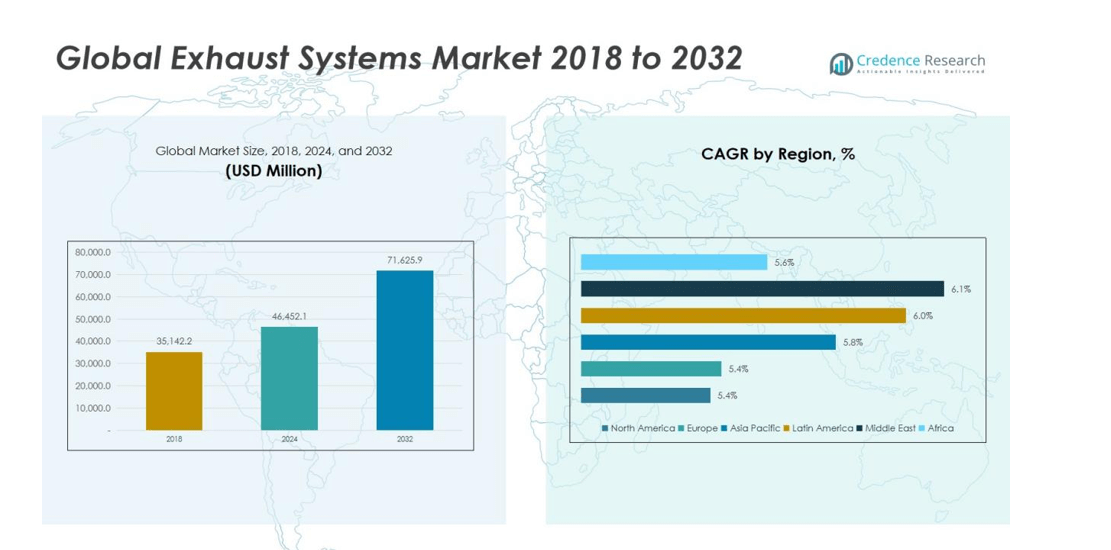
The Global Exhaust Systems Market size was valued at USD 35,142.2 million in 2018 to USD 46,452.1 million in 2024 and is anticipated to reach USD 71,625.9 million by 2032, at a CAGR of 5.62% during the forecast period.
| REPORT ATTRIBUTE | DETAILS |
|---|---|
| Historical Period | 2020-2023 |
| Base Year | 2024 |
| Forecast Period | 2025-2032 |
| Exhaust Systems Market Size 2024 | USD 46,452.1 million |
| Exhaust Systems Market, CAGR | 5.62% |
| Exhaust Systems Market Size 2032 | USD 71,625.9 million |
The market growth is driven by regulatory standards focused on reducing carbon emissions and improving engine performance. Automakers are investing in lightweight materials and innovative designs to enhance exhaust efficiency while reducing overall vehicle weight. The adoption of selective catalytic reduction (SCR) and gasoline particulate filters (GPF) further accelerates innovation in exhaust system manufacturing.
Regionally, Asia Pacific dominates the Global Exhaust Systems Market, accounting for the largest share due to high vehicle production in China, Japan, and India. Europe follows, supported by the presence of leading automotive manufacturers and strong environmental regulations. North America also holds a significant share, driven by demand for performance vehicles and technological advancements in emission reduction systems. Latin America and the Middle East & Africa are expected to witness steady growth through industrial expansion and rising automotive demand.
Market Insights:
- The Global Exhaust Systems Market was valued at USD 35,142.2 million in 2018, reached USD 46,452.1 million in 2024, and is projected to attain USD 71,625.9 million by 2032, growing at a CAGR of 5.62%.
- Asia Pacific leads the market with 34% share, supported by large-scale vehicle production in China, Japan, and India.
- Europe holds 26% share, driven by Euro 6 emission standards and innovation from major OEMs.
- North America captures 23% share, supported by EPA regulations and strong demand for high-performance vehicles.
- The Middle East is the fastest-growing region with a 6.11% CAGR, fueled by industrial expansion, luxury vehicle demand, and aftermarket growth.
- By product type, catalytic converters dominate the market with 38% share due to their key role in emission reduction.
- Mufflers account for 25% share, supported by the need for noise control and advanced acoustic designs in modern vehicles.
Market Drivers:
Stringent Emission Regulations Accelerating Adoption of Advanced Exhaust Technologies
The Global Exhaust Systems Market is driven by strict emission regulations imposed by governments to curb air pollution. Regulatory bodies in the U.S., Europe, and Asia-Pacific are enforcing Euro 6 and EPA standards, compelling automakers to integrate advanced exhaust components. These include catalytic converters, diesel particulate filters, and selective catalytic reduction systems. The growing enforcement of low-emission norms has pushed manufacturers to invest in research for improved exhaust treatment systems. It strengthens demand for high-efficiency, cost-effective emission control solutions.
- For Instance, Forvia (France) invested €1.8 billion in Research and Development in 2023. As a leader in automotive technology, Forvia develops advanced SCR and DPF systems that help vehicles meet stringent emissions regulations, such as the Euro 6 and U.S. EPA norms.
Rising Vehicle Production and Sales Driving Demand for Exhaust Systems
Increasing global vehicle production continues to fuel demand within the Global Exhaust Systems Market. Rapid urbanization and higher consumer spending have boosted sales of passenger and commercial vehicles. Automakers are enhancing exhaust performance to meet consumer preferences for durable, high-performing vehicles. The expansion of logistics and transportation networks worldwide also contributes to the growing requirement for robust exhaust systems. It reinforces steady market growth across both OEM and aftermarket segments.
- For Instance, Tenneco and Eaton are collaborating to produce an integrated exhaust thermal management system designed to help light and commercial vehicles meet upcoming emissions standards, such as the Euro 7 regulations.
Technological Advancements Supporting Lightweight and Efficient Designs
Ongoing innovations in materials and design are transforming the structure of exhaust systems. The Global Exhaust Systems Market benefits from the growing use of stainless steel, titanium, and composite materials that improve durability and reduce weight. Automakers are focusing on integrating advanced sensors and heat recovery technologies for better efficiency. These innovations help reduce fuel consumption and support sustainability goals in automotive manufacturing. It leads to higher adoption of technologically advanced exhaust solutions.
Growing Demand for Hybrid and Electric Vehicles Encouraging System Redesign
The increasing shift toward hybrid and mild-hybrid vehicles is reshaping exhaust system design. The Global Exhaust Systems Market is witnessing rising investments in adaptable and compact exhaust technologies suited for new powertrain architectures. Manufacturers are developing systems compatible with regenerative braking and energy recovery functions. The integration of electronic exhaust valves and sound management systems is also becoming common. It ensures continued relevance of exhaust systems even in a transitioning automotive landscape.
Market Trends:
Integration of Smart and Sustainable Exhaust Technologies Enhancing System Efficiency
The Global Exhaust Systems Market is experiencing a major shift toward smart and sustainable technologies that improve system performance and reduce emissions. Manufacturers are integrating IoT-enabled sensors and real-time monitoring systems to optimize exhaust flow and detect faults early. These digital solutions enhance diagnostics and maintenance, reducing downtime and improving overall vehicle efficiency. Growing focus on sustainability has encouraged the use of recyclable materials and coatings that extend product life while lowering environmental impact. Automakers are also developing variable exhaust valve systems to enhance engine sound and fuel efficiency. It is pushing manufacturers to design adaptable exhaust architectures that align with modern powertrain requirements and stricter environmental norms.
- For instance, FORVIA Faurecia’s electric actuated valve (EAV) technology delivers a 10–15 dB reduction in low-frequency noise while reducing silencer size by 30 %, combining acoustic refinement with improved exhaust aerodynamics.
Rising Focus on Lightweight Materials and Electrification-Compatible Designs
Ongoing advancements in lightweight materials are shaping the future of the Global Exhaust Systems Market. The use of high-strength steel, aluminum, and titanium alloys is expanding to reduce vehicle weight and improve fuel economy. Manufacturers are introducing modular exhaust structures that simplify installation and replacement. The growing penetration of hybrid and electric vehicles has accelerated the development of compact, thermally efficient exhaust systems. It supports improved integration with electric drivetrains while maintaining compliance with global emission standards. The emphasis on noise reduction technologies and active exhaust tuning is also creating new product opportunities. This trend is redefining the balance between performance, durability, and environmental responsibility in exhaust system design.
- For instance, Tenneco, through its collaboration with Eaton, developed an integrated exhaust thermal management system capable of heating the SCR catalyst to between 200°C and 250°C, cutting NOx emissions by up to 90% under Euro 7 standards, with production targeted for 2025.
Market Challenges Analysis:
Rising Shift Toward Electric Vehicles Limiting Traditional Exhaust Demand
The Global Exhaust Systems Market faces challenges from the rapid adoption of electric vehicles that eliminate the need for conventional exhaust systems. Governments are offering subsidies and incentives to promote EV usage, reducing long-term demand for combustion engine components. Automakers are redirecting investments toward battery technology and electric drivetrains, affecting growth opportunities for exhaust system suppliers. It has created pressure on manufacturers to diversify product lines or explore hybrid-compatible solutions. The transition toward zero-emission mobility is expected to gradually shrink the addressable market for traditional exhaust systems.
High Material Costs and Supply Chain Constraints Impacting Profitability
Fluctuating prices of raw materials such as stainless steel, nickel, and titanium have raised production costs for exhaust manufacturers. The Global Exhaust Systems Market is affected by supply chain disruptions that delay component delivery and increase operational expenses. Meeting emission standards requires complex designs and costly materials, tightening profit margins for suppliers. It also demands continuous R&D investment to maintain compliance and product quality. Limited availability of skilled labor and manufacturing capacity further constrains scalability and efficiency. These factors collectively challenge the industry’s ability to sustain competitive pricing and stable output levels.
Market Opportunities:
Expansion of Hybrid Vehicle Segment Creating New Growth Pathways
The Global Exhaust Systems Market is positioned to benefit from the rising adoption of hybrid and plug-in hybrid vehicles. These vehicles still require efficient exhaust systems to manage emissions during engine operation. Manufacturers are developing compact and thermally efficient exhaust designs tailored for hybrid configurations. It allows automakers to balance performance, weight, and environmental goals effectively. Growing consumer preference for hybrid options in Asia and Europe offers fresh opportunities for component suppliers. Continuous innovation in emission reduction and noise control technologies supports long-term market potential in this evolving segment.
Adoption of Lightweight and Smart Materials Enhancing Design Opportunities
The push toward lightweight vehicle construction is creating new opportunities for exhaust system advancements. The Global Exhaust Systems Market is witnessing increased demand for stainless steel, aluminum, and composite-based systems that improve performance and durability. It encourages suppliers to innovate in corrosion resistance and thermal management. Integration of smart sensors and monitoring units also opens avenues for predictive maintenance and real-time emission tracking. These enhancements align with stricter global sustainability goals and digital transformation trends. The shift toward intelligent exhaust technologies promises higher efficiency and stronger OEM partnerships worldwide.
Market Segmentation Analysis:
By Product Type
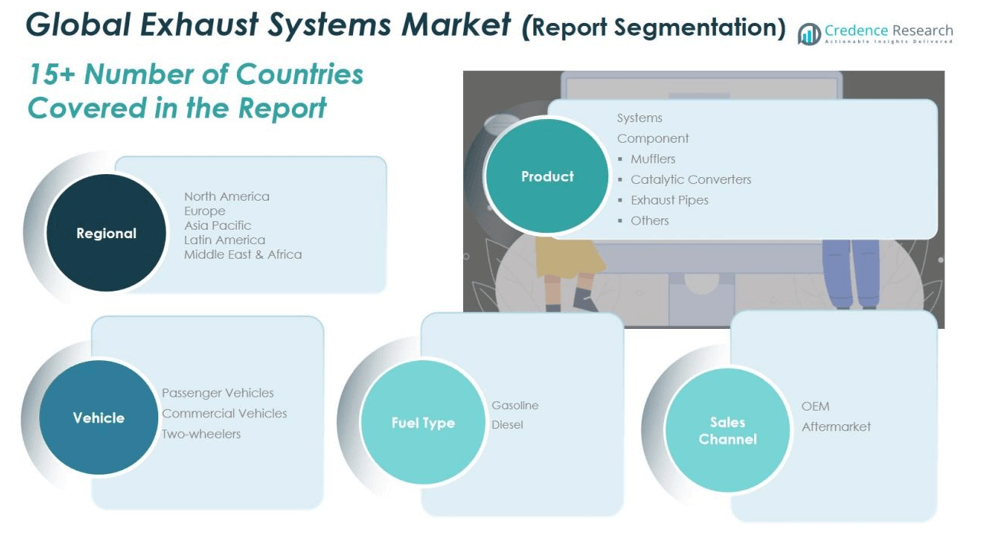
The Global Exhaust Systems Market by product type includes systems and components such as mufflers, catalytic converters, exhaust pipes, and others. Catalytic converters hold the largest share due to strict emission standards and their critical role in reducing pollutants. Mufflers also contribute significantly, driven by demand for noise control and vehicle comfort. It is witnessing growing innovation in lightweight materials and advanced coatings that improve durability and heat resistance. Exhaust pipes are evolving with modular and corrosion-resistant designs to support hybrid and high-performance vehicles.
- For Instance, BASF's Coatings division partnered with Toyota Motor Europe to develop its "Body&Paint" refinishing program for Toyota and Lexus vehicles in Europe, not catalytic converters.
By Vehicle Type
The market by vehicle type is divided into passenger vehicles, commercial vehicles, and two-wheelers. Passenger vehicles dominate due to higher production volumes and increasing adoption of emission control technologies. It benefits from rapid urbanization and demand for fuel-efficient cars across Asia Pacific and Europe. Commercial vehicles are showing steady growth, supported by logistics and industrial expansion. Two-wheelers hold a smaller yet important share in developing economies where cost-effective exhaust solutions are in demand.
- For instance, TVS Motor's BS6-compliant Jupiter, featuring Ecothrust Fuel Injection (ET-Fi) technology, improves overall fuel efficiency by 15%. Like all BS6 petrol engines, it achieves a 25% reduction in nitrogen oxide (NOx) emissions compared to the earlier BS4 standard, alongside stricter limits for hydrocarbons (HC) and other pollutants.
By Sales Channel
The market by sales channel includes OEM and aftermarket segments. OEMs account for a major share driven by technological integration and large-scale vehicle production. It benefits from partnerships between automakers and component suppliers focused on emission compliance. The aftermarket segment grows through replacement demand and customization trends. Expanding vehicle life cycles and stricter inspection norms continue to create strong opportunities for aftermarket suppliers.
Segmentations:
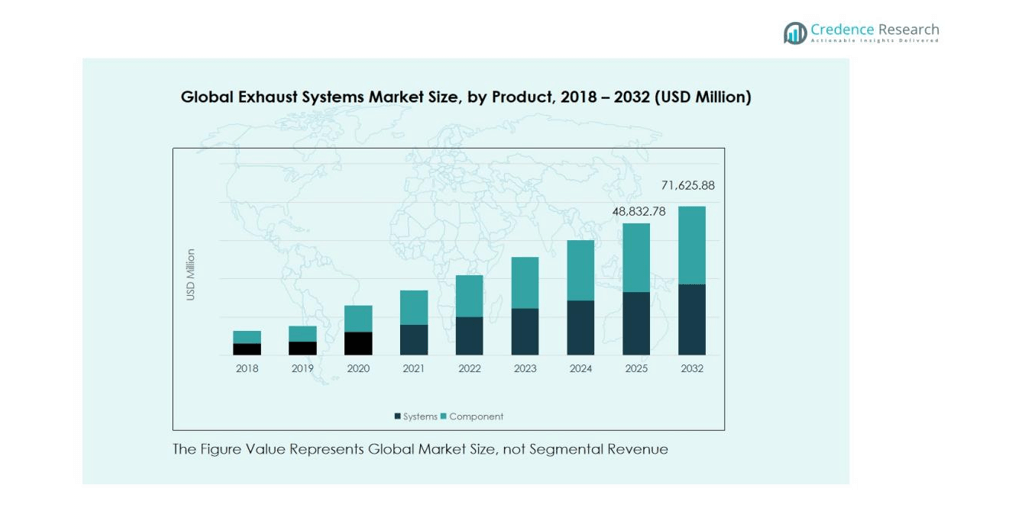
By Product Type
- Systems
- Component
- Mufflers
- Catalytic Converters
- Exhaust Pipes
- Others
By Vehicle Type
- Passenger Vehicles
- Commercial Vehicles
- Two-Wheelers
By Fuel Type
- Gasoline
- Diesel
By Sales Channel
- OEM
- Aftermarket
By Region
- North America
- U.S.
- Canada
- Mexico
- Europe
- Germany
- France
- U.K.
- Italy
- Spain
- Rest of Europe
- Asia Pacific
- China
- Japan
- India
- South Korea
- South-east Asia
- Rest of Asia Pacific
- Latin America
- Brazil
- Argentina
- Rest of Latin America
- Middle East & Africa
- GCC Countries
- South Africa
- Rest of the Middle East and Africa
Regional Analysis:
North America
The North America Exhaust Systems Market size was valued at USD 8,472.79 million in 2018 to USD 11,056.26 million in 2024 and is anticipated to reach USD 16,753.29 million by 2032, at a CAGR of 5.39% during the forecast period. The Global Exhaust Systems Market in this region holds 23% share, supported by high vehicle production and adoption of advanced emission technologies. It benefits from strong regulatory frameworks such as the EPA emission standards that mandate cleaner exhaust systems. Leading automakers in the U.S. and Canada are investing in lightweight and corrosion-resistant materials to improve system longevity. Demand for performance vehicles and commercial fleets continues to drive exhaust system upgrades. It also reflects a growing focus on integrating smart exhaust technologies to enhance monitoring and reduce maintenance costs.
Europe
The Europe Exhaust Systems Market size was valued at USD 9,488.40 million in 2018 to USD 12,404.70 million in 2024 and is anticipated to reach USD 18,844.77 million by 2032, at a CAGR of 5.43% during the forecast period. Europe accounts for 26% of the Global Exhaust Systems Market due to its strict emission norms and presence of leading OEMs. It is driven by Euro 6 regulations that promote cleaner and more efficient exhaust technologies. The region’s shift toward hybrid and low-emission vehicles stimulates innovation in particulate filters and catalytic converters. Germany, France, and the UK lead market demand through strong automotive manufacturing bases. It also benefits from increasing adoption of stainless steel and titanium exhausts to enhance durability and reduce weight.
Asia Pacific
The Asia Pacific Exhaust Systems Market size was valued at USD 11,480.96 million in 2018 to USD 15,309.29 million in 2024 and is anticipated to reach USD 23,880.07 million by 2032, at a CAGR of 5.78% during the forecast period. The region dominates the Global Exhaust Systems Market with 34% share, supported by expanding vehicle production in China, Japan, and India. It benefits from government initiatives promoting cleaner technologies and localized manufacturing. Rising income levels and increasing vehicle ownership drive continuous exhaust component demand. Automakers are investing in lightweight and thermally efficient materials to meet emission and performance standards. It continues to attract global manufacturers aiming to expand production facilities and supply networks.
Latin America
The Latin America Exhaust Systems Market size was valued at USD 3,078.46 million in 2018 to USD 4,156.80 million in 2024 and is anticipated to reach USD 6,589.58 million by 2032, at a CAGR of 5.99% during the forecast period. The region contributes 9% share to the Global Exhaust Systems Market, with Brazil and Mexico being key automotive hubs. It benefits from increasing vehicle exports and the gradual introduction of stricter emission norms. Local manufacturers are adopting advanced catalytic technologies to align with evolving environmental standards. Growing middle-class populations and infrastructure expansion are fueling automotive demand. It also reflects opportunities for global suppliers to strengthen OEM partnerships and aftermarket presence.
Middle East
The Middle East Exhaust Systems Market size was valued at USD 1,679.80 million in 2018 to USD 2,284.12 million in 2024 and is anticipated to reach USD 3,652.92 million by 2032, at a CAGR of 6.11% during the forecast period. The Global Exhaust Systems Market in this region holds 5% share, led by rising demand for passenger and luxury vehicles. It benefits from the growing focus on vehicle efficiency and compliance with emission standards across GCC countries. Increasing industrialization and construction fleet growth boost heavy-duty vehicle demand. Manufacturers are emphasizing corrosion-resistant materials suitable for high-temperature desert environments. It offers potential for aftermarket expansion supported by rising automotive imports and regional assembly operations.
Africa
The Africa Exhaust Systems Market size was valued at USD 941.81 million in 2018 to USD 1,240.93 million in 2024 and is anticipated to reach USD 1,905.25 million by 2032, at a CAGR of 5.57% during the forecast period. The region accounts for 3% share of the Global Exhaust Systems Market, driven by gradual automotive sector development. It is witnessing increased imports of passenger and commercial vehicles from Asia and Europe. Government initiatives promoting localized assembly are expected to strengthen market growth. Limited enforcement of emission regulations remains a challenge but creates long-term potential for regulatory-driven upgrades. It also shows growing interest in aftermarket exhaust products to improve performance and lifespan of imported vehicles.
Key Player Analysis:
- Tenneco Inc.
- Futaba Industrial Co., Ltd.
- Sango Co., Ltd.
- Yutaka Giken Co., Ltd.
- Eberspächer Gruppe GmbH & Co. KG
- Forvia (Faurecia SE)
- BOSAL Group
- Sejong Industrial Co., Ltd.
- Friedrich Boysen GmbH & Co. KG
- Continental AG
- Katcon Global
- Benteler International AG
- Sango Industrial Co. Ltd.
- Dinex Group
Competitive Analysis:
The Global Exhaust Systems Market features intense competition among key automotive component manufacturers focusing on emission reduction and efficiency improvement. Major players such as Tenneco Inc., Futaba Industrial Co., Ltd., Sango Co., Ltd., Yutaka Giken Co., Ltd., Eberspächer Gruppe GmbH & Co. KG, Forvia (Faurecia SE), BOSAL Group, and Sejong Industrial Co., Ltd. dominate global production and supply networks. It is defined by continuous innovation in lightweight materials, noise control, and catalytic technologies to comply with stringent global emission standards. Companies are strengthening partnerships with OEMs and expanding production facilities in high-growth regions such as Asia Pacific. Competitive strategies include product diversification, regional expansion, and adoption of smart exhaust technologies integrated with sensors and data analytics. It continues to evolve toward sustainable and modular system architectures, ensuring improved performance and reduced lifecycle emissions for both passenger and commercial vehicle applications.
Recent Developments:
- In September 2025, Futaba Industrial released its Earnings Results Presentation for the first three months of the fiscal year ending March 31, 2025 (112th term).
- In September 2025, Purem by Eberspächer developed Direct Air Capture Technology designed to remove CO₂ from the atmosphere, expanding the company's expertise beyond traditional exhaust systems.
Report Coverage:
The research report offers an in-depth analysis based on Segment 1, Segment 2, Segment 3, and Segment 3. It details leading market players, providing an overview of their business, product offerings, investments, revenue streams, and key applications. Additionally, the report includes insights into the competitive environment, SWOT analysis, current market trends, as well as the primary drivers and constraints. Furthermore, it discusses various factors that have driven market expansion in recent years. The report also explores market dynamics, regulatory scenarios, and technological advancements that are shaping the industry. It assesses the impact of external factors and global economic changes on market growth. Lastly, it provides strategic recommendations for new entrants and established companies to navigate the complexities of the market.
Future Outlook:
- The Global Exhaust Systems Market will continue advancing through integration of smart monitoring and emission control technologies.
- Rising demand for hybrid and plug-in hybrid vehicles will sustain partial dependence on efficient exhaust systems.
- Manufacturers will prioritize lightweight and recyclable materials to meet sustainability goals and reduce fuel consumption.
- OEM collaborations will strengthen as automakers seek integrated, modular exhaust solutions for evolving vehicle platforms.
- Research and development investments will grow in catalytic materials, noise suppression, and heat recovery systems.
- Asia Pacific will remain the largest production hub due to expanding vehicle manufacturing in China, Japan, and India.
- Europe and North America will maintain technological leadership through stricter emission norms and advanced testing capabilities.
- Aftermarket demand will rise as aging vehicle fleets require replacement and upgraded exhaust components.
- Digital technologies such as IoT and predictive maintenance will enhance efficiency and lifespan of exhaust systems.
- Global players will focus on strategic mergers and regional expansions to optimize supply chains and sustain competitiveness.

Request a Free Sample
Fill in your details and we'll send you a free sample report.
- Sample data tables & charts
- Research methodology
Need a Custom Version of This Report?
Tailor the scope, geography, or segments to your exact requirements.
- Custom geography or segment scope
- Direct access to our analyst team
Frequently Asked Questions
What is the current market size for the Global Exhaust Systems Market, and what is its projected size in 2032?
At what Compound Annual Growth Rate is the Global Exhaust Systems Market projected to grow between 2024 and 2032?
Which product type segment held the largest share in 2024?
What are the primary factors fueling the growth of the Global Exhaust Systems Market?
Who are the leading companies in the Global Exhaust Systems Market?
Table of Content
Chapter 1 Market Segmentation
- 1.1 Segmentation Framework
- 1.1.1 Product and Service Classification
- 1.1.2 Application and End-Use Classification
- 1.1.3 Technology and Solution Classification
- 1.1.4 Customer and Distribution Channel Classification
- 1.1.5 Geographic Segmentation
- 1.1.6 Market Segment Definitions and Boundaries
Chapter 2 Introduction
- 2.1 Report Objectives and Scope
- 2.2 Product Definition and Industry Terminology
- 2.3 Market Inclusions and Exclusions
- 2.4 Research Process
- 2.4.1 Primary Research and Expert Interviews
- 2.4.2 Secondary Research and Source Review
- 2.4.3 Top-Down and Bottom-Up Estimation
- 2.4.4 Data Triangulation and Verification
- 2.5 Market Size Measurement Basis
- 2.5.1 2024: USD 46,452.1 million → 2032: USD 71,625.9 million
- 2.6 Historical and Forecast Reference Periods
- 2.6.1 Base Year: 2024
- 2.6.2 Forecast Period: 2024-2032
- 2.7 Research Assumptions and Limitations
Chapter 3 Executive Summary
- 3.1 Market Snapshot and Key Findings
- 3.2 Base-Year Market Size, 2024
- 3.3 Forecast Market Size, 2032
- 3.4 Revenue and Volume Growth Outlook
- 3.5 Key Demand and Supply Indicators
- 3.6 Leading Market Segments
- 3.7 Fastest-Growing Market Opportunities
- 3.8 Regional Performance Highlights
- 3.9 Technology and Industry Transformation
- 3.10 Competitive Landscape Summary
- 3.11 Analyst View and Strategic Implications
Chapter 4 Global Exhaust Systems Market Trends and Developments
- 4.1 Historical Industry Development
- 4.2 Recent Market Trends and Developments
- 4.3 Demand and Customer Behavior Trends
- 4.4 Technology and Product Innovation
- 4.5 Artificial Intelligence, Automation and Digitalization
- 4.6 Local Manufacturing and Supply Chain Realignment
- 4.7 Industry Partnerships, Mergers and Acquisitions
- 4.8 Sustainability and Circular Economy Developments
- 4.9 Government and Private Sector Investment Trends
- 4.10 Emerging Business Models and Commercialization
- 4.11 Industry Developments and Announcements
Chapter 5 Global Exhaust Systems Market Production, Supply and Demand Analysis
- 5.1 Demand Trend and Consumption Analysis
- 5.2 Demand Forecast, 2024-2032
- 5.3 Production and Output Trend
- 5.4 Production and Output Forecast, 2024-2032
- 5.5 Installed Capacity and Capacity Utilization
- 5.6 Company-Wise Production Plants and Statistics
- 5.6.1 Installed Production Capacity
- 5.6.2 Actual Production
- 5.6.3 Planned Capacity and Expansion Targets
- 5.7 Supply Chain Structure and Procurement Trends
- 5.8 Supply-Demand Gap and Bottlenecks
- 5.9 Import Dependence and Sourcing Structure
- 5.10 Contract Manufacturing and Outsourcing
- 5.11 Regional Supply and Demand Concentration
Chapter 6 Global Exhaust Systems Market Pricing Analysis
- 6.1 Pricing Structure and Measurement
- 6.2 Historical Pricing Trends
- 6.3 Pricing Outlook, 2024-2032
- 6.4 Average Selling Price and Unit Economics
- 6.5 Pricing by Product and Market Segment
- 6.6 Geographic Pricing Differences
- 6.7 Key Input, Energy, Labor and Logistics Costs
- 6.8 Contract Pricing and Purchasing Models
- 6.9 Pricing Sensitivity and Competitive Positioning
- 6.10 Price, Margin and Profitability Implications
Chapter 7 Global Exhaust Systems Market Dynamics
- 7.1 Market Growth Drivers
- 7.1.1 Demand-Side Drivers
- 7.1.2 Technology and Innovation Drivers
- 7.1.3 Infrastructure and Investment Drivers
- 7.1.4 Regulatory and Policy Drivers
- 7.2 Market Restraints
- 7.2.1 Cost and Affordability Constraints
- 7.2.2 Technology and Adoption Barriers
- 7.2.3 Supply Chain and Operational Constraints
- 7.3 Market Challenges
- 7.3.1 Competitive Pressure and Margin Erosion
- 7.3.2 Skills, Infrastructure and Implementation Gaps
- 7.4 Emerging Market Opportunities
- 7.5 Market Dynamics Impact and Time-Horizon Assessment
Chapter 8 Global Exhaust Systems Value Chain Analysis
- 8.1 Industry Value Chain Overview
- 8.2 Upstream Suppliers and Critical Inputs
- 8.3 Technology and Component Providers
- 8.4 Manufacturing or Service Delivery
- 8.5 Distribution, Channel Partners and Integrators
- 8.6 Downstream Applications and End Users
- 8.7 Value Addition and Profit Pools
- 8.8 Vertical Integration and Outsourcing
- 8.9 Supplier Concentration and Risk
- 8.10 Supply Chain Localization and Resilience
Chapter 9 Global Exhaust Systems Market Regulations and Policies
- 9.1 Relevant Laws, Standards and Compliance Frameworks
- 9.2 Product, Service, Safety and Quality Requirements
- 9.3 Government Policies, Incentives and Subsidies
- 9.4 Imports, Exports and Trade Barriers
- 9.5 Public Procurement and Local Content Requirements
- 9.6 Environmental and Sustainability Compliance
- 9.7 Upcoming Policy Changes and Market Implications
Chapter 10 Global Exhaust Systems Market Hotspots and Opportunities
- 10.1 Market Opportunity Mapping and Growth Hotspots
- 10.2 High-Growth Applications and Customer Groups
- 10.3 Underserved Markets and White-Space Opportunities
- 10.4 Emerging Technology and Product Opportunities
- 10.5 New Capacity and Investment Hotspots
- 10.6 Market Entry and Expansion Opportunities
- 10.7 Distribution and Partnership Opportunities
- 10.8 Near-Term and Long-Term Commercial Potential
- 10.9 Opportunity Attractiveness and Execution Risks
Chapter 11 Global Exhaust Systems Market Outlook, 2024-2032
- 11.1 Market Size and Analysis
- 11.1.1 Revenue (Market Measurement: 2024: USD 46,452.1 million → 2032: USD 71,625.9 million)
- 11.1.2 Market Volume and Quantity Sold
- 11.1.3 Historical Market Size
- 11.1.4 Base-Year Market Size, 2024
- 11.2 Market Forecast, 2024-2032
- 11.2.1 Revenue Forecast to 2032
- 11.2.2 Volume Forecast to 2032
- 11.2.3 CAGR and Year-on-Year Growth
- 11.2.4 Incremental Revenue Opportunity
- 11.3 Forecast Assumptions and Scenario Analysis
- 11.3.1 Base-Case Forecast
- 11.3.2 Optimistic and Conservative Scenarios
- 11.3.3 Technology, Pricing and Policy Sensitivities
- 11.4 Market Attractiveness and Growth Outlook
Chapter 12 Global Exhaust Systems Market Segmentation and Outlook
- 12.1 Segmentation Summary and Market Shares, 2024
- 12.2 Largest and Fastest-Growing Segments
- 12.3 Segment Growth Comparison
- 12.4 Segment Attractiveness and Priority Matrix
Chapter 13 Global Exhaust Systems Geographic Market Outlook, 2024-2032
- 13.1 Regional Market Size and Share, 2024
- 13.2 Regional Market Forecast, 2024-2032
- 13.3 Regional Pricing, Production and Demand Differences
- 13.4 North America
- 13.4.1 United States
- 13.4.2 Canada
- 13.4.3 Mexico
- 13.5 Europe
- 13.5.1 Germany
- 13.5.2 France
- 13.5.3 Italy
- 13.5.4 United Kingdom
- 13.5.5 Spain
- 13.5.6 Poland
- 13.5.7 Russia
- 13.5.8 Netherlands
- 13.5.9 Belgium
- 13.5.10 Sweden
- 13.5.11 Denmark
- 13.5.12 Norway
- 13.5.13 Rest of Europe
- 13.6 Asia Pacific
- 13.6.1 China
- 13.6.2 India
- 13.6.3 Japan
- 13.6.4 South Korea
- 13.6.5 Thailand
- 13.6.6 Indonesia
- 13.6.7 Vietnam
- 13.6.8 Malaysia
- 13.6.9 Australia
- 13.6.10 Rest of Asia Pacific
- 13.7 Latin America
- 13.7.1 Brazil
- 13.7.2 Argentina
- 13.7.3 Colombia
- 13.7.4 Chile
- 13.7.5 Rest of Latin America
- 13.8 Middle East
- 13.8.1 Saudi Arabia
- 13.8.2 United Arab Emirates
- 13.8.3 Turkey
- 13.8.4 Israel
- 13.8.5 Iran
- 13.8.6 Rest of the Middle East
- 13.9 Africa
- 13.9.1 South Africa
- 13.9.2 Egypt
- 13.9.3 Nigeria
- 13.9.4 Morocco
- 13.9.5 Rest of Africa
- 13.10 Regional Investment, Policy and Supply Chain Differences
- 13.11 Regional Competitive Landscape
- 13.12 Geographic Growth Hotspots
Chapter 14 Global Exhaust Systems Technology, Innovation and Sustainability Outlook
- 14.1 Technology Landscape and Maturity
- 14.2 Product, Process and Service Innovation
- 14.3 AI, Automation and Digital Tools in the Industry
- 14.4 Technology Adoption and Performance Benchmarking
- 14.5 Innovation Pipeline and R&D Investment
- 14.6 Patent and Intellectual Property Trends
- 14.7 Energy Efficiency and Resource Management
- 14.8 Sustainability, Recycling and Circularity
- 14.9 Technology Roadmap, 2024-2032
- 14.10 Risks of Obsolescence and Technology Substitution
Chapter 15 Global Exhaust Systems Market Key Strategic Imperatives
- 15.1 Growth and Market Entry Priorities
- 15.2 High-Return Products and Segments
- 15.3 Pricing, Profitability and Cost Optimization
- 15.4 Technology Investment and Product Differentiation
- 15.5 Supply Chain Localization and Resilience
- 15.6 Distribution and Customer Acquisition
- 15.7 Partnership, Acquisition and Capacity Strategy
- 15.8 Regional Expansion Priorities
- 15.9 Short-, Medium- and Long-Term Actions
Chapter 16 Competition Outlook
- 16.1 Industry Competition Characteristics
- 16.2 Market Structure and Concentration
- 16.3 Market Share and Competitive Positioning, 2024
- 16.4 Company-Wise Revenue and Product Benchmarking
- 16.5 Production and Service Capacity Benchmarking
- 16.6 Technology, Pricing and Differentiation
- 16.7 Regional Footprint and Distribution Strength
- 16.8 Mergers, Acquisitions and Strategic Alliances
- 16.9 New Entrants and Competitive Threats
- 16.10 Porter's Five Forces and Industry Attractiveness
- 16.11 Competitive Outlook, 2024-2032
Chapter 17 Company Profiles
- 17.1 Company Coverage and Selection Criteria
- 17.2 Leading Market Participants – Standard Profile Structure
- 17.2.1 Business Description
- 17.2.2 Company Ownership and Geographic Presence
- 17.2.3 Product and Service Portfolio
- 17.2.4 Manufacturing and Operating Footprint
- 17.2.5 Production Capacity and Expansion Plans
- 17.2.6 Financial Performance and Investment
- 17.2.7 Market Share and Competitive Position
- 17.2.8 Technology and Innovation Capabilities
- 17.2.9 Strategic Alliances or Partnerships
- 17.2.10 Recent Developments
- 17.2.11 Growth Strategy and Outlook
- 17.3 Other Relevant Market Participants
Note: Every listed company is profiled on the structure shown under the first company. The company list is preliminary and may change based on research findings, market developments, data availability and client requirements.
Chapter 18 Disclaimer
- 18.1 Research and Forecast Disclaimer
- 18.2 Data Source and Estimation Limitations
Note: The depth of individual sections depends on data availability for this market. Volume, capacity, trade and other unit-based metrics are included where applicable.