Market Overview:
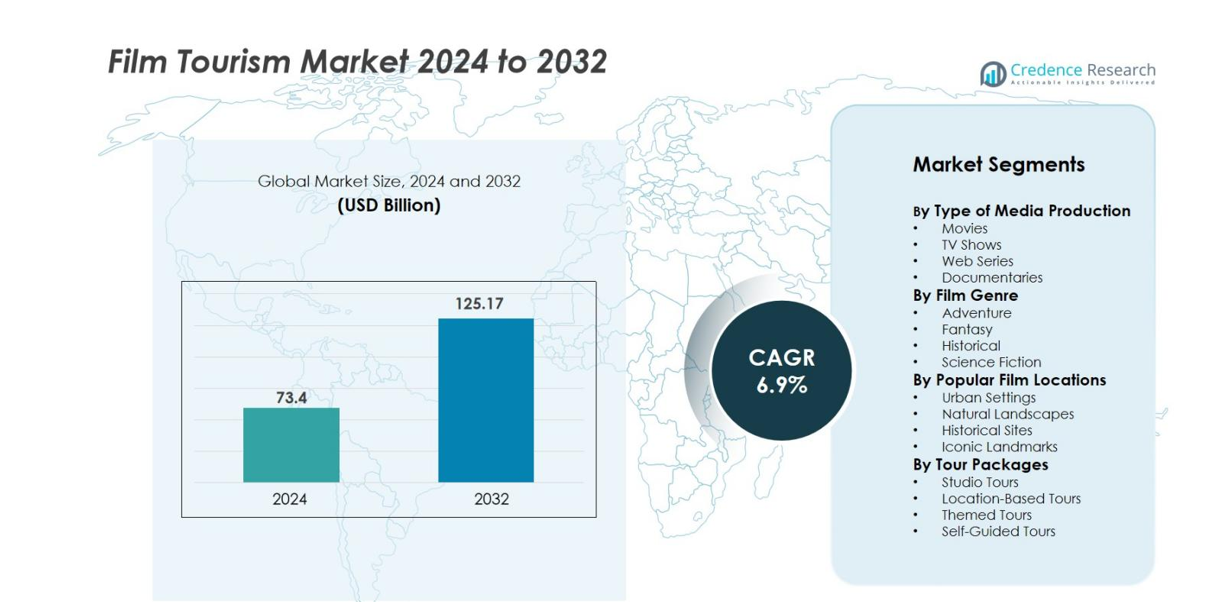
The Film Tourism Market size was valued at USD 73.4 Billion in 2024 and is anticipated to reach USD 125.17 Billion by 2032, growing at a CAGR of 6.9% during the forecast period.
| REPORT ATTRIBUTE | DETAILS |
|---|---|
| Historical Period | 2020-2023 |
| Base Year | 2024 |
| Forecast Period | 2025-2032 |
| Film Tourism Market Size 2024 | USD 73.4 Billion |
| Film Tourism Market, CAGR | 6.9% |
| Film Tourism Market Size 2032 | USD 125.17 Billion |
The Film Tourism market continues to expand as global audiences seek immersive travel experiences tied to their favorite films and series. Key players such as Warner Bros. Studio Tour, Universal Studios Hollywood, and New Zealand Film Tours dominate by offering exclusive behind-the-scenes access and themed location tours. Tourism boards like VisitScotland, Iceland Tourism Board, and Tourism New South Wales are also influential, leveraging iconic landscapes and strategic partnerships with production houses to attract visitors. North America leads the market with a 35% share, driven by Hollywood’s influence and established infrastructure, followed by Europe with 30%, propelled by historical and cinematic destinations across the UK, Italy, and Croatia.
Market Insights
- The Film Tourism market was valued at USD 73.4 billion in 2024 and is projected to reach USD 125.17 billion by 2032, growing at a CAGR of 6.9%.
- Growth is primarily driven by rising fan engagement and destination-marketing strategies linked to blockbuster franchises, which motivate travelers to visit filming sites for authentic experiences.
- The market is influenced by trends such as experiential tourism, digital content promotion, and the increased focus on themed tour packages, incorporating AR/VR and social media campaigns to attract younger audiences.
- Leading players like Warner Bros. Studio Tour, Universal Studios Hollywood, and tourism boards in New Zealand and Scotland dominate through strategic partnerships and film industry collaborations, though over-tourism and environmental risks pose key restraints.
- North America leads with a 35% regional share, followed by Europe at 30%, while the Movies segment holds the largest share at 48% across the market's media production categories.
Market Segmentation Analysis
By Type of Media Production
In the Film Tourism market, the Movies segment dominates with a market share of approximately 48% in 2024. This leadership is driven by the global appeal and cultural influence of blockbuster films, which motivate tourists to visit iconic filming sites. Major franchises and cinematic universes enhance destination visibility through immersive storytelling and memorable visuals. The availability of guided tours, movie-themed attractions, and behind-the-scenes experiences further strengthens this segment. Additionally, rising promotional collaborations between film studios and tourism boards support the continued expansion of movie-driven tourism.
- For instance, the release of Star Wars: The Force Awakens boosted tourism to Skellig Michael, Ireland, with recorded visitor capacity increasing from 11,000 in 2011 to over 16,700 in 2018.
By Film Genre
The Adventure genre holds the largest share in the Film Tourism market, accounting for around 35% in 2024. Adventure films often showcase exotic or dramatic landscapes that inspire travel to remote or unique destinations. The allure of physical exploration and the emotional connection formed through high-stakes storytelling contribute to its dominance. Popular adventure franchises filmed across global destinations like New Zealand and Iceland have set tourism trends. The strong demand for active, nature-based travel experiences also supports growth within this genre, making adventure films a major driver of tourism interest.
- For instance, tourism to Thailand’s Maya Bay surged to over 5,000 daily visitors after The Beach starring Leonardo DiCaprio was released, eventually prompting the bay’s temporary closure in 2018 to restore environmental conditions due to excessive footfall.
By Popular Film Locations
Natural Landscapes lead the Film Tourism market by location type, capturing approximately 40% of the segment’s market share in 2024. Tourists are drawn to dramatic outdoor settings featured in films and series that highlight mountains, forests, coastlines, and rural scenery. Destinations like New Zealand, Iceland, and Scotland have successfully leveraged natural settings to attract cinephiles and nature lovers alike. The rise of eco-tourism and experiential travel trends further fuels this category, as travelers increasingly seek immersive adventures that connect cinematic storytelling with real-life environmental beauty.
Key Growth Drivers
Increasing Influence of Global Blockbuster Films
The growing popularity of blockbuster films is one of the primary drivers of the Film Tourism market. Global franchises such as Lord of the Rings, Harry Potter, and Game of Thrones have transformed filming locations into international tourist destinations, attracting millions of fans annually. These productions not only promote iconic landscapes and cultural landmarks but also create a lasting emotional connection between viewers and destinations. The economic impact of film-induced tourism is further amplified by local partnerships, on-site experiences, and boosted media visibility. Tourism boards worldwide increasingly collaborate with studios to leverage this appeal, launching specialized tour packages, events, and travel itineraries. This synergy between the film and tourism industries creates a sustainable revenue stream, promotes cultural exchange, and fosters regional development. As streaming platforms continue to expand global content reach, locations featured in internationally popular series and films are seeing a dramatic rise in tourism-driven economic benefits.
- For instance, Harry Potter fans have driven over 10 million visitors to the Warner Bros. Studio Tour in London, where they can explore the magical world of Hogwarts and its iconic sets.
Rising Investment from Tourism Boards and Governments
Government and tourism boards are recognizing the potential of film tourism as both a cultural export and revenue generator. Strategic initiatives are being launched to attract filmmakers through incentives, grants, and streamlined permissions, particularly in countries like New Zealand, Scotland, and Iceland. These destinations have effectively branded themselves through their association with high-profile productions, enticing tourists seeking authentic experiences linked to their favorite films. Additionally, infrastructure development-such as themed museums, tours, and filming location trails-enhances the appeal of these areas. Public-private partnerships also play a crucial role in integrating film tourism into national economic plans. Investment in marketing campaigns and global promotional tours further increases awareness and draws international travelers. Through coordinated efforts, governments and tourism boards are helping create immersive, story-driven tourism experiences that blend culture, entertainment, and local heritage, thereby accelerating market growth.
- For instance, New Zealand offers a 20% production rebate under its NZSPG incentive scheme, which contributed to attracting major films like Avatar: The Way of Water, supporting over 3,000 local jobs during production.
Expansion of Digital Platforms and Fan Communities
Digital media and social platforms are transforming the landscape of fan engagement and film tourism. Influencers, travel bloggers, and fan groups actively share their experiences from filming locations, amplifying interest through captivating visuals and storytelling. Platforms like Instagram, YouTube, and TikTok make it easier for fans to discover iconic locations and plan their trips. Additionally, virtual tours and interactive websites allow users to explore landscapes from their favorite films, sparking travel intentions even before trips are booked. Streaming platforms also widen access to global content, sparking curiosity for destinations beyond traditional tourism hotspots. Fan conventions, movie-themed travel apps, and social media campaigns further boost engagement. The influence of digital fandom is particularly strong among younger audiences who prioritize unique, shareable experiences. As digital communities grow, they play a critical role in keeping film locations relevant and sustaining demand for film-induced travel.
Key Trends & Opportunities
Growth of Experiential and Themed Tourism
A rising preference for immersive travel experiences is influencing the Film Tourism market. Travelers no longer want to simply visit filming locations-they seek to relive iconic scenes and engage in themed activities. This trend includes offerings like guided set tours, cosplay events, themed accommodations, and interactive exhibits. For example, destinations like Warner Bros. Studio Tour in London and Hobbiton in New Zealand offer fans a complete sensory experience. Themed tourism blends real and fictional narratives, giving visitors the chance to physically inhabit spaces from their favorite movies and shows. This experiential shift allows tourism operators to diversify their offerings and attract a wider audience. Furthermore, integration of augmented reality (AR) and virtual reality (VR) enriches visitor engagement by recreating film settings on-site. The growing demand for meaningful and memorable travel presents vast opportunities for destinations to enhance experiential tourism aligned with fan expectations.
- For instance, Disney’s Star Wars: Galaxy’s Edge at Disneyland California spans 14 acres and includes interactive lightsaber workshops and droid-building stations, drawing thousands of fans daily.
Rising Popularity of Film Festivals and Screen Tourism Events
Film festivals and screen tourism events are evolving as powerful promotional tools for film tourism. They serve as platforms to spotlight destinations featured in noteworthy productions, often attracting international visitors. Events like the Cannes Film Festival and the Sundance Film Festival not only boost local tourism but also promote regional culture and production environments. Screen tourism events, pop-up exhibitions, and location-specific fan conventions extend the momentum of popular series or films. These gatherings give fans exclusive access to filmmakers, props, behind-the-scenes commentary, and immersive screenings. They also foster strong relationships between local tourism boards and production houses. As film festivals grow in scale and digital visibility, they create ripple effects that draw visitors intrigued by the cultural heritage and scenery showcased. Such opportunities also align with national branding, allowing countries to position themselves as cinematic destinations and boost overall tourist influx.
- For instance, the Game of Thrones Legacy Tour in Northern Ireland offers access to original props, more than 100 show costumes, and iconic sets, supported by Tourism Northern Ireland as part of a strategic investment in screen tourism.
Key Challenges
Environmental Impact and Over-Tourism
One of the major challenges facing the Film Tourism market is the environmental strain and over-tourism caused by large influxes of visitors to filming locations. Popular destinations like Skógafoss in Iceland and Hobbiton in New Zealand have reported significant ecological damage due to high foot traffic. Infrastructure, local biodiversity, and cultural sites face sustainability risks if visitor volumes are not properly managed. Additionally, over-tourism may lead to disruption of local lifestyles and strain on public resources. Tourism authorities must strike a balance between leveraging film popularity and protecting local ecosystems. Implementing visitor caps, promoting off-peak travel, and investing in sustainable infrastructure are crucial to mitigating these concerns. Responsible tourism development, backed by community participation and awareness campaigns, is essential to ensure continued profitability without compromising environmental integrity.
Volatility in Film Industry Activity and Media Trends
The Film Tourism market is highly sensitive to shifts in media consumption trends and film industry dynamics. A decline in film production due to economic downturns, strikes, or studio budget cuts can directly impact tourism inflows. Frequent changes in viewer preferences may also affect the long-term appeal of certain locations. For instance, a location tied to a single production may see a temporary spike in visitors but struggle to sustain interest in the long term. Additionally, competition from virtual tourism and digital content can reduce physical travel motivation. Film tourism operators need to adapt by diversifying offerings and associating destinations with multiple media productions. Strategic planning and consistent promotional efforts are necessary to manage demand fluctuations and sustain market relevance amid evolving media landscapes.
Regional Analysis
North America
North America leads the Film Tourism market with 35% market share in 2024, driven by the dominance of Hollywood and popular filming sites across the United States and Canada. Major studios like Universal and Warner Bros. offer immersive on-site experiences that attract millions of visitors each year. Iconic locations such as New York City, Los Angeles, and Vancouver have become synonymous with blockbuster films and TV shows. The availability of well-developed infrastructure, studio tours, and destination marketing campaigns also boost the region’s appeal. The growing demand for film-themed tourism packages further strengthens North America’s leadership in this industry.
Europe
Europe holds 30% of the Film Tourism market share in 2024, fueled by culturally rich locations featured in globally popular films and series. Countries like the United Kingdom, Italy, and Croatia attract fans with settings used in franchises like Harry Potter, Game of Thrones, and The Crown. Many European destinations leverage their historical architecture and natural beauty to create unique on-location experiences. Collaboration between tourism boards and production companies has resulted in themed walking tours, exhibitions, and promotional campaigns. Government incentives and UNESCO heritage sites further drive travel interest across Europe’s diverse and cinematic landscapes.
Asia Pacific
Asia Pacific accounts for 20% of the Film Tourism market share in 2024, with rapid growth attributed to expanding film production industries in countries like India, South Korea, and New Zealand. Destinations such as Seoul, Kyoto, and Queenstown are gaining international fame due to their portrayal in movies and TV dramas. Increased viewership of Korean dramas and Bollywood films has generated strong tourism demand. Governments in the region actively promote filming through incentives and location branding. A rising middle-class population and digital connectivity are encouraging domestic and international travel to prominent cinematic hotspots.
Latin America
Latin America holds a smaller yet growing share of 8% in 2024, with Brazil, Mexico, and Colombia emerging as key film tourism destinations. Productions like Narcos, Roma, and Motorcycle Diaries have increased international exposure to the region’s scenic and urban locations. The appeal is further enhanced by the diverse landscapes, vibrant culture, and heritage sites that resonate with global audiences. Investment in promoting filming locations and sustainable tourism practices is gaining momentum. As streaming platforms feature more Latin American content, destinations in the region are increasingly drawing cinephiles and content-inspired travelers.
Middle East & Africa
The Middle East & Africa region represents 7% of the Film Tourism market share in 2024, driven by destinations such as Jordan, Morocco, and South Africa, which have hosted iconic productions like Star Wars, Gladiator, and Black Panther. The region's unique desert landscapes, ancient architecture, and exotic locales offer compelling backdrops for global films. Governments are enhancing visibility through film-friendly policies and promotional partnerships. South Africa, in particular, stands out with a growing production ecosystem and diverse locations. As infrastructure improves and cultural storytelling expands, the region is poised to leverage its cinematic potential further.
Market Segmentations
By Type of Media Production
- Movies
- TV Shows
- Web Series
- Documentaries
By Film Genre
- Adventure
- Fantasy
- Historical
- Science Fiction
By Popular Film Locations
- Urban Settings
- Natural Landscapes
- Historical Sites
- Iconic Landmarks
By Tour Packages
- Studio Tours
- Location-Based Tours
- Themed Tours
- Self-Guided Tours
By Geography
- North America
- U.S.
- Canada
- Mexico
- Europe
- Germany
- France
- U.K.
- Italy
- Spain
- Rest of Europe
- Asia Pacific
- China
- Japan
- India
- South Korea
- South-east Asia
- Rest of Asia Pacific
- Latin America
- Brazil
- Argentina
- Rest of Latin America
- Middle East & Africa
- GCC Countries
- South Africa
- Rest of the Middle East and Africa
Competitive Landscape
The competitive landscape of the Film Tourism market is shaped by a blend of global film studios, tourism boards, destination management organizations, and specialized travel companies. Key players such as Warner Bros. Studio Tour, Universal Studios Hollywood, and New Zealand Film Tours lead the market by offering immersive, film-themed visitor experiences and guided tours to iconic locations. National tourism boards like VisitScotland, Tourism New South Wales, and Iceland Tourism Board actively collaborate with filmmakers to position their regions as attractive filming and travel destinations. Organizations like the Egyptian Tourism Authority and Jordan Tourism Board further enhance their appeal through promotional campaigns tied to blockbuster films. Additionally, travel operators and local businesses are increasingly developing customized film-location packages driven by growing fan interest. The competitive landscape emphasizes strategic partnerships between media production companies and tourism stakeholders, global event marketing, and digital engagement to attract both domestic and international film-inspired travelers.
Key Player Analysis
- New Zealand Film Tours
- Warner Bros. Studio Tour
- Universal Studios Hollywood
- VisitScotland
- Tourism New South Wales
- Egyptian Tourism Authority
- Jordan Tourism Board
- Iceland Tourism Board
- Ireland's Wild Atlantic Way
- New York City & Company
Recent Developments
- In 2025, the Meghalaya state cabinet approved the Meghalaya Film Tourism Policy 2025, offering subsidies and establishing a film facilitation cell to promote film-shoot locations and tourism.
- In May 2025, the Madhya Pradesh government officially launched its Film Tourism Policy 2025 and AVGC-XR Policy 2025, along with rolling out phase 2 of its Film Facilitation Portal.
- In October 2025, at the Madhya Pradesh Travel Mart 2025, MoUs were signed with film/television companies (including Balaji Telefilms) and other partners, marking strategic commitments to develop the region into a film-tourism and storytelling hub.
Report Coverage
The research report offers an in-depth analysis based on Type of Media Production, Film Genre, Popular Film Locations, Tour Packages and Geography. It details leading market players, providing an overview of their business, product offerings, investments, revenue streams, and key applications. Additionally, the report includes insights into the competitive environment, SWOT analysis, current market trends, as well as the primary drivers and constraints. Furthermore, it discusses various factors that have driven market expansion in recent years. The report also explores market dynamics, regulatory scenarios, and technological advancements that are shaping the industry. It assesses the impact of external factors and global economic changes on market growth. Lastly, it provides strategic recommendations for new entrants and established companies to navigate the complexities of the market.
Future Outlook
- Film Tourism will continue to grow as global audiences seek real-life experiences inspired by popular films and series.
- Streaming platforms will drive interest in previously lesser-known filming destinations worldwide.
- More destinations will invest in film-friendly policies and incentives to attract production houses.
- Themed travel packages and guided film location tours will become more personalized and immersive.
- Digital engagement through AR, VR, and interactive apps will enhance film location exploration.
- Collaboration between tourism boards and film studios will increase to promote co-branded travel experiences.
- Demand for sustainable and eco-conscious film tourism experiences will grow among environmental-minded travelers.
- Film festivals and pop culture events will play a larger role in promoting tourism around featured locations.
- Social media and influencer marketing will increasingly shape destination choices among younger audiences.
- Emerging markets in Asia Pacific and Latin America will gain momentum as global film tourism hubs.

Request a Free Sample
Fill in your details and we'll send you a free sample report.
- Sample data tables & charts
- Research methodology
Market Dynamics
Increasing Influence of Global Blockbuster Films
Major film franchises like Lord of the Rings, Harry Potter, and Game of Thrones have turned filming locations into international tourist destinations, drawing millions of fans and boosting local economies. These productions create strong emotional connections between audiences and destinations, driving sustained tourism interest.
Rising Investment from Tourism Boards and Governments
Governments and tourism boards are actively incentivizing film productions and developing infrastructure to attract filmmakers, which in turn promotes their regions as travel destinations. Strategic partnerships, marketing campaigns, and film-friendly policies are accelerating the growth of film tourism.
Expansion of Digital Platforms and Fan Communities
Social media, streaming platforms, and digital fan communities amplify interest in filming locations by sharing experiences and content, making it easier for travelers to discover and plan visits to iconic sites. Virtual tours and influencer marketing further broaden the reach and appeal of film tourism.
Growth of Experiential and Themed Tourism
Travelers increasingly seek immersive experiences, such as guided set tours, themed accommodations, and interactive exhibits that allow them to relive scenes from their favorite films. The integration of AR/VR and personalized tour packages enhances visitor engagement and drives market expansion.
Rising Popularity of Film Festivals and Screen Tourism Events
Film festivals and screen tourism events spotlight destinations featured in popular productions, attracting international visitors and promoting regional culture. These events foster collaboration between tourism boards and production companies, creating new opportunities for destination marketing and visitor engagement.
Need a Custom Version of This Report?
Tailor the scope, geography, or segments to your exact requirements.
- Custom geography or segment scope
- Direct access to our analyst team
Frequently Asked Questions
What is the current market size for the Film Tourism market, and what is its projected size in 2032?
At what Compound Annual Growth Rate is the Film Tourism market projected to grow between 2025 and 2032?
What are the key drivers for the growth of the film tourism market?
Which is the major segment in the film tourism market by booking channel?
Who are the leading companies in the Film Tourism market?
Which region commanded the largest share of the Film Tourism market in 2024?
Table of Content
Chapter 1 Market Segmentation
- 1.1 Segmentation Framework
- 1.1.1 Product and Service Classification
- 1.1.2 Application and End-Use Classification
- 1.1.3 Technology and Solution Classification
- 1.1.4 Customer and Distribution Channel Classification
- 1.1.5 Geographic Segmentation
- 1.1.6 Market Segment Definitions and Boundaries
- 1.2 By Film Genre
- 1.2.1 Adventure
- 1.2.2 Fantasy
- 1.2.3 Historical
- 1.2.4 Science Fiction
- 1.3 By Tour Packages
- 1.3.1 Studio Tours
- 1.3.2 Location-Based Tours
- 1.3.3 Themed Tours
- 1.3.4 Self-Guided Tours
- 1.4 By Popular Film Locations
- 1.4.1 Urban Settings
- 1.4.2 Natural Landscapes
- 1.4.3 Historical Sites
- 1.4.4 Iconic Landmarks
- 1.5 By Type of Media Production
- 1.5.1 Movies
- 1.5.2 TV Shows
- 1.5.3 Web Series
- 1.5.4 Documentaries
Chapter 2 Introduction
- 2.1 Report Objectives and Scope
- 2.2 Product Definition and Industry Terminology
- 2.3 Market Inclusions and Exclusions
- 2.4 Research Process
- 2.4.1 Primary Research and Expert Interviews
- 2.4.2 Secondary Research and Source Review
- 2.4.3 Top-Down and Bottom-Up Estimation
- 2.4.4 Data Triangulation and Verification
- 2.5 Market Size Measurement Basis
- 2.5.1 2024: USD 73.4 billion → 2032: USD 125.17 billion
- 2.6 Historical and Forecast Reference Periods
- 2.6.1 Base Year: 2024
- 2.6.2 Forecast Period: 2024-2032
- 2.7 Research Assumptions and Limitations
Chapter 3 Executive Summary
- 3.1 Market Snapshot and Key Findings
- 3.2 Base-Year Market Size, 2024
- 3.3 Forecast Market Size, 2032
- 3.4 Revenue and Volume Growth Outlook
- 3.5 Key Demand and Supply Indicators
- 3.6 Leading Market Segments
- 3.7 Fastest-Growing Market Opportunities
- 3.8 Regional Performance Highlights
- 3.9 Technology and Industry Transformation
- 3.10 Competitive Landscape Summary
- 3.11 Analyst View and Strategic Implications
Chapter 4 Global Film Tourism Market Trends and Developments
- 4.1 Historical Industry Development
- 4.2 Recent Market Trends and Developments
- 4.3 Demand and Customer Behavior Trends
- 4.4 Technology and Product Innovation
- 4.5 Artificial Intelligence, Automation and Digitalization
- 4.6 Local Manufacturing and Supply Chain Realignment
- 4.7 Industry Partnerships, Mergers and Acquisitions
- 4.8 Sustainability and Circular Economy Developments
- 4.9 Government and Private Sector Investment Trends
- 4.10 Emerging Business Models and Commercialization
- 4.11 Industry Developments and Announcements
Chapter 5 Global Film Tourism Market Supply and Demand Analysis
- 5.1 Demand Trend and Consumption Analysis
- 5.2 Demand Forecast, 2024-2032
- 5.3 Supply Chain Structure and Procurement Trends
- 5.4 Supply-Demand Gap and Bottlenecks
- 5.5 Import Dependence and Sourcing Structure
- 5.6 Regional Supply and Demand Concentration
Chapter 6 Global Film Tourism Market Pricing Analysis
- 6.1 Pricing Structure and Measurement
- 6.2 Historical Pricing Trends
- 6.3 Pricing Outlook, 2024-2032
- 6.4 Pricing by Product and Market Segment
- 6.5 Geographic Pricing Differences
- 6.6 Key Input, Energy, Labor and Logistics Costs
- 6.7 Contract Pricing and Purchasing Models
- 6.8 Pricing Sensitivity and Competitive Positioning
- 6.9 Price, Margin and Profitability Implications
Chapter 7 Global Film Tourism Market Dynamics
- 7.1 Market Growth Drivers
- 7.1.1 Demand-Side Drivers
- 7.1.2 Technology and Innovation Drivers
- 7.1.3 Infrastructure and Investment Drivers
- 7.1.4 Regulatory and Policy Drivers
- 7.2 Market Restraints
- 7.2.1 Cost and Affordability Constraints
- 7.2.2 Technology and Adoption Barriers
- 7.2.3 Supply Chain and Operational Constraints
- 7.3 Market Challenges
- 7.3.1 Competitive Pressure and Margin Erosion
- 7.3.2 Skills, Infrastructure and Implementation Gaps
- 7.4 Emerging Market Opportunities
- 7.5 Market Dynamics Impact and Time-Horizon Assessment
Chapter 8 Global Film Tourism Value Chain Analysis
- 8.1 Industry Value Chain Overview
- 8.2 Upstream Suppliers and Critical Inputs
- 8.3 Technology and Component Providers
- 8.4 Manufacturing or Service Delivery
- 8.5 Distribution, Channel Partners and Integrators
- 8.6 Downstream Applications and End Users
- 8.7 Value Addition and Profit Pools
- 8.8 Vertical Integration and Outsourcing
- 8.9 Supplier Concentration and Risk
- 8.10 Supply Chain Localization and Resilience
Chapter 9 Global Film Tourism Market Regulations and Policies
- 9.1 Relevant Laws, Standards and Compliance Frameworks
- 9.2 Product, Service, Safety and Quality Requirements
- 9.3 Government Policies, Incentives and Subsidies
- 9.4 Imports, Exports and Trade Barriers
- 9.5 Public Procurement and Local Content Requirements
- 9.6 Data Protection, AI and Cybersecurity Compliance
- 9.7 Upcoming Policy Changes and Market Implications
Chapter 10 Global Film Tourism Market Hotspots and Opportunities
- 10.1 Market Opportunity Mapping and Growth Hotspots
- 10.2 High-Growth Applications and Customer Groups
- 10.3 Underserved Markets and White-Space Opportunities
- 10.4 Emerging Technology and Product Opportunities
- 10.5 New Capacity and Investment Hotspots
- 10.6 Market Entry and Expansion Opportunities
- 10.7 Distribution and Partnership Opportunities
- 10.8 Near-Term and Long-Term Commercial Potential
- 10.9 Opportunity Attractiveness and Execution Risks
Chapter 11 Global Film Tourism Market Outlook, 2024-2032
- 11.1 Market Size and Analysis
- 11.1.1 Revenue (Market Measurement: 2024: USD 73.4 billion → 2032: USD 125.17 billion)
- 11.1.2 Historical Market Size
- 11.1.3 Base-Year Market Size, 2024
- 11.2 Market Forecast, 2024-2032
- 11.2.1 Revenue Forecast to 2032
- 11.2.2 CAGR and Year-on-Year Growth
- 11.2.3 Incremental Revenue Opportunity
- 11.3 Forecast Assumptions and Scenario Analysis
- 11.3.1 Base-Case Forecast
- 11.3.2 Optimistic and Conservative Scenarios
- 11.3.3 Technology, Pricing and Policy Sensitivities
- 11.4 Market Attractiveness and Growth Outlook
Chapter 12 Global Film Tourism Market Segmentation and Outlook
- 12.1 Segmentation Summary and Market Shares, 2024
- 12.2 Largest and Fastest-Growing Segments
- 12.3 By Film Genre - Market Size and Forecast, 2024-2032
- 12.3.1 Segment Definition and Scope
- 12.3.2 Historical Market Size
- 12.3.3 Revenue Forecast, 2024-2032
- 12.3.4 Base-Year Market Share, 2024
- 12.3.5 Segment CAGR and Growth Drivers
- 12.3.6 Subsegment Market Size and Forecast
- 12.3.6.1 Adventure
- 12.3.6.2 Fantasy
- 12.3.6.3 Historical
- 12.3.6.4 Science Fiction
- 12.3.7 Subsegment Pricing and Adoption Trends
- 12.3.8 Leading Suppliers and Competition
- 12.3.9 Regional Demand and Opportunities
- 12.4 By Tour Packages - Market Size and Forecast, 2024-2032
- 12.4.1 Segment Definition and Scope
- 12.4.2 Historical Market Size
- 12.4.3 Revenue Forecast, 2024-2032
- 12.4.4 Base-Year Market Share, 2024
- 12.4.5 Segment CAGR and Growth Drivers
- 12.4.6 Subsegment Market Size and Forecast
- 12.4.6.1 Studio Tours
- 12.4.6.2 Location-Based Tours
- 12.4.6.3 Themed Tours
- 12.4.6.4 Self-Guided Tours
- 12.4.7 Subsegment Pricing and Adoption Trends
- 12.4.8 Leading Suppliers and Competition
- 12.4.9 Regional Demand and Opportunities
- 12.5 By Popular Film Locations - Market Size and Forecast, 2024-2032
- 12.5.1 Segment Definition and Scope
- 12.5.2 Historical Market Size
- 12.5.3 Revenue Forecast, 2024-2032
- 12.5.4 Base-Year Market Share, 2024
- 12.5.5 Segment CAGR and Growth Drivers
- 12.5.6 Subsegment Market Size and Forecast
- 12.5.6.1 Urban Settings
- 12.5.6.2 Natural Landscapes
- 12.5.6.3 Historical Sites
- 12.5.6.4 Iconic Landmarks
- 12.5.7 Subsegment Pricing and Adoption Trends
- 12.5.8 Leading Suppliers and Competition
- 12.5.9 Regional Demand and Opportunities
- 12.6 By Type of Media Production - Market Size and Forecast, 2024-2032
- 12.6.1 Segment Definition and Scope
- 12.6.2 Historical Market Size
- 12.6.3 Revenue Forecast, 2024-2032
- 12.6.4 Base-Year Market Share, 2024
- 12.6.5 Segment CAGR and Growth Drivers
- 12.6.6 Subsegment Market Size and Forecast
- 12.6.6.1 Movies
- 12.6.6.2 TV Shows
- 12.6.6.3 Web Series
- 12.6.6.4 Documentaries
- 12.6.7 Subsegment Pricing and Adoption Trends
- 12.6.8 Leading Suppliers and Competition
- 12.6.9 Regional Demand and Opportunities
- 12.7 Segment Growth Comparison
- 12.8 Segment Attractiveness and Priority Matrix
Chapter 13 Global Film Tourism Geographic Market Outlook, 2024-2032
- 13.1 Regional Market Size and Share, 2024
- 13.2 Regional Market Forecast, 2024-2032
- 13.3 Regional Pricing, Production and Demand Differences
- 13.4 North America
- 13.4.1 United States
- 13.4.2 Canada
- 13.4.3 Mexico
- 13.5 Europe
- 13.5.1 Germany
- 13.5.2 France
- 13.5.3 Italy
- 13.5.4 United Kingdom
- 13.5.5 Spain
- 13.5.6 Poland
- 13.5.7 Russia
- 13.5.8 Netherlands
- 13.5.9 Belgium
- 13.5.10 Sweden
- 13.5.11 Denmark
- 13.5.12 Norway
- 13.5.13 Rest of Europe
- 13.6 Asia Pacific
- 13.6.1 China
- 13.6.2 India
- 13.6.3 Japan
- 13.6.4 South Korea
- 13.6.5 Thailand
- 13.6.6 Indonesia
- 13.6.7 Vietnam
- 13.6.8 Malaysia
- 13.6.9 Australia
- 13.6.10 Rest of Asia Pacific
- 13.7 Latin America
- 13.7.1 Brazil
- 13.7.2 Argentina
- 13.7.3 Colombia
- 13.7.4 Chile
- 13.7.5 Rest of Latin America
- 13.8 Middle East
- 13.8.1 Saudi Arabia
- 13.8.2 United Arab Emirates
- 13.8.3 Turkey
- 13.8.4 Israel
- 13.8.5 Iran
- 13.8.6 Rest of the Middle East
- 13.9 Africa
- 13.9.1 South Africa
- 13.9.2 Egypt
- 13.9.3 Nigeria
- 13.9.4 Morocco
- 13.9.5 Rest of Africa
- 13.10 Regional Investment, Policy and Supply Chain Differences
- 13.11 Regional Competitive Landscape
- 13.12 Geographic Growth Hotspots
Chapter 14 Global Film Tourism Technology, Innovation and Sustainability Outlook
- 14.1 Technology Landscape and Maturity
- 14.2 Product, Process and Service Innovation
- 14.3 AI, Automation and Digital Tools in the Industry
- 14.4 Technology Adoption and Performance Benchmarking
- 14.5 Innovation Pipeline and R&D Investment
- 14.6 Energy Efficiency and Resource Management
- 14.7 Sustainability, Recycling and Circularity
- 14.8 Technology Roadmap, 2024-2032
- 14.9 Risks of Obsolescence and Technology Substitution
Chapter 15 Global Film Tourism Market Key Strategic Imperatives
- 15.1 Growth and Market Entry Priorities
- 15.2 High-Return Products and Segments
- 15.3 Pricing, Profitability and Cost Optimization
- 15.4 Technology Investment and Product Differentiation
- 15.5 Supply Chain Localization and Resilience
- 15.6 Distribution and Customer Acquisition
- 15.7 Partnership, Acquisition and Capacity Strategy
- 15.8 Regional Expansion Priorities
- 15.9 Short-, Medium- and Long-Term Actions
Chapter 16 Competition Outlook
- 16.1 Industry Competition Characteristics
- 16.2 Market Structure and Concentration
- 16.3 Market Share and Competitive Positioning, 2024
- 16.4 Company-Wise Revenue and Product Benchmarking
- 16.5 Production and Service Capacity Benchmarking
- 16.6 Technology, Pricing and Differentiation
- 16.7 Regional Footprint and Distribution Strength
- 16.8 Mergers, Acquisitions and Strategic Alliances
- 16.9 New Entrants and Competitive Threats
- 16.10 Porter's Five Forces and Industry Attractiveness
- 16.11 Competitive Outlook, 2024-2032
Chapter 17 Company Profiles
- 17.1 Company Coverage and Selection Criteria
- 17.2 Warner Bros. Studio Tour
- 17.2.1 Business Description
- 17.2.2 Company Ownership and Geographic Presence
- 17.2.3 Product and Service Portfolio
- 17.2.4 Manufacturing and Operating Footprint
- 17.2.5 Financial Performance and Investment
- 17.2.6 Market Share and Competitive Position
- 17.2.7 Technology and Innovation Capabilities
- 17.2.8 Strategic Alliances or Partnerships
- 17.2.9 Recent Developments
- 17.2.10 Growth Strategy and Outlook
- 17.3 Universal Studios Hollywood
- 17.4 New Zealand Film Tours
- 17.5 VisitScotland
- 17.6 Tourism New South Wales
- 17.7 Iceland Tourism Board
- 17.8 Jordan Tourism Board
- 17.9 Egyptian Tourism Authority
- 17.10 Ireland's Wild Atlantic Way
- 17.11 New York City & Company
- 17.12 Other Relevant Market Participants
Note: Every listed company is profiled on the structure shown under the first company. The company list is preliminary and may change based on research findings, market developments, data availability and client requirements.
Chapter 18 Disclaimer
- 18.1 Research and Forecast Disclaimer
- 18.2 Data Source and Estimation Limitations
Note: The depth of individual sections depends on data availability for this market. Volume, capacity, trade and other unit-based metrics are included where applicable.