
| REPORT ATTRIBUTE | DETAILS |
|---|---|
| Historical Period | 2020-2023 |
| Base Year | 2024 |
| Forecast Period | 2025-2032 |
| France Military Vehicle Sustainment Market Size 2024 | USD 632.88 million |
| France Military Vehicle Sustainment Market , CAGR | 7.68% |
| France Military Vehicle Sustainment Market Size 2032 | USD 1,144.10 million |
Market Overview
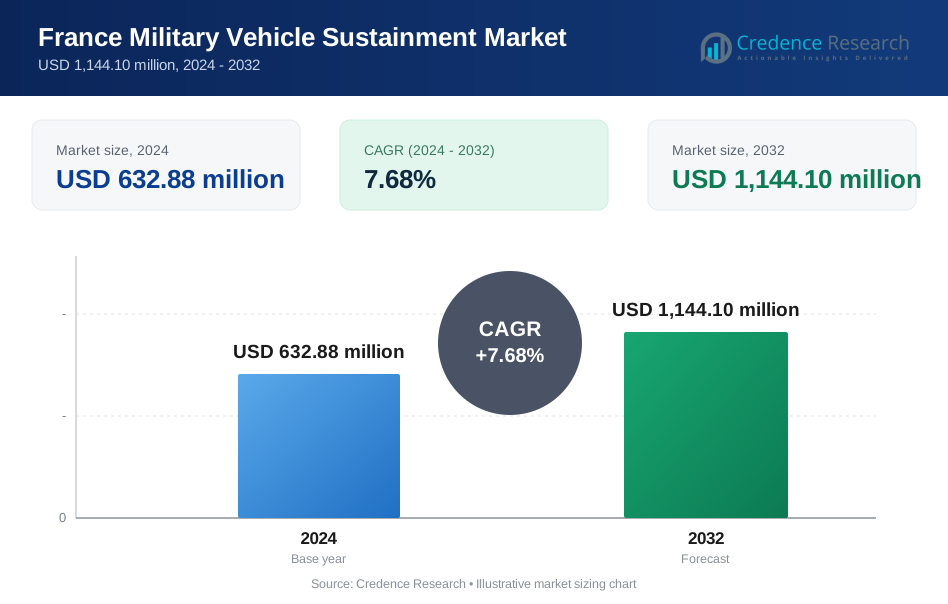
France Military Vehicle Sustainment market size was valued at USD 632.88 million in 2024 and is anticipated to reach USD 1,144.10 million by 2032, at a CAGR of 7.68% during the forecast period (2024-2032).
The France Military Vehicle Sustainment Market is driven by increasing defense budgets and the need to maintain operational readiness amid evolving security threats. The French government prioritizes modernization and lifecycle extension of armored vehicles, boosting demand for maintenance, repair, and overhaul (MRO) services. Additionally, advancements in predictive maintenance, AI-driven diagnostics, and 3D printing for spare parts enhance sustainment efficiency. The growing integration of hybrid and electric propulsion in military fleets further necessitates specialized support infrastructure. Trends indicate a rising preference for outsourcing sustainment services to private defense contractors, fostering industry collaborations. Moreover, NATO commitments and France’s active participation in international missions reinforce the need for a well-maintained vehicle fleet. Sustainability initiatives, such as eco-friendly maintenance practices and recyclable materials, are also gaining traction. Collectively, these factors drive the market’s expansion, ensuring sustained growth in the coming years.
France's military vehicle sustainment market is geographically diverse, with key regions such as Northern, Southern, Eastern, and Western France playing crucial roles in maintenance, repair, and modernization activities. Northern France serves as a strategic hub due to its concentration of defense contractors and military bases, while Southern France is expanding sustainment efforts, particularly for combat and amphibious vehicles. Eastern France benefits from its proximity to European defense corridors, ensuring rapid fleet readiness, whereas Western France is emerging as a center for digitalized maintenance solutions. The market is driven by leading defense firms, including Rheinmetall AG, Leonardo S.p.A., BAE Systems, Thales Group, Nexter Systems, Saab AB, GDELS, Krauss-Maffei Wegmann (KMW), Patria Group, and MBDA Systems. These companies are actively investing in advanced diagnostics, automation, and AI-driven predictive maintenance, ensuring operational efficiency and extending the lifespan of military fleets across the country.
Market Insights
- The France Military Vehicle Sustainment Market was valued at USD 632.88 million in 2024 and is projected to reach USD 1,144.10 million by 2032, growing at a CAGR of 7.68% during the forecast period.
- Increasing defense budgets and government investments in fleet modernization are driving demand for advanced maintenance and sustainment solutions.
- Adoption of AI-driven diagnostics, predictive maintenance, and automation is transforming military vehicle sustainment practices, improving operational efficiency.
- The market is highly competitive, with key players such as Rheinmetall AG, BAE Systems, Leonardo S.p.A., Thales Group, and Nexter Systems investing in advanced technologies.
- High costs associated with upgrading legacy vehicles and cybersecurity concerns pose challenges to market growth.
- Northern and Southern France lead in sustainment operations due to their strong defense infrastructure and military presence.
- Increasing emphasis on eco-friendly sustainment solutions, including sustainable materials and energy-efficient maintenance, is shaping market trends.
Market Drivers
Increasing Defense Budget and Modernization Efforts
France’s growing defense budget significantly drives the military vehicle sustainment market, ensuring long-term investments in maintenance, repair, and overhaul (MRO) services. The French government prioritizes the modernization of its armored vehicle fleet, enhancing operational readiness and extending vehicle lifespans. For instance, programs like the SCORPION initiative focus on upgrading combat vehicles with advanced digital and networked capabilities, emphasizing the need for efficient sustainment strategies. These initiatives not only support military preparedness but also encourage collaborations with private contractors specializing in MRO services. Additionally, the increased focus on fleet standardization and interoperability within NATO operations further strengthens the demand for comprehensive sustainment programs, ensuring vehicles remain combat-ready and technologically advanced.
Technological Advancements in Predictive Maintenance
The integration of advanced predictive maintenance solutions significantly enhances the efficiency of military vehicle sustainment in France. Technologies such as artificial intelligence (AI), the Internet of Things (IoT), and big data analytics enable real-time monitoring and early detection of potential failures, reducing unexpected breakdowns and optimizing maintenance schedules. For instance, the French Army has seen significant progress in predictive maintenance through the digitization of workshops, which has improved the efficiency of maintenance operations. Furthermore, the adoption of 3D printing for spare parts manufacturing allows for rapid on-site production of critical components, reducing logistical challenges associated with traditional supply chains. These advancements not only improve cost-effectiveness but also ensure sustained operational capabilities, reinforcing the market’s growth.
Rising Demand for Outsourced Maintenance Services
The increasing reliance on private defense contractors for sustainment services is another key driver of the France military vehicle sustainment market. Outsourcing MRO activities to specialized firms allows the military to focus on core operational tasks while leveraging the expertise and efficiency of the private sector. Defense companies such as Nexter Systems and Arquus are playing a crucial role in providing advanced sustainment solutions, including field support, component refurbishment, and system upgrades. This shift towards public-private partnerships fosters innovation and cost savings, while also ensuring that maintenance capabilities align with evolving technological requirements. Additionally, outsourcing enables faster response times in conflict zones and remote deployments, enhancing the military’s overall logistical resilience.
Sustainability and Eco-Friendly Maintenance Initiatives
The growing emphasis on sustainability in defense operations is shaping the future of military vehicle sustainment in France. The adoption of eco-friendly maintenance practices, such as biodegradable lubricants, energy-efficient repair facilities, and reduced emissions from MRO activities, aligns with France’s broader environmental policies. Additionally, the transition towards hybrid and electric military vehicles necessitates new sustainment strategies, including battery management and specialized diagnostic tools. Recycling and refurbishing vehicle components further contribute to cost savings and reduced environmental impact. These sustainability-driven initiatives are expected to gain momentum, encouraging defense agencies to adopt greener sustainment solutions while maintaining high operational standards.
Market Trends
Adoption of Predictive Maintenance and AI-Driven Diagnostics
The France military vehicle sustainment market is witnessing a significant shift toward predictive maintenance solutions powered by artificial intelligence (AI) and big data analytics. These technologies enable real-time monitoring of vehicle health, allowing for early detection of mechanical failures and reducing unplanned downtime. For instance, similar to the U.S. Army's use of AI for predictive maintenance on vehicles like the Bradley, the French military can leverage AI-driven diagnostics to enhance maintenance efficiency by optimizing repair schedules and prioritizing critical components, ensuring sustained operational readiness. The integration of the Internet of Things (IoT) further strengthens this trend, as connected sensors continuously assess vehicle performance and predict potential issues before they escalate. This proactive approach to maintenance minimizes costs, extends vehicle lifespan, and enhances overall fleet availability.
Integration of 3D Printing for Spare Parts Manufacturing
The growing adoption of 3D printing technology is transforming the sustainment process by enabling rapid and cost-effective production of spare parts. Traditionally, military vehicle maintenance faced challenges due to long lead times for component replacements, especially for aging fleets. With additive manufacturing, the French military can produce critical spare parts on demand, reducing dependency on traditional supply chains and improving repair turnaround times. This trend is particularly beneficial in remote deployment areas, where immediate access to spare parts is crucial for maintaining fleet readiness. Additionally, 3D printing enhances design flexibility, allowing for the production of customized components that improve vehicle performance and durability.
Increasing Focus on Public-Private Partnerships for MRO Services
France’s military is increasingly collaborating with private defense contractors to enhance maintenance, repair, and overhaul (MRO) capabilities. Public-private partnerships allow the armed forces to leverage the expertise of specialized firms while optimizing costs and resource allocation. Defense companies such as Nexter Systems and Arquus are playing a key role in providing sustainment solutions, including component upgrades, system integration, and field support. These partnerships facilitate faster response times, improved logistics, and streamlined maintenance operations, particularly in overseas missions. The trend also supports France’s broader defense modernization goals by ensuring access to cutting-edge technologies and best industry practices in sustainment operations.
Sustainability-Driven Maintenance Practices
The push for environmentally sustainable military operations is influencing sustainment strategies in France. The adoption of eco-friendly maintenance practices includes the use of biodegradable lubricants, energy-efficient repair facilities, and advanced waste management solutions. Additionally, as the military transitions toward hybrid and electric vehicle fleets, sustainment efforts are adapting to include battery management systems and specialized diagnostics for new propulsion technologies. Recycling and refurbishing older vehicle components are also gaining traction, reducing environmental impact while extending the usability of existing assets. These sustainability-driven trends align with France’s commitment to reducing its defense sector’s carbon footprint while maintaining high operational efficiency.
Market Challenges Analysis
High Maintenance Costs and Budget Constraints
One of the primary challenges in the France Military Vehicle Sustainment Market is the high cost associated with maintenance, repair, and overhaul (MRO) services. Advanced military vehicles require specialized components, skilled labor, and cutting-edge technologies to ensure operational efficiency, all of which contribute to rising sustainment expenses. For instance, the French Armed Forces Minister has emphasized the need to improve maintenance processes and vehicle availability, highlighting the importance of restructuring the industrial and technological base for service to address these financial challenges. Additionally, budget constraints within the defense sector often lead to delays in procurement and refurbishment programs, affecting overall fleet readiness. The challenge is further amplified by inflation in raw material prices and supply chain disruptions, which increase the cost of spare parts and maintenance contracts. Balancing operational efficiency with cost control remains a critical issue, compelling the military to explore cost-effective sustainment solutions such as outsourcing and predictive maintenance technologies.
Logistical and Supply Chain Challenges
Ensuring a steady supply of spare parts and timely repair services is another significant challenge for the France military vehicle sustainment sector. Military operations, particularly in remote or conflict-prone areas, require immediate access to critical components, which can be hindered by complex supply chains and geopolitical factors. Dependence on foreign suppliers for certain high-tech components exposes sustainment operations to potential delays, regulatory restrictions, and trade disruptions. Additionally, maintaining older vehicle fleets presents difficulties due to the limited availability of obsolete spare parts, requiring extensive refurbishment efforts. The growing reliance on advanced technologies, such as AI-driven diagnostics and 3D-printed spare parts, is helping to mitigate some of these logistical challenges. However, ensuring seamless coordination between military agencies, private contractors, and suppliers remains essential for overcoming these obstacles and maintaining fleet readiness.
Market Opportunities
The France Military Vehicle Sustainment Market presents significant opportunities driven by advancements in predictive maintenance technologies and digital transformation. The adoption of artificial intelligence (AI), big data analytics, and the Internet of Things (IoT) is revolutionizing maintenance operations by enabling real-time monitoring and predictive diagnostics. These technologies allow for early fault detection, reducing unexpected failures and optimizing vehicle uptime. Additionally, the growing integration of 3D printing for on-demand spare part manufacturing enhances supply chain efficiency and reduces logistical bottlenecks. As the military increasingly relies on digital solutions, companies specializing in AI-driven maintenance systems, additive manufacturing, and advanced diagnostics stand to benefit from lucrative contracts with defense agencies. The transition toward hybrid and electric military vehicles also presents new sustainment challenges, creating opportunities for specialized service providers to develop battery management solutions, energy-efficient maintenance facilities, and advanced propulsion diagnostics.
Furthermore, the increasing trend of public-private partnerships (PPPs) in the defense sector opens avenues for private firms to contribute to sustainment operations. Outsourcing maintenance, repair, and overhaul (MRO) services to specialized contractors allows the French military to enhance efficiency while focusing on strategic operations. Defense companies offering comprehensive lifecycle support, fleet modernization services, and remote sustainment capabilities are well-positioned to capitalize on this growing demand. Additionally, France’s active participation in NATO and international peacekeeping missions necessitates robust sustainment capabilities to ensure vehicle readiness in overseas deployments. Companies that can provide rapid-response maintenance solutions, mobile repair units, and innovative sustainment technologies will find expanding opportunities in this evolving market. The increasing focus on sustainable military operations, including eco-friendly maintenance practices and recycling programs, also creates a niche for companies specializing in green defense technologies to contribute to France’s long-term defense sustainability goals.
Market Segmentation Analysis:
By Vehicle Type:
The France Military Vehicle Sustainment Market is segmented by vehicle type into armored vehicles, combat vehicles, utility vehicles, and others, each requiring distinct sustainment strategies. Armored vehicles, including tanks and infantry fighting vehicles, demand extensive maintenance due to their heavy-duty operations and exposure to extreme combat conditions. Their sustainment involves advanced diagnostics, armor reinforcement, and specialized repair solutions. Combat vehicles, such as self-propelled artillery and amphibious assault vehicles, require frequent overhaul and refurbishment to maintain their firepower, mobility, and electronic warfare capabilities. Utility vehicles, including transport trucks, command vehicles, and medical evacuation units, have high usage rates, making preventive maintenance critical for ensuring continuous operation. These vehicles often undergo fleet-wide modernization efforts to incorporate upgraded communication and navigation systems. The others category includes engineering and reconnaissance vehicles, which require tailored sustainment approaches to support specialized military missions. The increasing deployment of hybrid and electric propulsion technologies across these vehicle categories further necessitates innovative maintenance solutions, particularly in battery management and electronic system integration.
By Service Type:
The market is also segmented based on service type into maintenance and repair, overhaul and refurbishment, and upgrade and modernization, reflecting the diverse sustainment needs of military fleets. Maintenance and repair services constitute a major segment, as regular inspections, diagnostics, and component replacements are crucial to ensuring operational readiness. Predictive maintenance using AI-driven analytics is gaining traction, enabling early fault detection and reducing unplanned downtime. Overhaul and refurbishment services are critical for extending the lifespan of aging military vehicles, particularly those undergoing mid-life upgrades. These services involve structural reinforcements, engine replacements, and electronic system enhancements, ensuring vehicles meet evolving combat requirements. Upgrade and modernization efforts focus on integrating next-generation technologies, such as advanced armor materials, improved weapon systems, and enhanced battlefield connectivity. This segment is witnessing significant growth, driven by France’s military modernization programs and the need for NATO interoperability. The rising emphasis on sustainable maintenance practices also influences service innovations, fostering the adoption of energy-efficient repair solutions and eco-friendly sustainment processes.
Segments:
Based on Vehicle Type:
- Armored Vehicles
- Combat Vehicles
- Utility Vehicles
- Others
Based on Service Type:
- Maintenance and Repair
- Overhaul and Refurbishment
- Upgrade and Modernization
Based on End- User:
- Army
- Navy
- Air Force
Based on the Geography:
- Northern France
- Southern France
- Eastern France
- Western France
Regional Analysis
Northern France
Northern France holds the largest market share of 35% in the France Military Vehicle Sustainment Market, driven by the presence of key military bases, defense contractors, and maintenance facilities. The region houses major military logistics centers and manufacturing hubs, particularly in and around Paris, where strategic defense operations are coordinated. The high concentration of armored and combat vehicle fleets in Northern France necessitates extensive maintenance, repair, and overhaul (MRO) services, contributing significantly to the region’s dominance in the market. Additionally, government investments in modernizing existing fleets and upgrading maintenance depots are fostering the adoption of advanced sustainment technologies, including predictive analytics and AI-driven diagnostics. The presence of defense firms such as Nexter Systems and Arquus further strengthens the region’s sustainment capabilities. With a strong focus on maintaining operational readiness, Northern France continues to lead in both traditional and digitalized military vehicle sustainment solutions, ensuring the long-term efficiency of its defense assets.
Southern France
Southern France accounts for 28% of the military vehicle sustainment market, making it the second-largest region in this sector. This is driven by a mix of defense infrastructure, training centers, and logistics hubs. The region is home to key military bases and maintenance facilities, particularly in Toulon and Marseille, where sustainment operations for land and amphibious military vehicles are conducted. The demand for combat vehicle maintenance and fleet modernization programs is increasing in this region, as the French military continues to enhance its capabilities for overseas deployments. Additionally, Southern France is witnessing significant investments in hybrid and electric military vehicle sustainment, with research institutions and defense firms focusing on developing next-generation propulsion systems. The growing emphasis on public-private partnerships (PPPs) is also fostering collaboration between the military and specialized MRO service providers. As the region expands its defense sustainment capabilities, the integration of 3D printing for spare parts manufacturing and AI-based predictive maintenance is becoming a key growth driver.
Eastern France
Eastern France holds a market share of 20%, playing a crucial role in the military vehicle sustainment market due to its proximity to key European defense corridors and border security operations. The region is strategically positioned near NATO-aligned defense infrastructures, making it essential for cross-border military collaborations and fleet readiness initiatives. Sustainment efforts in Eastern France primarily focus on armored and reconnaissance vehicle maintenance, as these fleets are critical for regional security and rapid response missions. The presence of specialized maintenance depots and defense technology centers allows for the efficient overhaul and refurbishment of military vehicles, ensuring their sustained operational effectiveness. The growing deployment of smart logistics systems and automated diagnostics tools is further streamlining maintenance operations in this region. Additionally, the emphasis on eco-friendly sustainment solutions, such as energy-efficient repair facilities and sustainable material usage, aligns with France’s broader defense sustainability goals, enhancing Eastern France’s role in the evolving sustainment landscape.
Western France
Western France is an emerging market in military vehicle sustainment, holding a 17% market share, with a growing focus on both land and naval vehicle maintenance. The region has historically been a key player in defense manufacturing and logistics, particularly around Brittany and Nantes, where military equipment production and sustainment services are expanding. The need for utility vehicle maintenance and modernization is rising as the region supports multiple training and defense deployment operations. Additionally, Western France is witnessing increasing investments in cybersecurity and digitalized sustainment solutions, ensuring that military vehicles remain protected from cyber threats while undergoing maintenance and upgrades. The adoption of automated repair systems, AI-driven diagnostics, and remote monitoring technologies is gaining traction, making Western France an attractive region for defense contractors looking to expand their sustainment services. As modernization efforts accelerate, the region’s role in integrating advanced materials, improved electronic warfare systems, and sustainable maintenance practices is expected to grow significantly.
Key Player Analysis
- Rheinmetall AG
- Leonardo S.p.A.
- BAE Systems
- Thales Group
- Nexter Systems
- Saab AB
- GDELS (General Dynamics European Land Systems)
- Krauss-Maffei Wegmann (KMW)
- Patria Group
- MBDA Systems
Competitive Analysis
The France Military Vehicle Sustainment Market is highly competitive, with key players focusing on technological advancements, strategic partnerships, and modernization initiatives to enhance fleet sustainability. Leading companies such as Rheinmetall AG, BAE Systems, Leonardo S.p.A., Thales Group, Nexter Systems, Saab AB, GDELS, Krauss-Maffei Wegmann (KMW), Patria Group, and MBDA Systems are investing in AI-driven diagnostics, predictive maintenance, and automation to optimize vehicle lifecycle management. For instance, companies like ARQUUS have successfully tested predictive maintenance tools on land equipment, such as the VAB armoured vehicles, demonstrating the effectiveness of Health and Usage Monitoring Systems (HUMS) in improving vehicle availability and reducing maintenance downtime. These firms are also expanding their maintenance, repair, and overhaul (MRO) capabilities through collaborations with defense agencies and local service providers.Many players are integrating cybersecurity measures to safeguard digitalized sustainment solutions, ensuring resilience against cyber threats. Additionally, companies are focusing on sustainable maintenance practices, such as 3D-printed spare parts and eco-friendly refurbishments, aligning with France’s environmental goals. The competition is further intensified by ongoing government contracts and defense modernization programs, driving firms to innovate, improve service efficiency, and enhance operational readiness across military fleets.
Recent Developments
- In March 2024, BAE Systems secured a $318 million vering lifecycle sustainment and technical services.
- In June 2023, General Dynamics Land Systems attained a $712.3 million order from the U.S. Army for 300 Stryker DVHA1 vehicles. This contract enhances the capabilities of Stryker brigades by providing advanced technological features such as a powerful engine, robust suspension, and digital network integration.
- In June 2023, Rheinmetall AG presented a new solution for the mobile production of spare parts for military vehicles. The Mobile Smart Factory (MSF) offers metal 3D printing and postprocessing capabilities and is fully integrated into Rheinmetall’s IRIS (Integrated Rheinmetall Information System) digital ecosystem.
- In June 2022, General Dynamics Corporation demonstrated Autonomous Vehicle System (AVS) at CANSEC 2022. The AVS solution will optimize equipment performance and increase operational readiness to reduce the military's cost of ownership of vehicle fleets.
Market Concentration & Characteristics
The France Military Vehicle Sustainment Market exhibits a moderate to high market concentration, with a few dominant players driving innovation and service efficiency. Leading companies, including Rheinmetall AG, BAE Systems, Leonardo S.p.A., Thales Group, Nexter Systems, and Krauss-Maffei Wegmann (KMW), maintain a strong presence through government contracts and strategic partnerships. The market is characterized by high barriers to entry, as sustainment services require advanced technological expertise, regulatory compliance, and significant infrastructure investment. Additionally, the growing adoption of predictive maintenance, AI-driven diagnostics, and digitalized logistics is reshaping market dynamics, enhancing fleet longevity and operational efficiency. The presence of strict defense procurement policies and cybersecurity measures further influences market operations. While established firms dominate the landscape, the rising demand for sustainable maintenance solutions and next-generation vehicle upgrades is opening avenues for specialized service providers, fostering a competitive yet innovation-driven market environment.
Report Coverage
The research report offers an in-depth analysis based on Vehicle Type, Service Type, End-User and Geography. It details leading market players, providing an overview of their business, product offerings, investments, revenue streams, and key applications. Additionally, the report includes insights into the competitive environment, SWOT analysis, current market trends, as well as the primary drivers and constraints. Furthermore, it discusses various factors that have driven market expansion in recent years. The report also explores market dynamics, regulatory scenarios, and technological advancements that are shaping the industry. It assesses the impact of external factors and global economic changes on market growth. Lastly, it provides strategic recommendations for new entrants and established companies to navigate the complexities of the market.
Future Outlook
- The France Military Vehicle Sustainment market will continue to expand, driven by increasing defense budgets and fleet modernization efforts.
- Advanced technologies like AI-driven predictive maintenance and automated diagnostics will enhance operational efficiency.
- Strategic partnerships between defense firms and government agencies will strengthen sustainment capabilities.
- The demand for cybersecurity solutions in digitalized maintenance systems will rise to protect critical military assets.
- Sustainable maintenance practices, including 3D printing and eco-friendly refurbishments, will gain traction.
- Investment in localized maintenance hubs will improve logistics efficiency and reduce downtime for military fleets.
- Upgrades and modernization of legacy vehicles will remain a priority to enhance combat readiness.
- The integration of data analytics and IoT in sustainment operations will optimize fleet management.
- Competition among key players will intensify, leading to continuous innovation in sustainment solutions.
- Government policies and procurement strategies will play a crucial role in shaping market growth and technological advancements.
Request a Free Sample
Fill in your details and we'll send you a free sample report.
- Sample data tables & charts
- Research methodology
Need a Custom Version of This Report?
Tailor the scope, geography, or segments to your exact requirements.
- Custom geography or segment scope
- Direct access to our analyst team
Frequently Asked Questions
What is the current size of the France Military Vehicle Sustainment market?
What factors are driving the growth of the France Military Vehicle Sustainment market?
What are some challenges faced by the France Military Vehicle Sustainment market?
Who are the major players in the France Military Vehicle Sustainment market?
Table of Content
Chapter 1. Report Introduction
- 1.1 Report Description & Purpose
- 1.1.1 Report Title & Market Definition
- 1.1.2 Unique Selling Propositions (USP) & Key Differentiators
- 1.1.3 Value Proposition for Stakeholders
- 1.2 Research Objectives
- 1.2.1 Market Sizing Objectives (Volume & Revenue)
- 1.2.2 Segmentation Objectives
- 1.2.3 Competitive Intelligence Objectives
- 1.2.4 Forecast & Scenario Objectives
- 1.3 Report Scope
- 1.3.1 France Military Vehicle Sustainment Scope – Types & Subtypes Covered
- 1.3.2 Geographic Scope – Regions & Countries Covered
- 1.3.3 Historical Period, Base Year & Forecast Period (2024; forecast to 2032)
- 1.3.4 Inclusions & Exclusions
- 1.4 HS Code & Classification Framework
- 1.5 Currency, Units & Pricing Basis
- 1.6 Target Stakeholders
- 1.7 Limitations & Assumptions
Chapter 2. Executive Summary
- 2.1 Global France Military Vehicle Sustainment Market Snapshot
- 2.1.1 Market Size – Historical (2024) & Forecast (2024-2032) (2024: USD 632.88 million → 2032: USD 1,144.10 million)
- 2.1.2 Volume & Revenue – Global Totals
- 2.1.3 Key Market Highlights – Top Five Facts
- 2.2 France Military Vehicle Sustainment Market Segmentation Snapshot
- 2.2.1 Market Split by Region – 2024 vs. 2032
- 2.3 Competitive Snapshot
- 2.3.1 Top 10 Players by Revenue Share – 2024
- 2.3.2 Top 10 Players by Volume Share – 2024
- 2.3.3 Recent Strategic Developments (18-Month Summary)
- 2.4 Key Investment Highlights & Strategic Conclusions
Chapter 3. France Military Vehicle Sustainment Market Dynamics & Industry Analysis
- 3.1 Market Overview & Context
- 3.1.1 France Military Vehicle Sustainment Market Position in the Broader Automotive Value Chain
- 3.1.2 OEM vs. Replacement Market Dynamics
- 3.1.3 Market Maturity & Development Stage by Region
- 3.2 France Military Vehicle Sustainment Market Drivers
- 3.3 France Military Vehicle Sustainment Market Restraints & Challenges
- 3.4 France Military Vehicle Sustainment Market Opportunities
- 3.5 Porter's Five Forces Analysis
- 3.5.1 Threat of New Entrants
- 3.5.2 Bargaining Power of Suppliers
- 3.5.3 Bargaining Power of Buyers
- 3.5.4 Threat of Substitutes
- 3.5.5 Competitive Rivalry – Intensity Assessment
- 3.6 France Military Vehicle Sustainment Value Chain Analysis
- 3.6.1 Upstream – Raw Material/Input Suppliers
- 3.6.1.1 Raw Material/Input 1
- 3.6.1.2 Raw Material/Input 2
- 3.6.1.3 Raw Material/Input 3
- 3.6.2 Midstream – Production/Manufacturing/Service Delivery
- 3.6.2.1 Production/Process Overview
- 3.6.2.2 Key Facility Locations & Capacity by Manufacturer
- 3.6.3 Downstream – Distribution & End Consumer
- 3.6.3.1 Primary Channel – B2B/OEM
- 3.6.3.2 Secondary Channels – Dealer, Retail, Online, Direct
- 3.6.4 Value Chain Profitability Analysis
- 3.6.1 Upstream – Raw Material/Input Suppliers
- 3.7 PESTEL Analysis
- 3.7.1 Political Factors
- 3.7.2 Economic Factors
- 3.7.3 Social Factors
- 3.7.4 Technological Factors
- 3.7.5 Environmental Factors
- 3.7.6 Legal Factors
- 3.8 France Military Vehicle Sustainment Supply Chain Analysis
- 3.8.1 Raw Material/Input Supply Risk Assessment
- 3.8.2 Manufacturing Concentration Risk (Geographic Exposure)
- 3.8.3 Trade Disruption Impact Analysis
- 3.9 Regulatory & Policy Landscape
Note: The regulatory and policy landscape section covers regulations based on their applicability to the market, France Military Vehicle Sustainment category, geography, and scope of the study. Only regulatory frameworks with a material impact on operations, compliance, trade, sustainability, or market access are analyzed in detail.
Chapter 4. Key Investment Pockets & Opportunity Analysis
- 4.1 France Military Vehicle Sustainment Market Attractiveness Analysis
- 4.1.1 By Region – Investment Attractiveness Matrix (Volume × CAGR)
- 4.2 Absolute Revenue Growth Opportunity
- 4.2.1 By Region – Absolute USD Growth Through 2032
- 4.3 Incremental Volume Opportunity
- 4.3.1 By Region – Incremental Volume Through 2032
- 4.3.2 Segment – Incremental Volume
- 4.4 Emerging Submarket Opportunity Deep Dive (Subject to Applicability)
- 4.5 Emerging Market Opportunity Scorecards
- 4.5.1 United States
- 4.5.2 Europe
- 4.5.3 Asia
- 4.5.4 Middle East & Africa
Note: Emerging Market Opportunity Scorecards will be included based on relevance and strategic importance. Regions listed are indicative and may vary depending on data availability and market dynamics.
Chapter 5. France Military Vehicle Sustainment Import-Export Analysis & Trade Flows
- 5.1 Global Trade Overview
- 5.1.1 Global Export Value by Country (2024)
- 5.1.2 Global Export Volume by Country (2024)
- 5.1.3 Global Import Value by Country (2024)
- 5.1.4 Global Import Volume by Country (2024)
- 5.1.5 Net Trade Balance by Country (2024)
- 5.2 Export Analysis – Segment
- 5.2.1 Type 1 (HS Code)
- 5.2.2 Type 2 (HS Code)
- 5.2.3 Type 3 (HS Code)
- 5.2.4 Type 4 (HS Code)
- 5.2.5 Type 5 (HS Code)
- 5.3 Import Analysis – Segment
- 5.3.1 Type 1 (HS Code)
- 5.3.2 Type 2 (HS Code)
- 5.3.3 Type 3 (HS Code)
- 5.3.4 Type 4 (HS Code)
- 5.3.5 Type 5 (HS Code)
- 5.4 Average Unit Trade Prices
- 5.4.1 Average Export Price – Segment & Country
- 5.4.2 Average Import Price – Segment & Source Country
- 5.4.3 Price Trends (2024)
- 5.5 Key Trade Route Analysis
- 5.5.1 Trade Route 1
- 5.5.2 Trade Route 2
- 5.5.3 Trade Route 3
- 5.5.4 Trade Route 4
- 5.5.5 Trade Route 5
- 5.6 Trade Policy Impact Assessment
- 5.6.1 US Anti-Dumping & Section 301 Tariffs
- 5.6.2 EU Customs Union Impact
- 5.6.3 Major Free Trade Agreements
- 5.6.4 USMCA Rules of Origin
Note: Trade policy analysis will be included only where relevant to the France Military Vehicle Sustainment market.
Chapter 6. Competitive Landscape & Company Benchmarking
- 6.1 France Military Vehicle Sustainment Market Concentration & Structure
- 6.1.1 Herfindahl-Hirschman Index (HHI) – vs. 2024
- 6.1.2 Tier 1, Tier 2 & Tier 3 Market Structure
- 6.1.3 Global, Regional & Local Player Dynamics
- 6.2 France Military Vehicle Sustainment Market Share Analysis – 2024
- 6.2.1 Global Revenue Share by Company
- 6.2.2 Global Volume Share by Company
- 6.2.3 Regional Revenue Share
- 6.2.4 Market Share Evolution ( vs. 2024)
- 6.2.5 OEM Segment Share by Company
- 6.2.6 Replacement Segment Share by Company
- 6.3 Production/Delivery Capacity & Facility Analysis
- 6.3.1 Global Installed Capacity
- 6.3.2 Capacity Utilization Rates
- 6.3.3 Production/Output Volume
- 6.3.4 Facility Locations & Capacity Map
- 6.3.5 Planned Capacity Additions
- 6.4 France Military Vehicle Sustainment Competitive Benchmarking Matrix
- 6.4.1 Revenue, Volume, CAGR & Profitability Comparison
- 6.4.2 Channel Revenue Mix
- 6.4.3 Geographic Revenue Exposure
- 6.4.4 R&D Intensity
- 6.4.5 Sustainability Maturity
- 6.5 Strategic Developments in France Military Vehicle Sustainment (Last 24 Months)
- 6.5.1 Mergers, Acquisitions & Divestments
- 6.5.2 New France Military Vehicle Sustainment Launches
- 6.5.3 Facility Expansions
- 6.5.4 Strategic Alliances, Joint Ventures & Partnerships
- 6.5.5 Distribution Expansion & Market Entry
- 6.5.6 Sustainability & ESG Initiatives
- 6.6 Competitive Strategy Mapping
- 6.6.1 Leader, Challenger, Follower & Niche Classification
- 6.6.2 Pricing Strategy Comparison
- 6.6.3 Channel Strategy Matrix
Note: Strategic developments are included based on their materiality and the availability of reliable information.
Chapter 7. Global France Military Vehicle Sustainment Market – By Distribution Channel
- 7.1 Segment Overview
- 7.1.1 Volume & Revenue Split by Channel (2024 & 2032)
- 7.1.2 Channel Mix Evolution (2024-2032)
Chapter 8. Regional Market Analysis – Global Overview
- 8.1 Global Regional Overview
- 8.1.1 Regional Volume Share
- 8.1.2 Regional Revenue Share
- 8.1.3 Regional Volume by Region
- 8.1.4 Regional Revenue by Region
- 8.1.5 Regional Forecast Through 2032
- 8.2 Cross-Regional Segment Analysis
- 8.2.1 By Distribution Channel
- 8.2.2 By Brand/Price Tier
Chapter 9. North America France Military Vehicle Sustainment Market
- 9.1 United States
- 9.2 Canada
- 9.3 Mexico
Chapter 10. Europe France Military Vehicle Sustainment Market
- 10.1 Germany
- 10.2 France
- 10.3 Italy
- 10.4 United Kingdom
- 10.5 Spain
- 10.6 Poland
- 10.7 Russia
- 10.8 Netherlands
- 10.9 Belgium
- 10.10 Sweden
- 10.11 Denmark
- 10.12 Norway
- 10.13 Rest of Europe
Chapter 11. Asia Pacific France Military Vehicle Sustainment Market
- 11.1 China
- 11.2 India
- 11.3 Japan
- 11.4 South Korea
- 11.5 Thailand
- 11.6 Indonesia
- 11.7 Vietnam
- 11.8 Malaysia
- 11.9 Australia
- 11.10 Rest of Asia Pacific
Chapter 12. Latin America France Military Vehicle Sustainment Market
- 12.1 Brazil
- 12.2 Argentina
- 12.3 Colombia
- 12.4 Chile
- 12.5 Rest of Latin America
Chapter 13. Middle East France Military Vehicle Sustainment Market
- 13.1 Saudi Arabia
- 13.2 United Arab Emirates
- 13.3 Turkey
- 13.4 Israel
- 13.5 Iran
- 13.6 Rest of the Middle East
Chapter 14. Africa France Military Vehicle Sustainment Market
- 14.1 South Africa
- 14.2 Egypt
- 14.3 Nigeria
- 14.4 Morocco
- 14.5 Rest of Africa
Chapter 15. France Military Vehicle Sustainment Company Profiles
- 15.1 [Company 01]
- 15.1.1 Company Overview
- 15.1.2 Key Management Personnel
- 15.1.3 Products & Services Portfolio
- 15.1.4 Financial Performance
- 15.1.5 Key Market Focus & Geographic Presence
- 15.1.6 Recent Developments & Strategic Initiatives
Note: The company profile list is preliminary and may change based on research findings, market developments, data availability, and client requirements.
Chapter 16. Appendices
- Appendix A – List of Abbreviations & Acronyms
- Appendix B – Industry Classification Code Reference – Full Series
- Appendix C – Production & Capacity Data Tables
- Appendix D – End-Use & Demand Base Tables
- Appendix E – Consumption & Replacement Rate Assumptions
- Appendix F – ASP Reference Tables
- Appendix G – Manufacturing & Facility Database
- Appendix H – Import-Export Data Tables
- Appendix I – Regulatory Summary Tables
- Appendix J – Primary Research Participant List (Anonymized)
- Appendix K – Primary Research Questionnaire Framework
- Appendix L – Data Sources & Bibliography
- Appendix M – Market Size Divergence & Source Comparison
Chapter 17. Research Methodology
- 17.1 Research Framework & Philosophy
- 17.2 Secondary Research – Sources, Hierarchy & Data Extraction
- 17.3 Data Modeling – Bottom-Up & Top-Down Market Sizing
- 17.4 Primary Research – Stakeholder Framework, LOI & Sample Sizes
- 17.5 Forecast Methodology – Regression, Scenario & Sensitivity Analysis
- 17.6 Quality Control – Four-Layer Validation Framework
- 17.7 Limitations & Standard Assumptions
- 17.8 Disclaimer
