
| REPORT ATTRIBUTE | DETAILS |
|---|---|
| Historical Period | 2020-2023 |
| Base Year | 2024 |
| Forecast Period | 2025-2032 |
| Germany Internet Data Center (IDC) Market Size 2024 | USD 3,730.39 million |
| Germany Internet Data Center (IDC) Market, CAGR | 12.72% |
| Germany Internet Data Center (IDC) Market Size 2032 | USD 9,718.81 million |
Market Overview
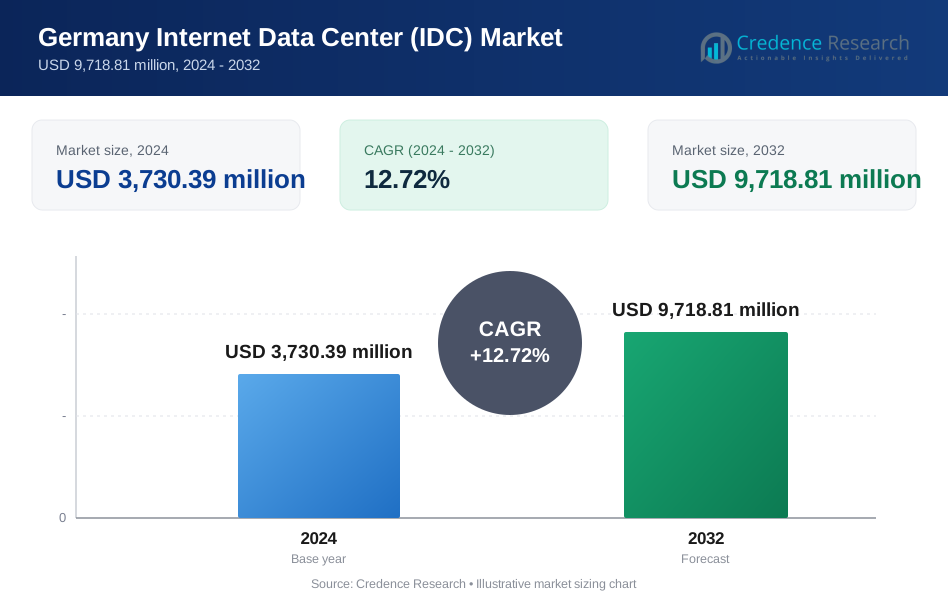
The Germany Internet Data Center (IDC) Market size was valued at USD 3,730.39 million in 2024 and is anticipated to reach USD 9,718.81 million by 2032, at a CAGR of 12.72% during the forecast period (2024-2032).
The Germany Internet Data Center (IDC) market benefits from robust cloud adoption, as enterprises migrate mission-critical applications to scalable, on-demand infrastructure. Stringent data sovereignty and privacy regulations, including GDPR, drive investments in secure, locally hosted facilities. Growth in artificial intelligence, big data analytics, and high-performance computing workloads fuels demand for advanced cooling technologies and high-density power configurations. The rollout of 5G networks and the rise of edge computing encourage deployment of micro-data centers near major population centers to reduce latency. Sustainability initiatives push operators to integrate renewable energy sources, modular designs, and liquid-cooling systems to improve energy efficiency and reduce carbon footprints.
The Germany Internet Data Center (IDC) landscape spans key hubs in Frankfurt, Berlin, Munich and Hamburg, each offering robust connectivity and reliable power infrastructure. Frankfurt retains its position as the primary interconnection point for global traffic, hosting major Internet exchanges and hyperscale campuses. Berlin combines government-backed fiber networks with a thriving startup scene. Munich supports industrial and automotive clusters with low-latency solutions, while Hamburg and Bremen drive edge deployments for maritime and logistics operators. Leading colocation and managed service providers such as Equinix, Digital Realty (Interxion), NTT, Global Switch and e-shelter operate extensive facilities across these regions. National players like Hetzner, T-Systems and Colt complement international offerings. Hyperscale operators including AWS, Microsoft Azure and Google Cloud maintain dedicated data centers and partner with local colocation firms.
Market Insights
- The Germany Internet Data Center (IDC) market size was valued at USD 3,730.39 million (2024) to USD 9,718.81 million (2032) at a CAGR of 12.72%.
- The global Internet Data Center (IDC) market was valued at USD 61,521.80 million in 2024 and is projected to reach USD 150,594.58 million by 2032, growing at a CAGR of 11.84% during the forecast period.
- Strong cloud migration drives demand for scalable, on-demand infrastructure across enterprise and public sector workloads.
- Hybrid cloud adoption gains traction as organizations balance data control with flexibility.
- Edge computing expansion and 5G deployment spur micro-data center rollouts near urban and industrial hubs.
- Tight data sovereignty and GDPR compliance create opportunities for local colocation specialists and secure hosting services.
- High upfront investment and complex regional regulations constrain rapid facility expansion.
- Frankfurt, Berlin, Munich, Hamburg and Bremen emerge as focal points for hyperscale and colocation deployments.
Report Scope
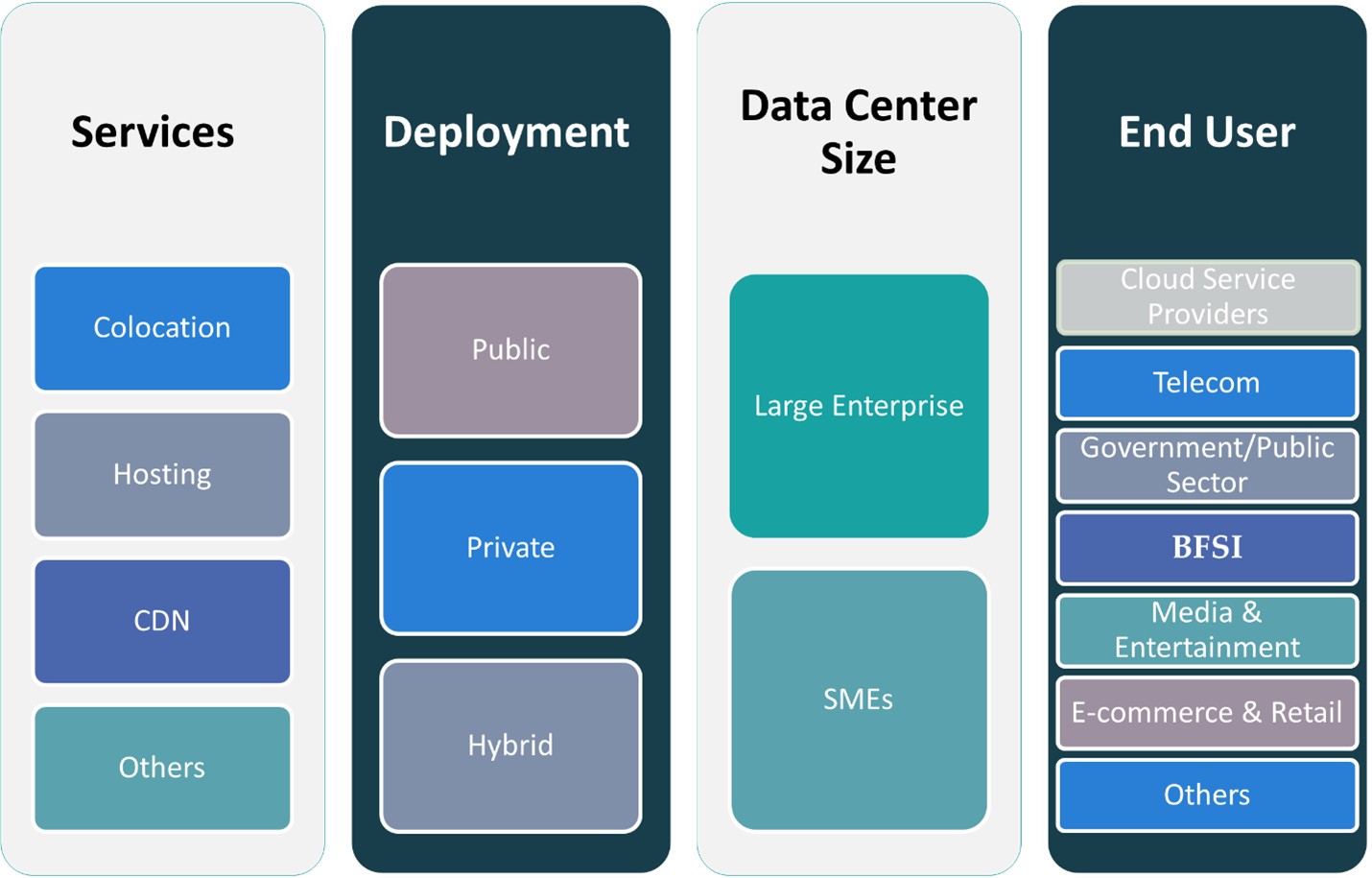
This report segments the Germany Internet Data Center (IDC) Market as follows:
Market Drivers
Accelerated Cloud Adoption and Digital Transformation
Digital transformation and cloud adoption drive demand for data center capacity across Germany. Organizations migrate mission-critical workloads to flexible platforms that scale with business needs. It supports enterprise agility and resilience under market pressures. The Germany Internet Data Center (IDC) Market gains momentum from public and private cloud deployments. Companies invest in hybrid solutions that combine on-premises infrastructure with cloud resources. It reduces capital expenditures and optimizes resource utilization.
- For instance, Germany’s data center market is experiencing significant growth, driven by increasing demand for cloud services, big data analytics, and AI integration.
Strict Data Sovereignty and Regulatory Compliance
Germany enforces strict data privacy standards that shape data center strategies. Organizations must host sensitive data within national borders to comply with GDPR and local laws. It creates demand for certified facilities that meet strict audit requirements. The Germany Internet Data Center (IDC) Market benefits from enterprises that require secure environments for data. Colocation providers offer solutions to address compliance and audit readiness. It fosters partnerships between global hyperscalers and local operators to meet legal mandates.
- For instance, Germany is the first regulated data center market in Europe, with strict compliance requirements shaping facility operations.
Demand for High-Performance Computing and Analytics
Advanced analytics, artificial intelligence, and high-performance computing drive need for robust infrastructure. Research institutions, finance firms, and automotive players require low-latency, high-capacity solutions for complex workloads. It pushes operators to deploy high-density power and advanced cooling systems. The Germany Internet Data Center (IDC) Market attracts investment from HPC cluster initiatives and data-driven enterprises. Providers upgrade network fabrics to support massive data transfers. It enhances service quality for compute-intensive applications.
Edge Computing Expansion and Green Initiatives
5G rollout and edge computing reduce latency and expand data centers for critical applications. Telecom operators and enterprises deploy micro data centers near urban hubs to support IoT services. The Germany Internet Data Center (IDC) Market prioritizes green credentials. Providers use renewable power and modular designs to improve energy efficiency. It extends footprint to local sites and expands capacity at regional level. It meets environmental objectives and aligns with carbon reduction targets.
Market Trends
Adoption of Hybrid and Multi-Cloud Strategies
Organizations combine on-premises infrastructure with public cloud resources to balance control and elasticity. The Germany Internet Data Center (IDC) Market reflects this shift through partnerships between enterprises and cloud providers. It improves workload flexibility and risk management under variable demand. Companies configure hybrid environments to optimize costs and maintain performance levels. It reduces vendor lock-in and ensures seamless data migration across platforms. Providers offer integrated services that unify management of distributed environments.
- For instance, Germany’s federal government has implemented a multi-cloud strategy to strengthen digital sovereignty while reducing dependency on foreign providers.
Emphasis on Green Energy and Carbon Neutral Operations
Regulators and investors push clean energy integration at data centers. The Germany Internet Data Center (IDC) Market highlights projects powered by wind, solar and hydro sources. It tracks power usage to meet sustainability targets. Operators adopt liquid cooling and free-air systems to cut energy use. It reduces carbon footprint and lowers expenses. Providers commit to carbon-neutral goals via renewable energy certificates and power purchase agreements.
- For instance, Germany’s data center industry is prioritizing sustainability, with 88% of colocation facilities using renewable energy.
Shift toward Modular and Prefabricated Infrastructure Solutions
Prefabricated data center modules accelerate capacity expansion under tight timelines. The Germany Internet Data Center (IDC) Market shows rising interest in containerized and skids-based builds. It allows rapid site rollout in emerging urban and industrial zones. Operators adopt standardized racks and power distributions to simplify maintenance. It ensures consistent quality across installations and lowers upfront costs. Vendors supply turnkey packages that integrate power, cooling, and security systems.
Expansion of Edge Data Center Networks for Low Latency
Demand for real-time applications drives site deployment near data sources. The Germany Internet Data Center (IDC) Market experiences growth in micro facility rollouts across metro areas. It supports 5G services, IoT platforms, and content delivery operations. Telecom operators collaborate with local colocation providers to host edge sites. It reduces round-trip delays and enhances user experiences for critical services. Enterprises deploy localized processing nodes to handle peak loads.
Market Challenges Analysis
High Upfront Infrastructure Investment and Operational Costs
Operators require significant capital to build data centers; land acquisition, power setup and advanced cooling systems drive costs. The Germany Internet Data Center (IDC) Market experiences strained budgets due to high electricity tariffs and steep real estate prices. It places pressure on smaller providers to secure funding or partner with larger stakeholders. Power availability challenges in dense urban regions force operators to install backup generators and UPS units. It increases maintenance expenses and reduces profit margins. Financing delays can stall expansion projects and limit market agility.
Complex Regulatory Environment and Data Sovereignty Obligations
Strict data privacy regulations demand that sensitive information remain within national borders to comply with GDPR and local directives. Operators must invest in certification and audit processes to verify compliance. It delays new facility openings and increases legal expenses. Fragmented regional rules for renewable energy supply and noise limits require tailored site studies for each location. It creates administrative burdens for colocation providers that serve multiple German states. Heightened scrutiny from regulators can trigger unexpected fines and reputational damage. Market entrants must navigate licensing procedures that vary by municipality.
- For instance, Germany’s data center industry contributes €10.4 billion annually to GDP, with 88% of colocation facilities using renewable energy, reflecting the country’s commitment to regulatory and sustainability standards.
Market Opportunities
Growth Potential from Edge Computing and 5G Integration Edge computing adoption and nationwide 5G rollout open new deployment sites near data sources. The Germany Internet Data Center (IDC) Market can capitalize on micro data centers placed in urban and industrial hubs. It delivers low-latency processing needed for IoT, autonomous vehicles and AR/VR applications. Telecom operators and technology firms seek localized compute capacity. It drives partnerships between colocation providers and network operators. Demand for real-time analytics offers growth potential beyond traditional facilities.
Advancements in Sustainable Infrastructure and AI-Driven Workloads Investments in renewable energy integration present cost savings and regulatory alignment. The Germany Internet Data Center (IDC) Market can leverage wind and solar power PPAs to lower operating expenses. It enhances green credentials and attracts ESG-focused customers. AI and machine learning applications drive demand for GPU-accelerated clusters and high-density power. Providers that offer specialized AI infrastructure can capture market share. It encourages development of modular, scalable designs that support varied workload patterns.
Market Segmentation Analysis:
By Services:
Services in the Germany Internet Data Center (IDC) market cover colocation, hosting, content delivery networks (CDN), and other offerings. Enterprises choose colocation for secure rack space and power redundancy at scale. Hosting providers deliver managed servers and infrastructure support to enterprises that require customized environments. It ensures clients access reliable uptime and proactive maintenance. CDN services distribute content globally to minimize latency and optimize user experience. Other specialized services include disaster recovery, backup solutions and managed security tools.
By Deployment: Deployment models include public, private and hybrid configurations. Public data centers host shared resources and offer cost efficiency for startups and SMEs. Private deployments allocate dedicated infrastructure for enterprises that demand strict control and compliance. Hybrid environments combine public cloud elasticity with private data center security to balance performance and cost. It enables dynamic workload placement and responsive scaling. Providers offer unified management platforms for hybrid orchestration and monitoring.
By Data Center Size: Data center size segments include large enterprises and small and medium enterprises (SMEs). Large enterprise facilities provide high-density power, advanced cooling and extensive network backbones. SMEs opt for smaller facilities that deliver essential services without high capex requirements. It allows businesses to match infrastructure investment with growth stages. Providers tailor capacity and service level agreements to meet varied needs and budgets.
Segments:
Based on Services:
- Colocation
- Hosting
- CDN
- Others
Based on Deployment:
- Public
- Private
- Hybrid
Based on Data Center Size:
- Large Enterprise
- SMEs
Based on End- User:
- Cloud Service Providers
- Telecom
- Government/Public Sector
- BFSI
- Media & Entertainment
- E-commerce & Retail
- Others
Based on the Geography:
- Berlin
- Munich
- Hamburg
- Bremen
Regional Analysis
Berlin and Munich
Berlin leads Germany in colocation capacity and enterprise deployments, with numerous hyperscale and regional facilities. Its strategic location and connectivity to major fiber routes drive client investment. The Germany Internet Data Center (IDC) Market establishes strong demand in this region. It attracts global cloud providers seeking low-latency access to central Europe. Berlin accounts for roughly 30% of national market share. Sustainability projects and renewable power integration bolster operational efficiency in Berlin. Munich follows with robust managed services and dedicated server environments, capturing about 25% market share thanks to proximity to automotive and manufacturing clusters.
Hamburg
Hamburg handles major European exchange points and submarine cable landings that support high-throughput connectivity. It positions the Germany Internet Data Center (IDC) Market to leverage CDN and edge computing deployments. Companies choose Hamburg for low-latency media streaming and real-time transaction processing. It secures roughly 20% of national market share. Media and digital commerce firms rely on facilities in Hamburg for robust network fabrics. It benefits from municipal incentives for renewable energy procurement. These factors strengthen Hamburg’s reputation as a reliable digital gateway.
Bremen
Bremen expands its role through modular data center sites near port and logistics hubs. It appeals to companies that require rapid deployment and flexible capacity in northern Germany. The Germany Internet Data Center (IDC) Market finds Bremen attractive for pilot projects and micro data centers. It holds about 10% of the national market share. Providers implement green energy tariffs and seawater cooling trials at Bremen facilities. It creates a blueprint for sustainable operations that other regions may adopt. Local incentives reduce setup costs and encourage innovation in power efficiency.
Key Player Analysis
- Goodman Group
- Green Mountain
- VIRTUS Data Centres
- Hochtief AG
- Siemens AG
Competitive Analysis
In the Germany Internet Data Center (IDC) Market, global colocation giants such as Equinix, Digital Realty and NTT compete on network reach and facility scale, while local providers like Hetzner, T-Systems and Colt leverage national expertise and compliance credentials. Hyperscale operators AWS, Microsoft Azure and Google Cloud maintain dedicated campuses and partner with colocation firms to expand capacity rapidly. Specialized entrants differentiate through sustainable infrastructure, offering renewable power and advanced liquid cooling. They secure clients with tailored service-level agreements, flexible deployment models and managed security portfolios. Industry collaboration emerges through partnerships between telecom carriers, cloud platforms and colocation providers to deliver hybrid and edge solutions near urban and industrial sites. It intensifies price competition and drives innovation in latency optimization and energy efficiency services. Market consolidation trends continue as firms pursue acquisitions and joint ventures to broaden coverage and expand service portfolios. New entrants face high capital requirements and strict regional regulations, which limit rapid growth. Investors prioritize operators with strong connectivity, operational reliability and ESG credentials.
Recent Developments
- In 2025, Microsoft plans to invest about $80 billion in AI-enabled data centers, significantly increasing its investment from previous years. Over half of this investment will be directed towards the United States, supporting AI model training and the development of cloud-based applications globally. This investment is part of Microsoft's broader strategy to advance AI technology and infrastructure.
- In September 2023, Google, Microsoft, Schneider Electric, and Danfoss jointly unveiled a collaborative initiative known as the Net Zero Innovation Hub for Data Center. This groundbreaking project is developed in partnership with the Danish Data Center Industry. The proposed location for this innovative center is Fredericia, Denmark.
Market Concentration & Characteristics
Market concentration in the Germany Internet Data Center (IDC) Market remains high, with top global colocation providers and hyperscale cloud operators that hold a sizeable share. Equinix, Digital Realty and NTT operate large facilities near key interconnection hubs, while AWS, Microsoft Azure and Google Cloud secure capacity through dedicated campuses and strategic partnerships. It faces competition from domestic players such as Hetzner, T-Systems and Colt, which focus on compliance expertise and localized services. Offerings span colocation, managed hosting and edge deployments. It raises barriers for new entrants due to capital intensity and regulatory requirements. Economies of scale give established firms pricing power, while new providers pursue niche opportunities in sustainability and specialized workloads
Report Coverage
The research report offers an in-depth analysis based on Services, Deployment, Data Center Size, End-User and Geography. It details leading market players, providing an overview of their business, product offerings, investments, revenue streams, and key applications. Additionally, the report includes insights into the competitive environment, SWOT analysis, current market trends, as well as the primary drivers and constraints. Furthermore, it discusses various factors that have driven market expansion in recent years. The report also explores market dynamics, regulatory scenarios, and technological advancements that are shaping the industry. It assesses the impact of external factors and global economic changes on market growth. Lastly, it provides strategic recommendations for new entrants and established companies to navigate the complexities of the market.
Future Outlook
- Edge data center footprint will expand to support 5G and IoT applications.
- Providers will invest in renewable energy and advanced cooling to improve sustainability.
- Hyperscale operators will form partnerships with local firms to accelerate capacity growth.
- AI and machine learning workloads will drive demand for GPU-optimized infrastructure.
- Multi-cloud orchestration tools will become essential for seamless workload portability.
- Network densification will prompt deployment of micro data centers in urban areas.
- Regulatory emphasis on data sovereignty will boost demand for secure domestic hosting.
- Modular, prefabricated builds will shorten deployment time and lower capital outlay.
- Demand for high-density power configurations will increase to support compute-intensive tasks.
- Providers will deliver integrated edge-to-core solutions to optimize performance and resilience.
Request a Free Sample
Fill in your details and we'll send you a free sample report.
- Sample data tables & charts
- Research methodology
Need a Custom Version of This Report?
Tailor the scope, geography, or segments to your exact requirements.
- Custom geography or segment scope
- Direct access to our analyst team
Frequently Asked Questions
What is the current size of the Germany Internet Data Center (IDC) market?
What factors are driving the growth of the Germany Internet Data Center (IDC) market?
What are some challenges faced by the Germany Internet Data Center (IDC) market?
Who are the major players in the Germany Internet Data Center (IDC) market?
Table of Content
Chapter 1. Report Introduction
- 1.1 Report Description & Purpose
- 1.1.1 Report Title & Market Definition
- 1.1.2 Unique Selling Propositions (USP) & Key Differentiators
- 1.1.3 Value Proposition for Stakeholders
- 1.2 Research Objectives
- 1.2.1 Market Sizing Objectives (Volume & Revenue)
- 1.2.2 Segmentation Objectives
- 1.2.3 Competitive Intelligence Objectives
- 1.2.4 Forecast & Scenario Objectives
- 1.3 Report Scope
- 1.3.1 Germany Internet Data Center (IDC) Scope – Types & Subtypes Covered
- 1.3.2 Geographic Scope – Regions & Countries Covered
- 1.3.3 Historical Period, Base Year & Forecast Period (2024; forecast to 2032)
- 1.3.4 Inclusions & Exclusions
- 1.4 HS Code & Classification Framework
- 1.5 Currency, Units & Pricing Basis
- 1.6 Target Stakeholders
- 1.7 Limitations & Assumptions
Chapter 2. Executive Summary
- 2.1 Global Germany Internet Data Center (IDC) Market Snapshot
- 2.1.1 Market Size – Historical (2024) & Forecast (2024-2032) (2024: USD 3,730.39 million → 2032: USD 9,718.81 million)
- 2.1.2 Volume & Revenue – Global Totals
- 2.1.3 Key Market Highlights – Top Five Facts
- 2.2 Germany Internet Data Center (IDC) Market Segmentation Snapshot
- 2.2.1 Market Split by Region – 2024 vs. 2032
- 2.3 Competitive Snapshot
- 2.3.1 Top 10 Players by Revenue Share – 2024
- 2.3.2 Top 10 Players by Volume Share – 2024
- 2.3.3 Recent Strategic Developments (18-Month Summary)
- 2.4 Key Investment Highlights & Strategic Conclusions
Chapter 3. Germany Internet Data Center (IDC) Market Dynamics & Industry Analysis
- 3.1 Market Overview & Context
- 3.1.1 Germany Internet Data Center (IDC) Market Position in the Broader Automotive Value Chain
- 3.1.2 OEM vs. Replacement Market Dynamics
- 3.1.3 Market Maturity & Development Stage by Region
- 3.2 Germany Internet Data Center (IDC) Market Drivers
- 3.3 Germany Internet Data Center (IDC) Market Restraints & Challenges
- 3.4 Germany Internet Data Center (IDC) Market Opportunities
- 3.5 Porter's Five Forces Analysis
- 3.5.1 Threat of New Entrants
- 3.5.2 Bargaining Power of Suppliers
- 3.5.3 Bargaining Power of Buyers
- 3.5.4 Threat of Substitutes
- 3.5.5 Competitive Rivalry – Intensity Assessment
- 3.6 Germany Internet Data Center (IDC) Value Chain Analysis
- 3.6.1 Upstream – Raw Material/Input Suppliers
- 3.6.1.1 Raw Material/Input 1
- 3.6.1.2 Raw Material/Input 2
- 3.6.1.3 Raw Material/Input 3
- 3.6.2 Midstream – Production/Manufacturing/Service Delivery
- 3.6.2.1 Production/Process Overview
- 3.6.2.2 Key Facility Locations & Capacity by Manufacturer
- 3.6.3 Downstream – Distribution & End Consumer
- 3.6.3.1 Primary Channel – B2B/OEM
- 3.6.3.2 Secondary Channels – Dealer, Retail, Online, Direct
- 3.6.4 Value Chain Profitability Analysis
- 3.6.1 Upstream – Raw Material/Input Suppliers
- 3.7 PESTEL Analysis
- 3.7.1 Political Factors
- 3.7.2 Economic Factors
- 3.7.3 Social Factors
- 3.7.4 Technological Factors
- 3.7.5 Environmental Factors
- 3.7.6 Legal Factors
- 3.8 Germany Internet Data Center (IDC) Supply Chain Analysis
- 3.8.1 Raw Material/Input Supply Risk Assessment
- 3.8.2 Manufacturing Concentration Risk (Geographic Exposure)
- 3.8.3 Trade Disruption Impact Analysis
- 3.9 Regulatory & Policy Landscape
Note: The regulatory and policy landscape section covers regulations based on their applicability to the market, Germany Internet Data Center (IDC) category, geography, and scope of the study. Only regulatory frameworks with a material impact on operations, compliance, trade, sustainability, or market access are analyzed in detail.
Chapter 4. Key Investment Pockets & Opportunity Analysis
- 4.1 Germany Internet Data Center (IDC) Market Attractiveness Analysis
- 4.1.1 By Region – Investment Attractiveness Matrix (Volume × CAGR)
- 4.2 Absolute Revenue Growth Opportunity
- 4.2.1 By Region – Absolute USD Growth Through 2032
- 4.3 Incremental Volume Opportunity
- 4.3.1 By Region – Incremental Volume Through 2032
- 4.3.2 Segment – Incremental Volume
- 4.4 Emerging Submarket Opportunity Deep Dive (Subject to Applicability)
- 4.5 Emerging Market Opportunity Scorecards
- 4.5.1 United States
- 4.5.2 Europe
- 4.5.3 Asia
- 4.5.4 Middle East & Africa
Note: Emerging Market Opportunity Scorecards will be included based on relevance and strategic importance. Regions listed are indicative and may vary depending on data availability and market dynamics.
Chapter 5. Germany Internet Data Center (IDC) Import-Export Analysis & Trade Flows
- 5.1 Global Trade Overview
- 5.1.1 Global Export Value by Country (2024)
- 5.1.2 Global Export Volume by Country (2024)
- 5.1.3 Global Import Value by Country (2024)
- 5.1.4 Global Import Volume by Country (2024)
- 5.1.5 Net Trade Balance by Country (2024)
- 5.2 Export Analysis – Segment
- 5.2.1 Type 1 (HS Code)
- 5.2.2 Type 2 (HS Code)
- 5.2.3 Type 3 (HS Code)
- 5.2.4 Type 4 (HS Code)
- 5.2.5 Type 5 (HS Code)
- 5.3 Import Analysis – Segment
- 5.3.1 Type 1 (HS Code)
- 5.3.2 Type 2 (HS Code)
- 5.3.3 Type 3 (HS Code)
- 5.3.4 Type 4 (HS Code)
- 5.3.5 Type 5 (HS Code)
- 5.4 Average Unit Trade Prices
- 5.4.1 Average Export Price – Segment & Country
- 5.4.2 Average Import Price – Segment & Source Country
- 5.4.3 Price Trends (2024)
- 5.5 Key Trade Route Analysis
- 5.5.1 Trade Route 1
- 5.5.2 Trade Route 2
- 5.5.3 Trade Route 3
- 5.5.4 Trade Route 4
- 5.5.5 Trade Route 5
- 5.6 Trade Policy Impact Assessment
- 5.6.1 US Anti-Dumping & Section 301 Tariffs
- 5.6.2 EU Customs Union Impact
- 5.6.3 Major Free Trade Agreements
- 5.6.4 USMCA Rules of Origin
Note: Trade policy analysis will be included only where relevant to the Germany Internet Data Center (IDC) market.
Chapter 6. Competitive Landscape & Company Benchmarking
- 6.1 Germany Internet Data Center (IDC) Market Concentration & Structure
- 6.1.1 Herfindahl-Hirschman Index (HHI) – vs. 2024
- 6.1.2 Tier 1, Tier 2 & Tier 3 Market Structure
- 6.1.3 Global, Regional & Local Player Dynamics
- 6.2 Germany Internet Data Center (IDC) Market Share Analysis – 2024
- 6.2.1 Global Revenue Share by Company
- 6.2.2 Global Volume Share by Company
- 6.2.3 Regional Revenue Share
- 6.2.4 Market Share Evolution ( vs. 2024)
- 6.2.5 OEM Segment Share by Company
- 6.2.6 Replacement Segment Share by Company
- 6.3 Production/Delivery Capacity & Facility Analysis
- 6.3.1 Global Installed Capacity
- 6.3.2 Capacity Utilization Rates
- 6.3.3 Production/Output Volume
- 6.3.4 Facility Locations & Capacity Map
- 6.3.5 Planned Capacity Additions
- 6.4 Germany Internet Data Center (IDC) Competitive Benchmarking Matrix
- 6.4.1 Revenue, Volume, CAGR & Profitability Comparison
- 6.4.2 Channel Revenue Mix
- 6.4.3 Geographic Revenue Exposure
- 6.4.4 R&D Intensity
- 6.4.5 Sustainability Maturity
- 6.5 Strategic Developments in Germany Internet Data Center (IDC) (Last 24 Months)
- 6.5.1 Mergers, Acquisitions & Divestments
- 6.5.2 New Germany Internet Data Center (IDC) Launches
- 6.5.3 Facility Expansions
- 6.5.4 Strategic Alliances, Joint Ventures & Partnerships
- 6.5.5 Distribution Expansion & Market Entry
- 6.5.6 Sustainability & ESG Initiatives
- 6.6 Competitive Strategy Mapping
- 6.6.1 Leader, Challenger, Follower & Niche Classification
- 6.6.2 Pricing Strategy Comparison
- 6.6.3 Channel Strategy Matrix
Note: Strategic developments are included based on their materiality and the availability of reliable information.
Chapter 7. Global Germany Internet Data Center (IDC) Market – By Distribution Channel
- 7.1 Segment Overview
- 7.1.1 Volume & Revenue Split by Channel (2024 & 2032)
- 7.1.2 Channel Mix Evolution (2024-2032)
Chapter 8. Regional Market Analysis – Global Overview
- 8.1 Global Regional Overview
- 8.1.1 Regional Volume Share
- 8.1.2 Regional Revenue Share
- 8.1.3 Regional Volume by Region
- 8.1.4 Regional Revenue by Region
- 8.1.5 Regional Forecast Through 2032
- 8.2 Cross-Regional Segment Analysis
- 8.2.1 By Distribution Channel
- 8.2.2 By Brand/Price Tier
Chapter 9. North America Germany Internet Data Center (IDC) Market
- 9.1 United States
- 9.2 Canada
- 9.3 Mexico
Chapter 10. Europe Germany Internet Data Center (IDC) Market
- 10.1 Germany
- 10.2 France
- 10.3 Italy
- 10.4 United Kingdom
- 10.5 Spain
- 10.6 Poland
- 10.7 Russia
- 10.8 Netherlands
- 10.9 Belgium
- 10.10 Sweden
- 10.11 Denmark
- 10.12 Norway
- 10.13 Rest of Europe
Chapter 11. Asia Pacific Germany Internet Data Center (IDC) Market
- 11.1 China
- 11.2 India
- 11.3 Japan
- 11.4 South Korea
- 11.5 Thailand
- 11.6 Indonesia
- 11.7 Vietnam
- 11.8 Malaysia
- 11.9 Australia
- 11.10 Rest of Asia Pacific
Chapter 12. Latin America Germany Internet Data Center (IDC) Market
- 12.1 Brazil
- 12.2 Argentina
- 12.3 Colombia
- 12.4 Chile
- 12.5 Rest of Latin America
Chapter 13. Middle East Germany Internet Data Center (IDC) Market
- 13.1 Saudi Arabia
- 13.2 United Arab Emirates
- 13.3 Turkey
- 13.4 Israel
- 13.5 Iran
- 13.6 Rest of the Middle East
Chapter 14. Africa Germany Internet Data Center (IDC) Market
- 14.1 South Africa
- 14.2 Egypt
- 14.3 Nigeria
- 14.4 Morocco
- 14.5 Rest of Africa
Chapter 15. Germany Internet Data Center (IDC) Company Profiles
- 15.1 [Company 01]
- 15.1.1 Company Overview
- 15.1.2 Key Management Personnel
- 15.1.3 Products & Services Portfolio
- 15.1.4 Financial Performance
- 15.1.5 Key Market Focus & Geographic Presence
- 15.1.6 Recent Developments & Strategic Initiatives
Note: The company profile list is preliminary and may change based on research findings, market developments, data availability, and client requirements.
Chapter 16. Appendices
- Appendix A – List of Abbreviations & Acronyms
- Appendix B – Industry Classification Code Reference – Full Series
- Appendix C – Production & Capacity Data Tables
- Appendix D – End-Use & Demand Base Tables
- Appendix E – Consumption & Replacement Rate Assumptions
- Appendix F – ASP Reference Tables
- Appendix G – Manufacturing & Facility Database
- Appendix H – Import-Export Data Tables
- Appendix I – Regulatory Summary Tables
- Appendix J – Primary Research Participant List (Anonymized)
- Appendix K – Primary Research Questionnaire Framework
- Appendix L – Data Sources & Bibliography
- Appendix M – Market Size Divergence & Source Comparison
Chapter 17. Research Methodology
- 17.1 Research Framework & Philosophy
- 17.2 Secondary Research – Sources, Hierarchy & Data Extraction
- 17.3 Data Modeling – Bottom-Up & Top-Down Market Sizing
- 17.4 Primary Research – Stakeholder Framework, LOI & Sample Sizes
- 17.5 Forecast Methodology – Regression, Scenario & Sensitivity Analysis
- 17.6 Quality Control – Four-Layer Validation Framework
- 17.7 Limitations & Standard Assumptions
- 17.8 Disclaimer
