
Market Overview
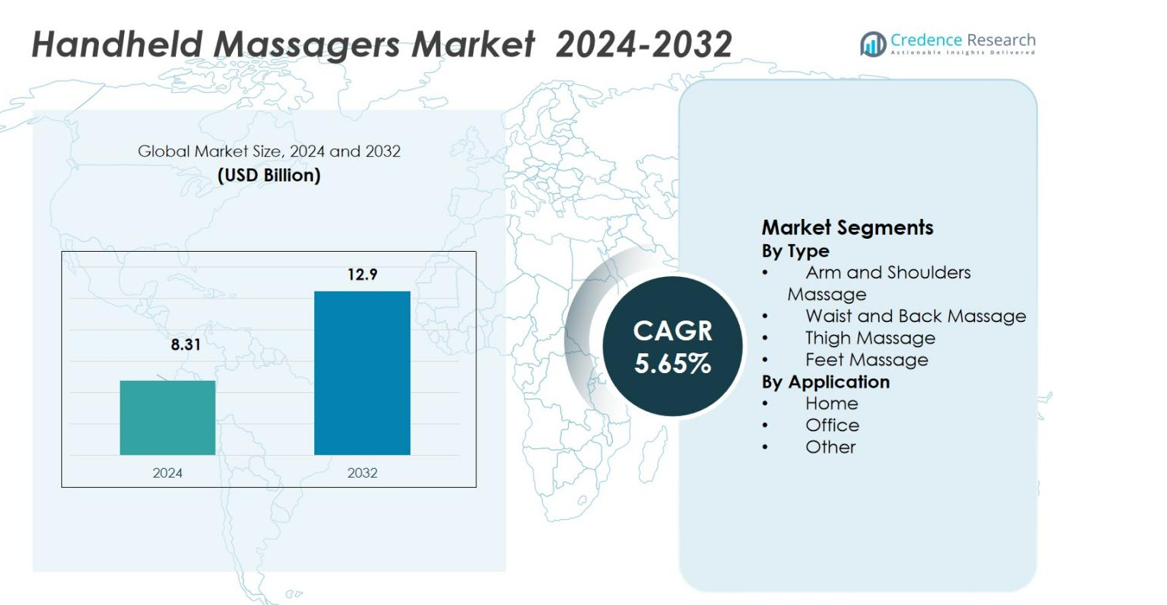
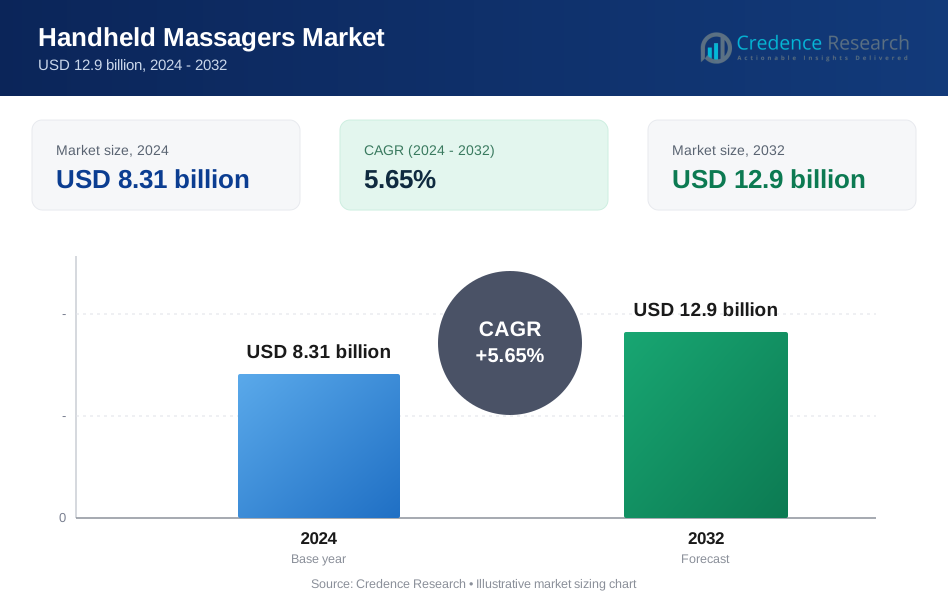
The Handheld Massagers Market size was valued at USD 8.31 billion in 2024 and is anticipated to reach USD 12.9 billion by 2032, at a CAGR of 5.65% during the forecast period.
| REPORT ATTRIBUTE | DETAILS |
|---|---|
| Historical Period | 2020-2023 |
| Base Year | 2024 |
| Forecast Period | 2025-2032 |
| Handheld Massagers Market Size 2024 | USD 8.31 billion |
| Handheld Massagers Market, CAGR | 5.65% |
| Handheld Massagers Market Size 2032 | USD 12.9 billion |
The Handheld Massagers Market is led by key players such as Breo, Beurer, Homedics, Thumper, Conair, and Scholl. These companies are at the forefront of innovation, offering a range of advanced handheld massagers with features like smart connectivity, customizable massage settings, and ergonomic designs. North America holds the largest market share at 37.5% in 2024, driven by strong consumer demand for wellness products and high disposable income. Europe follows with a share of 29.8%, fueled by increasing health awareness and the preference for at-home therapeutic solutions. Asia-Pacific, with a share of 24.1%, is experiencing rapid growth due to rising disposable incomes and a growing focus on health and wellness. These regions are expected to continue dominating the market as demand for personalized and portable wellness solutions expands globally.
Market Insights
- The Handheld Massagers Market size stood at USD 8.31 billion in 2024 and is projected to reach USD 12.9 billion by 2032 at a CAGR of 5.65%.
- The market is driven by rising consumer demand for wellness and self‑care, with handheld devices gaining traction as convenient solutions for muscle tension and fatigue.
- A key trend involves the integration of smart connectivity and customizable settings into massagers, enabling users to personalize their therapy and replicate spa‑like experiences at home.
- Competitive forces remain strong, with major players such as Breo, Beurer, Homedics, Thumper, Conair and Scholl pushing innovation in design, distribution and technology while navigating price sensitivity and evolving consumer preferences.
- From a regional perspective, North America leads with a 37.5% share, Europe follows at 29.8%, Asia‑Pacific holds 24.1%, while Latin America and Middle East & Africa account for 5.6% and 3.0% respectively; in terms of segmentation, the Arm & Shoulders type held a 35.4% share and Home application captured 58.6% in 2024.
Market Segmentation Analysis
By Type
The Arm and Shoulders Massage segment leads the Handheld Massagers Market, holding a dominant share of 35.4% in 2024. This segment is driven by the increasing need for relief from muscle tension and fatigue, especially from stress-related conditions and sedentary work lifestyles. As consumers seek convenience and effectiveness in muscle relaxation, handheld massagers designed specifically for the arm and shoulder areas have seen heightened demand. Advances in product technology, such as customizable intensity and ergonomic features, further support the segment’s growth.
- For instance, Therabody’s Theragun PRO delivers up to 60 pounds of stall force and reaches 2,400 percussions per minute, powered by a professional-grade brushless motor with a 16-millimeter amplitude.
By Application
The Home application segment holds the largest share of 58.6% in the Handheld Massagers Market in 2024. This growth is primarily fueled by the increasing consumer shift towards home-based wellness solutions, particularly during the pandemic. With self-care and wellness becoming top priorities, consumers are increasingly opting for handheld massagers as part of their home relaxation routines. The segment benefits from the convenience of at-home therapy, where consumers use these devices to alleviate stress, muscle tension, and discomfort, replicating spa-like experiences at home.
- For instance, HoMedics’ Therapist Select Percussion Handheld Massager is equipped with a dual-motor design delivering up to 3,100 pulses per minute and features four interchangeable heads to target different muscle groups.
Key Growth Drivers
Increasing Consumer Demand for Wellness and Self-Care
The rising focus on personal wellness and self-care has significantly contributed to the growth of the Handheld Massagers Market. As individuals seek more convenient ways to manage stress, muscle tension, and overall physical well-being, handheld massagers have become popular choices. The growing emphasis on relaxation techniques and physical therapy in daily routines, especially amid the ongoing demand for at-home solutions, has propelled the market forward. Consumers are increasingly investing in devices that offer targeted relief, convenience, and comfort, further expanding the market's potential.
- For instance, the RENPHO Power Massage Gun (R3 model) operates with a powerful high-torque brushless motor (16.8V or 25W electrical power estimate, actual motor power not specified) delivering up to 3,200 percussions per minute and an approximate 10-millimeter amplitude for deep muscle impact
Advancements in Technology and Product Innovation
Technological advancements have played a critical role in driving growth in the Handheld Massagers Market. New product innovations, including customizable intensity levels, improved ergonomics, and multi-functional devices, have expanded the appeal of handheld massagers. The integration of smart features such as app connectivity, heating functions, and adjustable massage techniques has enhanced user experience. These innovations enable consumers to tailor their massage therapy sessions, addressing specific needs like pain relief, stress reduction, and muscle relaxation, thus fostering market expansion.
- For instance, Therabody’s Theragun Elite connects to the Therabody App via Bluetooth and automatically adjusts routines based on user feedback, while delivering up to 2,400 percussions per minute with a 16-millimeter amplitude.
Rising Prevalence of Musculoskeletal Disorders
The increasing prevalence of musculoskeletal disorders, particularly back and neck pain, has also been a key growth driver for the Handheld Massagers Market. With a growing number of individuals suffering from chronic pain due to sedentary lifestyles, poor posture, and stress, the demand for effective pain relief solutions has surged. Handheld massagers provide a cost-effective, convenient, and non-invasive solution for managing muscle discomfort. This has resulted in a steady rise in the adoption of handheld massagers, further contributing to the market's expansion.
Key Trends & Opportunities
Growing Popularity of Home-Based Wellness Solutions
There is a notable trend toward home-based wellness solutions, which has accelerated the demand for handheld massagers. Consumers are increasingly seeking ways to enhance their self-care routines without the need to visit spas or clinics. Handheld massagers, offering on-demand relief and therapeutic benefits, fit perfectly into this evolving lifestyle. The increasing adoption of devices that enable users to enjoy professional-grade massages from the comfort of their homes presents a significant opportunity for market players to expand their offerings and cater to the growing demand for home wellness solutions.
- For instance, Ekrin Athletics’ B37 percussion massager delivers up to 3,200 percussions per minute with a 56-pound stall force and features a 12-millimeter amplitude for deep tissue reach.
Integration of Smart Technology and Personalization
The integration of smart technology into handheld massagers is another significant trend driving market growth. Modern handheld massagers now offer features such as app connectivity, customizable massage programs, real-time feedback, and personalized settings based on user preferences. This trend toward intelligent devices allows users to have a more tailored and enhanced experience. As consumers increasingly seek personalized solutions, this trend presents a unique opportunity for companies to innovate and introduce advanced features that cater to individual needs, thus driving further market expansion.
- For instance, Hyperice’s Hypervolt Bluetooth model connects to the Hyperice App, which automates massage routines by syncing with real-time activity data from Apple Health and Strava.
Key Challenges
High Initial Cost and Consumer Perception
One of the primary challenges faced by the Handheld Massagers Market is the high initial cost of some advanced massager models. While basic models are affordable, premium handheld massagers equipped with advanced features can be expensive, which may deter cost-sensitive consumers. Additionally, there may be a perception among potential buyers that these devices are a luxury or unnecessary, further hindering widespread adoption. Overcoming these barriers through affordability and educating consumers on the benefits of these products is essential for market growth.
Limited Awareness and Education About Product Benefits
Another challenge facing the Handheld Massagers Market is the lack of awareness and education about the benefits and proper usage of these devices. Many consumers are unfamiliar with how handheld massagers work or how they can address specific pain points effectively. Without proper understanding, potential customers may be hesitant to invest in such devices. Increased efforts in marketing, education, and demonstration of the therapeutic benefits of handheld massagers are necessary to increase consumer confidence and drive adoption.
Regional Analysis
North America
North America holds a significant share of 37.5% in the Handheld Massagers Market in 2024, driven by a well-established wellness culture and the increasing demand for self-care solutions. The market is supported by the growing adoption of advanced massaging devices equipped with smart features and personalized settings. High disposable income, strong healthcare awareness, and an inclination toward home-based wellness solutions further contribute to market growth. The United States leads the region, with a large consumer base seeking effective pain relief solutions, and Canada also contributes to the demand for handheld massagers, particularly in the wellness and therapeutic sectors.
Europe
Europe commands a market share of 29.8% in the Handheld Massagers Market in 2024. The region’s growth is fueled by a high demand for wellness products, especially in countries like Germany, the UK, and France. Increasing awareness of the benefits of self-care and physical therapy has propelled the adoption of handheld massagers, with many consumers seeking devices for stress management, muscle relief, and relaxation. Additionally, the rise in sedentary lifestyles due to work culture and the growing preference for home-based wellness solutions are driving market expansion in Europe, particularly in urban areas.
Asia-Pacific
Asia-Pacific is poised for substantial growth in the Handheld Massagers Market, holding a share of 24.1% in 2024. The region's growth is driven by rising disposable incomes, an increasing focus on health and wellness, and a rapidly expanding middle class in countries like China and India. As these economies grow, consumers are becoming more inclined toward investing in personal wellness devices. Furthermore, the aging population in countries such as Japan is boosting demand for massagers to manage musculoskeletal conditions. The region’s increasing adoption of health-oriented technologies is expected to contribute to the further expansion of the market.
Latin America
Latin America holds a share of 5.6% in the Handheld Massagers Market in 2024, with Brazil and Mexico being the key contributors to market growth. The demand for handheld massagers in the region is primarily driven by the rising interest in wellness products and physical therapy solutions. As disposable incomes rise, particularly in urban areas, consumers are more willing to invest in self-care devices. The growing awareness of the benefits of massage therapy for stress relief, muscle pain, and relaxation further supports the growth of the handheld massagers market in Latin America, with increasing adoption across various segments.
Middle East & Africa
The Middle East and Africa region holds a market share of 3.0% in the Handheld Massagers Market in 2024. While the market is relatively smaller compared to other regions, it is expected to witness steady growth due to the increasing focus on health, wellness, and personal care in countries like the UAE and Saudi Arabia. Rising urbanization, coupled with higher disposable incomes, is driving demand for handheld massagers. Additionally, a growing interest in self-care and relaxation therapies, particularly among the working population in urban areas, is contributing to the market’s development in the region.
Market Segmentations
By Type
- Arm and Shoulders Massage
- Waist and Back Massage
- Thigh Massage
- Feet Massage
By Application
- Home
- Office
- Other
By Geography
- North America
- U.S.
- Canada
- Mexico
- Europe
- Germany
- France
- U.K.
- Italy
- Spain
- Rest of Europe
- Asia Pacific
- China
- Japan
- India
- South Korea
- South-east Asia
- Rest of Asia Pacific
- Latin America
- Brazil
- Argentina
- Rest of Latin America
- Middle East & Africa
- GCC Countries
- South Africa
- Rest of the Middle East and Africa
Competitive Landscape
The Handheld Massagers Market is highly competitive, with key players such as Breo, Beurer, Homedics, Thumper, Conair, and Scholl leading the industry. These companies are focused on product innovation, technological advancements, and strategic partnerships to strengthen their market positions. Leading players are introducing devices with features like smart connectivity, customizable massage settings, and ergonomic designs to cater to growing consumer demand for personalized wellness solutions. With the increasing emphasis on health and wellness, these companies are also expanding their product portfolios to include massagers targeting specific areas, such as the back, shoulders, and feet. Additionally, market players are leveraging e-commerce platforms and retail partnerships to enhance their distribution networks. Intense competition, along with the rising demand for home-based wellness products, is driving continuous product innovation, making the market dynamic and fast-evolving. As consumer preferences shift toward more advanced and multifunctional devices, companies are continually striving to offer enhanced user experiences.
Key Player Analysis
Recent Developments
- In 2025, Therabody launched “Coach by Therabody”, an AI‑powered feature in its app that offers personalized recovery routines compatible with its handheld massager devices.
- In October 2023, Therabody launched the Theragun Relief, a new affordable handheld massage device designed for everyday pain management and ergonomic home use.
- In August 2022, Beurer announced the release of the MG 99 Compact Massage Gun, expanding its lineup of portable therapeutic massage devices.
Report Coverage
The research report offers an in-depth analysis based on Type, Application and Geography. It details leading market players, providing an overview of their business, product offerings, investments, revenue streams, and key applications. Additionally, the report includes insights into the competitive environment, SWOT analysis, current market trends, as well as the primary drivers and constraints. Furthermore, it discusses various factors that have driven market expansion in recent years. The report also explores market dynamics, regulatory scenarios, and technological advancements that are shaping the industry. It assesses the impact of external factors and global economic changes on market growth. Lastly, it provides strategic recommendations for new entrants and established companies to navigate the complexities of the market.
Future Outlook
- The Handheld Massagers Market is expected to witness continued growth due to the increasing demand for at-home wellness solutions.
- Consumer preferences will shift towards advanced massagers with smart features like app integration and customizable settings.
- There will be an increased focus on ergonomic designs and portability, making handheld massagers more user-friendly.
- The rising popularity of personalized health and wellness experiences will drive innovation in massager technologies.
- Key players will continue to introduce multifunctional massagers that target specific areas such as the back, neck, and feet.
- Demand for handheld massagers will grow as an alternative to traditional spa visits and therapeutic treatments.
- The aging population, particularly in developed regions, will boost the market for massagers catering to muscle relief and pain management.
- E-commerce and online retail platforms will play a major role in expanding market reach and consumer accessibility.
- The growing trend of self-care and stress management will further increase the adoption of handheld massagers across various demographics.
- Manufacturers will focus on affordability and accessibility to attract a wider range of consumers, expanding the market base.
Request a Free Sample
Fill in your details and we'll send you a free sample report.
- Sample data tables & charts
- Research methodology
Need a Custom Version of This Report?
Tailor the scope, geography, or segments to your exact requirements.
- Custom geography or segment scope
- Direct access to our analyst team
Frequently Asked Questions
What is the current market size for Handheld Massagers Market, and what is its projected size in 2032?
At what Compound Annual Growth Rate is the Handheld Massagers Market projected to grow between 2025 and 2032?
Which is the leading region of the market for handheld massagers?
What are the critical drivers for the growth of the handheld massagers market?
Which is the major segment in the handheld massagers market by application?
Who are the leading companies in the Handheld Massagers Market?
Table of Content
Chapter 1. Report Introduction
- 1.1 Report Description & Purpose
- 1.1.1 Report Title & Market Definition
- 1.1.2 Unique Selling Propositions (USP) & Key Differentiators
- 1.1.3 Value Proposition for Stakeholders
- 1.2 Research Objectives
- 1.2.1 Market Sizing Objectives (Volume & Revenue) (Volume Where Applicable)
- 1.2.2 Segmentation Objectives
- 1.2.3 Competitive Intelligence Objectives
- 1.2.4 Forecast & Scenario Objectives
- 1.3 Report Scope
- 1.3.1 Handheld Massagers Scope – Segments & Subsegments Covered
- 1.3.2 Geographic Scope – Regions & Countries Covered
- 1.3.3 Historical Period, Base Year & Forecast Period (2024; forecast to 2032)
- 1.3.4 Inclusions & Exclusions
- 1.4 Industry Classification & Applicable Codes
- 1.5 Currency, Measurement Units & Valuation Basis
- 1.6 Target Stakeholders
- 1.7 Limitations & Assumptions
Chapter 2. Executive Summary
- 2.1 Global Handheld Massagers Market Snapshot
- 2.1.1 Market Size – Historical (2024) & Forecast (2024-2032) (2024: USD 8.31 billion → 2032: USD 12.9 billion)
- 2.1.2 Volume & Revenue – Global Totals (Volume Where Applicable)
- 2.1.3 Key Market Highlights – Top Five Facts
- 2.2 Handheld Massagers Market Segmentation Snapshot
- 2.2.1 Market Split by Region – 2024 vs. 2032
- 2.3 Competitive Snapshot
- 2.3.1 Top 10 Players by Revenue Share – 2024
- 2.3.2 Top 10 Players by Volume Share – 2024 (Volume Where Applicable)
- 2.3.3 Recent Strategic Developments (18-Month Summary)
- 2.4 Key Investment Highlights & Strategic Conclusions
Chapter 3. Handheld Massagers Market Dynamics & Industry Analysis
- 3.1 Market Overview & Context
- 3.1.1 Handheld Massagers Market Position in the Broader Industry Value Chain
- 3.1.2 Demand Structure & Purchasing Dynamics
- 3.1.3 Market Maturity & Development Stage by Region
- 3.2 Handheld Massagers Market Drivers
- 3.3 Handheld Massagers Market Restraints & Challenges
- 3.4 Handheld Massagers Market Opportunities
- 3.5 Porter's Five Forces Analysis
- 3.5.1 Threat of New Entrants
- 3.5.2 Bargaining Power of Suppliers
- 3.5.3 Bargaining Power of Buyers
- 3.5.4 Threat of Substitutes
- 3.5.5 Competitive Rivalry – Intensity Assessment
- 3.6 Handheld Massagers Value Chain Analysis
- 3.6.1 Upstream – Key Inputs, Resources & Suppliers
- 3.6.1.1 Key Input/Resource 1
- 3.6.1.2 Key Input/Resource 2
- 3.6.1.3 Key Input/Resource 3
- 3.6.2 Midstream – Core Operations & Value Creation
- 3.6.2.1 Operating Model & Process Overview
- 3.6.2.2 Key Operating Locations & Capabilities by Company
- 3.6.3 Downstream – Market Channels & End Users
- 3.6.3.1 Direct Sales & Customer Engagement Channels
- 3.6.3.2 Indirect Sales, Intermediaries & Partner Channels
- 3.6.4 Value Chain Profitability Analysis
- 3.6.1 Upstream – Key Inputs, Resources & Suppliers
- 3.7 PESTEL Analysis
- 3.7.1 Political Factors
- 3.7.2 Economic Factors
- 3.7.3 Social Factors
- 3.7.4 Technological Factors
- 3.7.5 Environmental Factors
- 3.7.6 Legal Factors
- 3.8 Handheld Massagers Supply Chain Analysis
- 3.8.1 Critical Input & Resource Availability Risk Assessment
- 3.8.2 Supplier & Operational Concentration Risk (Geographic Exposure)
- 3.8.3 Supply & Service Disruption Impact Analysis
- 3.9 Regulatory & Policy Landscape
Note: The regulatory and policy landscape section covers regulations based on their applicability to the market, Handheld Massagers category, geography, and scope of the study. Only regulatory frameworks with a material impact on operations, compliance, trade, sustainability, or market access are analyzed in detail.
Chapter 4. Key Investment Pockets & Opportunity Analysis
- 4.1 Handheld Massagers Market Attractiveness Analysis
- 4.1.1 By Region – Investment Attractiveness Matrix (Market Size × CAGR)
- 4.2 Absolute Revenue Growth Opportunity
- 4.2.1 By Region – Absolute Revenue Growth Through 2032
- 4.3 Incremental Demand Opportunity
- 4.3.1 By Region – Incremental Demand Through 2032
- 4.3.2 Segment – Incremental Demand
- 4.4 Emerging Submarket Opportunity Deep Dive (Subject to Applicability)
- 4.5 Priority Market Opportunity Scorecards
- 4.5.1 United States
- 4.5.2 Europe
- 4.5.3 Asia
- 4.5.4 Middle East & Africa
Note: Priority market opportunity scorecards reflect the geographic scope and strategic relevance of the study. Listed markets are indicative and may be adapted to the industry.
Chapter 5. Handheld Massagers Cross-Border Trade & Market Access Analysis
- 5.1 International Trade & Cross-Border Activity Overview
- 5.1.1 Global Export Value by Country (2024)
- 5.1.2 Global Export Volume by Country (2024) (Volume Where Applicable)
- 5.1.3 Global Import Value by Country (2024)
- 5.1.4 Global Import Volume by Country (2024) (Volume Where Applicable)
- 5.1.5 Net Trade Balance by Country (2024)
- 5.2 Export Analysis – Segment
- 5.2.1 Category 1 (Applicable Classification Code)
- 5.2.2 Category 2 (Applicable Classification Code)
- 5.2.3 Category 3 (Applicable Classification Code)
- 5.2.4 Category 4 (Applicable Classification Code)
- 5.2.5 Category 5 (Applicable Classification Code)
- 5.3 Import Analysis – Segment
- 5.3.1 Category 1 (Applicable Classification Code)
- 5.3.2 Category 2 (Applicable Classification Code)
- 5.3.3 Category 3 (Applicable Classification Code)
- 5.3.4 Category 4 (Applicable Classification Code)
- 5.3.5 Category 5 (Applicable Classification Code)
- 5.4 Cross-Border Pricing & Transaction Benchmarks
- 5.4.1 Export Pricing – Segment & Country
- 5.4.2 Import Pricing – Segment & Source Country
- 5.4.3 Price Trends (2024)
- 5.5 Key Cross-Border Trade & Delivery Routes
- 5.5.1 Cross-Border Trade/Delivery Route 1
- 5.5.2 Cross-Border Trade/Delivery Route 2
- 5.5.3 Cross-Border Trade/Delivery Route 3
- 5.5.4 Cross-Border Trade/Delivery Route 4
- 5.5.5 Cross-Border Trade/Delivery Route 5
- 5.6 Trade Policy & Market Access Impact Assessment
- 5.6.1 Tariff & Non-Tariff Barriers
- 5.6.2 Regional Trade & Economic Integration Frameworks
- 5.6.3 Bilateral & Multilateral Trade Agreements
- 5.6.4 Cross-Border Operating, Licensing & Localization Requirements
Note: This chapter applies where cross-border trade or delivery is relevant to Handheld Massagers. Goods, services, and digital offerings are assessed using applicable classifications and transaction measures. Import-export volumes, trade balances, and route analyses are included only where meaningful to the market.
Chapter 6. Competitive Landscape & Company Benchmarking
- 6.1 Handheld Massagers Market Concentration & Structure
- 6.1.1 Herfindahl-Hirschman Index (HHI) – vs. 2024
- 6.1.2 Leading, Mid-Sized & Emerging Player Structure
- 6.1.3 Global, Regional & Local Player Dynamics
- 6.2 Handheld Massagers Market Share Analysis – 2024
- 6.2.1 Global Revenue Share by Company
- 6.2.2 Global Volume Share by Company (Volume Where Applicable)
- 6.2.3 Regional Revenue Share
- 6.2.4 Market Share Evolution ( vs. 2024)
- 6.2.5 Company Market Share by Key Segment
- 6.2.6 Company Market Share by Customer Group
- 6.3 Operating Scale, Capacity & Infrastructure Analysis
- 6.3.1 Global Operating Scale & Supply Capacity
- 6.3.2 Resource Utilization & Operating Efficiency
- 6.3.3 Output, Service Delivery & Activity Metrics
- 6.3.4 Operating Footprint & Infrastructure Map
- 6.3.5 Planned Operational & Capacity Expansion
- 6.4 Handheld Massagers Competitive Benchmarking Matrix
- 6.4.1 Revenue, Growth, Profitability & Operating Metric Comparison
- 6.4.2 Channel Revenue Mix
- 6.4.3 Geographic Revenue Exposure
- 6.4.4 R&D Intensity
- 6.4.5 Sustainability Maturity
- 6.5 Strategic Developments in Handheld Massagers (Last 24 Months)
- 6.5.1 Mergers, Acquisitions & Divestments
- 6.5.2 New Products, Services & Solutions in Handheld Massagers
- 6.5.3 Operational & Infrastructure Expansions
- 6.5.4 Strategic Alliances, Joint Ventures & Partnerships
- 6.5.5 Distribution Expansion & Market Entry
- 6.5.6 Sustainability & ESG Initiatives
- 6.6 Competitive Strategy Mapping
- 6.6.1 Leader, Challenger, Follower & Niche Classification
- 6.6.2 Pricing Strategy Comparison
- 6.6.3 Channel Strategy Matrix
Note: Strategic developments are included based on their materiality and the availability of reliable information.
Chapter 7. Global Handheld Massagers Market – By Sales & Delivery Channel
- 7.1 Segment Overview
- 7.1.1 Volume & Revenue Split by Channel (2024 & 2032) (Volume Where Applicable)
- 7.1.2 Channel Mix Evolution (2024-2032)
Chapter 8. Regional Market Analysis – Global Overview
- 8.1 Global Regional Overview
- 8.1.1 Regional Volume Share (Volume Where Applicable)
- 8.1.2 Regional Revenue Share
- 8.1.3 Regional Volume by Region (Volume Where Applicable)
- 8.1.4 Regional Revenue by Region
- 8.1.5 Regional Forecast Through 2032
- 8.2 Cross-Regional Segment Analysis
- 8.2.1 By Sales & Delivery Channel
- 8.2.2 By Competitive Positioning & Price Tier
Chapter 9. North America Handheld Massagers Market
- 9.1 United States
- 9.2 Canada
- 9.3 Mexico
Chapter 10. Europe Handheld Massagers Market
- 10.1 Germany
- 10.2 France
- 10.3 Italy
- 10.4 United Kingdom
- 10.5 Spain
- 10.6 Poland
- 10.7 Russia
- 10.8 Netherlands
- 10.9 Belgium
- 10.10 Sweden
- 10.11 Denmark
- 10.12 Norway
- 10.13 Rest of Europe
Chapter 11. Asia Pacific Handheld Massagers Market
- 11.1 China
- 11.2 India
- 11.3 Japan
- 11.4 South Korea
- 11.5 Thailand
- 11.6 Indonesia
- 11.7 Vietnam
- 11.8 Malaysia
- 11.9 Australia
- 11.10 Rest of Asia Pacific
Chapter 12. Latin America Handheld Massagers Market
- 12.1 Brazil
- 12.2 Argentina
- 12.3 Colombia
- 12.4 Chile
- 12.5 Rest of Latin America
Chapter 13. Middle East Handheld Massagers Market
- 13.1 Saudi Arabia
- 13.2 United Arab Emirates
- 13.3 Turkey
- 13.4 Israel
- 13.5 Iran
- 13.6 Rest of the Middle East
Chapter 14. Africa Handheld Massagers Market
- 14.1 South Africa
- 14.2 Egypt
- 14.3 Nigeria
- 14.4 Morocco
- 14.5 Rest of Africa
Chapter 15. Handheld Massagers Company Profiles
- 15.1 [Company 01]
- 15.1.1 Company Overview
- 15.1.2 Key Management Personnel
- 15.1.3 Products & Services Portfolio
- 15.1.4 Financial Performance
- 15.1.5 Key Market Focus & Geographic Presence
- 15.1.6 Recent Developments & Strategic Initiatives
Note: The company profile list is preliminary and may change based on research findings, market developments, data availability, and client requirements.
Chapter 16. Appendices
- Appendix A – List of Abbreviations & Acronyms
- Appendix B – Industry Classification Code Reference – Full Series
- Appendix C – Supply, Output & Operating Capacity Data Tables
- Appendix D – End-Use & Demand Base Tables
- Appendix E – Demand, Adoption & Usage Assumptions
- Appendix F – Pricing & Revenue Metric Reference Tables
- Appendix G – Company Operations & Infrastructure Database
- Appendix H – Cross-Border Trade & Activity Data Tables (Where Applicable)
- Appendix I – Regulatory Summary Tables
- Appendix J – Primary Research Participant List (Anonymized)
- Appendix K – Primary Research Questionnaire Framework
- Appendix L – Data Sources & Bibliography
- Appendix M – Market Size Divergence & Source Comparison
Chapter 17. Research Methodology
- 17.1 Research Framework & Philosophy
- 17.2 Secondary Research – Sources, Hierarchy & Data Extraction
- 17.3 Data Modeling – Bottom-Up & Top-Down Market Sizing
- 17.4 Primary Research – Stakeholder Framework, LOI & Sample Sizes
- 17.5 Forecast Methodology – Regression, Scenario & Sensitivity Analysis
- 17.6 Quality Control – Four-Layer Validation Framework
- 17.7 Limitations & Standard Assumptions
- 17.8 Disclaimer
