
| REPORT ATTRIBUTE | DETAILS |
|---|---|
| Historical Period | 2019-2022 |
| Base Year | 2023 |
| Forecast Period | 2024-2032 |
| Identity And Access Management (IAM) Market Size 2024 | USD 16150 million |
| Identity And Access Management (IAM) Market, CAGR | 15.7% |
| Identity And Access Management (IAM) Market Size 2032 | USD 51860.82 million |
Market Insights
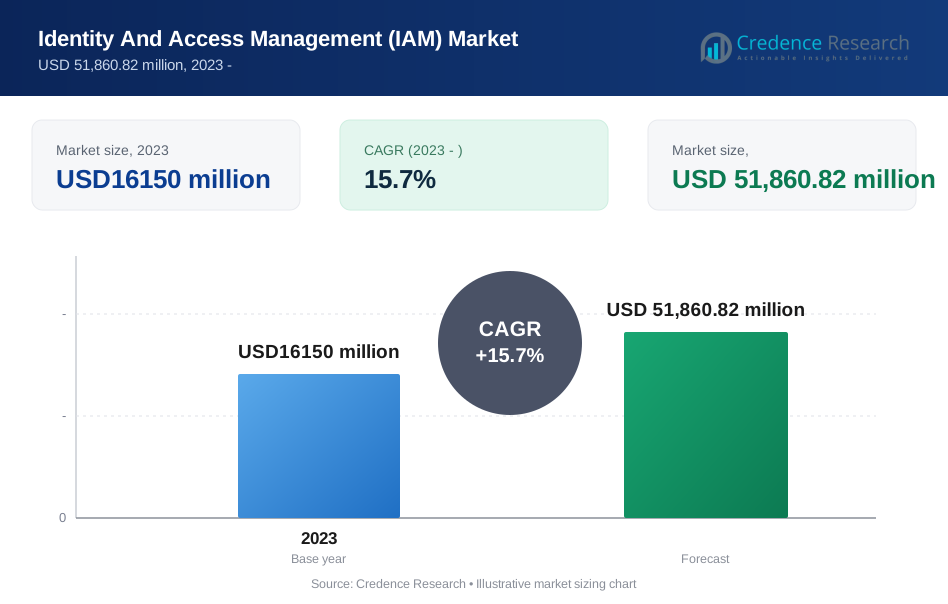
- The global demand for Identity And Access Management (IAM) was valued at USD 16150 million in 2024 and is expected to reach USD 51860.82 million in 2032, growing at a CAGR of 15.7% between 2024 and 2032.
- The provisioning sector is the market leader by component, accounting for more than 31% of total value in 2023, while the authentication segment is expected to grow rapidly throughout the forecast period.
- The on-premises deployment type dominates the global need for Identity And Access Management (IAM), accounting for more than 45% in 2023 and is predicted to expand at a high CAGR.
- The small and medium enterprises (SMEs) sector is predicted to grow fastest over the projection period, while the large enterprises segment will have a market share of more than 55% in 2023.
- Over the projection period, the IT and telecom category is expected to expand at the highest rate, while the BFSI category will dominate the market in 2023 with a 25% share.
- The professional services category is expected to expand quickly over the forecast period, while the implementation and integration segment will have the greatest market share in 2023.
- North America is fueling the growth of the Identity And Access Management (IAM) industry with over one-third share in 2023, while Asia Pacific and Europe collectively account for just under 55% share in 2023. Europe held over 20% share in 2023.
- Due to the rising frequency and sophistication of cyberattacks drive the demand for robust identity and access management solutions to protect sensitive data and systems.
- The market's primary possibilities include the significant growth potential in North America, shift towards cloud computing and services demands IAM solutions.

Executive Summary
Market Definition
The Identity and Access Management (IAM) is a comprehensive framework of policies, technologies, and processes designed to ensure secure and efficient control over the digital identities and access privileges of individuals within an organization. IAM encompasses the management of user authentication, authorization, and the assignment of permissions, aiming to establish and maintain a reliable and secure digital identity for each user. This involves verifying the identity of users, providing them with appropriate access to resources based on their roles and responsibilities, and consistently monitoring and managing these privileges throughout the user lifecycle. IAM plays a critical role in enhancing cybersecurity, ensuring compliance with regulations, and supporting seamless and controlled access to digital assets in an increasingly complex and interconnected computing environment.
Market Overview
The global Identity And Access Management (IAM) market has witnessed steady growth in recent years and is expected to grow at a CAGR of 16.20% between 2024 and 2032. The market was valued at USD 16,151.20 million in 2023 and is expected to reach USD 62,382.09 million in 2032.
The key driver boosting the growth rate of the Identity And Access Management (IAM) market is the increase frequency and sophistication of cyber threats compel organizations to invest in robust IAM solutions to fortify their cybersecurity postures. As data breaches and cyberattacks become more prevalent, businesses recognize the imperative of securing sensitive information and infrastructure through advanced authentication, authorization, and access management protocols. The increasing awareness of the potential financial and reputational consequences associated with data breaches is propelling organizations across various sectors to prioritize IAM as a foundational element of their overall cybersecurity strategy.
Furthermore, the global surge in digital transformation initiatives is a significant growth driver for the IAM market. Organizations are undergoing extensive digitization to improve operational efficiency, enhance customer experiences, and stay competitive. This digital shift requires a secure and streamlined approach to managing user identities and access to digital assets. IAM solutions play a pivotal role in facilitating secure access in dynamic, cloud-based, and interconnected environments, ensuring that the right individuals have appropriate access privileges while safeguarding against unauthorized activities. As businesses embrace cloud computing, mobile technologies, and IoT devices, the demand for IAM solutions continues to rise, positioning it as a key enabler of secure and efficient digital transformation strategies.
Segmentation by Component
- Provisioning is the leading segment by interface type and held over 31% share in value in 2023, attributable to the market's wide usage of IAM solutions in automated onboarding/offboarding, and role management.
- The Authentication segment will likely exhibit a significant CAGR during the forecast period. The growing acceptance and advancements in biometric authentication technologies contribute to the adoption of IAM solutions for enhanced security and user authentication.
- Authorization is another segment which contributes significantly to the global Identity And Access Management (IAM) market compared to the provisioning and authentication segments.
Segmentation by Deployment Type
- The on-premises segment governs the demand for Identity And Access Management (IAM) in the world, holding a massive share of over 45% in 2023, and is also expected to grow at a rapid CAGR due to the ongoing digital transformation across industries necessitates secure and seamless access to digital assets, fueling the adoption of IAM solutions to manage identities efficiently.
- The cloud-based sectors segment contributes to the demand for Identity And Access Management (IAM).
Segmentation by Organization Size
- The small and medium enterprises (SMEs) segment is expected to post the highest CAGR during the forecast period. This is primarily due to the organizations expand globally, the need for IAM solutions that can manage identities and access across diverse geographic locations and regulatory environments becomes increasingly important.
- The large enterprises segment is leading the market share with over 55% share in 2023.
Segmentation by End-User
- The IT and telecom segment is anticipated to register the highest CAGR during the projection period.
- With a market share of nearly 25% in 2023, the BFSI category is currently in the lead.
Segmentation by Service
- The implementation and integration dominate the global need for Identity And Access Management (IAM), accounting for more than 30% in 2023.
- Professional Services are predicted to expand at a high CAGR during the forecast period.
- The rest of the demand for Identity And Access Management (IAM) comes from the consulting, support and maintenance, and managed services.
Segmentation by Region
- North America is fueling the growth of the Identity And Access Management (IAM) industry with over one-third share in 2023 due to the adoption of zero-trust security models, which assume no implicit trust and verify everyone, drives the demand for IAM solutions as a fundamental component of a zero-trust architecture.
- Asia Pacific and Europe collectively account for just under 55% share in 2023, with Europe holding over 20% share in the same year.
- The rest of the world, including Latin America, the Middle East, and Africa, supplies the remaining demand for Identity And Access Management (IAM).
The market for Identity And Access Management (IAM) is driven by prevalence of remote work increases the need for IAM solutions that enable secure and convenient access for employees working from various locations and devices.
North America stands as a dominant region in the Identity and Access Management (IAM) market, driven by a combination of factors. The region's robust IT infrastructure, high adoption of advanced technologies, and stringent regulatory requirements contribute to the widespread implementation of IAM solutions. The United States, in particular, is home to numerous technology-intensive industries and financial institutions that prioritize cybersecurity, propelling the demand for IAM solutions. Additionally, the increasing frequency and severity of cyber threats have heightened the focus on IAM as a crucial component of comprehensive cybersecurity strategies. North American organizations are keen on investing in sophisticated IAM solutions to safeguard sensitive data, meet compliance standards, and mitigate the risks associated with evolving cyber threats.
The Asia Pacific region emerges as the fastest-growing market for Identity and Access Management (IAM), fueled by rapid technological advancements, increasing digitalization, and a burgeoning number of enterprises. Countries like China, India, Japan, and South Korea are at the forefront of digital transformation, leading to a surge in demand for IAM solutions to secure digital assets and manage identities effectively. The region's expanding e-commerce sector, the proliferation of mobile devices, and the rise in remote work trends contribute to the growing need for IAM solutions. Moreover, as regulatory environments evolve, businesses in Asia Pacific are recognizing the importance of IAM in achieving compliance and data protection. The IAM market in Asia Pacific is characterized by a proactive approach to cybersecurity measures, making it a hotbed for the adoption and innovation of IAM technologies, and presenting substantial growth opportunities for both local and international IAM vendors.
Key Highlights of the Report
The global Identity And Access Management (IAM) market is segmented by component, deployment type, organization size, end-user, service, and region. Provisioning-based Identity And Access Management (IAM) are the most popular, while On-Premises and Large Enterprises are the primary segments. In addition, IT and Telecom and Professional Services are the most commonly used categories. However, Implementation and Integration ranges dominate the market, with North America leading the market growth.
One of the main factors propelling the global market for Identity And Access Management (IAM) is rising frequency and sophistication of cyberattacks drive the demand for robust identity and access management solutions to protect sensitive data and systems. The Stricter data protection regulations and compliance requirements, such as GDPR, HIPAA, and CCPA, compel organizations to implement IAM solutions to ensure adherence and avoid penalties.
Nonetheless, North America is anticipated to have the greatest share of the worldwide Identity And Access Management (IAM) market because of the ongoing digital transformation across industries necessitates secure and seamless access to digital assets, fueling the adoption of IAM solutions to manage identities efficiently. Furthermore, the market is anticipated to expand at the highest rate in the Asia-Pacific (APAC) region due to the shift towards cloud computing and services demands IAM solutions that can secure access to cloud-based applications, data, and infrastructure.
What Are The Main Drivers Of The Global Identity And Access Management (IAM) Market?
The main drivers of the global Identity and Access Management (IAM) market include the escalating cybersecurity threats, where the increasing frequency and sophistication of cyberattacks compel organizations to invest in robust IAM solutions for data protection. Furthermore, the surge in digital transformation initiatives globally is driving the demand for IAM as organizations seek secure and efficient control over user identities and access to digital assets.
What Are The Major Challenges Faced By The Global Identity And Access Management (IAM) Market?
The global IAM market faces several challenges, including the complexity of implementing IAM solutions across diverse and evolving IT environments. Integration with legacy systems and ensuring a seamless user experience while maintaining robust security measures pose challenges for organizations. Additionally, the increasing sophistication of cyber threats requires IAM solutions to constantly evolve to address emerging risks. Balancing security with user convenience can be a challenge, as organizations aim to provide efficient access without compromising on protection.
What Are The Growth Opportunities In The Global Identity And Access Management (IAM) Market?
The global IAM market presents significant growth opportunities, especially with the increasing adoption of advanced technologies. Opportunities arise from the integration of artificial intelligence (AI) and machine learning (ML) into IAM solutions, enhancing threat detection and adaptive access controls. As organizations expand globally, the demand for IAM solutions that can manage identities across diverse geographic locations creates growth potential. The rise of IoT devices and the need for securing access to these interconnected devices offer opportunities for IAM vendors to provide comprehensive solutions.
Market Drivers
The global Identity And Access Management (IAM) market is driven by several factors. The following are the key drivers of the global Identity And Access Management (IAM) market:
Evolving Cybersecurity Threat Landscape
The Global Identity and Access Management (IAM) market is growing due to the continuously evolving cybersecurity threat landscape. The rise in the frequency and sophistication of cyberattacks, including data breaches, phishing, and ransomware attacks, has propelled organizations to prioritize robust IAM solutions. IAM systems play a crucial role in fortifying digital identities, ensuring secure access, and mitigating the risks associated with unauthorized access and data breaches. As cyber threats become more sophisticated, the demand for advanced IAM technologies grows, driving innovation and investment in the IAM market.
Market Restraints
The global Identity And Access Management (IAM) market faces some challenges that may hinder its growth. These include the following:
Integration Challenges with Legacy Systems
A key restraint faced by the Global IAM market is the complexity and challenges associated with integrating IAM solutions into existing legacy systems. Many organizations operate on diverse technology stacks and legacy infrastructures, making the seamless implementation of IAM solutions a complex task. The integration process often requires significant time, resources, and expertise, leading to potential disruptions and resistance from users. Overcoming these integration challenges is crucial for ensuring the smooth adoption and effectiveness of IAM solutions across various industries and enterprises.
Opportunities
The global Identity And Access Management (IAM) market offers significant growth opportunities. These include the following:
Adoption of Zero-Trust Security Models
An emerging opportunity in the Global IAM market is the widespread adoption of zero-trust security models. Zero-trust security assumes no implicit trust, requiring continuous verification of users and devices, even those within the organization's network. This approach aligns with the evolving nature of cyber threats and the need for enhanced security postures. IAM solutions are integral to implementing zero-trust architectures, providing adaptive access controls and multifactor authentication to verify identities. The growing acceptance and implementation of zero-trust models present a significant opportunity for IAM vendors to offer solutions that align with modern security paradigms and address the dynamic nature of cybersecurity threats.
Competitive Landscape
Key Players
The global Identity And Access Management (IAM) market is highly competitive, with several key players. Some of the major players in the market and their market share are as follows:
- Amazon Web Services, Inc.
- Broadcom
- One Identity LLC.
- ForgeRock
- HID Global Corp.
- IBM
- McAfee, LLC
- Microsoft
- Okta
- OneLogin
- Oracle
- Ping Identity
- SecureAuth
- Evidian
- Intel Corp.
- Others
These organizations prioritize product innovation, distribution channel expansion, and mergers and acquisitions to stay competitive.
The global Identity And Access Management (IAM) market's key players continually seek to stay ahead by offering new products and developments.
In May 2022, Microsoft has unveiled Entra, a comprehensive Identity and Access Management (IAM) suite that integrates existing tools like Azure AD with novel products such as Decentralized Identity and Cloud Infrastructure Entitlement Management (CIEM). Entra is designed to enhance security by enabling security professionals to detect and control permissions across multi-cloud environments, ensuring the protection of digital identities throughout the entire process.
In October 2023, ManageEngine has introduced Identity360, a cloud-native identity management platform specifically tailored to tackle the complexities of cloud identity and access management (IAM) within enterprise workforces.
Summary of Key Findings
- The demand for IAM solutions is rising due to the rising frequency and sophistication of cyberattacks drive the demand for robust identity and access management solutions to protect sensitive data and systems, which is boosting the growth of the Identity And Access Management (IAM) market.
- Market segmented by component, deployment type, organization size, end-user, service, and region.
- Provisioning-based Identity And Access Management (IAM) are the most popular, while On-Premises and Large Enterprises are the primary segments.
- IT and Telecom and Professional Services are the most commonly used categories. However, Implementation and Integration ranges dominate the market.
- North America is leading market growth; the market is highly competitive with key players including Amazon Web Services, Inc., Broadcom, One Identity LLC., ForgeRock, HID Global Corp., IBM, McAfee, LLC, Microsoft, Okta, OneLogin, Oracle, Ping Identity, SecureAuth, Evidian, Intel Corp., and Others.
Future Outlook
- Positive outlook for the global Identity And Access Management (IAM) market with significant growth potential in the North American region
- One of the main factors promoting the market's expansion is the government and business sectors' current reliance on Identity And Access Management (IAM).
- During the forecast period, consumers' increasing cybersecurity threats is a significant factor projected to restrain the growth of the Identity And Access Management (IAM) market.
- Key firms must focus on product innovation, growing market reach, and maintaining competitive pricing to keep ahead of the competition.
How CXOs Can Benefit from the Credence Research Identity And Access Management (IAM) Market Report
The Credence Research Identity And Access Management (IAM) Market Report provides CXOs with a comprehensive overview of the market, including:
- Market size and growth forecast: The report provides detailed estimates of the global Identity And Access Management (IAM) market size, segmented by component, deployment type, organization size, end-user, service, and region. It also includes forecasts for the market through 2032, based on key trends and drivers.
- Market segmentation: The report segments the Identity And Access Management (IAM) market by component, deployment type, organization size, end-user, service, and region. This segmentation provides CXOs with a granular understanding of the market and the opportunities in each segment.
- Competitive landscape: The report profiles the key players in the Identity And Access Management (IAM) market and provides insights into their strategies, product offerings, and financial performance. This information can help CXOs to identify and assess their competition.
- Key trends and drivers: The report identifies and analyzes the key trends and drivers that are shaping the Identity And Access Management (IAM) This information can help CXOs to make informed decisions about their investments and strategies.
CXOs can use the insights from the Credence Research Identity And Access Management (IAM) Market Report to:
- Identify growth opportunities: The report can help CXOs to identify new growth opportunities in the Identity And Access Management (IAM) For example, the report identifies the growing demand for Identity And Access Management (IAM) from cloud computing providers and telecom companies as a key opportunity.
- Make informed investment decisions: The report can help CXOs to make informed investment decisions about Identity And Access Management (IAM). For example, the report provides insights into the key factors to consider when evaluating Identity And Access Management (IAM) providers and selecting Identity And Access Management (IAM)
- Develop competitive strategies: The report can help CXOs to develop competitive strategies for their Identity And Access Management (IAM) For example, the report identifies the key strategies that Identity And Access Management (IAM) providers are using to differentiate themselves from their competitors.
- Track market developments: The report can help CXOs to track market developments and stay ahead of the curve. For example, the report provides insights into the latest trends and innovations in the Identity And Access Management (IAM)
Overall, the Credence Research Identity And Access Management (IAM) Market Report is a valuable resource for CXOs who are looking to gain a deeper understanding of the market and identify opportunities for growth.
Segmentation
- By Component
- Provisioning
- Automated Onboarding/Offboarding
- Role Management
- Authentication
- Single Sign-On (SSO)
- Multi-Factor Authentication (MFA)
- Biometrics
- Authorization
- Access Control
- Policy Management
- Directory Services
- LDAP (Lightweight Directory Access Protocol)
- Active Directory
- Others
- Provisioning
- By Deployment Type
- On-Premises
- Cloud-based
- Hybrid
- By Organization Size
- Small and Medium Enterprises (SMEs)
- Large Enterprises
- By End-User
- BFSI (Banking, Financial Services, and Insurance)
- Healthcare
- IT and Telecom
- Government
- Energy and Utilities
- Manufacturing
- Retail
- Others
- By Service
- Professional Services
- Implementation and Integration
- Consulting
- Support and Maintenance
- Managed Services
- By Region
- North America
- The U.S.
- Canada
- Mexico
- Europe
- Germany
- France
- The U.K.
- Italy
- Spain
- Rest of Europe
- Asia Pacific
- China
- Japan
- India
- South Korea
- South-east Asia
- Rest of Asia Pacific
- Latin America
- Brazil
- Argentina
- Rest of Latin America
- Middle East & Africa
- GCC Countries
- South Africa
- Rest of Middle East and Africa
- North America
Request a Free Sample
Fill in your details and we'll send you a free sample report.
- Sample data tables & charts
- Research methodology
Market Dynamics
Escalating Cybersecurity Threats
The increasing frequency and sophistication of cyberattacks, such as data breaches and ransomware, are compelling organizations to invest in robust IAM solutions to protect sensitive data and critical infrastructure.
Digital Transformation Initiatives
As organizations accelerate digital transformation, including cloud adoption and remote work, the need for secure and efficient identity and access management becomes critical to enable seamless and secure access to digital assets.
Regulatory Compliance Requirements
Stricter data protection regulations like GDPR, HIPAA, and CCPA are driving organizations to implement IAM solutions to ensure compliance, avoid penalties, and maintain customer trust.
Adoption of Zero-Trust Security Models
The shift towards zero-trust architectures, which require continuous verification of users and devices, is increasing demand for advanced IAM solutions as a foundational element of modern security strategies.
Growth of Cloud and Mobile Environments
The proliferation of cloud-based applications, mobile devices, and IoT is expanding the attack surface, making comprehensive IAM solutions essential for managing identities and access across diverse platforms and environments.
Need a Custom Version of This Report?
Tailor the scope, geography, or segments to your exact requirements.
- Custom geography or segment scope
- Direct access to our analyst team
Frequently Asked Questions
What is the current size of the global Identity And Access Management (IAM) market?
What is the expected growth rate of the Identity And Access Management (IAM) market between 2024 and 2032?
Which segment is leading the market share in terms of Component?
Which end users segment governs the demand for Identity And Access Management (IAM) in the world?
Who are the major players in the global Identity And Access Management (IAM) market?
Table of Content
Chapter 1 Market Segmentation
- 1.1 Segmentation Framework
- 1.1.1 Product and Service Classification
- 1.1.2 Application and End-Use Classification
- 1.1.3 Technology and Solution Classification
- 1.1.4 Customer and Distribution Channel Classification
- 1.1.5 Geographic Segmentation
- 1.1.6 Market Segment Definitions and Boundaries
- 1.2 By End-User
- 1.2.1 BFSI
- 1.2.2 Healthcare
- 1.2.3 IT and Telecom
- 1.2.4 Government
- 1.2.5 Energy and Utilities
- 1.2.6 Manufacturing
- 1.2.7 Retail
- 1.2.8 Others
- 1.3 By Component
- 1.3.1 Provisioning
- 1.3.2 Authentication
- 1.3.3 Authorization
- 1.3.4 Directory Services
- 1.3.5 Others
- 1.4 By Deployment Type
- 1.4.1 On-Premises
- 1.4.2 Cloud-based
- 1.4.3 Hybrid
- 1.5 By Organization Size
- 1.5.1 Small and Medium Enterprises (SMEs)
- 1.5.2 Large Enterprises
Chapter 2 Introduction
- 2.1 Report Objectives and Scope
- 2.2 Product Definition and Industry Terminology
- 2.3 Market Inclusions and Exclusions
- 2.4 Research Process
- 2.4.1 Primary Research and Expert Interviews
- 2.4.2 Secondary Research and Source Review
- 2.4.3 Top-Down and Bottom-Up Estimation
- 2.4.4 Data Triangulation and Verification
- 2.5 Market Size Measurement Basis
- 2.5.1 2023: USD16150 million → 2032: USD 51,860.82 million
- 2.6 Historical and Forecast Reference Periods
- 2.6.1 Base Year: 2023
- 2.6.2 Forecast Period: 2023-2032
- 2.7 Research Assumptions and Limitations
Chapter 3 Executive Summary
- 3.1 Market Snapshot and Key Findings
- 3.2 Base-Year Market Size, 2023
- 3.3 Forecast Market Size, 2032
- 3.4 Revenue and Volume Growth Outlook
- 3.5 Key Demand and Supply Indicators
- 3.6 Leading Market Segments
- 3.7 Fastest-Growing Market Opportunities
- 3.8 Regional Performance Highlights
- 3.9 Technology and Industry Transformation
- 3.10 Competitive Landscape Summary
- 3.11 Analyst View and Strategic Implications
Chapter 4 Global Identity And Access Management (IAM) Market Trends and Developments
- 4.1 Historical Industry Development
- 4.2 Recent Market Trends and Developments
- 4.3 Demand and Customer Behavior Trends
- 4.4 Technology and Product Innovation
- 4.5 Artificial Intelligence, Automation and Digitalization
- 4.6 Local Manufacturing and Supply Chain Realignment
- 4.7 Industry Partnerships, Mergers and Acquisitions
- 4.8 Sustainability and Circular Economy Developments
- 4.9 Government and Private Sector Investment Trends
- 4.10 Emerging Business Models and Commercialization
- 4.11 Industry Developments and Announcements
Chapter 5 Global Identity And Access Management (IAM) Market Production, Supply and Demand Analysis
- 5.1 Demand Trend and Consumption Analysis
- 5.2 Demand Forecast, 2023-2032
- 5.3 Production and Output Trend
- 5.4 Production and Output Forecast, 2023-2032
- 5.5 Installed Capacity and Capacity Utilization
- 5.6 Company-Wise Production Plants and Statistics
- 5.6.1 Installed Production Capacity
- 5.6.2 Actual Production
- 5.6.3 Planned Capacity and Expansion Targets
- 5.7 Supply Chain Structure and Procurement Trends
- 5.8 Supply-Demand Gap and Bottlenecks
- 5.9 Import Dependence and Sourcing Structure
- 5.10 Contract Manufacturing and Outsourcing
- 5.11 Regional Supply and Demand Concentration
Chapter 6 Global Identity And Access Management (IAM) Market Pricing Analysis
- 6.1 Pricing Structure and Measurement
- 6.2 Historical Pricing Trends
- 6.3 Pricing Outlook, 2023-2032
- 6.4 Average Selling Price and Unit Economics
- 6.5 Pricing by Product and Market Segment
- 6.6 Geographic Pricing Differences
- 6.7 Key Input, Energy, Labor and Logistics Costs
- 6.8 Contract Pricing and Purchasing Models
- 6.9 Pricing Sensitivity and Competitive Positioning
- 6.10 Price, Margin and Profitability Implications
Chapter 7 Global Identity And Access Management (IAM) Market Dynamics
- 7.1 Market Growth Drivers
- 7.1.1 Demand-Side Drivers
- 7.1.2 Technology and Innovation Drivers
- 7.1.3 Infrastructure and Investment Drivers
- 7.1.4 Regulatory and Policy Drivers
- 7.2 Market Restraints
- 7.2.1 Cost and Affordability Constraints
- 7.2.2 Technology and Adoption Barriers
- 7.2.3 Supply Chain and Operational Constraints
- 7.3 Market Challenges
- 7.3.1 Competitive Pressure and Margin Erosion
- 7.3.2 Skills, Infrastructure and Implementation Gaps
- 7.4 Emerging Market Opportunities
- 7.5 Market Dynamics Impact and Time-Horizon Assessment
Chapter 8 Global Identity And Access Management (IAM) Value Chain Analysis
- 8.1 Industry Value Chain Overview
- 8.2 Upstream Suppliers and Critical Inputs
- 8.3 Technology and Component Providers
- 8.4 Manufacturing or Service Delivery
- 8.5 Distribution, Channel Partners and Integrators
- 8.6 Downstream Applications and End Users
- 8.7 Value Addition and Profit Pools
- 8.8 Vertical Integration and Outsourcing
- 8.9 Supplier Concentration and Risk
- 8.10 Supply Chain Localization and Resilience
Chapter 9 Global Identity And Access Management (IAM) Market Regulations and Policies
- 9.1 Relevant Laws, Standards and Compliance Frameworks
- 9.2 Product, Service, Safety and Quality Requirements
- 9.3 Government Policies, Incentives and Subsidies
- 9.4 Imports, Exports and Trade Barriers
- 9.5 Public Procurement and Local Content Requirements
- 9.6 Environmental and Sustainability Compliance
- 9.7 Data Protection, AI and Cybersecurity Compliance
- 9.8 Upcoming Policy Changes and Market Implications
Chapter 10 Global Identity And Access Management (IAM) Market Hotspots and Opportunities
- 10.1 Market Opportunity Mapping and Growth Hotspots
- 10.2 High-Growth Applications and Customer Groups
- 10.3 Underserved Markets and White-Space Opportunities
- 10.4 Emerging Technology and Product Opportunities
- 10.5 New Capacity and Investment Hotspots
- 10.6 Market Entry and Expansion Opportunities
- 10.7 Distribution and Partnership Opportunities
- 10.8 Near-Term and Long-Term Commercial Potential
- 10.9 Opportunity Attractiveness and Execution Risks
Chapter 11 Global Identity And Access Management (IAM) Market Outlook, 2023-2032
- 11.1 Market Size and Analysis
- 11.1.1 Revenue (Market Measurement: 2023: USD16150 million → 2032: USD 51,860.82 million)
- 11.1.2 Market Volume and Quantity Sold
- 11.1.3 Historical Market Size
- 11.1.4 Base-Year Market Size, 2023
- 11.2 Market Forecast, 2023-2032
- 11.2.1 Revenue Forecast to 2032
- 11.2.2 Volume Forecast to 2032
- 11.2.3 CAGR and Year-on-Year Growth
- 11.2.4 Incremental Revenue Opportunity
- 11.3 Forecast Assumptions and Scenario Analysis
- 11.3.1 Base-Case Forecast
- 11.3.2 Optimistic and Conservative Scenarios
- 11.3.3 Technology, Pricing and Policy Sensitivities
- 11.4 Market Attractiveness and Growth Outlook
Chapter 12 Global Identity And Access Management (IAM) Market Segmentation and Outlook
- 12.1 Segmentation Summary and Market Shares, 2023
- 12.2 Largest and Fastest-Growing Segments
- 12.3 By End-User - Market Size and Forecast, 2023-2032
- 12.3.1 Segment Definition and Scope
- 12.3.2 Historical Market Size
- 12.3.3 Revenue Forecast, 2023-2032
- 12.3.4 Volume Forecast, 2023-2032
- 12.3.5 Base-Year Market Share, 2023
- 12.3.6 Segment CAGR and Growth Drivers
- 12.3.7 Subsegment Market Size and Forecast
- 12.3.7.1 BFSI
- 12.3.7.2 Healthcare
- 12.3.7.3 IT and Telecom
- 12.3.7.4 Government
- 12.3.7.5 Energy and Utilities
- 12.3.7.6 Manufacturing
- 12.3.7.7 Retail
- 12.3.7.8 Others
- 12.3.8 Subsegment Pricing and Adoption Trends
- 12.3.9 Leading Suppliers and Competition
- 12.3.10 Regional Demand and Opportunities
- 12.4 By Component - Market Size and Forecast, 2023-2032
- 12.4.1 Segment Definition and Scope
- 12.4.2 Historical Market Size
- 12.4.3 Revenue Forecast, 2023-2032
- 12.4.4 Volume Forecast, 2023-2032
- 12.4.5 Base-Year Market Share, 2023
- 12.4.6 Segment CAGR and Growth Drivers
- 12.4.7 Subsegment Market Size and Forecast
- 12.4.7.1 Provisioning
- 12.4.7.2 Authentication
- 12.4.7.3 Authorization
- 12.4.7.4 Directory Services
- 12.4.7.5 Others
- 12.4.8 Subsegment Pricing and Adoption Trends
- 12.4.9 Leading Suppliers and Competition
- 12.4.10 Regional Demand and Opportunities
- 12.5 By Deployment Type - Market Size and Forecast, 2023-2032
- 12.5.1 Segment Definition and Scope
- 12.5.2 Historical Market Size
- 12.5.3 Revenue Forecast, 2023-2032
- 12.5.4 Volume Forecast, 2023-2032
- 12.5.5 Base-Year Market Share, 2023
- 12.5.6 Segment CAGR and Growth Drivers
- 12.5.7 Subsegment Market Size and Forecast
- 12.5.7.1 On-Premises
- 12.5.7.2 Cloud-based
- 12.5.7.3 Hybrid
- 12.5.8 Subsegment Pricing and Adoption Trends
- 12.5.9 Leading Suppliers and Competition
- 12.5.10 Regional Demand and Opportunities
- 12.6 By Organization Size - Market Size and Forecast, 2023-2032
- 12.6.1 Segment Definition and Scope
- 12.6.2 Historical Market Size
- 12.6.3 Revenue Forecast, 2023-2032
- 12.6.4 Volume Forecast, 2023-2032
- 12.6.5 Base-Year Market Share, 2023
- 12.6.6 Segment CAGR and Growth Drivers
- 12.6.7 Subsegment Market Size and Forecast
- 12.6.7.1 Small and Medium Enterprises (SMEs)
- 12.6.7.2 Large Enterprises
- 12.6.8 Subsegment Pricing and Adoption Trends
- 12.6.9 Leading Suppliers and Competition
- 12.6.10 Regional Demand and Opportunities
- 12.7 Segment Growth Comparison
- 12.8 Segment Attractiveness and Priority Matrix
Chapter 13 Global Identity And Access Management (IAM) End-Use and Application Market Outlook
- 13.1 End-Use Industry and Customer Demand Structure
- 13.2 Leading Applications and Customer Groups
- 13.3 End-Use Market Size, Share and Forecast
- 13.4 Major End-Use Industry Deep Dives
- 13.4.1 Customer Requirements and Use Cases
- 13.4.2 Demand and Replacement Cycles
- 13.4.3 Technical and Regulatory Considerations
- 13.4.4 Purchasing and Procurement Models
- 13.4.5 Leading Vendors and Distribution Channels
- 13.4.6 Forecast and Commercial Opportunities
- 13.5 Emerging Applications and Cross-Segment Demand
- 13.6 End-Use Industry Investment Priorities
Chapter 14 Global Identity And Access Management (IAM) Geographic Market Outlook, 2023-2032
- 14.1 Regional Market Size and Share, 2023
- 14.2 Regional Market Forecast, 2023-2032
- 14.3 Regional Pricing, Production and Demand Differences
- 14.4 North America
- 14.4.1 United States
- 14.4.2 Canada
- 14.4.3 Mexico
- 14.5 Europe
- 14.5.1 Germany
- 14.5.2 France
- 14.5.3 Italy
- 14.5.4 United Kingdom
- 14.5.5 Spain
- 14.5.6 Poland
- 14.5.7 Russia
- 14.5.8 Netherlands
- 14.5.9 Belgium
- 14.5.10 Sweden
- 14.5.11 Denmark
- 14.5.12 Norway
- 14.5.13 Rest of Europe
- 14.6 Asia Pacific
- 14.6.1 China
- 14.6.2 India
- 14.6.3 Japan
- 14.6.4 South Korea
- 14.6.5 Thailand
- 14.6.6 Indonesia
- 14.6.7 Vietnam
- 14.6.8 Malaysia
- 14.6.9 Australia
- 14.6.10 Rest of Asia Pacific
- 14.7 Latin America
- 14.7.1 Brazil
- 14.7.2 Argentina
- 14.7.3 Colombia
- 14.7.4 Chile
- 14.7.5 Rest of Latin America
- 14.8 Middle East
- 14.8.1 Saudi Arabia
- 14.8.2 United Arab Emirates
- 14.8.3 Turkey
- 14.8.4 Israel
- 14.8.5 Iran
- 14.8.6 Rest of the Middle East
- 14.9 Africa
- 14.9.1 South Africa
- 14.9.2 Egypt
- 14.9.3 Nigeria
- 14.9.4 Morocco
- 14.9.5 Rest of Africa
- 14.10 Regional Investment, Policy and Supply Chain Differences
- 14.11 Regional Competitive Landscape
- 14.12 Geographic Growth Hotspots
Chapter 15 Global Identity And Access Management (IAM) Technology, Innovation and Sustainability Outlook
- 15.1 Technology Landscape and Maturity
- 15.2 Product, Process and Service Innovation
- 15.3 AI, Automation and Digital Tools in the Industry
- 15.4 Technology Adoption and Performance Benchmarking
- 15.5 Innovation Pipeline and R&D Investment
- 15.6 Patent and Intellectual Property Trends
- 15.7 Energy Efficiency and Resource Management
- 15.8 Sustainability, Recycling and Circularity
- 15.9 Technology Roadmap, 2023-2032
- 15.10 Risks of Obsolescence and Technology Substitution
Chapter 16 Global Identity And Access Management (IAM) Market Key Strategic Imperatives
- 16.1 Growth and Market Entry Priorities
- 16.2 High-Return Products and Segments
- 16.3 Pricing, Profitability and Cost Optimization
- 16.4 Technology Investment and Product Differentiation
- 16.5 Supply Chain Localization and Resilience
- 16.6 Distribution and Customer Acquisition
- 16.7 Partnership, Acquisition and Capacity Strategy
- 16.8 Regional Expansion Priorities
- 16.9 Short-, Medium- and Long-Term Actions
Chapter 17 Competition Outlook
- 17.1 Industry Competition Characteristics
- 17.2 Market Structure and Concentration
- 17.3 Market Share and Competitive Positioning, 2023
- 17.4 Company-Wise Revenue and Product Benchmarking
- 17.5 Production and Service Capacity Benchmarking
- 17.6 Technology, Pricing and Differentiation
- 17.7 Regional Footprint and Distribution Strength
- 17.8 Mergers, Acquisitions and Strategic Alliances
- 17.9 New Entrants and Competitive Threats
- 17.10 Porter's Five Forces and Industry Attractiveness
- 17.11 Competitive Outlook, 2023-2032
Chapter 18 Company Profiles
- 18.1 Company Coverage and Selection Criteria
- 18.2 Microsoft
- 18.2.1 Business Description
- 18.2.2 Company Ownership and Geographic Presence
- 18.2.3 Product and Service Portfolio
- 18.2.4 Manufacturing and Operating Footprint
- 18.2.5 Production Capacity and Expansion Plans
- 18.2.6 Financial Performance and Investment
- 18.2.7 Market Share and Competitive Position
- 18.2.8 Technology and Innovation Capabilities
- 18.2.9 Strategic Alliances or Partnerships
- 18.2.10 Recent Developments
- 18.2.11 Growth Strategy and Outlook
- 18.3 IBM
- 18.4 Okta
- 18.5 Oracle
- 18.6 Ping Identity
- 18.7 Amazon Web Services, Inc.
- 18.8 Broadcom
- 18.9 One Identity LLC.
- 18.10 ForgeRock
- 18.11 HID Global Corp.
- 18.12 Other Relevant Market Participants
Note: Every listed company is profiled on the structure shown under the first company. The company list is preliminary and may change based on research findings, market developments, data availability and client requirements.
Chapter 19 Disclaimer
- 19.1 Research and Forecast Disclaimer
- 19.2 Data Source and Estimation Limitations
Note: The depth of individual sections depends on data availability for this market. Volume, capacity, trade and other unit-based metrics are included where applicable.

