
| REPORT ATTRIBUTE | DETAILS |
|---|---|
| Historical Period | 2020-2023 |
| Base Year | 2024 |
| Forecast Period | 2025-2032 |
| India AI-generated Sports Funny Content Market Size 2024 | USD 151.51 Million |
| India AI-generated Sports Funny Content Market, CAGR | 31.70% |
| India AI-generated Sports Funny Content Market Size 2032 | USD 1,808.12 Million |
Market Overview
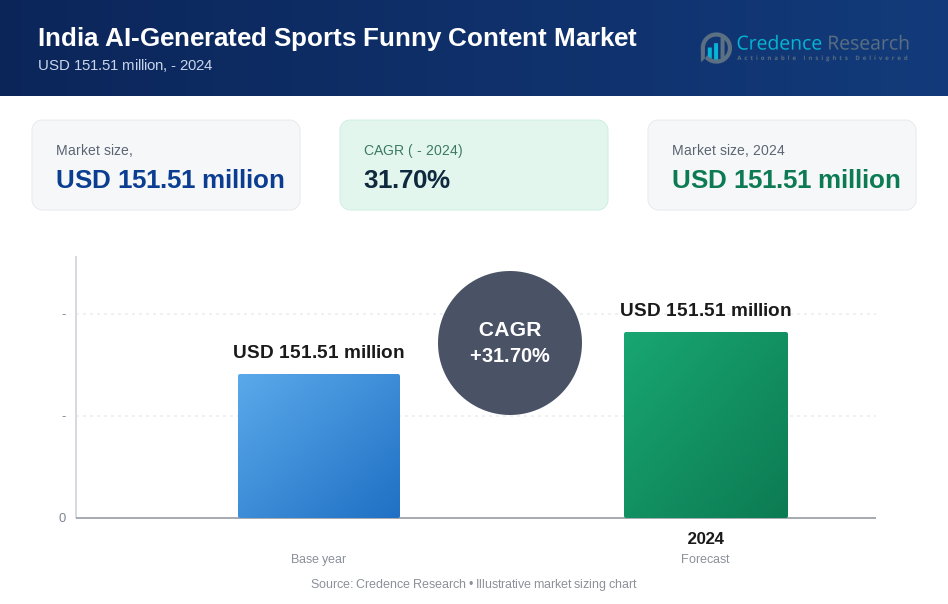
The India AI-generated Sports Funny Content Market is projected to grow from USD 151.51 million in 2024 to an estimated USD 1,808.12 million by 2032, reflecting a compound annual growth rate (CAGR) of 31.70% from 2025 to 2032. This substantial growth is driven by the increasing integration of artificial intelligence in content creation and the rising demand for engaging sports-related entertainment.
Key drivers of this market include advancements in AI technologies that enable personalized and interactive content, a growing sports fan base seeking innovative entertainment, and the expanding adoption of AI solutions across media and entertainment industries. Emerging trends such as the use of AI for real-time content generation during live sports events and the development of AI-driven platforms for personalized fan experiences are further fueling market expansion.
Geographically, the market is witnessing significant growth across urban centers in India, with key players like Sportz Interactive, Reely.ai, and Crayon Data leading the development of AI-generated sports content solutions. These companies are leveraging AI to enhance fan engagement and revolutionize sports entertainment in the country.
Market Insights
- The India AI-generated sports funny content market is projected to grow from USD 151.51 million in 2024 to USD 1,808.12 million by 2032, with a CAGR of 31.70% from 2025 to 2032.
- AI technologies, such as NLP and machine learning, are enabling more sophisticated, personalized, and interactive sports content creation, driving market growth.
- Increasing demand for personalized and humorous sports content is fueling the adoption of AI in the media and entertainment industries.
- AI-driven platforms are enhancing fan engagement by delivering personalized, real-time content tailored to individual preferences and specific sports interests.
- The rise of social media platforms boosts the distribution of AI-generated sports content, making it more accessible and shareable among fans.
- North India leads the market, followed by West, South, and East India, with urban centers seeing the highest adoption of AI technologies in sports content creation.
- The market faces challenges related to data privacy, ethical concerns, and the need for high-quality, contextually relevant content.
Market Drivers
Increased Engagement with Social Media and Digital Platforms
The proliferation of social media and digital platforms has been a significant enabler of AI-generated sports funny content. Social media platforms like Twitter, Instagram, TikTok, and YouTube provide a massive audience base where fans can share, comment on, and interact with sports-related content. AI-generated humorous content, including memes, GIFs, and short videos, has become a popular form of digital engagement across these platforms. Given the viral nature of humorous content, AI-generated funny sports content has the potential to quickly reach a vast audience, thereby enhancing the visibility and appeal of both the content and the sports teams or athletes featured. As fans increasingly share AI-generated sports content on their personal social media accounts, it creates a ripple effect, further promoting the content and encouraging its consumption. This has resulted in increased adoption of AI content creation tools by media companies and sports organizations seeking to enhance their online presence and connect with fans in more creative, humorous ways. The growing reliance on social media for entertainment and engagement will continue to drive the demand for AI-generated sports funny content in India.
Shift Toward Interactive and Real-Time Content Generation
The shift toward interactive and real-time content generation is another key driver of the AI-generated sports funny content market. Sports fans no longer just consume content; they expect to actively participate in the experience. This has created a demand for real-time, AI-generated content that responds to live events, enabling fans to interact with the ongoing sports narrative. For instance, AI can instantly analyze a sporting event as it unfolds and create funny content related to key moments, such as a dramatic goal, a surprising play, or a controversial decision. The immediacy of AI-generated content, coupled with its humorous spin on live sports events, enhances the fan experience and keeps them engaged throughout the game. Moreover, AI can enable fans to interact with the content by allowing them to personalize the humor or choose their favorite types of sports moments for AI to generate content around. This level of interactivity adds an immersive dimension to the fan experience and deepens the connection between the audience and the content. As sports teams, broadcasters, and content creators seek innovative ways to boost fan engagement, AI-generated funny content offers a solution that is both entertaining and instantly responsive to fan preferences, driving its growing adoption.
Advancements in AI Technologies for Content Creation
The integration of artificial intelligence in content creation is a key driver of the India AI-generated sports funny content market. With advancements in natural language processing (NLP), machine learning, and computer vision, AI can generate highly engaging and humorous content for sports fans. AI algorithms analyze vast amounts of sports data to create personalized, real-time content that resonates with specific audience segments. These technologies enable the creation of witty commentary, memes, and videos based on live events, creating an entertaining and unique experience for viewers. The ability of AI to tailor content to individual preferences enhances fan engagement and satisfaction, driving the demand for AI-generated funny sports content. For instance, AI can analyze fan feedback from surveys to understand what types of humor are most appealing, allowing it to craft content that aligns with these preferences. This capacity for analyzing historical data and predicting potential humorous scenarios in real-time fosters constant fan engagement and attention.
Rising Demand for Personalized Sports Entertainment
The growing demand for personalized sports entertainment is another significant factor driving the AI-generated sports funny content market. Fans today expect content that is tailored to their specific preferences and interests. Traditional sports coverage often lacks this level of personalization, leaving fans craving more individualized experiences. AI technology can effectively fill this gap by generating content that aligns with each fan’s unique viewing habits, preferences, and favorite teams or players. By delivering customized, funny sports content, AI platforms can keep fans engaged and encourage them to return for more. For instance, AI can create personalized jokes, highlight reels, or even memes featuring specific athletes or teams that resonate with the audience. This demand for personalized content is particularly evident among younger fans, who are more likely to engage with digital platforms and prefer content that speaks directly to them. As a result, AI-generated funny content is increasingly seen as a critical tool for building long-term fan loyalty and engagement.
Market Trends
Integration of Real-Time Content Generation During Live Sports Events
One of the most notable trends in the India AI-generated sports funny content market is the growing use of AI for real-time content generation during live sports events. As sports fans increasingly demand instant entertainment and engagement, the need for immediate and relevant content has surged. AI technologies, including natural language processing (NLP) and computer vision, are now being used to create humorous content in real-time, responding to live events as they unfold. For instance, AI can quickly analyze a match’s key moments, such as goals, fouls, or player reactions, and generate witty comments, memes, or GIFs that capture the essence of those moments. This trend allows content creators to take advantage of the immediacy and excitement of live sports while offering fans a humorous twist that amplifies their engagement. Real-time content generation helps maintain the momentum of the match while enhancing the fan experience through light-hearted commentary and humorous takes on critical events. As a result, this trend is reshaping how sports fans interact with live events, with AI playing a pivotal role in keeping viewers entertained throughout the game.
Personalized and Targeted AI-Generated Content for Individual Fans
Another significant trend in the India AI-generated sports funny content market is the rise of personalized content tailored to individual preferences. AI technologies allow content creators to segment their audience based on specific interests, behaviors, and past interactions, enabling the production of highly targeted, personalized sports content. This level of customization is particularly important in a country like India, where fans follow a wide range of sports and have varying levels of interest in specific teams or athletes. By leveraging data-driven insights, AI can generate funny content that resonates with a fan’s specific tastes, such as humor related to their favorite team, player, or sporting event. For instance, AI could create jokes, memes, or videos based on specific teams or even particular sports moments that hold significance for the individual fan. Personalized content not only strengthens the bond between sports fans and the content they consume but also increases the likelihood of content being shared across social media platforms, which enhances visibility and engagement. As AI continues to refine its ability to predict and respond to fan preferences, personalized, funny sports content is becoming a key tool for content creators seeking to increase engagement and build long-term relationships with audiences.
Integration of Real-Time Content Generation During Live Sports Events
The integration of AI for real-time content generation during live sports events is transforming fan engagement in India’s sports industry. As fans increasingly seek instant entertainment, AI technologies such as natural language processing (NLP) and computer vision are being deployed to analyze live game moments and produce humorous and engaging content on the fly. For instance, AI can identify pivotal events like goals, fouls, or player reactions and instantly generate memes, witty commentary, or GIFs that resonate with fans. This capability enhances the viewing experience by delivering content that mirrors the excitement of live sports while adding a humorous twist. Companies in India are leveraging AI to create dynamic content that keeps fans entertained throughout matches, highlighting the immediacy and relevance of AI-driven solutions. Platforms dedicated to sports broadcasting are increasingly adopting these tools to strengthen fan engagement and amplify the social media reach of such content. This trend is reshaping how fans interact with live sports, fostering a deeper connection between audiences and their favorite teams or players. As AI continues to evolve, its role in real-time content creation is expected to further redefine the landscape of sports entertainment in India.
Personalized and Targeted AI-Generated Content for Individual Fans
Personalization is emerging as a cornerstone of AI-driven sports content in India, enabling creators to tailor experiences to individual fan preferences. By analyzing behavioral data, past interactions, and regional interests, AI systems produce highly targeted humorous content that resonates with diverse audiences. For instance, Indian fans following cricket or football can enjoy jokes or memes specifically related to their favorite teams or players. This level of customization is particularly valuable in India’s multi-sport ecosystem, where fans have varied interests across disciplines like hockey, badminton, and kabaddi. AI-powered platforms also enable localized content creation in multiple languages, ensuring inclusivity across regions. The ability to deliver personalized experiences strengthens fan loyalty while increasing the likelihood of content being shared on social media platforms, thus boosting visibility. Moreover, generative AI tools are helping brands and broadcasters create tailored highlight reels or interactive features that align with individual fan tastes. This shift towards personalization not only enhances engagement but also positions AI as a critical driver for building long-term relationships with audiences. As Indian sports fandom becomes increasingly digitalized, personalized AI-generated content will play a pivotal role in ensuring fans feel valued and connected to their favorite sporting moments.
Market Challenges
Data Privacy and Ethical Concerns
The increasing reliance on AI for generating personalized sports funny content raises concerns around data privacy and ethical issues, particularly with the collection and use of fan data. AI systems often rely on large datasets to personalize content, track user preferences, and generate tailored experiences. However, this involves gathering sensitive data about individual fans, such as their behavior, interests, and interactions with sports content. In India, data privacy regulations are evolving, and there is growing scrutiny over how personal data is collected, stored, and utilized by businesses. AI-driven platforms that generate sports content must navigate these regulations and ensure they are compliant with data protection laws, avoiding potential legal repercussions or damage to their reputation. Moreover, there is the ethical question of AI-generated content being manipulated for commercial purposes or crossing boundaries in terms of humor, especially in sensitive contexts. Balancing the need for personalized, engaging content with respect for user privacy and ethical considerations is a significant challenge that needs to be addressed for the continued growth and acceptance of AI-generated sports funny content in India.
Quality and Accuracy of AI-Generated Content
Ensuring the quality and accuracy of AI-generated sports humor content in India remains a significant challenge. AI technologies, such as natural language processing and machine learning, have advanced considerably, but they still struggle to grasp cultural nuances and the intricacies of humor. For instance, generative AI tools have been used to create personalized sports commentary and fan engagement experiences, yet they often fail to deliver content that resonates deeply with diverse audiences. This is particularly evident in India, where sports preferences vary widely across regions, languages, and cultural contexts. AI-powered systems like those employed in cricket broadcasting or kabaddi analytics have shown promise in enhancing fan engagement but occasionally produce content that lacks wit or relevance. A humorous take on a cricket match moment may appeal to some fans but alienate others due to regional differences in humor. To address these challenges, companies are refining AI algorithms to better interpret context and deliver culturally appropriate humor. For instance, generative AI is being integrated into platforms like Star Sports for tailored commentary and immersive experiences aimed at diverse fan bases. However, achieving consistent quality requires ongoing improvements in data collection, algorithm training, and human oversight to ensure that AI-generated humor aligns with audience expectations.
Market Opportunities
Expansion of Digital and Social Media Engagement
As social media platforms continue to dominate entertainment consumption in India, there is a significant opportunity for AI-generated sports funny content to expand its reach. With an increasing number of sports fans engaging with content on platforms such as Instagram, Twitter, TikTok, and YouTube, the demand for quick, shareable, and humorous content is growing. AI technologies can take advantage of these platforms by producing personalized, real-time content that resonates with diverse fan bases. Given the viral nature of humor, AI-generated memes, GIFs, and short videos have the potential to rapidly capture the attention of sports fans, creating widespread engagement. As sports organizations and media companies seek to enhance fan interaction through digital channels, AI-driven content offers a scalable and cost-effective way to keep audiences entertained and engaged, thus opening up a substantial market opportunity for businesses in this space.
Integration with Sports Broadcasts and Fan Engagement Platforms
Another promising opportunity lies in the integration of AI-generated sports funny content with live sports broadcasts and fan engagement platforms. As sports consumption increasingly shifts to digital mediums, broadcasters and sports teams are seeking innovative ways to enhance the viewing experience. AI-generated content can be seamlessly incorporated into live broadcasts, offering real-time humorous takes on game highlights, player interactions, and key moments. This not only adds entertainment value but also boosts fan engagement by providing content that is timely, interactive, and shareable. Furthermore, fan engagement platforms can leverage AI to create personalized humorous content based on individual fan preferences, driving further loyalty and interaction. The combination of live sports events and AI-driven humor presents a unique opportunity to enhance the overall fan experience, making it a key area for growth in the India market.
Market Segmentation Analysis
By Type
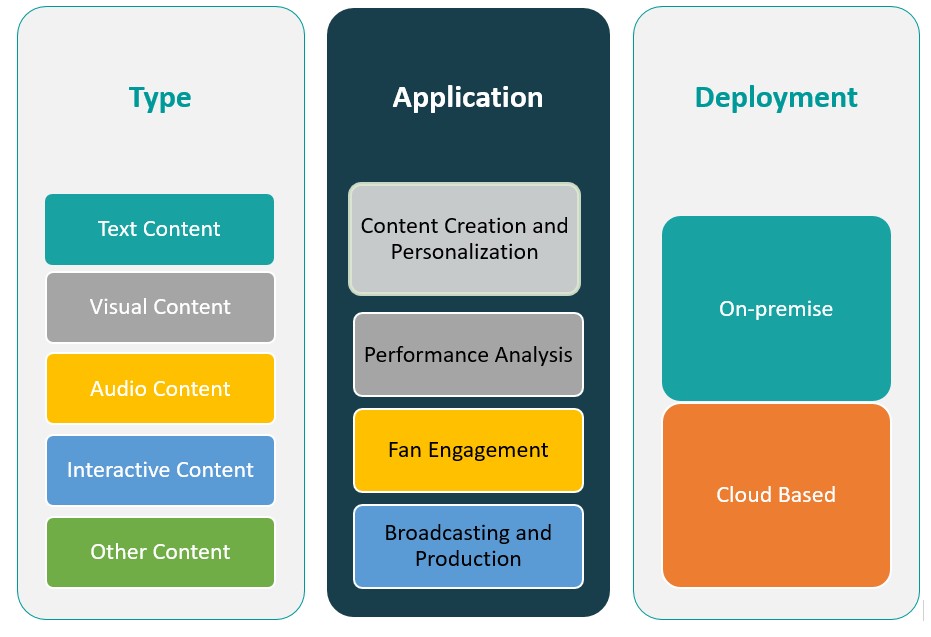
Text-based content such as jokes, memes, and witty commentary remains a dominant segment. This content is generated by AI through natural language processing (NLP) algorithms, which can analyze sports events and craft humorous responses or observations in real time. Text content is highly shareable on social media platforms and is a primary driver of engagement among sports fans. Visual content, including AI-generated memes, GIFs, and highlight reels, is also a significant portion of the market. AI tools can quickly generate visually appealing and humorous content, which resonates well on platforms like Instagram and Twitter. This content enhances the fan experience by offering immediate entertainment during live events or following key sports moments. Audio content such as witty commentary, podcasts, and humorous voiceovers adds another layer to the fan experience. AI-generated voiceovers, for instance, can offer fans a comedic take on game highlights or player interactions, further enriching the content landscape. Interactive content, such as AI-driven quizzes, games, and fan polls that generate humorous responses based on user interaction, is increasingly popular. This content type allows fans to engage directly with AI-generated humor, making the fan experience more immersive. Other Content includes innovative formats like AI-generated videos, GIFs, and more, creating opportunities for content creators to experiment with new ways to entertain fans.
By Application
AI's ability to personalize content based on individual preferences is crucial. Fans increasingly demand content that aligns with their interests and the teams they follow, making AI-driven content creation tools highly valuable for delivering tailored experiences.AI-generated content can be tied to performance analysis, offering fans humorous commentary on player performances, in-game statistics, or tactical breakdowns with a comedic twist, enhancing the fan's understanding while keeping them entertained.AI-driven funny content is an essential tool for boosting fan engagement, particularly through social media platforms and fan apps. Personalized, humorous content helps maintain continuous interaction with the fan base, deepening their connection to the sport. Sports broadcasters and production houses are increasingly adopting AI to generate funny content during live events. This includes real-time humor, player reactions, and event-specific memes that can be incorporated into broadcast streams, increasing viewer retention and enhancing the overall viewing experience.
Segments
Based on Type
- Text Content
- Visual Content
- Audio Content
- Interactive Content
- Other Content
Based on Application
- Content Creation and Personalization
- Performance Analysis
- Fan Engagement
- Broadcasting and Production
Based on Deployment
- On-premise
- Cloud Based
Based on Region
- North India
- West India
- South India
- East India
Regional Analysis
North India (32%)
North India, comprising states such as Delhi, Haryana, Punjab, and Uttar Pradesh, holds the largest market share within the India AI-generated sports funny content market, accounting for 32%. The region's dominance is driven by the high concentration of sports fans, particularly in cricket, and the widespread adoption of digital platforms. Cities like Delhi and Chandigarh are major hubs for technology, media, and sports content creation. The growing interest in sports like football, hockey, and cricket, along with the increasing use of AI-driven content in entertainment, fuels market expansion in this region. Additionally, North India's high engagement with social media platforms accelerates the distribution and virality of AI-generated content.
West India (28%)
West India, including states like Maharashtra, Gujarat, and Rajasthan, captures 28% of the market share. This region is home to major sports hubs like Mumbai and Pune, where sports content creation and broadcasting industries are well-established. Maharashtra’s large urban population is highly engaged with sports, particularly cricket, and increasingly with football. The adoption of AI technologies in media and entertainment is rapidly growing, with AI-driven sports content being widely distributed via social media, especially in cosmopolitan areas like Mumbai. The demand for personalized and humorous sports content continues to drive growth in this region.
Key players
- Sportskeeda
- Krutrim AI
- Sarvam AI
- KissanAI
- FanCric
- JioStar
- CognitiveLabIndic
- TWO AI
- ai
- Xylem AI
Competitive Analysis
The India AI-generated sports funny content market is highly competitive, with several key players leveraging advanced AI technologies to cater to the growing demand for personalized and engaging sports content. Sportskeeda, a prominent player in the sports media sector, utilizes AI to enhance fan engagement by providing humorous content that resonates with a broad audience. Krutrim AI and Sarvam AI focus on AI-driven content personalization, allowing them to deliver tailor-made sports humor for fans across various platforms. KissanAI and FanCric also capitalize on the growing popularity of cricket and other regional sports, ensuring that their content aligns with fan preferences. Newer entrants like Stition.ai and Xylem AI are innovating in real-time content generation, contributing to the dynamic and rapidly evolving market. As these companies continue to refine their AI capabilities and business strategies, they will likely shape the future of AI-generated sports funny content in India.
Recent Developments
- In March 2025, Sportskeeda released a series of memes following Chennai Super Kings' loss to Royal Challengers Bengaluru during IPL 2025. The memes gained traction on social media, reflecting fans' humorous takes on the match.
- In December 2023, Krutrim AI introduced its large language model capable of generating content in multiple Indian languages, laying the foundation for AI-driven sports humor tailored to regional audiences.
- In March 2025, Sarvam AI continued its efforts to expand generative AI capabilities for Indian languages, enhancing accessibility and inclusivity in sports-related content creation.
Market Concentration and Characteristics
The India AI-generated sports funny content market is characterized by moderate concentration, with a mix of established media companies and emerging AI-focused startups driving innovation. Key players like Sportskeeda dominate the market through extensive reach and a strong content portfolio, while newer entrants such as Krutrim AI and Sarvam AI focus on niche solutions for personalized fan engagement. The market is highly dynamic, with companies leveraging artificial intelligence to create personalized, real-time humorous content that resonates with diverse fan bases. The competitive landscape is evolving rapidly as players innovate with AI technologies, integrating humor with live sports events, digital media, and social media platforms. While large players lead in terms of market share and resources, startups bring agility and fresh approaches to AI content creation, contributing to a fragmented yet fast-growing market. This balance of established dominance and emerging innovation shapes the market's characteristics and its potential for growth.
Report Coverage
The research report offers an in-depth analysis based on Type, Application, Deployment and Region. It details leading market players, providing an overview of their business, product offerings, investments, revenue streams, and key applications. Additionally, the report includes insights into the competitive environment, SWOT analysis, current market trends, as well as the primary drivers and constraints. Furthermore, it discusses various factors that have driven market expansion in recent years. The report also explores market dynamics, regulatory scenarios, and technological advancements that are shaping the industry. It assesses the impact of external factors and global economic changes on market growth. Lastly, it provides strategic recommendations for new entrants and established companies to navigate the complexities of the market.
Future Outlook
- The demand for AI-generated sports funny content is expected to grow exponentially as more fans seek personalized and engaging experiences. As sports consumption increasingly shifts to digital platforms, this trend will continue to accelerate.
- Advancements in AI technologies, particularly natural language processing and machine learning, will enable even more sophisticated and humorous content generation. AI will become better at creating contextually relevant and highly engaging content in real time.
- AI-generated content will become an integral part of live sports events, offering humorous commentary, memes, and highlights that enhance the viewing experience. This integration will drive further fan engagement during broadcasts and on digital platforms.
- The future will see more tailored content as AI systems become increasingly capable of understanding individual fan preferences. Personalized jokes, memes, and video highlights will cater to specific teams, players, and even unique fan interests.
- More sports organizations will adopt AI for content creation to improve fan engagement. Teams and leagues will partner with AI-driven platforms to provide real-time, entertaining content across digital media.
- AI-generated sports funny content will be widely distributed across multiple digital platforms, including social media, apps, and websites. This cross-platform approach will maximize content visibility and fan interaction.
- AI-generated humorous content will open new monetization opportunities, including advertising, sponsorships, and branded content. Sports broadcasters and digital platforms will increasingly leverage AI for revenue generation through creative and engaging content.
- Partnerships between AI platforms and sports influencers or content creators will become more common. These collaborations will help drive content distribution, expand audience reach, and build a stronger fan community around AI-generated content.
- As the market grows, the need for ethical AI content generation will become a key concern. Companies will focus on creating content that is both humorous and sensitive to cultural and social nuances, avoiding potential controversies.
- The market will see growing competition as new players enter the AI-generated sports funny content space. This will drive innovation in content creation, improving the overall quality and diversity of offerings, which will benefit fans and content creators alike.
Request a Free Sample
Fill in your details and we'll send you a free sample report.
- Sample data tables & charts
- Research methodology
Market Dynamics
Increased Engagement with Social Media and Digital Platforms
The widespread use of social media platforms like Instagram, Twitter, TikTok, and YouTube in India enables rapid sharing and virality of AI-generated sports funny content, driving both reach and engagement among sports fans.
Advancements in AI Technologies for Content Creation
Progress in natural language processing, machine learning, and computer vision allows for the creation of highly personalized, real-time, and contextually relevant humorous sports content, enhancing fan experience and market growth.
Shift Toward Interactive and Real-Time Content Generation
Fans increasingly expect to interact with content in real time during live sports events. AI enables the instant creation of funny memes, commentary, and GIFs based on live action, deepening engagement and making content more immersive.
Rising Demand for Personalized Sports Entertainment
Indian sports fans, especially younger audiences, seek content tailored to their favorite teams, players, and sports. AI-driven platforms deliver customized jokes, memes, and highlights, fostering loyalty and repeat engagement.
Expansion of Digital and Social Media Engagement
The dominance of digital and social media consumption in India provides a fertile ground for AI-generated sports funny content to reach diverse audiences quickly, leveraging the viral nature of humor to maximize fan interaction and content distribution.
Need a Custom Version of This Report?
Tailor the scope, geography, or segments to your exact requirements.
- Custom geography or segment scope
- Direct access to our analyst team
Frequently Asked Questions
What is the projected market size of the India AI-generated sports funny content market in 2023 and 2032?
What are the key drivers of growth in the AI-generated sports funny content market?
Which companies are leading the AI-generated sports funny content market in India?
How is AI used in the creation of sports funny content?
What role does social media play in the AI-generated sports funny content market?
Table of Content
Chapter 1 Market Segmentation
- 1.1 Segmentation Framework
- 1.1.1 Product and Service Classification
- 1.1.2 Application and End-Use Classification
- 1.1.3 Technology and Solution Classification
- 1.1.4 Customer and Distribution Channel Classification
- 1.1.5 Geographic Segmentation
- 1.1.6 Market Segment Definitions and Boundaries
- 1.2 By Type
- 1.2.1 Text Content
- 1.2.2 Visual Content
- 1.2.3 Audio Content
- 1.2.4 Interactive Content
- 1.2.5 Other Content
- 1.3 By Deployment
- 1.3.1 On-premise
- 1.3.2 Cloud Based
- 1.4 By Application
- 1.4.1 Content Creation and Personalization
- 1.4.2 Performance Analysis
- 1.4.3 Fan Engagement
- 1.4.4 Broadcasting and Production
Chapter 2 Introduction
- 2.1 Report Objectives and Scope
- 2.2 Product Definition and Industry Terminology
- 2.3 Market Inclusions and Exclusions
- 2.4 Research Process
- 2.4.1 Primary Research and Expert Interviews
- 2.4.2 Secondary Research and Source Review
- 2.4.3 Top-Down and Bottom-Up Estimation
- 2.4.4 Data Triangulation and Verification
- 2.5 Market Size Measurement Basis
- 2.5.1 2024: USD 151.51 million → 2024: USD 151.51 million
- 2.6 Historical and Forecast Reference Periods
- 2.6.1 Base Year: 2024
- 2.6.2 Forecast Period: 2024-2024
- 2.7 Research Assumptions and Limitations
Chapter 3 Executive Summary
- 3.1 Market Snapshot and Key Findings
- 3.2 Base-Year Market Size, 2024
- 3.3 Forecast Market Size, 2024
- 3.4 Revenue and Volume Growth Outlook
- 3.5 Key Demand and Supply Indicators
- 3.6 Leading Market Segments
- 3.7 Fastest-Growing Market Opportunities
- 3.8 Regional Performance Highlights
- 3.9 Technology and Industry Transformation
- 3.10 Competitive Landscape Summary
- 3.11 Analyst View and Strategic Implications
Chapter 4 India AI-Generated Sports Funny Content Market Trends and Developments
- 4.1 Historical Industry Development
- 4.2 Recent Market Trends and Developments
- 4.3 Demand and Customer Behavior Trends
- 4.4 Technology and Product Innovation
- 4.5 Artificial Intelligence, Automation and Digitalization
- 4.6 Local Manufacturing and Supply Chain Realignment
- 4.7 Industry Partnerships, Mergers and Acquisitions
- 4.8 Sustainability and Circular Economy Developments
- 4.9 Government and Private Sector Investment Trends
- 4.10 Emerging Business Models and Commercialization
- 4.11 Industry Developments and Announcements
Chapter 5 India AI-Generated Sports Funny Content Market Production, Supply and Demand Analysis
- 5.1 Demand Trend and Consumption Analysis
- 5.2 Demand Forecast, 2024-2024
- 5.3 Production and Output Trend
- 5.4 Production and Output Forecast, 2024-2024
- 5.5 Installed Capacity and Capacity Utilization
- 5.6 Company-Wise Production Plants and Statistics
- 5.6.1 Installed Production Capacity
- 5.6.2 Actual Production
- 5.6.3 Planned Capacity and Expansion Targets
- 5.7 Supply Chain Structure and Procurement Trends
- 5.8 Supply-Demand Gap and Bottlenecks
- 5.9 Import Dependence and Sourcing Structure
- 5.10 Contract Manufacturing and Outsourcing
- 5.11 Regional Supply and Demand Concentration
Chapter 6 India AI-Generated Sports Funny Content Market Pricing Analysis
- 6.1 Pricing Structure and Measurement
- 6.2 Historical Pricing Trends
- 6.3 Pricing Outlook, 2024-2024
- 6.4 Average Selling Price and Unit Economics
- 6.5 Pricing by Product and Market Segment
- 6.6 Geographic Pricing Differences
- 6.7 Key Input, Energy, Labor and Logistics Costs
- 6.8 Contract Pricing and Purchasing Models
- 6.9 Pricing Sensitivity and Competitive Positioning
- 6.10 Price, Margin and Profitability Implications
Chapter 7 India AI-Generated Sports Funny Content Market Dynamics
- 7.1 Market Growth Drivers
- 7.1.1 Demand-Side Drivers
- 7.1.2 Technology and Innovation Drivers
- 7.1.3 Infrastructure and Investment Drivers
- 7.1.4 Regulatory and Policy Drivers
- 7.2 Market Restraints
- 7.2.1 Cost and Affordability Constraints
- 7.2.2 Technology and Adoption Barriers
- 7.2.3 Supply Chain and Operational Constraints
- 7.3 Market Challenges
- 7.3.1 Competitive Pressure and Margin Erosion
- 7.3.2 Skills, Infrastructure and Implementation Gaps
- 7.4 Emerging Market Opportunities
- 7.5 Market Dynamics Impact and Time-Horizon Assessment
Chapter 8 India AI-Generated Sports Funny Content Value Chain Analysis
- 8.1 Industry Value Chain Overview
- 8.2 Upstream Suppliers and Critical Inputs
- 8.3 Technology and Component Providers
- 8.4 Manufacturing or Service Delivery
- 8.5 Distribution, Channel Partners and Integrators
- 8.6 Downstream Applications and End Users
- 8.7 Value Addition and Profit Pools
- 8.8 Vertical Integration and Outsourcing
- 8.9 Supplier Concentration and Risk
- 8.10 Supply Chain Localization and Resilience
Chapter 9 India AI-Generated Sports Funny Content Market Regulations and Policies
- 9.1 Relevant Laws, Standards and Compliance Frameworks
- 9.2 Product, Service, Safety and Quality Requirements
- 9.3 Government Policies, Incentives and Subsidies
- 9.4 Imports, Exports and Trade Barriers
- 9.5 Public Procurement and Local Content Requirements
- 9.6 Environmental and Sustainability Compliance
- 9.7 Data Protection, AI and Cybersecurity Compliance
- 9.8 Upcoming Policy Changes and Market Implications
Chapter 10 India AI-Generated Sports Funny Content Market Hotspots and Opportunities
- 10.1 Market Opportunity Mapping and Growth Hotspots
- 10.2 High-Growth Applications and Customer Groups
- 10.3 Underserved Markets and White-Space Opportunities
- 10.4 Emerging Technology and Product Opportunities
- 10.5 New Capacity and Investment Hotspots
- 10.6 Market Entry and Expansion Opportunities
- 10.7 Distribution and Partnership Opportunities
- 10.8 Near-Term and Long-Term Commercial Potential
- 10.9 Opportunity Attractiveness and Execution Risks
Chapter 11 India AI-Generated Sports Funny Content Market Outlook, 2024-2024
- 11.1 Market Size and Analysis
- 11.1.1 Revenue (Market Measurement: 2024: USD 151.51 million → 2024: USD 151.51 million)
- 11.1.2 Market Volume and Quantity Sold
- 11.1.3 Historical Market Size
- 11.1.4 Base-Year Market Size, 2024
- 11.2 Market Forecast, 2024-2024
- 11.2.1 Revenue Forecast to 2024
- 11.2.2 Volume Forecast to 2024
- 11.2.3 CAGR and Year-on-Year Growth
- 11.2.4 Incremental Revenue Opportunity
- 11.3 Forecast Assumptions and Scenario Analysis
- 11.3.1 Base-Case Forecast
- 11.3.2 Optimistic and Conservative Scenarios
- 11.3.3 Technology, Pricing and Policy Sensitivities
- 11.4 Market Attractiveness and Growth Outlook
Chapter 12 India AI-Generated Sports Funny Content Market Segmentation and Outlook
- 12.1 Segmentation Summary and Market Shares, 2024
- 12.2 Largest and Fastest-Growing Segments
- 12.3 By Type - Market Size and Forecast, 2024-2024
- 12.3.1 Segment Definition and Scope
- 12.3.2 Historical Market Size
- 12.3.3 Revenue Forecast, 2024-2024
- 12.3.4 Volume Forecast, 2024-2024
- 12.3.5 Base-Year Market Share, 2024
- 12.3.6 Segment CAGR and Growth Drivers
- 12.3.7 Subsegment Market Size and Forecast
- 12.3.7.1 Text Content
- 12.3.7.2 Visual Content
- 12.3.7.3 Audio Content
- 12.3.7.4 Interactive Content
- 12.3.7.5 Other Content
- 12.3.8 Subsegment Pricing and Adoption Trends
- 12.3.9 Leading Suppliers and Competition
- 12.3.10 Regional Demand and Opportunities
- 12.4 By Deployment - Market Size and Forecast, 2024-2024
- 12.4.1 Segment Definition and Scope
- 12.4.2 Historical Market Size
- 12.4.3 Revenue Forecast, 2024-2024
- 12.4.4 Volume Forecast, 2024-2024
- 12.4.5 Base-Year Market Share, 2024
- 12.4.6 Segment CAGR and Growth Drivers
- 12.4.7 Subsegment Market Size and Forecast
- 12.4.7.1 On-premise
- 12.4.7.2 Cloud Based
- 12.4.8 Subsegment Pricing and Adoption Trends
- 12.4.9 Leading Suppliers and Competition
- 12.4.10 Regional Demand and Opportunities
- 12.5 By Application - Market Size and Forecast, 2024-2024
- 12.5.1 Segment Definition and Scope
- 12.5.2 Historical Market Size
- 12.5.3 Revenue Forecast, 2024-2024
- 12.5.4 Volume Forecast, 2024-2024
- 12.5.5 Base-Year Market Share, 2024
- 12.5.6 Segment CAGR and Growth Drivers
- 12.5.7 Subsegment Market Size and Forecast
- 12.5.7.1 Content Creation and Personalization
- 12.5.7.2 Performance Analysis
- 12.5.7.3 Fan Engagement
- 12.5.7.4 Broadcasting and Production
- 12.5.8 Subsegment Pricing and Adoption Trends
- 12.5.9 Leading Suppliers and Competition
- 12.5.10 Regional Demand and Opportunities
- 12.6 Segment Growth Comparison
- 12.7 Segment Attractiveness and Priority Matrix
Chapter 13 India AI-Generated Sports Funny Content End-Use and Application Market Outlook
- 13.1 End-Use Industry and Customer Demand Structure
- 13.2 Leading Applications and Customer Groups
- 13.3 End-Use Market Size, Share and Forecast
- 13.4 Major End-Use Industry Deep Dives
- 13.4.1 Customer Requirements and Use Cases
- 13.4.2 Demand and Replacement Cycles
- 13.4.3 Technical and Regulatory Considerations
- 13.4.4 Purchasing and Procurement Models
- 13.4.5 Leading Vendors and Distribution Channels
- 13.4.6 Forecast and Commercial Opportunities
- 13.5 Emerging Applications and Cross-Segment Demand
- 13.6 End-Use Industry Investment Priorities
Chapter 14 India AI-Generated Sports Funny Content Geographic Market Outlook, 2024-2024
- 14.1 Domestic Market Distribution and Demand Clusters
- 14.2 State- or Province-Wise Market Size and Forecast, 2024-2024
- 14.3 City and Metropolitan Market Outlook
- 14.4 Industrial, Manufacturing and Commercial Clusters
- 14.5 Geographic Concentration of Key End Users
- 14.6 Local Pricing and Purchasing Differences
- 14.7 Domestic Production Facilities and Capacity Map
- 14.8 Local Infrastructure and Project Pipeline
- 14.9 State-Level Policy and Incentive Differences
- 14.10 Subnational Investment Hotspots and Opportunities
- 14.11 Distribution and Logistics Networks
- 14.12 Domestic Competitive Footprint
Chapter 15 India AI-Generated Sports Funny Content Technology, Innovation and Sustainability Outlook
- 15.1 Technology Landscape and Maturity
- 15.2 Product, Process and Service Innovation
- 15.3 AI, Automation and Digital Tools in the Industry
- 15.4 Technology Adoption and Performance Benchmarking
- 15.5 Innovation Pipeline and R&D Investment
- 15.6 Patent and Intellectual Property Trends
- 15.7 Energy Efficiency and Resource Management
- 15.8 Sustainability, Recycling and Circularity
- 15.9 Technology Roadmap, 2024-2024
- 15.10 Risks of Obsolescence and Technology Substitution
Chapter 16 India AI-Generated Sports Funny Content Market Key Strategic Imperatives
- 16.1 Growth and Market Entry Priorities
- 16.2 High-Return Products and Segments
- 16.3 Pricing, Profitability and Cost Optimization
- 16.4 Technology Investment and Product Differentiation
- 16.5 Supply Chain Localization and Resilience
- 16.6 Distribution and Customer Acquisition
- 16.7 Partnership, Acquisition and Capacity Strategy
- 16.8 Regional Expansion Priorities
- 16.9 Short-, Medium- and Long-Term Actions
Chapter 17 Competition Outlook
- 17.1 Industry Competition Characteristics
- 17.2 Market Structure and Concentration
- 17.3 Market Share and Competitive Positioning, 2024
- 17.4 Company-Wise Revenue and Product Benchmarking
- 17.5 Production and Service Capacity Benchmarking
- 17.6 Technology, Pricing and Differentiation
- 17.7 Regional Footprint and Distribution Strength
- 17.8 Mergers, Acquisitions and Strategic Alliances
- 17.9 New Entrants and Competitive Threats
- 17.10 Porter's Five Forces and Industry Attractiveness
- 17.11 Competitive Outlook, 2024-2024
Chapter 18 Company Profiles
- 18.1 Company Coverage and Selection Criteria
- 18.2 Sportskeeda
- 18.2.1 Business Description
- 18.2.2 Company Ownership and Geographic Presence
- 18.2.3 Product and Service Portfolio
- 18.2.4 Manufacturing and Operating Footprint
- 18.2.5 Production Capacity and Expansion Plans
- 18.2.6 Financial Performance and Investment
- 18.2.7 Market Share and Competitive Position
- 18.2.8 Technology and Innovation Capabilities
- 18.2.9 Strategic Alliances or Partnerships
- 18.2.10 Recent Developments
- 18.2.11 Growth Strategy and Outlook
- 18.3 Krutrim AI
- 18.4 Sarvam AI
- 18.5 KissanAI
- 18.6 FanCric
- 18.7 JioStar
- 18.8 CognitiveLabIndic
- 18.9 TWO AI
- 18.10 Stition.ai
- 18.11 Xylem AI
- 18.12 Other Relevant Market Participants
Note: Every listed company is profiled on the structure shown under the first company. The company list is preliminary and may change based on research findings, market developments, data availability and client requirements.
Chapter 19 Disclaimer
- 19.1 Research and Forecast Disclaimer
- 19.2 Data Source and Estimation Limitations
Note: The depth of individual sections depends on data availability for this market. Volume, capacity, trade and other unit-based metrics are included where applicable.

