
| REPORT ATTRIBUTE | DETAILS |
|---|---|
| Historical Period | 2020-2023 |
| Base Year | 2024 |
| Forecast Period | 2025-2032 |
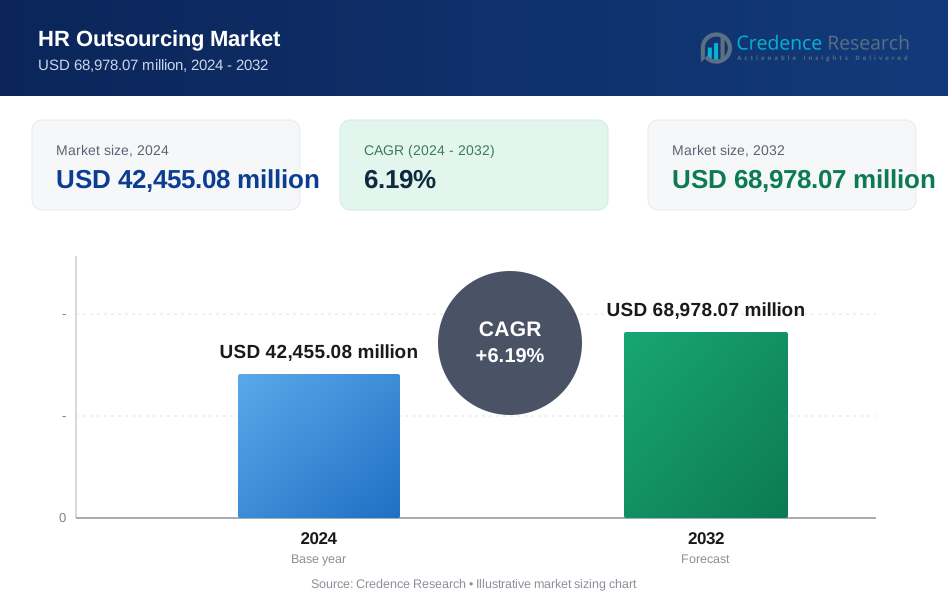
| HR Outsourcing Market Size 2024 | USD 42,455.08 Million |
| HR Outsourcing Market, CAGR | 6.19% |
| HR Outsourcing Market Size 2032 | USD 68,978.07 Million |
Market Overview:
HR Outsourcing Market size was valued at USD 42,455.08 Million in 2024 and is anticipated to reach USD 68,978.07 Million by 2032, at a CAGR of 6.19% during the forecast period.
The HR outsourcing market features a competitive landscape dominated by key players such as HP Company, Genesys, Aon Hewitt LLC, Infosys, Accenture, IBM, Ultimate Software Group, Inc., Mercer, LLC, Adecco Group, Conduent Incorporated, and ADP, along with several other regional and niche service providers. These companies offer a wide range of solutions, including payroll management, recruitment process outsourcing, benefits administration, and workforce analytics, to meet evolving enterprise demands. North America emerged as the leading region in the HR outsourcing market, accounting for 42.6% of the global share in 2024, driven by high technology adoption, a mature outsourcing ecosystem, and the presence of established multinational corporations.
Market Insights
- Payroll outsourcing leads the market by type, holding 31.4% of the global share in 2024, driven by organizations’ need to manage complex payroll functions efficiently and ensure compliance.
- The IT & ITES sector dominates end-use industries with a 27.9% market share in 2024, benefiting from large workforce volumes and continuous hiring demands that require scalable HR outsourcing solutions.
- North America commands the largest regional share at 42.6% in 2024, supported by advanced technology adoption, a mature outsourcing ecosystem, and numerous multinational corporations.
- Europe holds 28.3% of the market share, driven by rapid digital transformation and strict labor regulations, while Asia-Pacific accounts for 19.8%, fueled by rising industrialization, SME growth, and increasing cloud-based HR platform adoption.
Market Segment Insights
Global HR Outsourcing Market – By Type
In the HR outsourcing market by type, payroll outsourcing emerged as the dominant sub-segment, capturing 31.4% of the global market share in 2024. Organizations continue to rely on third-party providers to manage complex payroll operations, reduce administrative burden, and ensure regulatory compliance across multiple jurisdictions. The increasing need for automation, integration with cloud platforms, and cost optimization strategies further drive adoption in this segment. Recruitment process outsourcing and benefits administration outsourcing also show strong growth, fueled by talent acquisition demands and evolving employee expectations around benefits management.
- Payroll outsourcing is one of the most commonly outsourced HR functions, with 73% of organizations globally outsourcing payroll and reporting high satisfaction with third-party providers. This widespread reliance underscores the segment’s centrality within HR outsourcing strategies.
Global HR Outsourcing Market – By End Use
Among end-use industries, the IT & ITES sector led the HR outsourcing market with a 27.9% share in 2024. The segment benefits from its high workforce volume, global delivery models, and continuous hiring cycles that necessitate scalable HR support. Companies in this space increasingly seek outsourced solutions to streamline talent acquisition, training, and compliance management. The BFSI and healthcare sectors follow closely, driven by regulatory complexities and the need to maintain operational efficiency while ensuring talent retention in highly competitive labor markets.
- The IT and telecom industries specifically emphasize the need for rapid talent acquisition to meet dynamic project requirements and growth . With nearly 6 in 10 (56%) of organizations generally finding attracting and retaining talent challenging, the IT sector, known for its demand for specialized skills, particularly benefits from the specialized recruitment capabilities of outsourcing providers . The use of AI in recruiting (43% of HR AI use) by outsourcing firms can further accelerate this process .
Market Overview
Key Growth Drivers
Rising Demand for Cost Efficiency and Operational Streamlining
Organizations increasingly adopt HR outsourcing to reduce operational costs and streamline administrative functions. By delegating non-core HR activities such as payroll processing and benefits administration to specialized providers, companies minimize overhead and improve efficiency. This trend is particularly pronounced among small and medium enterprises (SMEs) seeking scalable, flexible HR solutions without investing heavily in in-house infrastructure. The ability to access advanced technology platforms and expertise through outsourcing also enhances accuracy and compliance, further driving market expansion.
- For example, small businesses can avoid substantial overhead costs, such as the reported average of $4,000 to hire a single employee and an additional $1,252 for training, by outsourcing HR functions to a Professional Employer Organization (PEO).
Technological Advancements and Digital Transformation
The integration of cloud computing, AI, and automation within HR outsourcing services significantly fuels market growth. Advanced technologies enable real-time data analytics, improved employee engagement platforms, and streamlined recruitment processes, increasing service quality and speed. Outsourcing providers leverage these innovations to deliver customized and agile solutions that align with dynamic business needs. As organizations prioritize digital transformation, demand rises for outsourced HR services that can support seamless technology adoption and ongoing process optimization.
- For instance, Atos, an IT and consulting firm, rolled out a cloud-based solution in 70 countries that integrated its Employee File Management with the recruiting module of its HRIS, enabling managers to generate an offer letter with the push of a button and automating a previously paper-intensive process.
- The Los Angeles County Sheriff’s Department (LASD) implemented an automation solution to digitize its recruitment files, which could previously exceed 1000 paper pages, resulting in a considerable reduction in their 18-month time to hire and improved data security.
- For instance, Anchor Trust, a UK housing association, employed a recruitment chatbot that increased its candidate conversion rate from just over 2 applicants per 100 to more than 27 applicants per 100, and cut the average cost per applicant from 51 GBP to 18 GBP.
Focus on Core Business Functions and Talent Management
Companies increasingly outsource HR functions to concentrate on strategic priorities and core business activities. Delegating routine HR tasks allows internal teams to focus on talent acquisition, development, and retention, which are critical for competitive advantage. The growing complexity of workforce management, coupled with evolving regulatory requirements, compels organizations to rely on external experts to ensure compliance and risk mitigation. This strategic focus on high-value human capital management drives sustained demand for comprehensive HR outsourcing solutions.
Key Trends & Opportunities
Expansion of Multi-process Human Resource Outsourcing
Multi-process HR outsourcing is gaining traction as organizations seek integrated solutions covering payroll, recruitment, benefits, and learning services within a single contract. This comprehensive approach offers cost savings, process standardization, and better data visibility, presenting significant growth opportunities for providers capable of delivering end-to-end services. The trend toward bundled HR solutions reflects client demand for simplicity and efficiency in vendor management, encouraging market consolidation and service innovation.
- For instance, by bundling services like payroll, benefits administration, and recruitment under a single outsourcing provider, companies have reported reductions in HR operational costs; one mid-sized company saved over $200,000 annually by outsourcing its payroll and benefits administration.
Increasing Adoption of Cloud-based HR Platforms
Cloud-based HR platforms underpin a major market opportunity by enabling remote access, scalability, and enhanced collaboration between clients and providers. These platforms facilitate seamless integration with existing enterprise systems, support real-time analytics, and improve user experience for both HR professionals and employees. The growing preference for flexible, on-demand HR solutions positions cloud technology as a key enabler for market growth, especially among mid-sized and large enterprises.
- For instance, Spotify effectively utilized a cloud-based Human Capital Management (HCM) system to support its rapid global expansion, successfully scaling its HR operations to manage its workforce across more than 70 countries.
Emergence of AI-driven Recruitment and Talent Analytics
Artificial intelligence applications in recruitment and talent management are transforming traditional HR outsourcing services. AI-powered tools automate candidate screening, enhance predictive analytics for workforce planning, and improve employee engagement through personalized insights. Providers incorporating AI capabilities differentiate themselves by delivering higher quality outcomes and reducing time-to-hire. This trend creates new avenues for growth as organizations increasingly rely on data-driven HR strategies.
- For example, AI recruiting tools can significantly reduce the time spent on screening and shortlisting resumes, with one study indicating recruiters spend an average of 23 hours on these tasks for a single hire; AI automates this, freeing up recruiters for strategic objectives.
Key Challenges
Data Security and Privacy Concerns
The HR outsourcing market faces significant challenges related to safeguarding sensitive employee information. As data breaches and cyber threats rise, organizations remain cautious about sharing confidential personnel data with third-party providers. Compliance with diverse data protection regulations, such as GDPR and CCPA, adds complexity to outsourcing arrangements. Ensuring robust cybersecurity measures and transparent data governance remains critical to building trust and driving broader adoption.
Integration Complexities and Customization Demands
Integrating outsourced HR services with existing enterprise systems often presents technical and operational hurdles. Companies require customized solutions tailored to their unique workflows, which can increase implementation timelines and costs. Resistance from internal HR teams due to perceived loss of control may also impede smooth transitions. Addressing these challenges demands close collaboration between clients and providers to deliver flexible, interoperable solutions that align with organizational needs.
Regional Analysis
North America
North America leads the HR outsourcing market, holding 42.6% of the global share in 2024. The region benefits from a mature outsourcing ecosystem, widespread adoption of advanced HR technologies, and the presence of numerous multinational corporations requiring scalable and compliant HR solutions. Strong regulatory frameworks and increasing demand for workforce analytics and digital HR platforms further propel market growth. Additionally, North American organizations prioritize cost reduction and operational efficiency, which drives sustained investment in outsourced payroll, recruitment, and benefits administration services.
- For example, in the United States alone, there were approximately 33,185,550 small businesses in 2023, many of which require scalable and compliant HR solutions for critical functions like talent management, payroll, and workforce management, thereby fueling the substantial demand for outsourcing services.
Europe
Europe accounts for 28.3% of the HR outsourcing market, driven by rapid digital transformation and stringent labor regulations across the region. Countries such as the United Kingdom, Germany, and France exhibit significant demand for compliant and efficient HR services, especially in payroll and recruitment outsourcing. Growing focus on employee engagement and talent retention encourages adoption of learning and development outsourcing. Furthermore, increasing cross-border business activities create demand for standardized HR processes and multi-country outsourcing solutions, supporting market expansion in Europe.
- For example, in France, reflecting the regional push for digital transformation, more than 60 out of every 100 companies have adopted AI-driven recruitment tools, which have been shown to reduce time-to-hire by 35 percent.
Asia-Pacific
The Asia-Pacific region holds a 19.8% share of the HR outsourcing market, fueled by rising industrialization, growing SMEs, and expanding service sectors such as IT and manufacturing. Rapid urbanization and increasing adoption of cloud-based HR platforms contribute to the region’s growth. India, China, and Australia emerge as key markets due to their large labor pools and evolving regulatory environments. Cost advantages and rising awareness of outsourcing benefits among local businesses drive demand for payroll, recruitment, and multi-process HR outsourcing services in Asia-Pacific.
Market Segmentations:
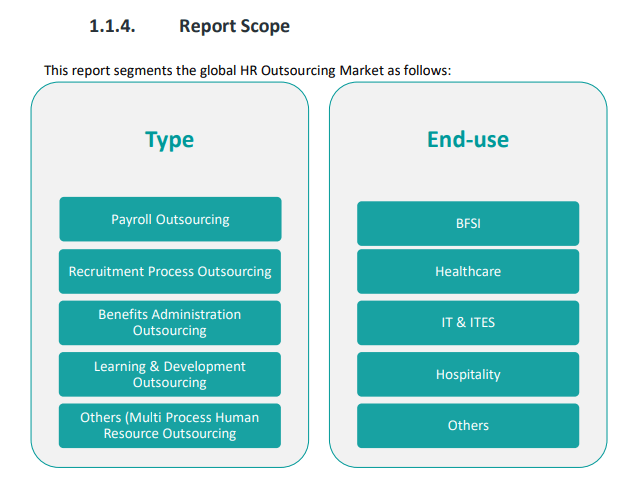
Global HR Outsourcing Market – By Type- Payroll Outsourcing
- Benefits Administration Outsourcing
- Multi process Human Resource Outsourcing
- Recruitment Process Outsourcing
- Learning Services Outsourcing
- BFSI
- Healthcare
- IT & ITES
- Hospitality
- Retail
- Others
- U.S.
- Canada
- Mexico
-
- Germany
- France
- UK.
- Italy
- Spain
- Rest of Europe
-
- China
- Japan
- India
- South Korea
- South-east Asia
- Rest of Asia Pacific
-
- Brazil
- Argentina
- Rest of Latin America
- Middle East & Africa
- GCC Countries
- South Africa
- Rest of the Middle East and Africa
Competitive Landscape
The competitive landscape of the HR outsourcing market is characterized by the presence of established global players alongside emerging regional providers, fostering a dynamic and fragmented environment. Leading companies such as HP Company, Genesys, Aon Hewitt LLC, Infosys, Accenture, IBM, Ultimate Software Group, Mercer, Adecco Group, Conduent Incorporated, and ADP continuously innovate to expand their service portfolios and enhance technological capabilities. These firms leverage advanced digital platforms, including AI-driven recruitment tools and cloud-based HR management systems, to differentiate their offerings and meet diverse client needs. Strategic partnerships, mergers, and acquisitions further strengthen their market positioning and geographic reach. Despite intense competition, providers focus on delivering customized, scalable solutions across industries to address growing demand for integrated payroll, benefits administration, recruitment, and learning services. The competitive pressure drives continuous improvement in service quality, compliance management, and cost efficiency, positioning the market for sustained growth and innovation.
Key Players
- HP Company
- Genesys
- Aon Hewitt LLC
- Infosys
- Accenture
- IBM
- Ultimate Software Group, Inc.
- Mercer, LLC
- Adecco Group
- Conduent Incorporated
- ADP
- Others
Recent Developments
- In 2025, IBM launched watsonx HR Agents for clients. These prebuilt AI agents are designed to automate routine employee support tasks like answering FAQs about payroll or benefits, streamlining talent acquisition processes (from job requisitions to scheduling), and enhancing onboarding experiences. They integrate with over 80 enterprise applications to provide comprehensive, AI-driven assistance.
- In May 2025, UKG (Ultimate Kronos Group) introduced UKG Bryte payroll AI agents. These agents leverage AI to boost productivity for both employees and payroll administrators by automating key touchpoints in the payroll process, reducing manual effort and improving accuracy.
- In March 2025, Infosys collaborated with LKQ Europe for a major HR Transformation project. This involved implementing a unified, cloud-based Human Capital Management (HCM) platform. Leveraging Infosys Cobalt (their cloud services) and Infosys Topaz (their AI-first offering with generative AI), the platform provides advanced analytics, real-time insights into employee engagement, and retention trends, signifying a move towards data-driven HR outsourcing.
- In March 2023, Mercer, LLC acquired Leapgen, a prominent digital HR consulting firm. This acquisition significantly strengthened Mercer's capabilities in HR transformation strategy, digital HR implementation, and workforce solutions, allowing them to advise clients on adopting cutting-edge HR technology and optimizing their HR outsourcing strategies.
- In March 2025, the Adecco Group launched Potential, a new enterprise intelligence company backed by Adecco and Salesforce. This initiative leverages Salesforce's platform and Agentforce (a digital labor platform with autonomous AI agents) to create hybrid workforces where human and digital capabilities are combined, marking a significant strategic move towards AI-driven workforce solutions and managed services.
- In April 2025 HP Company launched its HP Workforce Experience Platform (WXP) While primarily an IT offering, WXP significantly impacts the digital employee experience. It uses AI for sentiment analysis, provides natural language querying for IT support, and integrates with HR-relevant systems like ServiceNow, showcasing how proactive IT support and digital tools are becoming integral to the employee's overall well-being and productivity, a key HR concern.
Report Coverage:
The research report offers an in-depth analysis based on By Type, By End Use and By Region. It details leading market players, providing an overview of their business, product offerings, investments, revenue streams, and key applications. Additionally, the report includes insights into the competitive environment, SWOT analysis, current market trends, as well as the primary drivers and constraints. Furthermore, it discusses various factors that have driven market expansion in recent years. The report also explores market dynamics, regulatory scenarios, and technological advancements that are shaping the industry. It assesses the impact of external factors and global economic changes on market growth. Lastly, it provides strategic recommendations for new entrants and established companies to navigate the complexities of the market.
Future Outlook:
-
The HR outsourcing market will continue growing steadily, driven by increasing demand for cost-effective and scalable HR solutions across industries worldwide.
-
Adoption of AI-powered recruitment and talent analytics will accelerate, enhancing automation, reducing time-to-hire, and improving workforce planning accuracy.
-
Multi-process HR outsourcing, offering integrated services like payroll, recruitment, and benefits administration under a single contract, will gain wider acceptance due to its operational efficiency.
-
Cloud-based HR platforms will become the backbone of outsourcing services, enabling remote access, real-time analytics, and seamless integration with enterprise systems.
-
Regions like Asia-Pacific are expected to witness rapid market expansion, supported by rising SMEs, industrialization, and growing awareness of outsourcing benefits.
-
Data security and privacy concerns will prompt providers to strengthen cybersecurity measures and ensure compliance with evolving global regulations, building greater client trust.
-
Strategic partnerships, mergers, and technology-driven innovations by key players will intensify competition, fostering service quality improvements and broader market penetration.
Request a Free Sample
Fill in your details and we'll send you a free sample report.
- Sample data tables & charts
- Research methodology
Need a Custom Version of This Report?
Tailor the scope, geography, or segments to your exact requirements.
- Custom geography or segment scope
- Direct access to our analyst team
Frequently Asked Questions
What was the size of the global HR outsourcing market in 2024, and what isits expected value by 2032?
Which segment holds the largest share in the HR outsourcing market by type?
Who are some of the key players in the global HR outsourcing market?
What key factor is driving the growth of the HR outsourcing market?
Table of Content
Chapter 1. Report Introduction
- 1.1 Report Description & Purpose
- 1.1.1 Report Title & Market Definition
- 1.1.2 Unique Selling Propositions (USP) & Key Differentiators
- 1.1.3 Value Proposition for Stakeholders
- 1.2 Research Objectives
- 1.2.1 Market Sizing Objectives (Volume & Revenue)
- 1.2.2 Segmentation Objectives
- 1.2.3 Competitive Intelligence Objectives
- 1.2.4 Forecast & Scenario Objectives
- 1.3 Report Scope
- 1.3.1 HR Outsourcing Scope – Types & Subtypes Covered
- 1.3.2 Geographic Scope – Regions & Countries Covered
- 1.3.3 Historical Period, Base Year & Forecast Period (2024; forecast to 2032)
- 1.3.4 Inclusions & Exclusions
- 1.4 HS Code & Classification Framework
- 1.5 Currency, Units & Pricing Basis
- 1.6 Target Stakeholders
- 1.7 Limitations & Assumptions
Chapter 2. Executive Summary
- 2.1 Global HR Outsourcing Market Snapshot
- 2.1.1 Market Size – Historical (2024) & Forecast (2024-2032) (2024: USD 42,455.08 million → 2032: USD 68,978.07 million)
- 2.1.2 Volume & Revenue – Global Totals
- 2.1.3 Key Market Highlights – Top Five Facts
- 2.2 HR Outsourcing Market Segmentation Snapshot
- 2.2.1 Market Split by Region – 2024 vs. 2032
- 2.3 Competitive Snapshot
- 2.3.1 Top 10 Players by Revenue Share – 2024
- 2.3.2 Top 10 Players by Volume Share – 2024
- 2.3.3 Recent Strategic Developments (18-Month Summary)
- 2.4 Key Investment Highlights & Strategic Conclusions
Chapter 3. HR Outsourcing Market Dynamics & Industry Analysis
- 3.1 Market Overview & Context
- 3.1.1 HR Outsourcing Market Position in the Broader Automotive Value Chain
- 3.1.2 OEM vs. Replacement Market Dynamics
- 3.1.3 Market Maturity & Development Stage by Region
- 3.2 HR Outsourcing Market Drivers
- 3.3 HR Outsourcing Market Restraints & Challenges
- 3.4 HR Outsourcing Market Opportunities
- 3.5 Porter's Five Forces Analysis
- 3.5.1 Threat of New Entrants
- 3.5.2 Bargaining Power of Suppliers
- 3.5.3 Bargaining Power of Buyers
- 3.5.4 Threat of Substitutes
- 3.5.5 Competitive Rivalry – Intensity Assessment
- 3.6 HR Outsourcing Value Chain Analysis
- 3.6.1 Upstream – Raw Material/Input Suppliers
- 3.6.1.1 Raw Material/Input 1
- 3.6.1.2 Raw Material/Input 2
- 3.6.1.3 Raw Material/Input 3
- 3.6.2 Midstream – Production/Manufacturing/Service Delivery
- 3.6.2.1 Production/Process Overview
- 3.6.2.2 Key Facility Locations & Capacity by Manufacturer
- 3.6.3 Downstream – Distribution & End Consumer
- 3.6.3.1 Primary Channel – B2B/OEM
- 3.6.3.2 Secondary Channels – Dealer, Retail, Online, Direct
- 3.6.4 Value Chain Profitability Analysis
- 3.6.1 Upstream – Raw Material/Input Suppliers
- 3.7 PESTEL Analysis
- 3.7.1 Political Factors
- 3.7.2 Economic Factors
- 3.7.3 Social Factors
- 3.7.4 Technological Factors
- 3.7.5 Environmental Factors
- 3.7.6 Legal Factors
- 3.8 HR Outsourcing Supply Chain Analysis
- 3.8.1 Raw Material/Input Supply Risk Assessment
- 3.8.2 Manufacturing Concentration Risk (Geographic Exposure)
- 3.8.3 Trade Disruption Impact Analysis
- 3.9 Regulatory & Policy Landscape
Note: The regulatory and policy landscape section covers regulations based on their applicability to the market, HR Outsourcing category, geography, and scope of the study. Only regulatory frameworks with a material impact on operations, compliance, trade, sustainability, or market access are analyzed in detail.
Chapter 4. Key Investment Pockets & Opportunity Analysis
- 4.1 HR Outsourcing Market Attractiveness Analysis
- 4.1.1 By Region – Investment Attractiveness Matrix (Volume × CAGR)
- 4.2 Absolute Revenue Growth Opportunity
- 4.2.1 By Region – Absolute USD Growth Through 2032
- 4.3 Incremental Volume Opportunity
- 4.3.1 By Region – Incremental Volume Through 2032
- 4.3.2 Segment – Incremental Volume
- 4.4 Emerging Submarket Opportunity Deep Dive (Subject to Applicability)
- 4.5 Emerging Market Opportunity Scorecards
- 4.5.1 United States
- 4.5.2 Europe
- 4.5.3 Asia
- 4.5.4 Middle East & Africa
Note: Emerging Market Opportunity Scorecards will be included based on relevance and strategic importance. Regions listed are indicative and may vary depending on data availability and market dynamics.
Chapter 5. HR Outsourcing Import-Export Analysis & Trade Flows
- 5.1 Global Trade Overview
- 5.1.1 Global Export Value by Country (2024)
- 5.1.2 Global Export Volume by Country (2024)
- 5.1.3 Global Import Value by Country (2024)
- 5.1.4 Global Import Volume by Country (2024)
- 5.1.5 Net Trade Balance by Country (2024)
- 5.2 Export Analysis – Segment
- 5.2.1 Type 1 (HS Code)
- 5.2.2 Type 2 (HS Code)
- 5.2.3 Type 3 (HS Code)
- 5.2.4 Type 4 (HS Code)
- 5.2.5 Type 5 (HS Code)
- 5.3 Import Analysis – Segment
- 5.3.1 Type 1 (HS Code)
- 5.3.2 Type 2 (HS Code)
- 5.3.3 Type 3 (HS Code)
- 5.3.4 Type 4 (HS Code)
- 5.3.5 Type 5 (HS Code)
- 5.4 Average Unit Trade Prices
- 5.4.1 Average Export Price – Segment & Country
- 5.4.2 Average Import Price – Segment & Source Country
- 5.4.3 Price Trends (2024)
- 5.5 Key Trade Route Analysis
- 5.5.1 Trade Route 1
- 5.5.2 Trade Route 2
- 5.5.3 Trade Route 3
- 5.5.4 Trade Route 4
- 5.5.5 Trade Route 5
- 5.6 Trade Policy Impact Assessment
- 5.6.1 US Anti-Dumping & Section 301 Tariffs
- 5.6.2 EU Customs Union Impact
- 5.6.3 Major Free Trade Agreements
- 5.6.4 USMCA Rules of Origin
Note: Trade policy analysis will be included only where relevant to the HR Outsourcing market.
Chapter 6. Competitive Landscape & Company Benchmarking
- 6.1 HR Outsourcing Market Concentration & Structure
- 6.1.1 Herfindahl-Hirschman Index (HHI) – vs. 2024
- 6.1.2 Tier 1, Tier 2 & Tier 3 Market Structure
- 6.1.3 Global, Regional & Local Player Dynamics
- 6.2 HR Outsourcing Market Share Analysis – 2024
- 6.2.1 Global Revenue Share by Company
- 6.2.2 Global Volume Share by Company
- 6.2.3 Regional Revenue Share
- 6.2.4 Market Share Evolution ( vs. 2024)
- 6.2.5 OEM Segment Share by Company
- 6.2.6 Replacement Segment Share by Company
- 6.3 Production/Delivery Capacity & Facility Analysis
- 6.3.1 Global Installed Capacity
- 6.3.2 Capacity Utilization Rates
- 6.3.3 Production/Output Volume
- 6.3.4 Facility Locations & Capacity Map
- 6.3.5 Planned Capacity Additions
- 6.4 HR Outsourcing Competitive Benchmarking Matrix
- 6.4.1 Revenue, Volume, CAGR & Profitability Comparison
- 6.4.2 Channel Revenue Mix
- 6.4.3 Geographic Revenue Exposure
- 6.4.4 R&D Intensity
- 6.4.5 Sustainability Maturity
- 6.5 Strategic Developments in HR Outsourcing (Last 24 Months)
- 6.5.1 Mergers, Acquisitions & Divestments
- 6.5.2 New HR Outsourcing Launches
- 6.5.3 Facility Expansions
- 6.5.4 Strategic Alliances, Joint Ventures & Partnerships
- 6.5.5 Distribution Expansion & Market Entry
- 6.5.6 Sustainability & ESG Initiatives
- 6.6 Competitive Strategy Mapping
- 6.6.1 Leader, Challenger, Follower & Niche Classification
- 6.6.2 Pricing Strategy Comparison
- 6.6.3 Channel Strategy Matrix
Note: Strategic developments are included based on their materiality and the availability of reliable information.
Chapter 7. Global HR Outsourcing Market – By Distribution Channel
- 7.1 Segment Overview
- 7.1.1 Volume & Revenue Split by Channel (2024 & 2032)
- 7.1.2 Channel Mix Evolution (2024-2032)
Chapter 8. Regional Market Analysis – Global Overview
- 8.1 Global Regional Overview
- 8.1.1 Regional Volume Share
- 8.1.2 Regional Revenue Share
- 8.1.3 Regional Volume by Region
- 8.1.4 Regional Revenue by Region
- 8.1.5 Regional Forecast Through 2032
- 8.2 Cross-Regional Segment Analysis
- 8.2.1 By Distribution Channel
- 8.2.2 By Brand/Price Tier
Chapter 9. North America HR Outsourcing Market
- 9.1 United States
- 9.2 Canada
- 9.3 Mexico
Chapter 10. Europe HR Outsourcing Market
- 10.1 Germany
- 10.2 France
- 10.3 Italy
- 10.4 United Kingdom
- 10.5 Spain
- 10.6 Poland
- 10.7 Russia
- 10.8 Netherlands
- 10.9 Belgium
- 10.10 Sweden
- 10.11 Denmark
- 10.12 Norway
- 10.13 Rest of Europe
Chapter 11. Asia Pacific HR Outsourcing Market
- 11.1 China
- 11.2 India
- 11.3 Japan
- 11.4 South Korea
- 11.5 Thailand
- 11.6 Indonesia
- 11.7 Vietnam
- 11.8 Malaysia
- 11.9 Australia
- 11.10 Rest of Asia Pacific
Chapter 12. Latin America HR Outsourcing Market
- 12.1 Brazil
- 12.2 Argentina
- 12.3 Colombia
- 12.4 Chile
- 12.5 Rest of Latin America
Chapter 13. Middle East HR Outsourcing Market
- 13.1 Saudi Arabia
- 13.2 United Arab Emirates
- 13.3 Turkey
- 13.4 Israel
- 13.5 Iran
- 13.6 Rest of the Middle East
Chapter 14. Africa HR Outsourcing Market
- 14.1 South Africa
- 14.2 Egypt
- 14.3 Nigeria
- 14.4 Morocco
- 14.5 Rest of Africa
Chapter 15. HR Outsourcing Company Profiles
- 15.1 [Company 01]
- 15.1.1 Company Overview
- 15.1.2 Key Management Personnel
- 15.1.3 Products & Services Portfolio
- 15.1.4 Financial Performance
- 15.1.5 Key Market Focus & Geographic Presence
- 15.1.6 Recent Developments & Strategic Initiatives
Note: The company profile list is preliminary and may change based on research findings, market developments, data availability, and client requirements.
Chapter 16. Appendices
- Appendix A – List of Abbreviations & Acronyms
- Appendix B – Industry Classification Code Reference – Full Series
- Appendix C – Production & Capacity Data Tables
- Appendix D – End-Use & Demand Base Tables
- Appendix E – Consumption & Replacement Rate Assumptions
- Appendix F – ASP Reference Tables
- Appendix G – Manufacturing & Facility Database
- Appendix H – Import-Export Data Tables
- Appendix I – Regulatory Summary Tables
- Appendix J – Primary Research Participant List (Anonymized)
- Appendix K – Primary Research Questionnaire Framework
- Appendix L – Data Sources & Bibliography
- Appendix M – Market Size Divergence & Source Comparison
Chapter 17. Research Methodology
- 17.1 Research Framework & Philosophy
- 17.2 Secondary Research – Sources, Hierarchy & Data Extraction
- 17.3 Data Modeling – Bottom-Up & Top-Down Market Sizing
- 17.4 Primary Research – Stakeholder Framework, LOI & Sample Sizes
- 17.5 Forecast Methodology – Regression, Scenario & Sensitivity Analysis
- 17.6 Quality Control – Four-Layer Validation Framework
- 17.7 Limitations & Standard Assumptions
- 17.8 Disclaimer
